
Yukultji Napangati: Biography, Painting Style and Importance
- c. 1970–
- Pintupi Marrapinti and Yunala Country, Western Desert
- Kiwirrkurra / Lake Mackay, Western Australia
- Papunya Tula Art / Western Desert Art
- Acrylic painting on linen
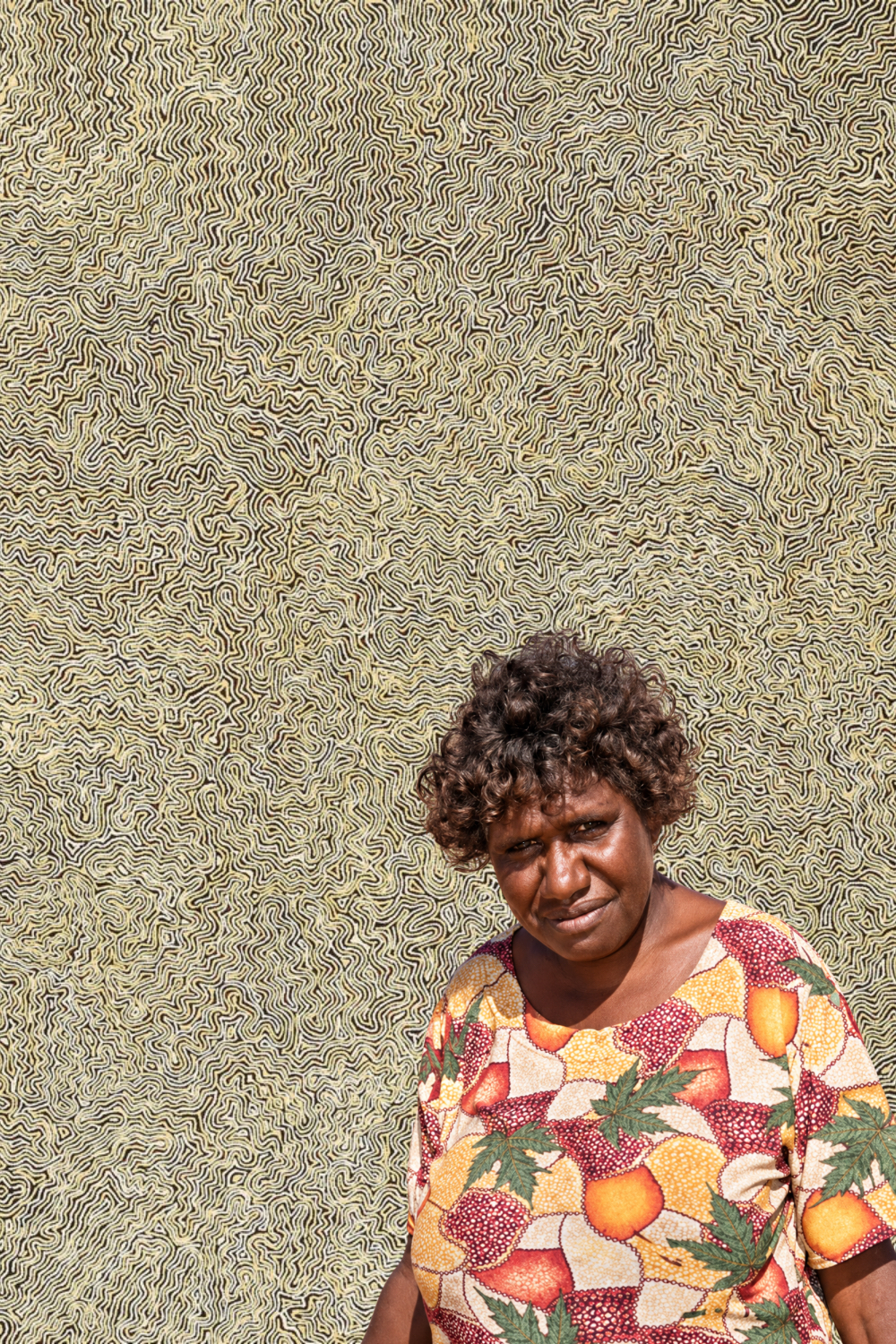
Yukultji Napangati (born c. 1970) is one of Australia’s most internationally recognised Pintupi painters, celebrated for her extraordinary paintings of shimmering lines and densely arranged dots representing women’s ancestral Country.
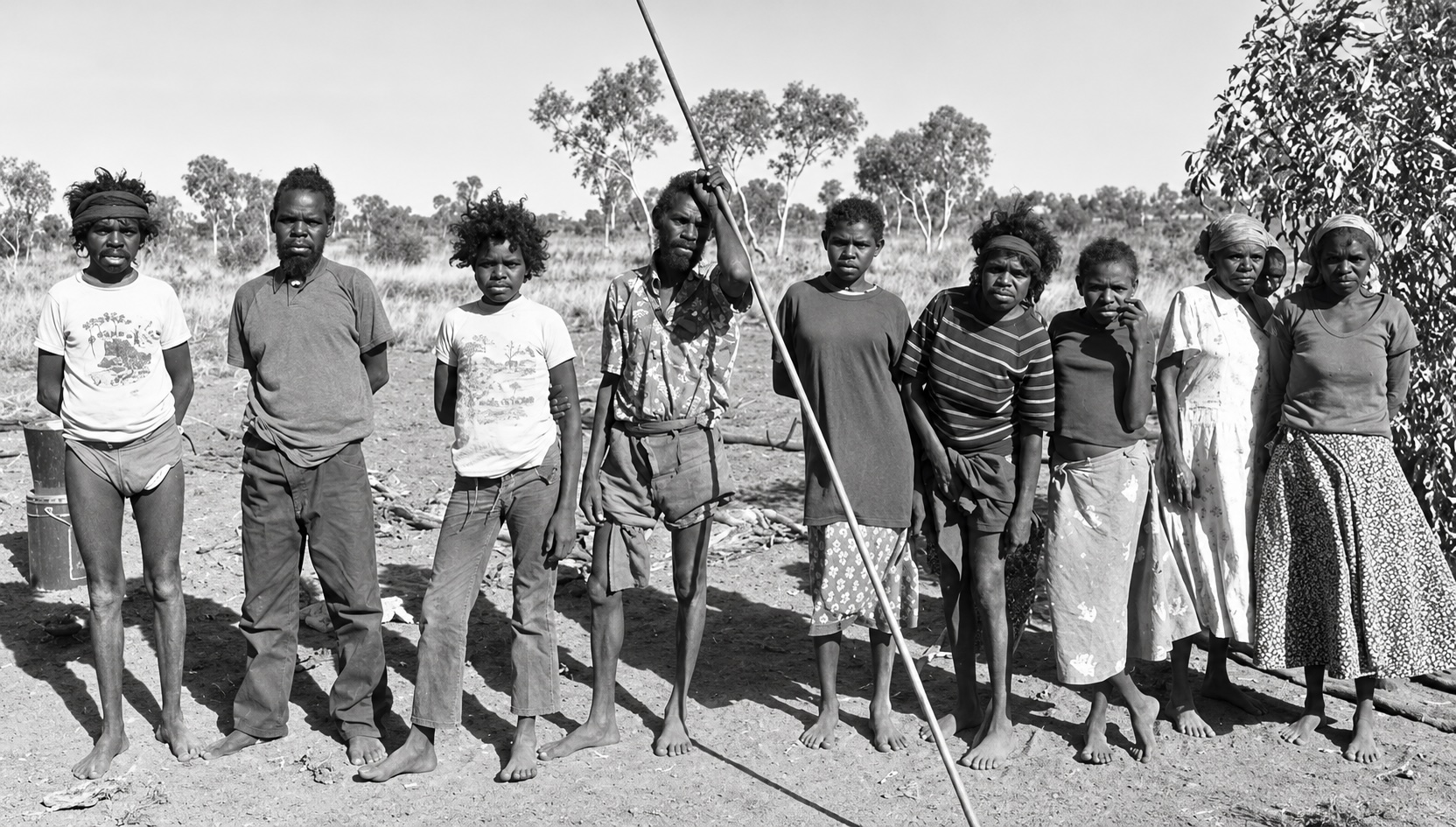
Born near Wilkinkarra (Lake Mackay), Yukultji grew up travelling with her family through the Gibson Desert before reuniting with relatives at Kiwirrkurra in 1984 as a member of the Pintupi Nine. Her older relative Warlimpirrnga Tjapaltjarri later became an internationally recognised painter, while the pioneering Papunya artist Freddy West Tjakamarra helped locate the family.
Yukultji began painting for Papunya Tula Artists in 1996. Her principal subjects are Marrapinti, her mother’s ancestral Country, and Yunala, a rockhole associated with women gathering edible bush banana roots. Her distinctive style creates extraordinary optical movement, comparable with the paintings of George Tjungurrayi, while expressing different ancestral traditions.
In 2018, she won the prestigious Wynne Prize with a painting of Yunala, establishing her importance within contemporary Australian Western Desert Art.
Yukultji Napangati Biography
Childhood in the Gibson Desert
Yukultji Napangati was born around 1970–1971 in the country west of Wilkinkarra (Lake Mackay), probably at Marruwa, also recorded as Marawa. She grew up travelling with her family between waterholes and hunting grounds across the northern Gibson Desert.
Her father, Lanti, had previously lived at Balgo Mission before returning to the desert during the 1950s. Her mother was Nanu Nangala, and her family included her sister Yalti Napangati and older relative Warlimpirrnga Tjapaltjarri.
Yukultji’s childhood involved considerable physical hardship but also an intimate knowledge of Country. The family hunted kangaroos, goannas, pythons and small mammals, collected witchetty grubs and ground wattle seeds into food. They travelled long distances to find water, slept beside campfires and sometimes curled up with dingoes for warmth.
Her parents taught the children Pintupi Law and Tjukurrpa through songs, stories and ceremony. The landscape itself was a source of knowledge: animal tracks, seasonal plants, waterholes and particular landforms were understood through their relationships with ancestral events.
In a detailed 2025 ABC interview, Yukultji and her sister recalled these experiences and demonstrated traditional food gathering on their ancestral Country.
The Pintupi Nine – October 1984
By the early 1980s, most Pintupi families had relocated from the western deserts to settlements such as Papunya, Kintore and Kiwirrkurra. Yukultji’s family continued living independently near Lake Mackay.
In October 1984, Warlimpirrnga and another family member, Payirti, encountered Pinta Pinta Tjapanangka, an established Papunya Tula painter, and his son Matthew near Winparrku.
Pinta Pinta returned to Kiwirrkurra and reported the encounter. A search party was organised, including the early Papunya painter Freddy West Tjakamarra, who had extensive knowledge of the surrounding Country.
Freddy West’s son, Bobby West Tjupurrula, later became an important Pintupi painter and helped interpret Warlimpirrnga’s recollections of the 1984 encounter for a published account. The reunion therefore connects Yukultji’s childhood with two generations of artists involved in the establishment of Papunya Tula and the return of Pintupi families to their ancestral homelands.
After following the family’s tracks for several days, the search party found the nine relatives. The initial encounter was frightening, particularly for Yukultji and Yalti, who had never seen motor vehicles or European clothing.
Recognising relatives among the visitors eventually reassured the family. After two days of discussion, they agreed to travel to Kiwirrkurra.
The event generated international publicity, with newspapers describing the family as a ‘lost tribe’. This was misleading. They were neither lost nor culturally isolated from Pintupi society. They had maintained their language, ceremonial traditions and detailed ancestral knowledge while living independently on their Country.
Becoming a Papunya Tula Artist
Yukultji settled at Kiwirrkurra, where she eventually married the painter Charlie Ward Tjakamarra.
Her relatives Warlimpirrnga and Walala Tjapangati became established Papunya Tula painters during the late 1980s and early 1990s.
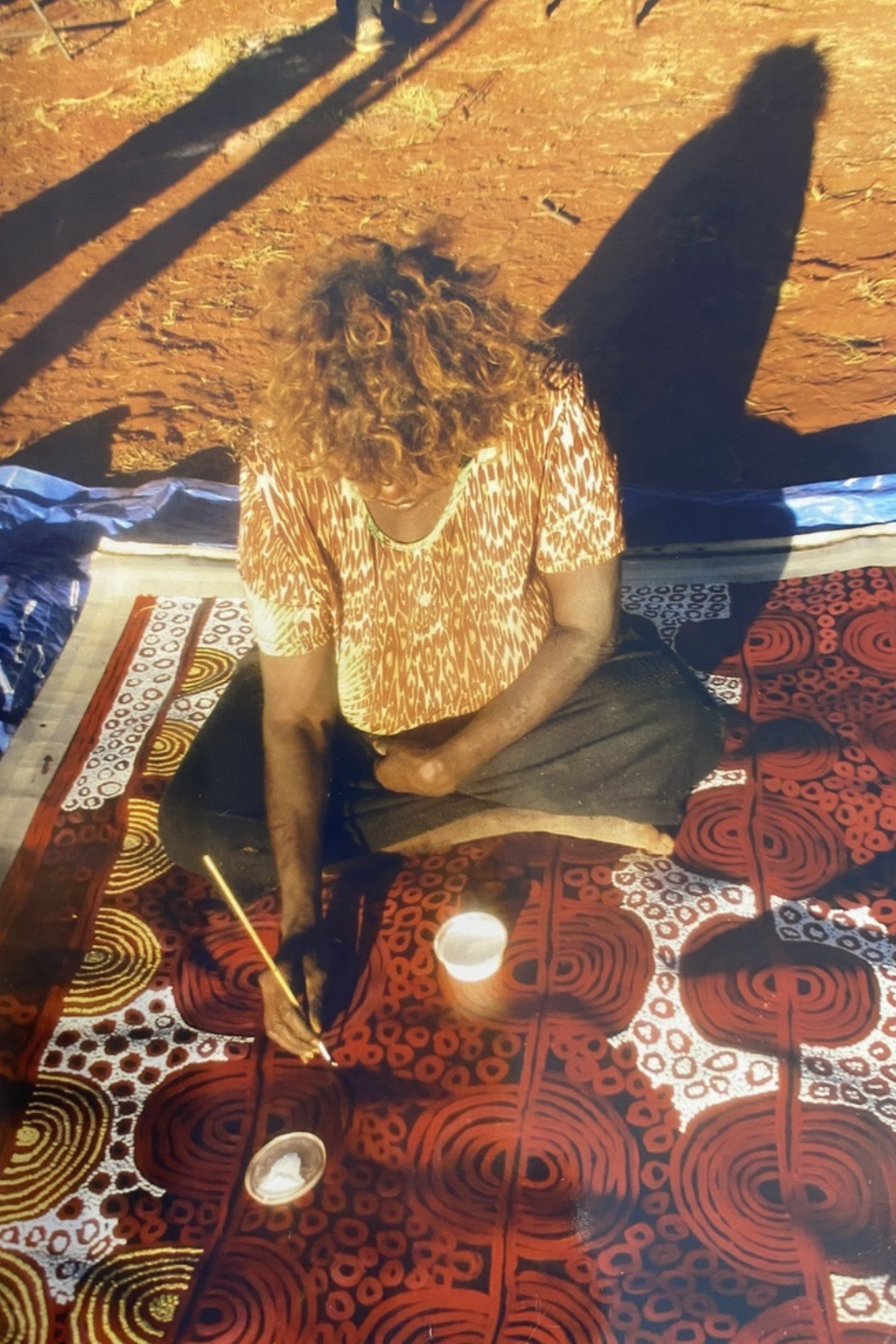
Yukultji began painting independently in 1996, joining the growing movement of Pintupi women artists that included Makinti Napanangka, Naata Nungurrayi and Ningura Napurrula.
In 1999, she participated in a Kiwirrkurra women’s collaborative painting associated with the Western Desert Dialysis Appeal.
Her career developed rapidly. In 2005, she was selected for Primavera, the Museum of Contemporary Art’s annual exhibition of emerging Australian artists. Her paintings subsequently entered leading Australian collections and gained international recognition.
Despite her success, Yukultji has maintained close connections with Kiwirrkurra and regularly returns to the sites of her childhood.
Yukultji Napangati Painting Style and Subjects
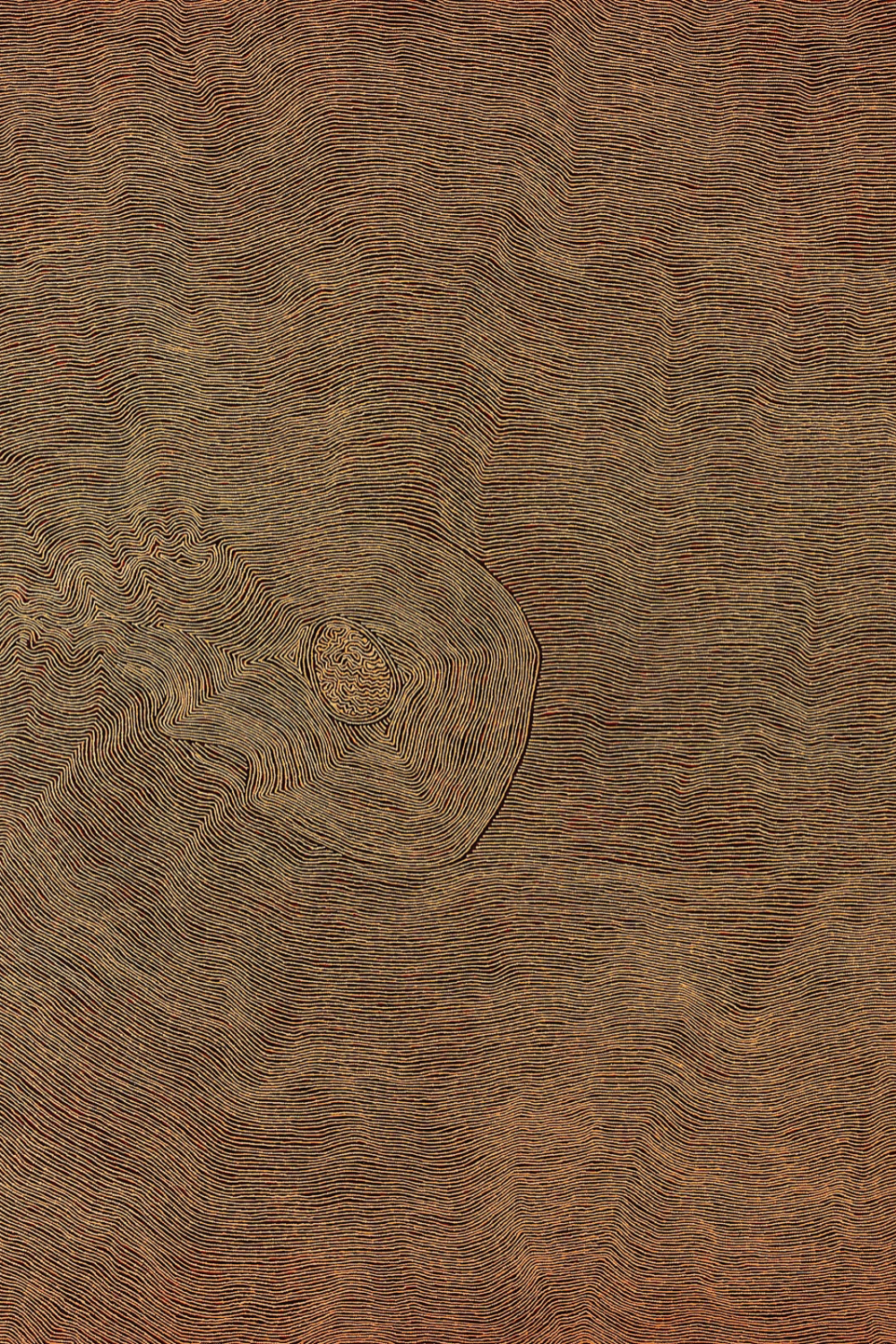
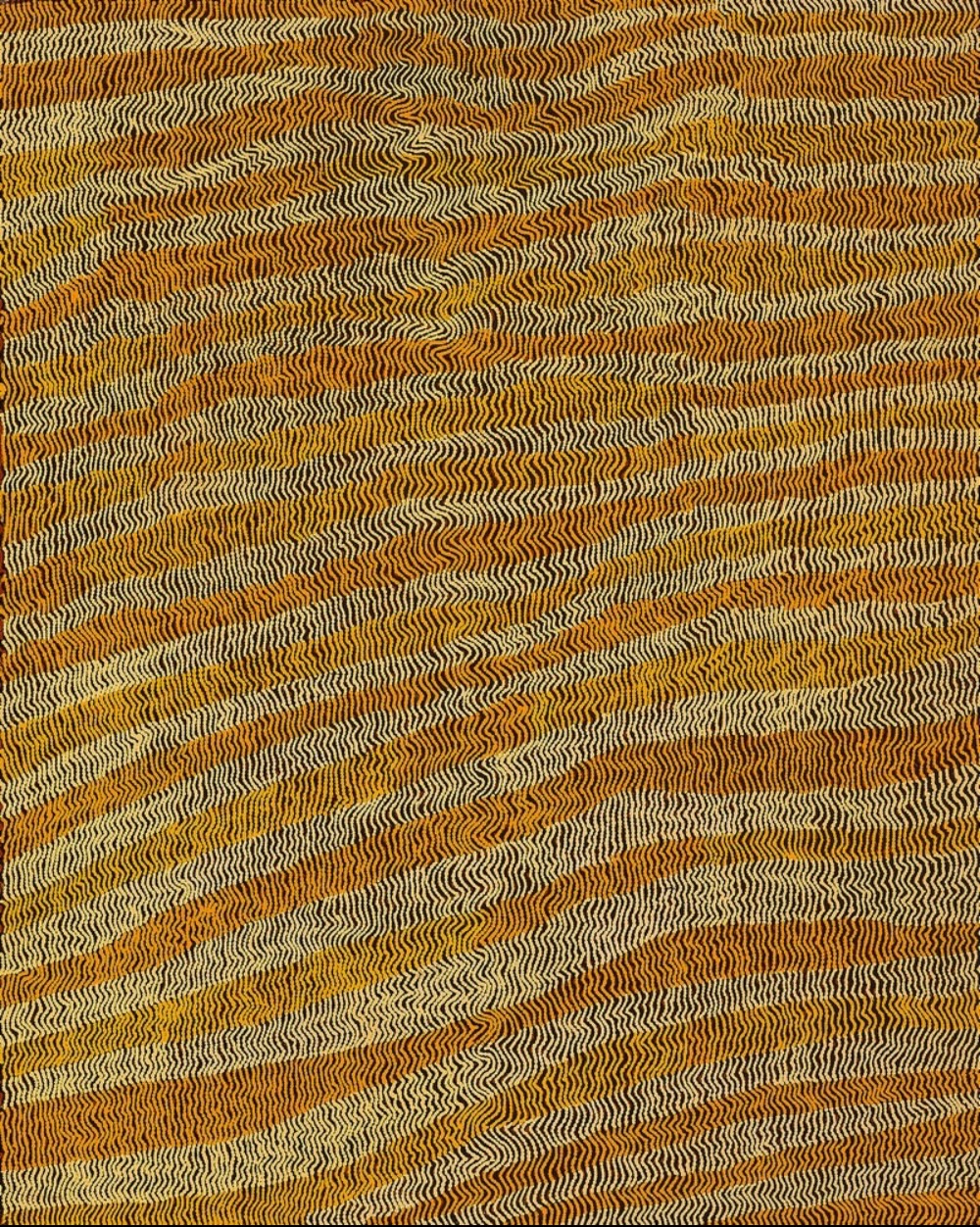
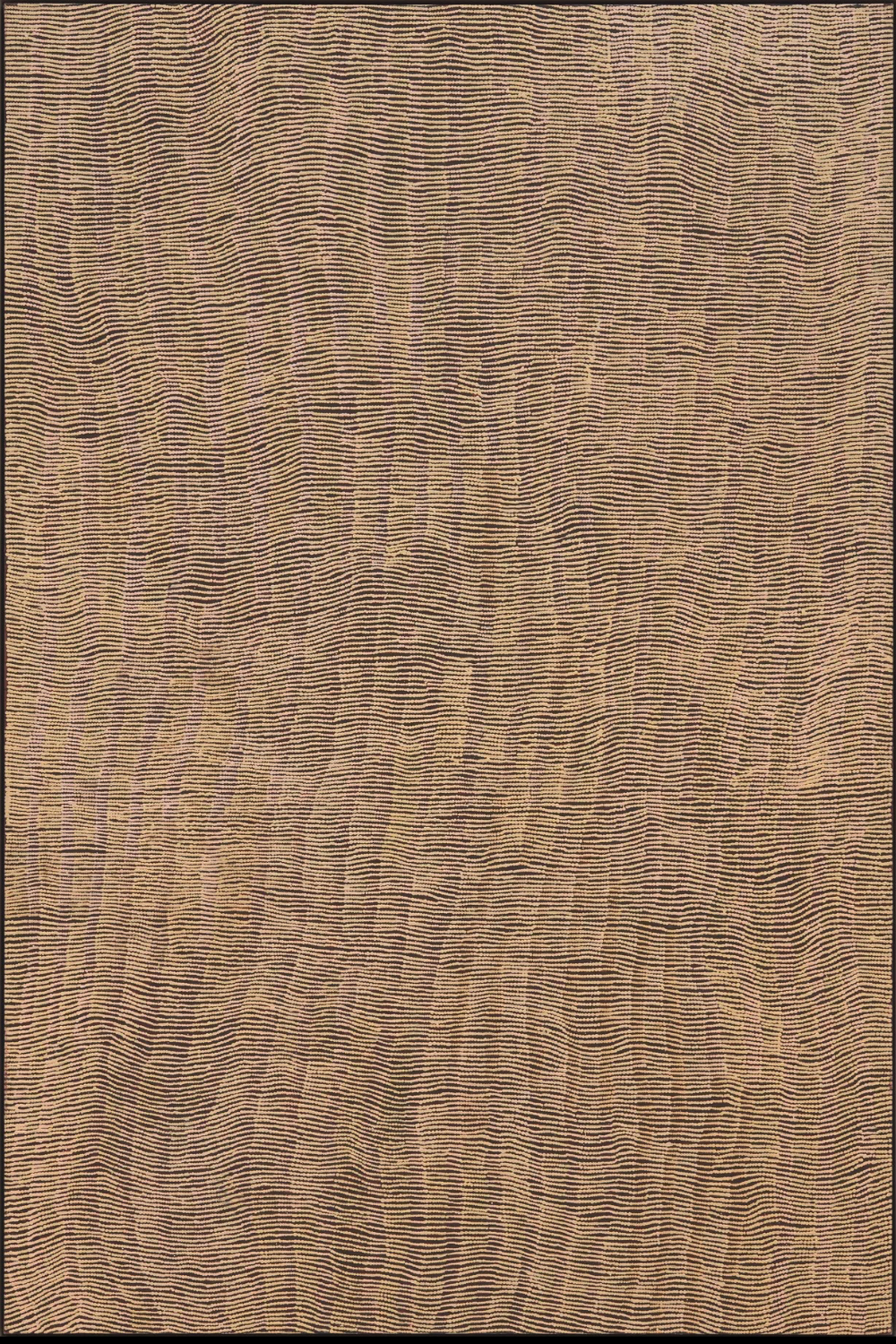
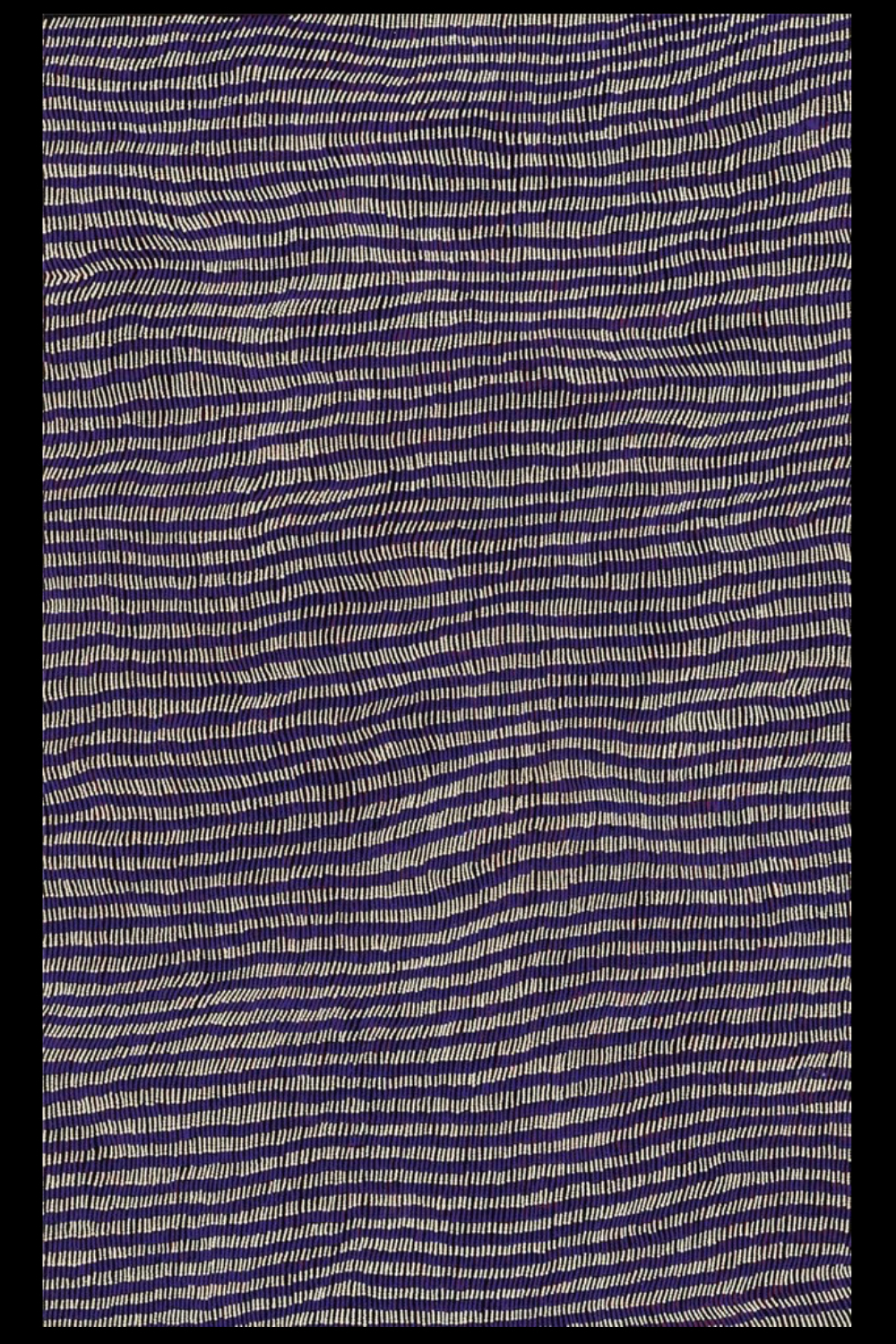
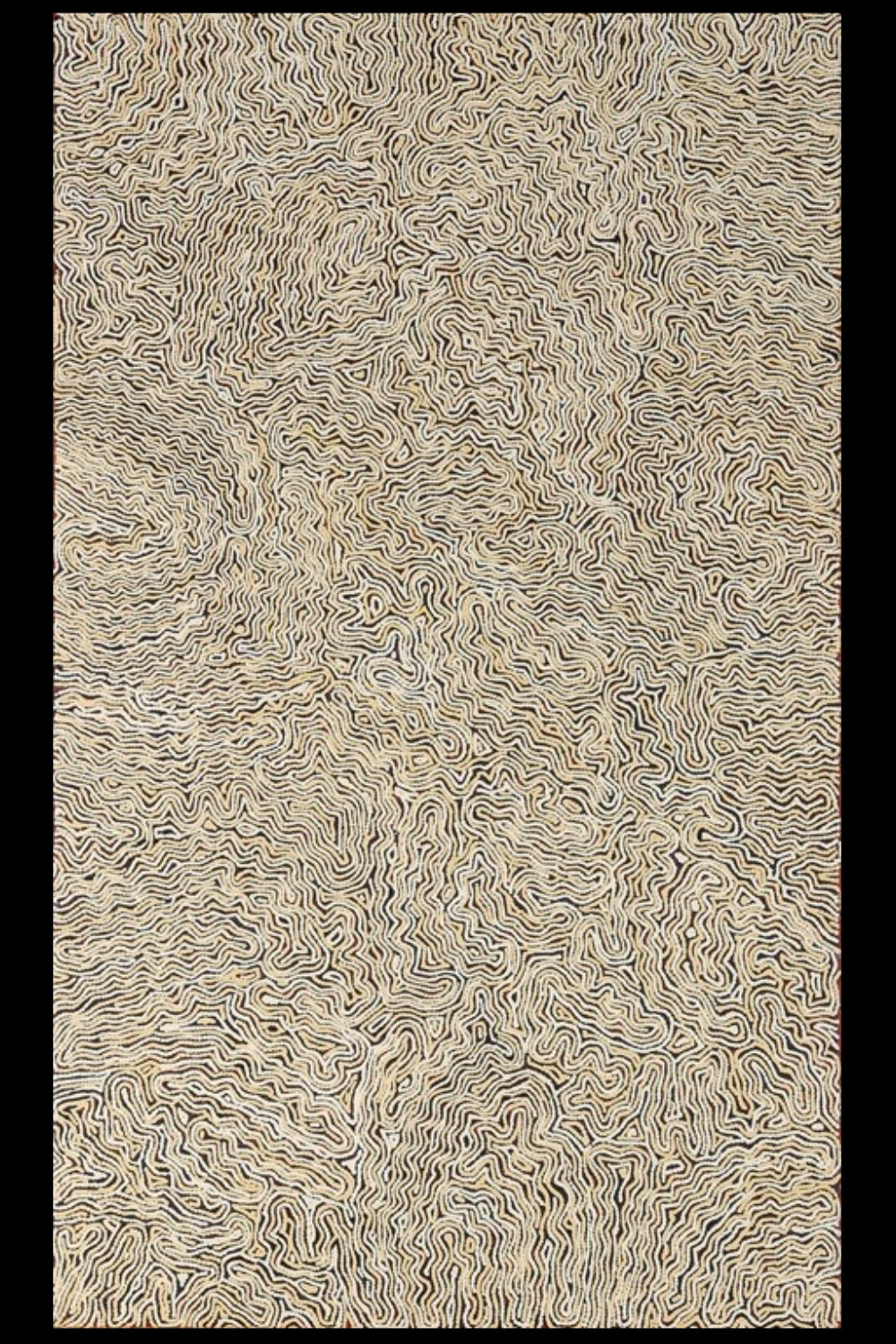
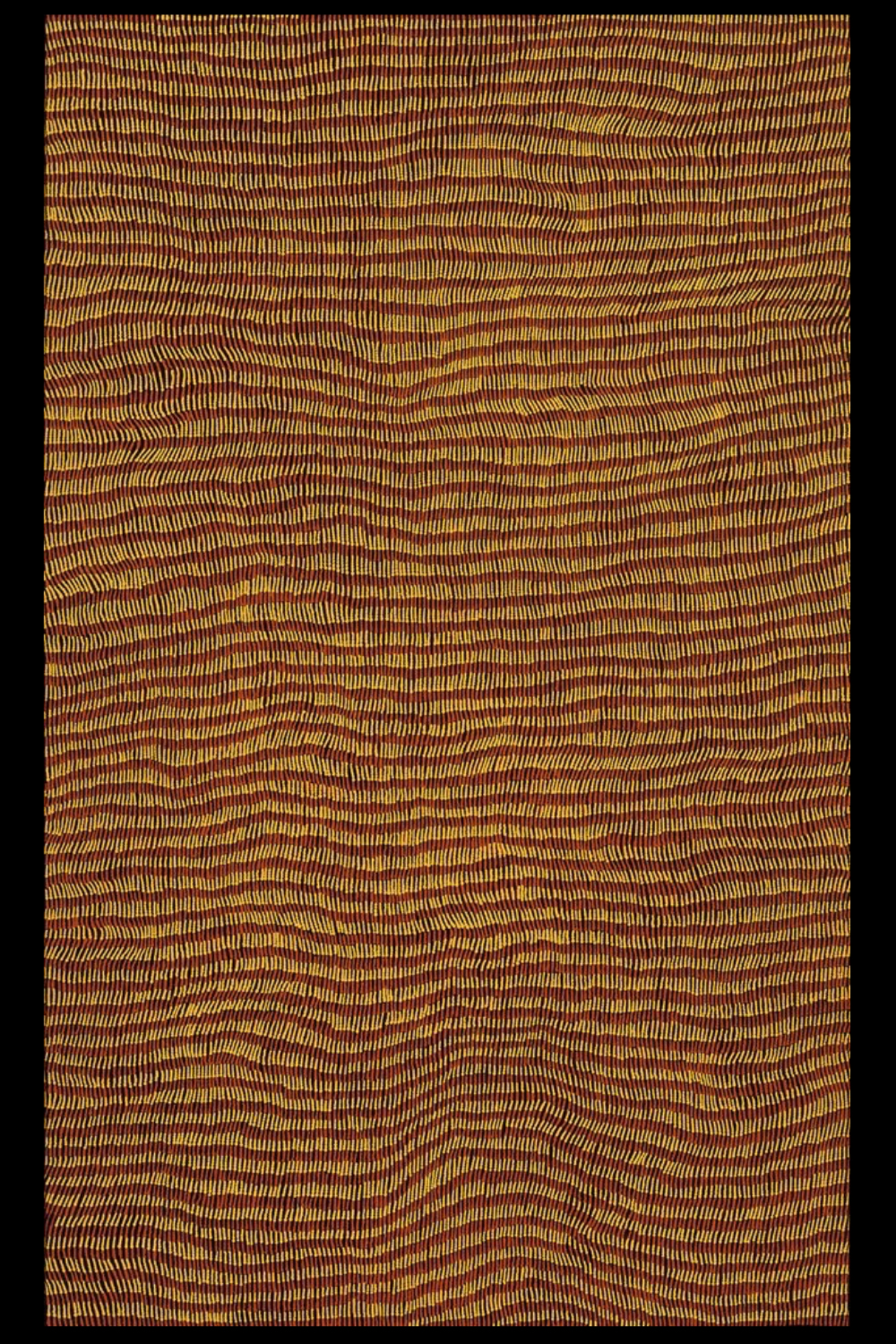
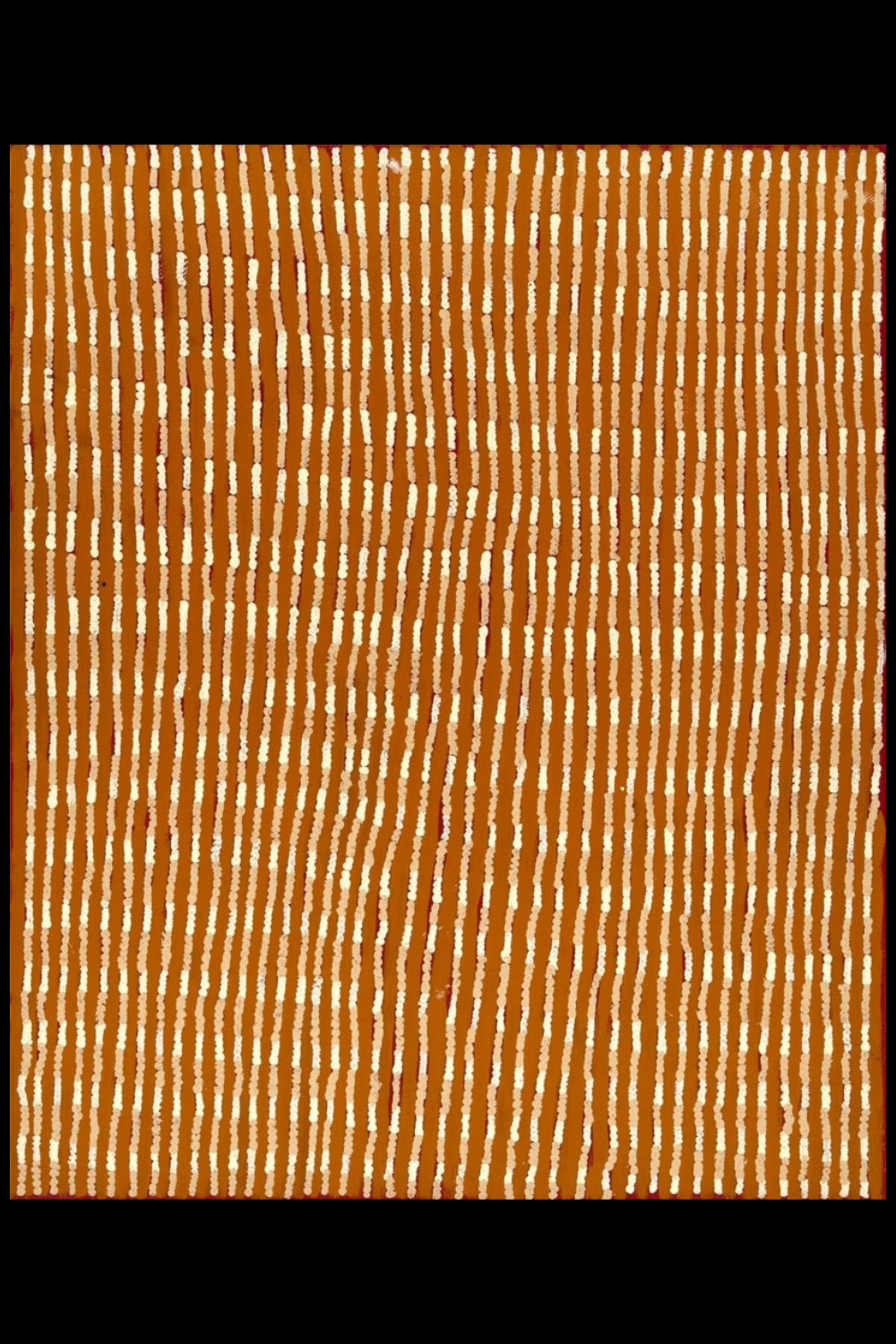
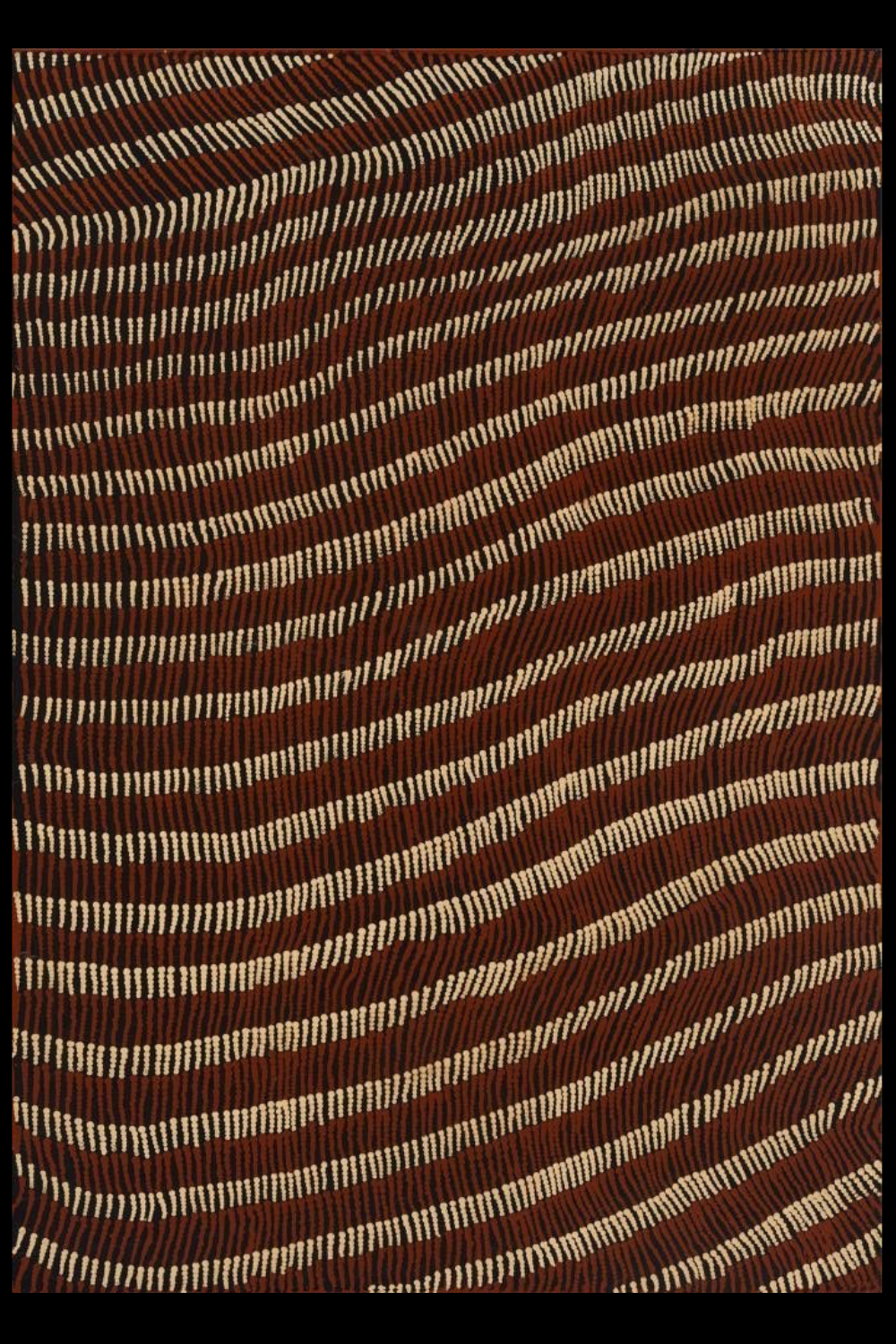
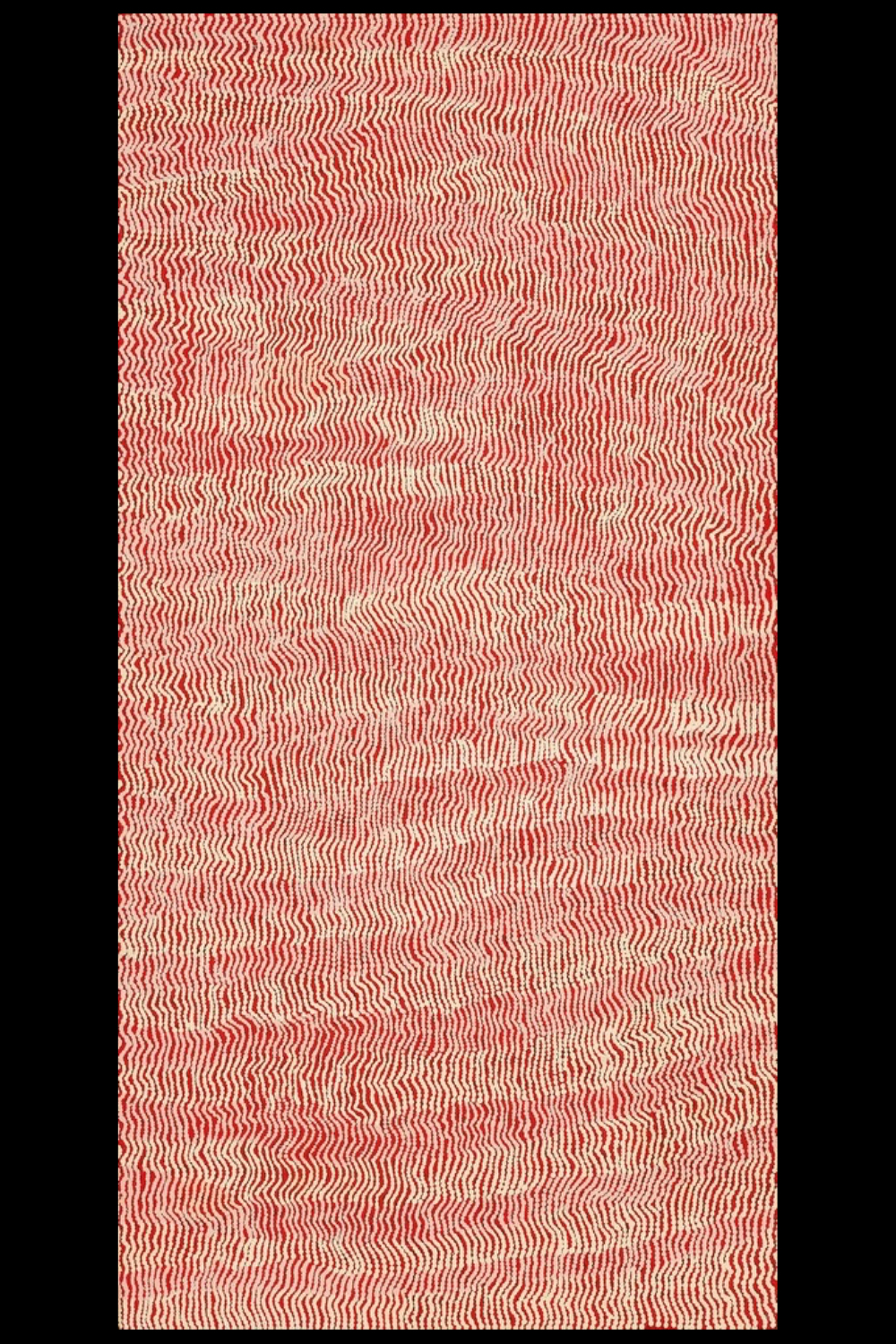
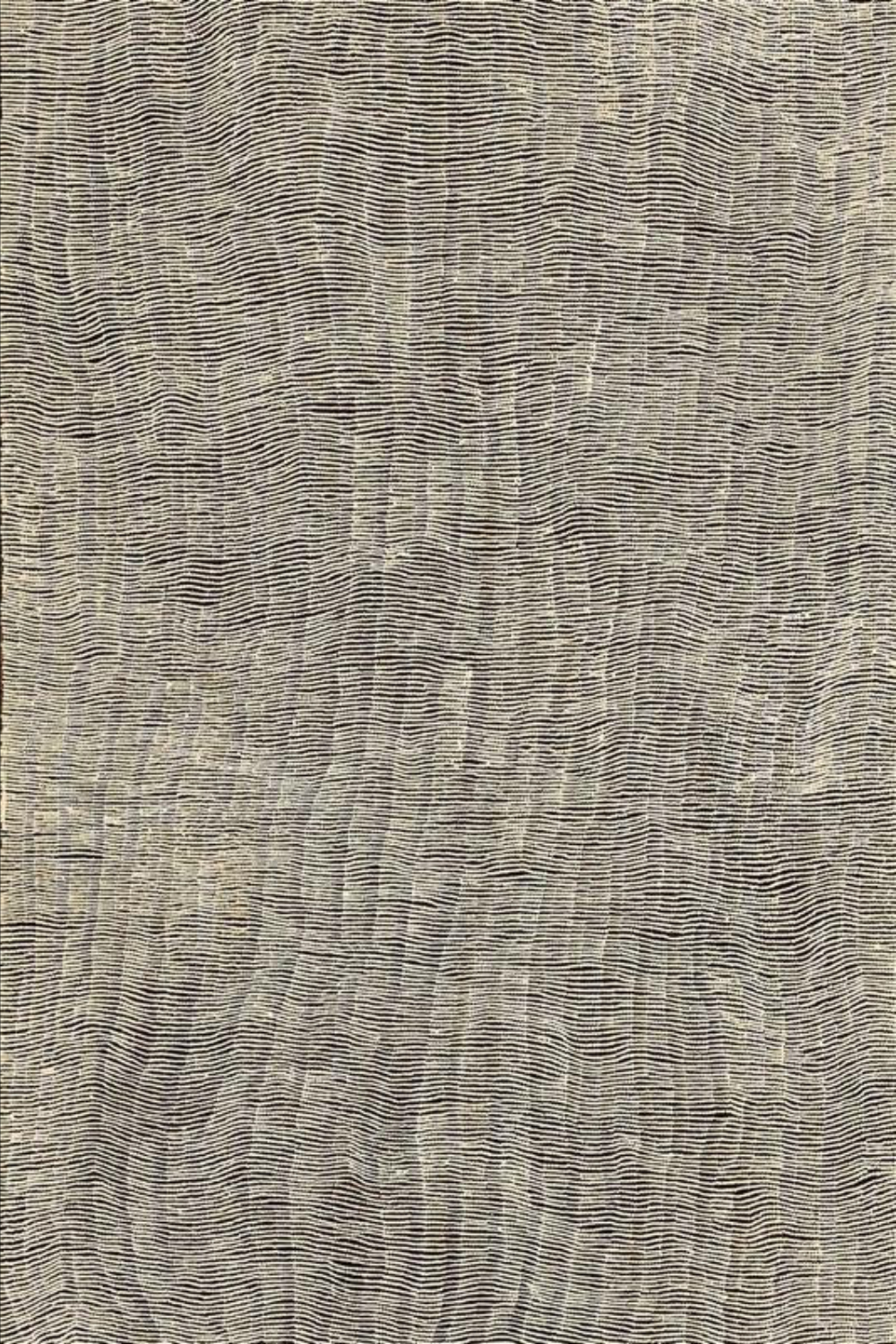
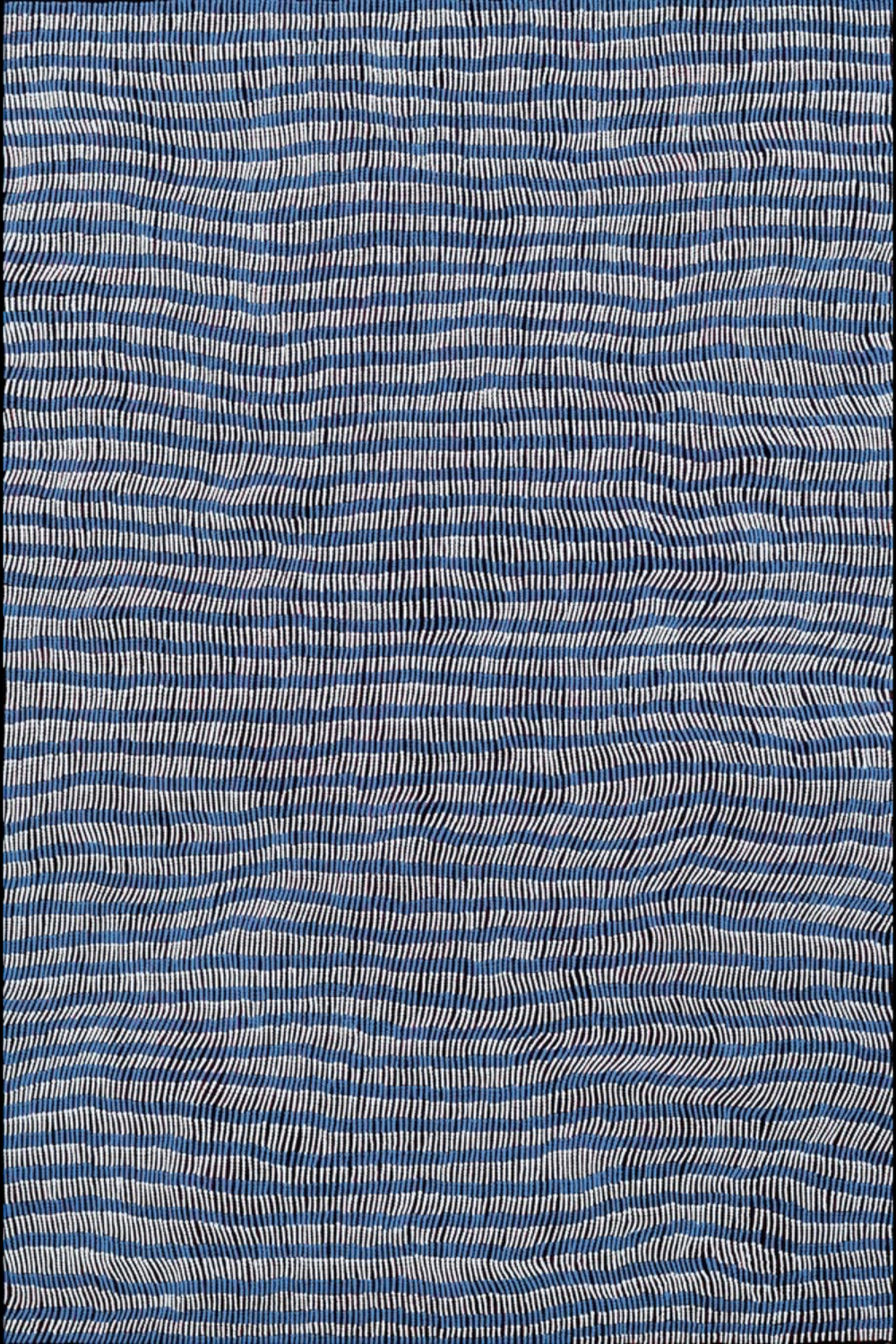
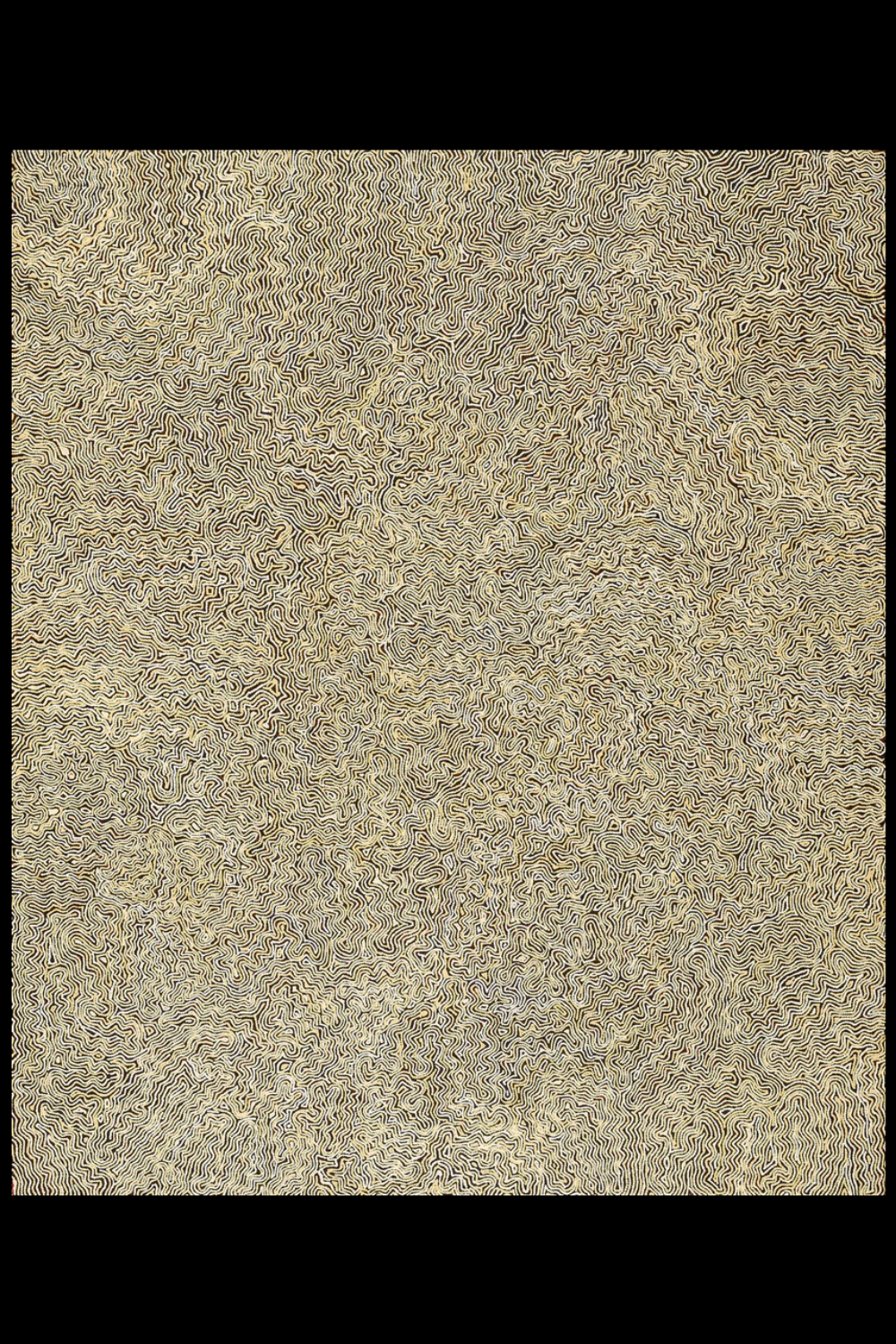
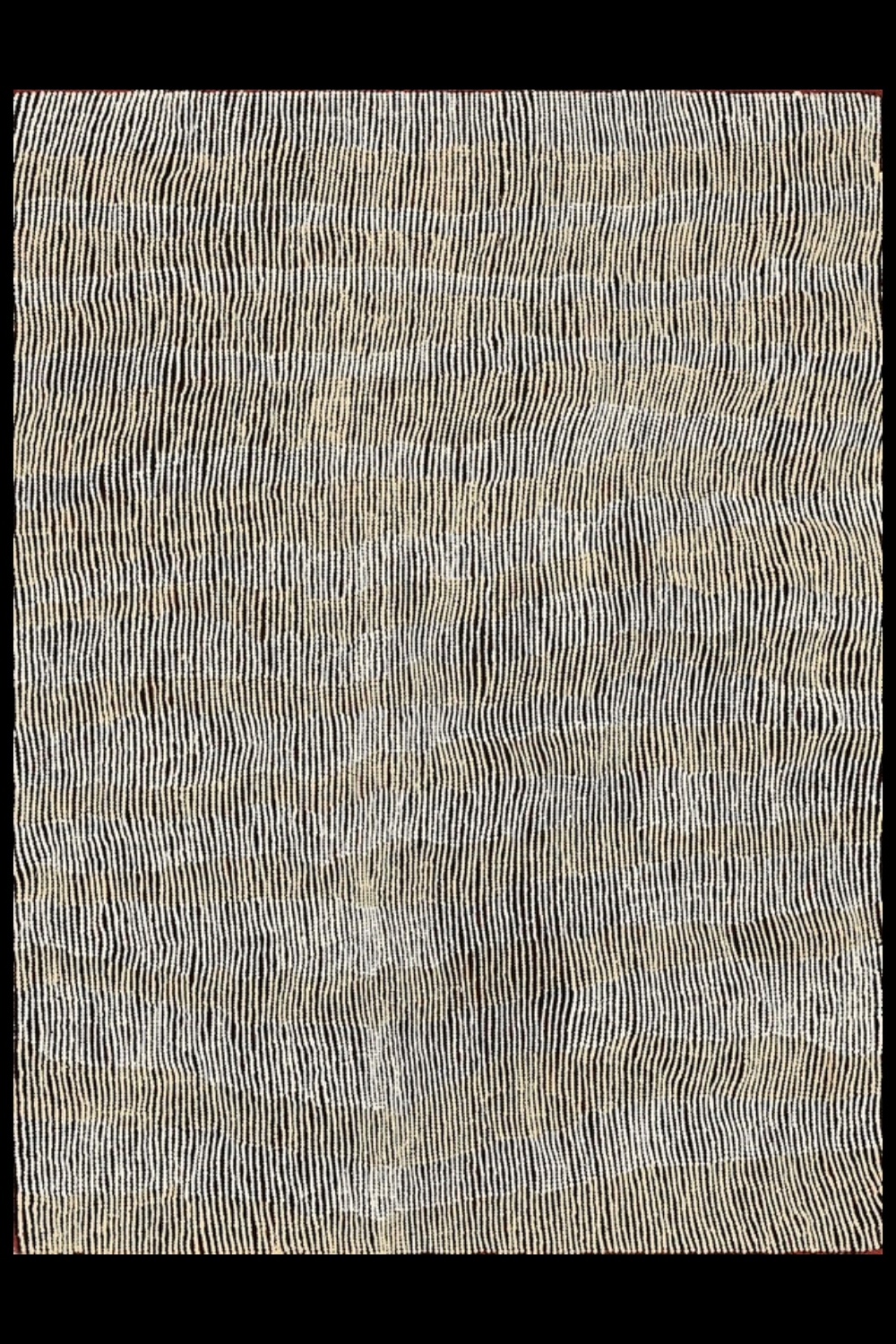
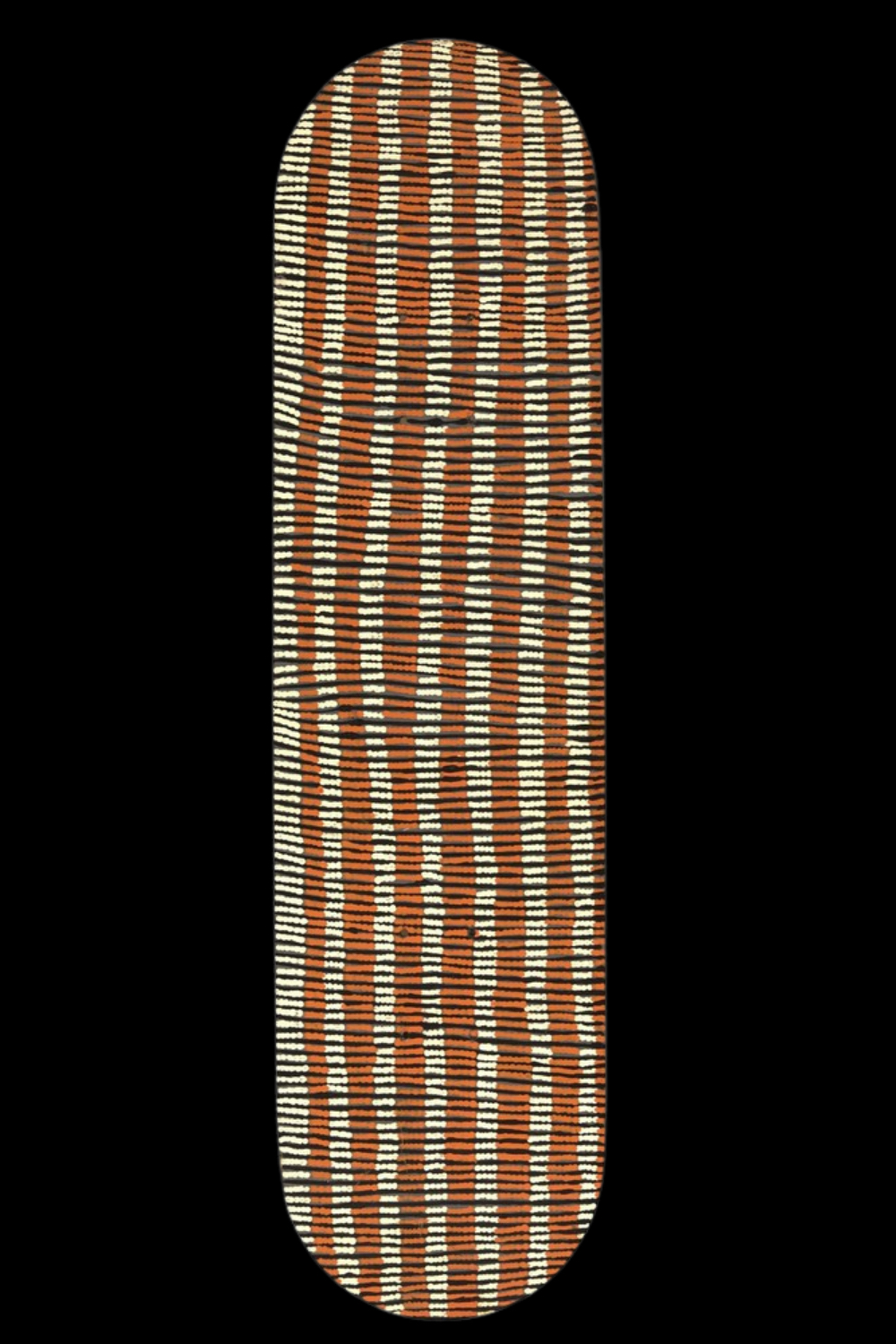
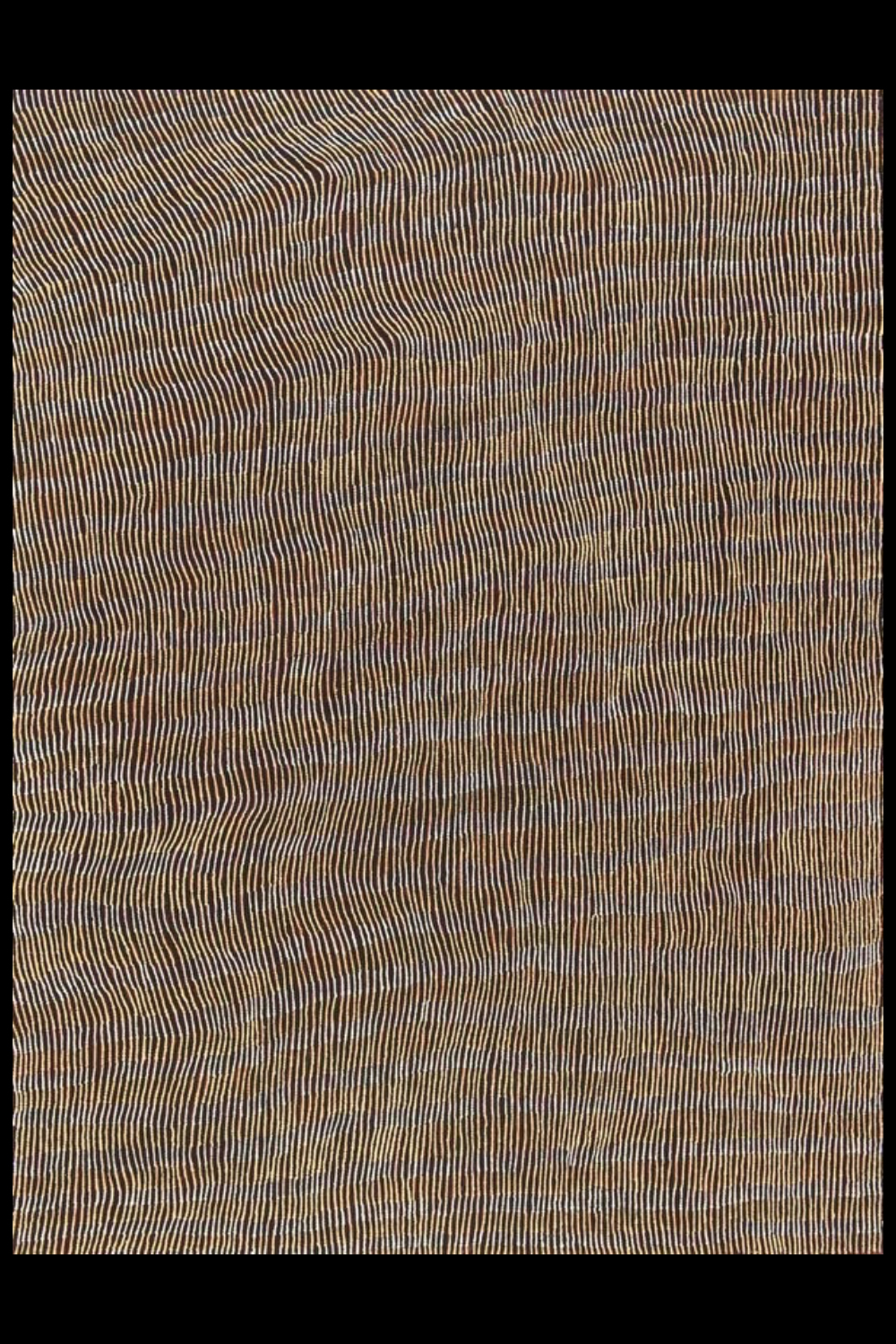
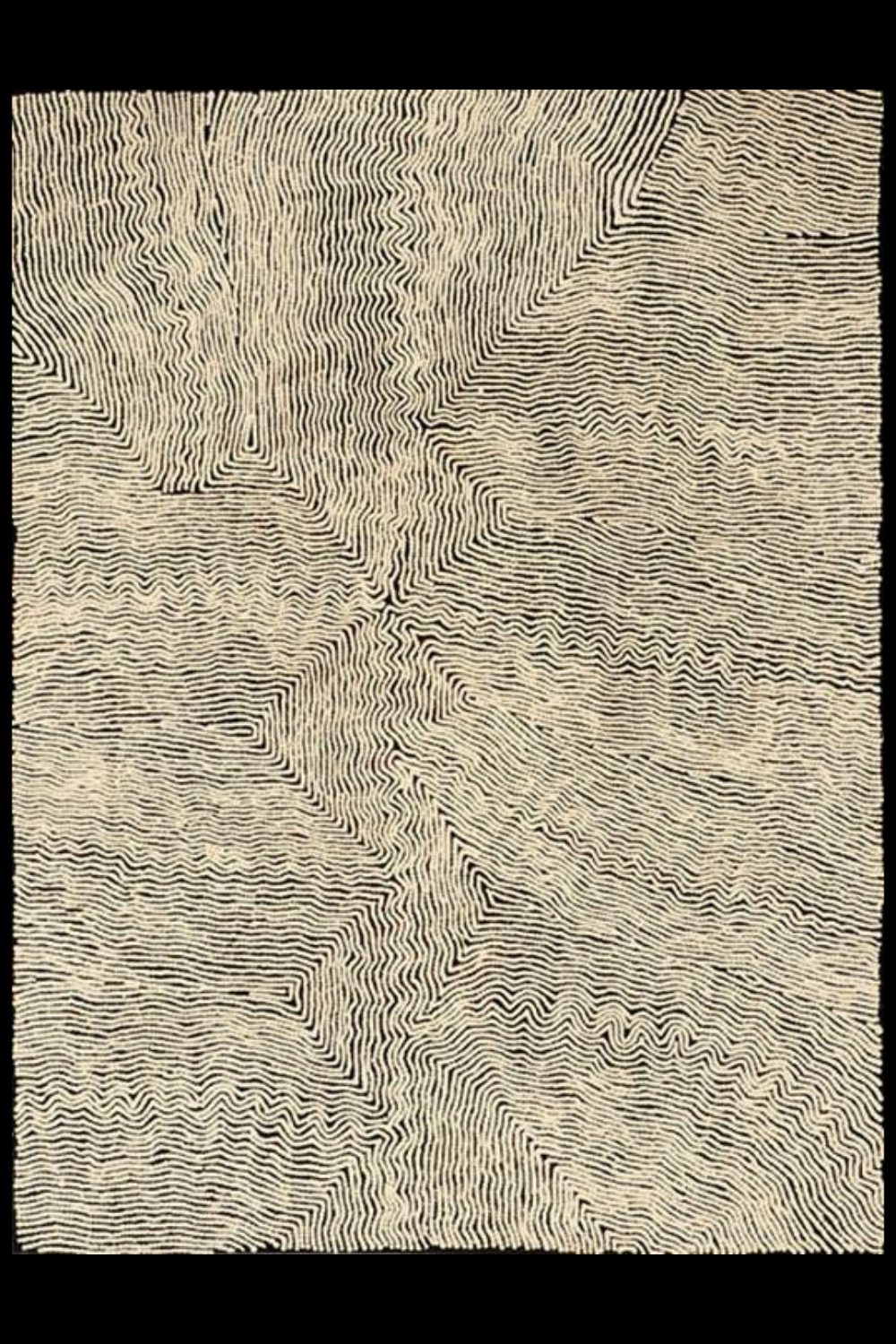
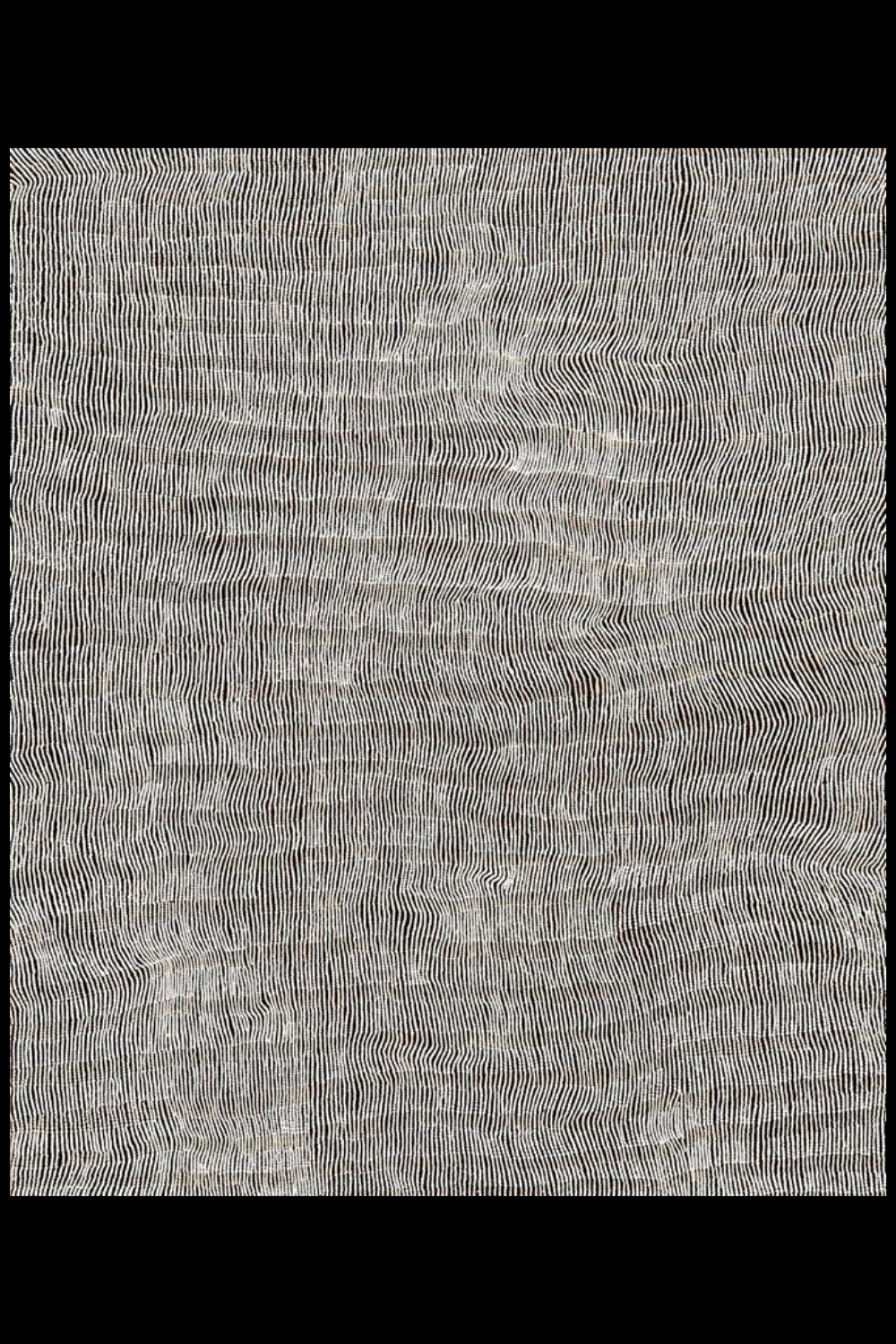
Yukultji Napangati’s paintings are immediately recognisable through their intricate arrangements of closely spaced dots, broken lines and undulating bands of colour. Working predominantly in white, cream, yellow, orange, black and red ochre, she creates shimmering compositions that appear to shift and move before the viewer.
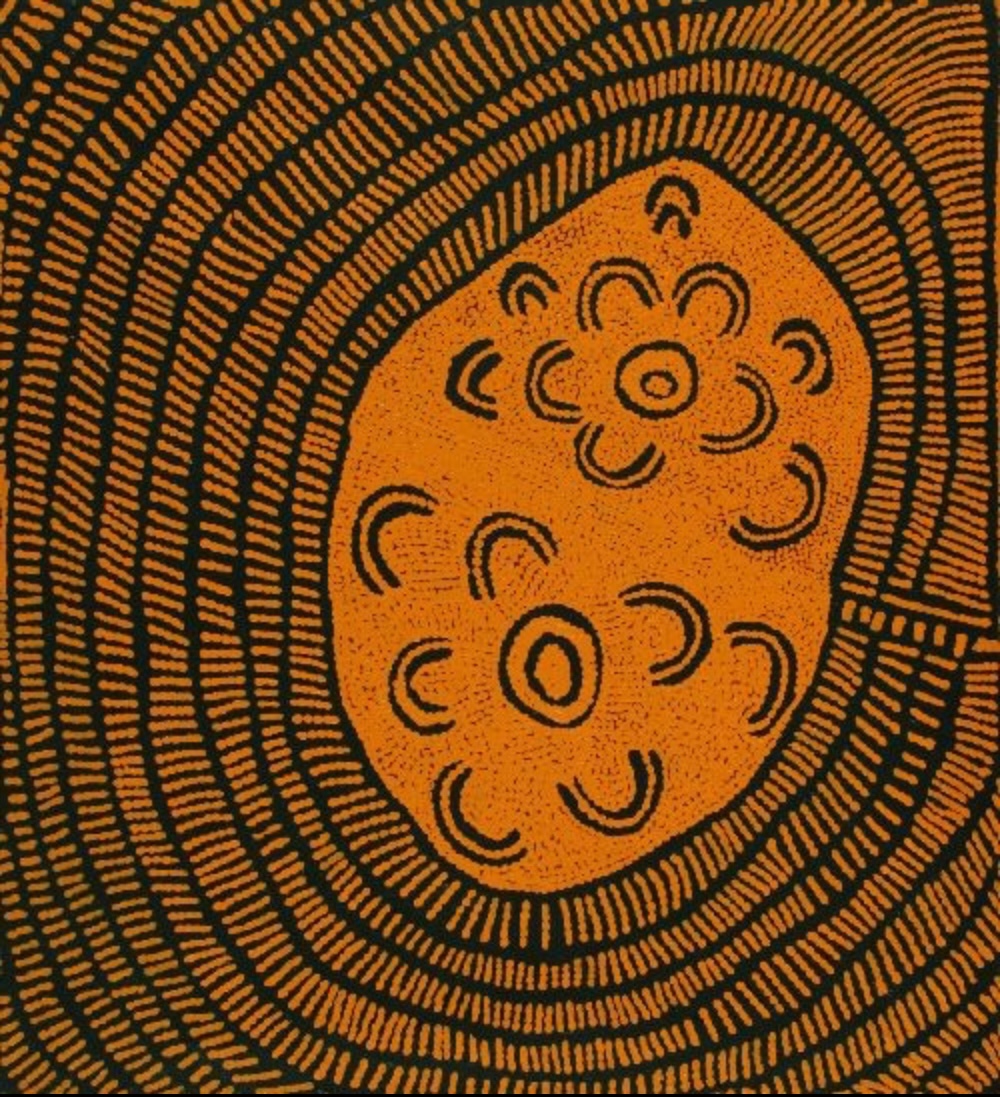
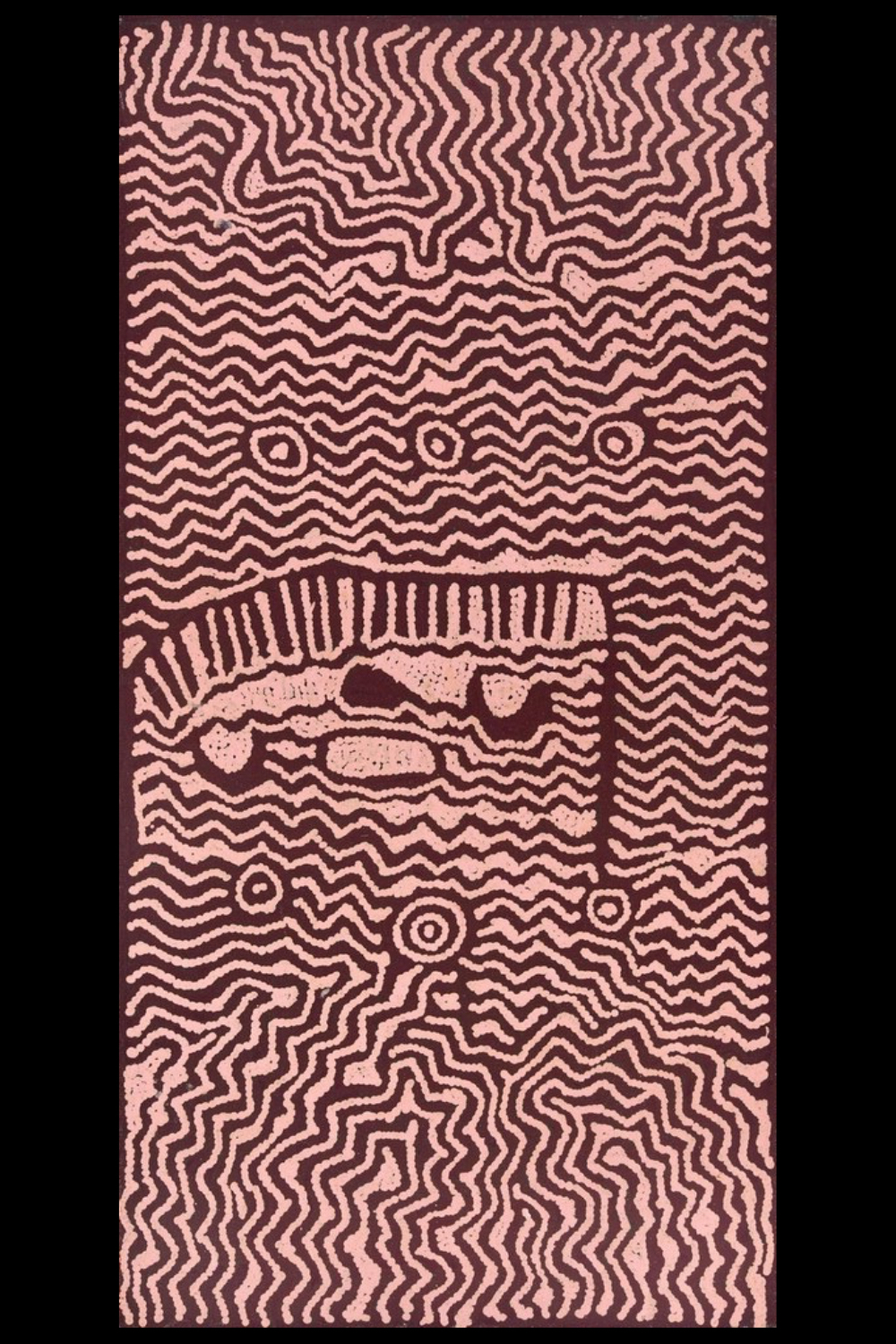
Her earliest paintings employed recognisable Pintupi symbols, including concentric circles representing rockholes, U-shaped figures depicting women and geometric arrangements describing hills. Gradually, these separate elements gave way to continuous fields of flowing lines, with subtle variations in spacing, direction and colour creating extraordinary optical intensity.
Art historian Felicity Fenner, curator of Home Ground (2006), provided one of the earliest detailed analyses of this development. Fenner described how Yukultji often began with an earth-red ground, sometimes covered with black, before building intricate patterns of rotating marks or undulating lines. She argued that Yukultji painted Country “from the inside out“, drawing upon her intimate experience of the desert rather than simply reproducing its outward appearance.
In her 2026 essay Portals to Place, curator Tamsin Hong identified fellow Pintupi painter Lorna Ward Napanangka as an important artistic influence. Lorna, daughter of pioneering Papunya painter Timmy Payungka Tjapangardi, developed a technique of fine white dots against dark grounds. Yukultji transformed this approach into her distinctive networks of densely packed, flowing lines.
Her paintings share the extraordinary optical movement found in the work of Warlimpirrnga Tjapaltjarri and George Tjungurrayi. However, whereas these artists frequently depict men’s Tingari traditions, Yukultji’s principal subjects concern women’s Tjukurrpa, particularly the ancestral sites of Marrapinti and Yunala.
Art historian Cara Pinchbeck, writing in Marking the Infinite (2016), explored how Yukultji’s paintings challenge conventional perceptions of time and space. Philosopher Timothy Morton was similarly struck by their optical intensity, comparing their visual movement with the Op Art of Bridget Riley.
Yet these comparisons explain only their visual effects. Beneath the apparently abstract patterns lie specific places, ancestral journeys, ceremonial knowledge and the sandhills and waterholes of Yukultji’s Country. Her achievement is to communicate this inherited knowledge through an exceptionally sophisticated and individual language of contemporary painting.
Yukultji Napangati Painting Subjects
Yukultji Napangati’s paintings primarily concern the ancestral Country of her mother and the journeys of women across the Gibson Desert towards Wilkinkarra (Lake Mackay). Her principal subjects are Marrapinti, Yunala, Wirrulnga and Ngaminya, places associated with women’s ceremony, waterholes, bush foods and ancestral events.
As Yukultji explained in an interview published by the Art Gallery of New South Wales:
“My mother’s country, Marrapinti, that’s what I paint about.”
Marrapinti – Women’s Ceremony and Ancestral Country
Marrapinti, west of the Pollock Hills in Western Australia, is Yukultji’s most important painting subject. It belongs to her mother’s ancestral Country and is associated with ceremonies performed by Nangala and Napangati women.
During the Tjukurrpa, a group of ancestral women camped at Marrapinti and made ceremonial nose bones, also called marrapinti. These ornaments were inserted through a piercing in the nasal septum and were traditionally worn by both men and women. After completing their ceremonies, the women continued east, travelling through Wala Wala, Ngaminya and Wirrulnga towards Lake Mackay.
Anthropologist Fred Myers, writing about Yukultji’s paintings for Gagosian in 2019, recorded a particularly revealing explanation of the landscape. Yukultji identified a cave in the hill at Marrapinti and a pathway descending from it, together with a rock understood to be the nose of an ancestral woman who had turned to stone.
Yukultji’s paintings of Marrapinti frequently use densely arranged, flowing lines to represent the surrounding sandhills. Their apparent abstraction expresses a very specific ancestral geography.
Yunala – Bush Banana Dreaming
Yunala is a rockhole and soakage water site among the sandhills west of Kiwirrkurra. It takes its name from the bush banana or silky pear vine, Marsdenia australis, whose edible underground parts were an important traditional food.
According to the ancestral narrative, a group of women travelling from the west stopped at Yunala and camped beside the rockhole. They dug for the edible roots before continuing their journey east towards Lake Mackay.
Yukultji’s paintings represent both the sandhills surrounding the waterhole and the underground tubers of the plant.
This combination of surface landscape and subterranean food resources is particularly important. The paintings describe knowledge of Country that extends beyond what can be seen from above.
The Metropolitan Museum of Art, which holds Ancestral Women at Yunala (2012), interprets its intricate lines as simultaneously expressing shifting desert sands, underground plant life and ancestral presence.
Gloria Strzelecki, Associate Curator at the Art Gallery of South Australia, similarly explains how Yukultji’s undulating lines evoke the sandy terrain crossed by the ancestral women.
Wirrulnga and Ngaminya – Rockholes and Desert Raisin
Wirrulnga and Ngaminya are important sites along the ancestral women’s journey towards Wilkinkarra. Their stories connect waterholes, rocky outcrops and the gathering of bush foods.
At Wirrulnga, east of Kiwirrkurra, ancestral women collected kampurarrpa, the desert raisin (Solanum centrale). These small fruits could be eaten directly from the plant or processed for later consumption.
In Yukultji’s early painting Wirrulnga (2000), two circular forms represent rockholes, U-shaped marks depict the women and a grid-like design describes the surrounding rocky hills.
Ngaminya, southwest of Kiwirrkurra, is another rockhole associated with ancestral women gathering desert raisins during their travels.
These paintings are particularly revealing because the places are connected through an ancestral journey rather than being isolated landscape subjects.
The women moved between waterholes, collected food and performed activities that established the continuing significance of these places within Pintupi Tjukurrpa.
Tali – Sandhills, Water and the Changing Desert
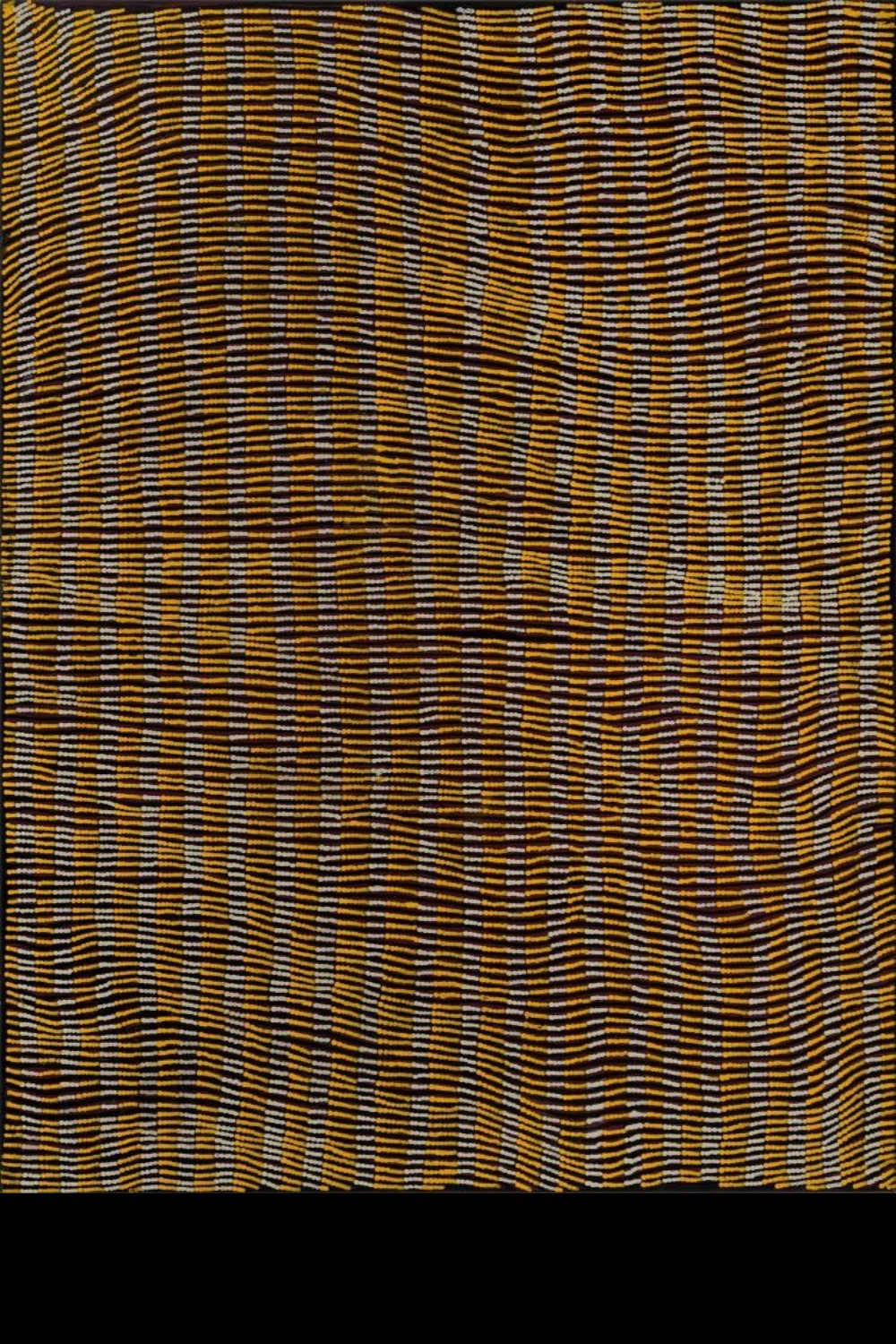
The vast sandhill country around Kiwirrkurra and Lake Mackay is a recurring element throughout Yukultji’s work.
Tali is the Pintupi term for sandhills, and paintings with this title often concentrate on the rhythmic formations of the Gibson Desert landscape.
Their closely spaced lines evoke the long, parallel dunes, their shifting contours and the optical effects of heat and light.
The Queensland Art Gallery | Gallery of Modern Art also identifies seasonal changes as an important subject in Yukultji’s painting. Curators describe how her flowing lines represent sandhills, while enlarged or mushroom-shaped forms can suggest water spreading across the landscape during the rainy season.
Art dealer and writer Christopher Hodges has also observed that her repeated lines may recall wind-driven ripples on Lake Mackay or patterns associated with women’s ceremonial designs.
These interpretations suggest that her paintings can bring together several aspects of Country within a single composition: the sandhills, seasonal water, ceremonial knowledge and ancestral events.
Why Yukultji Napangati Is Important
Yukultji Napangati is among the leading Pintupi painters of the generation that transformed Papunya Tula art during the 1990s, bringing women’s ancestral knowledge into a movement initially dominated by men.
Her greatest achievement is a distinctive visual language combining extraordinary optical sophistication with intimate knowledge of Country. Her undulating lines represent sandhills, underground food resources and ancestral events, expressing multiple dimensions of a place within a single composition.
Anthropologist Fred Myers, writing for Gagosian in 2019, emphasised that Yukultji’s paintings emerge from her lived experience of Country rather than simply depicting its appearance. The shimmering patterns admired by international critics are grounded in places she knew through walking, hunting and learning from her family.
Her work also challenges conventional distinctions between Aboriginal painting and Western abstraction. Although compared with the Op Art of Bridget Riley, its meanings derive from Pintupi Tjukurrpa. Her 2018 Wynne Prize victory demonstrated the importance of her approach to contemporary Australian landscape painting.
International recognition followed through exhibitions at Gagosian and acquisitions by major institutions, including the Metropolitan Museum of Art and National Gallery of Australia.
Yet her artistic innovation remains inseparable from cultural continuity. Her daughter, Jodie Napurrla Ward, now paints Marrapinti, continuing ancestral knowledge passed down through generations of women.
Yukultji’s achievement is to create internationally recognised contemporary paintings that remain deeply rooted in the specific places, ceremonies and ancestral knowledge of Pintupi Country.
Yukultji Napangati Value and Auction results
Works Offered at Auction: 74
Sale Rate: 53%
Highest Sale: $70,000 AUD
Median Sale Price: $4,600 AUD
To view individual select artworks along with dimensions provenance and sales prices please ivsit the Yukultji Napangati Value page (not yet constructed)
Exhibitions, Awards and Public Collections
Yukultji first attracted wider attention through Primavera at Sydney’s Museum of Contemporary Art in 2005. She subsequently exhibited extensively in Australia, Europe and North America, with her paintings entering important public collections.
Major Exhibitions and Awards
- 2005 – Primavera, Museum of Contemporary Art, Sydney.
- 2006 – Home Ground, Ivan Dougherty Gallery, Sydney.
- 2012 – Winner, Alice Prize, Alice Springs.
- 2015 – 8th Asia Pacific Triennial, Queensland Art Gallery | Gallery of Modern Art, Brisbane.
- 2016–2019 – Marking the Infinite: Contemporary Women Artists from Aboriginal Australia, touring North America.
- 2018 – Winner, Wynne Prize, Art Gallery of New South Wales.
- 2019 – Solo exhibition, Salon 94, New York; Desert Painters of Australia, Gagosian.
- 2020 – Shimmer, Utopia Art Sydney.
- 2026 – Portals to Place: Three Papunya Tula Artists, Edel Assanti, London, with Lorna Ward Napanangka and John West Tjupurrula.
Selected Public Collections
Yukultji Napangati’s paintings are represented in significant Australian and international institutions, including:
- Art Gallery of New South Wales, Sydney
- National Gallery of Australia, Canberra
- National Gallery of Victoria, Melbourne
- Museum of Contemporary Art Australia, Sydney
- Art Gallery of South Australia, Adelaide
- Queensland Art Gallery | Gallery of Modern Art, Brisbane
- Metropolitan Museum of Art, New York
Her international recognition reflects both the exceptional visual sophistication of her paintings and their importance within the continuing history of Pintupi art.
Further Reading
Felicity Fenner, Home Ground, 2006. Ivan Dougherty Gallery, University of New South Wales. One of the earliest detailed examinations of Yukultji’s painting technique and her relationship to Country. Read catalogue (PDF).
Cara Pinchbeck, Yukultji Napangati: Of Time and Space, 2016. In Henry F. Skerritt (ed.), Marking the Infinite: Contemporary Women Artists from Aboriginal Australia. An important curatorial analysis of her paintings and their spatial and perceptual complexity.
Tamsin Hong, Lorna Ward Napanangka, Yukultji Napangati, and John West Tjupurrula, 2026. Written for Portals to Place, Edel Assanti, London. Particularly valuable for Yukultji’s artistic influences and transmission of women’s Tjukurrpa. Read essay (PDF).
Crispin Gutteridge, Sandhills Surrounding the Rockhole and Water Site of Yunala, 2021. Deutscher and Hackett auction catalogue. Detailed discussion of an important 2005 painting. Read catalogue.
Metropolitan Museum of Art, Ancestral Women at Yunala, 2012. Collection documentation explaining the relationship between ancestral women, sandhills and underground plant resources. View collection record.
Charmayne Allison and Xavier Martin, From the Sands of Time, ABC News, 2025. An exceptionally useful account of the Pintupi Nine, featuring Yukultji and her sister Yalti discussing their childhood, the events of 1984 and their enduring connection with Country. Read ABC article.
Yukultji Napangati
Artwork images
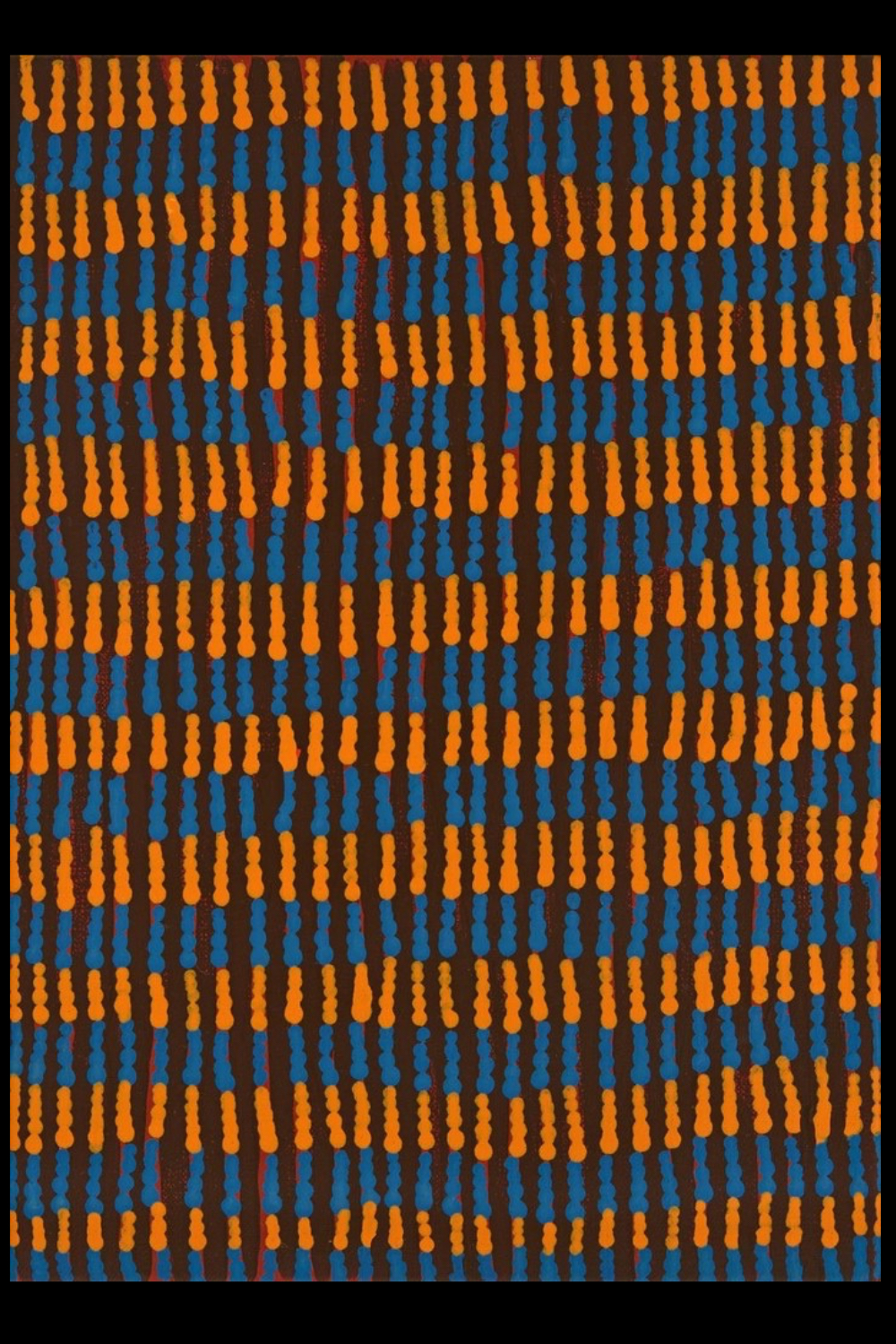
The following images are not intended to represent a complete catalogue of the artist’s work. Rather, they offer a representative selection illustrating the breadth of subjects, artistic styles and visual diversity of the artist’s oeuvre
All images featured in this article are presented strictly for educational and informational purposes.
This website may include copyrighted material for which specific authorization has not been obtained from the copyright owner.
All such images are presumed to be the intellectual property of the respective artist or their estate, and are used in accordance with principles of fair dealing or fair use under applicable copyright law.