Tiwi Painting
This article focuses specifically on Tiwi bark painting and does not examine painted Tunga baskets, body painting, Tutini burial poles, or painted sculpture, all of which are covered separately within our guide to Tiwi Art. The emphasis here is on the emergence of painted flat surfaces as a distinct artistic tradition and collectable field within Aboriginal Australian Art.
Tiwi painting is renowned for its bold geometric jilamara designs and richly textured ochre surfaces. Although many compositions appear abstract to outsiders, the circles, dots, crosshatching, and linear motifs often relate to ceremonial identity, kinship, and ancestral relationships traditionally understood within the Tiwi community. Unlike Western Desert painting, Tiwi bark painting evolved from ceremonial body designs and mortuary decoration rather than symbolic landscape mapping.
Traditionally, Tiwi artists painted onto bodies, bark baskets, and Tutini grave posts rather than flat bark surfaces. During the 1950s and 1960s, anthropologists and collectors encouraged artists to preserve ceremonial jilamara designs on sheets of eucalyptus bark, creating some of the earliest Tiwi bark paintings now encountered by collectors. Important early painters such as Ali Mungatopi and Deaf Tommy Mungatopi helped establish bark painting as an important new artistic medium within Tiwi art. As mission settlements increasingly promoted Aboriginal artworks for sale, bark paintings entered the developing art market alongside sculpture and ceremonial objects.
Later artists including Kitty Kantilla and Timothy Cook expanded these ceremonial painting traditions into highly sophisticated forms of contemporary abstraction, helping bring Tiwi painting to national and international attention while retaining strong connections to jilamara design traditions.
Today, early Tiwi bark paintings with strong provenance and finely executed ceremonial designs are highly collectable. If you own an early Tiwi bark painting and would like assistance with identification, valuation, or sale, feel free to contact me with a JPEG image and dimensions.
Jilamara Designs and Tiwi Painting Symbolism
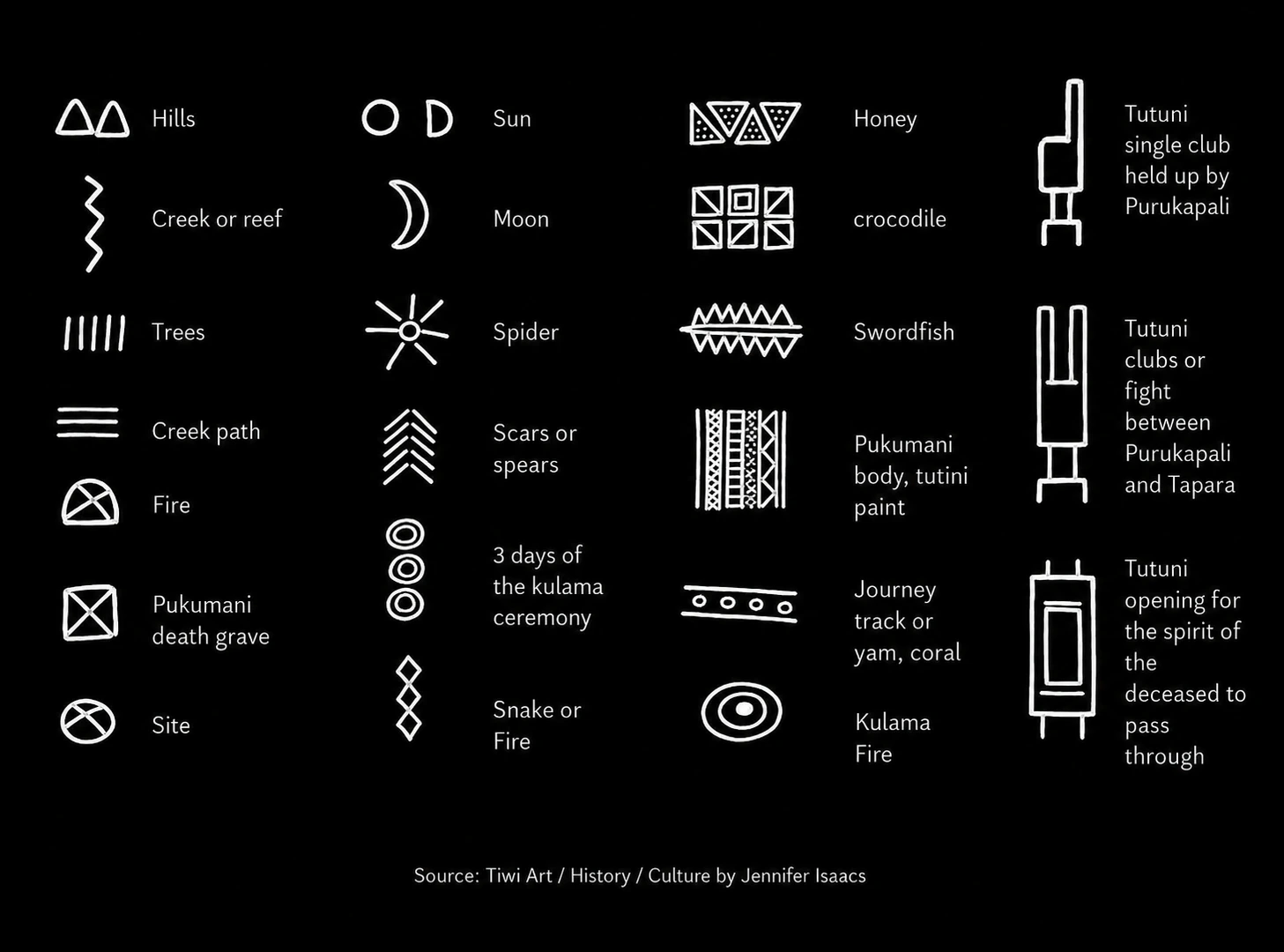
The geometric patterns found throughout Tiwi painting are collectively known as jilamara, a Tiwi term associated with ceremonial body painting, carved surface decoration, and sacred design traditions. These rhythmic ochre patterns form one of the most distinctive visual languages within Aboriginal Australian Art and remain closely connected to ceremony, kinship, mortuary ritual, and clan identity. Although many Tiwi paintings appear abstract to non-Indigenous viewers, the designs often contain layered ceremonial meanings associated with ancestral relationships and the Pukumani and Kulama ceremonies.
Many traditional Tiwi motifs relate to elements of both the natural and ceremonial world. Repeated bands and linear patterns may refer to spears, cicatrisation scars, trees, creek paths, or ceremonial body paint, while circles, dots, and geometric divisions can carry associations connected to ritual practice and social identity. Importantly, these meanings are rarely fixed or isolated. Individual symbols are traditionally understood in relation to surrounding forms within the overall composition, where meaning emerges through the interaction of pattern, rhythm, and ceremonial context rather than through a simple symbolic code.
Traditionally, much of the deeper meaning embedded within jilamara designs was understood only by initiated members of the Tiwi community. For this reason, Tiwi paintings should not be viewed merely as decorative abstraction, but as part of a living ceremonial system linked to song, dance, body painting, and ancestral law.
Early Tiwi Bark Paintings
Skin Designs
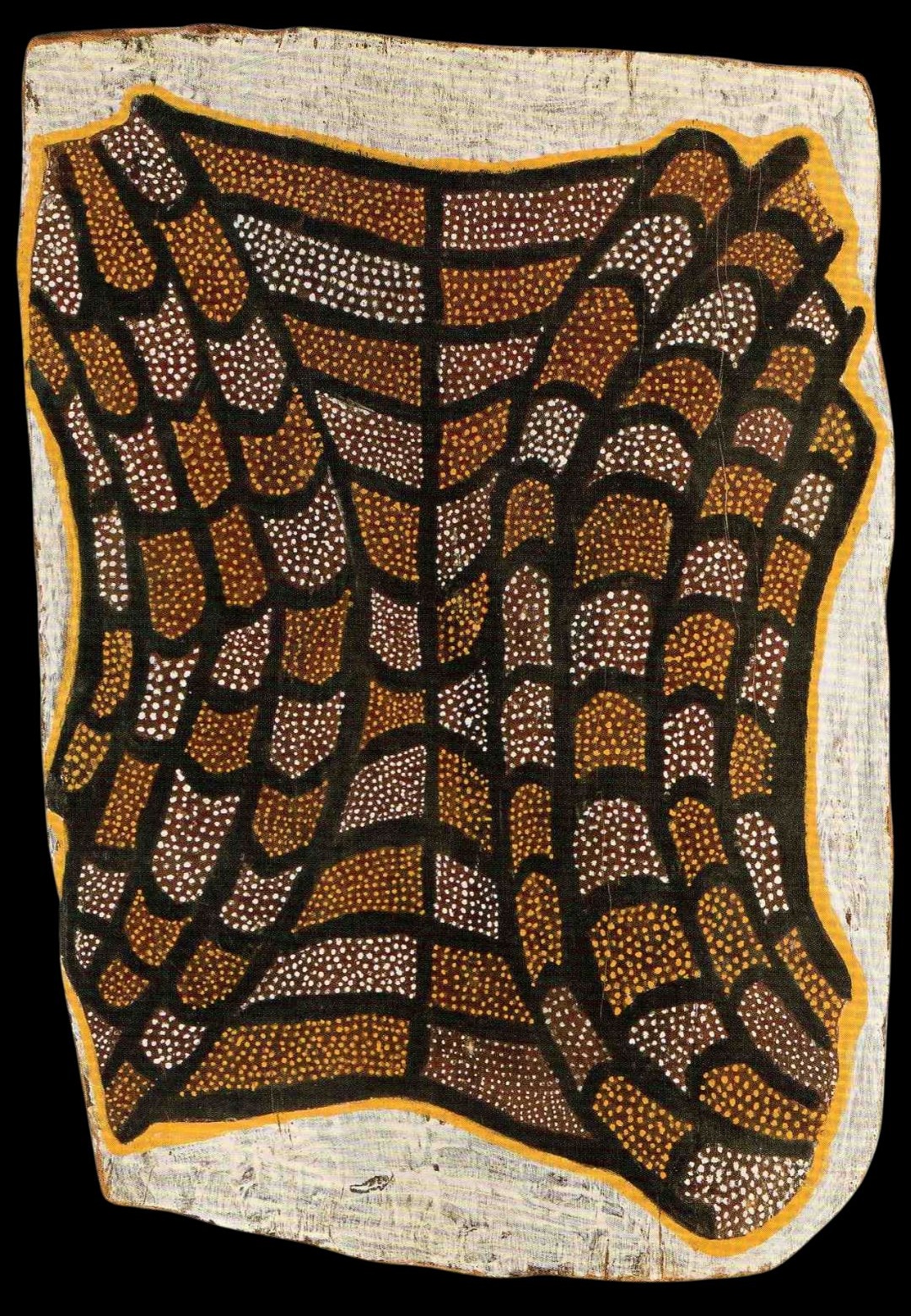
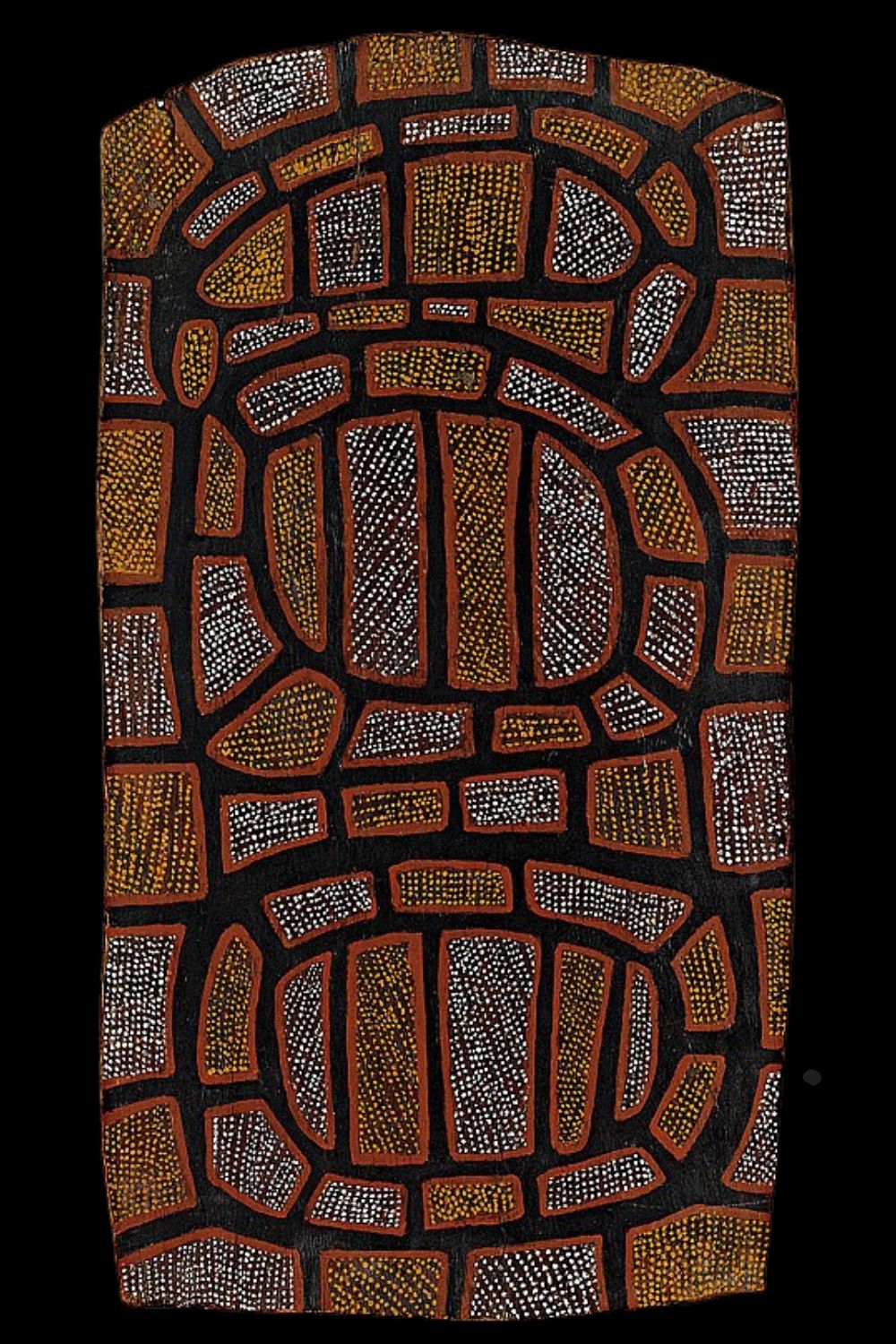
Many of the most recognisable and collectable early Tiwi bark paintings depict ceremonial Pukumani skin designs and date from the 1950s and 1960s. These early works are often painted on sheets of stringybark without the framing battens commonly associated with Arnhem Land bark painting. Among the most important early Tiwi bark painters were Ali Mungatopi Purawarrumpatu and Deaf Tommy Mungatopi, whose works remain highly sought after by collectors and museums for their ceremonial authority and historical significance.
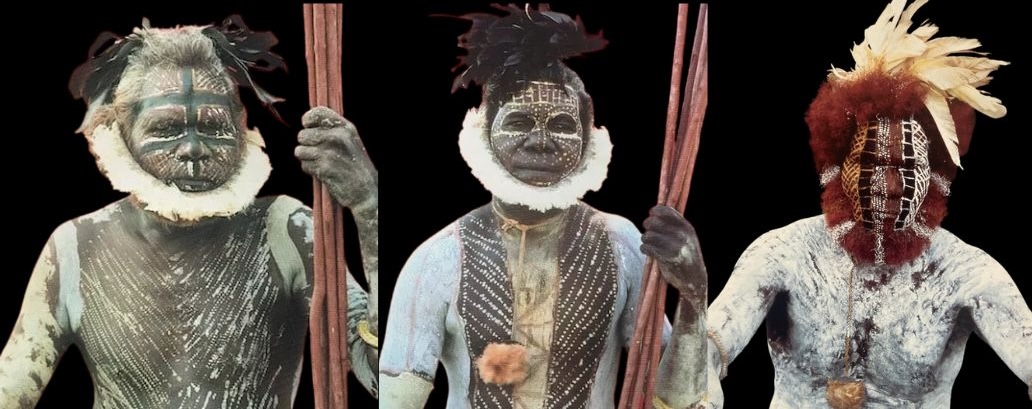
Traditional skin designs were closely connected to clan identity and ceremonial responsibility. Particular jilamara patterns could only be painted by members of the appropriate clan group, with the designs functioning not merely as decoration but as expressions of ancestral affiliation, mortuary ritual, and social identity. Today, early bark paintings depicting these ceremonial skin designs are regarded among the most historically important forms of Tiwi painting.
Figurative Painting
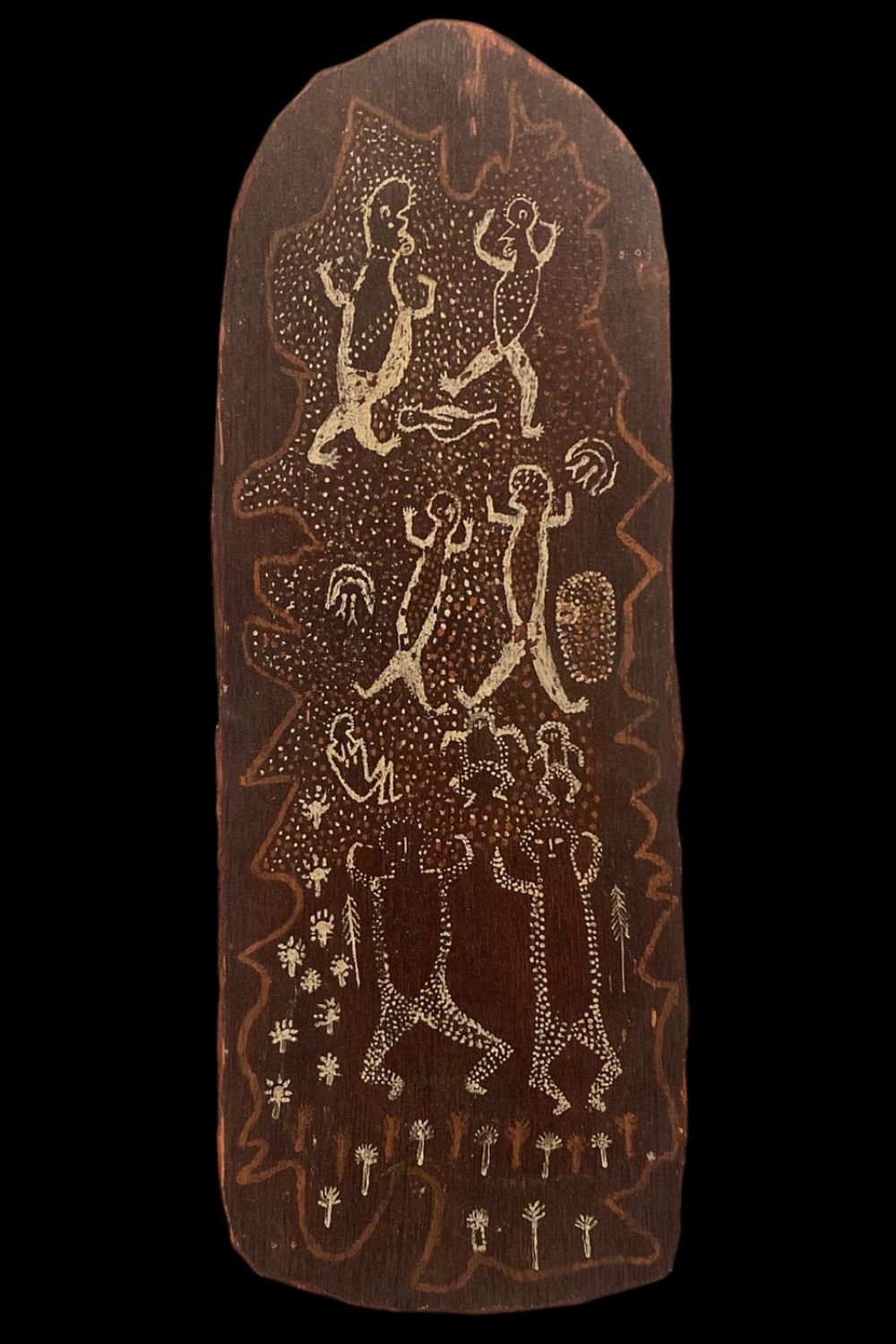
Alongside ceremonial skin designs, some early Tiwi artists also produced more figurative bark paintings depicting traditional narratives, mythic animals, hunting scenes, ceremonial conflict, and encounters with Europeans. These works often possess a direct and highly individual character distinct from the more formalised geometry of ceremonial jilamara painting.
Although generally less anatomically detailed than contemporaneous Oenpelli Art bark paintings, and lacking the strong abstract visual impact of ceremonial skin design compositions, these figurative works remain highly collectable because of their rarity, ethnographic importance, and documentary value. Examples with strong provenance or secure attribution to important Tiwi artists are particularly valued by collectors and museums.
Contemporary Tiwi Painting
Artists such as Kitty Kantilla and later Timothy Cook recognised that collectors were increasingly drawn not only to traditional ceremonial skin designs on bark, but also to the powerful abstract qualities of jilamara itself as a contemporary visual language. Kitty Kantilla in particular played a major role in transforming Tiwi painting from the direct reproduction of ceremonial skin designs into highly individual abstract compositions that reinterpreted traditional jilamara elements in innovative ways.
These later paintings were no longer simply the same designs painted onto Pukumani mourners during mortuary ceremony. Instead, artists began using circles, bands, dots, and crosshatched patterning more freely as compositional elements within contemporary painting while still maintaining strong connections to Tiwi identity, ceremonial tradition, and ancestral design systems. The result was the emergence of a uniquely Tiwi form of contemporary abstraction distinguished by rhythmic geometry, textured ochre surfaces, and remarkable visual intensity.
During the late 1960s, outside advisers and arts workers also encouraged Tiwi artists to diversify into screen-printing, fabric design, pottery, and other artistic mediums incorporating traditional jilamara patterns. While this expanded the visibility and commercial reach of Tiwi Art, it also meant that many younger artists increasingly explored alternative forms of artistic production rather than concentrating solely on bark painting. Nevertheless, painting remained central to the evolution of contemporary Tiwi visual culture and laid the foundation for the internationally recognised Tiwi painters working today.
Further Reading on Tiwi Painting and Tiwi Art
The following books, exhibition catalogues, and scholarly publications are among the most important resources on Tiwi painting, jilamara design traditions, Pukumani ceremony, and the development of contemporary Tiwi Art. Together they provide valuable insight into the history of Tiwi bark painting, ceremonial design systems, important Tiwi artists, and the transition from ritual surface decoration into contemporary Aboriginal painting practice.
Isaacs, Jennifer. Tiwi: Art, History, Culture. The Miegunyah Press, Melbourne, 2012.
Johnson, Vivien. Kitty Kantilla. Art Gallery of New South Wales, Sydney, 2007.
Mountford, Charles P. The Tiwi: Their Art, Myth and Ceremony. Phoenix House, Melbourne, 1958.
Holmes, Sandra Le Brun. Aboriginal Artists of the Tiwi Islands. Tiwi Art Network, Darwin, 1995.
Tungutalum, Bede. Tiwi Designs. Aboriginal Arts Board of the Australia Council, Sydney, 1978.
Morphy, Howard. Aboriginal Art. Phaidon Press, London, 1998.
Caruana, Wally. Aboriginal Art. Thames & Hudson, London, 1993.
Berndt, Ronald M., and Catherine H. Berndt. The World of the First Australians. Aboriginal Studies Press, Canberra, 1999.
All images in this article are for educational purposes only.
This site may contain copyrighted material the use of which was not specified by the copyright owner.