Jan Billycan: Biography, Painting Style and Importance
- c.1930–2015
- Yulparija / Manyjilyjarra
- Kiriwirri, Ilyarra Country, Great Sandy Desert
- Bidyadanga / Western Australia
- Yulparija Art / Western Desert Art
- Painting on canvas and plywood
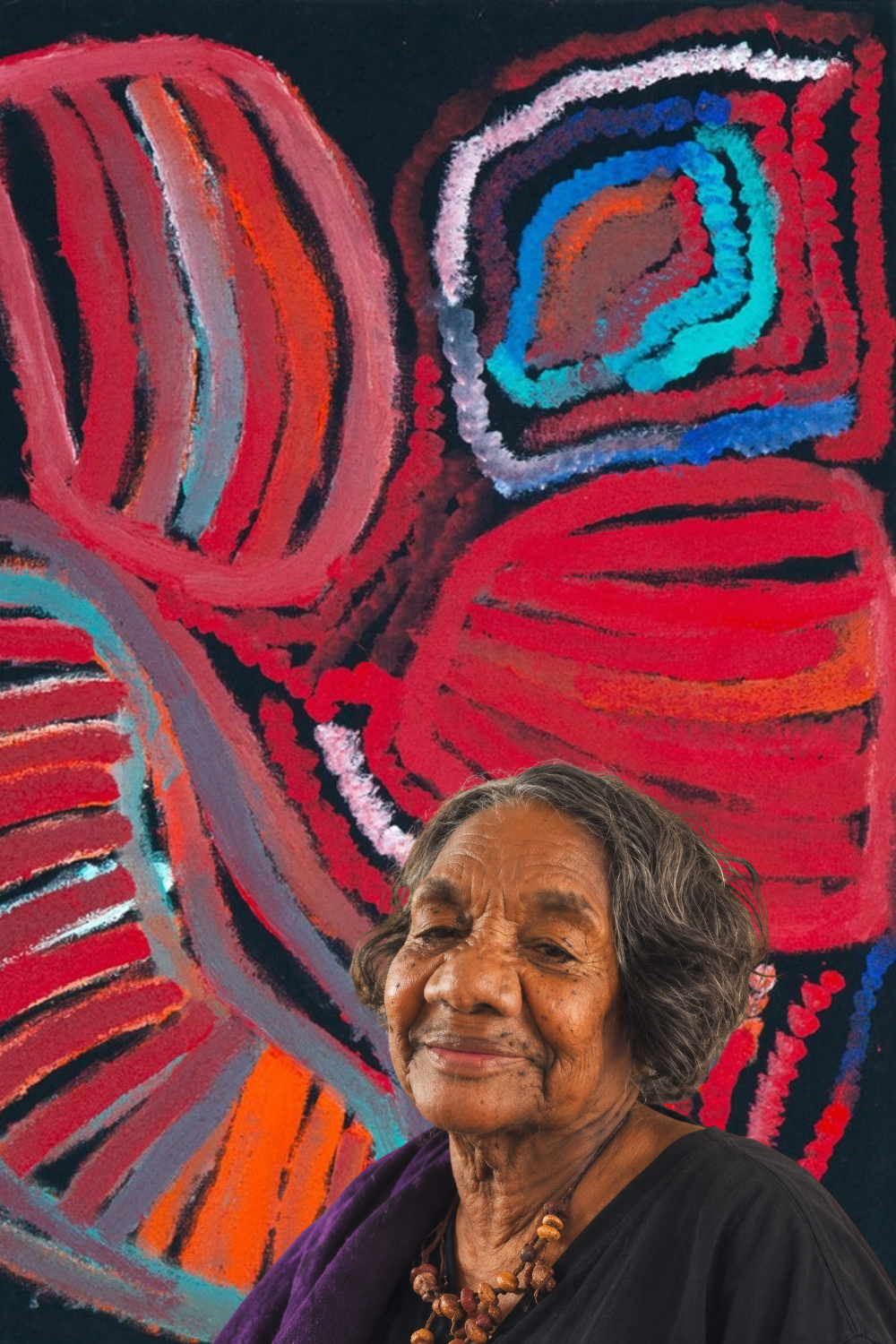
Jan Billycan (Djan Nanundie) was a senior Yulparija Aboriginal artist and traditional healer whose extraordinary paintings depict the living waterholes, sandhills and ancestral places of her Ilyarra Country in the Great Sandy Desert.
Born at Kiriwirri around 1930, she spent her childhood travelling through the desert with her parents before moving to the coastal community of Bidyadanga in the 1960s. She began painting in 2003, when already in her seventies, as part of a new Yulparija painting movement encouraged by the younger artist Daniel Walbidi. She developed a highly individual style of brilliant colour, sweeping organic forms and densely worked lines.
Her paintings are remarkable for their intimate relationship between the human body and the landscape, reflecting her knowledge as a maparn (traditional healer). Her work is represented in major Australian public collections, including the National Gallery of Australia.
Jan Billycan Biography
Jan Billycan, also recorded as Jarran Jan Billycan and Djan Nanundie, was born around 1930 at Kiriwirri, west of Well 33 on the Canning Stock Route in Western Australia’s Great Sandy Desert. She belonged to the Yulparija people, with Manyjilyjarra language affiliations, and was of the Karimarra skin group.
Kiriwirri was the birthplace of her father’s clan, within the vast landscape of the Percival Lakes, a chain of salt lakes, mud flats and sandhills stretching across the desert.
As a child, Billycan travelled with her parents through Ilyarra Country, learning the locations of permanent waters, seasonal resources and ancestral places. She remembered Karrparti, Kawarr, Jurntiwa and Wirrguj among the living waterholes, as well as Dodo, Kartal, Kiriwirri and Yukarri. These journeys established a detailed knowledge of Country that would become the foundation of her paintings more than half a century later.
During the 1960s, prolonged drought and changing conditions in the desert contributed to the movement of Yulparija families towards the coast. Billycan was taken by extended family members to Bidyadanga, formerly La Grange Mission, south of Broome.
Bidyadanga was Karajarri Country, hundreds of kilometres from the desert landscapes of her childhood. Billycan remained there for much of her adult life, becoming a respected senior woman and maparn (traditional healer).
Her emergence as an artist was closely connected with the young Yulparija painter Daniel Walbidi who approached Emily Rohr at Short St Gallery in Broome in 1999. Walbidi wanted to paint his ancestral Country and encouraged senior Yulparija people to record the places and histories they remembered.
With Rohr’s support, a generation of elders began working with contemporary painting materials. Billycan started painting in 2003, when already in her seventies, alongside artists including Weaver Jack, Alma Webou, Donald Moko and Lydia Balbal. Together, they helped establish the distinctive Yulparija painting movement at Bidyadanga.
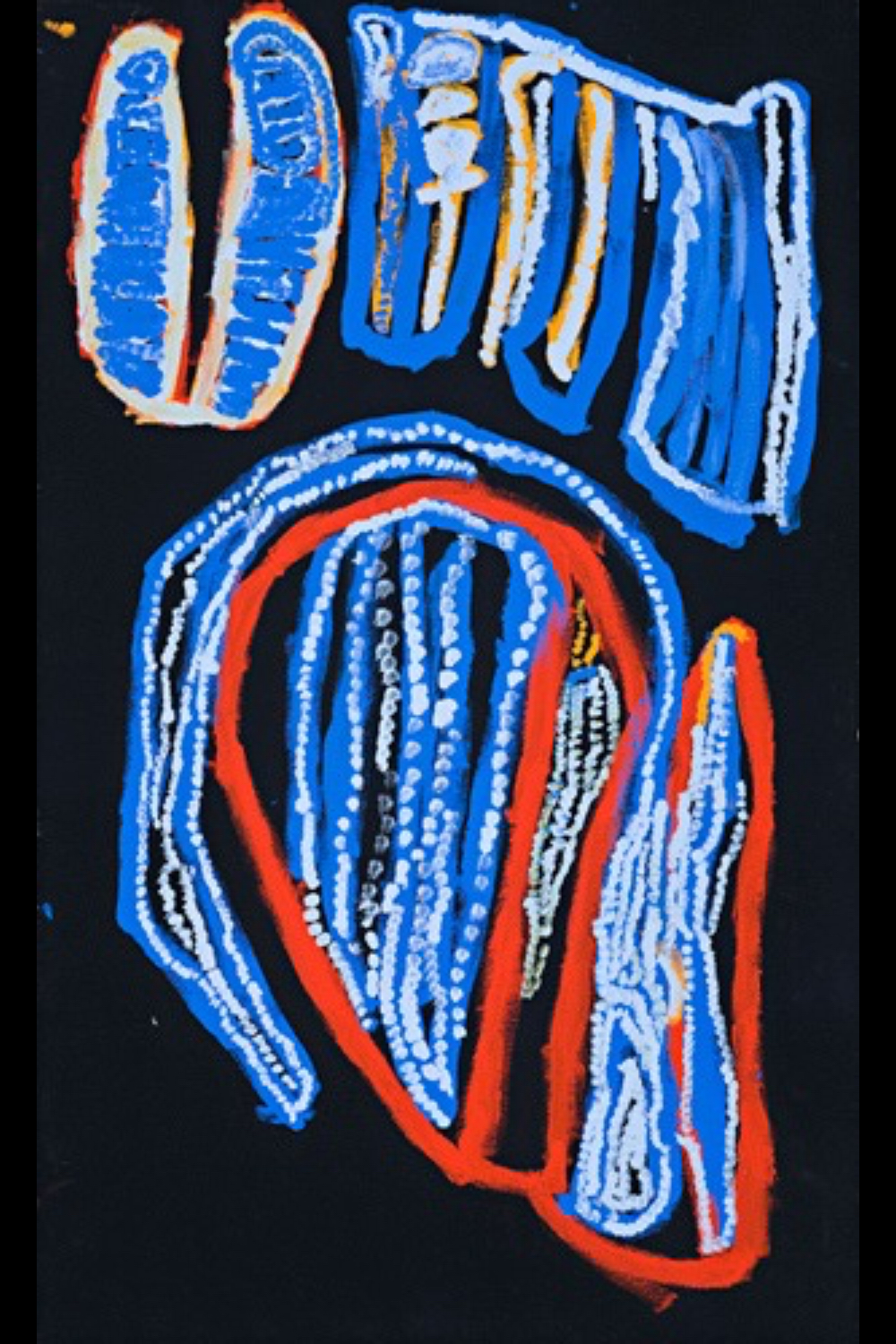
In 2007, her work was included in Culture Warriors, the inaugural National Indigenous Art Triennial at the National Gallery of Australia. Her paintings subsequently featured in Yiwarra Kuju: The Canning Stock Route at the National Museum of Australia in 2010.
In 2011, Billycan received the Western Australian Artist Award at the Western Australian Indigenous Art Awards, recognising her remarkable contribution to contemporary Aboriginal painting.
Jan Billycan Painting Style
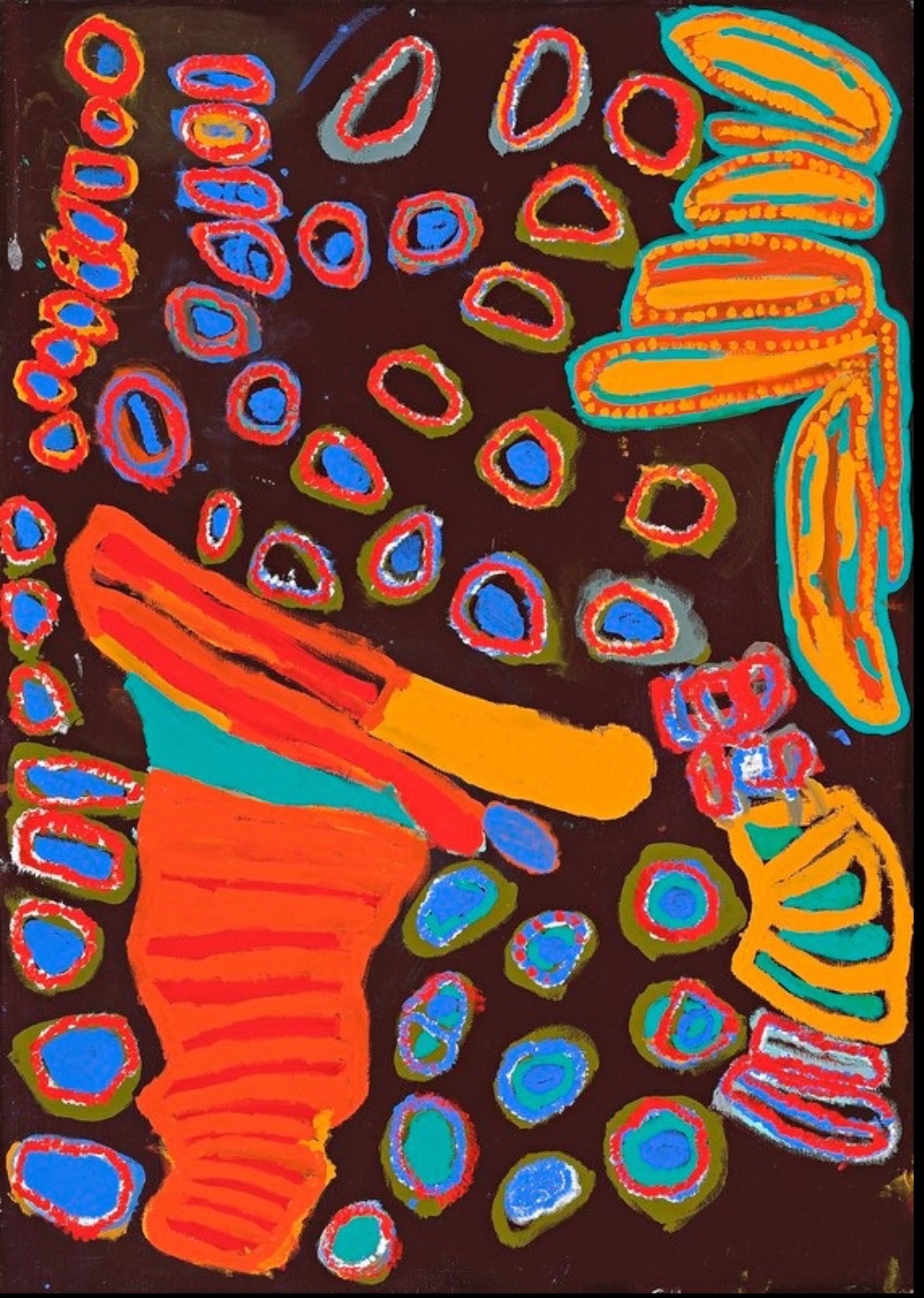
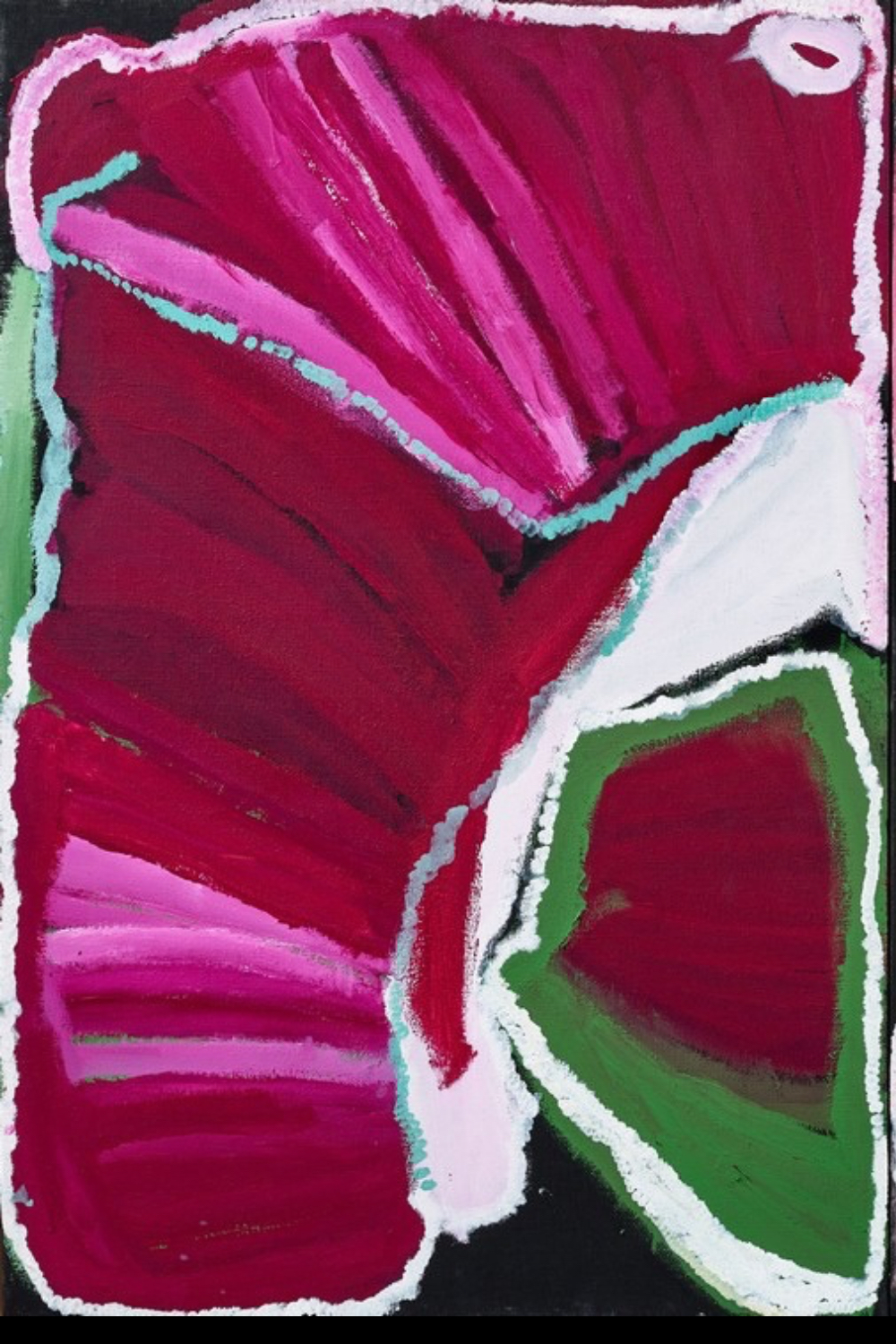
Billycan developed one of the most distinctive painting styles associated with the Bidyadanga artists. Her compositions consist of irregular masses of colour, sweeping bands, enclosed organic shapes and heavily worked lines, frequently outlined with contrasting dots.
She used saturated reds, pinks, greens, blues and yellows alongside natural earth pigments. The colours often appear to push against one another, producing a sense of movement and physical energy.
Her technique was equally individual.
Emily Rohr, who worked closely with the Bidyadanga artists, described watching Billycan begin a painting by recalling places and journeys from her childhood. When the composition outgrew one panel, she continued the narrative onto another, sometimes producing large arrangements of adjoining boards.
Billycan also mixed colours directly on the painting surface, repeatedly working lines until they acquired particular densities and hues. This process produced paintings whose irregular forms seem to expand, contract and move across the surface.
The Human Body and the Landscape
The most unusual quality of Billycan’s paintings is their relationship between human anatomy and the geography of Country.
Her reputation as a maparn informed interpretations of her work by art historians Patrick Hutchings and Wally Caruana.
In Billycan’s paintings, elongated forms resembling ribcages may correspond to rows of tali (sand dunes). Rounded, enclosed shapes suggest jila (living waterholes), while winding passages resemble the movements of internal organs.
Caruana interpreted these forms as expressing the relationship between ancestral identity, the physical body and the landscape. The artist’s Country was not an external view to be observed, but an inseparable part of the person and their ancestral identity.
Although Billycan’s paintings have the visual immediacy of modern abstraction, their meaning originates in her knowledge of particular places, ancestral journeys and living water.
As Patrick Hutchings observed in the catalogue for Culture Warriors, the paintings should not be understood solely through their resemblance to Western abstract art. They preserve the histories and identities of the people whose Country they depict.
Jan Billycan Painting Subjects and Important Artworks
Kirriwirri, 2005 — Women’s Country
Kiriwirri was Billycan’s birthplace and the ancestral homeland of her father’s clan. She repeatedly returned to this subject throughout her painting career.
A Short St Gallery certificate accompanying this 2005 painting records Billycan identifying two jila (living waterholes) associated with women’s Country. The accompanying explanation also identifies tali (sand dunes) and kaja (water).
The painting therefore records more than the physical appearance of Kiriwirri. It identifies a landscape of family belonging, women’s associations with Country and the living waters that sustained desert life.
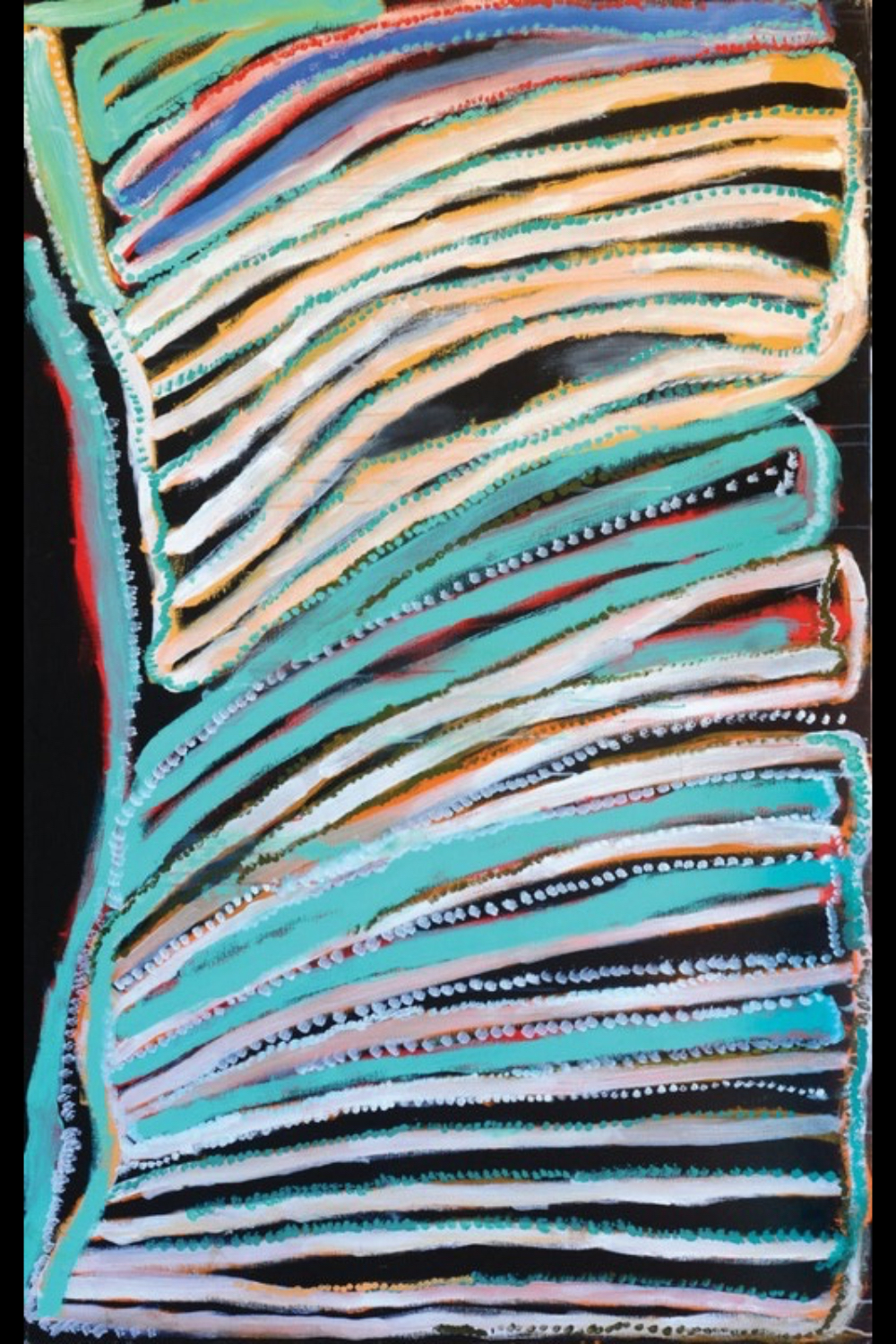
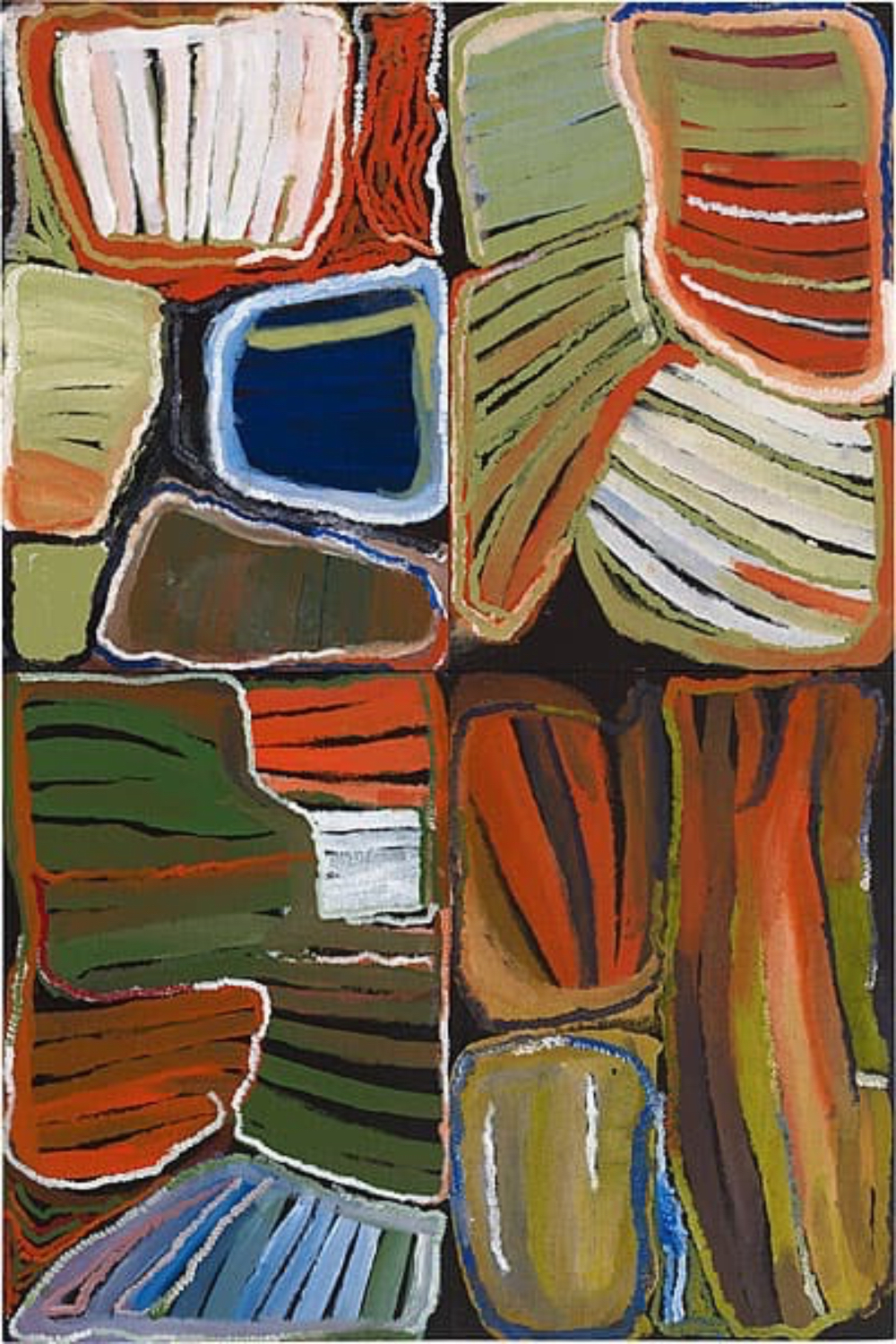
All the Jila, 2006 — Living Waterholes
All the Jila is Billycan’s most celebrated painting. Comprising eight adjoining panels, it depicts the living waters of Ilyarra Country near Well 33 on the Canning Stock Route.
In the Great Sandy Desert, jila are permanent water sources associated with powerful ancestral beings. They are places of physical sustenance, but also of ceremonial responsibility and spiritual significance.
Billycan explained that a quiet snake inhabits the living water and may rise or travel to bring rain. Through song, knowledgeable people maintain their relationship with this ancestral presence.
The painting’s interconnected panels convey the abundance and complexity of these water places. Patrick Hutchings compared the arrangement to a musical or choreographic sequence, in which individual forms contribute to the rhythm of a larger composition.
Acquired by the National Gallery of Australia in 2007, All the Jila became a central work in the inaugural Culture Warriors exhibition.
My Jila Country, 2006 — Remembered Waters
In My Jila Country, Billycan again returns to the living waterholes that sustained her childhood journeys through Ilyarra.
An accompanying Short St Gallery certificate preserves her spoken recollections of visiting particular waters. Although several place names in the transcription require further verification, the statement clearly expresses her familiarity with these places.
Rather than presenting the waterholes as distant geographical subjects, Billycan speaks of places she had visited and known personally.
The painting illustrates how her art combines detailed memories of the desert with the ancestral importance of its waters. Each location forms part of a larger network of places linked through family, movement and ceremonial knowledge.
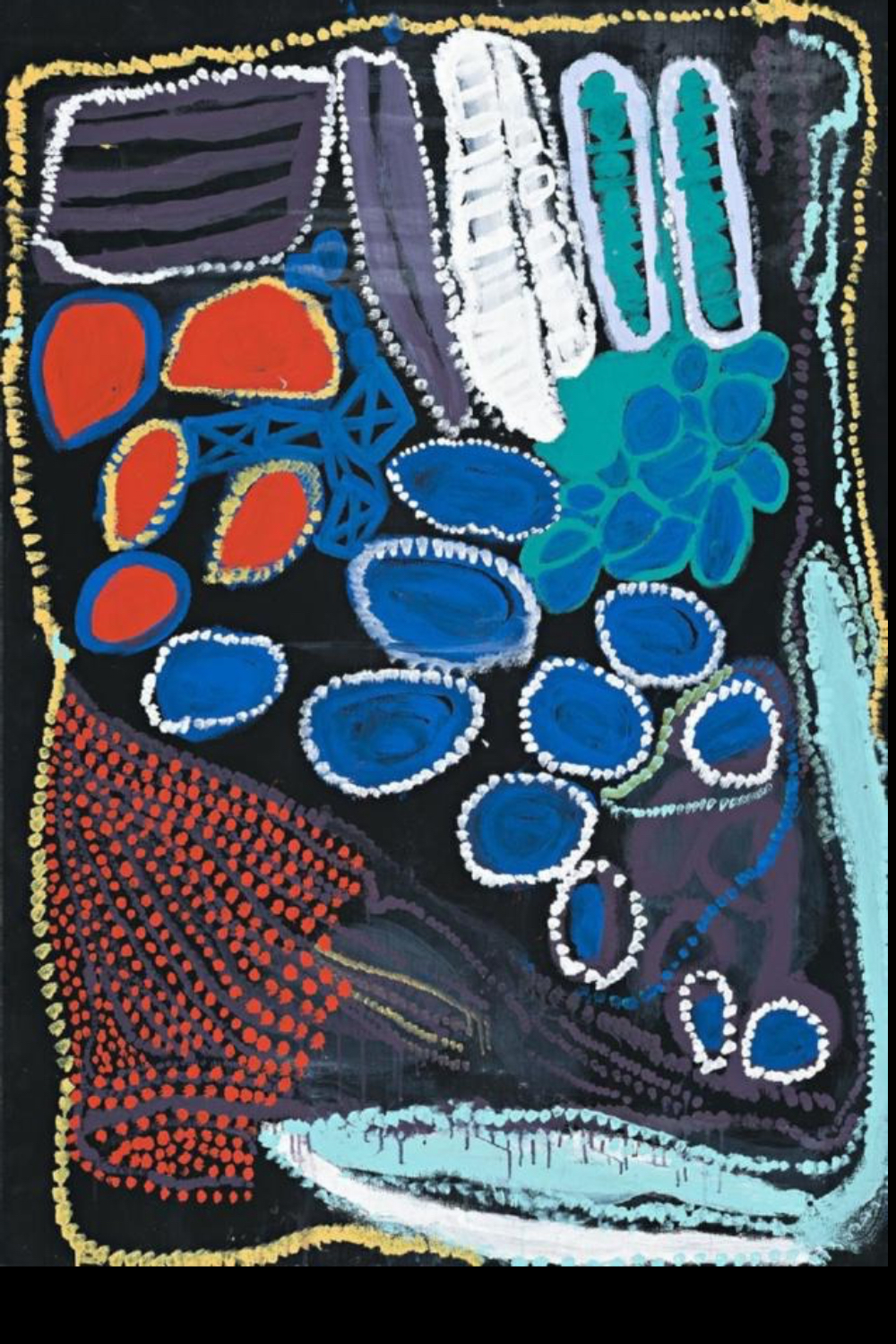
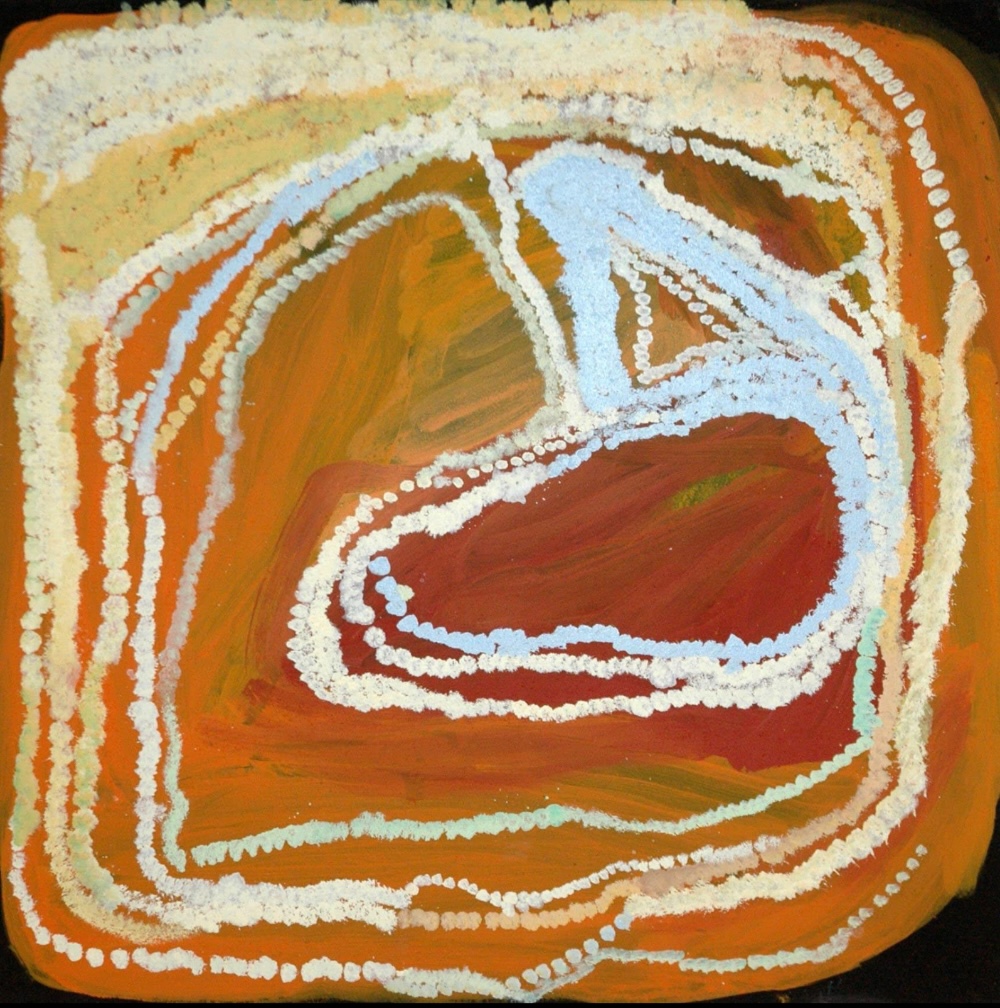
Kirrwirri & Dodo — Childhood Journeys
Kirrwirri & Dodo is especially revealing because Billycan’s accompanying statement describes memories of travelling with her parents.
She recalls the good water at Kiriwirri and the family’s journey towards Dodo. Her account includes her father calling to her mother and her mother replying.
The painting is therefore concerned with more than two locations. It recalls movement through Country, family relationships and events remembered from childhood.
Such paintings are particularly important documents of Yulparija history. They preserve memories of a landscape Billycan knew intimately before her family moved to the coast.
Jan Billycan’s Values and Auction results
Works Offered at Auction: 83
Sale Rate: 75%
Highest Sale: $80,000 AUD
Median Sale Price: $4.500 AUD
Jan Billycan’s Importance and Public Collections
Jan Billycan’s importance lies in the originality with which she transformed personal memory, ancestral knowledge and traditional healing into contemporary painting. She was among the senior Yulparija artists who established Bidyadanga as an important centre of Aboriginal painting during the early 2000s, developing a distinctive artistic tradition separate from those of Papunya and Balgo.
Her work featured in major exhibitions including Culture Warriors (2007) at the National Gallery of Australia and Yiwarra Kuju: The Canning Stock Route (2010) at the National Museum of Australia. Her paintings are represented in several significant Australian public collections:
- National Gallery of Australia, Canberra: All the Jila (2006), a monumental eight-panel painting acquired in 2007.
- National Gallery of Victoria, Melbourne: All the jila (2006), acquired through the Felton Bequest in 2011, and Kirriwirri (2008), gifted in 2018.
- Queensland Art Gallery, Brisbane: Kirriwirri (2011), a three-panel painting acquired in 2011.
- Art Gallery of Western Australia, Perth: Kirriwirri (2011), purchased through the Leah Jane Cohen Bequest.
- Museum and Art Gallery of the Northern Territory, Darwin: Kirriwirri (2010), held in the Telstra Collection.
- National Museum of Australia, Canberra: Work represented in the Canning Stock Route Collection, documenting the cultural histories of Western Desert communities.
Jan Billycan Exhibitions
Jan Billycan’s paintings attracted national and international recognition within a few years of her beginning to paint in 2003. She held solo exhibitions in Melbourne, Sydney and Broome, while her work featured in major Australian museum exhibitions and exhibitions of Aboriginal art in Europe, Asia and the United States.
Selected Solo Exhibitions
- 2007 – Jan Billycan, William Mora Galleries, Melbourne.
- 2007 – Kirriwirri, Short St Gallery at Mary Place Gallery, Sydney.
- 2008 – Kirriwirri: Jan Billycan, Short St Gallery, Broome.
- 2009 – Jan Billycan, William Mora Galleries, Melbourne.
Selected Group Exhibitions
- 2003 – Manjyiljara, Short St Gallery, Broome.
- 2006 – Jan Billycan & Weaver Jack: Recent Paintings, William Mora Galleries, Melbourne.
- 2007 – Culture Warriors: National Indigenous Art Triennial, National Gallery of Australia, Canberra.
- 2007 – Winpa: Works by the Yulparitja Artists of Bidyadanga, Raft Artspace, Darwin.
- 2007 – Desert Heart, Nevill Keating Gallery, London.
- 2008 – From the Desert to Saltwater, Booker-Lowe Gallery, Houston, USA.
- 2010 – Yiwarra Kuju: The Canning Stock Route, National Museum of Australia, Canberra.
- 2012 – Deserts and Rivers: Aboriginal Art from Western Australia’s North, FORM Gallery, Perth.
- 2013 – My Country, I Still Call Australia Home, Gallery of Modern Art, Brisbane.
- 2014 – Dreamings: Arte Aborigena Australiana incontra de Chirico, Museo Carlo Bilotti, Rome, Italy.
Abie Loy Kemarre Value and Auction results
Works Offered at Auction: 261
Sale Rate: 40%
Highest Sale: $15,000 AUD
Median Sale Price: $1,600 AUD
To view individual select artworks along with dimensions provenance and sales prices please ivsit the Abie Loy Kemarre Value page (not yet constructed)
Public Collections
Abie Loy Kemarre’s work is represented in Australian and international collections including:
- Metropolitan Museum of Art, New York
- Art Gallery of South Australia, Adelaide
- National Gallery of Victoria, Melbourne
- University of Canberra Art Collection
- Seattle Art Museum, Seattle
- Musée des Confluences, Lyon
- Ishibashi Foundation / Bridgestone Museum of Art, Tokyo
- Adelaide University Art Collection
Further Reading
- Jane Raffan and Stéphane Jacob, Abie Loy Kemarre: Abstraction Lyrique, Éditions Arts d’Australie – Stéphane Jacob, Paris, 2013. Bilingual French-English monograph devoted to Abie Loy Kemarre, examining Bush Hen Dreaming, Bush Leaf, Sandhill Country, Awelye, abstraction and cultural continuity.
- Wally Caruana, Barbara Glowczewski, Pierre Grundmann, Stéphane Jacob, Jessica de Largy Healy and Arnaud Morvan, Aborigènes: Collections australiennes contemporaines du Musée des Confluences, Musée des Confluences / Fage Éditions, Lyon, 2008. Includes Abie’s work, with one of her paintings reproduced on the cover.
- Dreaming Their Way: Australian Aboriginal Women Painters, National Museum of Women in the Arts / Scala Publishers, 2006. Includes Abie Loy Kemarre alongside major Aboriginal women painters.
- Stéphane Jacob, Pierre Grundmann and Maia Ponsonnet, La peinture aborigène, Nouvelles Éditions Scala, 2012. Broader study of Aboriginal painting that includes Abie Loy Kemarre.
- David Cossey, Dreampower: Art of Contemporary Aboriginal Australia, Museum Art International, 1997. Includes Abie Loy Kemarre, pp. 26–28.
All images featured in this article are presented strictly for educational and informational purposes.
This website may include copyrighted material for which specific authorization has not been obtained from the copyright owner.
All such images are presumed to be the intellectual property of the respective artist or their estate, and are used in accordance with principles of fair dealing or fair use under applicable copyright law.