Minnie Pwerle: Biography, Painting Style and Importance
c. 1922–2006
Anmatyerre / Alyawarre
Atnwengerrp Country, Utopia
Utopia / Central Australia
Utopia Art / Western Desert Art
Painting on canvas
Minnie Pwerle was one of the most distinctive painters to emerge from Utopia in Central Australia. An Anmatyerre/Alyawarre woman associated with Atnwengerrp Country, she began painting seriously around 1999–2000, when she was already in her late seventies.
In the few years that followed, Minnie developed a highly individual style built around sweeping gestural lines, vivid colour and loosely painted circular forms. Her principal subjects were Awelye, women’s ceremonial body painting, and the Bush Melon and Bush Melon Seed Dreamings associated with her Country.
Unlike Emily Kame Kngwarreye, Gloria Petyarre and many other Utopia women, Minnie was not part of the batik movement that preceded the emergence of Utopia painting on canvas. She came directly to painting decades later, making her path to becoming a major Utopia artist quite different from that of the earlier generation of Utopia painters.
For individual artwork provenance size and auction results please see the support page Minnie Pwerle Value

Minnie Pwerle Biography
Minnie Pwerle was born around 1922 and belonged to Atnwengerrp Country in the Utopia region northeast of Alice Springs. Long before becoming a professional artist, her life was grounded in Country, family and the ceremonial knowledge that would later provide the foundation of her paintings.
Minnie was the mother of Barbara Weir, who had been removed from her Utopia family as a child and spent many years away from her mother and Country. Barbara eventually returned to Utopia and became an important artist in her own right, working first in batik and later developing her distinctive My Mother’s Country and Grass Seed paintings.
Unlike Barbara, Emily Kame Kngwarreye, Gloria Petyarre and many other Utopia women who became involved in batik before moving onto canvas, Minnie came to painting remarkably late and was not part of the earlier Utopia batik movement. Auction catalogues repeatedly state that she began painting her Atnwengerrp Country and its associated Dreamings in earnest at about 77 years of age, around 1999–2000. Barbara, already an established artist by this time, is widely credited in accounts of Minnie’s career with encouraging her mother to paint.
Her career developed rapidly. Dacou Gallery was particularly prominent among the provenance of important early paintings, while Flinders Lane Gallery, Aboriginal Gallery of Dreamings, Fire-Works Gallery and Ironwood Arts also handled her work. Many surviving paintings retain catalogue numbers and certificates, and some are accompanied by photographs showing Minnie holding, signing or creating the work.
Minnie continued painting until shortly before her death in 2006. The mature body of work for which she became famous was therefore created almost entirely during the final seven years of her life, making her rapid emergence particularly remarkable within the history of Utopia art.
Minnie Pwerle Painting Style
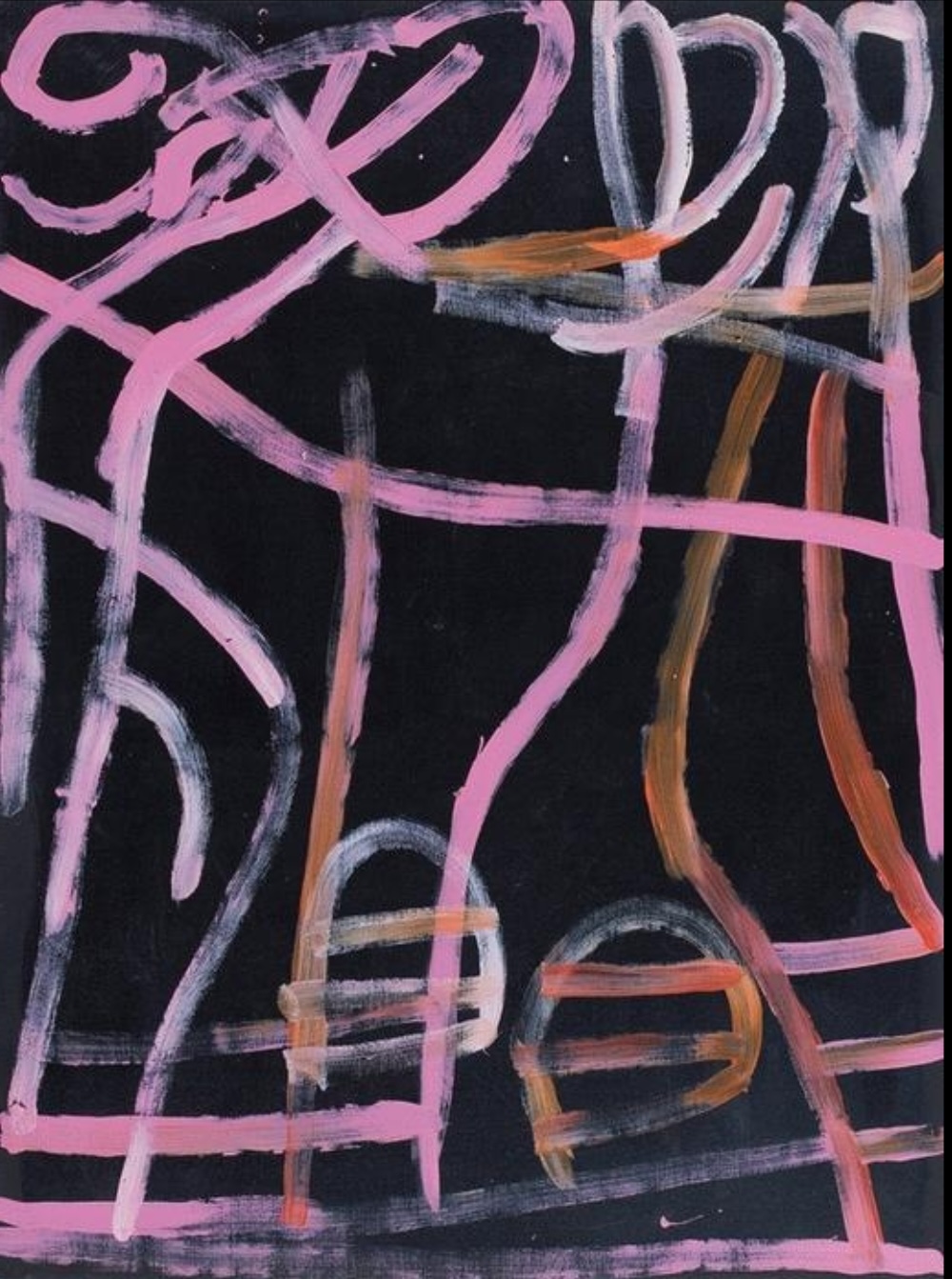
Minnie Pwerle’s style is characterised by gesture, rhythm and movement. Broad irregular lines sweep across the surface, changing direction and crossing one another, while other paintings employ loosely formed circles, curved shapes, short strokes and repeated areas of colour.
Her brushwork can appear remarkably spontaneous. Lines vary from thick to thin and from continuous to broken, frequently overlapping in combinations of white, black, red, yellow, orange, green, blue, pink and purple. The result is very different from the carefully controlled fields of dots commonly associated with some forms of Western Desert painting.
In some paintings Minnie reduced the composition almost entirely to gesture. A monumental 2002 Awelye Atnwengerrp, measuring 165 × 360 cm, is dominated by powerful lines in white, green and magenta, with only minimal reference to the breast designs and melon seeds found elsewhere in her work.
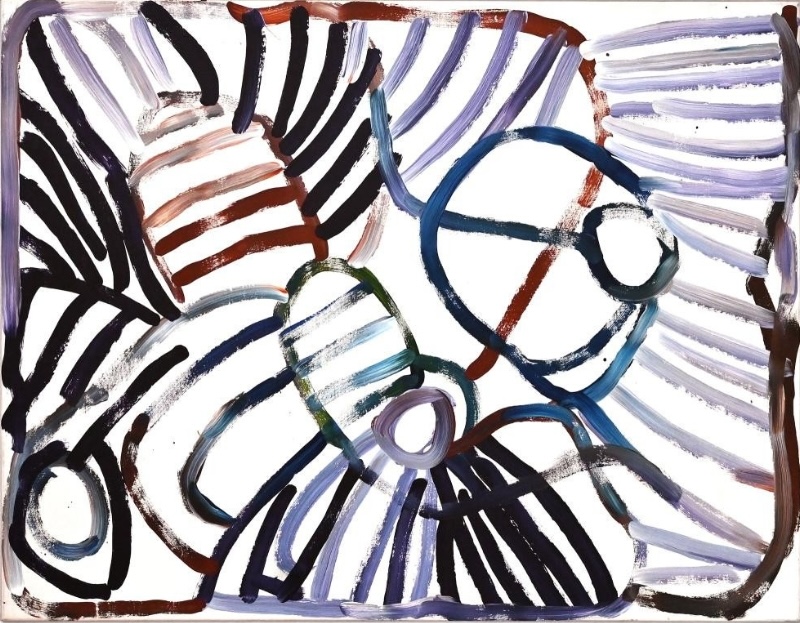
Scale could intensify this physical quality. Minnie painted canvases exceeding three metres in width, four-panel Awelye compositions extending to approximately 3.6 metres and a five-part Bush Melon Series measuring more than five metres overall.
Her paintings are sometimes compared with those of Emily Kame Kngwarreye because of their gestural freedom and shared connection with Utopia. The comparison is useful visually, but Minnie’s subjects and resulting imagery remained distinctly her own.
Minnie Pwerle Painting Subjects
The central subject of Minnie Pwerle’s art is Atnwengerrp Country and the women’s ceremonial and bush-food knowledge associated with it.
Awelye – Women’s Ceremony
Awelye encompasses women’s ceremony, song, dance and body painting. During ceremony, lines and patterns are painted across women’s upper bodies while songs are performed. The designs are therefore part of a living ceremonial practice rather than simply decorative patterns.
Auction documentation describes Awelye ceremonies as encouraging Country towards growth and abundance. Ceremonial poles known as Kwurraparra may be decorated with white cockatoo feathers, while participants can wear clusters of feathers secured with hair-string. Minnie’s sweeping linear paintings translate aspects of these ceremonial body designs onto canvas.
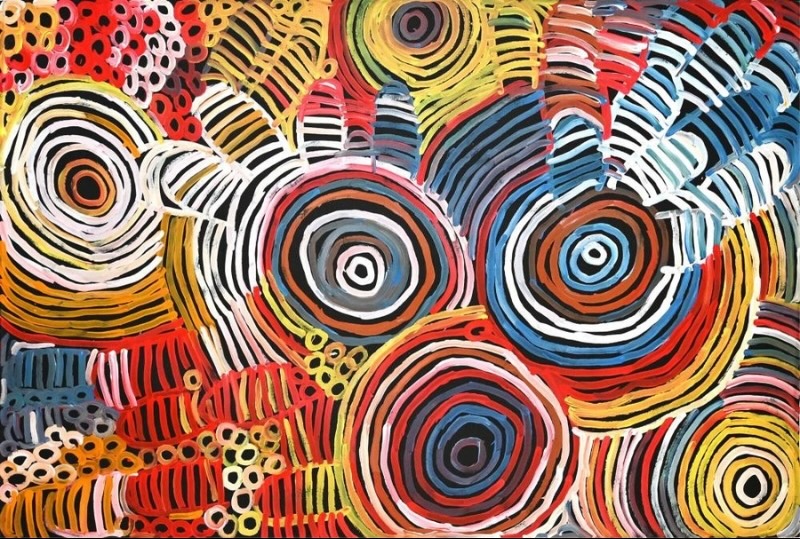
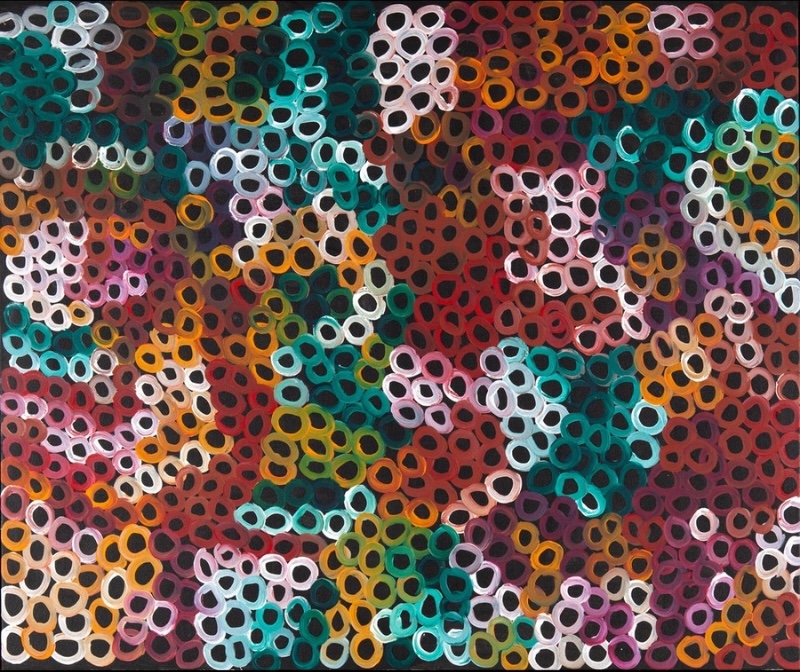
Bush Melon and Bush Melon Seed
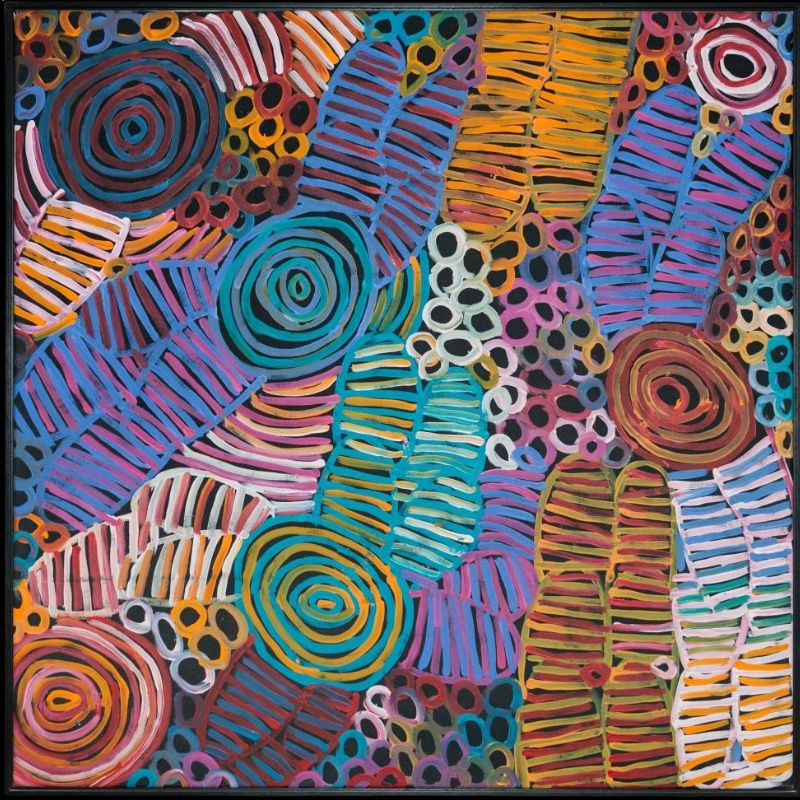
Bush Melon and Bush Melon Seed are equally important subjects and frequently appear together with Awelye imagery. The fruit had practical importance: it was gathered by women and could be eaten fresh or cut into pieces, skewered onto wood and dried for periods when bush foods were scarce.
Circular, curved and seed-like forms can coexist with the broad linear marks associated with body painting. Paintings titled Awelye, Bush Melon & Bush Melon Seed demonstrate that these elements were not separate styles but could be combined within a single composition.
Minnie’s recorded subjects also include Bush Tomato, Bush Orange Dreaming, Anemangkerr – Desert Melons, Body Paint, Body Design, My Country and Aldappa Dance Lines, showing that her subject matter extended beyond the better-known Awelye and Bush Melon paintings.
Importance of Minnie Pwerle
Minnie Pwerle’s importance lies partly in the extraordinary speed with which a distinctive body of work emerged so late in her life. Within only a few years she moved from being virtually unknown as a painter to becoming one of the most recognisable artists associated with Utopia.
Her uninhibited brushwork, irregular lines, intense colour and open gesture gave her paintings an appearance quite different from the fine dotting and tightly controlled pattern often associated with Western Desert art. Sonia Heitlinger, who gave Minnie her first solo exhibition at Flinders Lane Gallery in 2000, particularly admired her freedom of expression, inventiveness and courageous use of colour.
Other commentators have emphasised the gestural quality of her work. Jenny Green placed Minnie within the tradition of “gestural abstractionism” associated with Emily Kame Kngwarreye, while artist and curator Michael Eather compared the expressive qualities of Minnie and Emily with Australian abstractionist Tony Tuckson, drawing attention to their reliance on gesture, intuition and raw expression.
Yet Minnie’s apparent abstraction remained firmly grounded in Atnwengerrp Country and women’s cultural knowledge. Museum interpretations have connected the rhythm and movement of her lines with women singing and dancing during Awelye, while individual marks relate to designs painted on women’s bodies during ceremony.
This combination of extraordinary spontaneity and deep cultural continuity is central to Minnie’s importance. Her paintings can appear strikingly contemporary and abstract, but their energy comes from subjects deeply connected to Country, ceremony and bush foods. In a career lasting only a few years, Minnie created an immediately recognisable visual language and demonstrated the remarkable individuality and diversity possible within Utopia painting.
Minnie Pwerle Value and Auction results
Works Offered at Auction: 678
Sale Rate: 69%
Highest Sale: $65,000 AUD
Median Sale Price: $4,000 AUD
To view individual select artworks along with dimensions provenance and sales prices please ivsit the Minnie Pwerle Value page
Minnie Pwerle in Public Collections
Minnie Pwerle’s work is represented in major Australian public collections, including:
- National Gallery of Victoria, Melbourne
- Art Gallery of New South Wales, Sydney
- Queensland Art Gallery | Gallery of Modern Art, Brisbane
- Art Gallery of South Australia, Adelaide
- Art Gallery of Western Australia, Perth
- Bendigo Art Gallery, Victoria
- University of Canberra Art Collection, Canberra
- Artbank, Sydney
Further Reading
- Minnie Pwerle — dedicated publication on Minnie Pwerle and her paintings.
- Minnie Pwerle — illustrated publication exploring the artist and her work.
- Lisa Congdon, A Glorious Freedom: Older Women Leading Extraordinary Lives (Chronicle Books, 2017) — includes a profile of Minnie Pwerle and her emergence as an artist late in life.
All images featured in this article are presented strictly for educational and informational purposes.
This website may include copyrighted material for which specific authorization has not been obtained from the copyright owner.
All such images are presumed to be the intellectual property of the respective artist or their estate, and are used in accordance with principles of fair dealing or fair use under applicable copyright law.