
Angelina Pwerle: Biography, Painting Style and Importance
c. 1946–
Anmatyerre
Ahalpere Country, Utopia
Utopia / Central Australia
Utopia Art / Western Desert Art
Batik, sculpture and painting on canvas
Angelina Pwerle is a senior Anmatyerr artist from the Utopia region of Central Australia, best known for her extraordinary Bush Plum paintings. Her artistic career developed from the Utopia women’s batik movement and the transition to painting on canvas during the late 1980s.
Her principal subject is Anwekety, the Bush Plum Dreaming associated with Ahalpere, her father’s and grandfather’s Country. Over several decades she transformed this subject into dense fields of minute marks that evoke rain, flowers, ripening fruit, ceremony and the changing appearance of Country.
Although Bush Plum dominates her mature work, Angelina’s practice has been remarkably varied. She has produced batik, painted wooden sculpture, figurative paintings of ancestral beings, women’s ceremony, bush foods and medicine, and works concerned with historical encounters between Aboriginal people and European settlers.
Today her paintings are held in major Australian and international collections.
For individual artwork provenance size and auction results please see the support page Angelina Pwerle Value artworks and auction results
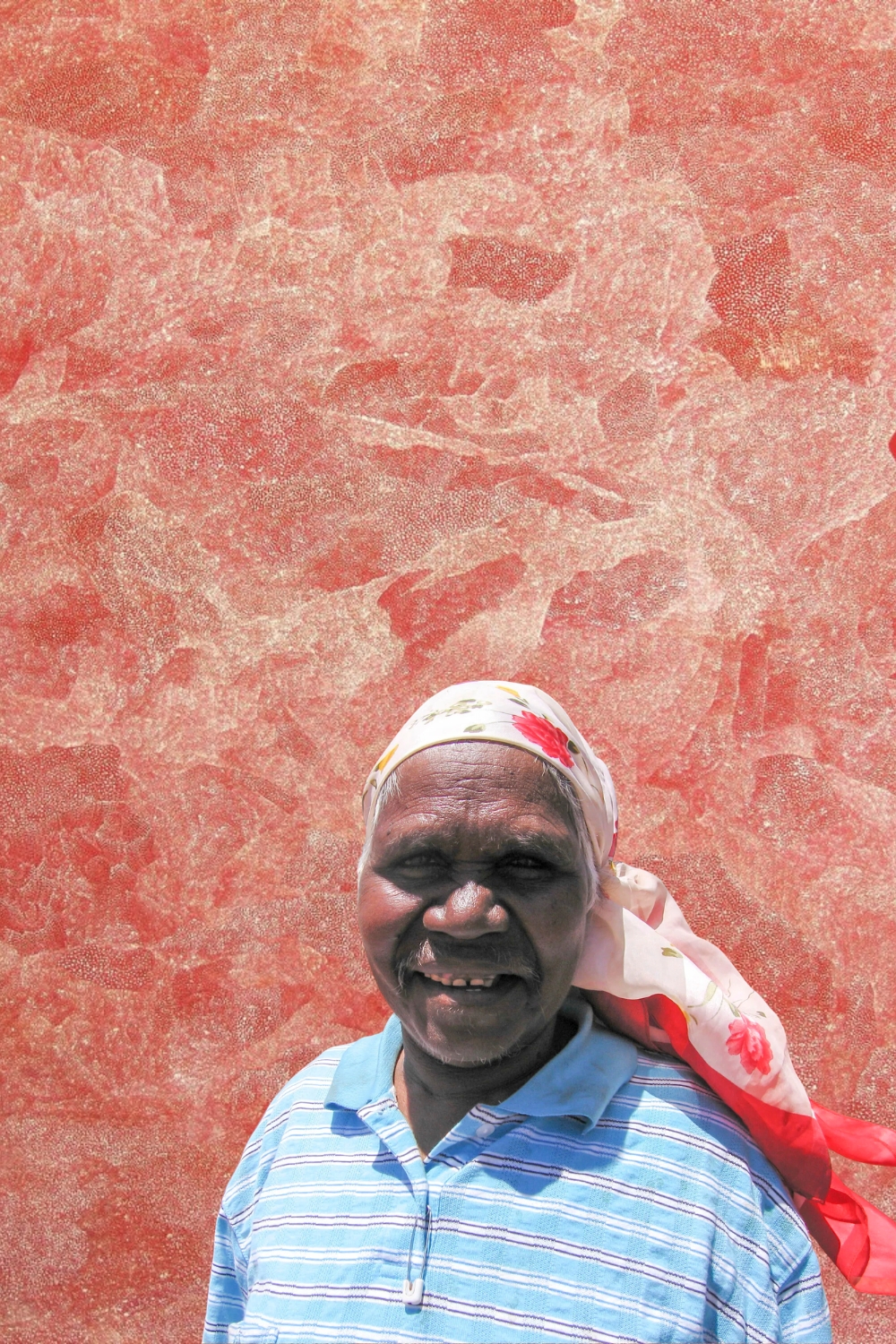
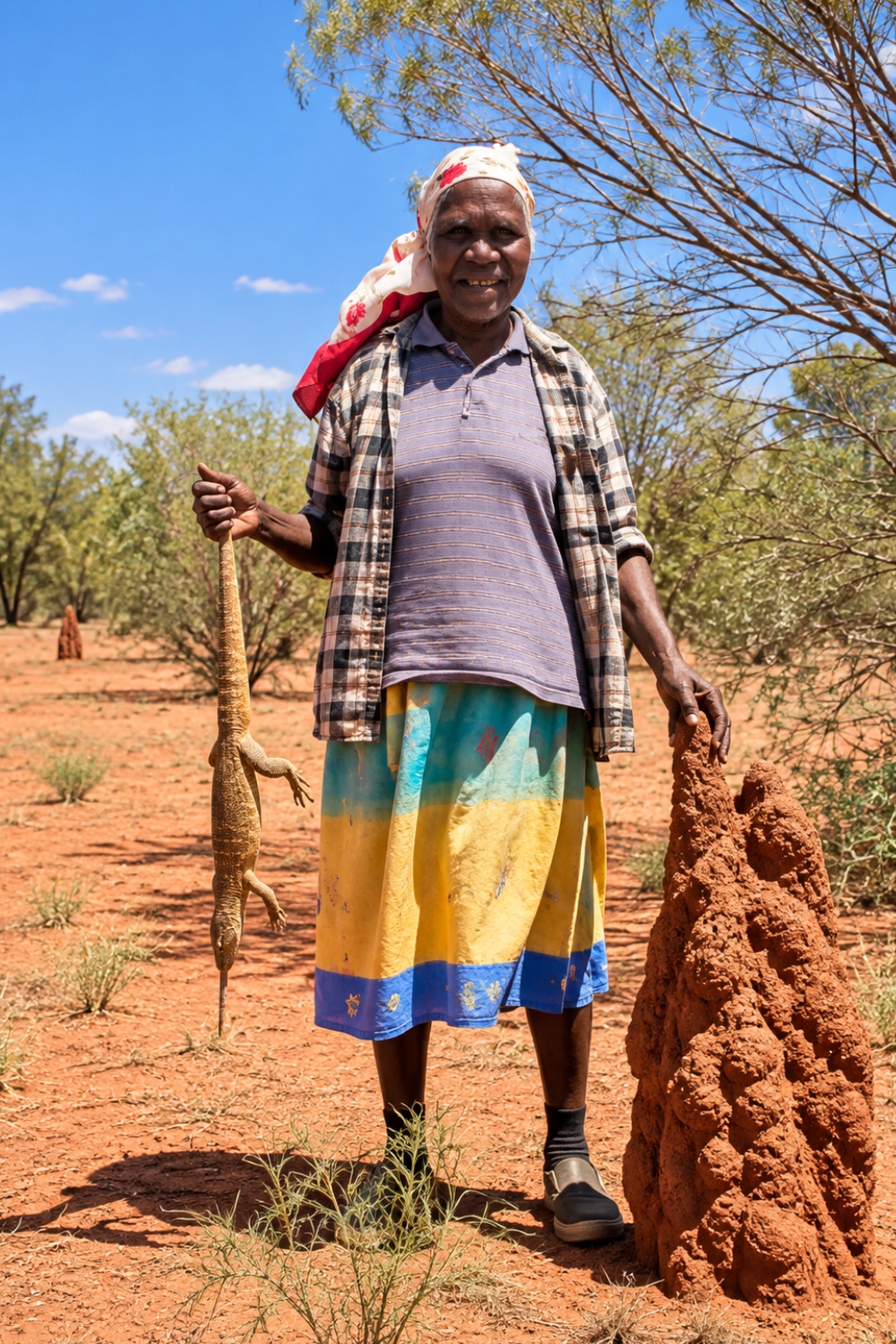
Angelina Pwerle Biography
Angelina Pwerle was born at Utopia in Central Australia, although published sources give conflicting dates for her birth. She is an Anmatyerr woman and the sister of artists Polly Ngale and Kathleen Ngale. Her mother is recorded as Nellie Petyarr, while her husband, Louis Pwerl, was also an artist and sculptor.
Angelina grew up with the songs, ceremonies and knowledge associated with her Country. Of particular importance is Ahalpere, her father’s and grandfather’s Country, and Anwekety, the Bush Plum Dreaming that would eventually become the defining subject of her painting.
Her public artistic career began through the Utopia women’s batik movement. Angelina and her sisters Polly Ngale and Kathleen Ngale were among the women producing batik alongside artists including Emily Kame Kngwarreye, Gloria Petyarre and Ada Bird Petyarre. During the landmark 1988–89 CAAMA Summer Project, Angelina joined other Utopia women in transferring designs grounded in Country and cultural knowledge to canvas, helping establish one of the most important movements in contemporary Aboriginal art.
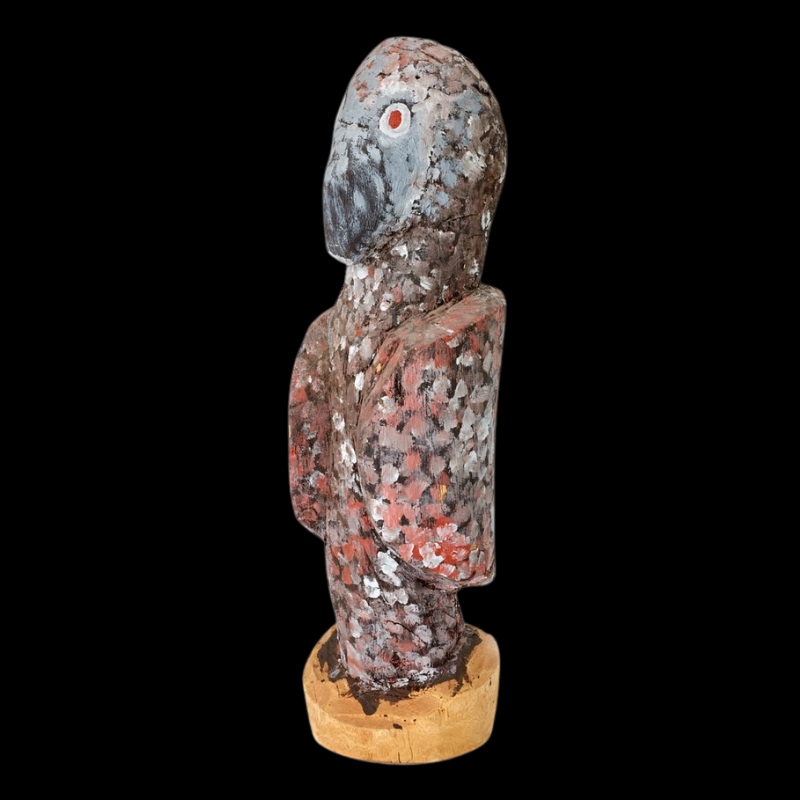
Painting was not her only early medium. Angelina also developed a distinctive practice in painted wooden sculpture. During the 1990s she created ancestral figures and animals, including Kula Kul (Night Owl), Town Puppy, Ancestor Flower Man and Bush Raisin Man. Several were included in her early solo exhibitions at Niagara Galleries.
By the mid-1990s Bush Plum had become increasingly central to her painting. Her first Niagara Galleries solo exhibition was held in 1996, and the subject developed over subsequent decades into the highly refined paintings for which she is now internationally recognised.
Angelina Pwerle Painting Style and Techniques
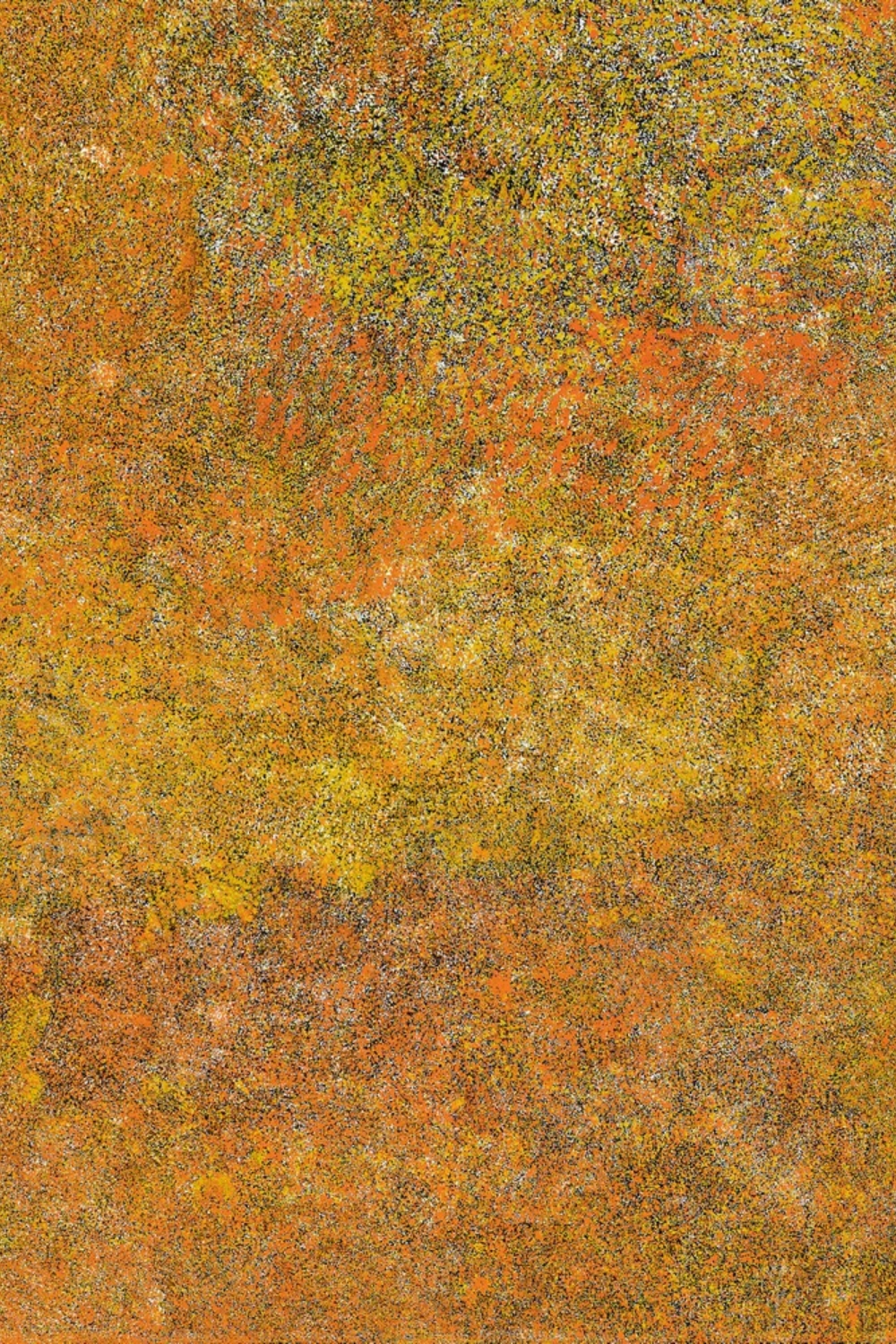
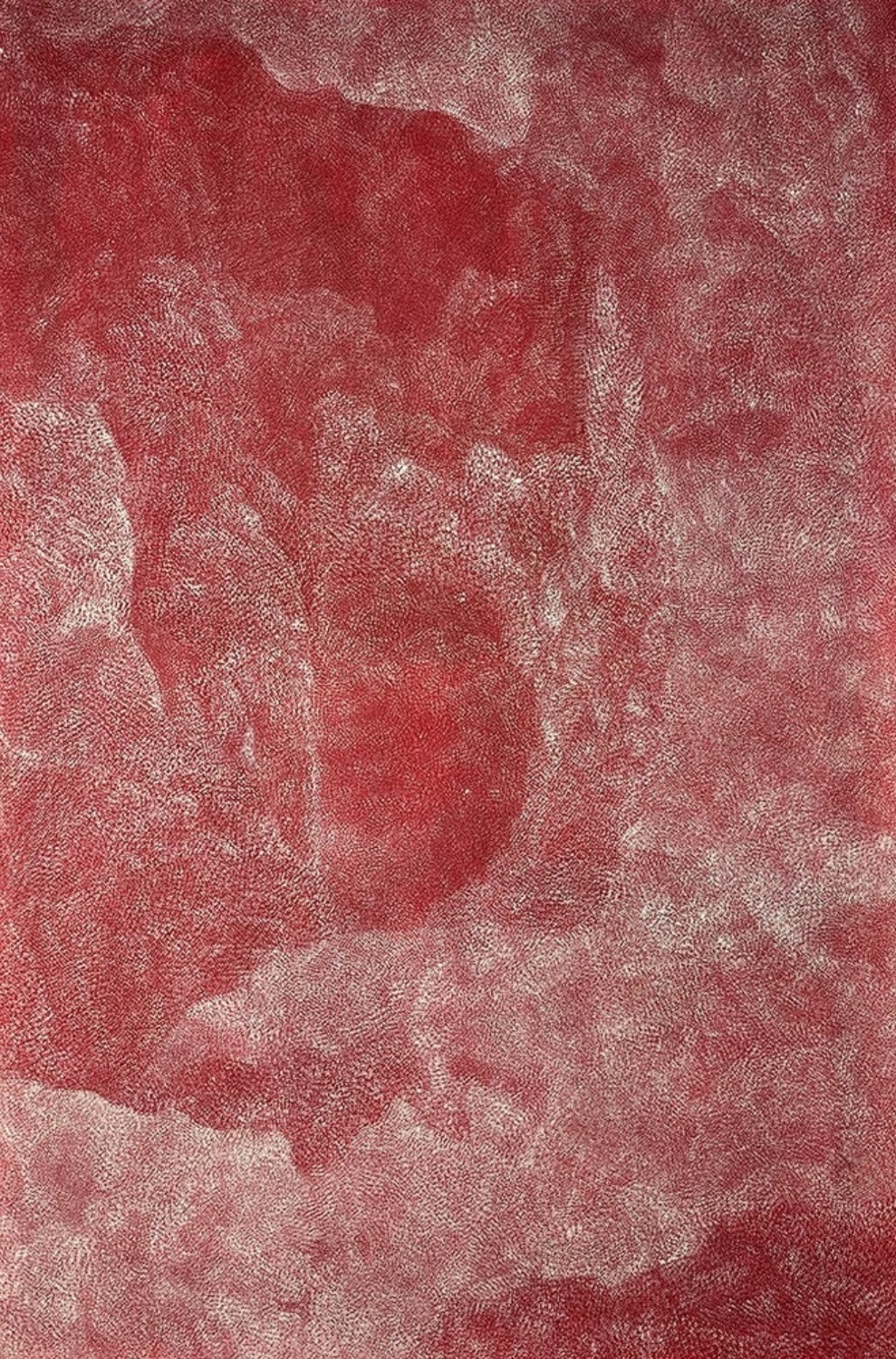
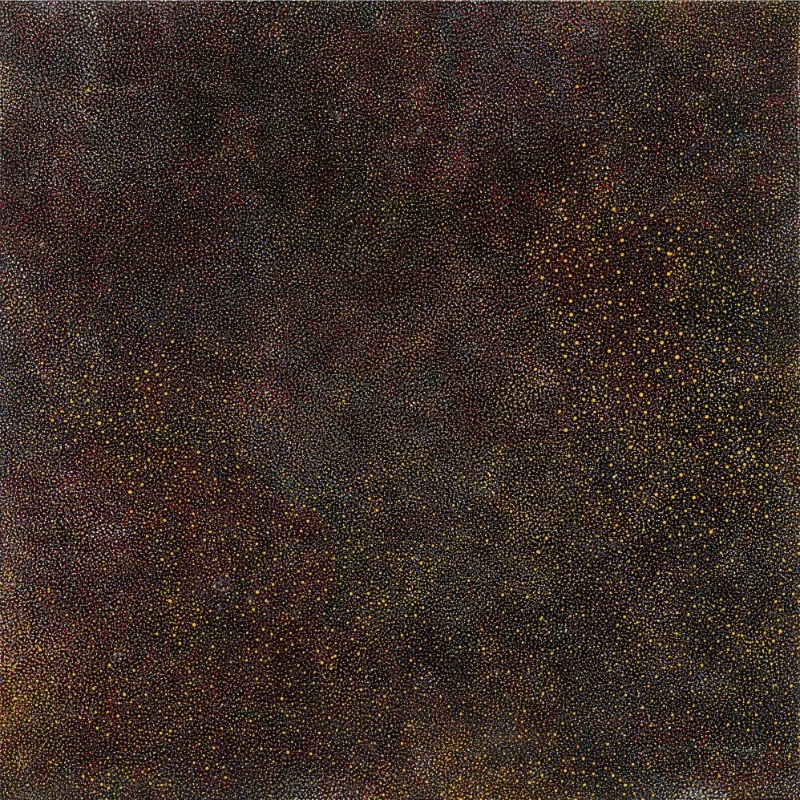
Angelina Pwerle’s mature paintings are constructed from thousands of tiny marks extending across the surface. Rather than creating a dominant central image, she builds all-over fields in which changes in density, colour and direction produce movement and depth.
Her technique goes well beyond conventional ideas of Aboriginal “dot painting”. She has used pointed sticks and bundles of fine sticks to repeatedly apply paint, producing marks that can be extraordinarily small. Built over dark grounds, these marks create surfaces that seem to shift as the viewer’s eye moves across them. Auction catalogues describe the effect as one of intense fine mark-making over a dark ground, creating both movement and considerable visual depth.
Curator Nici Cumpston has described the resulting surface as “subtly textured” and “shimmering”, while writer Patrick Witton has characterised the paintings as a “constellation of minute dots”. The descriptions capture an important aspect of Angelina’s work: individual marks almost disappear when the painting is viewed as a whole, becoming part of a much larger field.
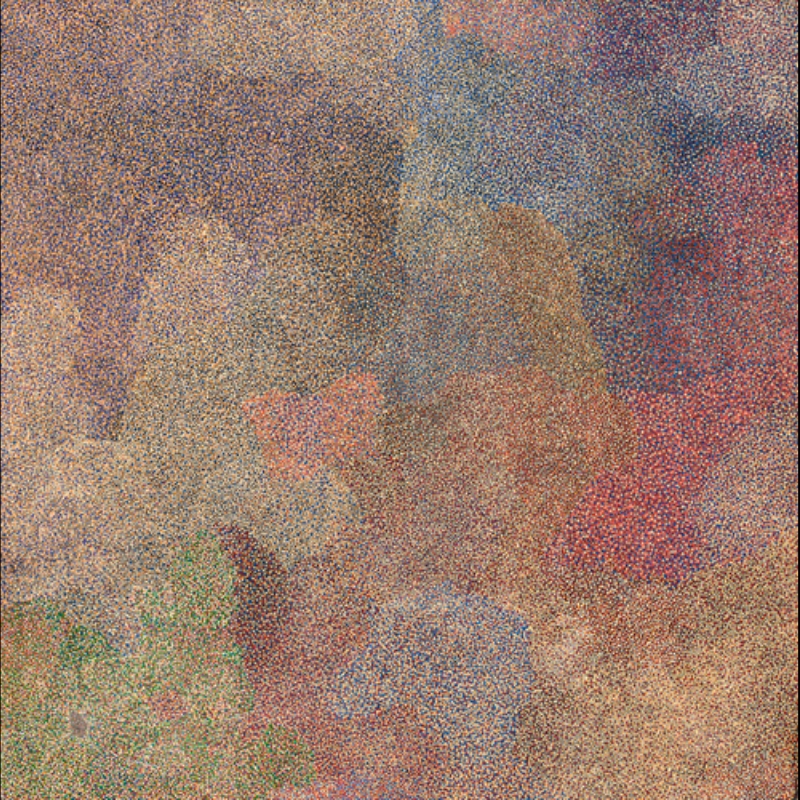
Colour can also carry meaning. A Delmore Gallery certificate for a 1997 Anookitja (Bush Plum) explains that different colours within Angelina’s dot work indicate different degrees of ripeness of the Bush Plum fruit.
Her earlier paintings frequently employ numerous colours, reflecting the extraordinary changes that follow rain in the desert — greens, flowers, fruit and new growth. Later works often became more restrained, sometimes reducing the palette to minute pale marks against black, red or other dark grounds.
Anne Marie Brody has described these mature paintings as “sensate abstractions” of Ahalpere. Although their immense fields of marks can suggest stars, galaxies or microscopic worlds to an outside viewer, their subject remains terrestrial: Country, its plants, seasons, places and ancestral presence.
Angelina Pwerle Painting Subjects
Anwekety, the Bush Plum, is Angelina Pwerle’s principal subject. It is both an important desert food and an inherited Dreaming associated with Ahalpere Country.
Bush Plum responds rapidly to rain. Flowers appear and fruit develops and ripens, transforming both the appearance of the plant and the surrounding Country. Angelina’s paintings can encompass this complete seasonal cycle rather than simply depicting the fruit itself. Different colours can signify stages of ripeness, while fields of marks can evoke flowers, vegetation and the abundance that follows rain.
Bush Plum is also inseparable from ceremony. A Delmore Gallery account describes Angelina and her sisters Polly and Kathleen covering their upper bodies with emu oil and ochre designs associated with Anwekety before dancing and singing its Awelye. These ceremonies concern the continuing vitality and productivity of the Bush Plum.
This helps explain why paintings titled Bush Plum, Bush Plum Awelye and Anookitja should not be interpreted simply as pictures of a plant. They bring together Country, food, rain, ceremony, ancestral inheritance and knowledge accumulated through generations.
Angelina has also painted Women’s Ceremony, Awelye, ancestral spirits, bush foods and bush medicine. Auction records document titles including Women’s Ceremony, Ancestral Spirits, Ancestors, and Bush Plants / Bush Medicine.
Her figurative work extended into painted wooden sculpture, while a less familiar group of paintings from the late 1990s dealt with historical encounters and conflict between Aboriginal people and European settlers. These works demonstrate that the familiar Bush Plum paintings represent only one, albeit dominant, aspect of a much broader artistic career.
Importance of Angelina Pwerle
Angelina Pwerle occupies an important position within the generation of Utopia women who transformed Australian Aboriginal art from the late twentieth century onwards. She emerged from the same remarkable artistic environment as Emily Kame Kngwarreye, Gloria Petyarre, Kathleen Petyarre and other major Utopia painters, yet developed a visual language that is unmistakably her own.
National Gallery of Australia director Nick Mitzevich has described the development of her practice as “extraordinary”, observing that she refined Central Desert dotting to create abstract visions distinct from those of her contemporaries.
That individuality is particularly apparent in her mature Bush Plum paintings. The extraordinary smallness of the marks, their accumulation across the entire canvas, the absence of a dominant centre and her increasingly restrained use of colour distinguish her work even among the many artists associated with Utopia.
Her significance also lies in the breadth and development of her career. Batik, painted sculpture, ancestral figures, Women’s Ceremony, bush foods, historical narratives and early figurative paintings preceded or existed alongside the mature Bush Plum works. Her career therefore represents a continuing process of experimentation rather than the repetition of a single successful style.
Anne Marie Brody has compared the achievement of Angelina’s mature paintings with the late work of Rothko and Monet, describing them as “deep crystallizations at the far frontier of creative endeavor.” The comparison reflects the increasingly international context in which Angelina’s work is now viewed: as both an expression of Anmatyerr cultural knowledge and an important contribution to contemporary abstraction.
Yet Angelina’s own explanation is ultimately more revealing than comparisons with Western abstraction:
“My Bush Plum paintings represent the whole thing: all of Country.”
The apparent simplicity of the Bush Plum subject therefore conceals the extraordinary breadth of what the paintings contain — Country, ancestral inheritance, ceremony, rain, flowers, food, memory and seasonal renewal.
Angelina Pwerle Artwork Values
Works Offered at Auction: 134
Sale Rate: 69%
Highest Sale: $130,000 AUD
Median Sale Price: $3,200 AUD
For individual artworks sizes provenance and details please see the Angelina Pwerle Value page
Angelina Pwerle in public collections
Angelina Pwerle’s work is held in major public collections in Australia and internationally, including:
- National Gallery of Australia, Canberra
- National Gallery of Victoria, Melbourne
- Art Gallery of New South Wales, Sydney
- Art Gallery of South Australia, Adelaide
- Queensland Art Gallery | Gallery of Modern Art, Brisbane
- Art Gallery of Ballarat, Victoria
- Benalla Art Gallery, Victoria
- TarraWarra Museum of Art, Victoria
- Artbank, Australia
- Australian National University Art Collection, Canberra
- The Metropolitan Museum of Art, New York, USA
- Fine Arts Museums of San Francisco, USA
- Holmes a Court Gallery
- National Museum of Art, Osaka, Japan
The National Gallery of Australia holds multiple works, including Body Paint (2002), while the National Gallery of Victoria collection includes Awely (1996), Whitefella killing blackfella (1998) and Plum Dreaming (1999).
Further reading
- Angelina Pwerle, Niagara Publishing / Niagara Galleries, Melbourne, 2005.
- Anne Marie Brody, Marking the Infinite: Contemporary Women Artists from Aboriginal Australia, DelMonico Books / Prestel, 2016.
- Angelina Pwerle, exhibition catalogue, Niagara Galleries, Melbourne, 2001.
- Bush Plum: The Contemporary Art of Angelina Pwerle, documentary film, Creative Cowboy Films, 2012.
- Marking the Infinite: Contemporary Women Artists from Aboriginal Australia, exhibition catalogue and associated essays, 2016–2019.
All images featured in this article are presented strictly for educational and informational purposes.
This website may include copyrighted material for which specific authorization has not been obtained from the copyright owner.
All such images are presumed to be the intellectual property of the respective artist or their estate, and are used in accordance with principles of fair dealing or fair use under applicable copyright law.