
Ginger Riley Munduwalawala
c. 1936–2002
Marra
Yulru, near Wamungu, Limmen Bight River, Northern Territory
Ngukurr / Borroloola
Contemporary Aboriginal Art / Ngukurr Art
Ngukurr Artists / Alcaston Gallery
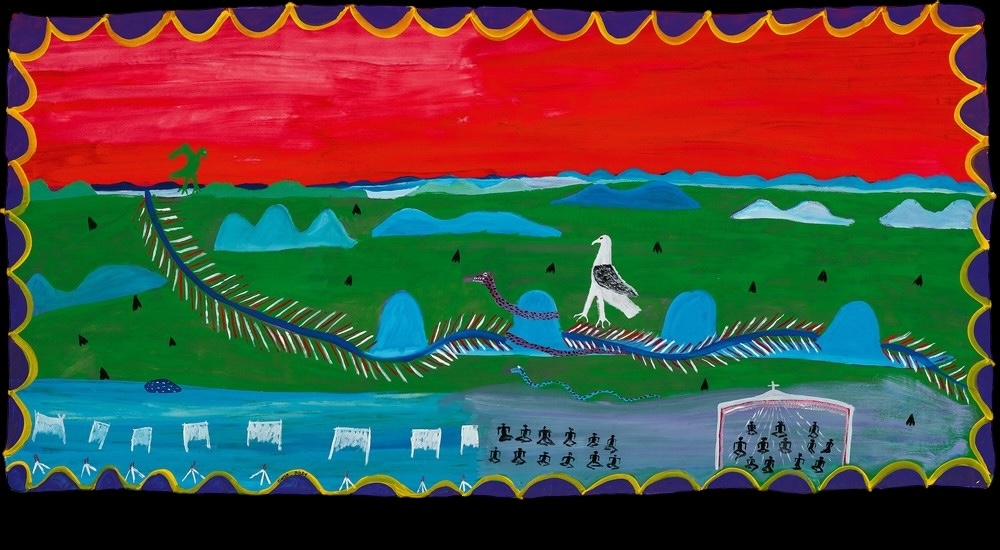
Ginger Riley Munduwalawala (c. 1936–2002) was one of Australia’s most original contemporary Aboriginal landscape painters. A Marra man from south-eastern Arnhem Land, he developed an unmistakable style of brilliant colours, sweeping rivers, stylised hills and ancestral figures representing his mother’s Country around the Limmen Bight River.
His paintings feature the distinctive Four Archers rock formations alongside ancestral beings including Ngak Ngak(white-breasted sea eagle), Garimala (ancestral snake) and Bulukbun (fire-breathing serpent). These figures inhabit expansive landscapes viewed from extraordinary perspectives, often appearing as though seen from above.
Inspired by Albert Namatjira, Riley began painting professionally around 1986–1987, when he was approximately 50 years old.
Within a decade, he had transformed expectations of contemporary Aboriginal art. In 1997, the National Gallery of Victoria presented a major retrospective of his work, making him the first living Aboriginal artist to receive such recognition at the institution.
His extraordinary command of colour earned him the description “the boss of colour”, a tribute from Australian expressionist painter David Larwill.
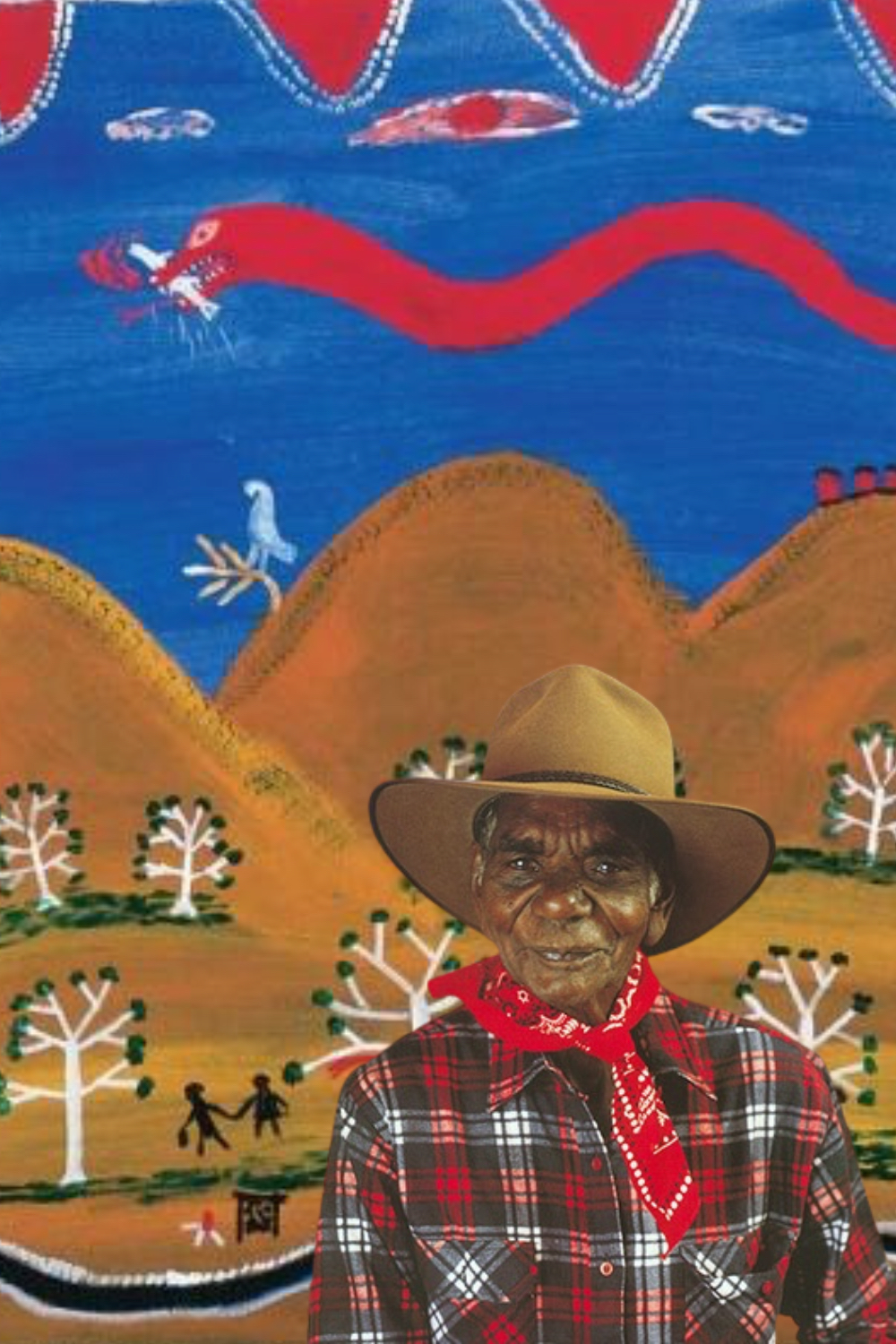
Ginger Riley Munduwalawala Biography
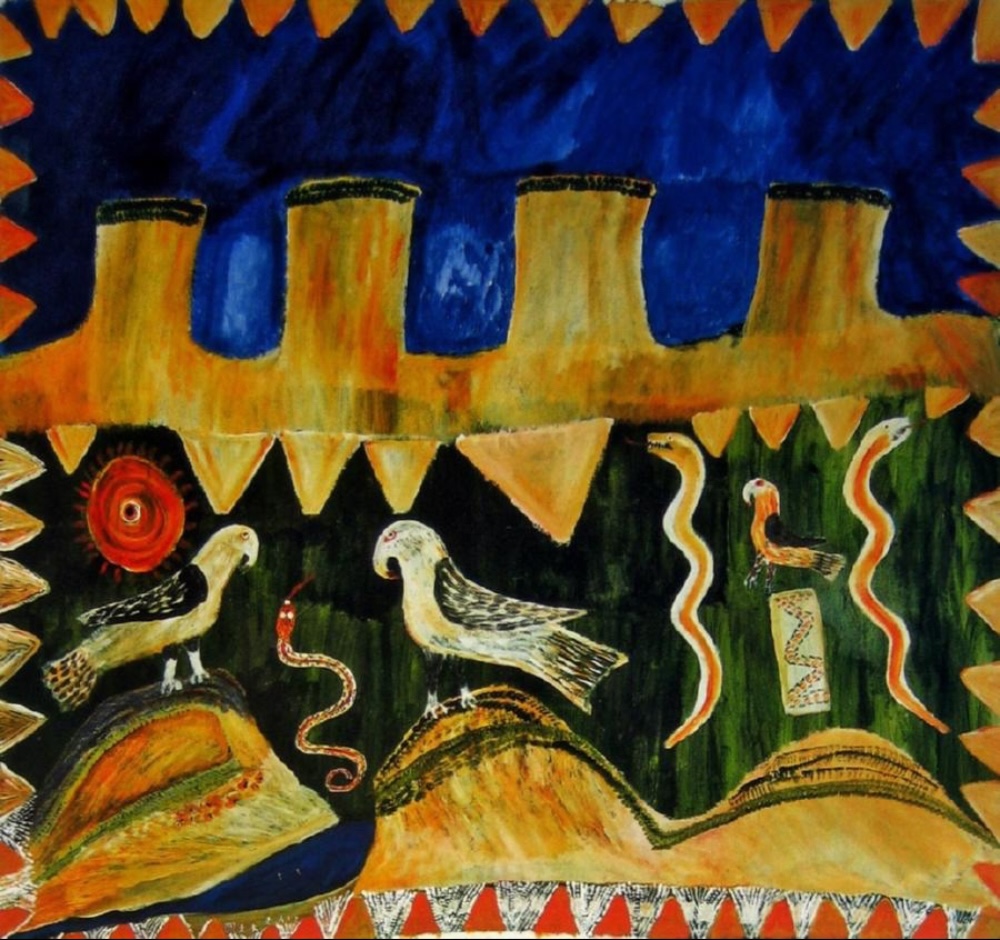
Early Life and Marra Country
Ginger Riley was born around 1936 at Yulru, near Wamungu on the Limmen Bight River in south-eastern Arnhem Land. Some historical records give his birth year as approximately 1937 or 1939.
He belonged to the Marra people, whose traditional lands extend across the coastal country of the southwestern Gulf of Carpentaria.
His mother died when he was an infant, and his family subsequently moved to the Anglican Roper River Mission, later known as Ngukurr.
Although his father sent him to the mission school, Riley preferred life outside the classroom. He watched his father and grandfather decorate weapons and utensils with natural ochres and later acquired knowledge of ceremonial body painting through initiation.
Riley held responsibilities as djungkayi (custodian or ceremonial caretaker) for his mother’s Country, including the ancestral places surrounding the Limmen Bight River and the Four Archers. These inherited responsibilities would eventually form the foundation of his artistic career.
Working as a Stockman and Meeting Albert Namatjira
During the early 1950s, Riley began working as a stockman at Nutwood Downs Station, part of the extensive Vestey pastoral operations in the Northern Territory.
He subsequently worked at other stations and undertook various labouring jobs across northern Australia, including employment in Darwin and on Groote Eylandt.
Around 1957, while travelling to Alice Springs with a station employer, he encountered the celebrated Arrernte watercolourist Albert Namatjira.
Namatjira’s paintings demonstrated that Aboriginal Country could be represented using European painting materials.
Inspired by this encounter, Riley attempted to paint his own landscapes in watercolour but struggled to achieve the effects he admired. Without suitable materials or instruction, his experiments were unsuccessful.
Almost thirty years passed before he returned seriously to painting.
Although Namatjira provided the initial inspiration, Riley eventually developed a radically different artistic language, replacing naturalistic observation with imaginative perspectives and extraordinary colour.
The Ngukurr Painting Movement
Riley returned to Ngukurr during the late 1970s and early 1980s.
Around 1986, adult education initiatives introduced painting and screenprinting activities to the community. Visiting art teacher John Nelson supplied canvas and acrylic paints, and further workshops followed in 1987.
Riley began experimenting with landscapes, animals, marine creatures and ancestral subjects.
In 1987, his painting Limmen Bight Story was entered in the National Aboriginal Art Award alongside works by fellow Ngukurr artists Djambu Barra Barra and Willie Gudabi.
The emerging Ngukurr painting movement attracted attention for its individual approaches to colour and composition, which differed considerably from established Arnhem Land bark-painting traditions.
Riley was determined to continue painting despite limited resources.
During 1988–1989, he collected discarded plywood and framing materials around Ngukurr because he could not always afford canvas. Some early paintings were framed by the artist using scrap plastic moulding and nails.
These modest works already reveal his confidence with colour, unusual perspectives and recurring ancestral subjects.
Commercial Success and National Recognition
Riley’s paintings attracted increasing attention following exhibitions of Ngukurr art in Melbourne during the late 1980s.
His first solo exhibition opened at William Mora Galleries in October 1990, in association with Beverly Knight of Alcaston Gallery. All 32 works reportedly sold.
Knight subsequently played an important role in establishing his national and international reputation.
In 1992, Riley won the Alice Prize with This Is My Country – This Is My Story and received a commission associated with the Australian Embassy in Beijing.
The following year, he received the inaugural National Aboriginal and Torres Strait Islander Heritage Commission Art Award. His work was included in Aratjara: Art of the First Australians at London’s Hayward Gallery, followed by exhibitions in Europe, Asia and Cuba.
In 1996, his monumental painting My Mothers Country became the design for Wamungku – My Mother’s Country, an eight-metre-wide tapestry created by the Australian Tapestry Workshop for the Department of Foreign Affairs and Trade.
In 1997, Riley received an Australia Council Fellowship and was honoured with Mother Country in Mind: The Art of Ginger Riley Munduwalawala at the National Gallery of Victoria.
Bringing together approximately 100 works, the exhibition established him among Australia’s foremost contemporary painters.
Riley also lived to see important recognition of traditional ownership. In 2000, the Federal Court recognised substantial native title rights over lands around the Roper, Cox and Limmen Bight rivers.
He died in Borroloola on 1 September 2002.
Ginger Riley Munduwalawala Painting Style
Riley developed a distinctive form of landscape painting combining ancestral geography, personal memory and imaginative composition.
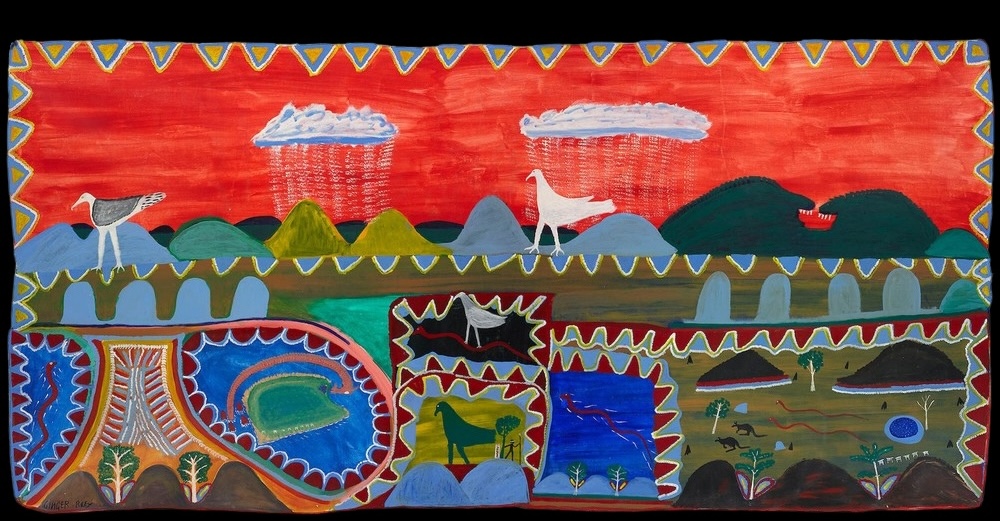
His most recognisable characteristic is his extraordinary use of colour. Electric blues, brilliant greens, intense reds, purples and luminous yellows create landscapes that frequently depart from natural appearances.
He famously explained:
“I have to see it: it must be bright.”
These colours distinguish important ancestral figures, establish atmosphere and express the changing conditions of Country.
Equally distinctive is his treatment of perspective.
Riley frequently combined aerial and horizontal viewpoints, arranging rivers, hills and ancestral figures across successive layers of landscape. Geographical features might appear enlarged, repeated or viewed simultaneously from different directions.
He described imagining himself high above Country, looking down before beginning to paint.
Art historian Anne Brody suggested that some compositions might also be understood through the viewpoint of Ngak Ngak, the ancestral eagle surveying the surrounding landscape.
Many paintings incorporate V-shaped borders and triangular motifs derived from traditional Marra ceremonial body painting, particularly designs applied to the shoulders and chest.
Although his subjects remained remarkably consistent, Riley continually experimented with colour, scale and arrangement.
He described his paintings as “the same, but different” — individual interpretations of an enduring ancestral landscape.
Ginger Riley Munduwalawala Painting Subjects
Ngak Ngak — The Guardian Sea Eagle
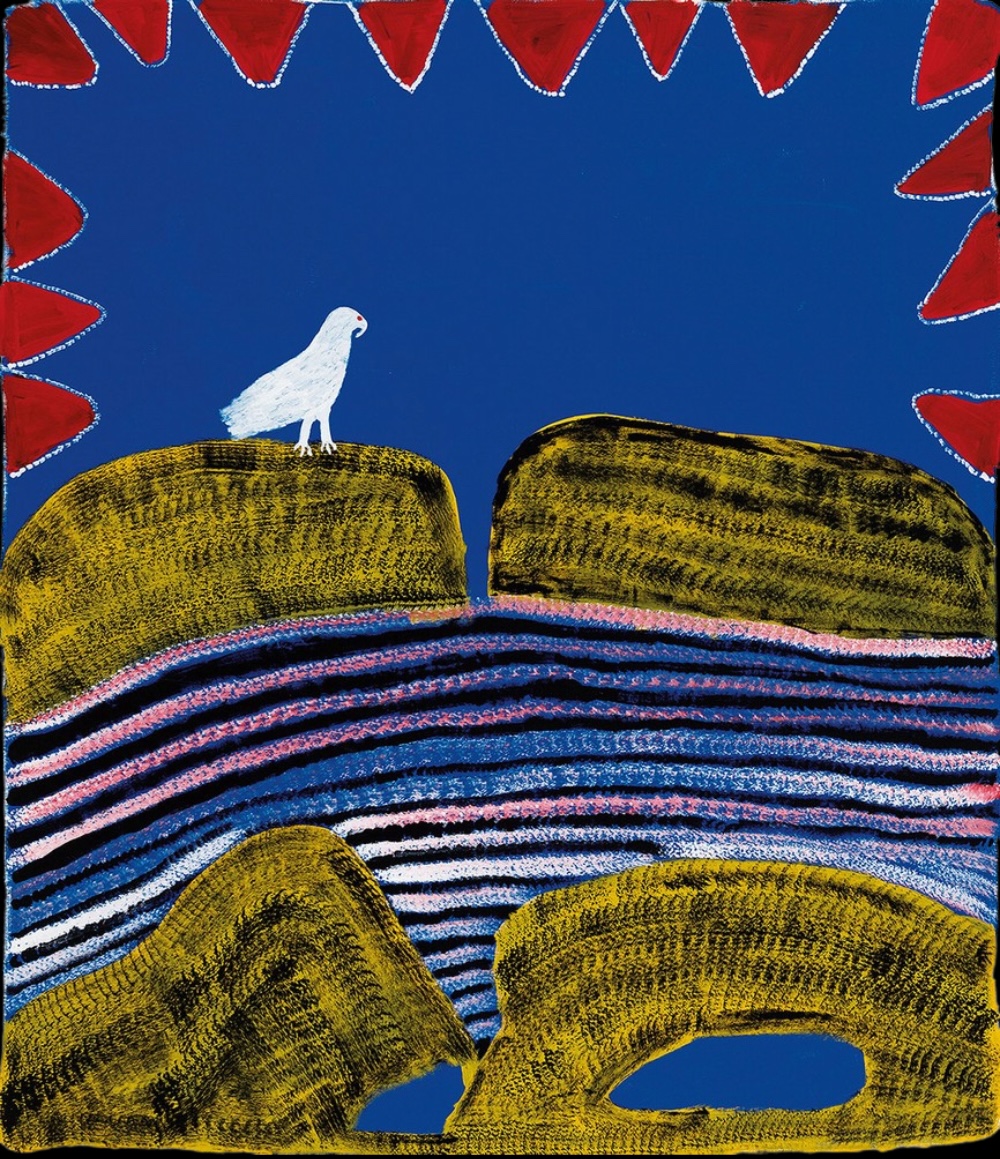
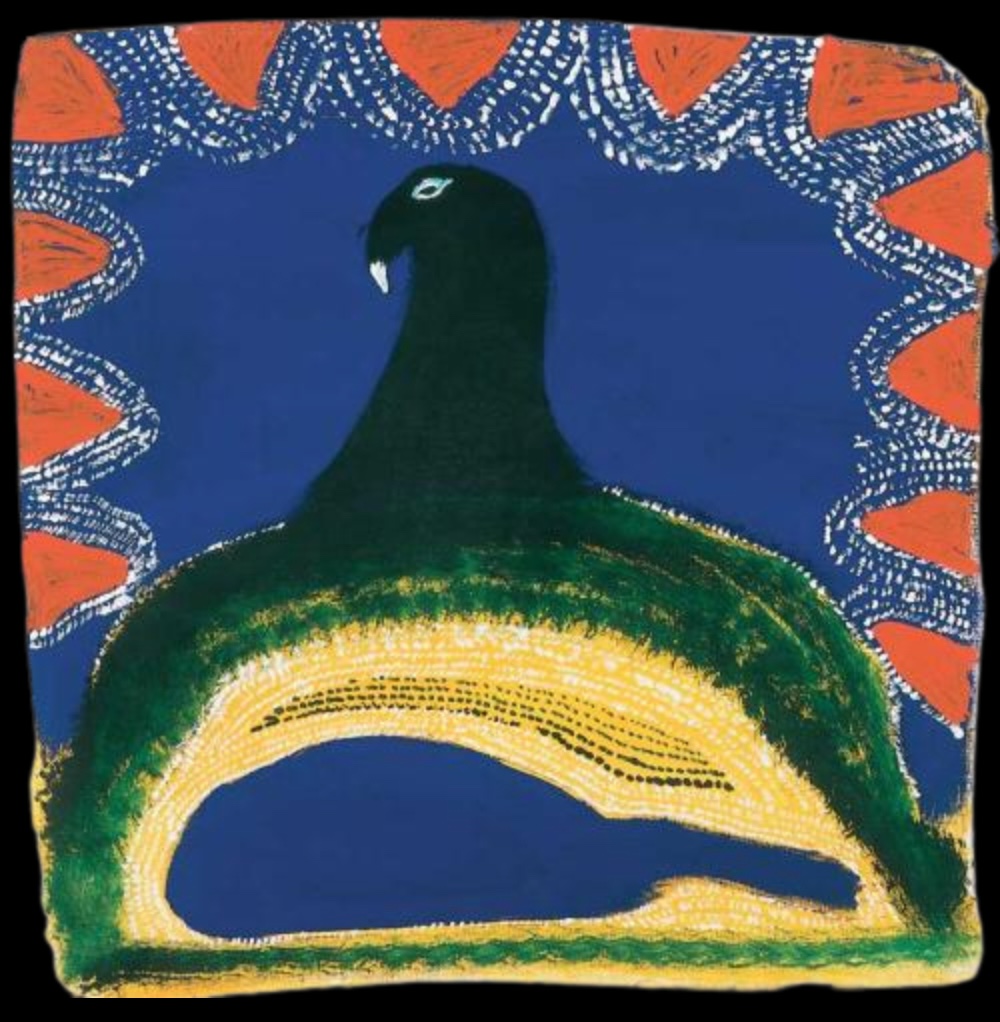
Ngak Ngak (white-breasted sea eagle) is the most recognisable ancestral figure in Riley’s paintings.
Usually depicted as a large white bird overlooking the landscape, Ngak Ngak acts as guardian of his mother’s Country.
According to the ancestral narrative, Ngak Ngak created Yumunkuni (Beatrice Island) near the mouth of the Limmen Bight River through his flight across the landscape.
Riley frequently enlarged the eagle beyond natural proportions, sometimes portraying him in unexpected colours, including green.
Ngak Ngak can also be understood as a witness to the ancestral events unfolding throughout the paintings, connecting the artist’s custodial responsibilities with the creation of Country.
An important example is Ngak Ngak in Limmen Bight (1994), held by the Art Gallery of South Australia.
The Four Archers — The Ancestral Hills
The Four Archers, also called the Four Arches, are distinctive rocky formations approximately 45–50 kilometres inland from the Gulf of Carpentaria.
They are among the most significant ancestral places in Riley’s mother’s Country.
According to ancestral accounts, powerful snake beings created the hills through their movements across the landscape.
Riley commonly represented the formations as rounded or pyramidal shapes arranged along the horizon.
Their scale and arrangement vary considerably. Sometimes they appear as distant landmarks; elsewhere they dominate the composition or are repeated from different viewpoints.
These variations express the ancestral importance of the place rather than strict geographical realism.
Ngak Ngak and the Four Archers (1993), in the National Gallery of Victoria, is an important example.
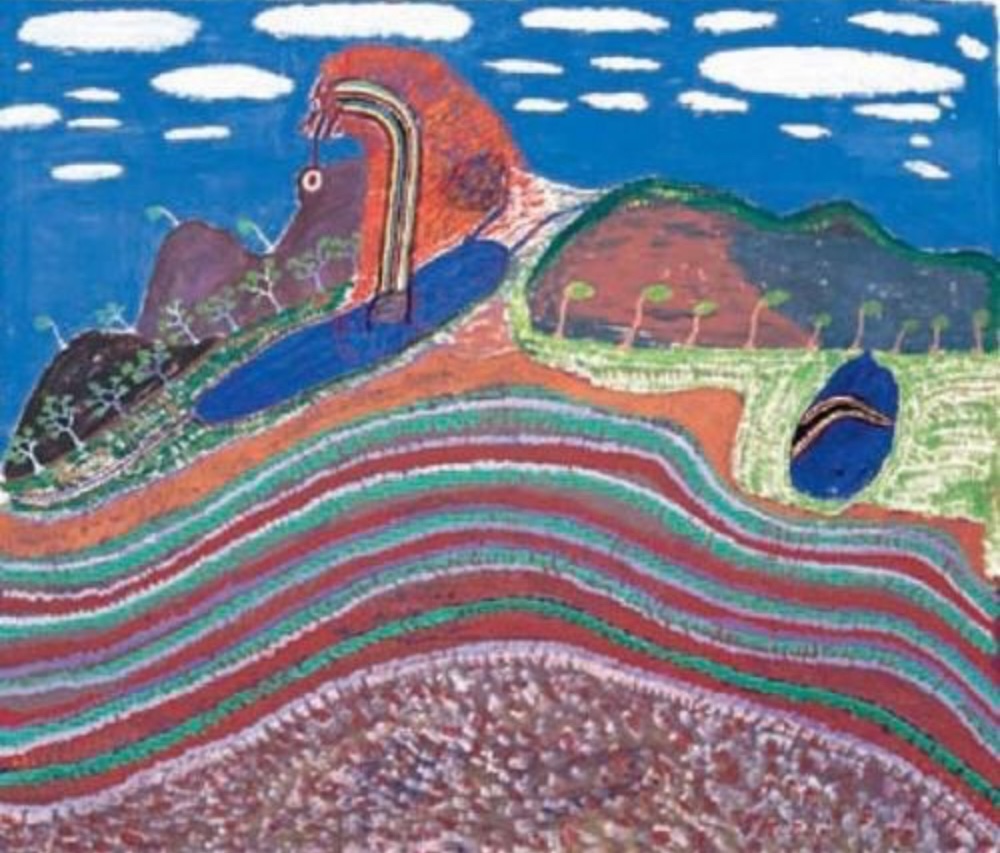
Garimala and Wawalu — The Ancestral Serpents
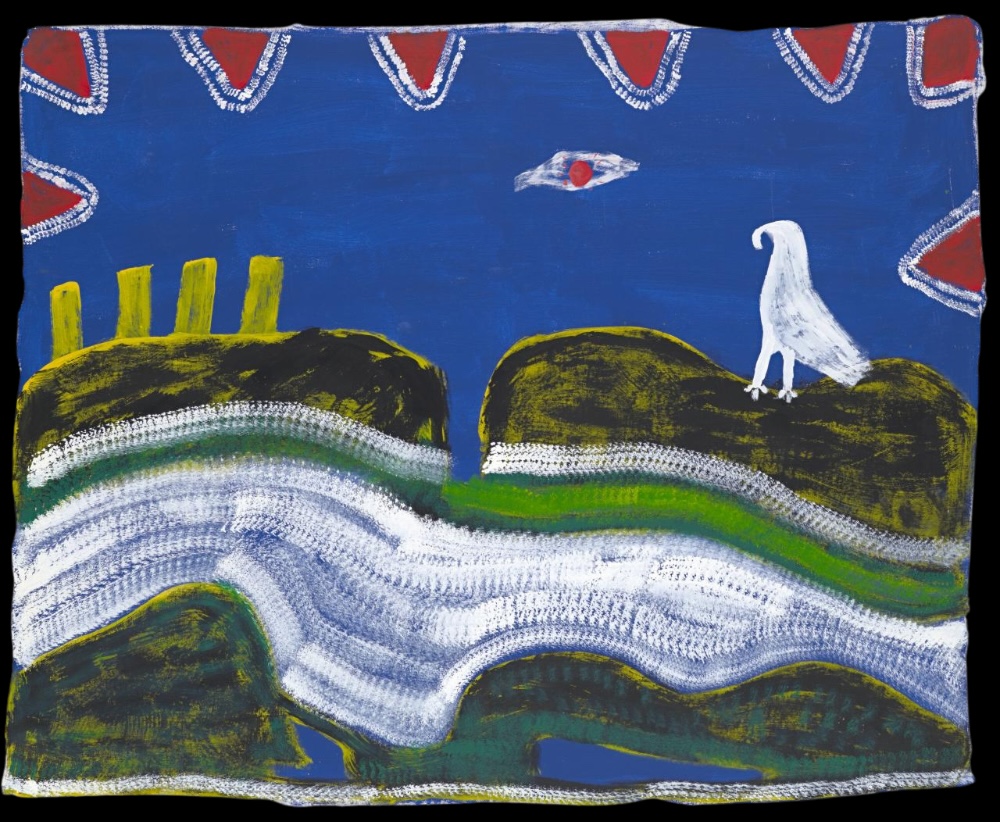
Garimala (ancestral snake, commonly identified as a taipan) travelled through the Limmen Bight landscape, creating important geographical features, including the Four Archers.
The being frequently appears as two snakes travelling together.
According to accounts recorded by Judith Ryan, Garimala journeyed towards Nyamiyukanji, disappeared beneath the water and transformed into Wawalu (Rainbow Serpent).
This transformation connects the ancestral being with fresh water, the monsoon season and the renewal of life.
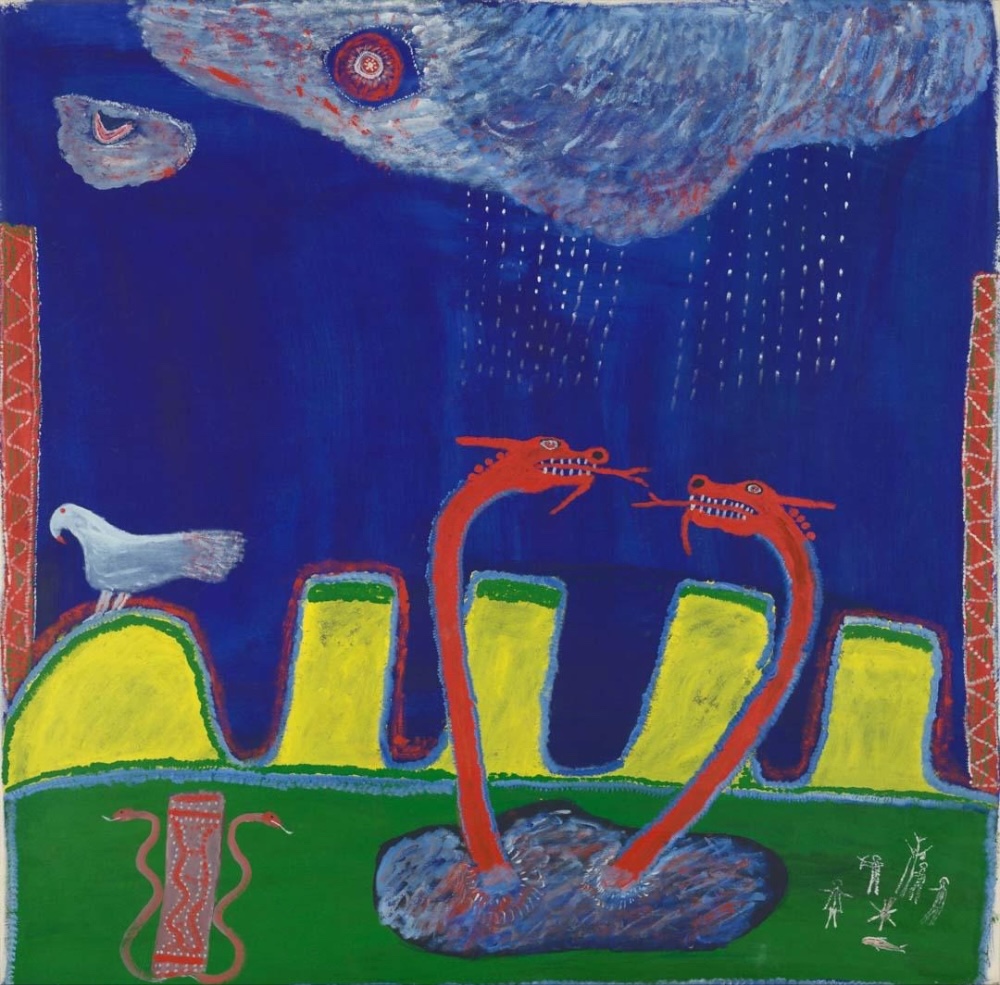
Riley represented these events through paired serpents, winding waterways, rain clouds and changing colours.
Other accounts identify Bandian (King Brown snake) and related ancestral manifestations. Published descriptions differ in their treatment of these relationships, which belong to specific ancestral narratives.
Bulukbun — The Fire-Breathing Serpent
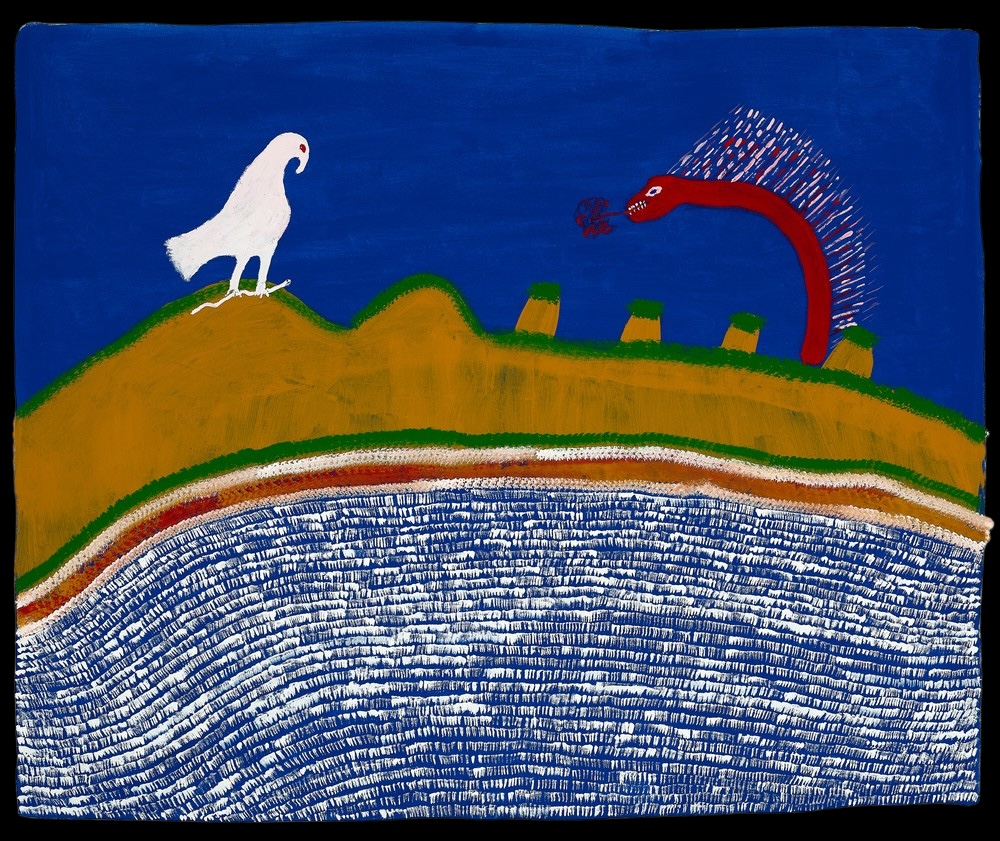
Bulukbun (fire-breathing ancestral serpent) is a dangerous supernatural being, frequently represented as a dragon-like creature with spines, an elongated body and fiery breath.
Unlike the protective Ngak Ngak, Bulukbun embodies threatening ancestral power and the consequences of disregarding ceremonial law.
One narrative concerns young men who improperly killed flying foxes around the Four Archers.
Bulukbun pursued them through caves and rocky formations, killing some with his fiery breath.
Riley frequently depicted the creature rising dramatically above the landscape or confronting other ancestral beings.
Angry Bulukbun (1990), included in his 1997 retrospective, is a particularly important example.
The Shark’s Liver Tree
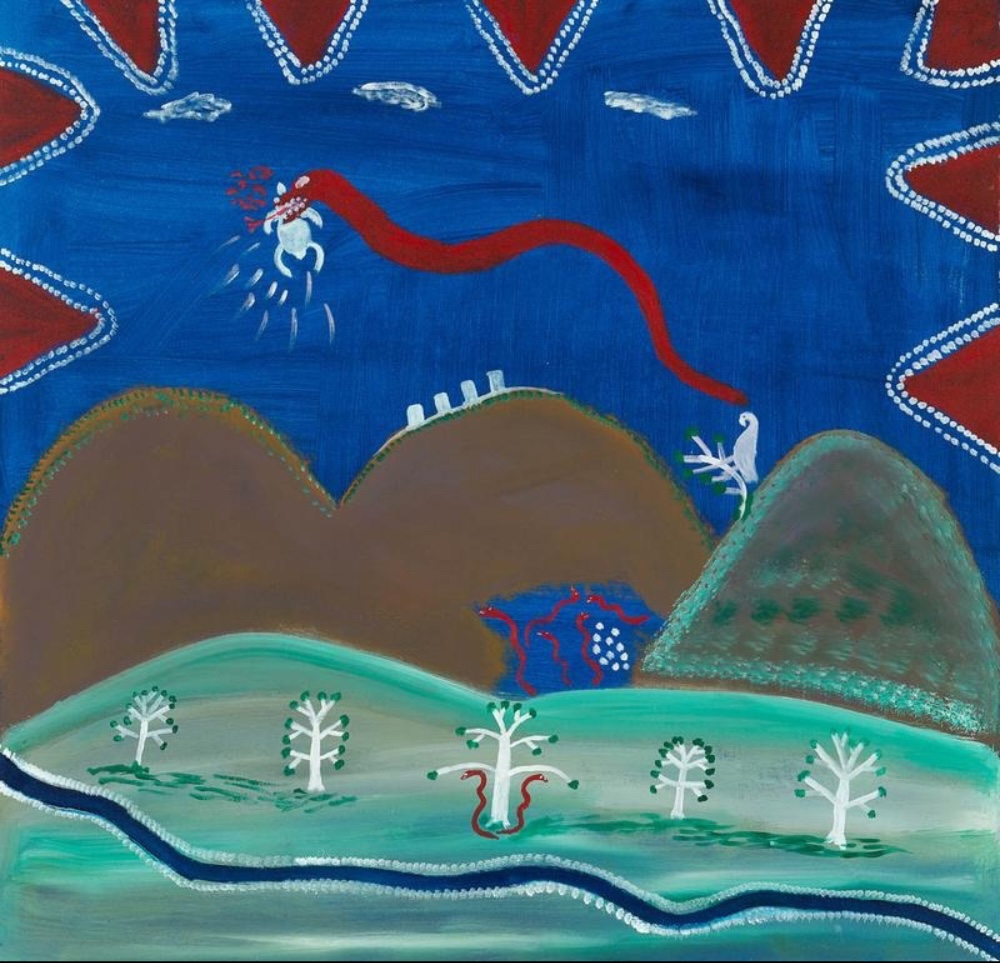
The shark’s liver tree is an ancestral ceremonial structure rather than a natural tree.
According to the narrative recorded by the National Gallery of Victoria, it originated when an ancestral shark gave up its liver, creating a ceremonial construction associated with Riley’s mother’s Country.
The structure is commonly depicted between two guardian snakes, sometimes with snake eggs near its base.
Art historian Wally Caruana identifies the ancestral shark as Yulmunji, whose story connects the Limmen Bight region with the Djambarrpuyŋu and Dhudi-Djapu clans further north in Arnhem Land.
These paintings therefore express ancestral relationships extending beyond Riley’s immediate Country.
The subject appears prominently in Sacred Liver Tree (1991).
The Limmen Bight River and the Wet Season
The Limmen Bight River connects the coastal saltwater environment with inland hills, waterholes and ancestral sites.
Riley frequently represented the river as broad, winding bands of blue crossing brilliantly coloured plains.
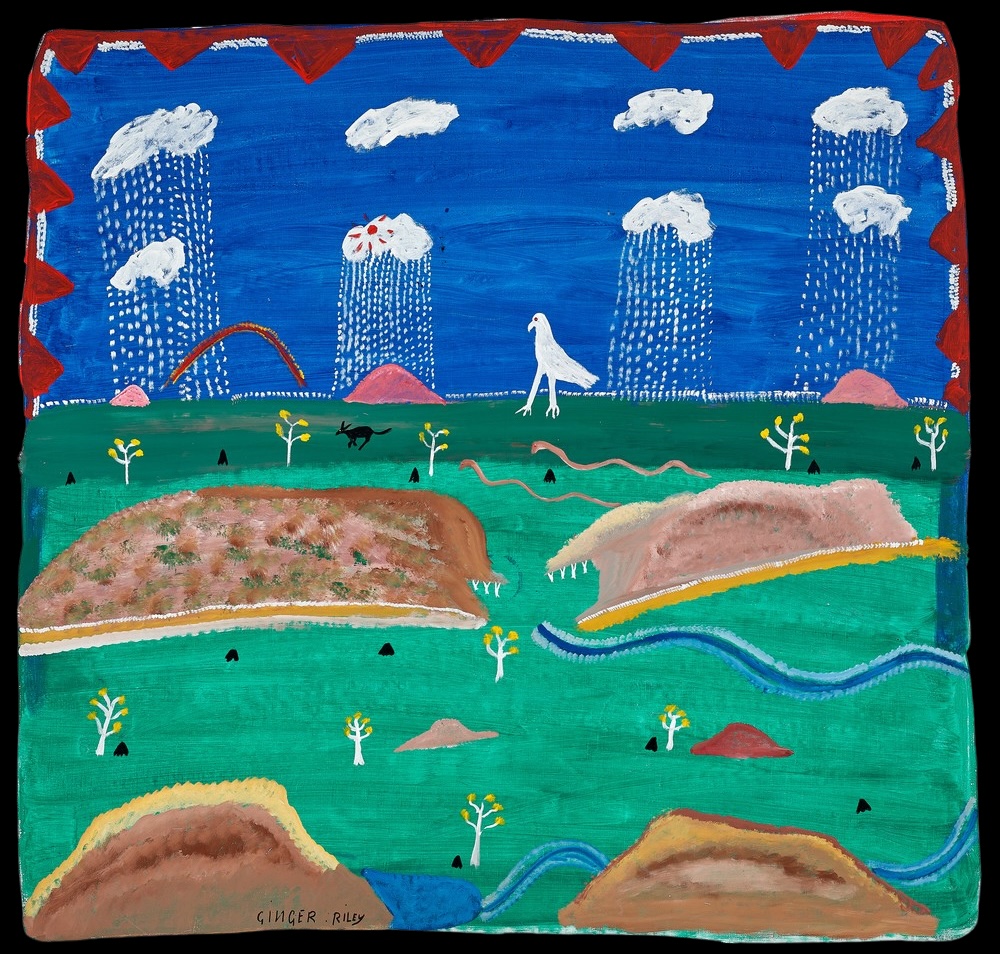
Seasonal change was particularly important. Rain clouds, flowing water and flourishing vegetation express the transformation of Country during the monsoon.
The artist also associated the sun and clouds with his deceased mother, giving these paintings a deeply personal dimension.
In The Wet – My Mother’s Country (1994), ancestral snakes, the Four Archers and threatening rain clouds combine to express seasonal renewal and the continuing presence of ancestral power.
Why Ginger Riley Munduwalawala Is Important
Ginger Riley transformed expectations of contemporary Aboriginal art by developing a highly individual form of landscape painting grounded in inherited ancestral knowledge.
Judith Ryan, curator of his 1997 retrospective, recognised his remarkable colour sense and ability to continually reinterpret the same ancestral subjects without becoming formulaic.
Anne Brody identified the sophistication beneath his apparently simple compositions, comparing their unexpected perspectives and mysterious atmosphere with European Surrealism.
More recently, Indigenous writer Tristen Harwood has examined how Riley’s landscapes privilege ancestral viewpoints, particularly that of Ngak Ngak, rather than presenting Country as scenery viewed by an outside observer.
His achievement extended beyond the Ngukurr painting movement.
By combining cultural responsibility with extraordinary artistic invention, Riley established a distinctive visual language that made an enduring contribution to Australian landscape painting.
Ginger Riley in Public Collections
Ginger Riley Munduwalawala is represented in major Australian and international collections, including:
- National Gallery of Victoria, Melbourne
- National Gallery of Australia, Canberra
- Art Gallery of New South Wales, Sydney
- Art Gallery of South Australia, Adelaide
- Art Gallery of Western Australia, Perth
- Queensland Art Gallery | Gallery of Modern Art, Brisbane
- Araluen Art Collection, Alice Springs
- Artizon Museum, Tokyo
- Nevada Museum of Art, United States
His monumental tapestry Wamungku – My Mother’s Country (1996) was commissioned for the Australian Department of Foreign Affairs and Trade.
Ginger Riley Munduwalawala Further Reading
Ryan, Judith. Ginger Riley. National Gallery of Victoria, Melbourne, 1997. The principal retrospective catalogue.
Brody, Anne. Ginger Riley Munduwalawala: His Own Man. Art and Australia, Vol. 33, No. 1, 1995, pp. 70–79.
Ryan, Judith. Ginger Riley Munduwalawala: A Seeing Artist. Artlink, Vol. 21, No. 4, 2001.
Bowdler, Cath, editor. Colour Country: Art from Roper River. Museum and Art Gallery of the Northern Territory, 2009.
Harwood, Tristen. Place of Many Stories, in Spirit Journeys: The Ngukurr School of Art, Alcaston Gallery, 2020.
National Gallery of Victoria. Ginger Riley Munduwalawala Collection.
All images featured in this article are presented strictly for educational and informational purposes.
This website may include copyrighted material for which specific authorization has not been obtained from the copyright owner.
All such images are presumed to be the intellectual property of the respective artist or their estate, and are used in accordance with principles of fair dealing or fair use under applicable copyright law.