
Tjumpo Tjapanangka
c. 1929–2007
Kukatja and Pintupi
Country west of Wilkinkarra (Lake Mackay)
Yagga Yagga / Balgo
Balgo Art / Western Desert Art
Warlayirti Artists
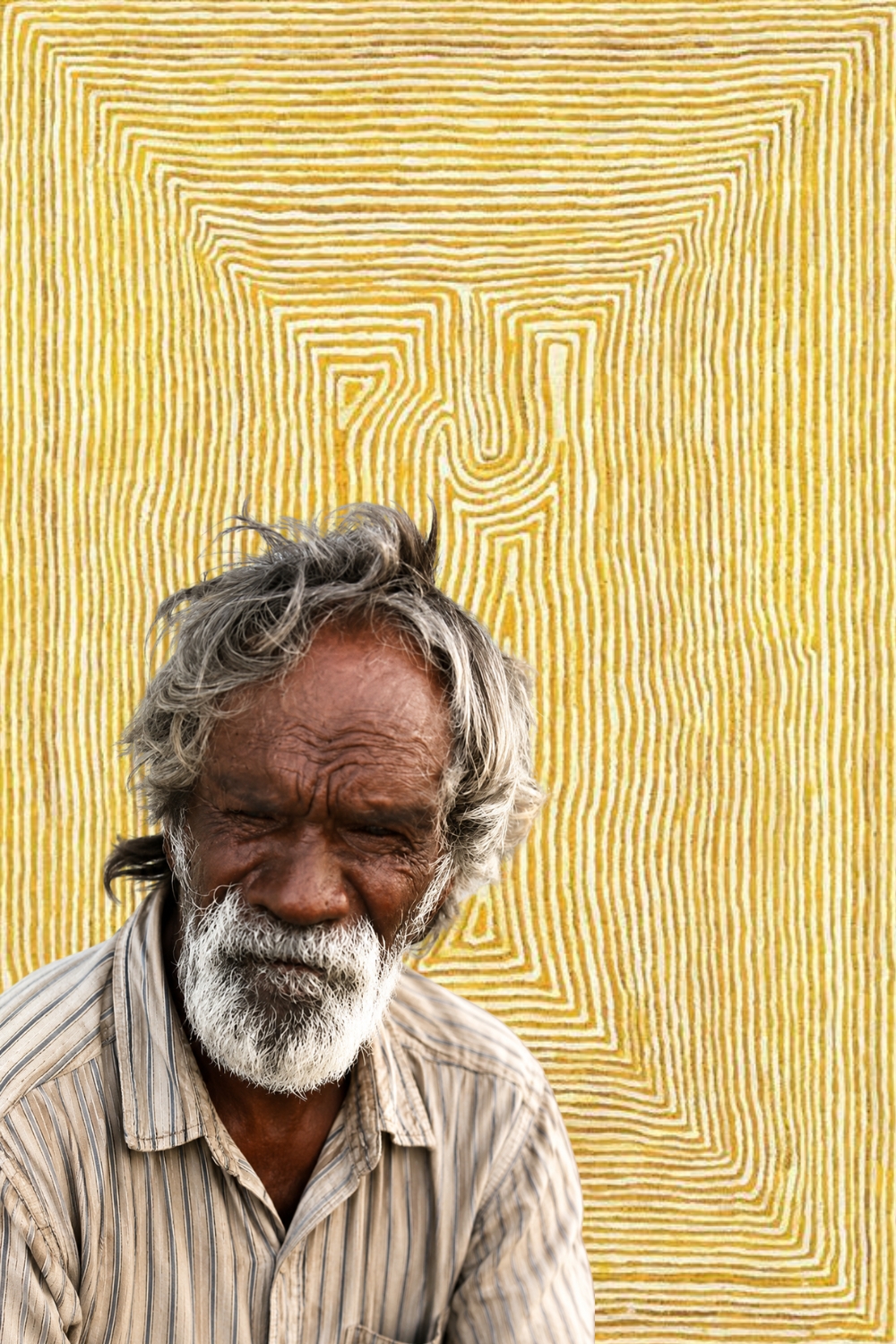
Tjumpo Tjapanangka (c.1929–2007) was a senior Kukatja and Pintupi man, Law man, traditional healer and one of the most distinctive painters associated with Balgo Art and Warlayirti Artists. Born in the desert country west of Wilkinkarra (Lake Mackay), he grew up travelling, hunting and learning the water sources, ancestral places and ceremonial knowledge of this remote region.
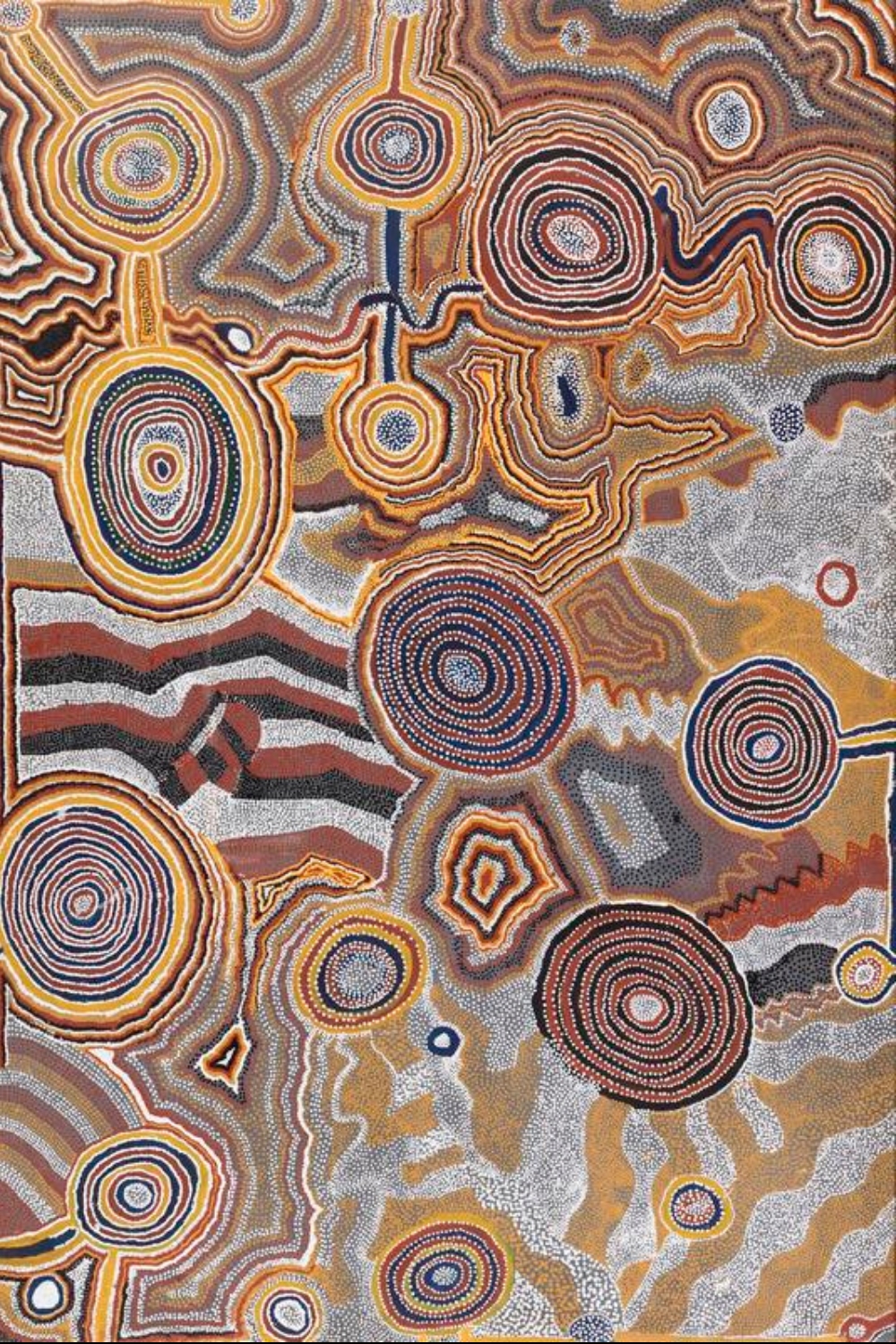
Tjumpo began painting in 1986, when he was already in his late fifties and a man of considerable cultural authority. During the late 1980s and early 1990s he lived and painted at Yagga Yagga, south of Balgo, alongside other important painters including Sunfly Tjampitjin. His early paintings mapped Country through circles, pathways, waterholes and ancestral journeys. During the 1990s and early 2000s he progressively compressed this detailed visual language into broad bands, repeated parallel lines and large fields of restrained colour.
The apparent simplicity of these late paintings can be deceptive. Red, yellow and white lines might represent ancestral fire,tali or sandhills, ceremonial designs and the journeys of the Wati Kutjarra, the Two Brothers whose travels through the Western Desert became one of Tjumpo’s principal subjects. Rather than moving away from traditional meaning, his mature paintings concentrated an extraordinary knowledge of Country into fewer and increasingly powerful visual elements.
Tjumpo Tjapanangka Value
For Tjumpo Tjapanangka value and auction results and additional images of artworks please see the
Tjumpo Tjapanangka Biography
Tjumpo Tjapanangka was born around 1929 in the remote desert country west of Wilkinkarra, or Lake Mackay, close to the Western Australia–Northern Territory border. Sources variously identify Muruwar, Kanapir and Karnapilya in connection with his birth and homeland, so his origins are best understood broadly as the Country west of Wilkinkarra.
He belonged to a generation of Western Desert Aboriginal people who spent their early lives largely independently in the desert. Tjumpo later recalled hunting goanna, echidna, wallaby and wild cat and constructing shelters during the wet season. He knew the water sources, travelling routes and ancestral histories associated with particular waterholes, sandhills and rocky places.
This lived knowledge became fundamental to his painting. Documentation for Wangapanta (1990) describes Kangaroo Dreaming Country containing rocky outcrops, sandhills and water sources regularly used by Tjumpo and his family. His paintings therefore represented landscapes through which he had travelled, hunted and lived, as well as places understood through ancestral Law.
By later life Tjumpo was an important Law man, ceremonial leader and maparn, or traditional healer. The places represented in his paintings belonged to systems of cultural knowledge and responsibility. Warlayirti documentation for Ngunkanapilka, West of Lake Mackay (1991) describes the painting as a bird’s-eye view of Country where the Wati Kutjarra had travelled and camped, leaving signs and powers in the land cared for by senior men such as Tjumpo.
During the late 1980s and early 1990s Tjumpo lived at Yagga Yagga, an outstation about 150 kilometres south of Balgo and closer to his traditional Country around Wilkinkarra. Yagga Yagga was also home to other important painters, including Sunfly Tjampitjin, and much significant early Balgo painting was produced there. Artists continued to work through Warlayirti Artists at Balgo, with painting materials transported between the communities. After Yagga Yagga was abandoned, Tjumpo returned to Balgo around 1996.
Although principally associated with Warlayirti Artists, Tjumpo also painted for Papunya Tula Artists while visiting Pintupi Country. Surviving works from 2002 and 2004 carry Papunya Tula catalogue numbers, making his career an unusual connection between two major traditions of Western Desert Art: Balgo painting and Pintupi painting.
Tjumpo began painting for the public around 1986, already in his late fifties and possessing decades of knowledge of Country and ceremony. His early paintings used circles, pathways, tracks and waterholes to create relatively detailed, map-like compositions. During the 1990s this visual language changed dramatically. Circles and detailed iconography diminished, parallel lines became increasingly dominant and his canvases expanded in scale.
By the early 2000s an immense ancestral landscape could be represented by little more than bands of red, yellow, white and black. This process of compression—expressing extensive knowledge of Country through increasingly economical visual forms—became the defining feature of Tjumpo Tjapanangka’s mature art.
What Did Tjumpo Tjapanangka Paint?
Tjumpo Tjapanangka painted Country and the ancestral events through which that Country acquired its physical and cultural form.
His paintings refer to particular waterholes, soakwaters, sandhills, rocky places, ancestral journeys and ceremonial sites rather than presenting a generic image of the Australian desert. Recurring subjects include Wilkinkarra, Marruwa, Tingari, Wati Kutjarra, Water Dreaming, Kangaroo Dreaming and Bandicoot Dreaming
Wati Kutjarra — The Two Brothers
The Wati Kutjarra, or Two Men/Two Brothers, became one of the dominant subjects of Tjumpo’s mature work.
The ancestral brothers travelled across large areas of the Tanami, Great Sandy and Western Deserts. Warlayirti documentation describes them travelling through the landscape, teaching people about food, fire and hunting and creating landforms along their route.
Wilkinkarra was particularly important in Tjumpo’s paintings of their journey. Documentation accompanying Wati Kutjarra (2004) describes the brothers travelling into this Country before Lake Mackay had been formed and lighting an enormous fire that burned through the Country and created the lake.
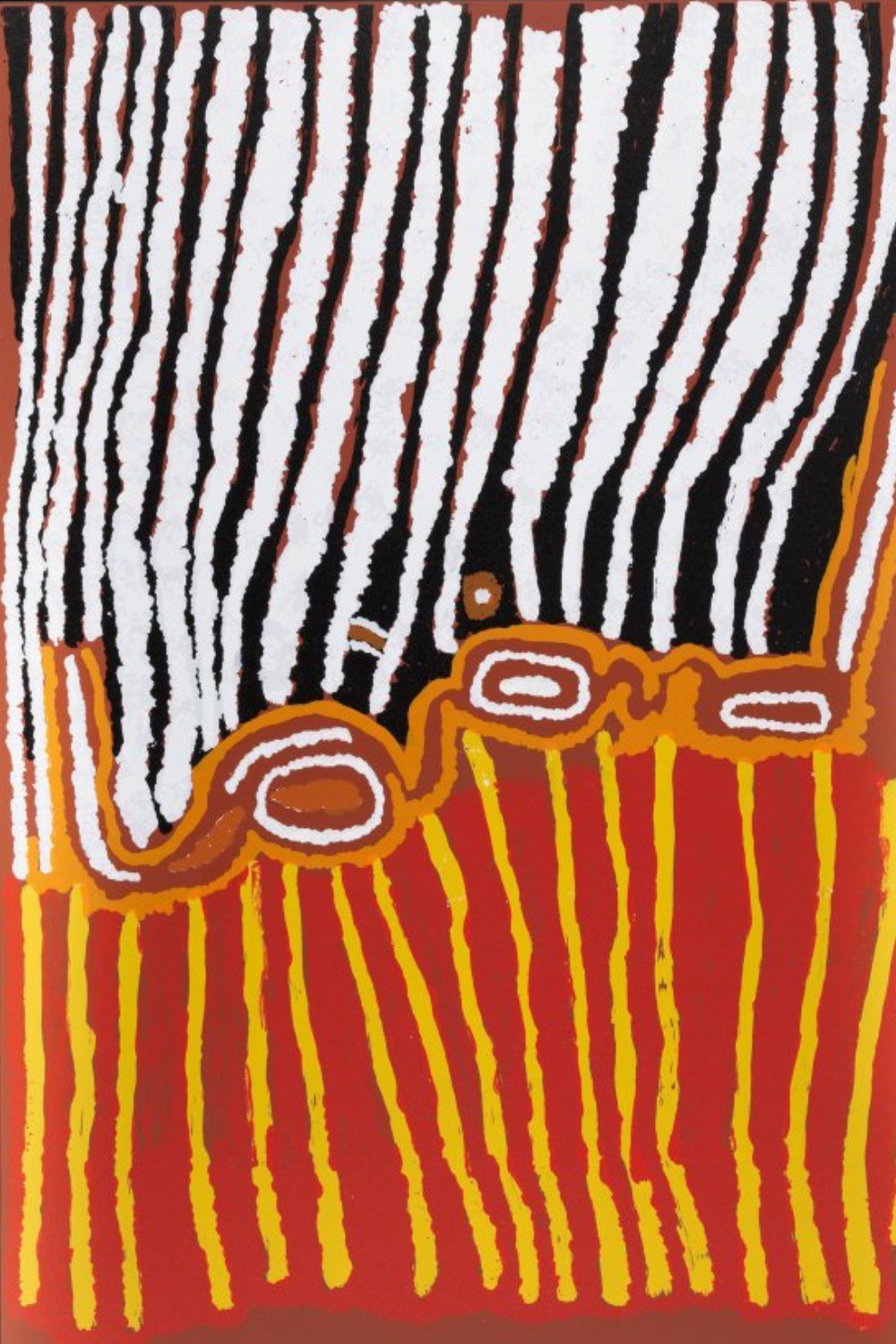
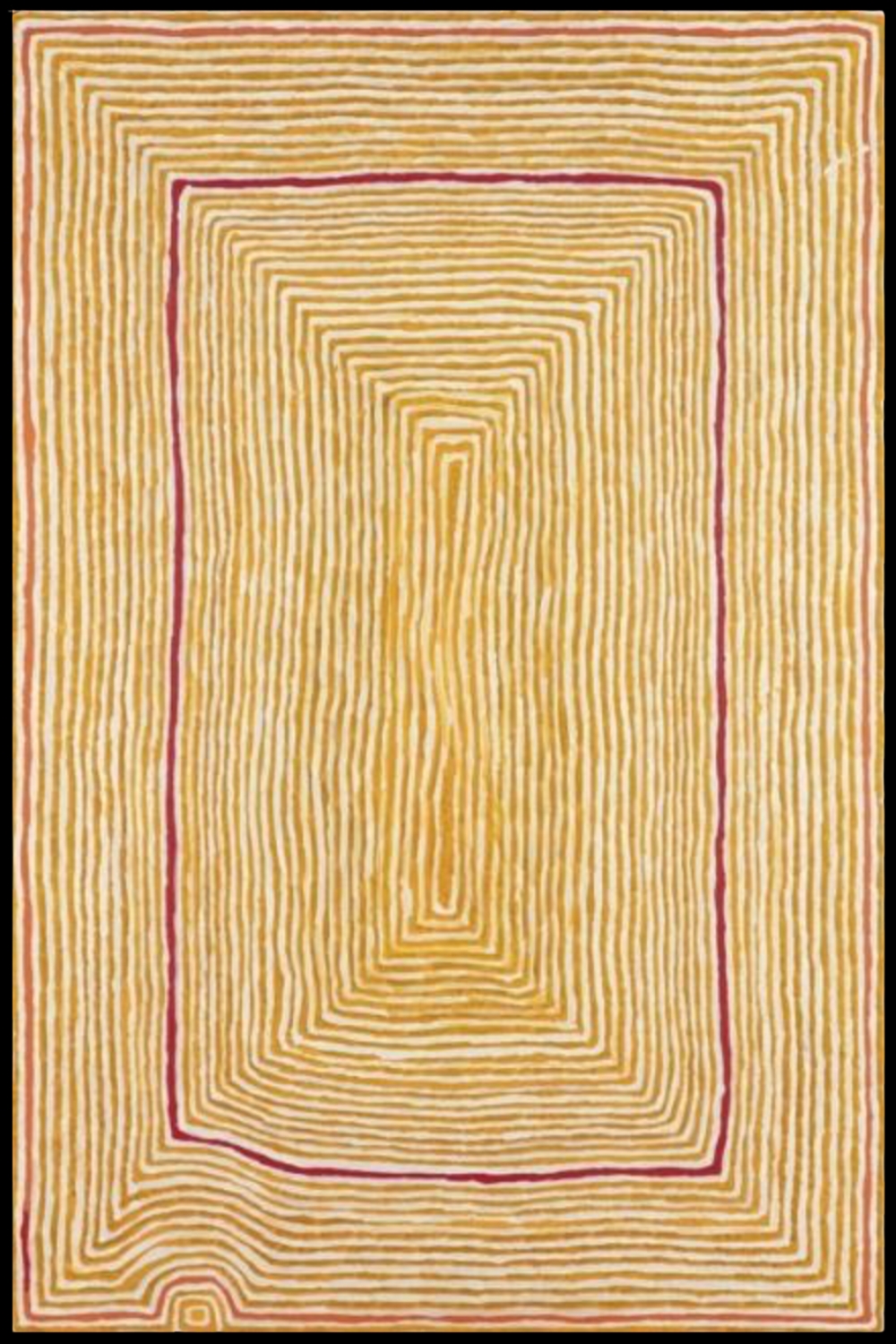
A 2003 painting provides a particularly clear explanation of how Tjumpo translated this event into paint. Red lines represent the intensity of the ancestral flames, while parallel yellow and white lines represent the tali, or sandhills, dominating the surrounding Country.
His late paintings therefore cannot be understood simply as abstract compositions. Even radically reduced arrangements of line and colour can refer to particular ancestral events occurring at particular places.
Wilkinkarra and Marruwa
Wilkinkarra, or Lake Mackay, lies at the centre of much of Tjumpo’s artistic geography. It was Country he had known since his youth and a landscape connected with both Tingari and Wati Kutjarra ancestral narratives.
The broader Country around Wilkinkarra is sometimes identified in his paintings as Marruwa. Documentation accompanying a 2006 Wilkinkarra describes Marruwa as the general name for Tjumpo’s Country south of Balgo and identifies it as a major Tingari place. The numerous parallel lines in the painting represent the tali, or sandhills, dominating the landscape.
Water sources were equally important. Marboree (2000), for example, represents a Water Dreaming associated with a soakwater. Marboree appears at the centre of the painting, while other forms identify a windbreak and a place where two ancestors lay down and entered the earth.
Tjumpo also painted Kangaroo and Bandicoot Dreamings associated with particular places. In Bandicoot Dreaming(1988), an ancestral Bandicoot creates small lakes with its footprints and sandhills through its digging before going underground at Kalututi, now a deep waterhole.
These paintings demonstrate a fundamental characteristic of Tjumpo’s art. Landscape and ancestral narrative are inseparable. Waterholes, lakes, sandhills and rocky formations are not merely scenery but places whose physical form and cultural significance are connected with ancestral events.
Tjumpo Tjapanangka’s Painting Style
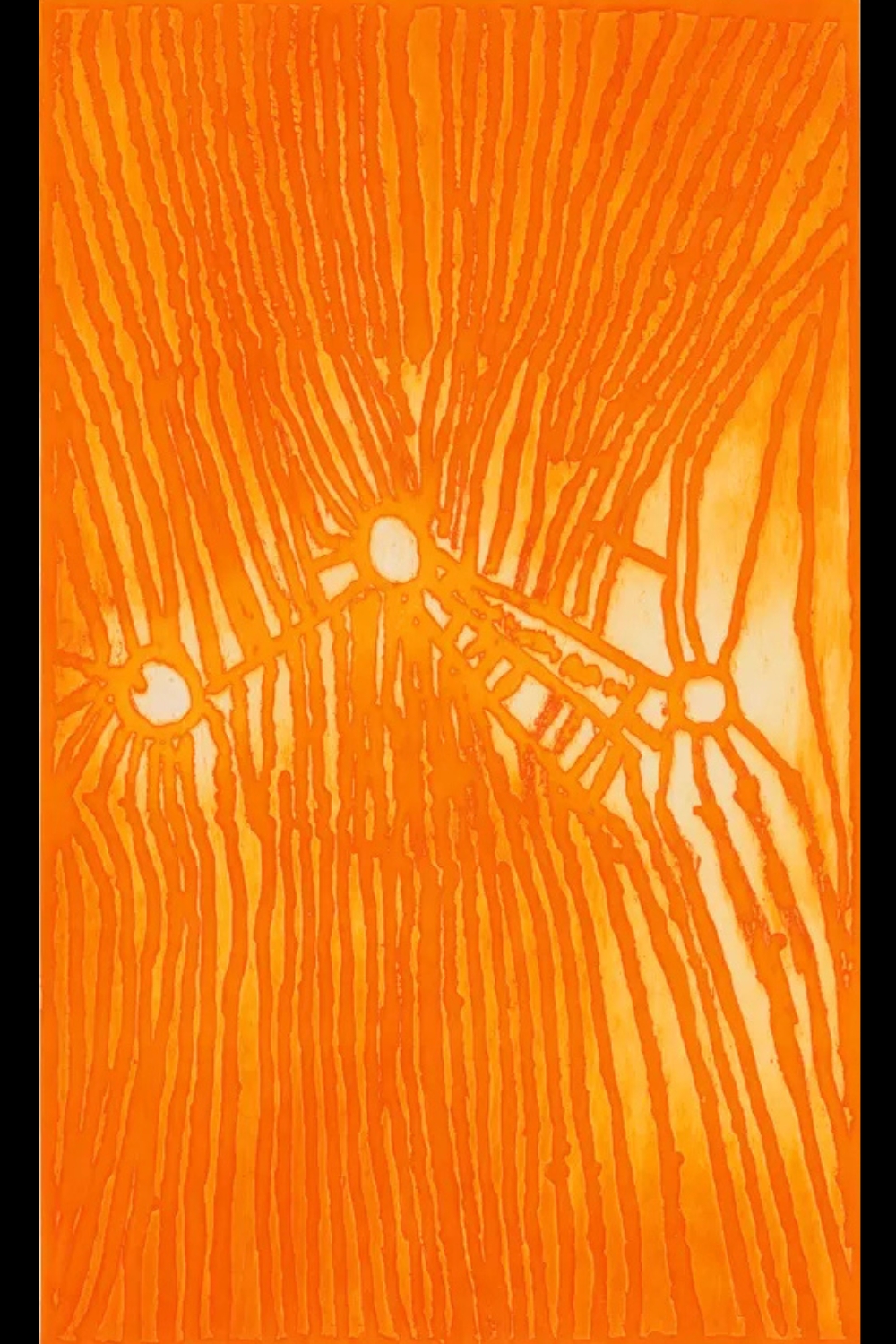
Tjumpo Tjapanangka’s painting style changed considerably during his twenty-year career. Works of the late 1980s and early 1990s contain relatively detailed representations of Country, using circles, pathways and lines to connect water sources, ancestral journeys and significant places. The paintings can resemble maps viewed from above; Warlayirti described Ngunkanapilka as a bird’s-eye view of the artist’s Country.
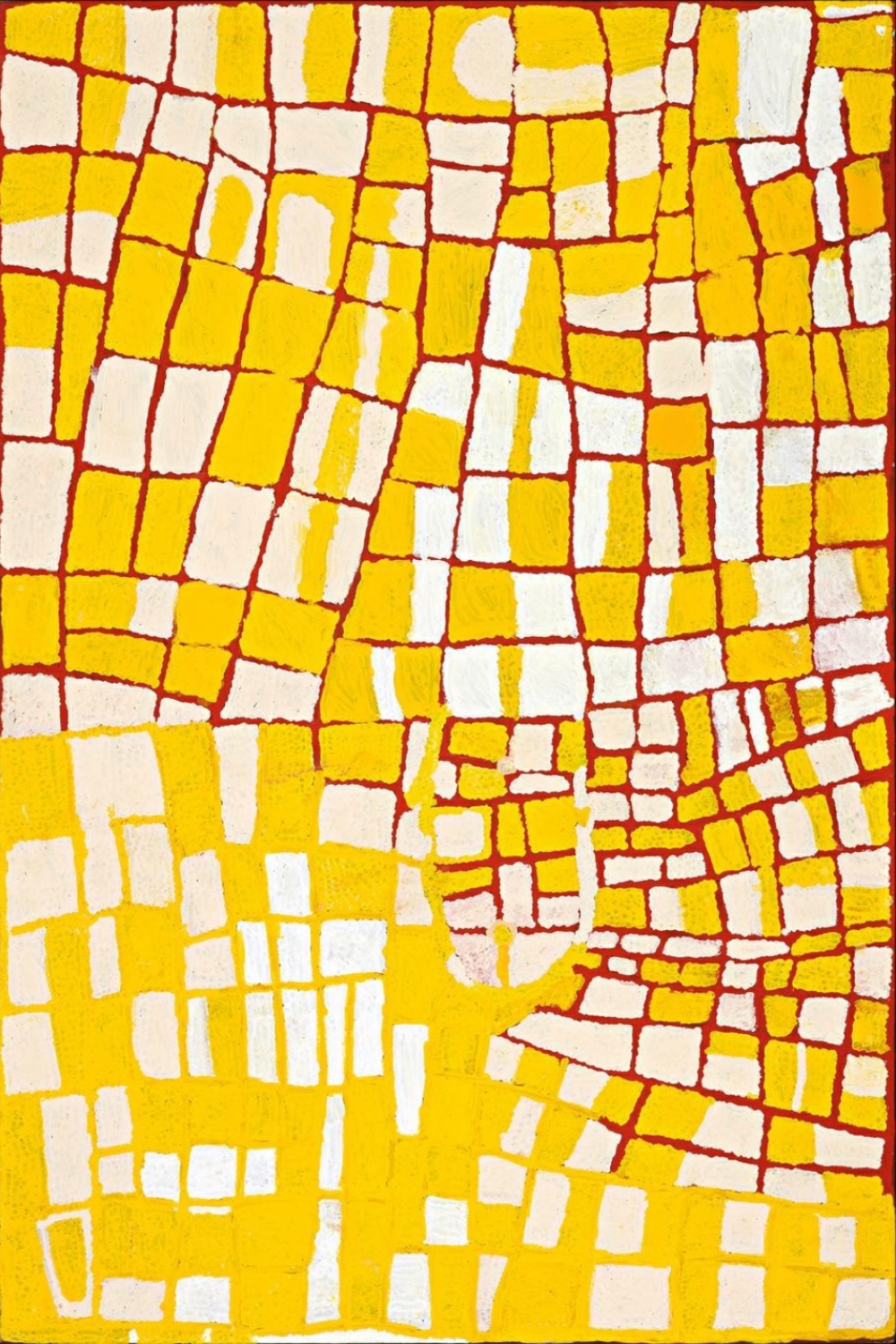
During the 1990s Tjumpo progressively simplified this imagery, expressing the same geographic and ancestral knowledge through fewer elements. Circles diminished, fields of colour expanded and parallel lines increasingly dominated the canvas.
By the early 2000s his paintings had achieved remarkable visual economy. A vast landscape could become a sequence of lines, sandhills could become alternating bands and ancestral fire could become a field of red. In Wati Kutjarra(2003), for example, red lines represent ancestral fire while yellow and white lines represent the surrounding sandhills.
Tjumpo’s mature style is therefore better understood as compression rather than abstraction—saying more with fewer marks.
Repeated parallel lines became a defining feature of these late works. Rather than being mechanically straight, they shift and tremble across the canvas. Wally Caruana described Tjumpo’s “quivering parallel lines” as suggestive of a mirage, evoking flames and ash, salt and shifting sands.
Tjumpo was also restrained in his use of colour compared with many Balgo painters, frequently favouring red, yellow, white and black. Red could evoke ancestral fire, while yellow and white represented sandhills. Some repeated bands have also been connected with ceremonial body-painting designs, making their apparent similarity to Western abstraction potentially misleading.
This increasing simplicity was accompanied by monumental scale. Wati Kutjarra at the Water Site of Mamara (2000) measures 295 × 120 cm, while a 2006 Wati Kutjarra reaches 300 × 130 cm. The former was later included in the international exhibition No Boundaries: Aboriginal Australian Contemporary Abstract Painting, while a major Wati Kutjarra from 2003 was selected for the 20th Telstra National Aboriginal & Torres Strait Islander Art Award.
These mature paintings represent the culmination of Tjumpo’s development. His earlier map-like compositions had been reduced to a handful of lines and colours, yet behind them remained Wilkinkarra, Marruwa, sandhills, ancestral fire, Wati Kutjarra, Tingari Law and his own experience of the desert.
Tjumpo’s achievement was to compress this extensive knowledge into an increasingly economical visual language, making him one of the most distinctive painters associated with Balgo Art.
Between Balgo and Pintupi Art
Although Tjumpo Tjapanangka is principally associated with Balgo Art and Warlayirti Artists, his life and painting extended into the Pintupi world around Wilkinkarra (Lake Mackay) and Kiwirrkurra. Tjumpo was Kukatja/Pintupi, and his traditional Country lay west of Wilkinkarra, far south of Balgo. He periodically travelled to Kiwirrkurra to stay with his countrymen and, during visits including those in 1999 and 2004, painted for Papunya Tula Artists.
These connections also continued through Tjumpo’s family. His son Vincent Nanala, who remained based primarily at Balgo, regularly travelled to Kiwirrkurra and described learning his distinctive optical painting style from both his father and his brother, the celebrated Pintupi painter Warlimpirrnga Tjapaltjarri. Tjumpo’s family therefore connected the painting communities of Balgo and Kiwirrkurra directly.
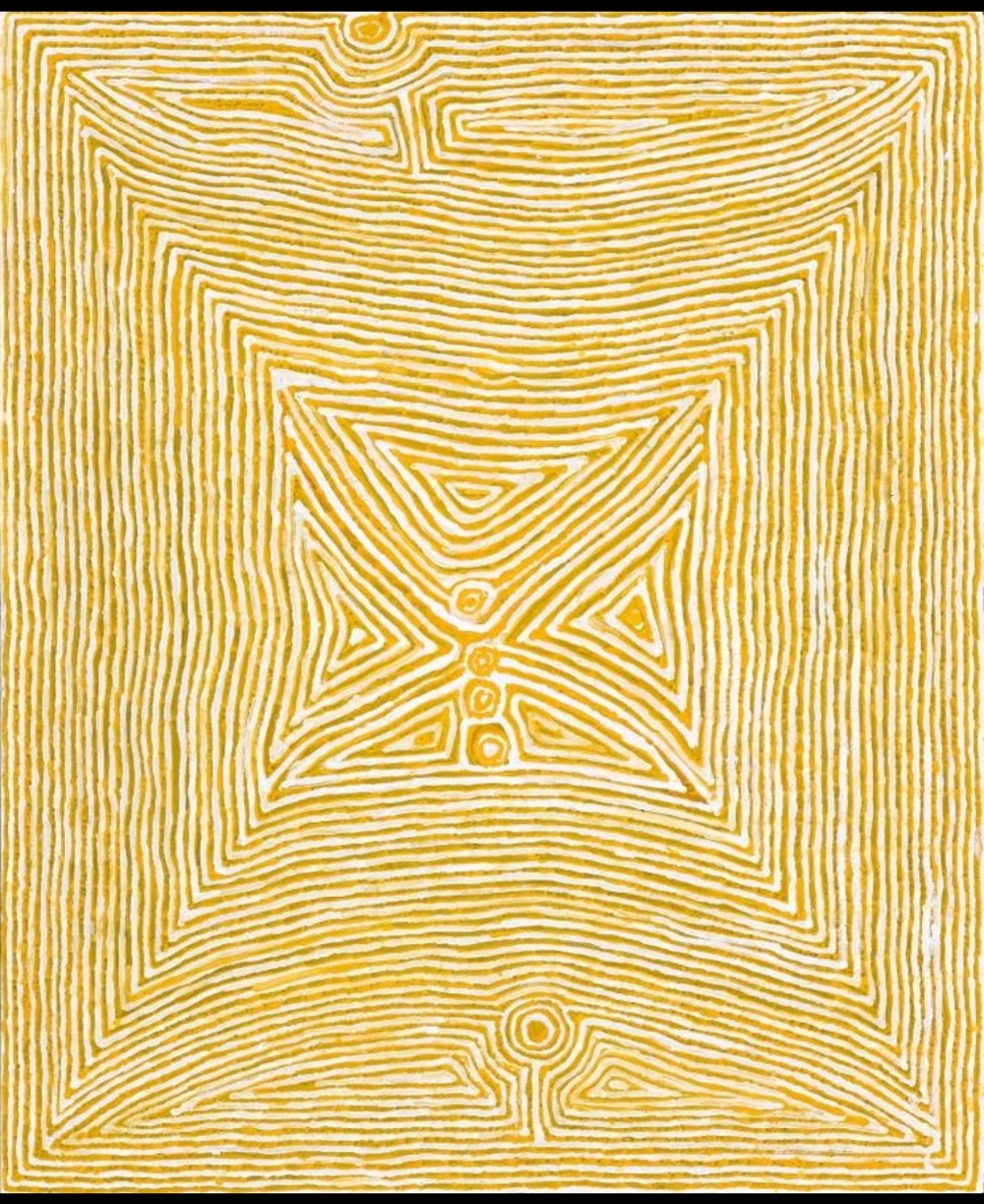
Tjumpo’s mature paintings developed within this interconnected artistic world. His repeated parallel and undulating lines have affinities with the highly refined linear paintings of Pintupi artists such as George Tjungurrayi, whose work also draws upon Country around Wilkinkarra. Yet Tjumpo retained his own freer handling of colour and form, producing paintings immediately recognisable as his own.
His career demonstrates why Balgo Art and Pintupi Art should not be treated as isolated movements. People, families and cultural responsibilities crossed the later boundaries between Balgo and Kiwirrkurra, and Tjumpo himself painted through both Warlayirti Artists and Papunya Tula Artists
Tjumpo Tjapanangka in Public collections
Tjumpo Tjapanangka’s work is held in several important Australian and international public collections, including:
- National Gallery of Victoria, Melbourne — holds four works, including Rainbow Serpent Dreaming (1987), Wati Kutjarra (Two Men) (1988), Wilkinkarra (Lake MacKay) (2001) and Marruwa (2006).
- Art Gallery of South Australia, Adelaide — holds Wilkinkarra (Lake Mackay) (2001), a major 121.3 × 181 cm painting, as well as the 2005 Wilkinkarra aquatint from the Warlayirti Suite.
- Art Gallery of New South Wales, Sydney — Wati Kutjarra (2002) is recorded in the collection.
- Art Gallery of Western Australia, Perth — Tjumpo is represented in the collection; AGWA records an Untitledsilkscreen from 1999 among its acquisitions.
- Parliament House Art Collection, Canberra — holds an Untitled screenprint from 2000, acquired in 2001.
- National Gallery of Australia
Further Reading
For further research on Tjumpo Tjapanangka and the development of painting at Balgo:
Carty, John. Balgo: Creating Country. UWA Publishing, Perth, 2021.
The most useful recent study of Balgo painting and its relationship to Country, community and artistic development. Includes discussion and illustration of Tjumpo’s work, including Wilkinkarra (2000).
Skerritt, Henry F. (ed.). No Boundaries: Aboriginal Australian Contemporary Abstract Painting. Prestel, Munich, London and New York, 2014.
Includes Una Rey’s essay “Tjumpo Tjapanangka: Hunting for Balgo’s Contemporary Warrior”, one of the most substantial published studies devoted specifically to Tjumpo and his paintings.
Laverty, Colin and Elizabeth et al. Beyond Sacred: Recent Painting from Australia’s Remote Aboriginal Communities. Hardie Grant Books, Melbourne, 2008.
Includes several important Tjumpo paintings from the Laverty Collection and is particularly useful for studying the development of his mature linear style. Works such as Wilkinba Near Lake Mackay (1993) and Marruwa (2002) are documented in the collection.
Warlayirti Artists — Tjumpo Tjapanangka artist biography.
An important art-centre source for Tjumpo’s Country, language, residence at Yagga Yagga and the development of his increasingly simplified painting style.
All images featured in this article are presented strictly for educational and informational purposes.
This website may include copyrighted material for which specific authorization has not been obtained from the copyright owner.
All such images are presumed to be the intellectual property of the respective artist or their estate, and are used in accordance with principles of fair dealing or fair use under applicable copyright law.