
Seven Sisters Dreaming: Aboriginal Dreamtime Story, Meaning & Songline
The Seven Sisters Dreaming is one of the most important Aboriginal creation stories and songlines in Australia. Known by names including Kungkarangkalpa and Minyipuru, it tells of seven ancestral women travelling across Country while being pursued by the powerful sorcerer Wati Nyiru. As they journey, they create rockholes, caves, hills, and sacred sites that remain culturally significant today.
Found across the Western and Central Deserts, the Seven Sisters dreamtime story connects many Aboriginal language groups through a shared system of law, culture, astronomy, and connection to Country. The sisters ultimately rise into the night sky as the Pleiades star cluster, while Wati Nyiru becomes Orion, creating one of the world’s most enduring relationships between landscape and the stars.
The Seven Sisters songline stretches from Western Australia through the Central Desert and into South Australia, passing through some of Australia’s most important Aboriginal cultural landscapes. Today, the story remains a major subject in contemporary Aboriginal art, particularly within APY Lands Art, where senior Anangu women have created internationally celebrated paintings inspired by Kungkarangkalpa. The story also appears throughout Western Desert Art, including works associated with Pintupi | Kintore Art and Balgo Art, making it one of the most significant ancestral narratives in contemporary Aboriginal Australian art.
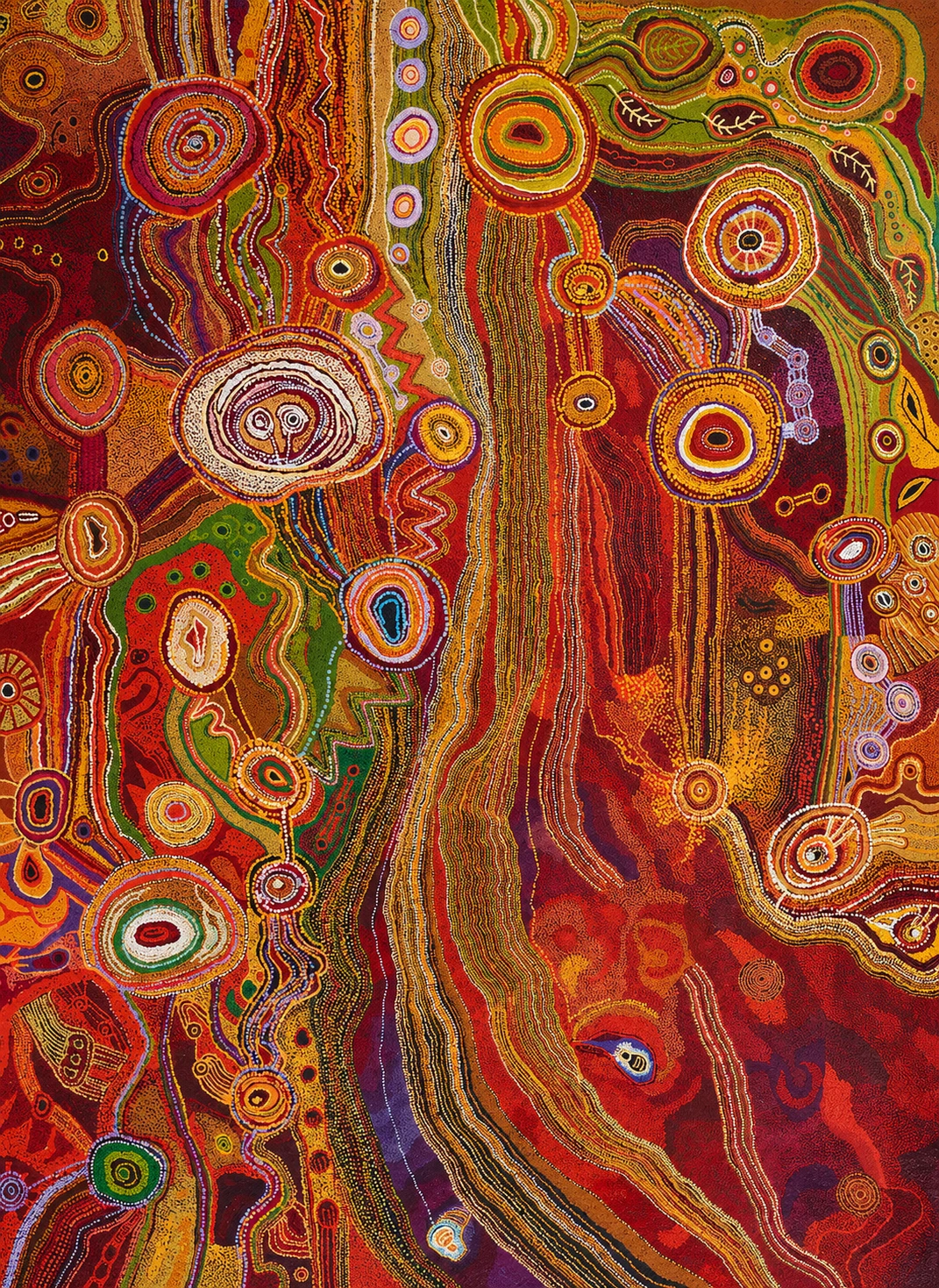
The Seven Sisters Dreamtime Story
A Cultural Narrative of Law, Landscape, and the Night Sky
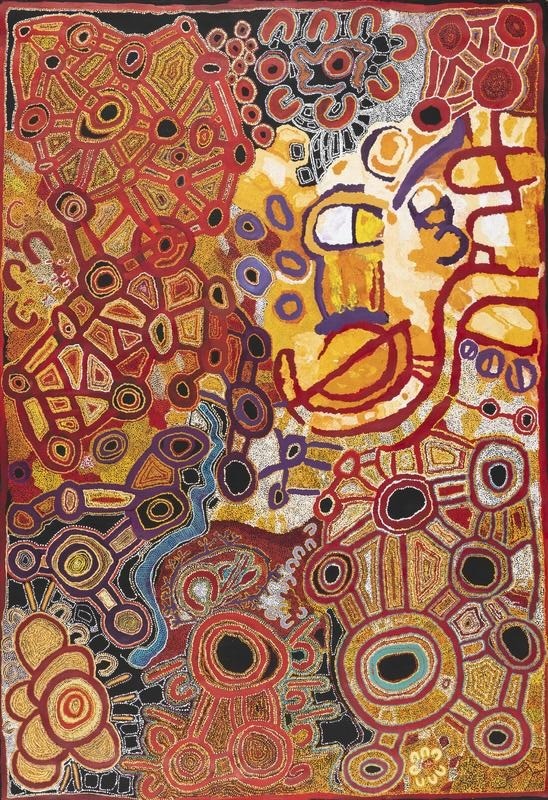
So they moved as one. Their fear did not scatter them—it bound them. Even when Wati Nyiru used his power to weaken them, making their limbs heavy and their steps slow, they supported one another, urging each other forward, sharing their strength. They crossed dry creek beds lined with ghost gums, climbed rocky rises, and passed through claypans where the earth cracked beneath their feet. They dug quickly for water, gathered what food they could, and moved on, never staying long.
Once, he came close—too close.
The youngest slowed and, for a moment, was alone. She turned, and there he stood, no longer hidden. Fear held her still. Then the eldest called out. The spell broke. She ran back into the circle of her sisters, and they closed around her, their unity unbroken.
They travelled on, faster now. Where they dug, waterholes formed. Where they ran, tracks were left behind. Hills, rockholes, and ridgelines marked their passing. As they travelled, their path became a songline across the desert, with each place marking part of their journey.
For many days and nights, the pursuit continued. Wati Nyiru did not tire. But the sisters did not break. They remained together, moving as one across Country.
At last, with nowhere left to run, they gathered close, holding the youngest among them.
Then, one by one, they rose.
Their bodies lifted from the earth and became light, ascending into the night sky where they formed the Pleiades—a tight cluster of shining stars. The youngest remained protected within them, never alone.
Wati Nyiru followed, rising after them into the sky as Orion, still reaching, still pursuing.
But he could not take them.
Each night above the desert, the Seven Sisters move together across the sky, always just beyond his grasp, their path unbroken, their unity holding them safe. Their story remains visible today, both in the night sky and across the landscape they shaped
Long ago, in the Dreaming, when the dunes ran long and red across the desert and the salt lakes shone white beneath the sun, seven sisters travelled together across a vast and unmarked Country. They moved over spinifex plains and through low mulga scrub, their feet pressing into soft sand as they journeyed from one water place to the next. The eldest led with quiet authority, reading the ground, knowing where to dig for wild yams and where the berry bushes would grow after rain. The youngest stayed close behind, light in her step, watching, listening, learning the ways of the land and the Law carried within it.
But their tracks were followed.
Wati Nyiru, a powerful ancestral man and sorcerer, had found their path and would not leave it. He moved through the country with force and cunning, changing his shape at will—tree, animal, shadow—appearing behind them, beside them, even ahead of them, setting traps where he knew they would pass. He hid close, unseen, watching and waiting. It was the youngest he desired, and he meant to take her.
The sisters did not see him, but they felt him.
At first it was a stillness that did not belong, a silence in the wind. Then it grew heavier—unease settling into their bodies. Their laughter faded. Their pace quickened. The youngest felt it most strongly; she knew it was her he followed. At times she would stop, her breath catching, her body tightening as if the land itself was warning her. Fear rose in her—deep, certain, and close—and she hurried back to the others, pressing in among them.
The eldest did not dismiss her fear.
“Stay together,” she said.
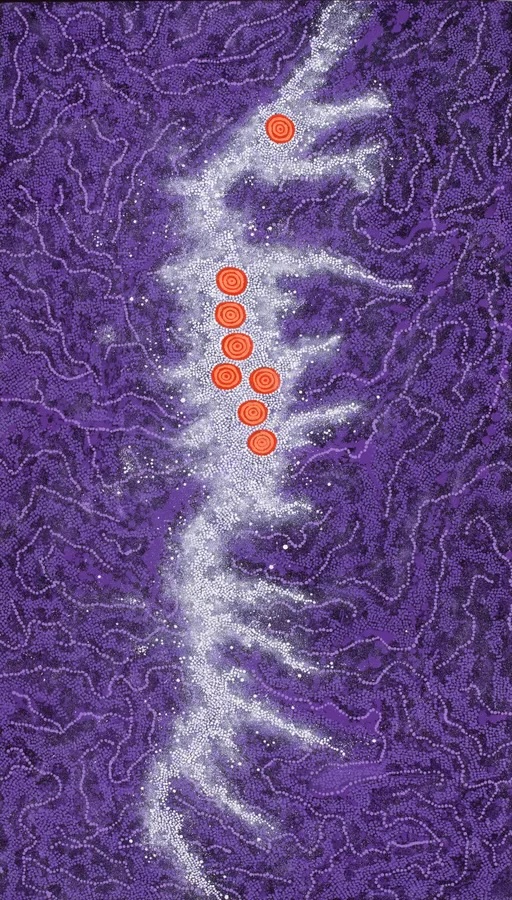
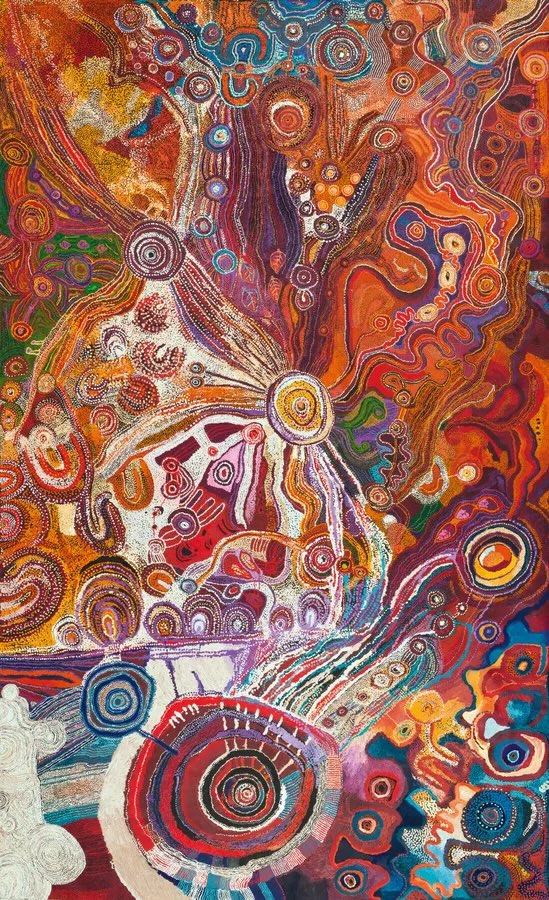
Meaning of the Seven Sisters Dreaming
The Seven Sisters Dreaming carries deep cultural meaning, centred on kinship, protection, and the strength of unity. At its core, the story teaches the importance of staying together, respecting boundaries, and upholding cultural law. The sisters’ journey reflects women’s knowledge and authority, while their refusal to be separated reinforces the power of collective strength.
As a songline, the story also embeds knowledge into the landscape, linking places, people, and ancestral events across vast distances. Its presence in the sky as the Pleiades, pursued by Orion, mirrors this journey, connecting land and astronomy. More than a story, the Seven Sisters Dreaming is a living system of law and identity, guiding relationships to Country and to each other.
Pleiades and the Seven Sisters
The Seven Sisters, known in astronomy as the Pleiades, appear in stories across an extraordinary range of cultures, from Aboriginal Australia to ancient Greece, Africa, and the Americas. What is striking is not simply that these stars are recognised, but that they are so often understood in the same way—as a group of young women, most commonly described as seven sisters.
This recurring pattern suggests a shared narrative structure that reaches far back into human history. While many cultures interpret stars through their own symbolic systems, the repetition of the idea of “seven sisters” across continents is unusually consistent. It points to the possibility that this story, or a version of it, travelled with early human populations as they moved across the world, adapting to new landscapes while retaining its core form.
One of the most intriguing elements is the number itself. To the naked eye, most observers can only clearly distinguish six stars within the Pleiades cluster, yet traditions across the globe insist there are seven. Many cultures explain this through the idea of a hidden or lost sister—suggesting that the story preserves an older memory of the sky, when the seventh star may have been more visible.
In many traditions, including the Aboriginal Seven Sisters Dreamtime story, the stars are not passive objects but active beings—often pursued, protected, or moving together in unity. The persistence of this narrative across vast distances and time suggests that the Seven Sisters may represent one of humanity’s oldest continuous stories, still visible each night in the sky and still carried in living cultural traditions.

Image of the Seven Sisters taken by the hubble telescope
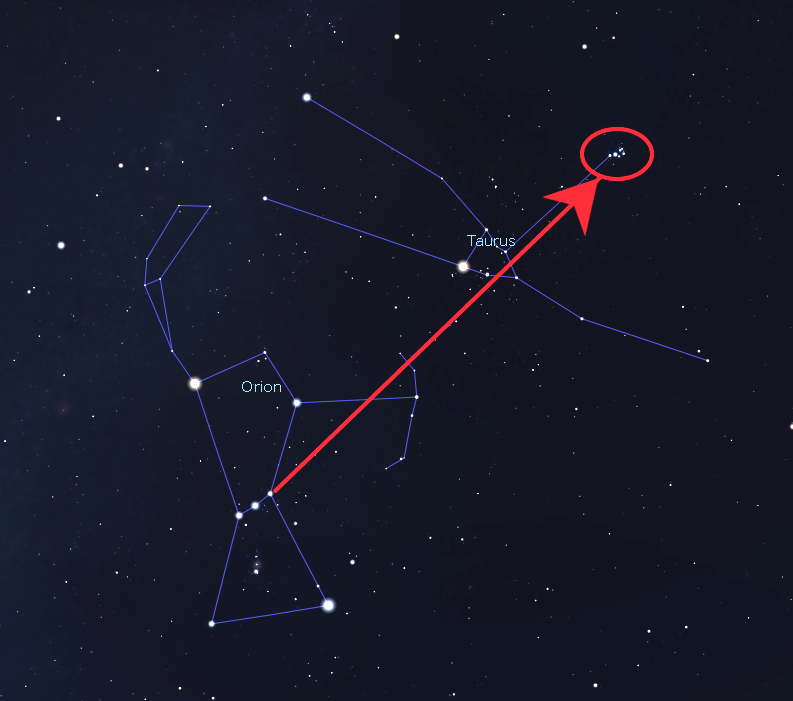
Locating the Seven Sisters in the Night Sky
Seven Sisters Dreaming and APY Lands Art
Nowhere has the Seven Sisters Dreaming become more influential in contemporary Aboriginal art than in the APY Lands of north-west South Australia. Known throughout much of the region as Kungkarangkalpa, the story forms the cultural foundation for many of the most celebrated paintings produced by Anangu artists.
Senior women artists including Tjungkara Ken, Sylvia Ken, Sandra Ken, Freda Brady, Nyunmiti Burton, and other custodians of the story have transformed this ancient songline into monumental contemporary artworks. Their paintings depict sacred sites, ancestral journeys, waterholes, and the living relationship between Tjukurpa and Ngura (Country), often through vibrant colour, expressive mark-making, and large-scale collaborative compositions.
Today, Seven Sisters paintings are among the most recognised works produced in the APY Lands and have helped establish the region as one of Australia’s most important centres of contemporary Indigenous art. To explore the artists, communities, art centres, and cultural traditions connected to these remarkable works, see our guide to APY Lands Art.
Further reading
All images featured in this article are presented strictly for educational and informational purposes.
This website may include copyrighted material for which specific authorization has not been obtained from the copyright owner.
All such images are presumed to be the intellectual property of the respective artist or their estate, and are used in accordance with principles of fair dealing or fair use under applicable copyright law.
Frequently Asked Questions About the Seven Sisters Dreaming
What is the Seven Sisters Dreaming?
The Seven Sisters Dreaming is one of the most important Aboriginal creation stories in Australia. It tells of seven ancestral women travelling across Country while being pursued by a powerful man, Wati Nyiru. As they move, they shape the landscape and establish cultural law. Their journey forms a vast songline, and their story continues in the sky as the Pleiades star cluster.
What is the Seven Sisters Dreamtime story about?
The Seven Sisters Dreamtime story follows the journey of seven sisters travelling across the desert, moving from place to place while avoiding Wati Nyiru, who is pursuing them. Along their path, they create rockholes, caves, and sacred sites. In the end, they escape by rising into the sky, where they become the Pleiades, forever just beyond his reach.
Who is Wati Nyiru?
Wati Nyiru is a powerful ancestral man and sorcerer who pursues the Seven Sisters across the land. He is often associated with the constellation Orion in the night sky. In the story, he uses shape-shifting and cunning to try to capture the youngest sister, but ultimately fails when the sisters transform into stars.
Why are the Seven Sisters in the sky?
The Seven Sisters are seen in the night sky as the Pleiades star cluster. In the Dreaming, they rose into the sky to escape Wati Nyiru, who continues to follow them as Orion. This connection between the story and the stars reflects a deep Aboriginal understanding of astronomy, where the sky mirrors events that took place on the land.
What does the Seven Sisters Dreaming mean?
The Seven Sisters Dreaming represents important cultural values including kinship, protection, law, and women’s knowledge. It teaches the importance of staying together, respecting boundaries, and understanding one’s role within Country. The story also reflects how knowledge is embedded in both the landscape and the sky.
Where is the Seven Sisters songline?
The Seven Sisters songline stretches across large parts of Australia, particularly through the Western and Central Deserts. It connects a series of sacred sites—such as rockholes, caves, and hills—that mark key moments in the sisters’ journey. Travelling along this songline is a way of engaging with the story and maintaining cultural knowledge.
Are there different versions of the Seven Sisters story?
Yes, the Seven Sisters Dreaming is shared by many Aboriginal groups, and each region has its own version of the story. While the core elements—such as the sisters, Wati Nyiru, and the journey across Country—remain consistent, the details vary depending on local language, Country, and cultural knowledge.
Why is the Seven Sisters Dreaming important?
The Seven Sisters Dreaming is important because it is a living system of cultural knowledge. It connects people to Country, law, and identity, and is maintained through storytelling, ceremony, and art. The story continues to guide how people understand the land, the sky, and their place within both.