
Nandabitta Maminyamandja
Groote Island Bark Painting
Nandabitta Maminyamandja
Born before 1921
Anindilyakwa
Groote Eylandt, Gulf of Carpentaria
Groote Eylandt
Groote Eylandt Art
Bark painting
Nandabitta Maminyamandja
Groote Eylandt Bark Paintings
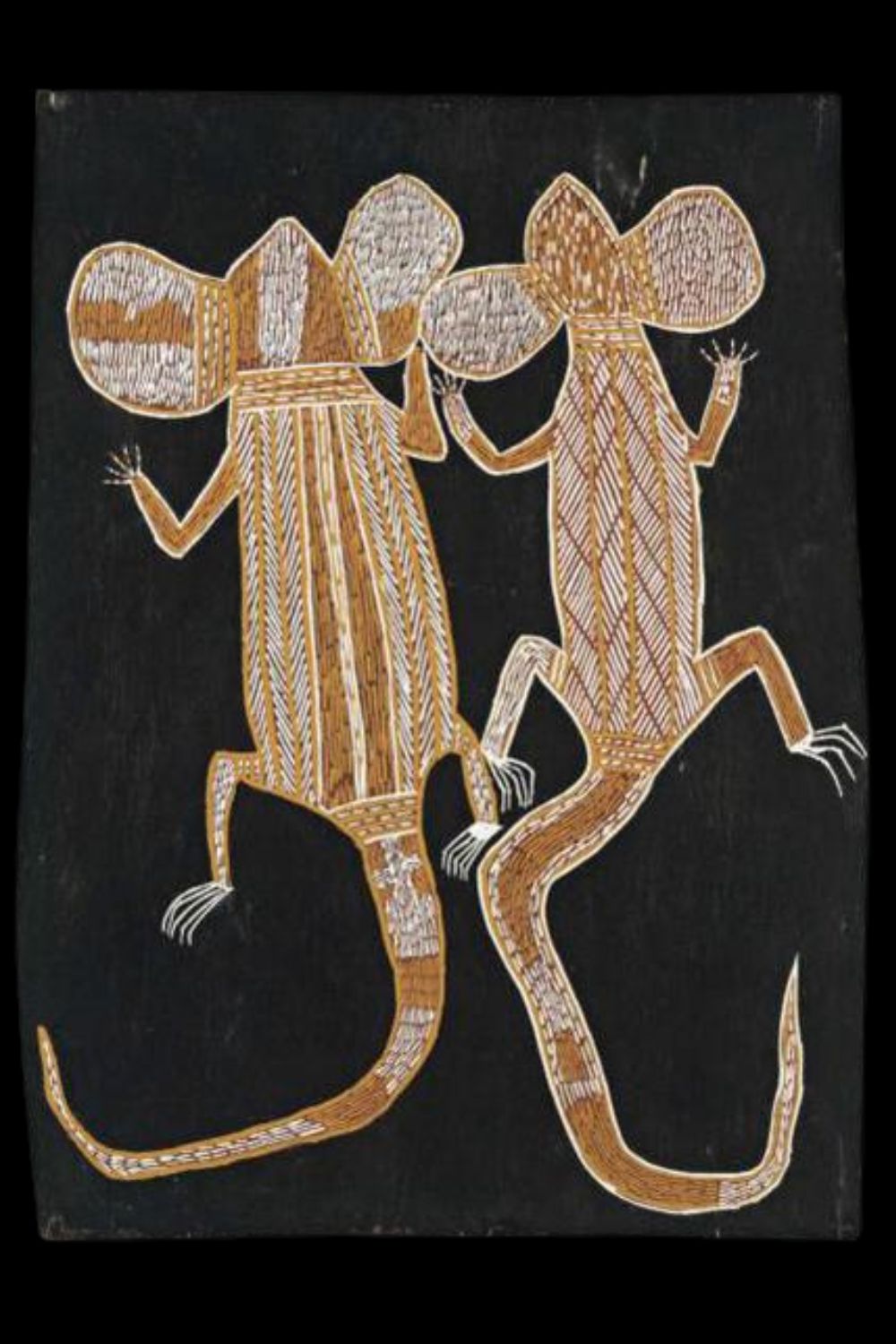
Nandabitta Maminyamandja is one of the few documented Anindilyakwa bark painters working in the traditional Groote Eylandt Art style during the mid-twentieth century. His artworks preserve important origin legends, Dreamtime narratives, and ceremonial stories associated with the Anindilyakwa people of the Gulf of Carpentaria. Painted in the distinctive regional manner of coloured dashes and dotted infill against black backgrounds, Nandabitta’s bark paintings frequently depict marine life, ancestral beings, fishing scenes, and creation stories connected to the land and sea.
Born before the establishment of the first Christian mission on Groote Eylandt in 1921, Nandabitta grew up within a fully traditional cultural environment. As a result, his bark paintings preserve important ceremonial and ancestral knowledge from a period before large-scale outside influence transformed life on the island. Stylistically, his works can sometimes resemble those of Thomas Nandjiwarra Amagula and Jabarrgwa (Kneepad) Warrabadalumba, particularly in their use of dense infill, black-ground compositions, and strong narrative imagery.
If you own a bark painting by Nandabitta Maminyamandja and would like assistance identifying, valuing, or selling the work, feel free to email clear images along with dimensions and any known history. I am always interested in acquiring important Groote Eylandt bark paintings and would be pleased to view the artwor
Nandabitta Maminyamandja Art Style
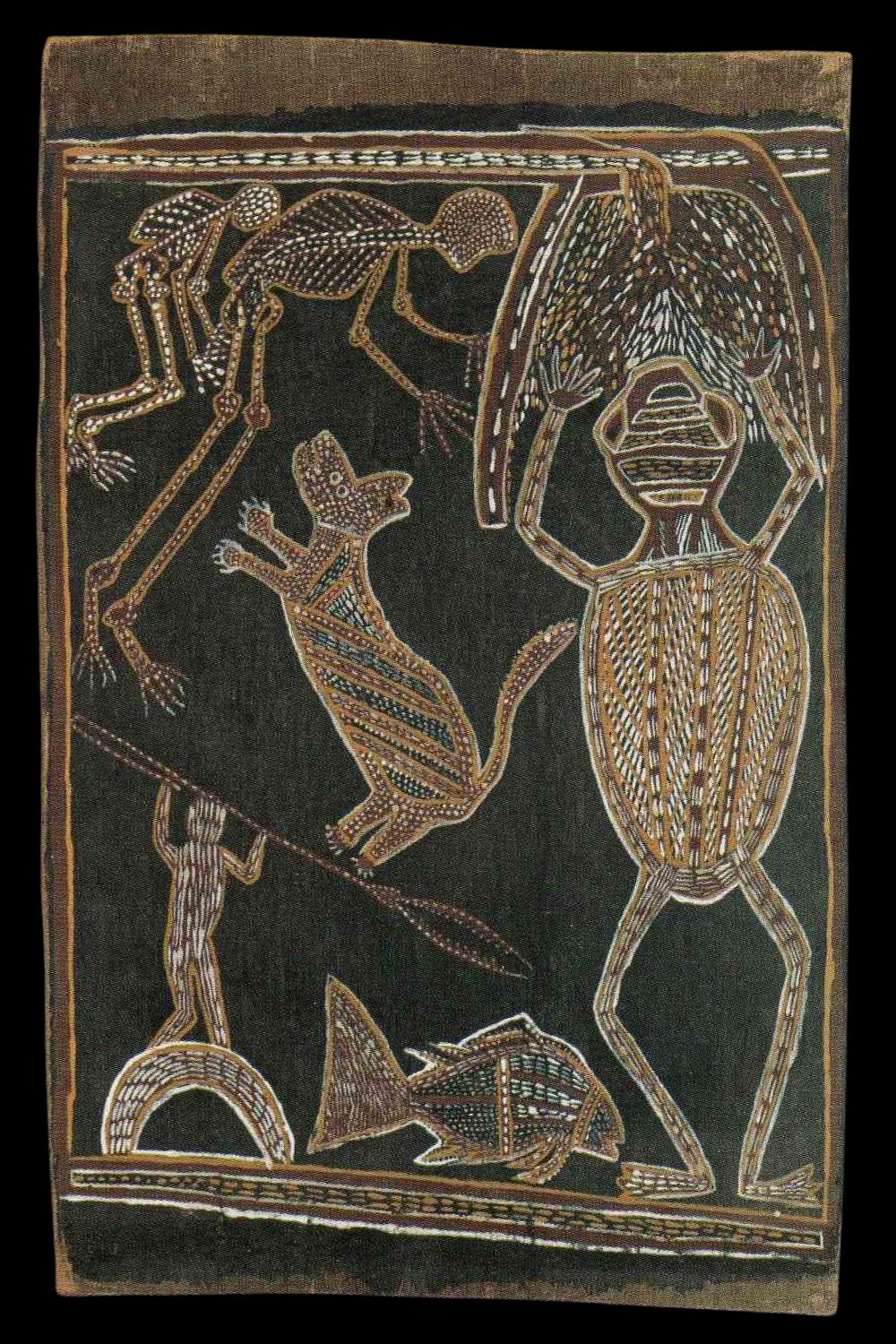
Like many examples of traditional Groote Eylandt Art, the majority of Nandabitta Maminyamandja’s bark paintings are executed against monochrome black backgrounds. His works frequently depict giant birds, sawfish, stingrays, sharks, and ancestral hunting or fishing scenes associated with Anindilyakwa Dreamtime stories and songlines explaining the creation of the land and sea.
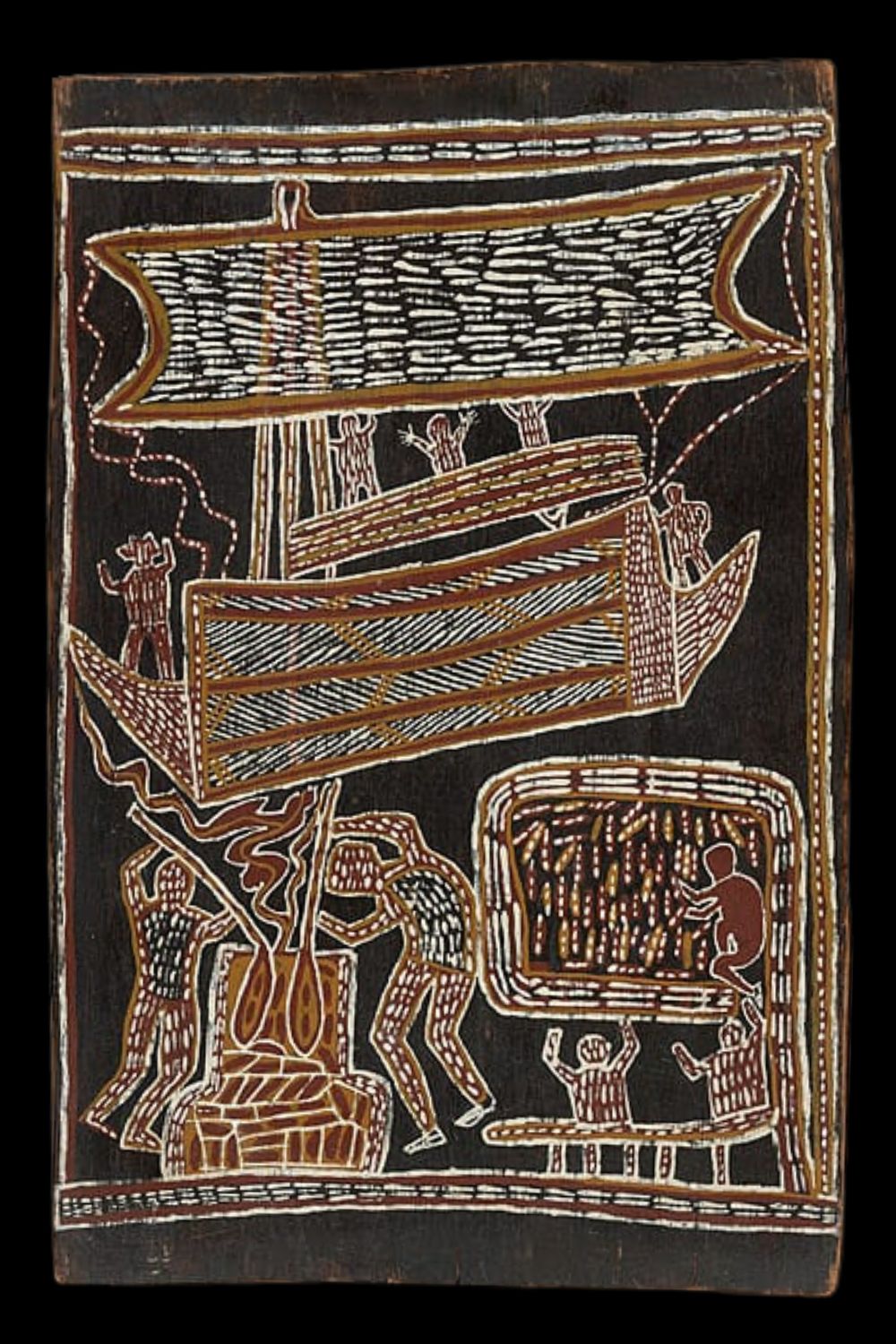
Like Jabarrgwa (Kneepad) Warrabadalumba, Nandabitta often utilised almost the entire bark surface for design, creating dense and visually dynamic compositions. Many later works are framed with parallel bands of pigment around the outer edge of the bark. His figurative forms are usually outlined in solid colour, while the interior surfaces are filled with the distinctive dotted and dashed infill characteristic of Groote Eylandt bark painting, occasionally incorporating areas of crosshatching.
Nandabitta’s human figures tend to be stocky in proportion and often lack clearly defined eyes. Despite their simplified forms, the figures possess a strong sense of movement and are frequently shown dancing, fishing, hunting, or participating in ceremony. He also produced several unusual bark paintings depicting skeletal spirit beings or ancestral skeleton figures brought back to life.
Unsigned bark paintings by Nandabitta can sometimes be difficult to distinguish from those of Thomas Nandjiwarra Amagula or Jabarrgwa (Kneepad) Warrabadalumba, particularly where the compositions feature dense infill, black-ground imagery, and complex ceremonial narratives.
Biography of Nandabitta Maminyamandja
Very little biographical information has survived regarding Nandabitta Maminyamandja, despite the importance of his bark paintings within the history of Groote Eylandt Art. Like many early Anindilyakwa artists, his works were often collected during a period when Aboriginal bark paintings were viewed primarily as ethnographic objects rather than individual artistic achievements. As a result, important details concerning his life, ceremonial role, and artistic career were rarely documented.
What is clear from the surviving bark paintings is that Nandabitta possessed deep knowledge of Anindilyakwa Dreamtime narratives, ceremonial traditions, and maritime creation stories associated with Groote Eylandt and the surrounding Gulf of Carpentaria. His works remain among the most distinctive examples of traditional Groote Eylandt bark painting.
If you possess further information, historical photographs, or artworks by Nandabitta Maminyamandja, I would be very interested to hear from you. Additional documentation may help preserve and expand knowledge surrounding this important Anindilyakwa artist and his contribution to Aboriginal Australian art.
Meaning of Nandabitta Maminyamandja Artworks
Creation Story by Nandabitta
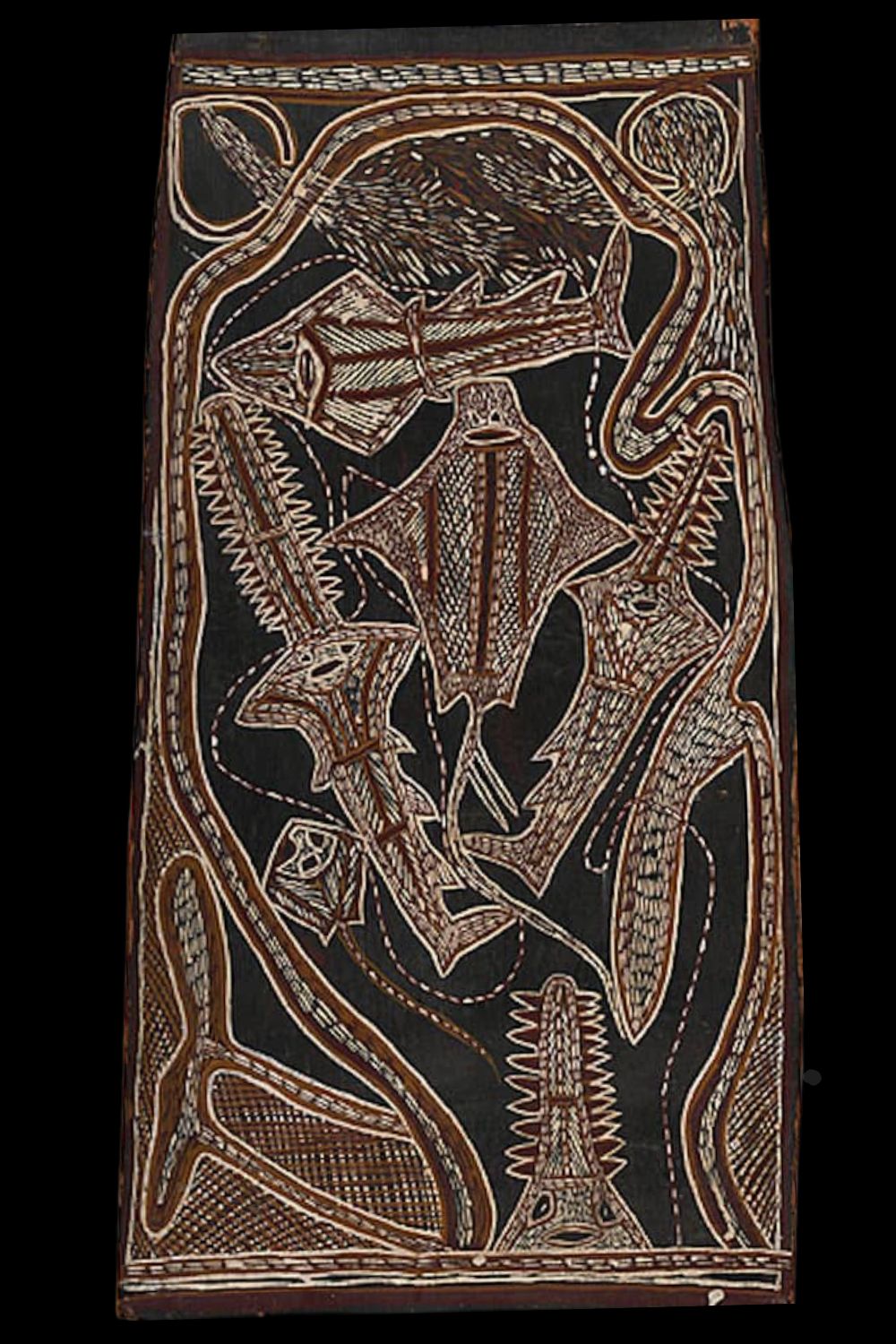
To a European viewer, the bark painting opposite may initially appear to depict little more than large fish and marine animals. In reality, the work records an important Anindilyakwa creation story explaining the formation of the Angurugu River and surrounding geographical features of Groote Eylandt.
According to the tradition, three Alawudawarra ancestral beings created the river system on the western coast of the island: Yukurrirridangwa the Sawfish, Dumarnindangwa the Manta Ray, and Manggabaramerra the Shovel-nosed Shark. These powerful ancestral beings travelled from Blue Mud Bay on the mainland across to Groote Eylandt. Upon arriving, the Sawfish cut a great channel through the earth, causing freshwater to gush from underground springs and fill the newly formed river. The Shovel-nosed Shark remained behind within the river system and transformed into a large rock formation, while the Manta Ray and its companions continued eastward toward Lake Angurugubira.
The painting itself functions as both narrative and map. The black ground running through the centre represents the Angurugu River. The Sawfish, depicted in multiple positions, cuts through the riverbanks as it shapes the landscape. In the lower left are forms representing sandbars near the river mouth, while the upper corners depict freshwater springs flowing into the river system. Dumarnindangwa the Manta Ray occupies the centre of the bark, accompanied by Yimaduwaya, a young stingray, while the Shovel-nosed Shark appears above. The dotted pathway traversing the composition represents the movements of people fishing for the descendants of these ancestral creator beings, which continue to inhabit the waters in animal form.
All images featured in this article are presented strictly for educational and informational purposes.
This website may include copyrighted material for which specific authorization has not been obtained from the copyright owner.
All such images are presumed to be the intellectual property of the respective artist or their estate, and are used in accordance with principles of fair dealing or fair use under applicable copyright law.