
Bobby West Tjupurrula: Biography, Painting Style and Importance
c.1958-
Pintupi
Western Desert, west of Kiwirrkurra
Papunya Tula Artists
Western Desert Art / Pintupi Art
Synthetic polymer paint on canvas and linen
Bobby West Tjupurrula is a senior Pintupi Aboriginal artist, former chairman of Papunya Tula Artists and influential community leader from Kiwirrkurra in Western Australia. The son of pioneering Western Desert painter Freddy West Tjakamarra, he grew up during the transition from traditional desert life to government settlements and witnessed the emergence of the Papunya painting movement.
His paintings depict ancestral sites and Tingari journeys through the Western Desert, ranging from intricate concentric designs to extraordinary fields of rhythmic, zigzagging lines. Beyond his artistic achievements, Bobby has played an important role in preserving Pintupi cultural knowledge and establishing remote dialysis services that allow Aboriginal people to remain connected to their Country.
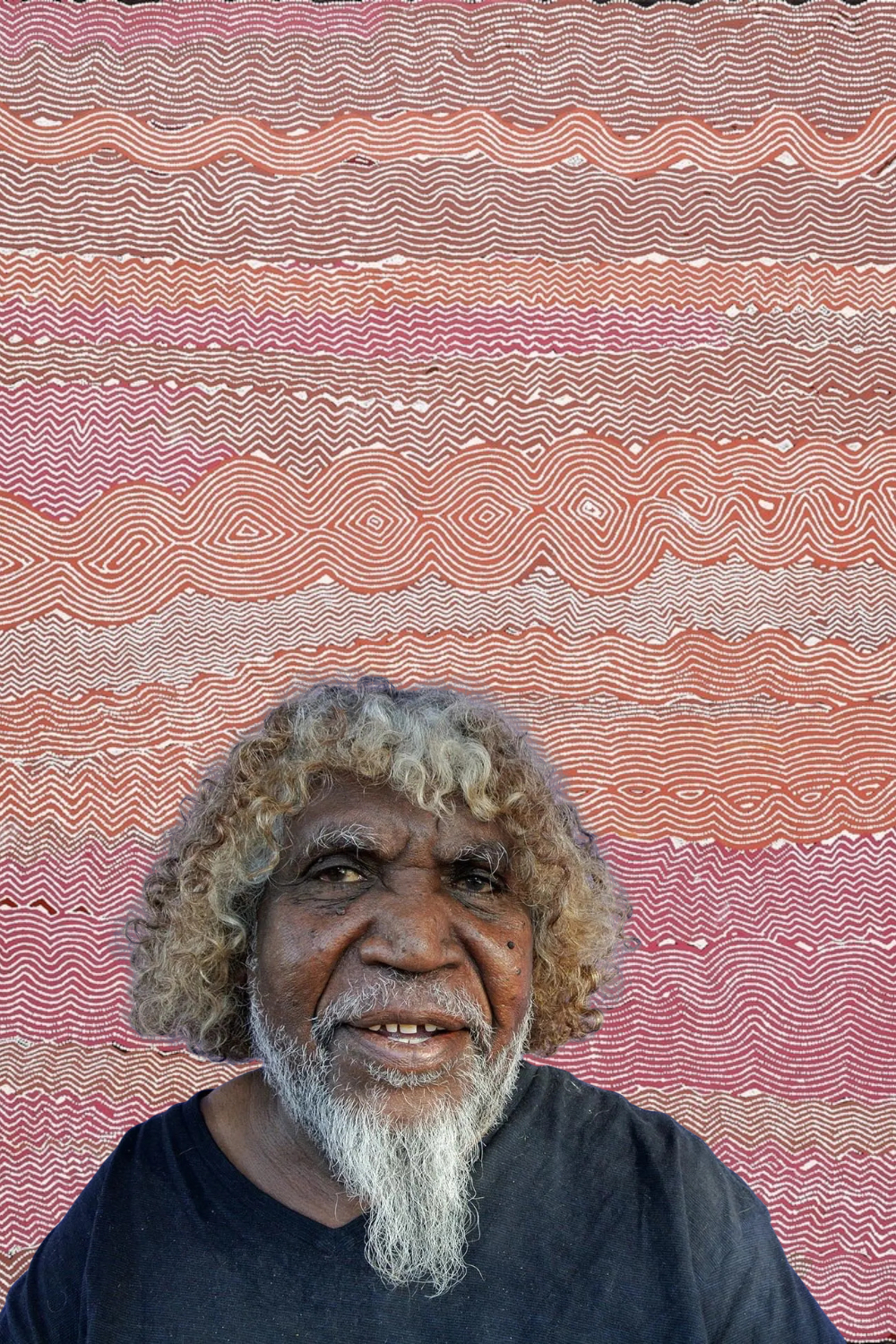
Bobby West Tjupurrula Biography
Bobby West Tjupurrula was born around 1958 at Tjamu Tjamu rockhole, east of present-day Kiwirrkurra, Western Australia. His father, Freddy West Tjakamarra, was a senior Pintupi man and an original shareholder of Papunya Tula Artists.
Bobby spent his early childhood travelling through the Western Desert with his family. In 1963, aged about five, they were encountered at Wili rockhole, east of Kintore, by a Northern Territory Welfare Branch patrol led by Jeremy Long. Douglas Lockwood later documented the encounter in The Lizard Eaters.
The family moved to Papunya, where Pintupi, Anmatyerr, Luritja and Warlpiri people lived together under difficult conditions. Interviewed by Steve Dow in 2017, Bobby recalled arriving with his baby sister, overcrowded settlement life and dependence on food rations. Nevertheless, Papunya became a centre of cultural exchange as senior men shared ceremonies and ancestral knowledge that helped shape the emerging painting movement.
Bobby was a teenager when painting flourished at Papunya in the early 1970s, with his father among its important Pintupi artists. As a young man, he travelled between Papunya, Balgo and Yuendumu, maintaining family connections. The National Gallery of Victoria holds an Untitled painting he made at Balgo around 1986.
The establishment of Walungurru (Kintore) in 1981 and later Kiwirrkurra enabled Pintupi families to return towards ancestral Country. Freddy West helped establish Kiwirrkurra, where Bobby eventually settled.
In 1984, nine Pintupi people, including future artist Warlimpirrnga Tjapaltjarri, came into contact with relatives near Kiwirrkurra after living independently in the desert. Bobby later interpreted Warlimpirrnga’s account of the encounter. Their childhoods reflected different experiences of settlement: Bobby had moved to Papunya in 1963, while Warlimpirrnga remained in the desert until adulthood.
Bobby began painting for Papunya Tula Artists in the late 1980s under his father’s guidance, working consistently from around 1993. Like Warlimpirrnga, he painted Tingari journeys and ancestral sites, but developed his own distinctive geometric style. He later served on the Kiwirrkurra community council and several times chaired Papunya Tula Artists.
In 1999, Bobby contributed to the Kiwirrkurra Men’s Painting for the Western Desert Dialysis Appeal. Turkey Tolson Tjupurrula, Naata Nungurrayi and Patrick Tjungurrayi also participated in the wider fundraising effort, which helped establish dialysis services closer to remote communities and traditional Country.
Bobby attended the National Gallery of Victoria’s Tjukurrtjanu exhibition in 2011 alongside Ronnie Tjampitjinpa and Long Jack Phillipus Tjakamarra. In 2017, he co-curated Tjungunutja: From Having Come Together at the Museum and Art Gallery of the Northern Territory, contributing firsthand Aboriginal perspectives on Papunya’s history and helping determine which culturally restricted early paintings should not be publicly exhibited.
In 2023, his work appeared alongside George Tjungurrayi and Warlimpirrnga in Papunya Tula Artists: Community XIII. His brother, John West Tjupurrula, and sister Kim Napurrula are also accomplished painters, and Bobby has taught younger family members. West: Three Generations of Painters (Utopia Art Sydney, 2025) celebrated this continuing family tradition, established by Freddy West and carried forward through successive generations.
Bobby West Tjupurrula Painting Style and Subjects
Bobby West Tjupurrula’s paintings are distinguished by their geometric precision, rhythmic repetition and extraordinary sense of movement. His work depicts ancestral sites and Tingari journeys through the Western Desert, transforming inherited ceremonial designs into highly individual compositions.
The Tingari are ancestral beings whose journeys established important sites, performed ceremonies and shaped the landscape. Their travels are preserved through interconnected songs, ceremonies and cultural knowledge, much of which remains restricted under Pintupi Law.
Bobby’s paintings relate to particular places associated with these journeys, including Palipalintja, Yunala, Tarkul, Malparringya, Ngamurru, Tingaritjarra, Tjutalpi and Wilkinkarra (Lake Mackay). Rather than illustrating entire narratives, individual paintings often concentrate on specific sites or sections of ancestral journeys.
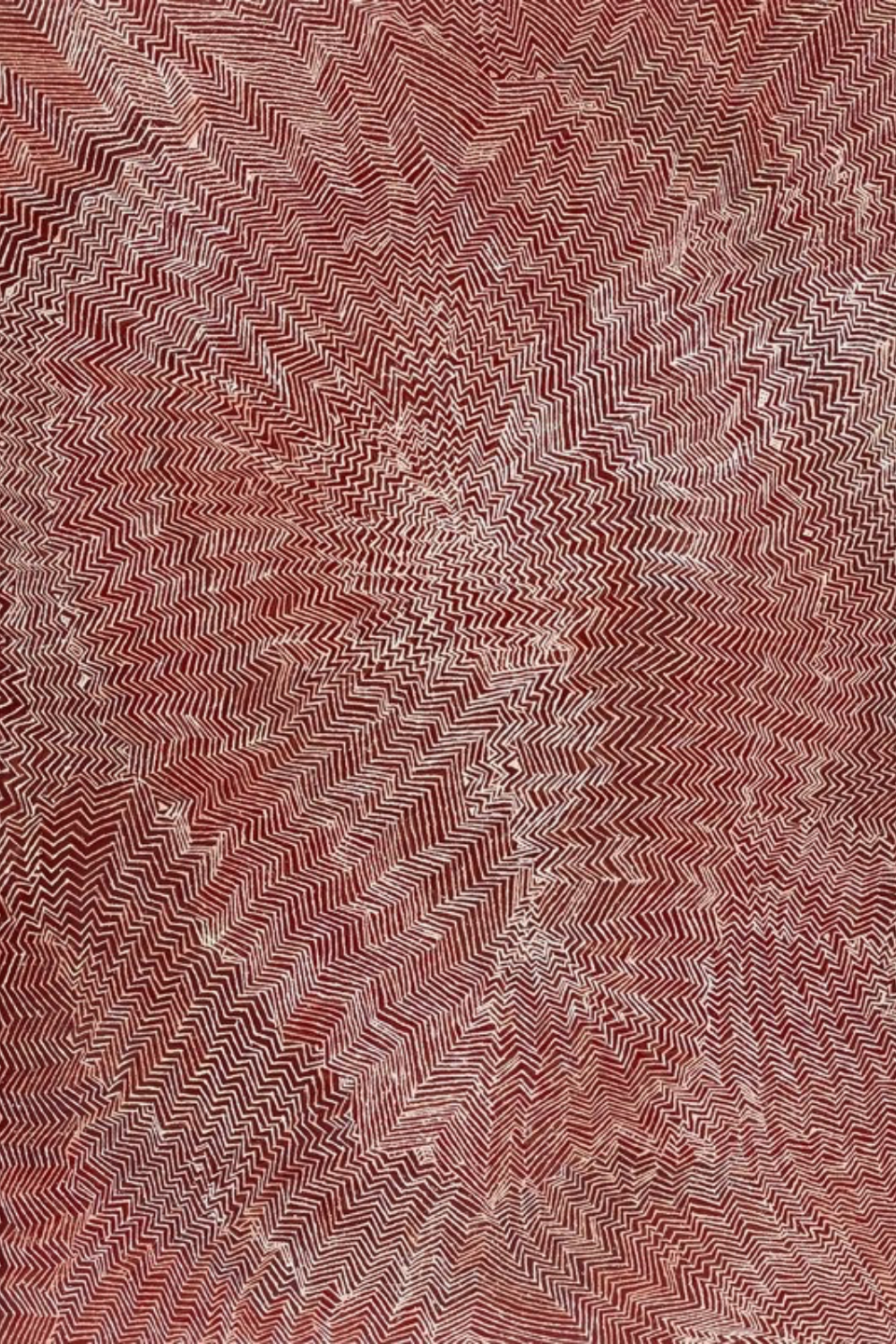
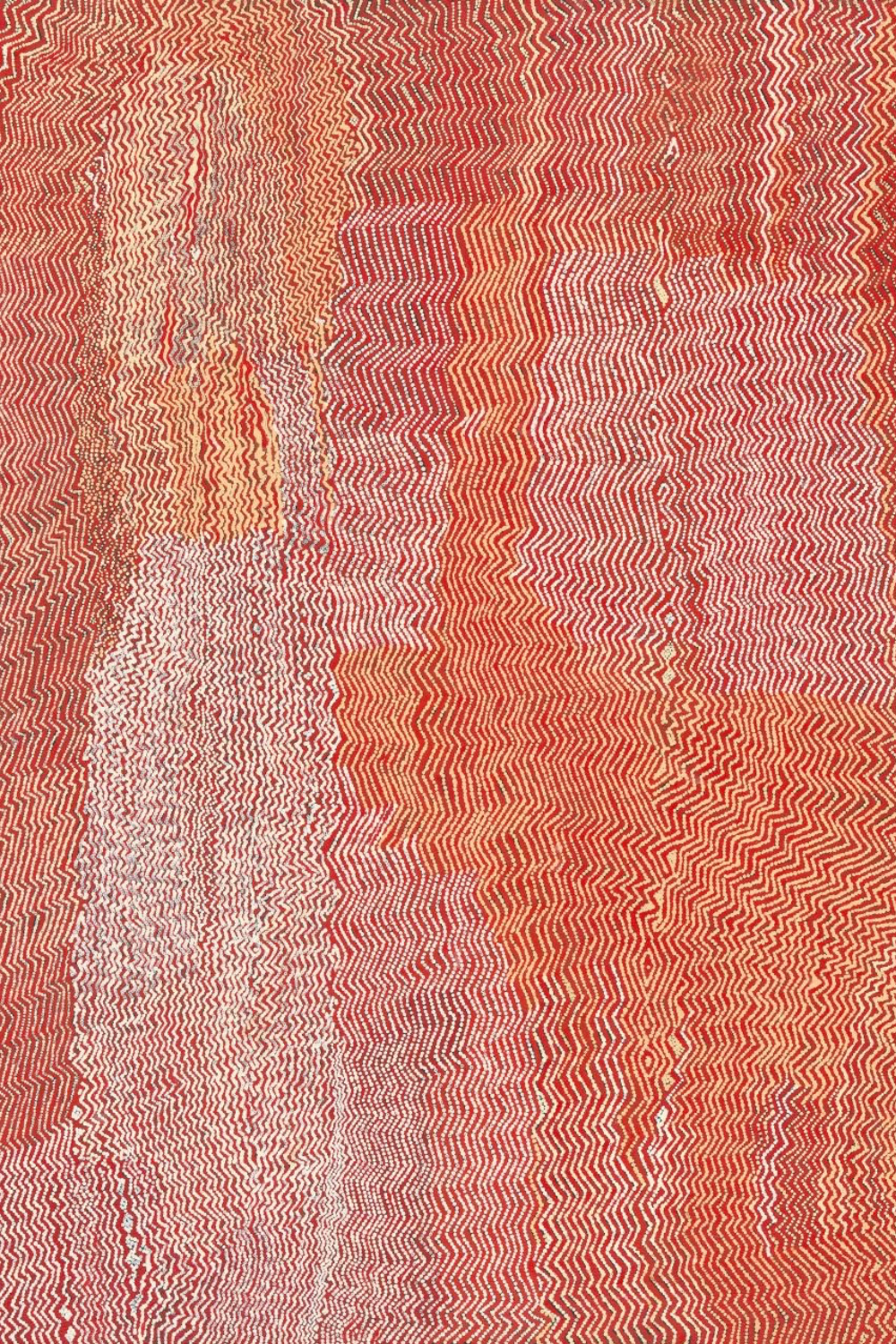
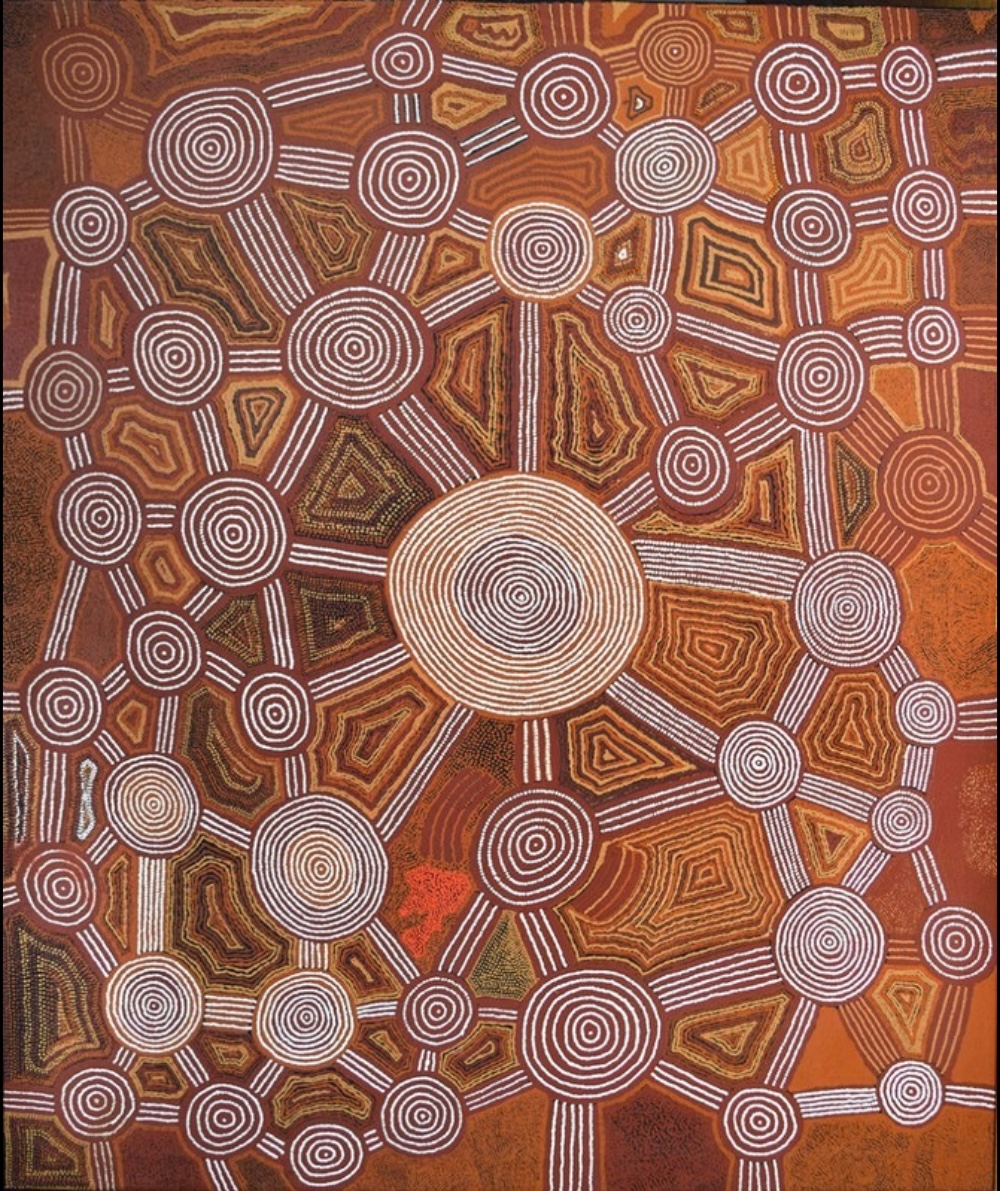
His earlier works frequently employ the characteristic Pintupi vocabulary of concentric circles, connecting lines and geometric arrangements, representing ancestral sites and the relationships between them. However, by the late 1990s he was already experimenting with other approaches, introducing closely repeated parallel lines, chevrons and zigzags.
These increasingly intricate patterns became a defining feature of his art. Lines expand, contract and change direction, forming undulating bands that appear to vibrate across the canvas. Subtle variations in spacing, colour and direction create an impression of shifting light and movement, while carefully controlled repetition gives the compositions their remarkable visual intensity.
This development was not a straightforward progression from traditional symbolism towards abstraction. Throughout his career, Bobby has explored different ways of depicting ancestral Country, sometimes using recognisable concentric forms and elsewhere reducing the composition to almost continuous fields of rhythmic markings.
The resulting optical effects are not simply decorative. His repeated lines can evoke the sandhills, ancestral pathways and ceremonial significance of particular places, expressing the relationship between physical landscape and inherited cultural knowledge.
More recently, Bobby has extended his artistic language beyond canvas. His designs were transformed into an immersive light installation for Parrtjima in 2025, while his 2026 presentation at Melbourne Art Fair introduced sculptural works incorporating his distinctive rhythmic patterns.
Tingari Cycle and Ancestral Journeys
The Tingari Cycle is central to Bobby West Tjupurrula’s painting. The Tingari are ancestral beings whose ceremonial journeys shaped the Western Desert, connecting rockholes, sandhills, sacred mountains and water soakages through songlines. Their stories are preserved through songs and ceremonies, much of which remains restricted to initiated Pintupi men.
Bobby’s Tingari Cycle (2002) depicts Umari, a rockhole in the sandhills east of Mount Webb, Western Australia. Concentric circles connected by parallel white lines form an intricate network of ancestral sites and pathways. According to the accompanying Papunya Tula documentation, Tingari ancestors gathered at such places for Maliera (initiation) ceremonies.
Other paintings depict sites including Palipalintja, Yunala, Tarkul, Malparringya and Wilkinkarra (Lake Mackay). Each concentrates on a particular place or section of an ancestral journey rather than the entire Tingari Cycle.
These paintings express more than physical geography. They connect ancestral history, ceremonial knowledge and Bobby’s continuing relationship with Country.
Palipalintja — Tingari Men and Sandhill Country
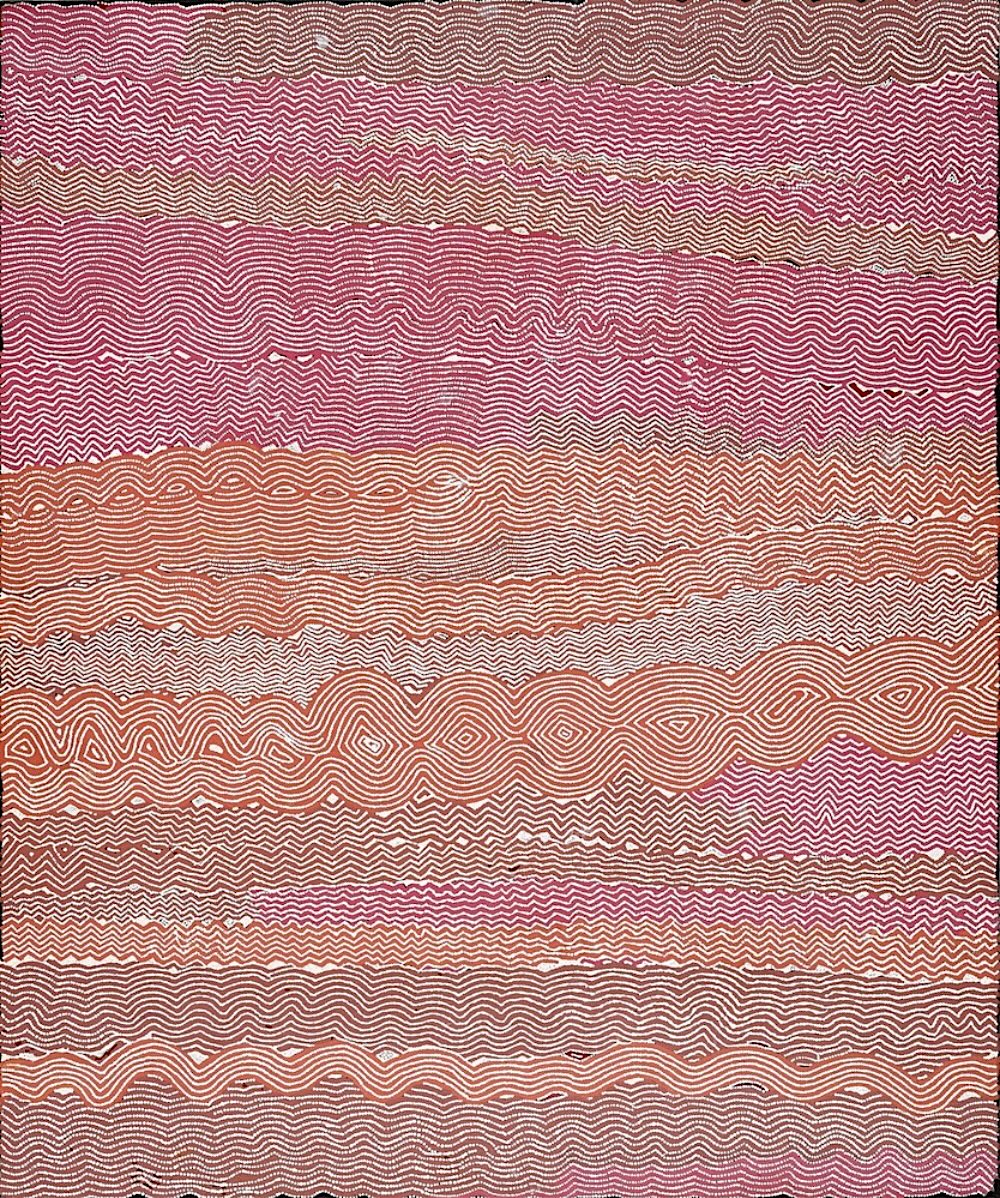
Palipalintja, a rockhole west of Jupiter Well, is among Bobby West’s recurring subjects. According to the original Papunya Tula certificate for Palipalintja (2003), a large group of Tingari men camped there before continuing northeast through Tarkul towards Lake Mackay.
The Tingari men were traditionally followed by Tingari women and accompanied by novices. Their ceremonial journeys form part of sacred song cycles, much of whose knowledge remains restricted.
The 2003 painting depicts this ancestral Country through densely repeated, undulating white lines across bands of pink, red and ochre. Subtle changes in their direction create an extraordinary impression of movement and shimmering light.
Another Palipalintja painting (2009) describes Tingari journeys through Wala Wala and Kiwirrkurra towards Tarkul and Lake Mackay. Its repeated lines specifically represent sandhills crossed by the ancestors.
These seemingly abstract compositions are grounded in particular ancestral places, connecting Bobby’s distinctive visual language with the geography and ceremonial knowledge of Pintupi Country.
Warlukurlangu — Bushfire Dreaming
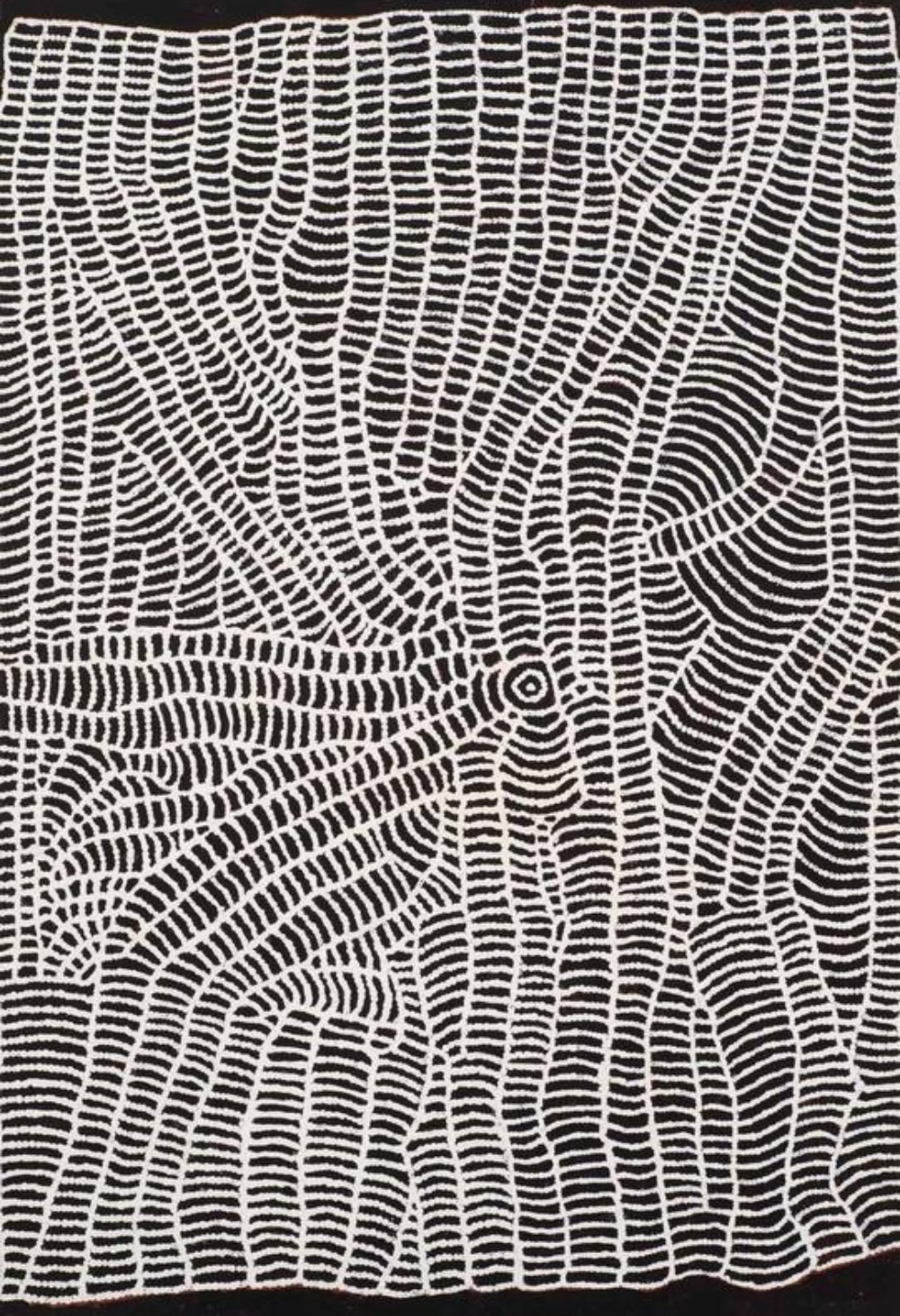
Warlukurlangu, southwest of Yuendumu, is an important ancestral Bushfire Dreaming site. According to the traditional narrative, Lungkata, the Blue-tongue Lizard ancestor, unleashed a great fire to punish his sons after they killed a sacred kangaroo.
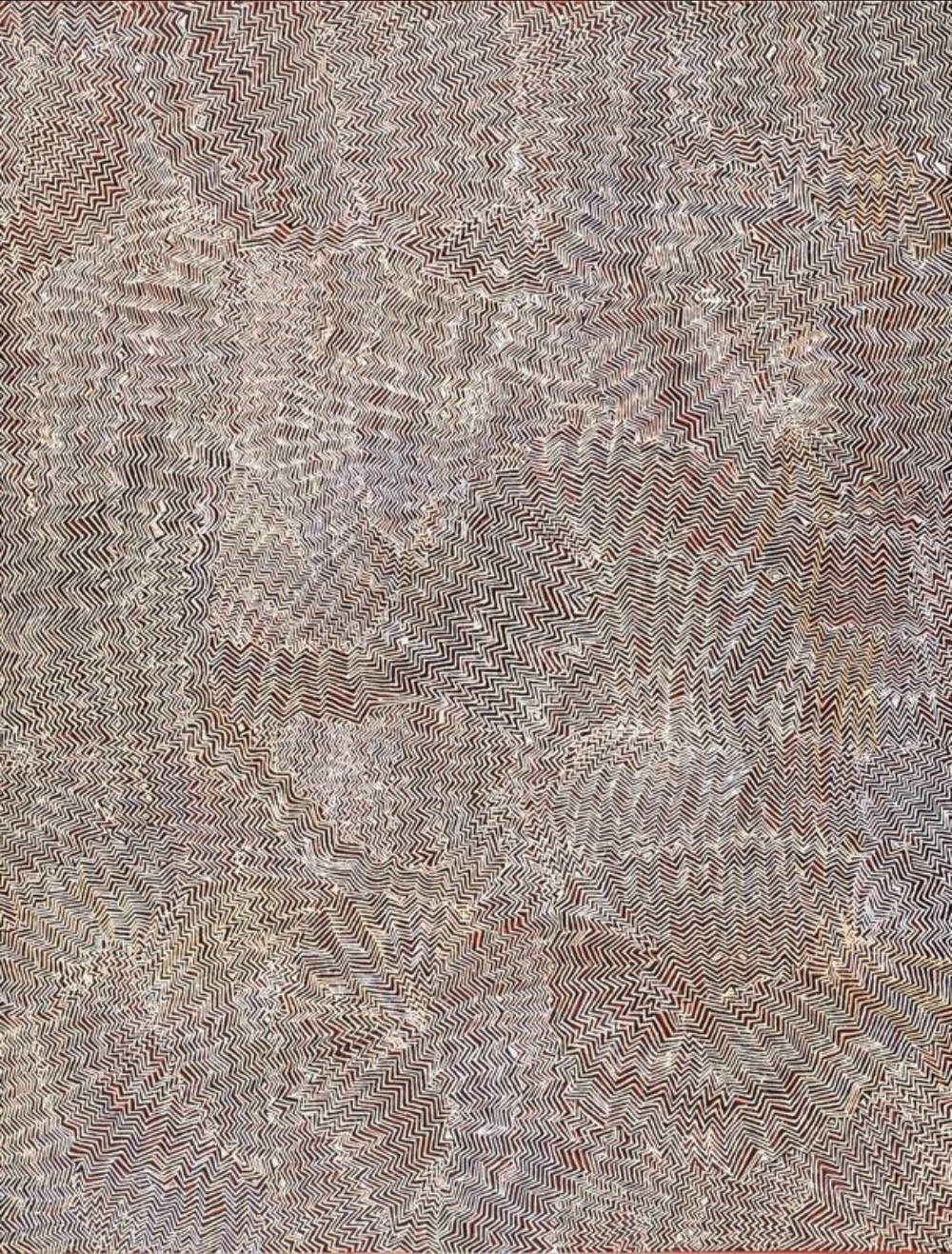
Bobby West’s Warlukulangu (2001) uses closely repeated white markings against black, the lines twisting and converging into an intricate, vibrating composition. The National Gallery of Victoria holds another painting, Bushfire Dreaming at Warlukurlangu (2001).
Other artists who depicted this Dreaming include Clifford Possum Tjapaltjarri and Tim Leura Tjapaltjarri, whose monumental Warlugulong (1976) is held by the Art Gallery of New South Wales.
These works demonstrate the strikingly different ways Aboriginal artists have represented the same ancestral Country.
Bobby West Tjupurrula’s Cultural Importance
Bobby West’s importance extends well beyond his paintings.
In 1999 he participated in the collaborative Kiwirrkurra Men’s Painting created for the Western Desert Dialysis Appeal. The work was auctioned for $340,000, contributing to a broader fundraising campaign that raised more than $1 million.
The money helped establish the Aboriginal-controlled dialysis organisation now known as Purple House. Its purpose was to enable people requiring dialysis to receive treatment closer to their communities rather than being permanently separated from family and Country.
Bobby has served as a Purple House director since its beginning. His involvement reflects the wider social responsibilities of senior Pintupi artists and community leaders.
He has also been influential in how the history of Western Desert painting is understood.
In 2017 Bobby was an Aboriginal co-curator of Tjungunutja: From Having Come Together at the Museum and Art Gallery of the Northern Territory. The exhibition examined the beginnings of Papunya painting through the knowledge and recollections of Aboriginal artists and custodians.
Bobby helped identify early paintings containing restricted ceremonial material that should not be displayed publicly.
He also challenged the simplified account of Papunya painting as a movement initiated solely by Geoffrey Bardon, emphasising the existing ceremonial traditions and exchange of cultural knowledge between Aboriginal peoples.
Speaking about the importance of painting to younger generations, he told Steve Dow in 2017:
The art is really important to my children. It’s the only way to keep the culture and the law together.
For Bobby, painting is therefore both an individual artistic practice and a means of continuing the knowledge and responsibilities inherited from earlier generations.
Bobby West Tjupurrula Value and Auction results
Works Offered at Auction: 29
Sale Rate: 59%
Highest Sale: $15,500 AUD
Median Sale Price: $4,500 AUD
To view individual select artworks along with dimensions provenance and sales prices please ivsit the Bobby West Tjupurrula Value page (not yet constructed)
Collections and Exhibitions
Bobby West Tjupurrula has exhibited throughout Australia and internationally, including New York, Paris, London and Singapore. His career spans more than three decades, with paintings held in major Australian and international public collections. His artistic achievements include the 2011 Telstra General Painting Award and, more recently, experiments with light installations and sculpture.
Selected Exhibitions and Awards
-
2002: First documented solo exhibition, William Mora Galleries, Melbourne.
-
2011: Telstra General Painting Award, 28th National Aboriginal and Torres Strait Islander Art Awards.
-
2017: Aboriginal co-curator, Tjungunutja: From Having Come Together, Museum and Art Gallery of the Northern Territory.
-
2025: West: Three Generations of Painters, Utopia Art Sydney.
-
2025: Hypnotic Reverberations, Parrtjima Festival of Light, Alice Springs.
-
2026: Melbourne Art Fair, Alcaston Gallery, featuring new sculptural works and a documentary of his return to ancestral Country.
Public Collections
Further Reading
-
Hetti Perkins, ‘Bobby West Tjupurrula in Conversation’, in One Sun One Moon: Aboriginal Art in Australia, Art Gallery of New South Wales, Sydney, 2007, pp. 190–194. A firsthand account of Bobby’s life, cultural knowledge and artistic background.
-
Hetti Perkins, Art + Soul: A Journey into the World of Aboriginal Art, Miegunyah Press, Melbourne, 2010, pp. 58–61. Features Bobby’s work and his involvement with Papunya Tula Artists.
-
Fred R. Myers, ‘Whose Story Is This? Complexities and Complicities of Using Archival Footage’, in Jane Anderson and Haidy Geismar (eds), The Routledge Companion to Cultural Property, Routledge, 2017, pp. 168–193. Discusses Bobby’s involvement in the return and interpretation of historical footage documenting his family.
-
Fred R. Myers and Terry Smith, Six Paintings from Papunya: A Conversation, Duke University Press, 2024. Examines early Papunya painting and discusses Bobby’s understanding of paintings as gifts of ancestral knowledge.
-
M. R. O’Connor, Wayfinding: The Science and Mystery of How Humans Navigate the World, St Martin’s Press, 2019. Includes Bobby’s personal recollections of arriving at Papunya as a child after travelling through the Western Desert.
All images featured in this article are presented strictly for educational and informational purposes.
This website may include copyrighted material for which specific authorization has not been obtained from the copyright owner.
All such images are presumed to be the intellectual property of the respective artist or their estate, and are used in accordance with principles of fair dealing or fair use under applicable copyright law.