Emily Kame Kngwarreye
c.1910–1996
Anmatyerre
Alhalkere Country, Utopia, Central Australia
Utopia, Northern Territory
Utopia Art / Central Desert Art
Batik and painting
Emily Kame Kngwarreye also recorded as Emily Kam Kngwarray, Emily Kngwarreye and Emily Kame Kngarreye, was one of the most important Australian painters of the twentieth century. Her public career on canvas lasted only eight years, yet concentrating on those eight years gives a misleading picture of the artist. By the time she first painted on canvas in 1988, Emily had spent a lifetime making marks through women’s ceremony: painting ochre designs onto bodies with her fingers and hands, drawing in sand, singing and dancing Awely, and later working for more than a decade in batik.
This helps explain why Emily’s paintings are so extraordinarily sensual and physically immediate. Dots pulse and accumulate, colours bloom into one another, lines wander across the surface and, in her later works, enormous brushstrokes record the movement and reach of her arm. Even after moving to canvas, there is evidence that she sometimes applied paint directly with her fingers, continuing the intimate contact between hand, pigment and surface that she had known through ceremonial body painting.
Emily began painting when she was nearly eighty, but by that stage had already been a batik artist for over a decade and painting on bodies for over half a century. Her art developed before the european paint brush.
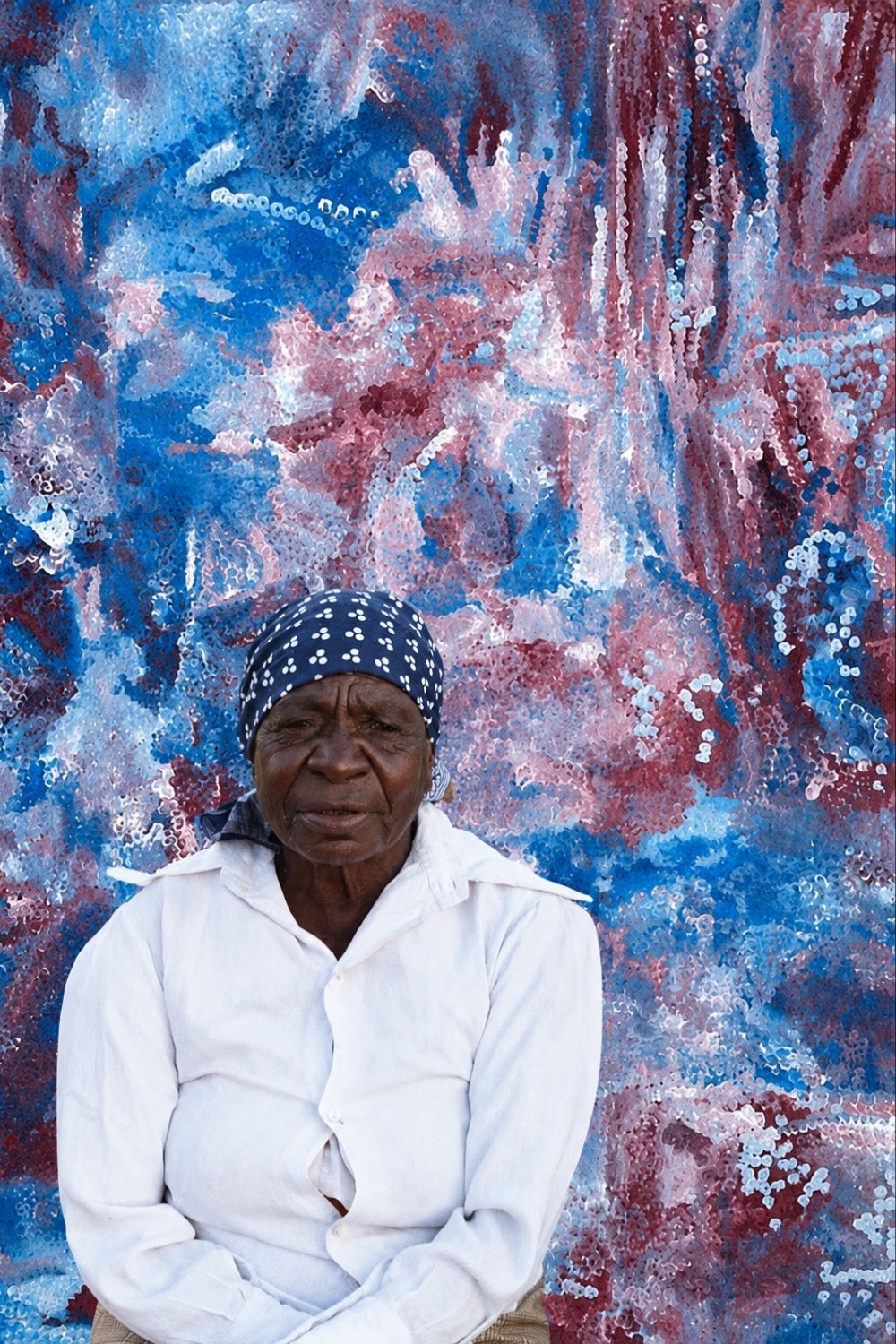
Throughout these transformations, one thing remained constant: Alhalkere, Emily’s Country. Its plants, yams, seeds, grasses, emus, lizards, rain, seasons and women’s ceremonies provided an interconnected body of knowledge from which her Utopia art emerged. When asked what she painted, Emily famously listed numerous elements of her Country before summarising them as “whole lot.”
Emily Kame Kngwarreye’s Early Life
Emily was born around 1910 at Alhalkere, her father’s and grandfather’s Country in what later became known as Utopia, about 230 kilometres north-east of Alice Springs. She was Anmatyerre and belonged to a generation whose lives encompassed extraordinary changes in Central Australia.
Emily grew up before motor vehicles, permanent settlements and the infrastructure that would transform the region. As a child she experienced the arrival of pastoralists, cattle, horses and other features of the expanding pastoral economy.
She became known as an exceptionally strong and capable woman. Rather than describing her station life simply as “domestic work”, it is important to recognise that Emily undertook work normally associated with men. She worked as a stockhand, handling livestock and carrying out demanding station work, and was also involved with camel teams carrying supplies between Alcoota and the Wolfram Mine at Mount Riddock.
This was hard physical work in an environment where almost everything depended upon endurance, knowledge of Country and practical competence. The strength and confidence later visible when Emily worked across enormous canvases did not suddenly appear in old age.
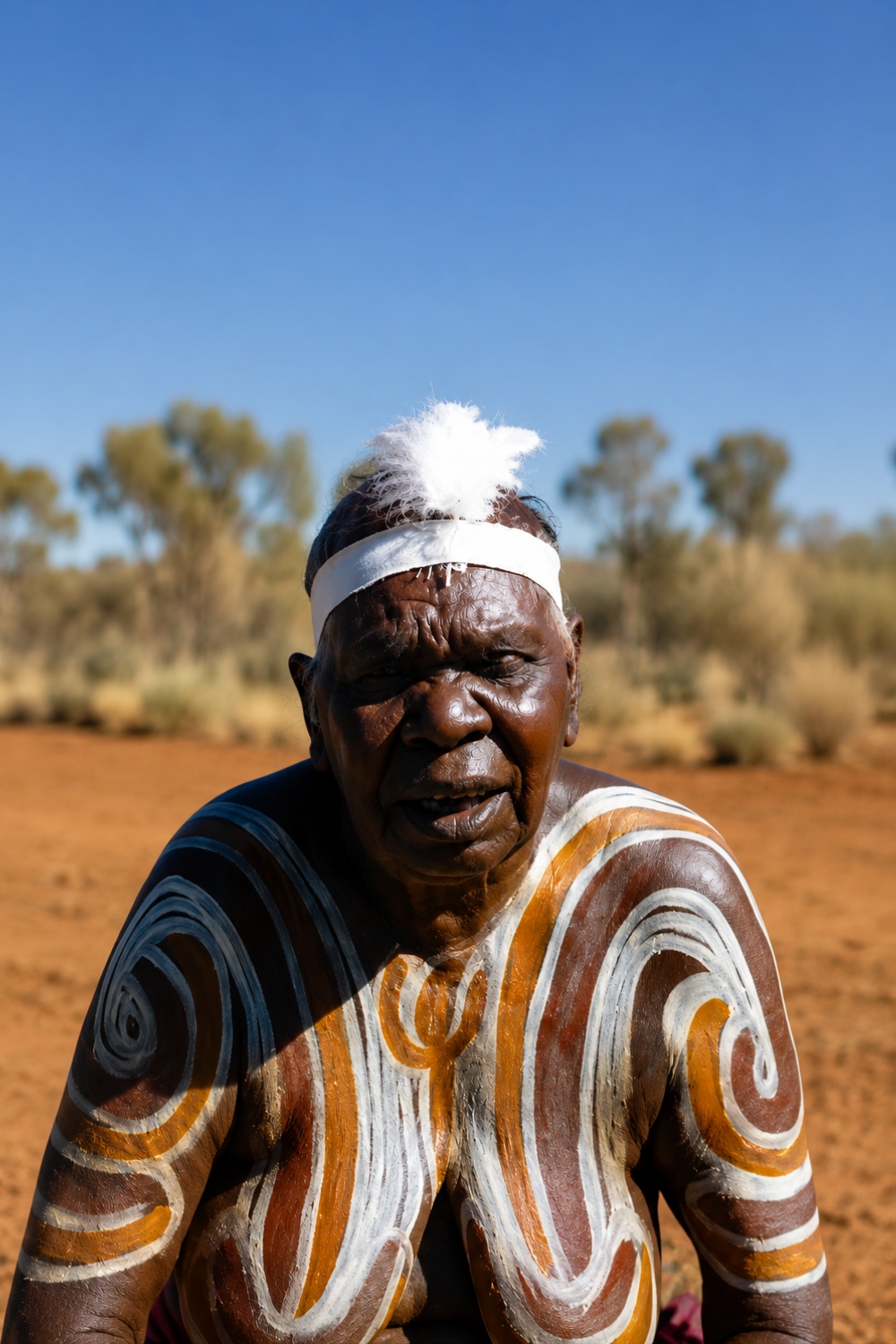
At the same time, Emily’s cultural education continued. She became a senior Anmatyerre woman with considerable ceremonial knowledge and authority. Awely—women’s ceremony involving Country, song, dance and body painting—was fundamental to this life.
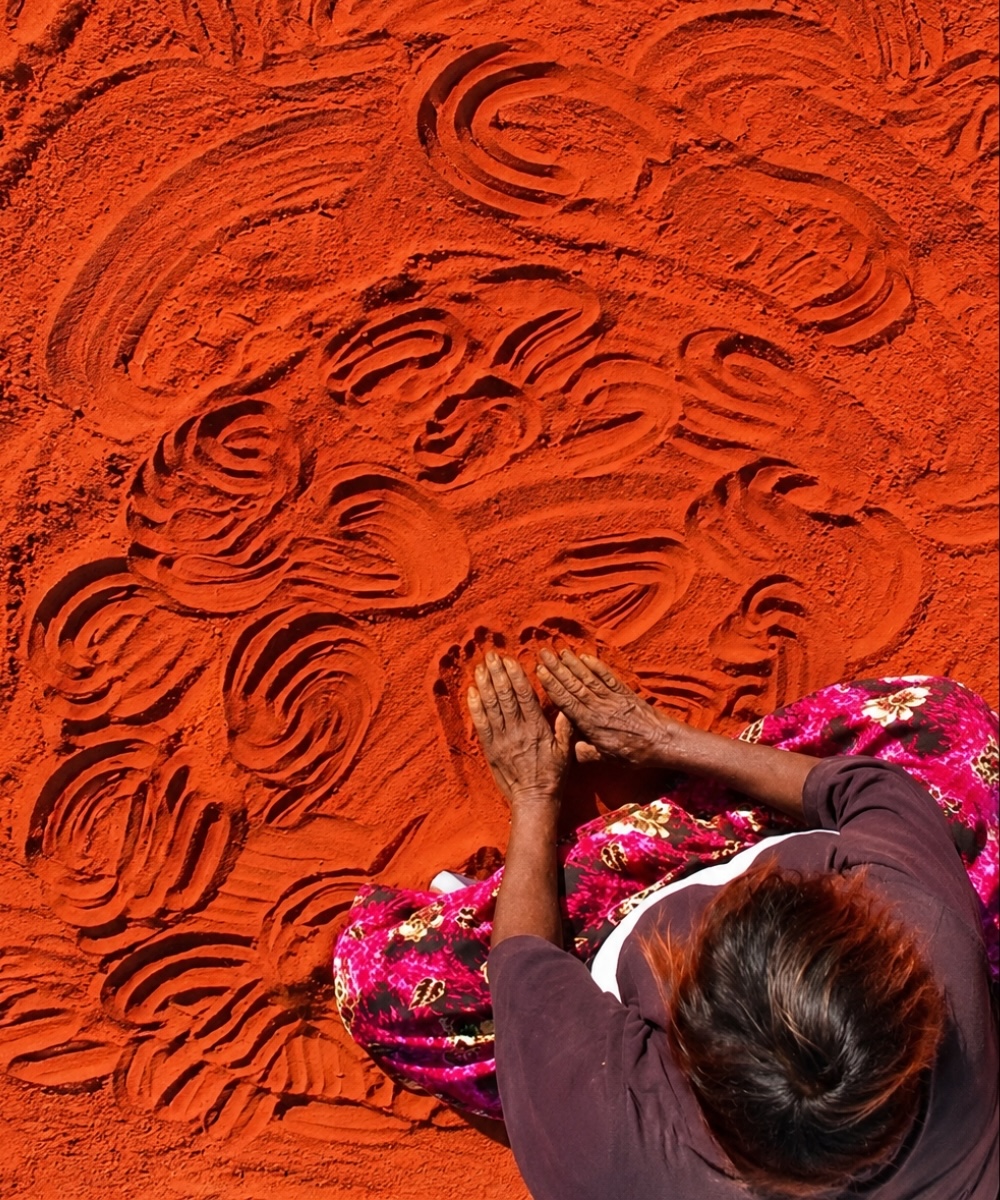
Emily painted the bodies of other women in preparation for ceremony. Ochre was handled directly. Fingers and hands moved across skin, following the contours of the body. Women also drew in sand, creating lines, marks and repeated fingertip impressions that could be altered or erased as songs and narratives progressed.
These were not preliminary exercises for a future career as an artist. They were already sophisticated forms of visual and performative expression.
Emily’s participation in ceremony and a lifetime of cultural practice formed the basis of her later artistic production.
Emily’s Utopia story was also deeply entwined with her sister in law Minnie Pwerle and Minnie’s daughter Barbara Weir. When Barbara was a child and authorities were attempting to remove children of mixed descent from their families, Minnie and Emily hid her from them. Barbara was eventually taken away, but many years later returned to Utopia, where Emily again became an important presence in her life during the Batik movement.
Alhalkere — A Living Country
After a lifetime gathering bush foods and watching the seasons change, Emily Kame Kngwarreye knew the ecology of Alhalkere, her father’s and grandfather’s Country, intimately. She knew where foods grew, when plants flowered and seeded, what could be dug from beneath the ground, and how rain transformed apparently dry Country into abundance.
Emily painted anwerlarr, the pencil yam; kame, its seeds and seedpods; grasses, flowers and other bush foods; emus, lizards and other creatures; rain and seasonal change. She also painted Awely, women’s ceremony, including body designs and the cultural knowledge connecting these things to Country.
Asked what she painted, Emily named pencil yam, mountain devil lizard, grass seed, dingo pup, emu, green bean, yam seed and other elements of Alhalkere, before summing it up as “whole lot.”
These were not necessarily separate subjects. Plants, animals, people, Country and ceremony were interconnected: rain brought plant growth, plants fed people and animals, seeds germinated and dispersed, underground foods matured, and these cycles were understood through practical experience and ceremony.
Her plants and animals were rarely naturalistic in a Western sense. An emu might appear through three-toed tracks, body parts or signs of movement; a yam through underground growth, tubers, flowers or seeds. Things above and below ground could appear simultaneously.
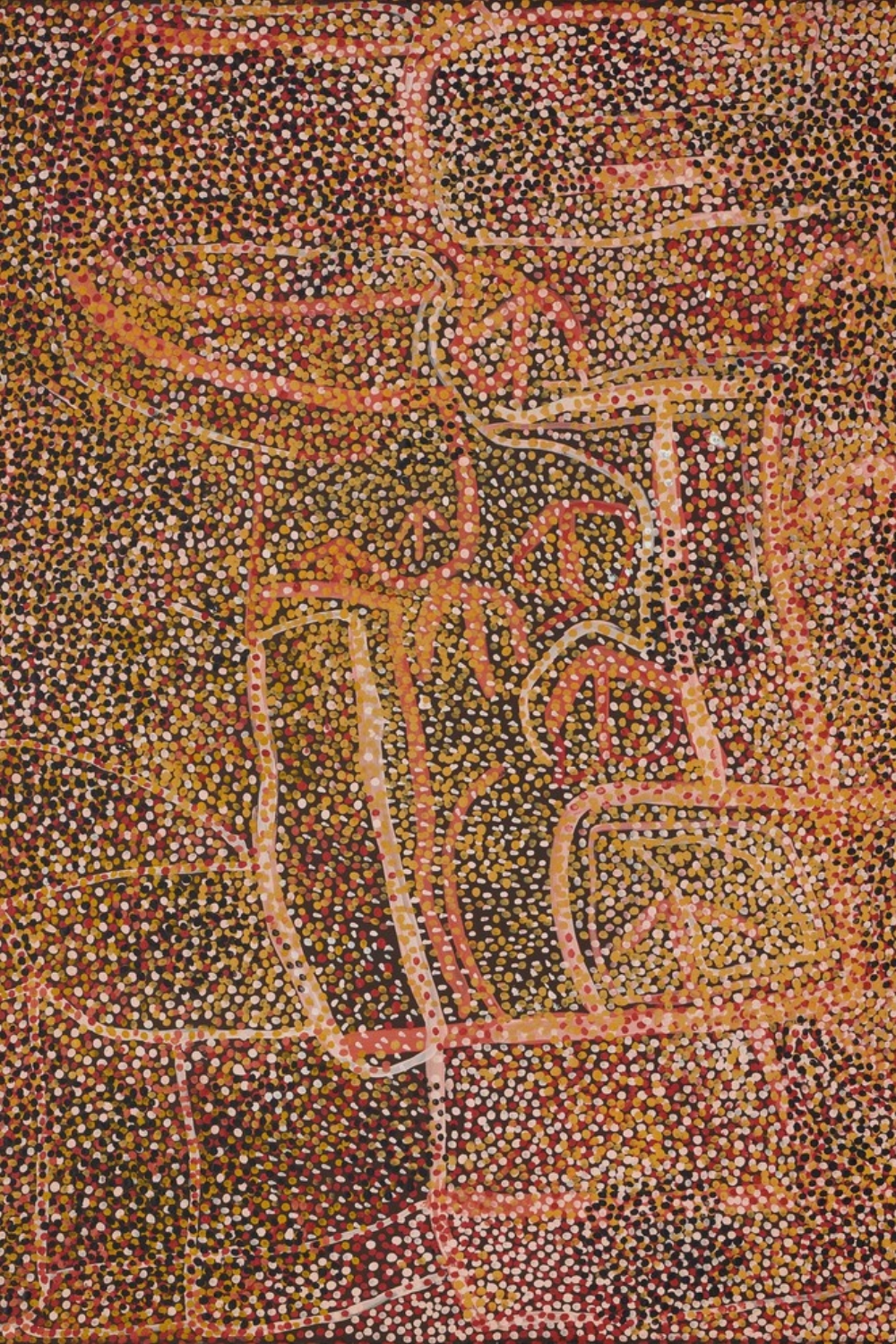
Summer Rains on Alalgura, 1991 is a vivid example. Greens, yellows, creams and pinks crowd its surface, suggesting vegetation erupting after rain. Documentation describes fertile seeds lying dormant in bare red soil until rain releases abundant growth, with Emily’s colours representing “raw, ripe and dry fruit, the seed, flower, or plant stalk,” scattered by wind or growing in dense profusion.
This knowledge came from living on Country. Emily had gathered its foods, recognised its plants, followed its animals and watched Alhalkere change through countless seasons.
She was not simply painting what Alhalkere looked like. She painted what grew there, what moved through it, what lay beneath the surface, what happened when rain arrived, and the ceremonial relationships connecting it all.
That is what she meant by “whole lot”: Alhalkere as a living, changing and interconnected Country.
From Skin and Sand to Batik
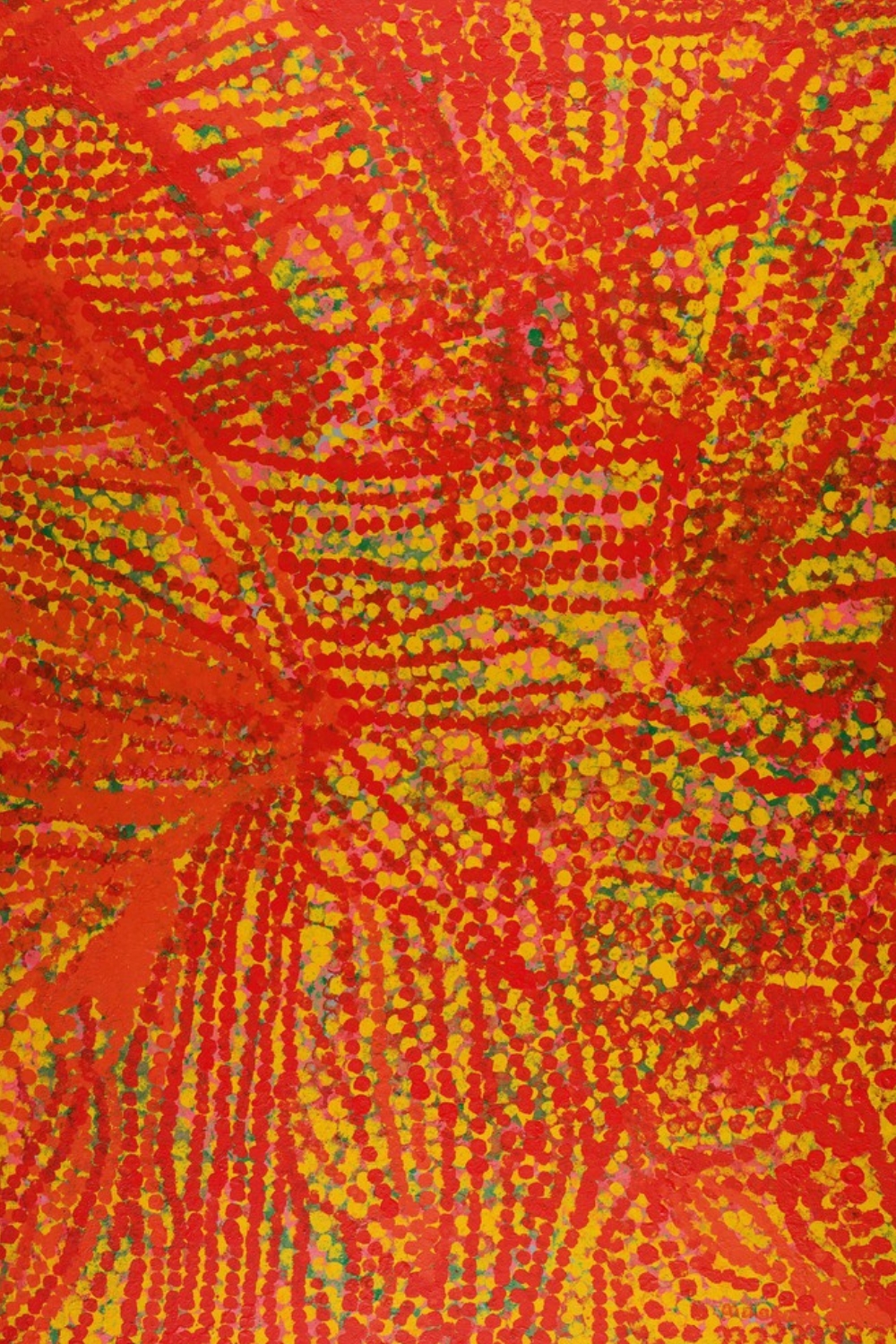
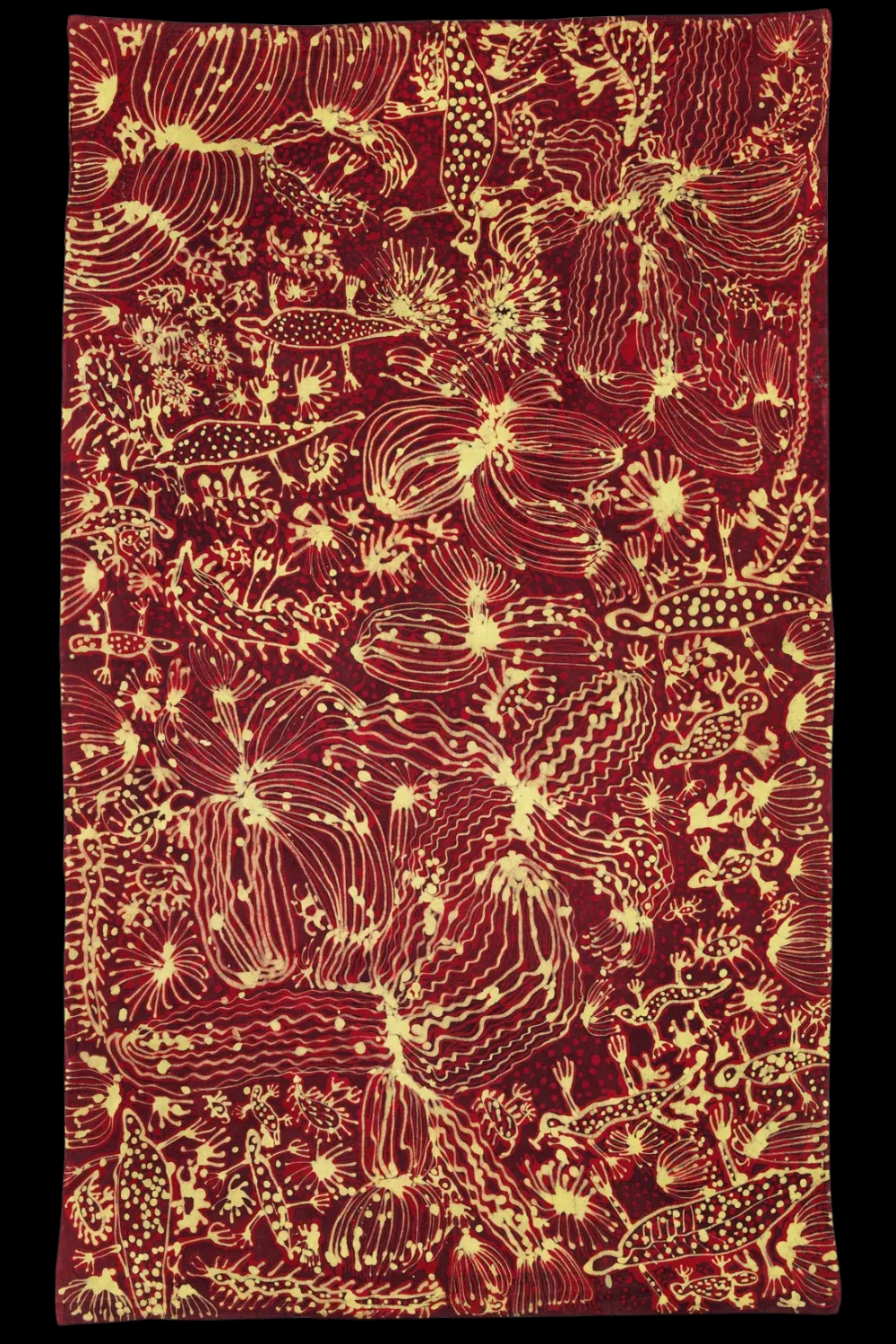
When batik was introduced at Utopia in 1977, Emily Kame Kngwarreye encountered a new material but a familiar way of making art. She already had decades of experience painting women’s bodies for Awely and drawing in sand. Batik provided another surface for line, touch, repetition and movement.
Emily was a founding member of the Utopia Women’s Batik Group, established in 1978, alongside other important Utopia artists including Barbara Weir, Gloria Petyarre, Kathleen Petyarre and Ada Bird Petyarre. Batik remained Emily’s principal public art form for about eleven years. Working outdoors, the women applied hot wax freehand to silk or cotton before successive dye baths transformed the cloth.
These batiks were not simply experiments leading towards canvas, they were artworks in their own right and the first substantial body of Emily’s work in introduced materials. The National Gallery of Australia describes her early batiks as possessing “raw vigour” and “sinuous energy.” Layered lines, dots, grids and plant forms demonstrated considerable control of flowing wax and successive applications of dye.
An early batik acquired by the National Gallery before Emily became widely known illustrates their independent strength. Christopher Hodges later recalled that it was selected with “no name — just the power of the fabric.” By 1981 her batiks already contained broad and narrow lines, grids, roundels, dots and overlapping structures that would recur throughout her later work.
Their subjects also came from Alhalkere. Plants, seeds, roots and animals appeared alongside Awely designs, generally through tracks, body parts, growth patterns and schematic signs rather than conventional Western representation. The National Museum has identified connections between the batiks and her later paintings in body markings, plant and animal forms, root systems, dots and overall patterning.
By 1988, Utopia – A Picture Story brought together 88 silk batiks by Utopia women, subsequently acquired by the Holmes à Court Collection. It was a major artistic achievement in its own right, not merely a prelude to painting.
Emily therefore arrived at canvas in 1988 as an accomplished artist: after decades of body painting and sand drawing, she had spent another eleven years working in wax and dye.
Emily Kame Kngwarreye’s Painting Style
Emily Kame Kngwarreye’s paintings changed with extraordinary speed. Dense fields of dots gave way to brilliant colour, stripes, networks of lines and sweeping brushstrokes. Yet these were not unrelated styles. Emily repeatedly returned to line, dot, colour and gesture, bringing different elements forward, burying them beneath others or stripping them away.
Rather than developing through a neat sequence of styles, her painting was a continuous process of experimentation with these fundamental forms.
Lines and Dots — Anooralya (Wild Yam), 1989
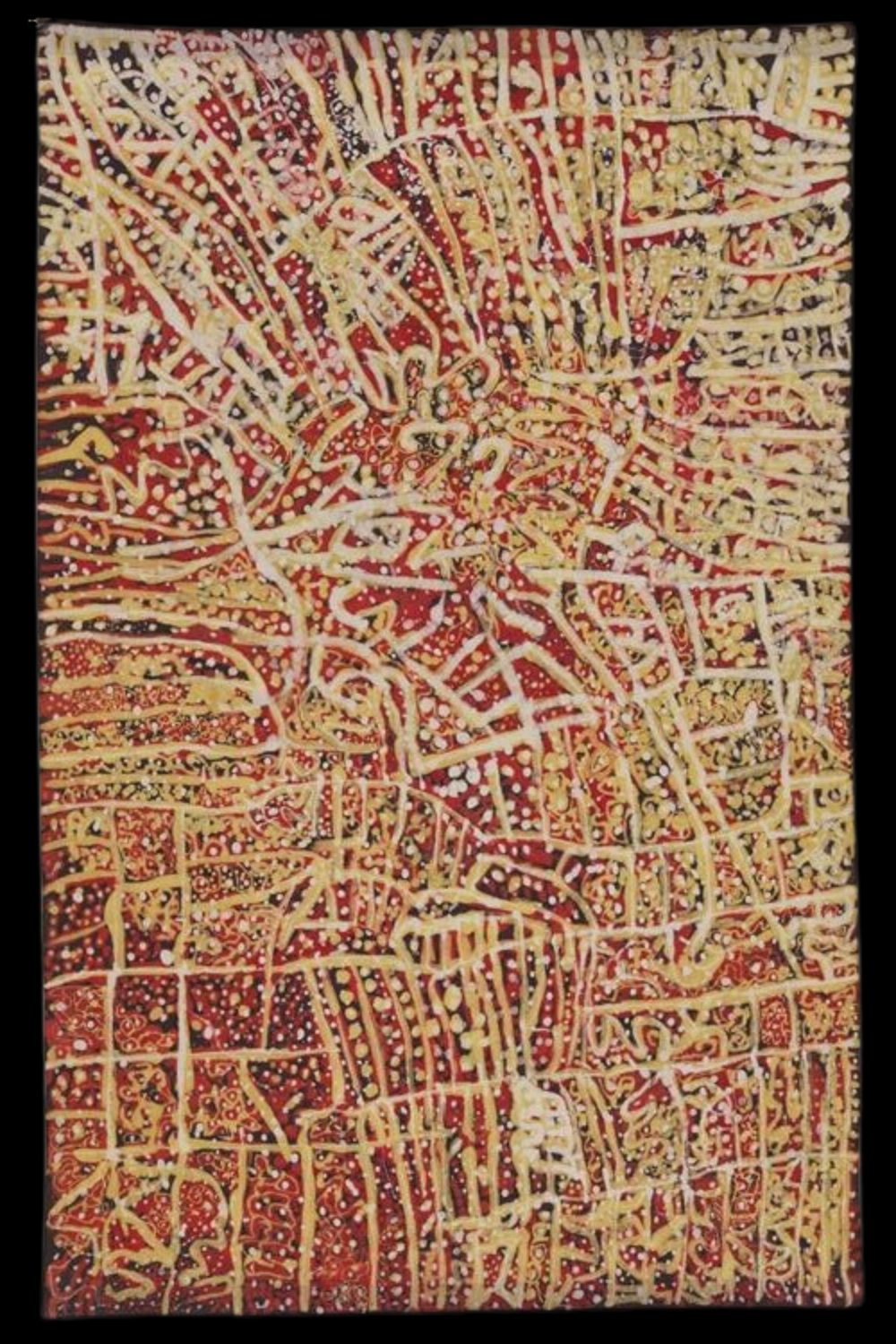
Anooralya (Wild Yam), 1989, shows particularly clearly how Emily Kame Kngwarreye carried elements of her eleven years of batik into her earliest canvases. Judith Ryan observed that these paintings “retain the linear network as an underlayer or foundation”, while dots that had been secondary in the batiks increasingly came to the surface. In Anooralya, she writes, “lines and dots converge in a dense field of irregular textured marks which create a sense of depth.”
The pale underlying lines have been identified with two different forms of movement through Country: the meandering roots of the yam beneath the soil and the tracks of emus travelling between nesting sites above it. Across them Emily layered red, yellow and white dots representing seeds, flowers and leaves. The painting demonstrates how line and dot could simultaneously evoke what was growing beneath the earth, what was moving across its surface and the plant life spreading above it.
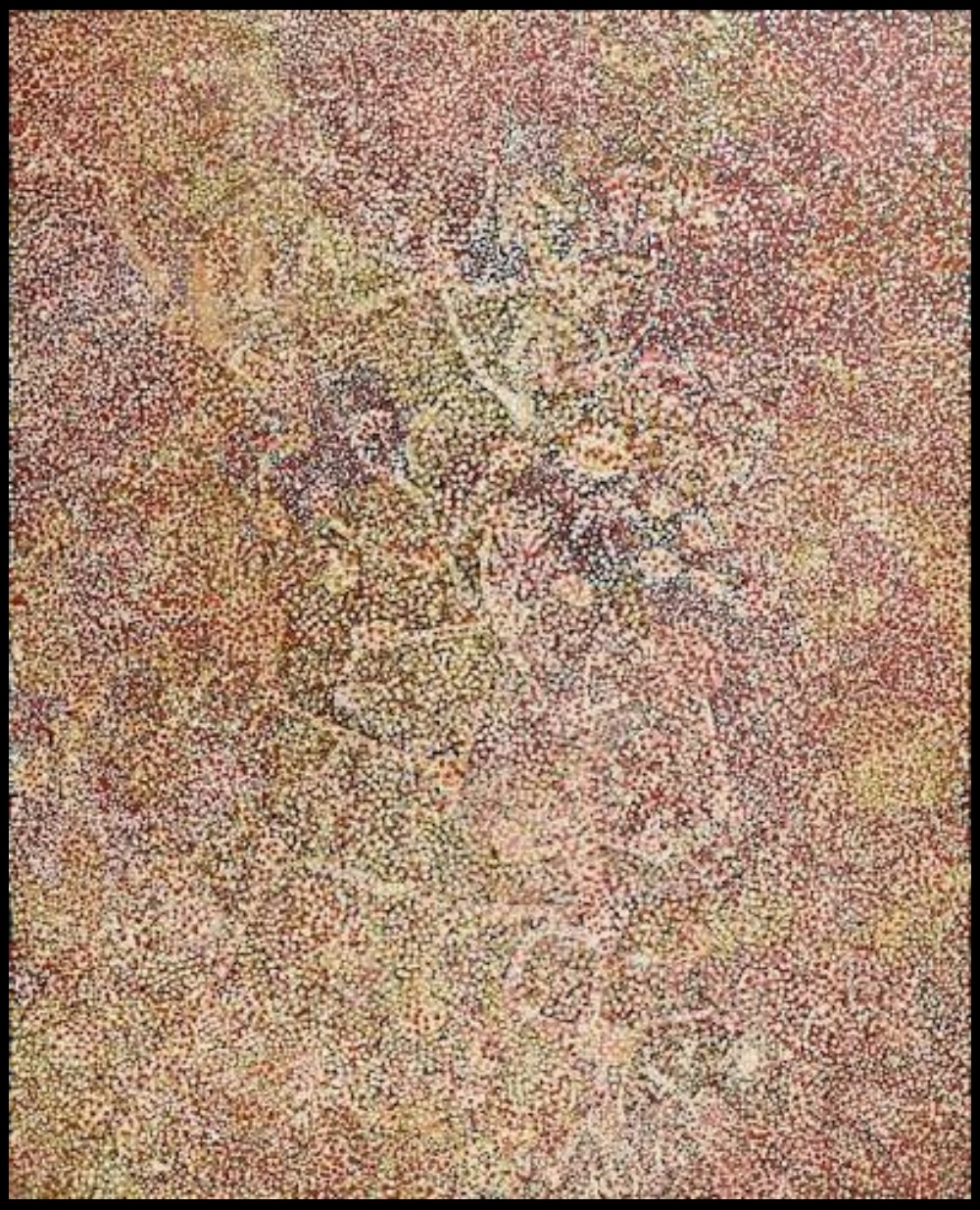
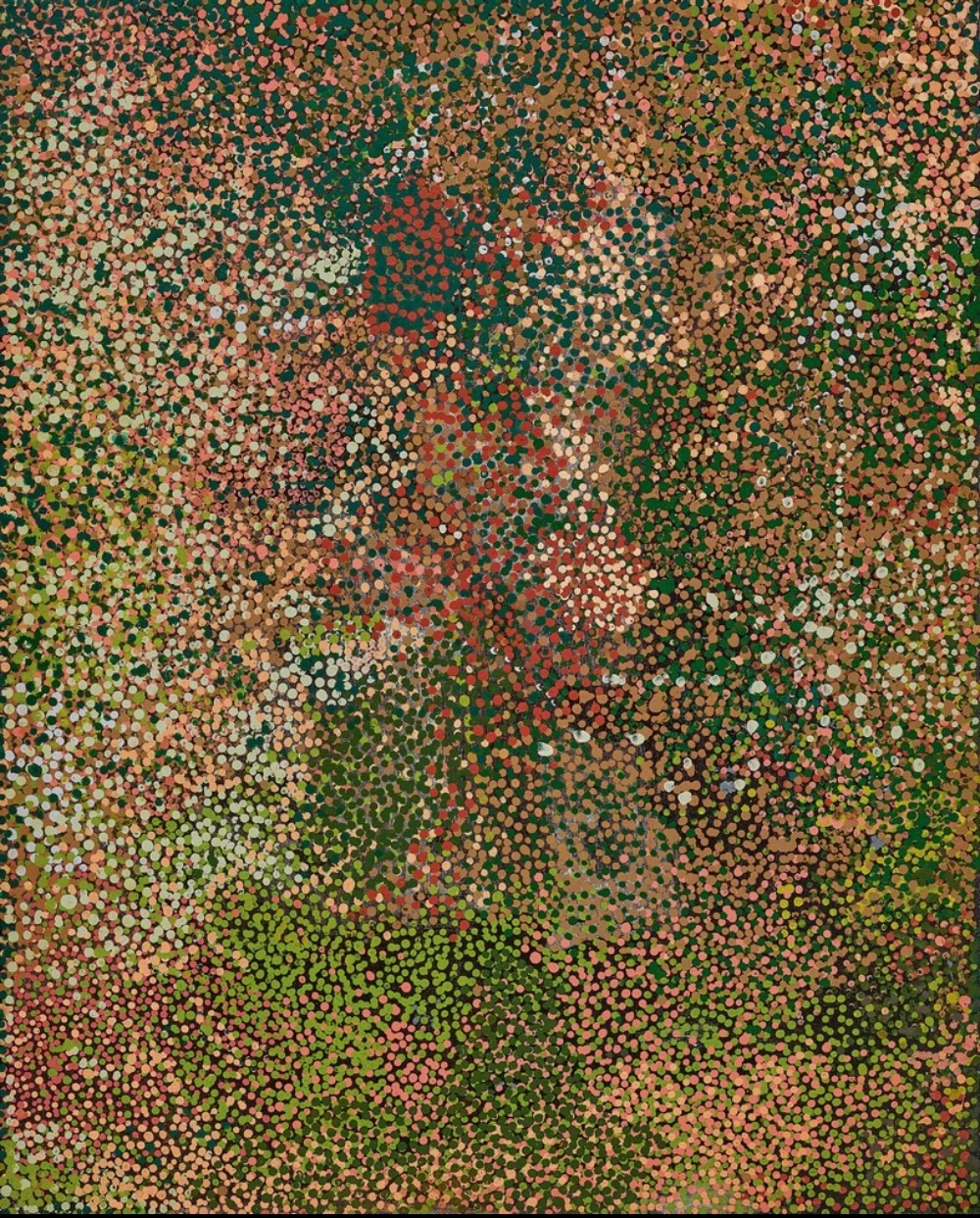
During 1990 and 1991, the dots increasingly overwhelmed these underlying structures. Lines might remain visible or almost disappear beneath accumulated marks. Emily varied their size and density, forming trails, clusters and masses that could virtually dissolve into colour.
The physical nature of these marks is important. In Of Rare Winter Rain, 1990, layers of pink, olive, green, purple, blue and grey dots build across the surface, with catalogue documentation recording that many were applied directly with Emily’s fingers. Judith Ryan described Emily as a “mark-maker extraordinaire”, making “intimate and grand gestures” as she layered and intensified dots until underlying graphic elements could disappear.
Finger-applied paint also provides a direct connection with Emily’s much older experience of applying ochre to women’s bodies for Awely. Curators have similarly connected repeated dotting with women’s sand drawing, where fingertips made repeated impressions in the earth, while repetition itself was fundamental to ceremonial song and movement.
Emily’s dots were therefore not simply decorative pattern. Their rhythm was created through repeated bodily action
Dots, Colour and Touch — My Country, 1993
In My Country, 1993, colour has largely taken control of the surface. Pink, yellow, orange, green, blue and white marks overlap and merge, while the underlying linear structures that were clearer in Emily’s earlier paintings have become increasingly difficult to distinguish.
Wally Caruana described the painting as a “visual florilegium of abundant plant growth”, expressed with a “gestural intensity and bravado” arising from Emily’s deep knowledge of the natural forces at work across Alhalkere. There is, he cautioned, “no one-to-one interpretative schema of the brush marks and dotted lines”. Instead, the marks allude to the “sporadic growth of plants in different stages of maturity.”
Colour itself carries associations with the seasonal life of Alhalkere. Caruana relates the changing colours to periods when plants flower and produce foods, seeds, medicines and materials used in ceremony. Yellow ochre has a more specific association with anwerlarr, the pencil yam, and its seed-bearing flowers or kam, from which Emily’s name derives.
Rather than depicting individual plants, My Country surrounds the viewer with growth, colour and movement. Terry Smith compared paintings of this period, including My Country and The Alhalkere Suite, with Monet’s Nymphéas. The similarity is experiential rather than cultural: both create a sense of immersion, as though the viewer is within the field of colour rather than looking across a landscape from outside it.
Gesture and the Body — Alhalkere (My Country), 1994
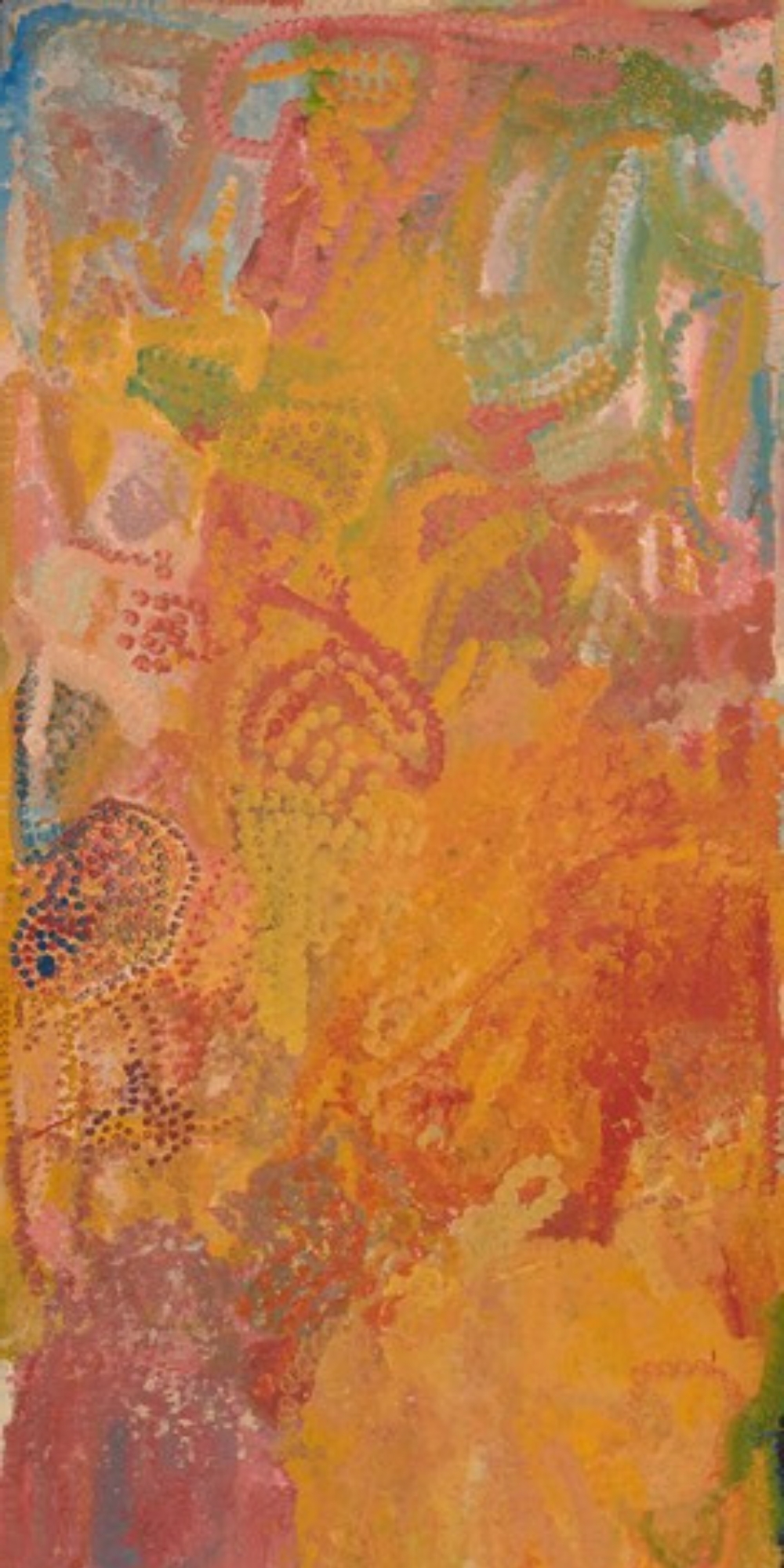
This section of Alhalkere (My Country), 1994, shows how strongly Emily’s physical movement could determine the structure of a painting. Almost five metres long, the work is saturated with red, yellow, pink and orange marks layered over an ochre ground. Dots accumulate upon dots, suggesting dense leaves and flowers, while trails of white marks move across the surface. The underlying lines and more recognisable graphic structures of her earlier paintings have largely lost their definition.
The catalogue commentary identifies what has replaced them: “It is the gesture, the way that the paint has been applied that dominates this painting.” Rather than forming a regular pattern, the dots flow in arcs and trails across the canvas. Their scale and direction record the movement of Emily’s hand and arm as she painted.
Despite the enormous size of the work, these gestures give it a distinctly human scale. The arcs are partly determined by the reach of Emily’s outstretched arm, while collectively they describe a much broader expanse of Country. The relationship was memorably described by the McCullochs as “body and country becoming one woman drawing her country with her body’s reach.”
In Alhalkere (My Country), gesture is therefore more than a stylistic effect. Emily’s own body becomes part of the painting’s structure: the reach of her arm determines the marks, while thousands of those marks build an expansive image of Alhalkere. It is a particularly powerful example of the physical relationship between touch, movement, painting and Country that runs throughout her work
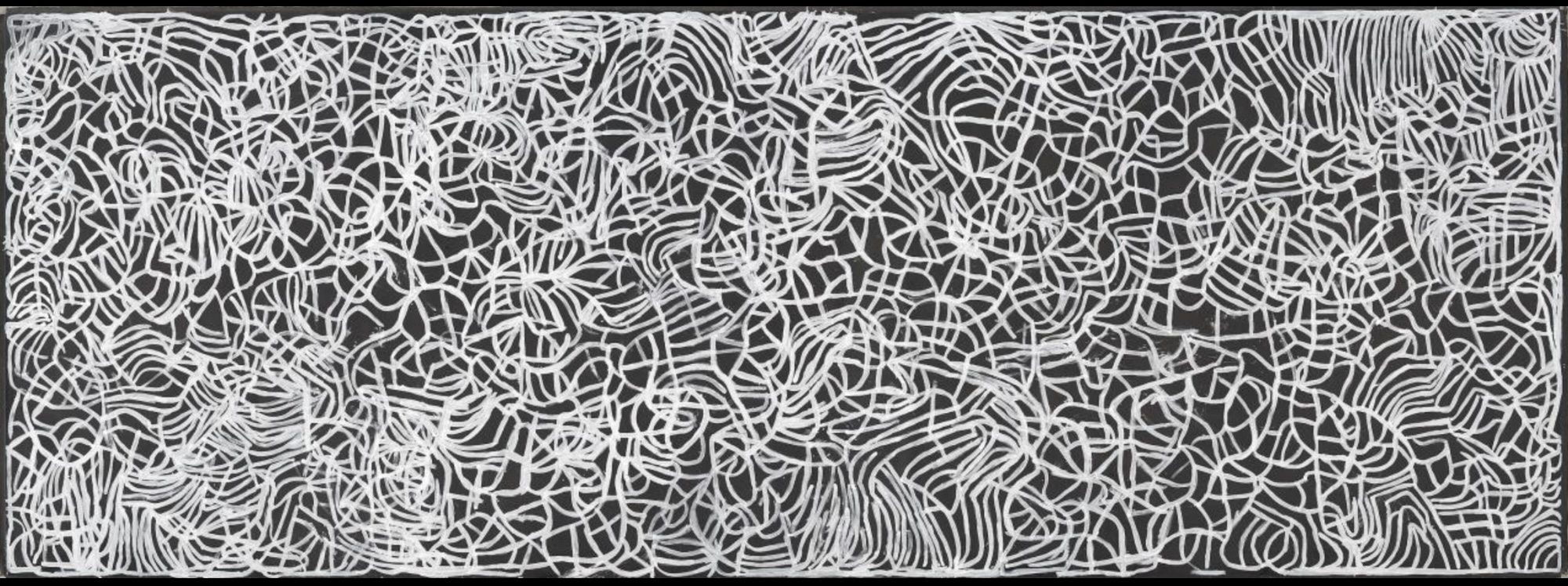
The Return of the Line — Big Yam Dreaming, 1995
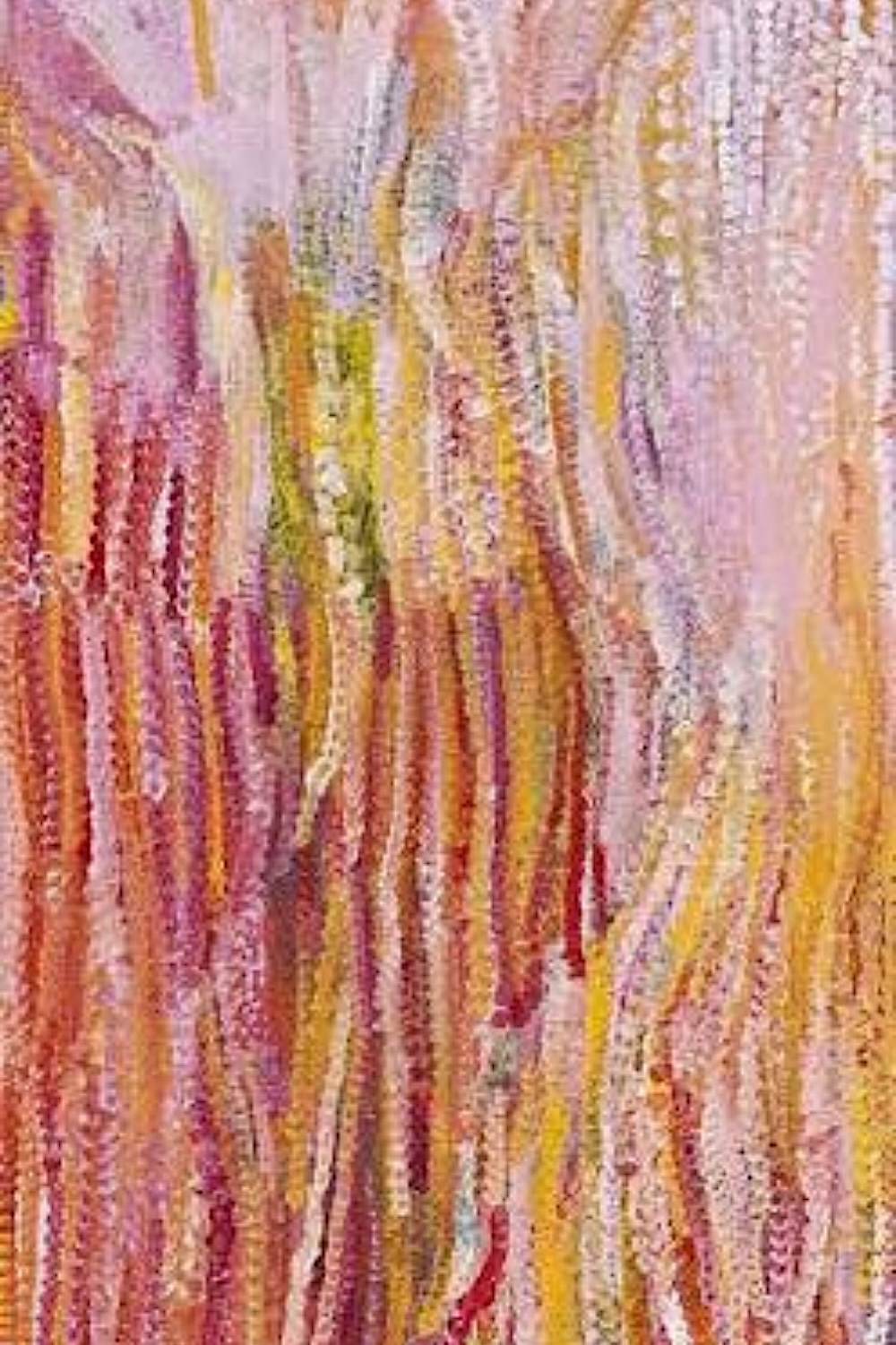
In 1994–95 Emily changed direction dramatically. Dense fields of dots and colour gave way to stripes, lines and increasingly economical marks, including striking paintings reduced almost entirely to black and white. Yet line was not new. It had been fundamental to Awely body painting, her batiks and her earliest canvases, often surviving beneath layers of dots.
In 1994 she produced stark striped works associated with Awely body-paint designs. During 1995 she developed black-and-white yam paintings, first using white lines on black and then reversing them to black on white. Removing colour and dense dotting exposed the structure and movement of the line itself.
This development reached monumental scale in Anwerlarr anganenty (Big Yam Dreaming), 1995. Nearly eight metres across, its immense pale network spreads across a dark ground. The lines relate to anwerlarr, the pencil yam and its underground roots, while also recalling the linear body designs of Awely. The dark ground has itself been associated with the body on which ceremonial designs were painted.
The transformation is clearest beside Anooralya (Wild Yam), 1989, where fine yam-root lines are increasingly obscured by dots. Six years later in Big Yam Dreaming, the dots have almost disappeared and the line itself has become the painting.
The NGV records that Big Yam Dreaming was painted continuously over two days and connects its fluid lines with both Emily’s batiks and the arlkeny body markings of women’s Awely ceremonies. The apparently radical change was therefore also a return to some of her oldest forms of mark-making: from body to batik, beneath the dots of her early canvases, through the black-and-white paintings, and finally across nearly eight metres of canvas.
Why Emily Kame Kngwarreye Is Important
Emily Kame Kngwarreye transformed Australian art in an extraordinarily short period. Her career as a canvas painter lasted only eight years, yet during that time she produced paintings that changed radically in colour, scale, density and structure while remaining grounded in Alhalkere and the ceremonial life she had known for decades.
Her importance does not lie simply in the resemblance of some paintings to Western abstraction. Comparisons with artists such as Monet, Pollock and de Kooning helped introduce her work to audiences accustomed to European and American modernism, but they can also obscure what made her paintings distinctive. Emily’s marks developed from a very different experience: Awely, body painting, drawing in sand, batik, knowledge of plants and animals, seasonal change and a lifetime lived on Country.
Her achievement was to make paintings that could be intensely physical and visually immediate without separating them from Country. A dot could be a fingertip impression, a line could follow the reach of an arm, and an enormous field of colour could evoke the abundance of Alhalkere after rain.
That combination of Country, cultural knowledge and extraordinary freedom of mark-making is what makes Emily Kame Kngwarreye one of the most important Australian artists of the twentieth century.
Emily Kame Kngwarreye Painting Values
Emily Kame Kngwarreye is one of the most commercially important Aboriginal Australian artists. Auction prices vary enormously according to period, size, quality, provenance and the significance of the individual painting.
Works offered at auction: 1551
Sale rate: 65%
Highest recorded sale: $2,100,000
Median sale price: $19,000 AUD
For individual auction results and a detailed discussion of how period, size, provenance and painting style affect prices, see Emily Kame Kngwarreye Values.
Where to See Emily Kame Kngwarreye’s Art
Emily Kame Kngwarreye’s paintings and batiks are held in major public collections throughout Australia and increasingly in important international museums.
- National Gallery of Australia, Canberra
- National Gallery of Victoria, Melbourne
- Art Gallery of New South Wales, Sydney
- Queensland Art Gallery | Gallery of Modern Art, Brisbane
- Art Gallery of South Australia, Adelaide
- Art Gallery of Western Australia, Perth
- National Museum of Australia, Canberra
- Tate, London
- Seattle Art Museum
- National Museum of Women in the Arts, Washington, DC
Further Reading
For readers wanting to explore Emily Kame Kngwarreye’s life, Country and paintings in greater depth, these are the strongest starting points:
- Margo Neale (ed.), Utopia: The Genius of Emily Kame Kngwarreye, National Museum of Australia, 2008 — probably the most useful substantial study, bringing together Emily’s work, Alhalkere, Awely and her stylistic development. The associated exhibition contained 120 works from around 60 collections.
- Margo Neale et al., Emily Kame Kngwarreye: Alhalkere — Paintings from Utopia, Queensland Art Gallery/Macmillan, 1998 — catalogue for the first major retrospective and an important source for understanding Emily’s work in relation to Alhalkere and Anmatyerre culture.
- Jennifer Isaacs et al., Emily Kngwarreye Paintings, Craftsman House, 1998 — particularly valuable because it contains different perspectives: Isaacs on Anmatyerre women’s culture, Terry Smith on abstraction, Judith Ryan on major paintings, and Donald and Janet Holt on Emily and Delmore.
- Kelli Cole, Jennifer Green and Hetti Perkins (eds.), Emily Kam Kngwarray, Tate Publishing, 2025 — the newest major publication, produced in association with the Tate Modern exhibition and incorporating recent research and community perspectives.
- Jennifer Isaacs et al., Emily Kngwarreye Paintings, Craftsman House, 1998 — an important early monograph with essays by Jennifer Isaacs, Terry Smith and Judith Ryan, together with accounts by Donald and Janet Holt. Particularly useful for Emily’s cultural context, stylistic development and major paintings.