
Ronnie Tjampitjinpa: Biography painting style and importance
c. 1943–2023
Pintupi
Muyinnga, west of the Kintore Ranges / Wilkinkarra (Lake Mackay) Country
Papunya / Walungurru (Kintore)
Pintupi Art / Western Desert Art
Papunya Tula Artists
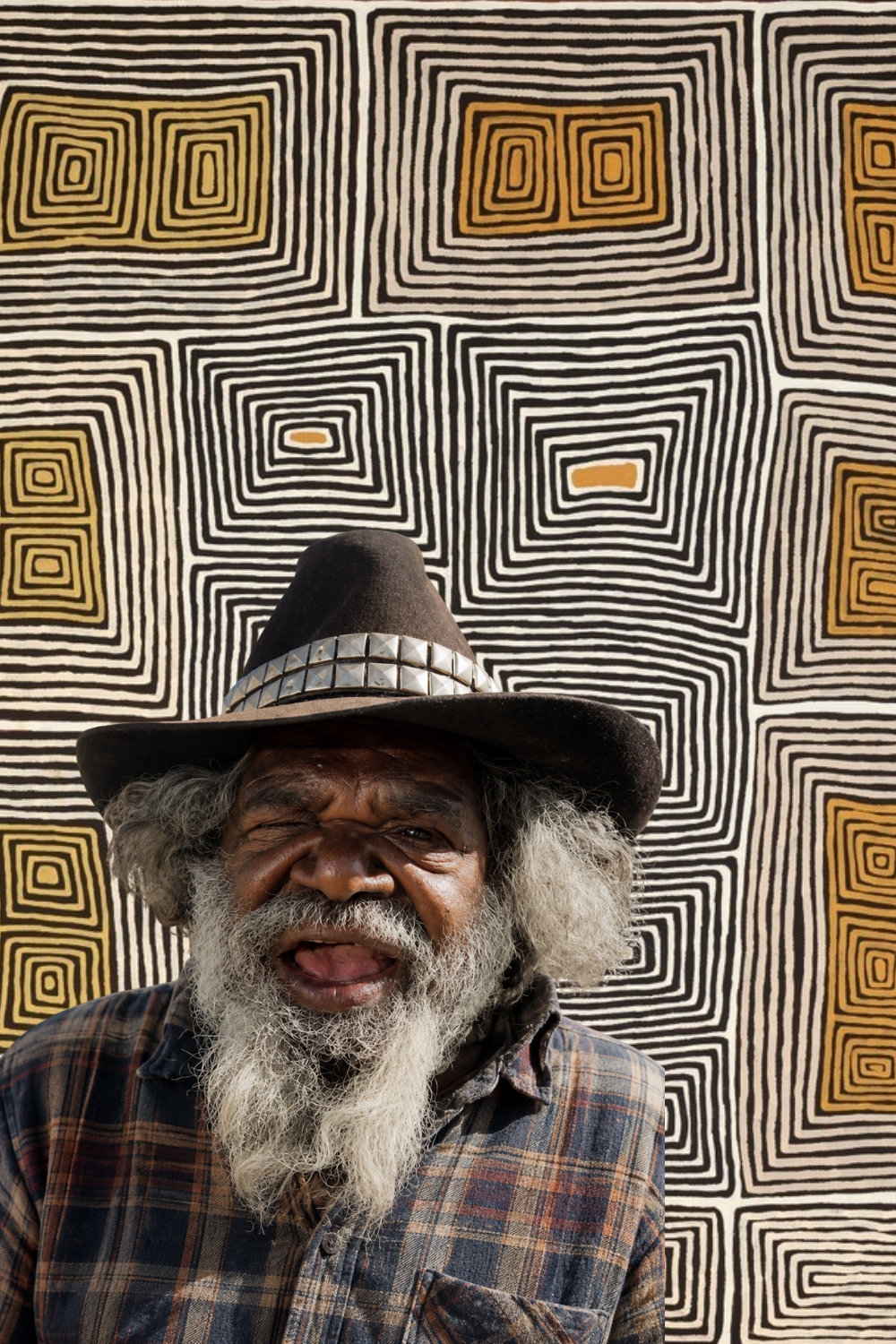
Ronnie Tjampitjinpa (c.1943–2023) was one of the most influential Pintupi artists of the Western Desert Art movement and a defining painter of Papunya Tula Artists. Although he joined the painting movement during its earliest years at Papunya in the early 1970s, his greatest artistic achievements came after the establishment of Walungurru (Kintore). There he transformed the visual language of Pintupi Art by reducing the symbolic vocabulary of the first Papunya artists to sweeping parallel bands, monumental concentric forms and carefully controlled negative space.
Rather than increasing visual complexity, Ronnie demonstrated that extraordinary artistic power could be achieved through restraint. Over several decades he refined his compositions until a small number of repeated geometric forms evoked the scale, rhythm and spiritual presence of Country. This bold linear aesthetic established a new direction within the Kintore school during the 1990s, alongside the increasingly abstract work of Pintupi contemporaries such as Turkey Tolson Tjupurrula, George Tjungurrayi and Patrick (Olodoodi) Tjungurrayi.
Today Ronnie is regarded as one of the leading painters of the later Papunya Tula period. His work bridges the symbolic imagery of the early Papunya boards and the refined abstract paintings that brought Western Desert Art to international audiences. His paintings are held in major public collections throughout Australia and overseas, reflecting their artistic innovation, cultural significance and enduring visual power.
Ronnie Tjampitjinpa values
For people wanting to see more images of Ronnie Tjampitjinpa artworks and what they sold for please visit Ronnie Tjampitjinpa Values
Biography
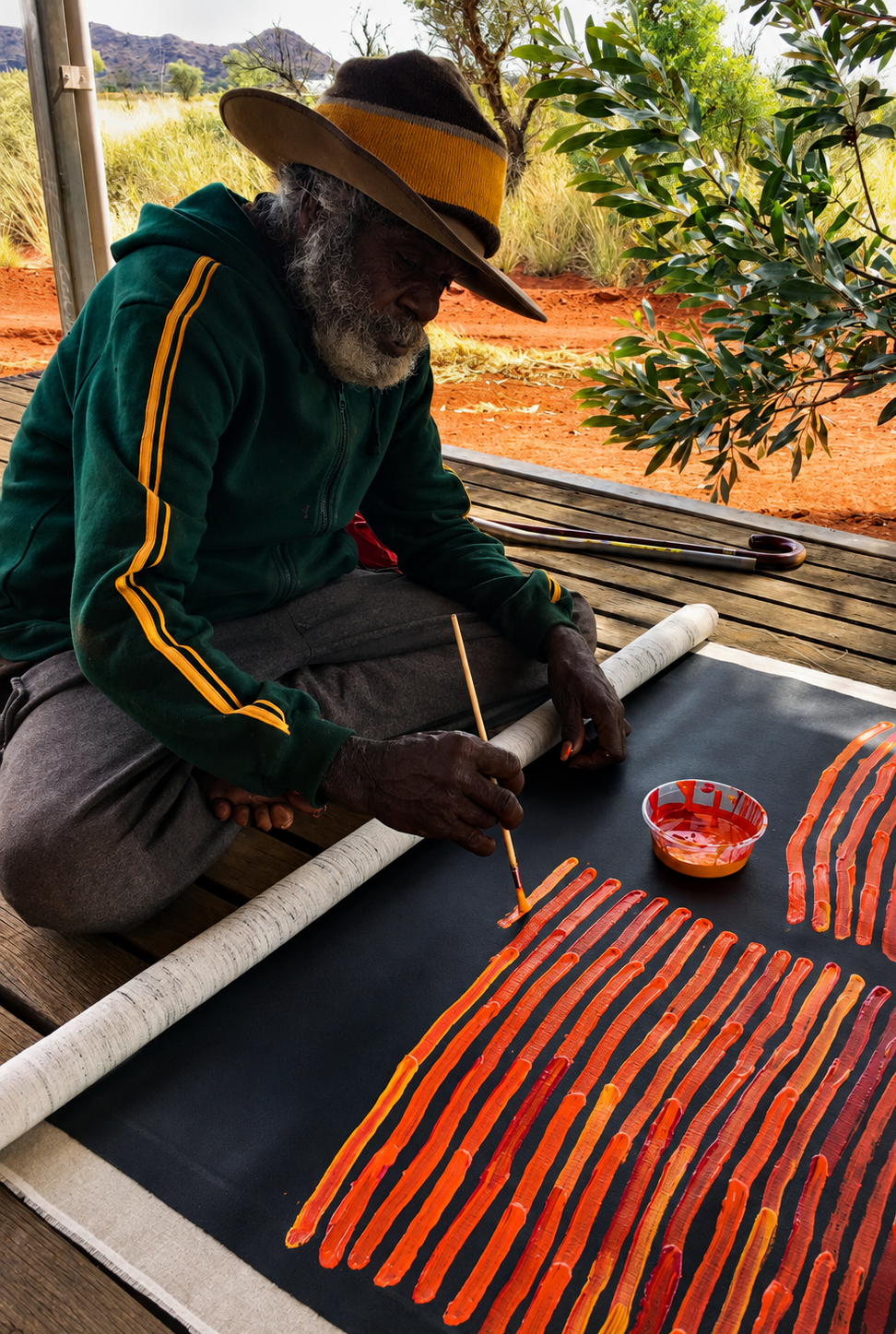
Ronnie Tjampitjinpa was born around 1943 at Muyinnga, west of the Kintore Ranges near the border of Western Australia and the Northern Territory. Like many Pintupi people of his generation, he spent his early childhood living a traditional nomadic life, travelling between waterholes, sandhills and ceremonial places around Wilkinkarra (Lake Mackay). This intimate knowledge of Country, gained long before permanent settlement, later became the foundation of his paintings.
During the prolonged droughts of the 1950s many Pintupi families were forced to leave the desert and move east to Haasts Bluff and later Papunya. There Ronnie worked as a stockman and labourer while maintaining his ceremonial responsibilities and strong connection to Country.
When Geoffrey Bardon encouraged Aboriginal men to paint their ceremonial designs in 1971, Ronnie belonged to the younger generation of Pintupi artists who joined the movement during its earliest years, alongside senior and influential Papunya painters such as Kaapa Mbitjana Tjampitjinpa, Johnny Warangkula Tjupurrula and Uta Uta Tjangala. Unlike many of the senior founding painters, however, painting formed only one part of Ronnie’s life throughout the 1970s. Much of his energy was devoted to the Pintupi Homelands movement, which sought to return families from government settlements to their ancestral Country. Consequently, although he painted with Papunya Tula Artists from an early stage, his artistic output during this period remained comparatively limited.
The establishment of Walungurru (Kintore) in 1981 marked a turning point in both Ronnie’s life and career. As Pintupi families re-established communities on their traditional lands, he was able to paint while living once again on Country. He later served as Chairman of the Kintore Outstation Council and established his own outstation at Ininti (Redbank), making an important contribution to the return of Pintupi people to their ancestral lands.
From the 1980s onwards Ronnie emerged as one of the leading artists of Papunya Tula Artists. His paintings gained national and international recognition through major exhibitions, including Dreamings: The Art of Aboriginal Australia, Australian Perspecta and Papunya Tula: Genesis and Genius. He won the Alice Prize in 1988, held his first solo exhibition at Gallery Gabrielle Pizzi in 1989, and his work entered major public collections throughout Australia and overseas.
By the end of his career Ronnie Tjampitjinpa was widely recognised as one of the defining painters of the later Papunya Tula period. In 2015 the Art Gallery of New South Wales presented a major survey exhibition celebrating more than four decades of his work, recognising his enduring contribution to contemporary Aboriginal art.
Ronnie Tjampitjinpa’s Early Painting Style
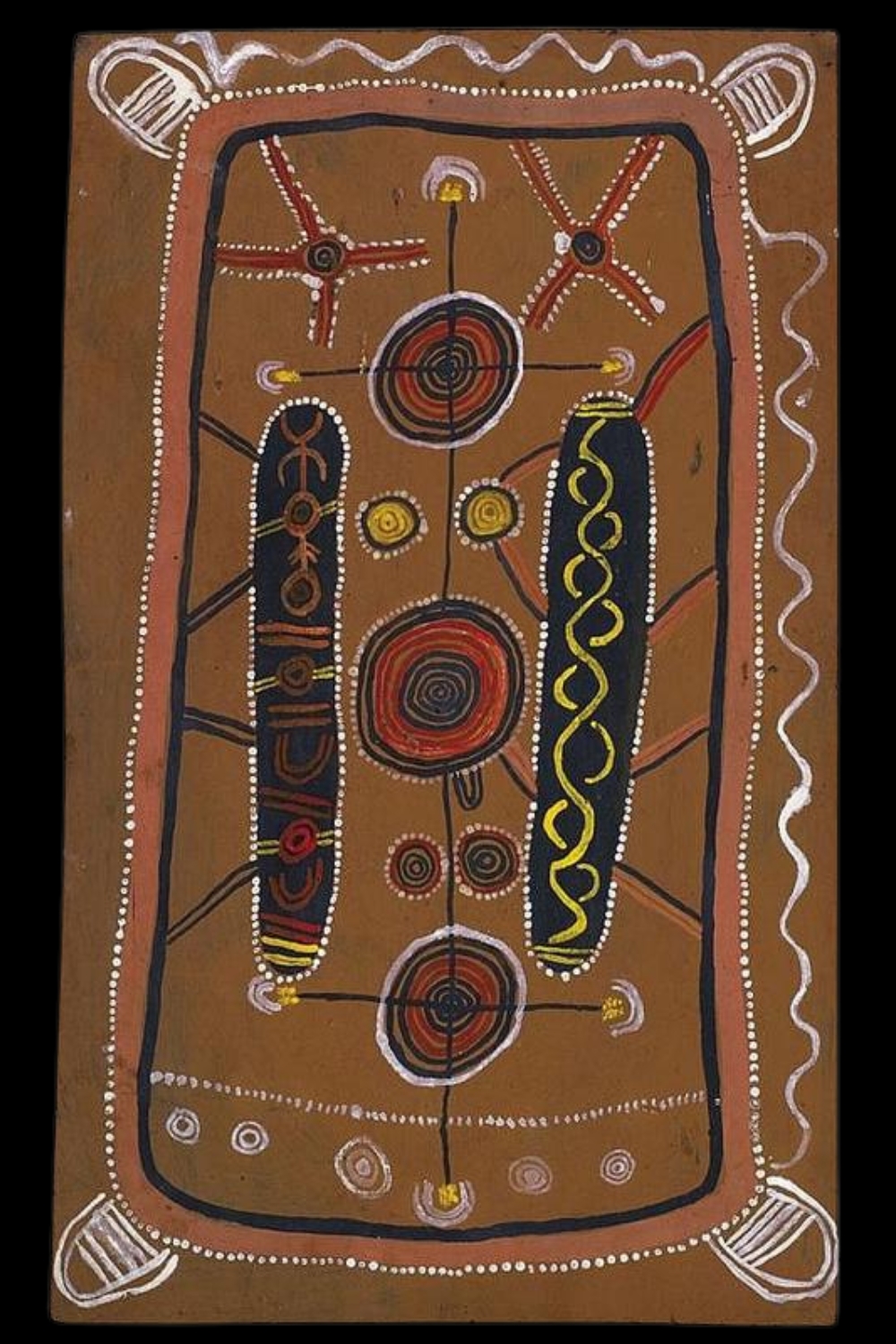
Ronnie Tjampitjinpa’s earliest paintings, produced during the 1970s and early 1980s, remained firmly grounded in the visual language of the early Papunya painting movement. They feature concentric circles, travelling lines and symbolic motifs arranged within relatively open compositions. Compared with his later work, these paintings contain a greater variety of iconographic elements, more visible dotting and a stronger resemblance to the early Papunya Boards, where ancestral journeys and important sites are described through networks of recognisable symbols.
Even in these early works, however, Ronnie’s distinctive artistic direction was beginning to emerge. Rather than filling the canvas with numerous symbols, he increasingly organised compositions around a small number of dominant forms. Concentric circles became larger, travelling lines assumed a stronger structural role, and his paintings displayed an unusual sense of balance and order.
This gradual simplification distinguished Ronnie from many of his contemporaries. Over time he reduced the symbolic vocabulary inherited from the first generation of Papunya painters, allowing individual motifs to become increasingly monumental. These early experiments evolved into the bold linear compositions that later transformed the Kintore school, demonstrating that the expressive power of Western Desert painting could be achieved through restraint, rhythm and carefully controlled geometry rather than visual complexity.
Ronnie Tjampitjinpa’s Later Painting Style
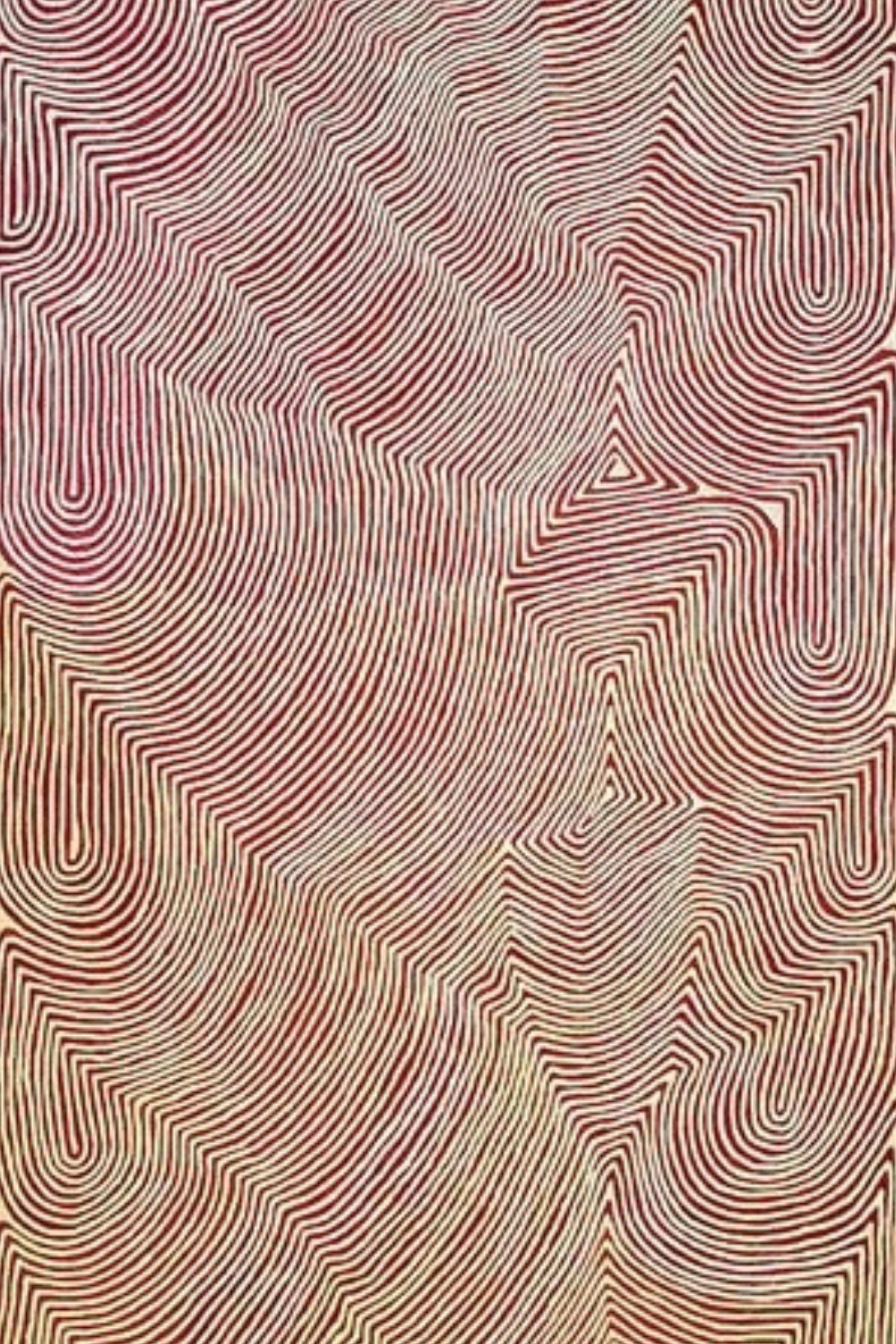
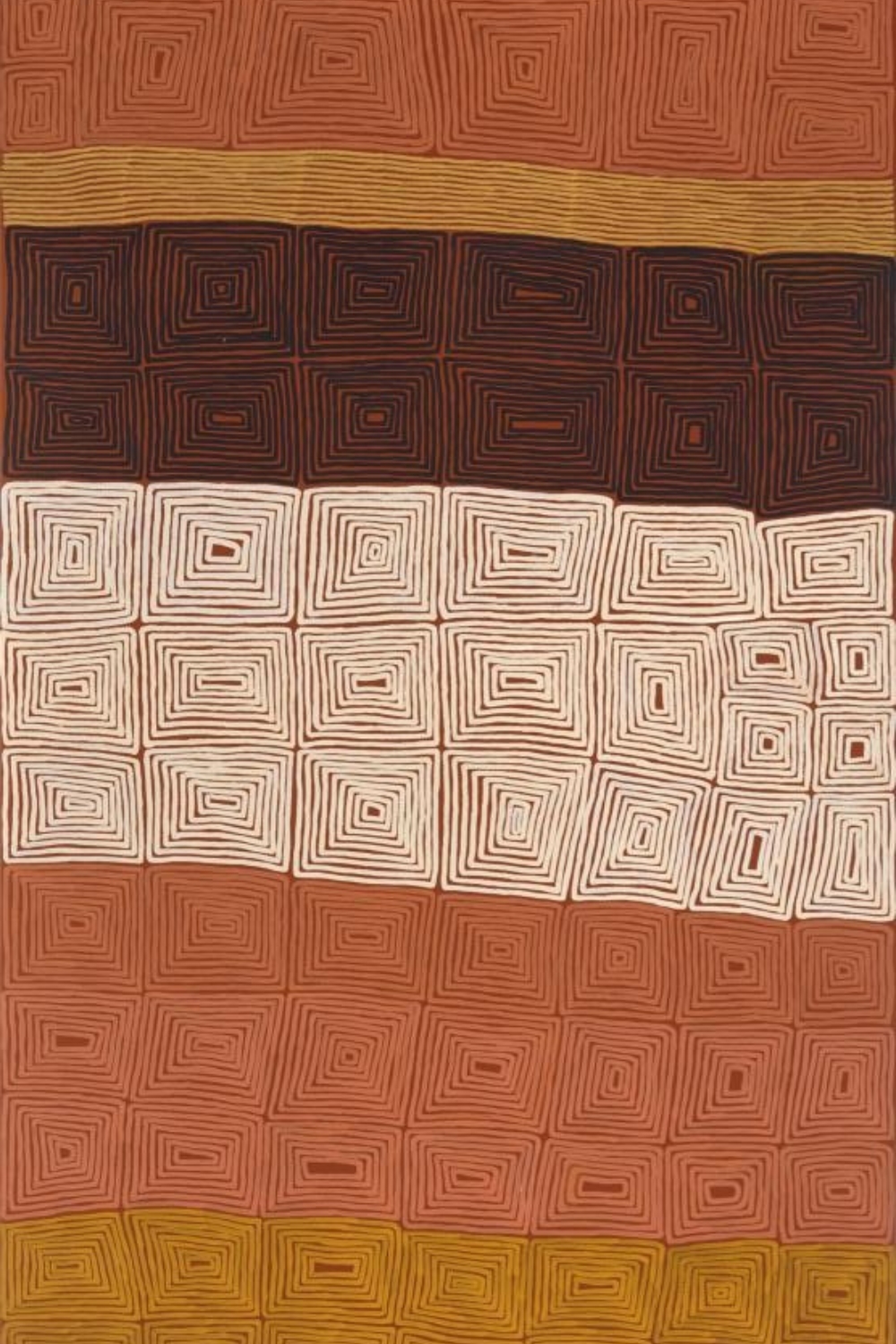
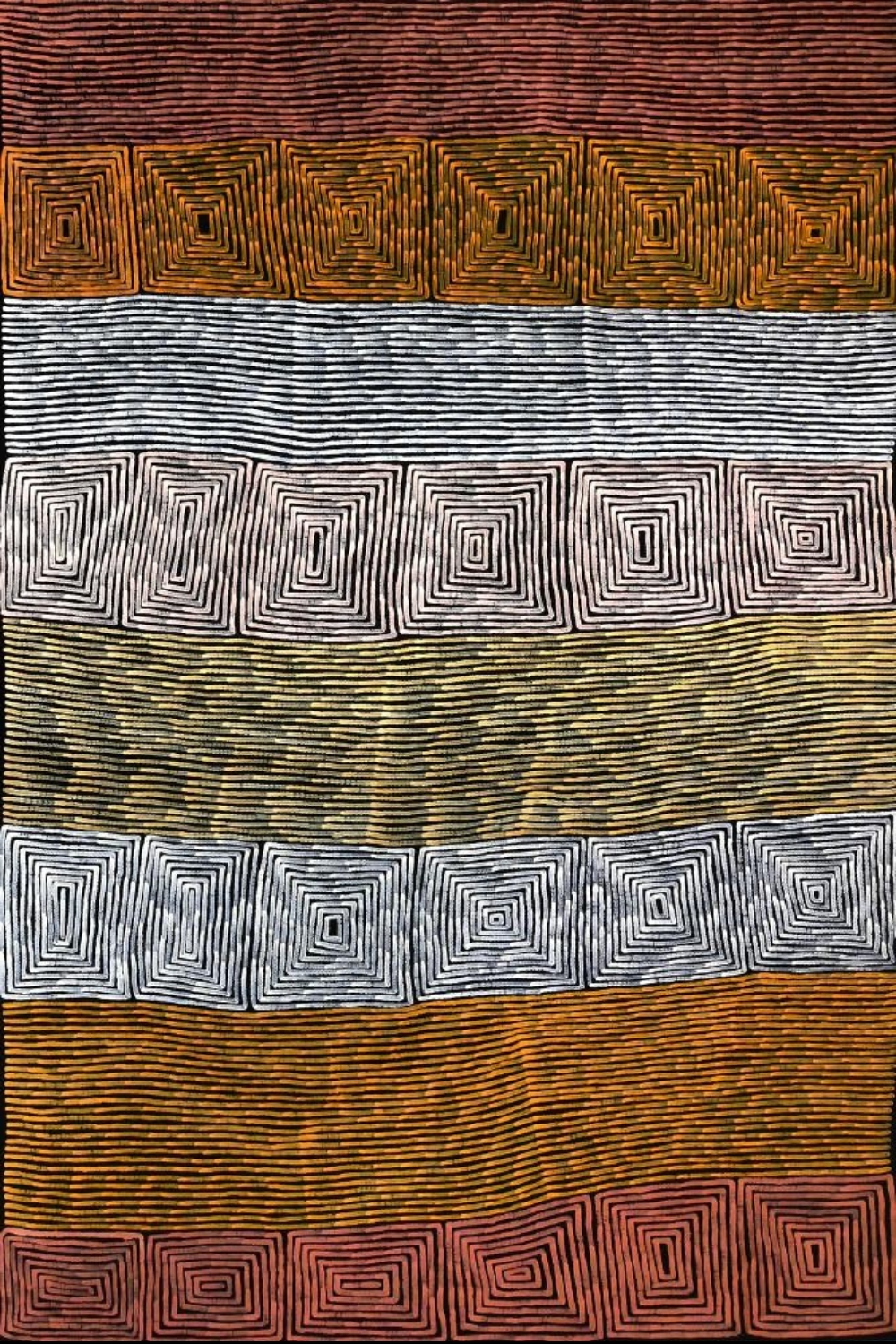
Following the establishment of Walungurru (Kintore) in 1981, Ronnie Tjampitjinpa developed one of the most distinctive painting styles in contemporary Aboriginal art. While remaining grounded in the Tingari tradition, he transformed the visual language of the early Papunya painters into a refined geometric abstraction. By enlarging ceremonial motifs into sweeping parallel bands, monumental concentric forms and carefully controlled negative space, he created the bold linear style that became the hallmark of his mature work.
His paintings are remarkable for their restraint. Fine parallel lines create a hypnotic rhythm, while subtle variations in spacing and scale generate a powerful optical effect. Monumental roundels dominate many compositions, allowing a small number of repeated forms to evoke the scale and spiritual presence of Pintupi Country.
Rather than inventing a new visual language, Ronnie refined one rooted in Pintupi ceremonial practice, drawing on designs traditionally painted onto men’s bodies and engraved onto sacred objects. Art historians regard him as one of the pioneers of the bold linear style that came to define many Kintore painters during the 1990s. His paintings established a new direction within Papunya Tula Artists, demonstrating that traditional ceremonial knowledge could be expressed through powerful abstraction while remaining firmly grounded in Pintupi culture.
What Do Ronnie Tjampitjinpa’s Paintings Depict and Why Are They Important?
Most of Ronnie Tjampitjinpa’s paintings depict public aspects of the Tingari cycle, one of the principal ancestral traditions of the Western Desert. Using the symbolic aerial perspective characteristic of Papunya Tula painting, monumental concentric circles represent important ceremonial sites or waterholes, while parallel bands and travelling lines describe the journeys of the Tingari ancestors across Pintupi Country. As with all Papunya Tula paintings, only public aspects of these traditions are shown, while sacred ceremonial knowledge remains protected.
Ronnie occupies a unique position in Australian art because he helped transform the visual language of Western Desert painting. By reducing ceremonial designs to their essential geometric forms, he pioneered a bold linear style that established a new direction for the Kintore school during the 1990s and influenced a generation of younger Pintupi artists. His paintings demonstrate that abstraction in Aboriginal art is not a departure from tradition but a refinement of it, distilling complex ceremonial knowledge into compositions of remarkable clarity, rhythm and visual power. Today he is regarded as one of the defining artists of the later Papunya Tula period.
Major Collections
Ronnie Tjampitjinpa’s paintings are held in numerous public collections, including:
- Art Gallery of New South Wales, Sydney
- National Gallery of Victoria, Melbourne
- Art Gallery of South Australia, Adelaide
- Art Gallery of Western Australia, Perth
- These collections reflect Ronnie Tjampitjinpa’s enduring reputation as one of the defining painters of Papunya Tula Artists and the Western Desert movement.
Further Reading
- Johnson, Vivien. Lives of the Papunya Tula Artists. IAD Press, Alice Springs, 2008. The most comprehensive published biography of Ronnie Tjampitjinpa, covering his life, the Homelands movement and the development of his distinctive linear painting style.
- Perkins, Hetti & Fink, Hannah (eds.). Papunya Tula: Genesis and Genius. Art Gallery of New South Wales in association with Papunya Tula Artists, Sydney, 2000. Includes important reproductions and discussion of Ronnie’s paintings within the broader history of Papunya Tula.
- Perkins, Hetti (ed.). Tradition Today: Indigenous Art in Australia. Art Gallery of New South Wales, Sydney, 2014. Includes Vivien Johnson’s essay on Ronnie Tjampitjinpa, examining his role in pioneering the bold, scaled-up linear style associated with Kintore.
- Bardon, Geoffrey & Bardon, James. Papunya: A Place Made After the Story – The Beginnings of the Western Desert Painting Movement. Miegunyah Press, Melbourne, 2004. Essential background to the origins of Papunya painting and Ronnie’s involvement in the movement’s formative years.
- Myers, Fred R. Painting Culture: The Making of an Aboriginal High Art. Duke University Press, Durham, 2002. A landmark anthropological study explaining the cultural, historical and aesthetic development of Western Desert painting, including the Pintupi tradition from which Ronnie’s work emerged.
- Art Gallery of New South Wales. Ronnie Tjampitjinpa (collection essay and artist profile). Provides an authoritative overview of his life, Homelands activism and artistic development, based largely on Vivien Johnson’s research.
- Gallery Gabrielle Pizzi. Papunya Tula (Exhibition Catalogue), Melbourne, 1990. One of Ronnie Tjampitjinpa’s earliest solo exhibition catalogues and an important record of his emergence as a leading Papunya Tula artist.
- John Weber Gallery. Papunya Tula: Contemporary Paintings from Australia’s Western Desert. New York, 1989. Documents the international presentation of Papunya Tula Artists during the period when Ronnie’s reputation was rapidly expanding.
All images featured in this article are presented strictly for educational and informational purposes.
This website may include copyrighted material for which specific authorization has not been obtained from the copyright owner.
All such images are presumed to be the intellectual property of the respective artist or their estate, and are used in accordance with principles of fair dealing or fair use under applicable copyright law.