
Ningura Napurrula: Biography, Painting style and importance
c. 1938–2013
Pintupi
South of Kiwirrkurra, Gibson Desert, Western Australia
Papunya / Kiwirrkurra
Pintupi Art / Western Desert Art
Papunya Tula Artists
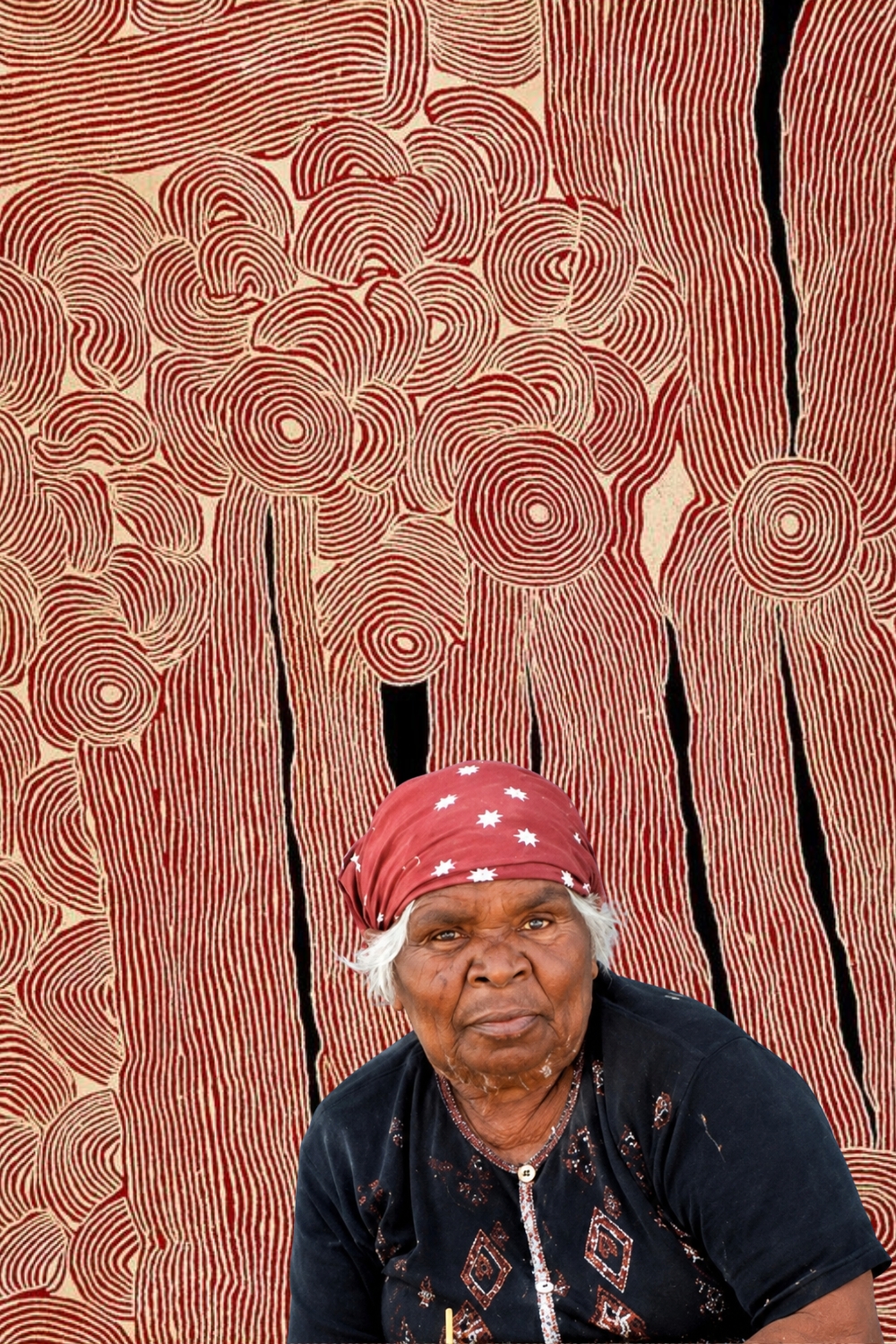
Ningura Napurrula Gibson (c.1938–2013) was a major Pintupi artist and one of the leading figures in the flowering of Pintupi women’s painting during the 1990s. Born south of Kiwirrkurra in the Gibson Desert, she spent her early life on Pintupi Country before travelling east with her husband, Yala Yala Gibbs Tjungurrayi, to Papunya.
Ningura began painting independently in 1995 after years of assisting Yala Yala, one of the founding painters of the Papunya Art movement. She belonged to an important generation of senior Pintupi women, including Makinti Napanangka and Naata Nungurrayi, whose emergence as independent artists transformed Western Desert Art during the 1990s.
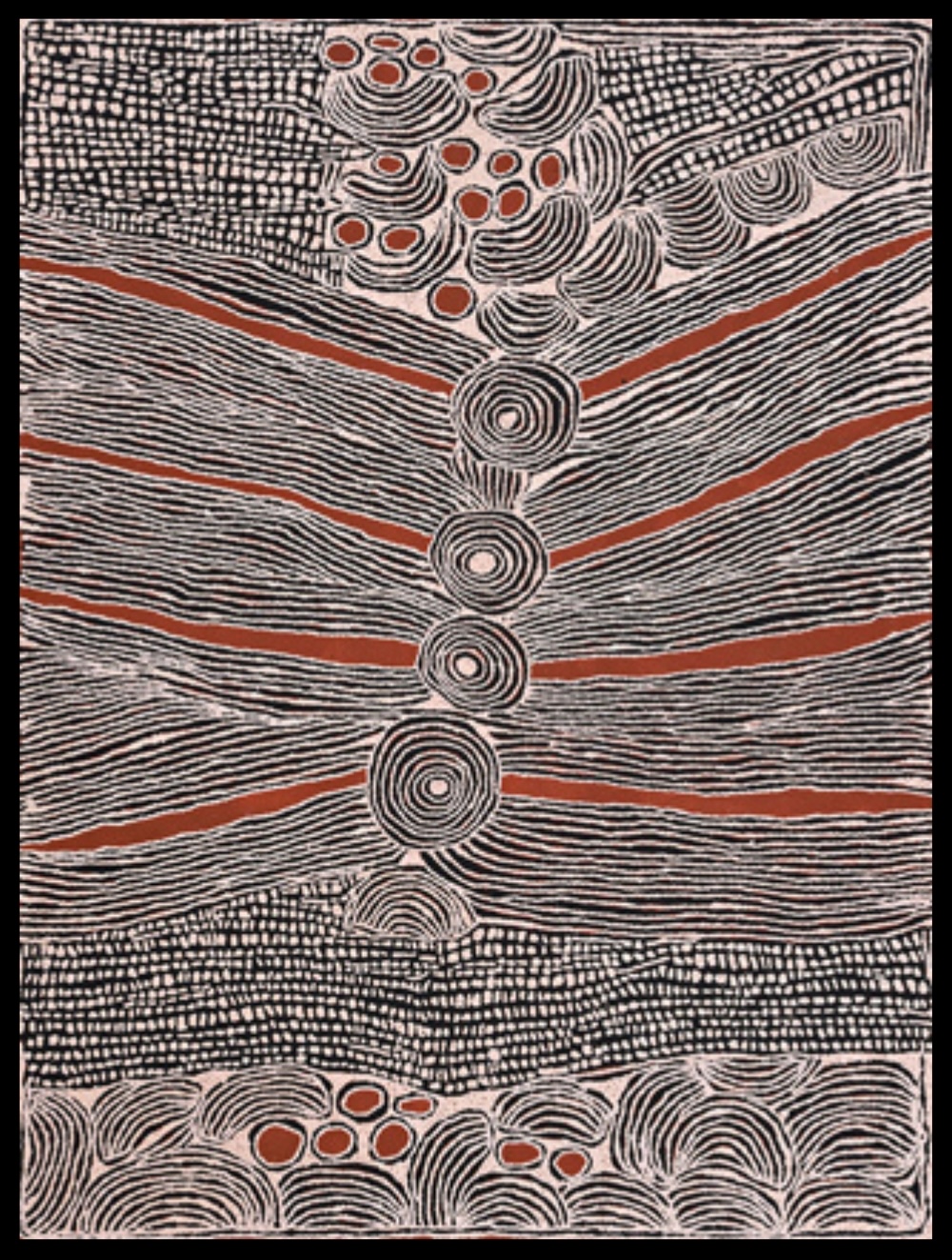
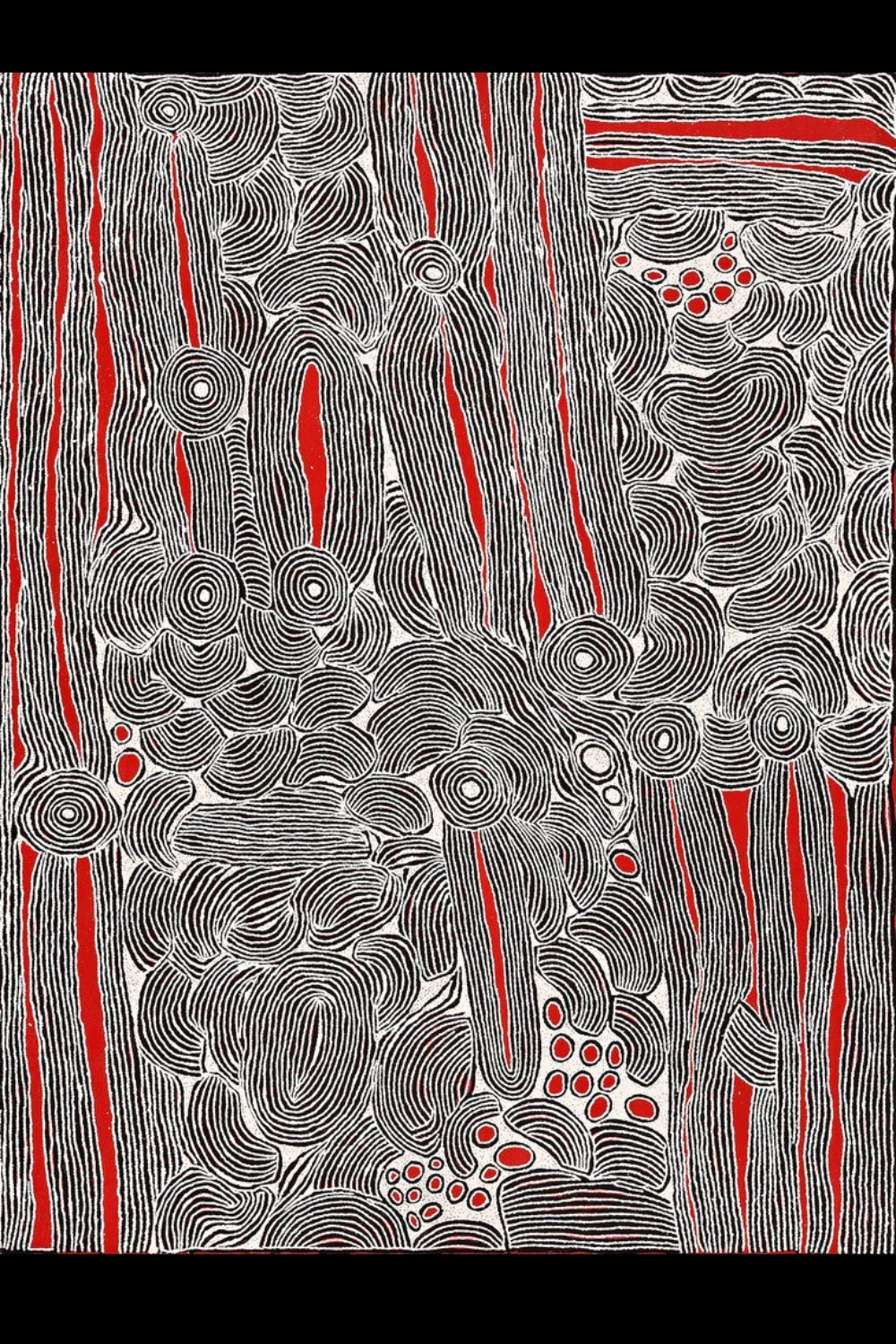
Her mature paintings are immediately recognisable for their fine parallel lines, textured fields of monochromatic dotting, irregular enclosing forms and restricted palettes of black, white, red and ochre. Many concern Pintupi women’s Country and ancestral narratives around Kiwirrkurra, particularly Wirrulnga and Ngaminya, while retaining visual structures continuous with earlier Western Desert iconography.
Ningura rapidly achieved national and international recognition. Her work entered major public collections, appeared on an Australian postage stamp, and her imagery was permanently incorporated into the architecture of the Musée du quai Branly – Jacques Chirac in Paris. Today she is recognised as one of the defining Pintupi women painters of her generation.
If you would like to know what a Ningura Napurrula painting is worth, or are considering selling an example, please see my Ningura Napurrula Art Values and Auction Results page.
Early Life and Return to Pintupi Country
Ningura Napurrula was born around 1938 south of Kiwirrkurra in the Gibson Desert of Western Australia. A Pintupi woman, she spent much of her early life on Country when many Pintupi families were still living largely independently of permanent settlements.
During the early 1960s she travelled east with her husband, Yala Yala Gibbs Tjungurrayi, and their family towards Papunya. Yala Yala subsequently became one of the original Papunya Tula painters and an important early painter of Tingari subjects. Ningura assisted him with his paintings, particularly with the meticulous dotted areas characteristic of his mature work, giving her considerable experience with acrylic painting long before she painted independently.
From the late 1970s, Pintupi families increasingly began returning west from Papunya to their ancestral lands. Walungurru (Kintore) was established in 1981, followed by Kiwirrkurra farther west, allowing families to live much closer to the Country and ceremonial places represented in their paintings.
Ningura and her family were part of this return. It was within this renewed connection to Pintupi Country that the senior women’s painting movement developed during the 1990s and Ningura emerged as an important artist in her own right.
Painting career
Ningura Napurrula began painting independently in 1995 during the second year of the Haasts Bluff/Kintore women’s painting project. Before this, she had assisted her husband, Yala Yala Gibbs Tjungurrayi, with his paintings, giving her experience with acrylic paint before developing a practice of her own.
She belonged to an important generation of senior Pintupi women, including Makinti Napanangka and Naata Nungurrayi, who emerged as major independent artists during the 1990s. Although women had long created ceremonial designs and assisted male relatives with paintings, the early Papunya movement had been dominated by men. The women’s painting projects of the 1990s brought senior women’s own Country and ceremonial traditions increasingly to the forefront of Western Desert Art.
Ningura rose rapidly to prominence. In 1999 she contributed to the collaborative Kintore Women’s Painting for the Western Desert Dialysis Appeal, and in 2000 held her first solo exhibition at William Mora Galleries in Melbourne. That year she also participated in the major collaborative women’s painting associated with Papunya Tula: Genesis and Genius at the Art Gallery of New South Wales.
By 2003 her work had been reproduced on an Australian postage stamp, and she was later selected as one of eight Indigenous Australian artists whose designs were incorporated into the Musée du quai Branly project in Paris.
What Was Ningura Napurrula’s Painting Style?
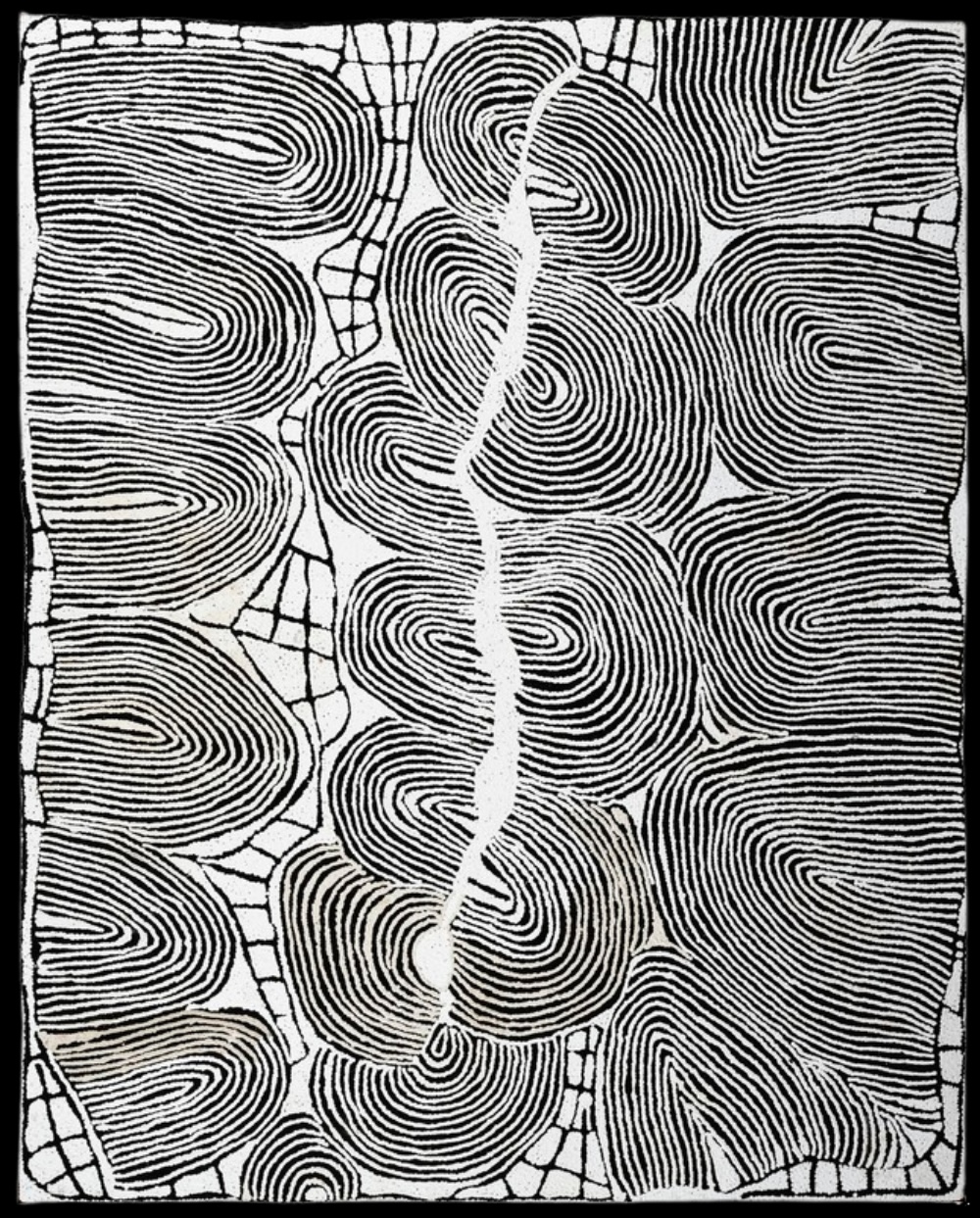
Ningura Napurrula developed one of the most recognisable painting styles among Pintupi artists of the late twentieth and early twenty-first centuries. Her work depends less on brilliant colour than on strong structure, restricted palettes and dense parallel lines.
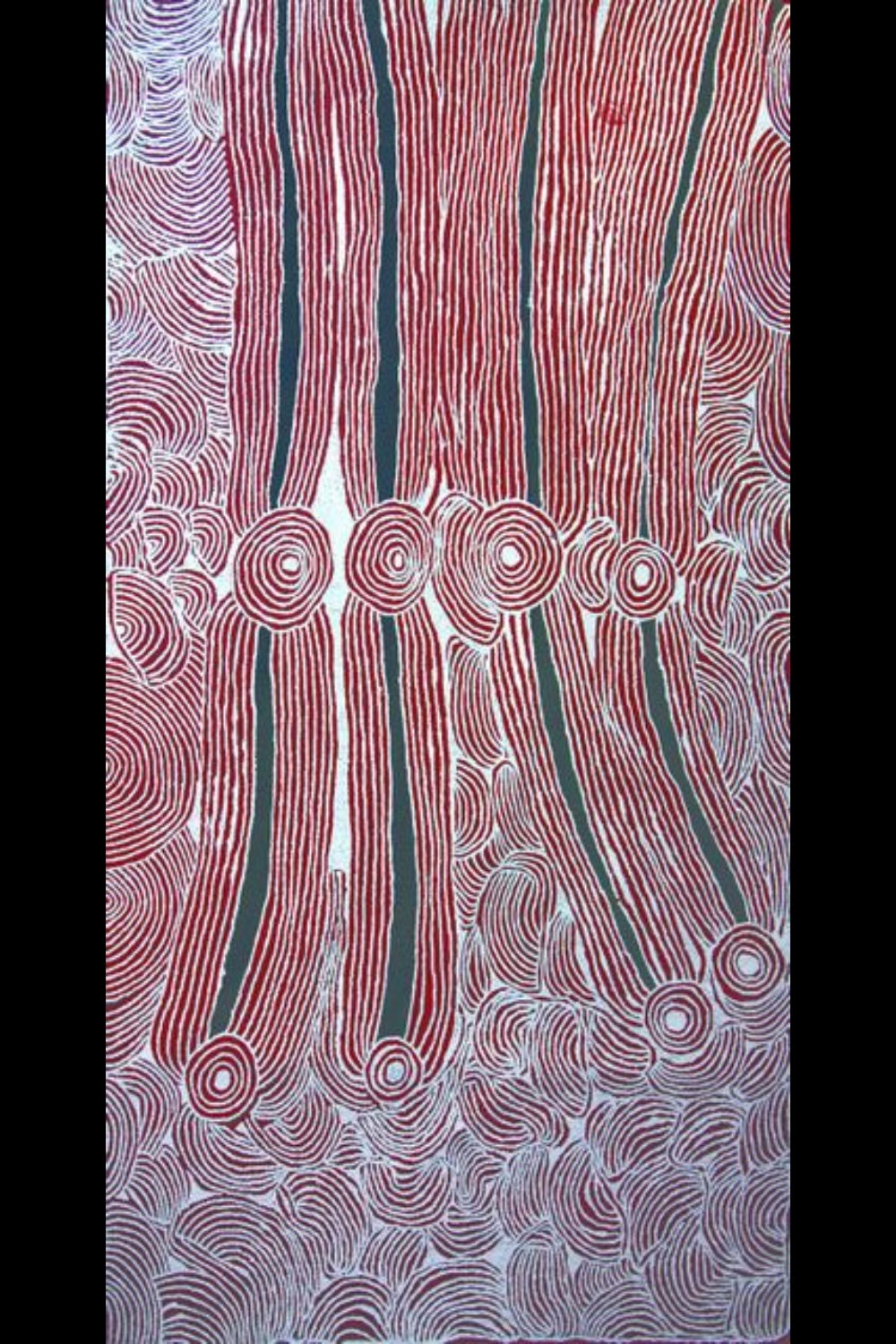
She typically worked with only two to four colours, particularly black, white or cream, red and ochre. Strong contrasts divide the canvas into large areas, while fine parallel lines curve around and connect concentric circles, arcs, elongated forms and other elements derived from earlier Western Desert iconography. She also used fields of dots, but these are generally monochromatic and function more as surface texture and rhythm than as contrasting fields of colour.
In this respect, Ningura’s paintings differ from the increasingly reductive geometric abstraction of contemporary Pintupi artists such as Warlimpirrnga Tjapaltjarri and George Tjungurrayi. Her work is highly abstract in appearance, but earlier Western Desert iconographic structures often remain more visibly present.
Her mature paintings also have a distinctive physical quality. Lines expand and contract, shapes remain irregular, and areas of line and dotting change in density and rhythm. The surfaces feel worked by hand rather than geometrically controlled, creating a sense of movement across the canvas.
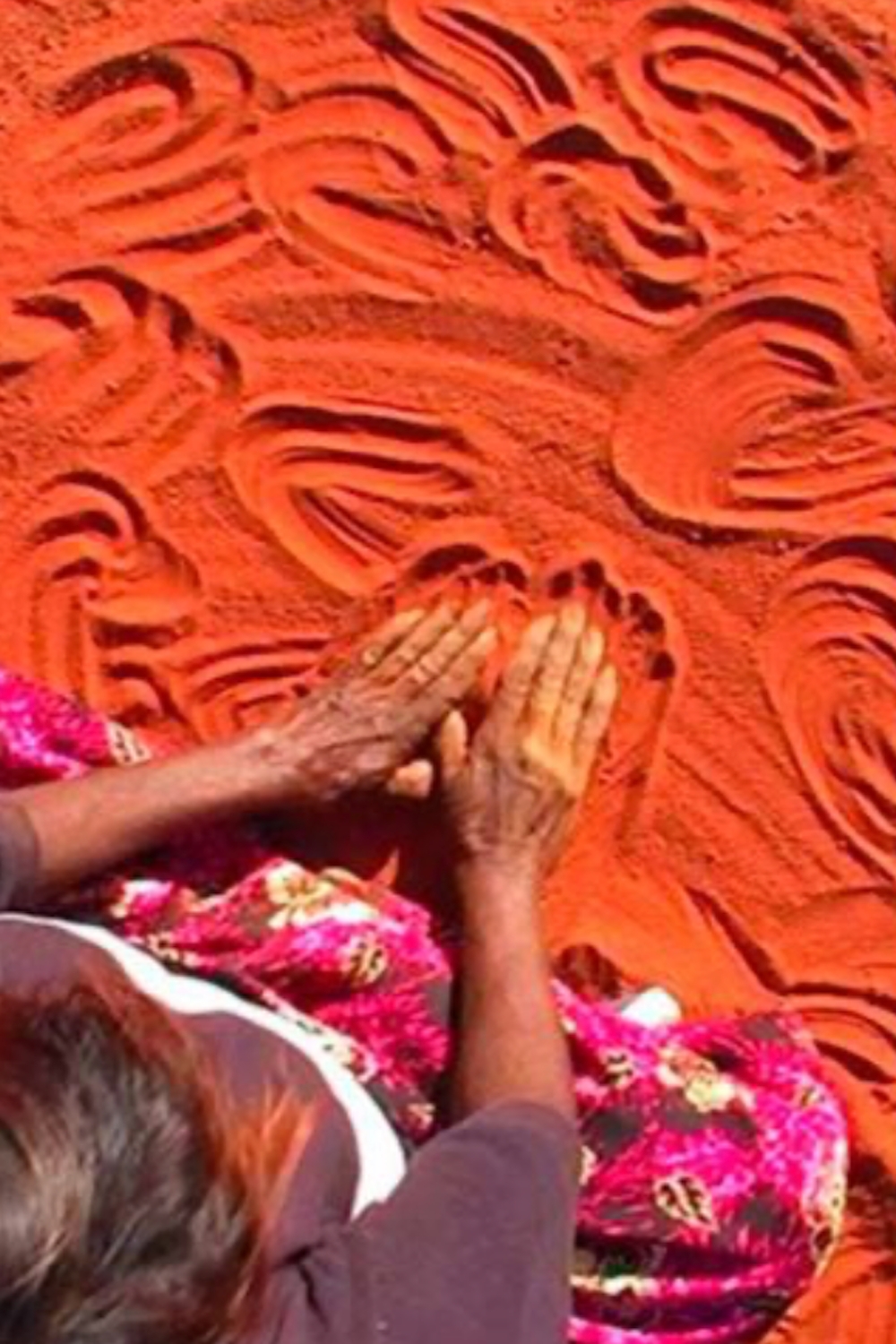
Writing about the Kintore Women’s Painting, Wally Caruana drew attention to its layered, undulating application of paint and related this process to the successive creation of narrative designs in sand. This combination of recognisable iconographic forms, restricted colour, rhythmic line, textured dotting and physical movement became one of the defining qualities of Ningura Napurrula’s mature work.
What Do Ningura Napurrula’s Paintings Depict?
Ningura Napurrula’s paintings primarily concern Pintupi women’s Country, ancestral narratives and ceremonial knowledge associated with Kiwirrkurra and the wider Western Desert. They are not simply decorative abstractions or pictures of isolated places, but expressions of an interconnected geography of women’s sites, journeys, food gathering and ceremony.
Across her documented works, places including Ngaminya, Wirrulnga, Tjuntulpul and Walkalkarra are connected by the journeys of ancestral women. Papunya Tula documentation describes women travelling between these places, performing ceremonies, giving birth, making ceremonial hair-string skirts and gathering foods such as kampurarrpa (desert raisins) and pura (bush tomato).
Wirrulnga, east of Kiwirrkurra, was one of Ningura’s most important recurring subjects. It is a rockhole site associated with women and birth. An ancestral Napaltjarri woman gave birth there, while women made spun hair-string used to produce nyimparra, skirts worn during ceremony. The women then continued towards Wilkinkarra (Lake Mackay), gathering bush foods along the way.
The imagery changes according to the particular painting. Roundels can represent rockholes or bush foods; lines may refer to ancestral women, creeks or features of the landscape; arc forms can represent women; and comb-like forms may depict nyimparra. Grid-like structures can evoke the sandhills or rocky country surrounding particular sites.
This variation is important. Ningura’s paintings cannot be decoded using a universal Aboriginal symbol key. A circle or line does not always have the same meaning. Its significance depends upon the particular place, ancestral narrative and ceremonial knowledge represented in each painting.
Women’s Ceremony and Sand Drawing
Ningura’s painting developed from a much older Western Desert visual tradition in which designs were created on the body and ground during ceremony and storytelling. Her layered surfaces and repeated linear forms are particularly closely related to women’s traditions of drawing and repeatedly remaking designs in sand.
As Wally Caruana observed of Ningura’s work, its “layered, undulating application of paint” recalls the way desert women create narratives through successive drawings in sand. The comparison helps explain the physical quality of her paintings: forms accumulate, overlap and move across the surface rather than appearing as rigid geometric diagrams.
Her paintings should not, however, be understood as literal copies of sand drawings or ceremonial designs. They are contemporary works made for public viewing, transforming elements of an older Pintupi visual and ceremonial tradition into acrylic paintings on canvas.
Why Is Ningura Napurrula Important?
Ningura Napurrula’s importance lies partly in the extraordinary historical span of her life. She grew up on Pintupi Country before permanent settlement, travelled east towards Papunya, assisted her husband Yala Yala Gibbs Tjungurrayi during the development of Papunya Tula painting, returned west during the homelands movement and emerged as a major artist during the rise of Pintupi women’s painting in the 1990s.
Her achievement was also intensely individual. Ningura developed an immediately recognisable visual language through which women’s Country, ancestral journeys and ceremonial knowledge could enter contemporary Australian art while remaining grounded in Pintupi traditions and place.
The international significance of her work was demonstrated by her selection for the Australian Indigenous Art Commission at the Musée du quai Branly – Jacques Chirac in Paris. One of eight Indigenous Australian artists chosen for the project, Ningura had her imagery translated into a permanent element of Jean Nouvel’s architecture. A visual language originating in Pintupi women’s Country in the Western Desert was thus embedded permanently within one of Europe’s major museums.
Ningura Napurrula died in 2013. Her life connects several defining periods of modern Pintupi history, while her paintings established a distinctive artistic language of their own. Today she is recognised as one of the defining Pintupi women painters of her generation and an important figure in contemporary Aboriginal Australian art.
Ningura Napurrula in Selected Collections
Further Reading
Hetti Perkins and Hannah Fink (eds.), Papunya Tula: Genesis and Genius, Art Gallery of New South Wales, 2000.
The essential starting point for the history of Papunya Tula painting. The catalogue traces the movement from the early Papunya painters through the return to Pintupi homelands and the emergence of senior women painters at Kintore during the 1990s. It is particularly relevant to Ningura because the exhibition included the major collaborative Kintore women’s painting in which she participated.
Hetti Perkins, Tradition Today: Indigenous Art in Australia, Art Gallery of New South Wales, 2004.
A major survey of contemporary Aboriginal and Torres Strait Islander art useful for placing Ningura within the wider emergence of senior Indigenous women as major contemporary painters.
Franchesca Cubillo and Wally Caruana (eds.), Aboriginal & Torres Strait Islander Art: Collection Highlights, National Gallery of Australia, 2010.
Includes Ningura Napurrula and reproduces one of her monumental paintings. It provides useful institutional context for understanding her work within the National Gallery of Australia collection and the wider history of Australian Indigenous art.
Fred R. Myers, Painting Culture: The Making of an Aboriginal High Art, Duke University Press, 2002.
One of the most important anthropological studies of Western Desert acrylic painting. Myers worked extensively with Pintupi people and examines how paintings grounded in Pintupi social, ceremonial and geographic knowledge became contemporary artworks circulating through galleries, museums and the international art market.
Although not a biography of Ningura, it provides essential context for understanding Pintupi painting and why describing such works simply as Western-style abstraction can be misleading.
Fred R. Myers, “Truth, Beauty, and Pintupi Painting.”
A particularly useful anthropological discussion of how Pintupi people evaluate paintings and visual form, examining relationships between aesthetics, cultural meaning and the social circumstances in which paintings are produced.
All images featured in this article are presented strictly for educational and informational purposes.
This website may include copyrighted material for which specific authorization has not been obtained from the copyright owner.
All such images are presumed to be the intellectual property of the respective artist or their estate, and are used in accordance with principles of fair dealing or fair use under applicable copyright law.