
Boxer Milner Tjampitjin: Biography Painting style and importance
c. 1934–2009
Tjaru / Jaru / Walmajarri
Matwanangu (Milnga-Milnga), near Sturt Creek
Billiluna / Balgo
Balgo Art / Western Desert Art
Warlayirti Artists
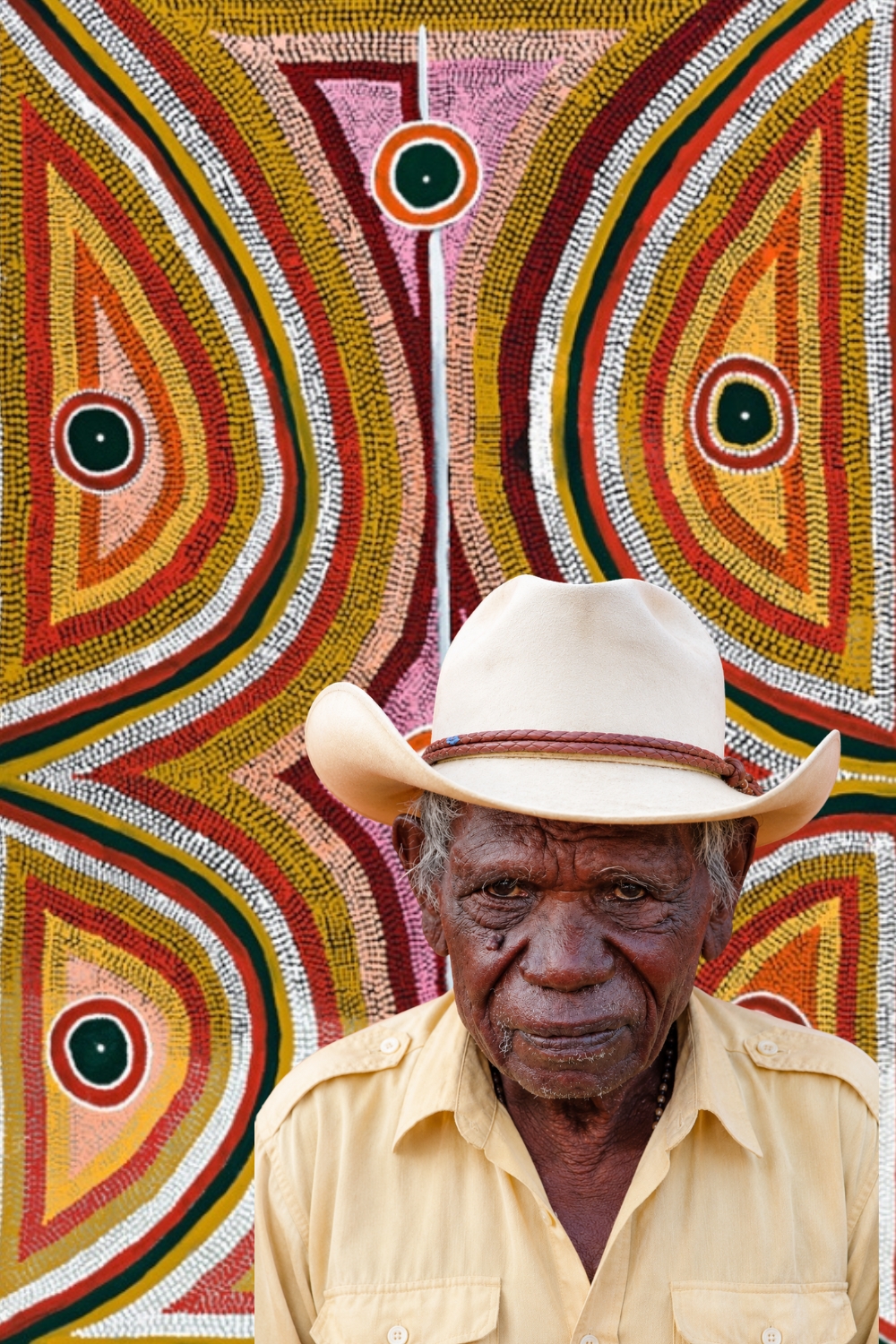
Boxer Milner Tjampitjin (c.1934–2009) was a senior Aboriginal Law man and one of the most distinctive painters associated with Balgo Art. Working with Warlayirti Artists from 1989, he became known above all for paintings of Purkitji (Sturt Creek), the great system of creek channels, floodplains and waterholes north of Balgo that lay at the centre of his Country and cultural responsibilities.
Rather than depicting Country as a static landscape, Boxer painted its transformation through the seasons. Rain, floods, tributaries, waterholes, black-soil plains, vegetation and rainbows recur throughout his work, along with the unusual pale floodwater known as “milk water”. These physical features were inseparable from the ancestral narratives, ceremony and Law through which he understood and cared for Country.
During the 1990s Boxer developed an increasingly individual language of strong lines, geometric grids, circles, blocks of colour and densely dotted surfaces. His paintings could look remarkably different from those of fellow senior Balgo artist Eubena Nampitjin, whose increasingly gestural fields of brilliant colour emerged during the same broad period. Their contrasting work demonstrates the extraordinary diversity within Balgo Art and, more broadly, Western Desert Art: artists working through the same art centre could develop radically different visual languages grounded in different Countries, cultural responsibilities and lived experience.
If you are researching Boxer Milner value and auction results or have a painting for sale feel please visit
Boxer Milner Values page.
Boxer Milner Biography
Boxer Milner was born around 1934–35 at Matwanangu or Milnga-Milnga, near Sturt Creek, southwest of Billiluna in northern Western Australia. Published sources vary in describing his language affiliation: Vivien Johnson identifies him as Tjaru, the National Gallery of Victoria as Jaru, while the Art Gallery of South Australia identifies him as Walmajarri. What is consistent across the sources is the central importance of Sturt Creek and the surrounding Country to his life and art.
As a younger man, Milner worked as a stockman throughout the Sturt Creek region. Years spent travelling and working across this landscape gave him an intimate knowledge of its watercourses, floodplains, soils, vegetation and dramatic seasonal changes. His relationship with Country, however, extended far beyond geographical familiarity. Milner was a senior lawman and, together with his two brothers, held custodial responsibilities for ancestral stories, songs and ceremonial knowledge associated with Sturt Creek.
Milner did not begin painting professionally until later in life. In 1989, when he was already in his fifties, he began painting with Warlayirti Artists, the Aboriginal-owned art centre based at Wirrimanu (Balgo). His paintings allowed him to translate aspects of his extensive knowledge of Country onto canvas, particularly the interconnected waterways and floodplains of Purkitji (Sturt Creek).
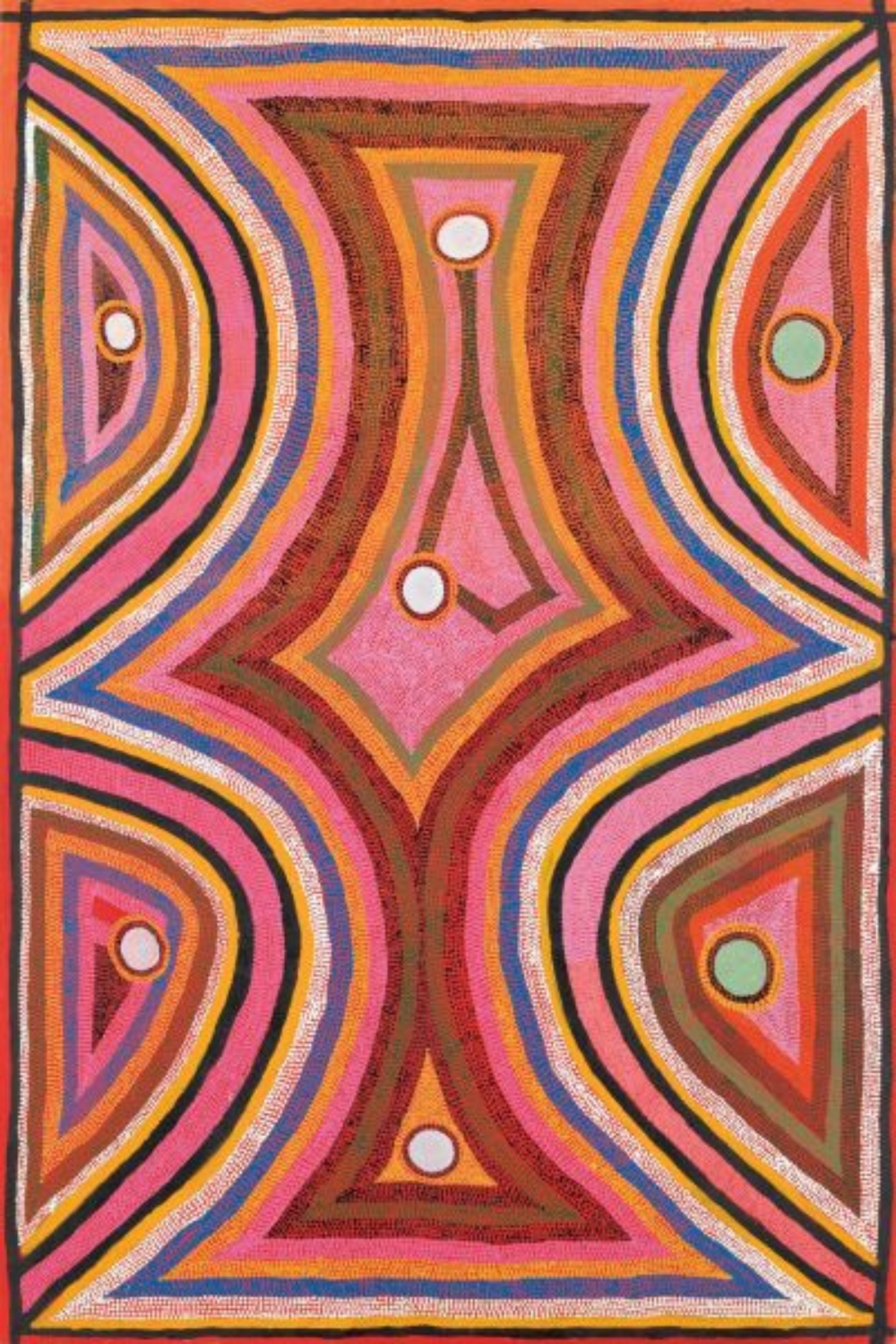
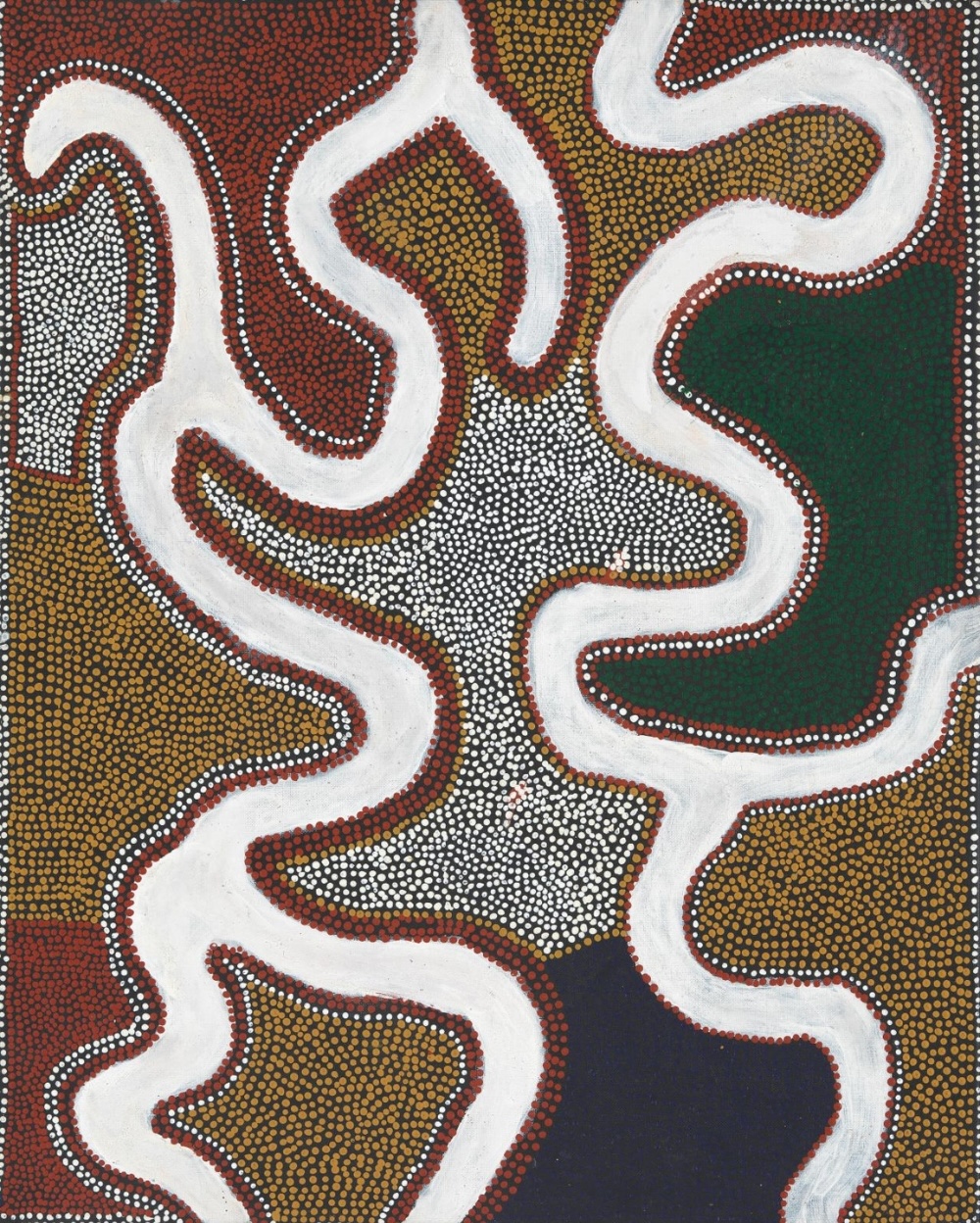
Two of his earliest documented paintings, both titled Milkwater, were painted at Billiluna in 1989 and acquired by the National Gallery of Victoria that same year. Over the following decade his work developed from relatively restrained early compositions into an increasingly individual language of lines, grids, circles, fields of colour and dense dotting.
By 2000 Milner had emerged as one of the most distinctive senior artists associated with Balgo. That year Gallery Gabrielle Pizzi in Melbourne presented his first solo exhibition, Pinti Pinti – Milk Water Country, bringing together paintings inspired by the water, flooding and seasonal transformation of Sturt Creek.
Milner’s painting career therefore grew from a lifetime already spent knowing and caring for this Country. His paintings drew on a lifetime of experience on Country, close observation of the landscape and deep ceremonial knowledge, giving his depictions of Sturt Creek a distinctive place within contemporary Balgo art.
What Did Boxer Milner Paint?
The central subject of Boxer Milner’s art was Purkitji (Sturt Creek) and the interconnected Country surrounding it. Rather than repeatedly painting a generic “Water Dreaming”, Milner depicted particular places and the changing states of a vast water system that he had known throughout his life.
Sturt Creek lies in a transition between sandy desert and river country north of Balgo. Its landscape contains extensive creek channels, tributaries, floodplains, permanent and temporary waterholes and black-soil country, all dramatically transformed by seasonal rain. Milner also depicted rain clouds, rainbows, vegetation and the changing appearance of Country through the wet and dry seasons.
The apparently abstract lines, circles, grids and fields of colour in his paintings can therefore have remarkably specific geographical meanings. A Warlayirti Artists certificate for a 2002 Purkitji, for example, explains that a central double-cross design represents the principal channels of Sturt Creek while smaller hooked forms represent its tributaries. In Water Channels at Sturt Creek (2000), a blue line represents the main creek while other lines trace the routes taken by floodwaters. Milner’s geometric compositions can consequently be understood, at least in part, as compressed representations of water moving through Country.
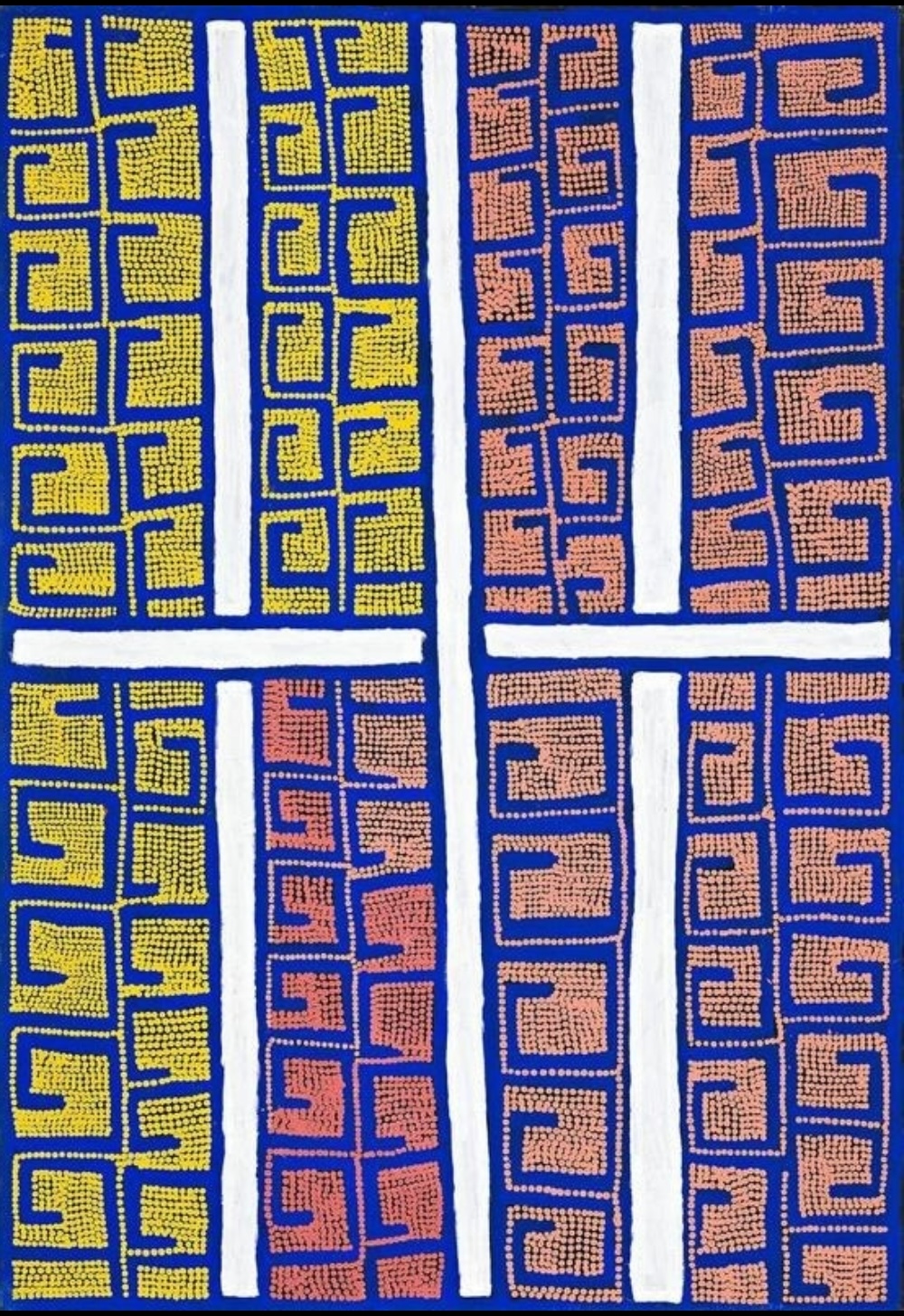
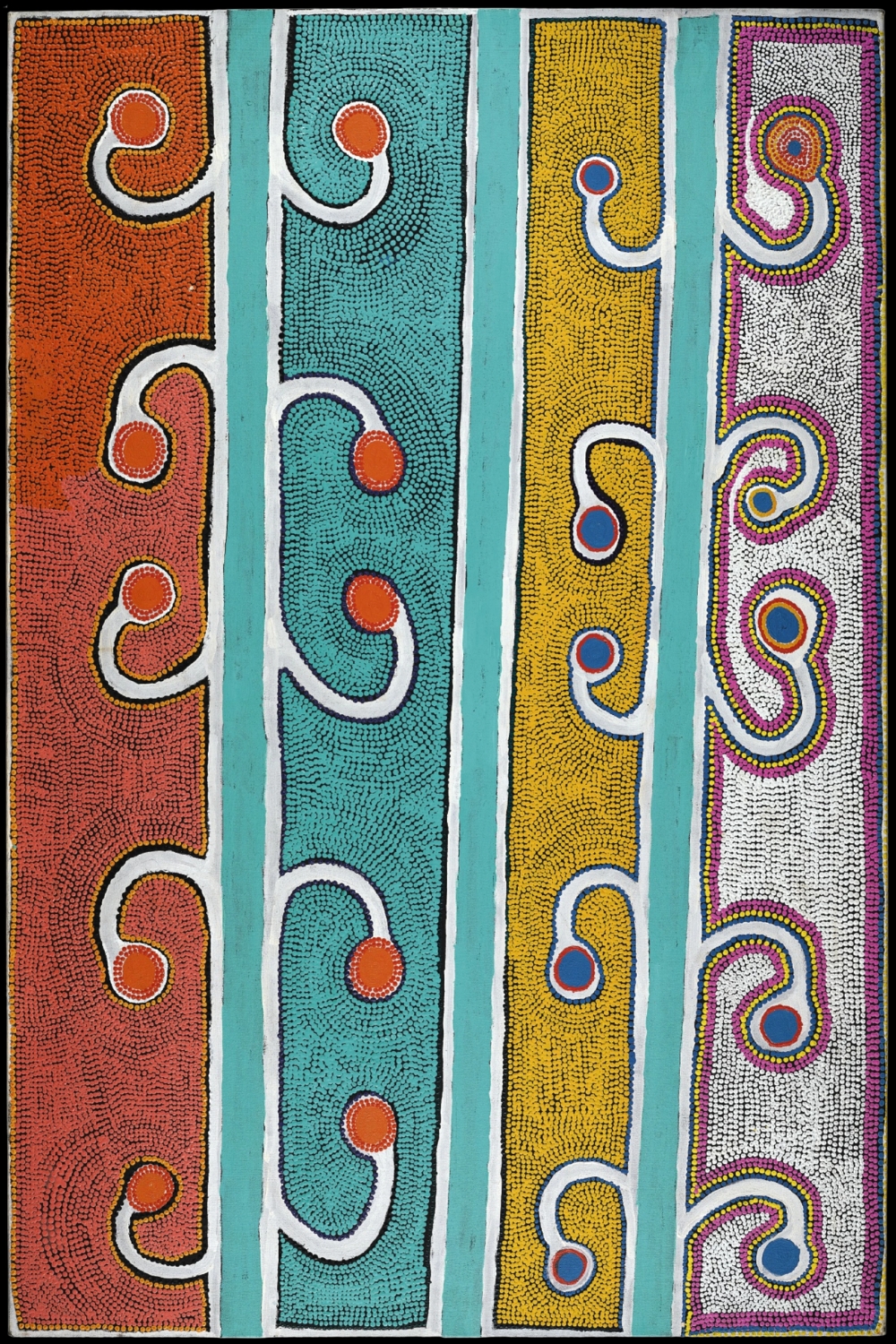
One of the most distinctive natural phenomena in his paintings is “milk water”. After seasonal rains, sediment carried through the Sturt Creek system can give the floodwater a pale, milky appearance. In Sturt Creek Near Billiluna (1999), this pale water is contrasted with black lines representing dark silt along the banks. The phenomenon became so closely associated with Milner that his first solo exhibition at Gallery Gabrielle Pizzi in Melbourne in 2000 was titled Pinti Pinti – Milk Water Country.
Milner’s paintings, however, should not be interpreted simply as geographical maps or observations of weather. The Country he painted also embodies ancestral events, ceremonial responsibilities and Law. Some works incorporate Kurrawarri designs, forms painted in ochre on men’s bodies during ceremonies associated with the Sturt Creek area. His imagery can therefore connect visible features of the landscape with the ceremonial knowledge through which that Country is understood.
Oolaign (2000) provides a particularly revealing example. Oolaign is associated with Tingari ancestors and important men’s ceremonies. Milner depicts early wet-season rain entering different catchments and flowing through tributaries towards Sturt Creek. Art historian Wally Caruana interpreted this movement of water as also suggesting the ceremonial transition of boys into men and their acquisition of ancestral knowledge.
The circles, lines and hooked forms in Milner’s paintings do not have fixed meanings. Their interpretation depends upon the particular Country and narrative represented. Lines can describe creeks, tributaries or flood channels, while circles can identify waterholes and soakwaters. In a documented 1999 Rainbow Dreaming, for example, central circles represent waterholes along Sturt Creek, while additional circles identify temporary waterholes created by flooding and coloured dots indicate water flowing from the surrounding bush.
Boxer Milner’s Painting Style
Boxer Milner developed one of the most distinctive styles associated with Balgo Art. His early paintings were comparatively small and restrained, often combining simple linear forms with extensive dotting. During the 1990s his work became increasingly bold, colourful and individual.
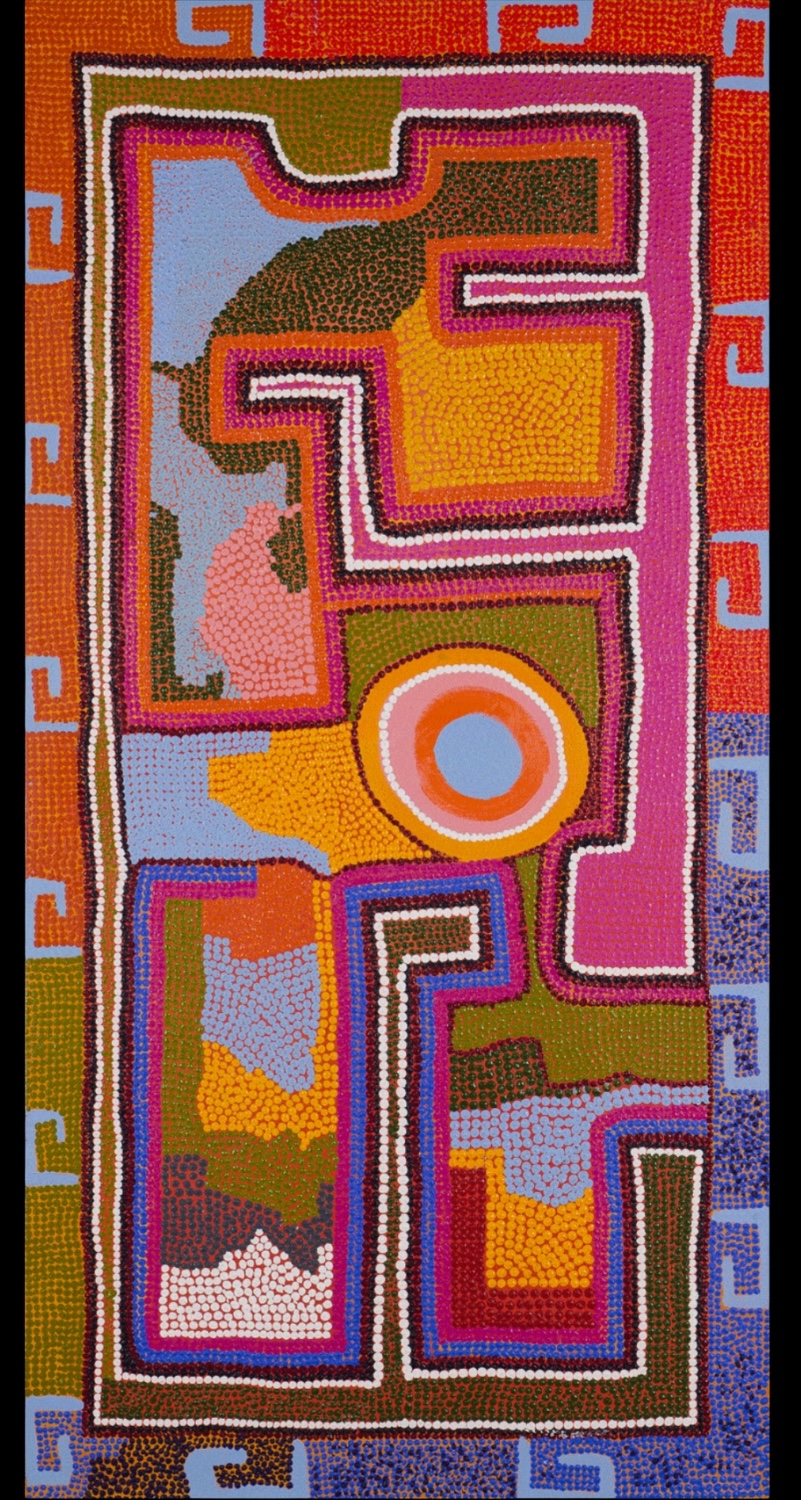
His mature paintings use strong geometric lines, grids, circles, hooked forms and broad fields of colour, often enriched by dense impasto dotting. Some compositions are tightly structured around intersecting lines, while others use sweeping bands and large areas of negative space.
Milner’s style was closely connected to his Sturt Creek Country, which lies between desert and river environments. Its branching waterways and dramatic seasonal transformations encouraged a more linear and geometric approach than that seen in the work of many other Balgo painters. Greens and blues also became prominent alongside pinks, reds, yellows and ochres.
By the late 1990s and early 2000s, Milner had developed a highly personal form of abstraction. Anthropologist and art historian John Carty examined this aspect of his work in Boxer Milner Tjampitjin: Portraits of Water, associated with No Boundaries: Aboriginal Australian Contemporary Abstract Painting. Milner’s monumental 2002 Purkitji diptych was included in the exhibition and subsequently shown in the United States.
Milner’s achievement was to create paintings that appear strikingly abstract while remaining firmly connected to Country and cultural knowledge.
Boxer Milner value and auction results
Works Offered at Auction: 128
Sale Rate: 57%
Highest Sale: $32,000 AUD
Median Sale Price: $8,000 AUD
For individual artworks, sizes provenance and more please visit the Boxer Milner Value support page
Why Is Boxer Milner Important?
Boxer Milner became one of the most distinctive senior artists associated with Warlayirti Artists and Balgo painting, gaining recognition in major Australian collections and exhibitions and, increasingly, internationally.
His work appeared in significant exhibitions including Images of Power: Aboriginal Art of the Kimberley at the National Gallery of Victoria and Colour Power: Aboriginal Art Post 1984. Individual paintings were subsequently exhibited in Italy, the Netherlands, Israel, France, Spain, New Zealand, the United States and Monaco, while important private collections formed by Gabrielle Pizzi and Colin and Elizabeth Laverty helped introduce his work to wider audiences.
Milner’s paintings are now represented in public collections including
Art Gallery of South Australia
British Museum.
In 2020 Australia Post reproduced his Milnga-Milnga, the artist’s birthplace (1999)as part of its Art of the Desert stamp issue.
His inclusion in No Boundaries: Aboriginal Australian Contemporary Abstract Painting further positioned his work within the broader history of contemporary Aboriginal abstraction, rather than solely within the regional history of Balgo painting.
Milner died on 23 June 2009. Warlayirti Artists remembered him as one of its most respected and prolific artists, recognising both his cultural responsibilities for Purkitji and the innovative character of his painting.
His legacy lies in the highly individual visual language he developed for Sturt Creek Country, establishing a body of work that is unmistakably his own.
Further Reading
This is probably the single most important extended study of Milner’s art. Carty examines his paintings of Sturt Creek, water, Country and their development into an increasingly abstract visual language. Adelaide University’s publication record confirms the chapter and pages.
John Carty, “Wimmitji Tjapangarti & Boxer Milner,” in Franchesca Cubillo and Wally Caruana (eds), Aboriginal & Torres Strait Islander Art: Collection Highlights, National Gallery of Australia, 2010, pp. 76–77.
A useful museum-based discussion placing Milner alongside Wimmitji Tjapangarti and within the development of Balgo painting.
Vivien Johnson, “Boxer Tjampitjin Milner,” in Aboriginal Artists of the Western Desert: A Biographical Dictionary.
Particularly valuable for Milner’s biography, Tjaru affiliation, Sturt Creek Country and the relationship between his imagery and the floodplains and creek systems around Milnga-Milnga. Johnson’s original biographical entry is preserved by Design & Art Australia Online.
Henry F. Skerritt (ed.), No Boundaries: Aboriginal Australian Contemporary Abstract Painting, DelMonico Books/Prestel, 2014–15.
The broader publication accompanying the international exhibition that presented Milner alongside Paddy Bedford, Ngarra, Tommy Mitchell, Warlimpirrnga Tjapaltjarri and other senior painters. It is particularly useful for understanding why Milner’s work has been discussed in relation to contemporary abstraction.
All images featured in this article are presented strictly for educational and informational purposes.
This website may include copyrighted material for which specific authorization has not been obtained from the copyright owner.
All such images are presumed to be the intellectual property of the respective artist or their estate, and are used in accordance with principles of fair dealing or fair use under applicable copyright law.