
Warlimpirrnga Tjapaltjarri: Biography and painting style
c. 1958
Pintupi
Wilkinkarra (Lake Mackay) and surrounding Tingari Country
Kiwirrkurra
Pintupi Art / Western Desert Art
Papunya Tula Artists
Warlimpirrnga Tjapaltjarri (born c.1958) is one of Australia’s most important contemporary Aboriginal artists. A senior Pintupi man, maparntjarra (traditional healer) and custodian of Wilkinkarra (Lake Mackay), he transformed the ancient Pintupi ceremonial language of parallel lines into one of the most distinctive bodies of contemporary Australian painting. Drawing on visual traditions found on woomera, engraved shields and ceremonial objects, his monumental works translate ancestral Country into shimmering networks of precisely controlled lines that remain firmly grounded in Tingari Tjukurrpa and Pintupi Law.
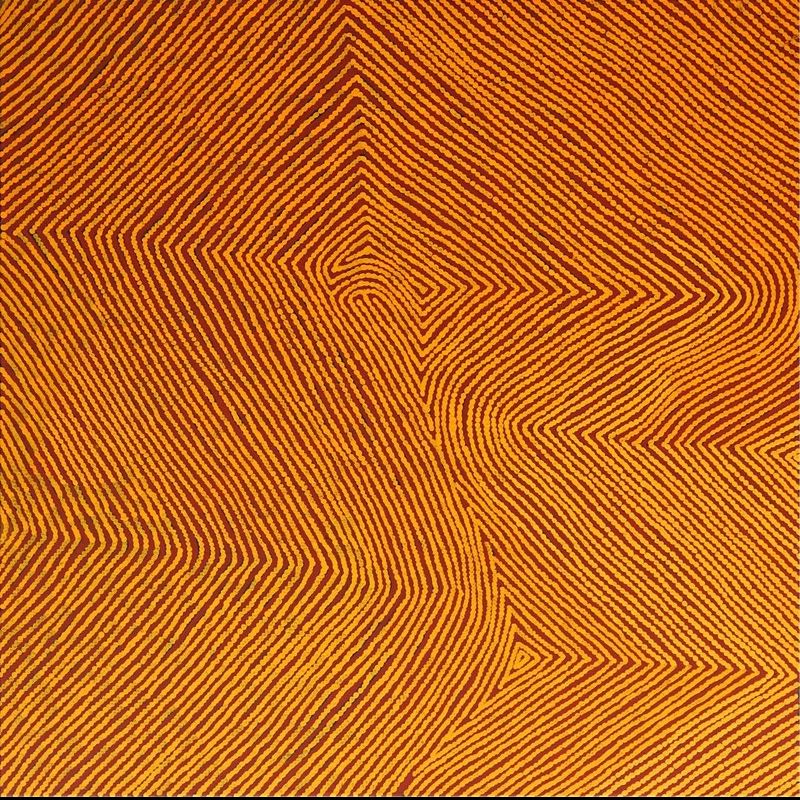
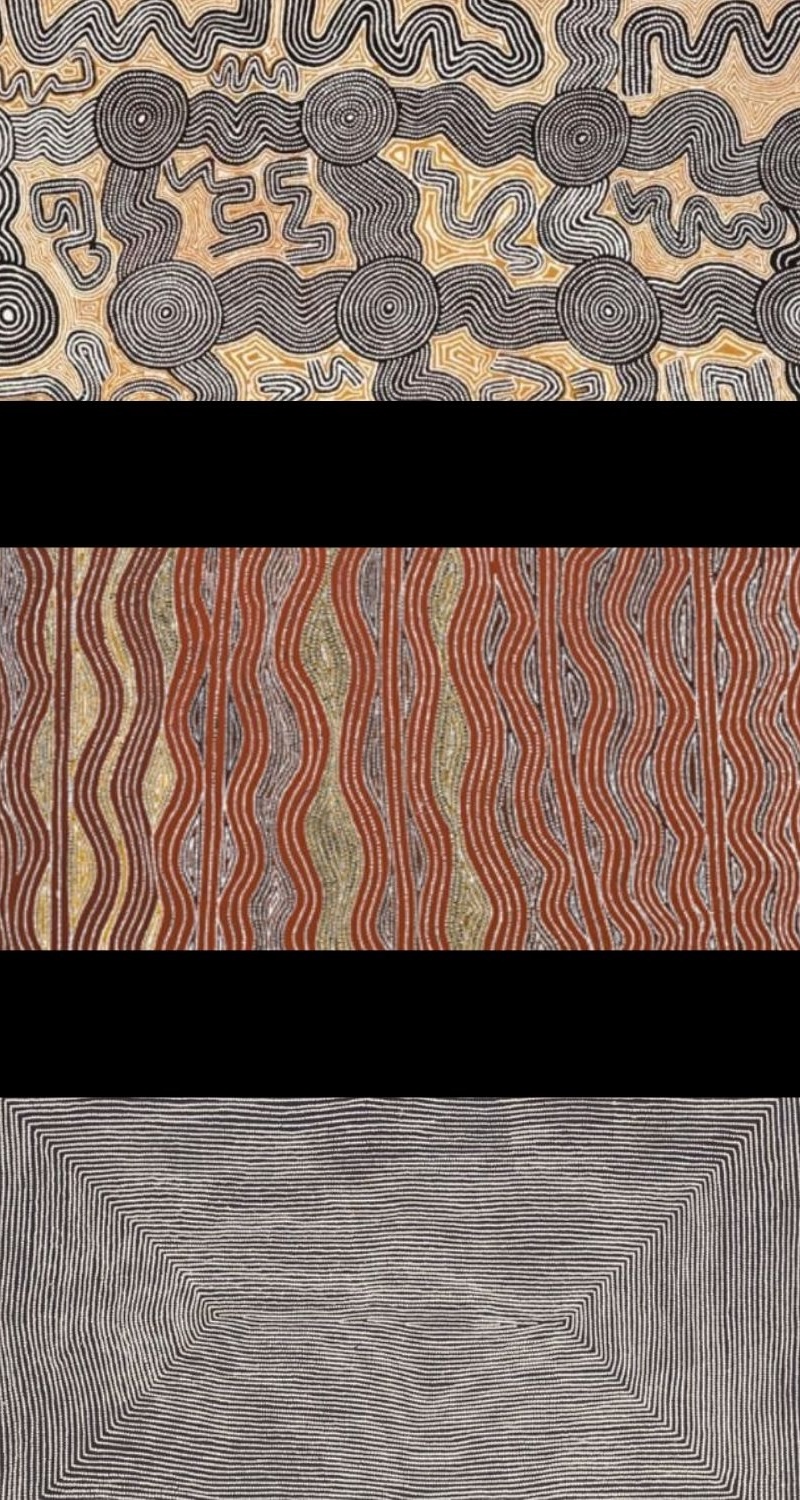
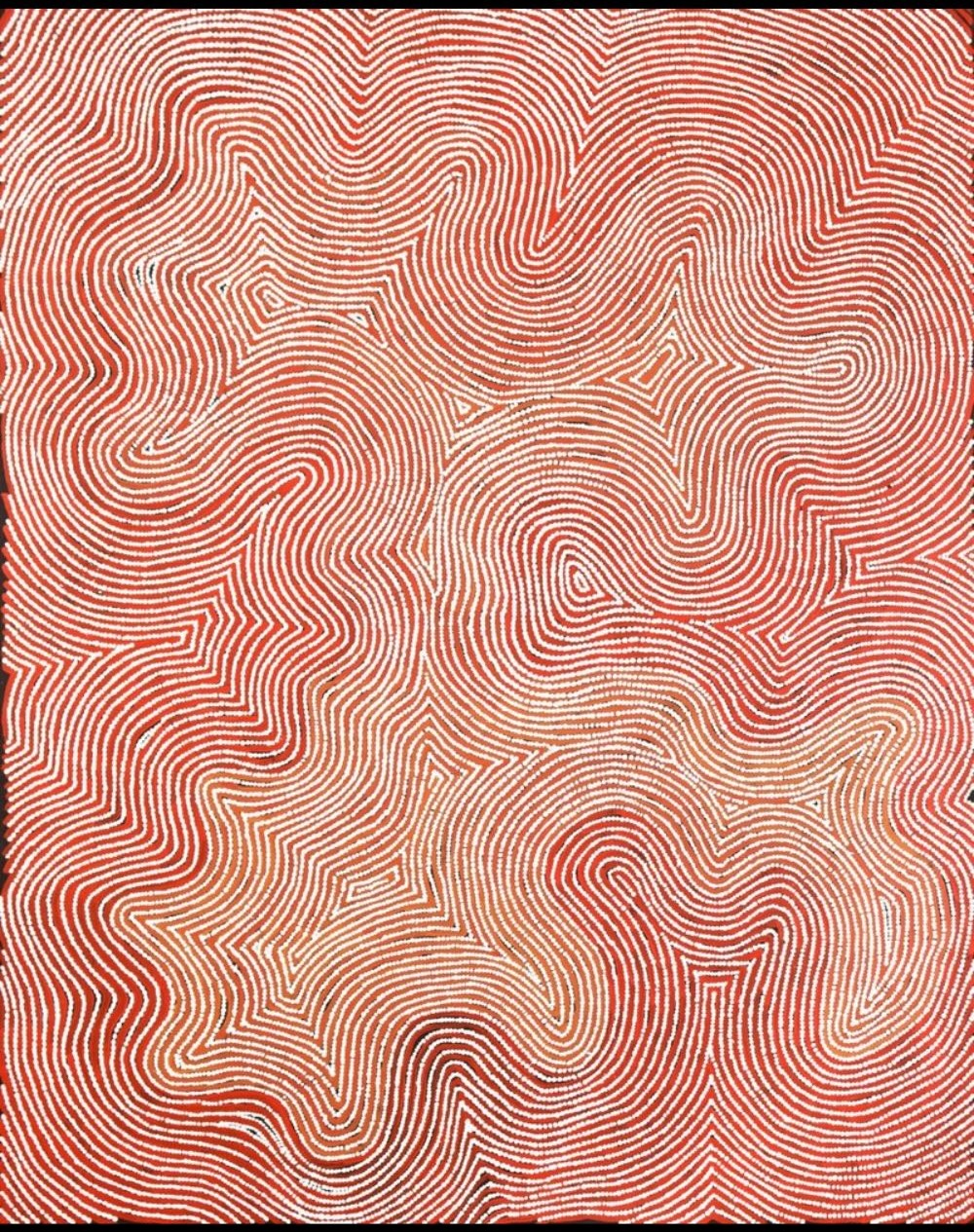
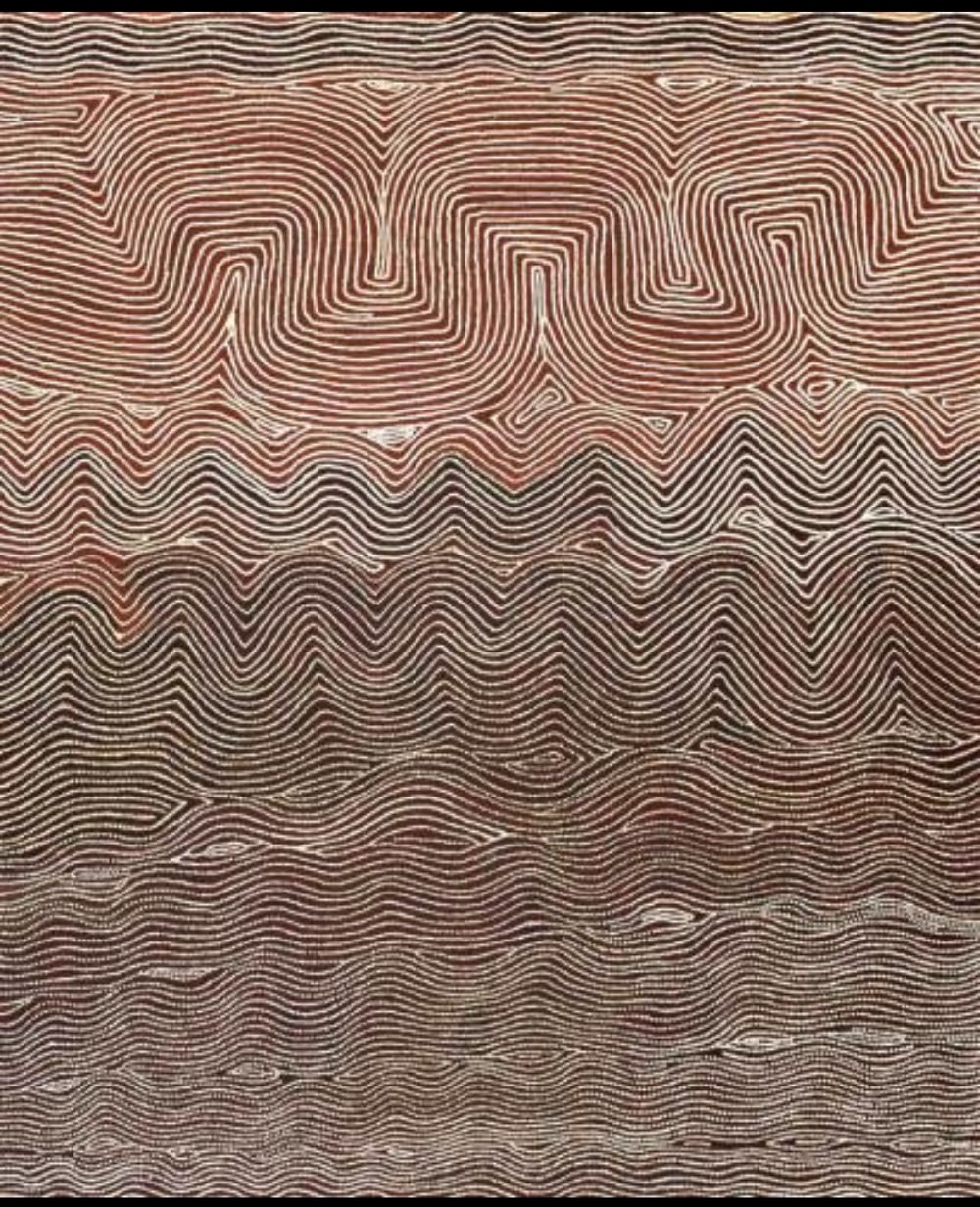
Unlike many Western Desert artists, whose paintings are defined by concentric circles and dotted iconography, Warlimpirrnga progressively allowed line itself to become the principal visual language of his art. This development also characterised the mature work of fellow Pintupi artists Turkey Tolson Tjupurrula and George Tjungurrayi, although each developed a distinctly individual style. Thousands of meticulously painted parallel lines flow across Warlimpirrnga’s canvases, creating powerful optical movement that evokes the rhythm of sandhills, ancestral journeys and the vast landscapes surrounding Lake Mackay. The result is a style that is instantly recognisable, technically extraordinary and widely regarded as one of the great achievements of contemporary Aboriginal art.
His work has entered major public collections in Australia and overseas and has been exhibited internationally, including dOCUMENTA 13 in Kassel.
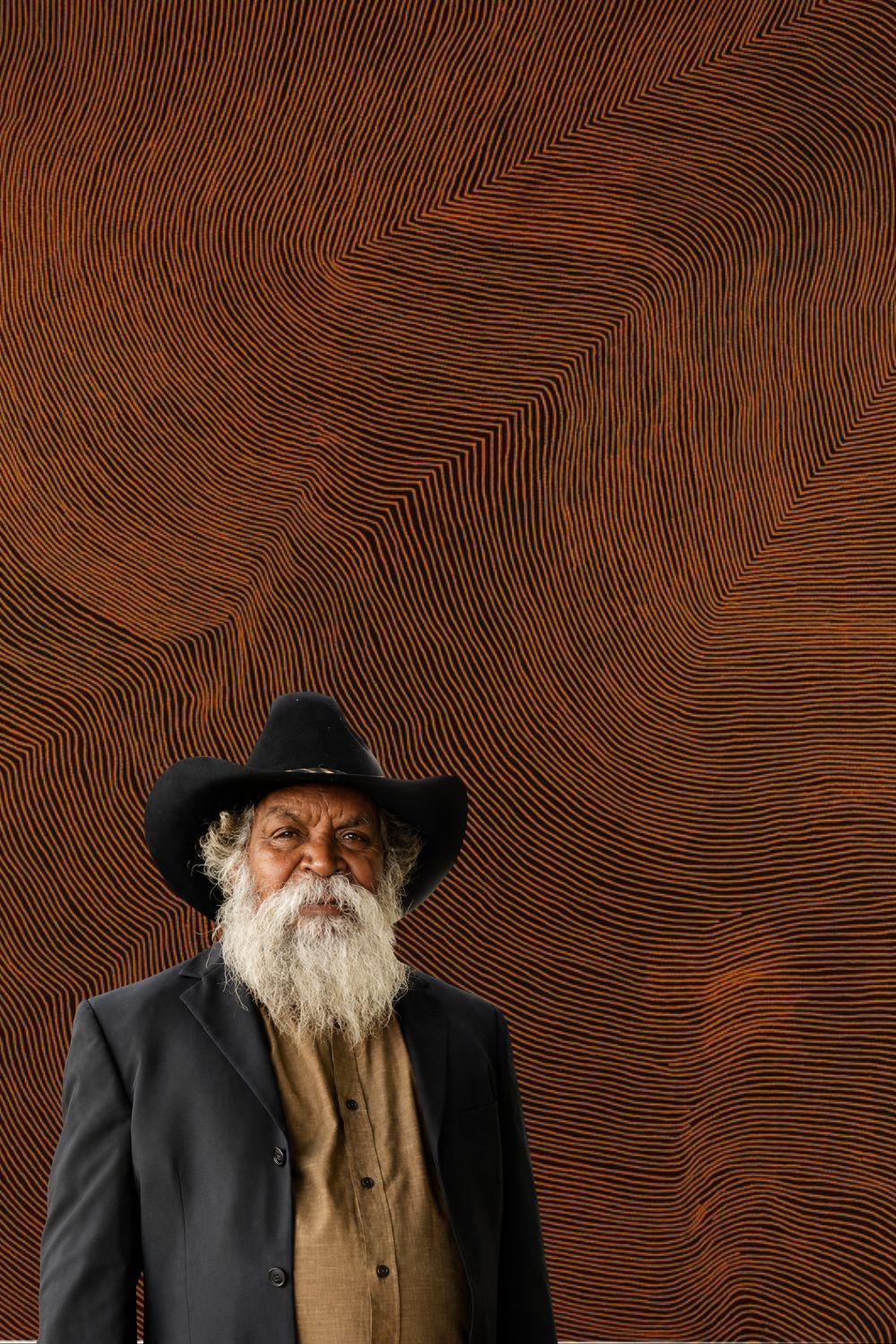
This guide explores Warlimpirrnga Tjapaltjarri’s life, painting style, important works and cultural significance. If you are researching the art market or considering selling, see Warlimpirrnga Tjapaltjarri Painting Values.
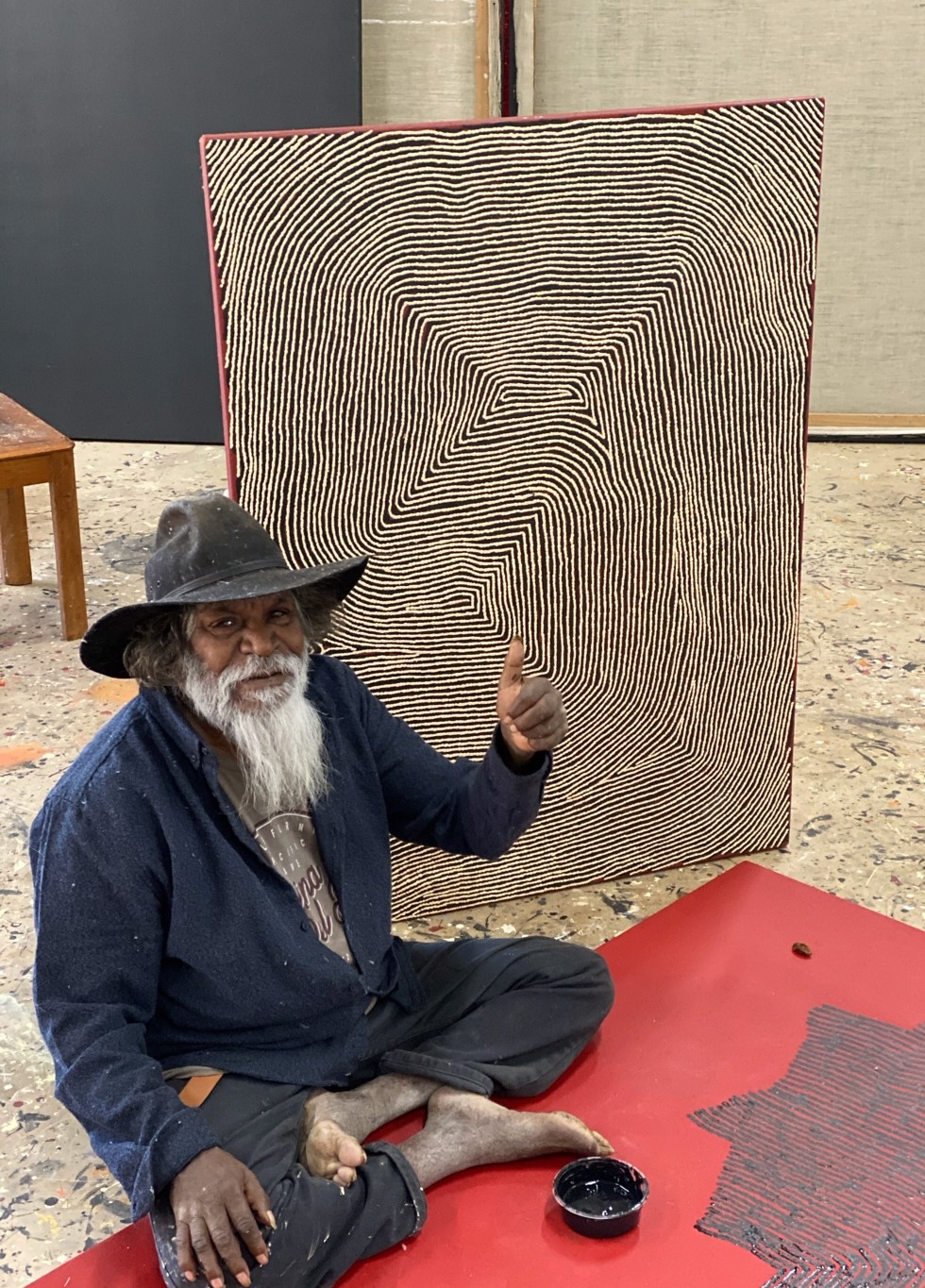
Raised entirely in the Western Desert before reuniting with relatives at Kiwirrkurra in 1984 as one of the Pintupi Nine, Warlimpirrnga brought an uninterrupted knowledge of Country and ceremony to his art. He began painting with Papunya Tula Artists in 1987 and within a year his first solo exhibition was acquired in its entirety for what is now the National Gallery of Victoria. Since then his paintings have been exhibited internationally, including dOCUMENTA 13 in Kassel, and are held in major public collections throughout Australia and overseas.
Today Warlimpirrnga is recognised as one of the defining artists of the Western Desert movement. His finest works demonstrate that profound complexity can emerge from remarkable restraint, using little more than rhythm, repetition and line to convey the enduring presence of ancestral Country. In doing so, he has established one of the most recognisable and influential visual languages in contemporary Aboriginal art.
Biography
Warlimpirrnga was born around 1958 east of present-day Kiwirrkurra in Western Australia and spent his childhood living a traditional nomadic Pintupi life centred on Wilkinkarra and surrounding Tingari Country. Unlike almost every other major Western Desert artist, he grew up entirely on Country, travelling on foot with his family and learning ceremonial law through customary life rather than settlement communities.
In 1984, Warlimpirrnga, his brothers Walala Tjapaltjarri and Thomas Tjapaltjarri, together with other family members, emerged from the desert after decades without sustained contact with wider Australian society. International media described the group as the Pintupi Nine, although many scholars now regard this label as an oversimplification of a much more complex history of family separation and reunion. Warlimpirrnga later recalled his amazement at tasting sugar for the first time and encountering motor vehicles, while relatives remembered the emotional reunion between long-separated families.
Catalogue essays reveal another important aspect of his life that is often overlooked. Before arriving at Kiwirrkurra he had already become a maparntjarra (traditional healer), giving him considerable cultural authority within Pintupi society. This deep ceremonial knowledge would later become the foundation of his painting.
Only three years after arriving at Kiwirrkurra, Warlimpirrnga began painting with Papunya Tula Artists. His rise was extraordinary. His first exhibition in Melbourne in 1988 was purchased in its entirety for the National Gallery of Victoria, immediately establishing him as one of the most significant younger painters of the Western Desert.
Why Warlimpirrnga Tjapaltjarri Is Important
Many Western Desert artists are celebrated for preserving ceremonial knowledge through painting. Warlimpirrnga is distinguished by the remarkable way he distilled that knowledge into an exceptionally refined visual language.
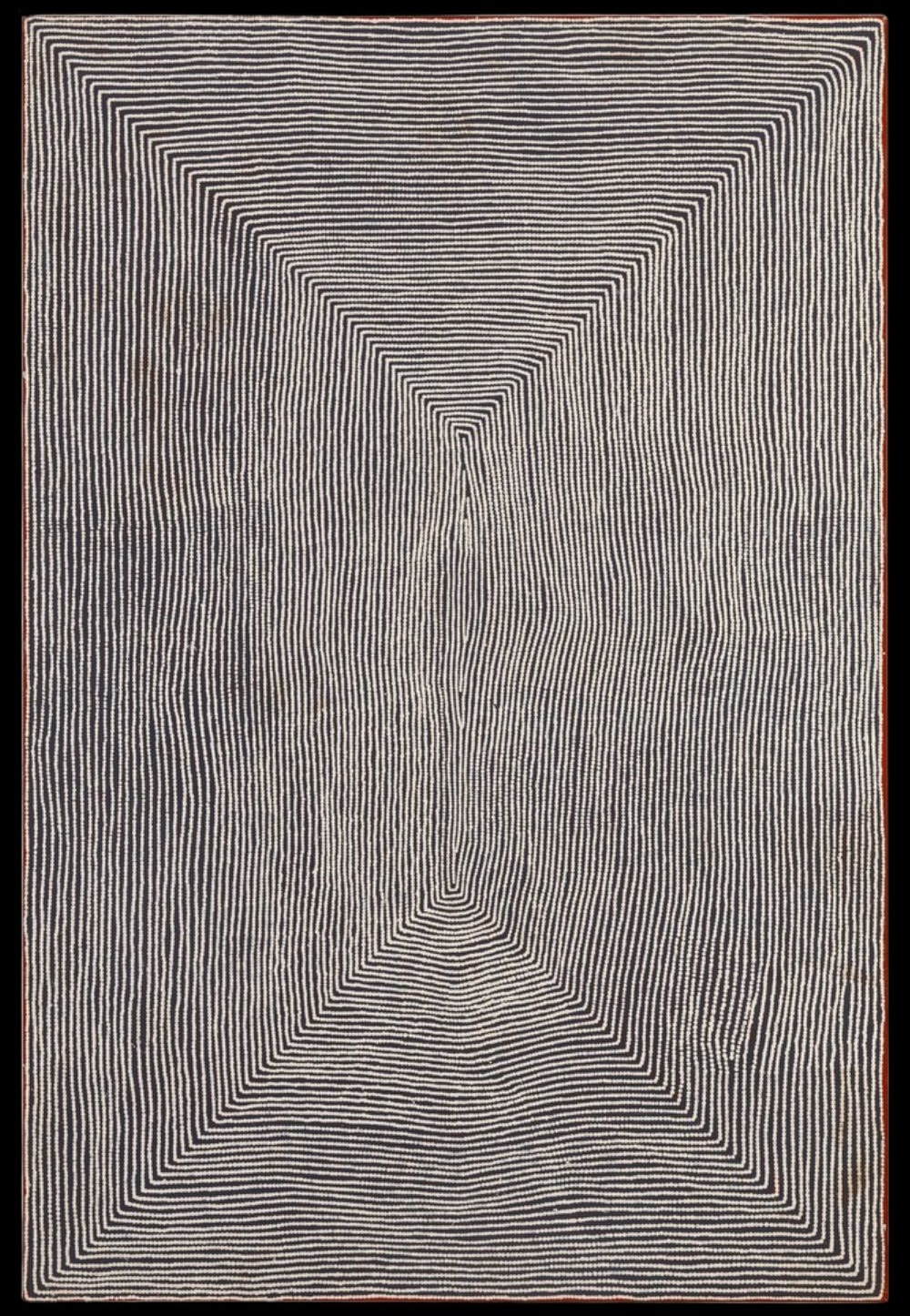
His paintings achieve a rare balance between cultural authority and artistic innovation. Rather than increasing detail, his mature works progressively eliminate unnecessary imagery until only rhythm, movement and geometric order remain. Yet this reduction does not diminish their meaning.
Anthropologist Fred Myers argues that Pintupi paintings should not primarily be understood as maps or abstract compositions. Instead, they are judged according to whether they are true to Tjukurrpa. Their authority comes from their relationship to Country, ceremony and custodianship rather than from accurately depicting the landscape. Myers further writes that these visual forms are “the constitutive forms of the Dreaming itself,” emphasising that the paintings participate in an enduring ceremonial reality rather than merely representing it.
Painting Style
Warlimpirrnga’s earliest paintings retained many of the concentric circles, connecting pathways and symbolic motifs familiar from first-generation Papunya painting. During the 1990s and 2000s, however, his work underwent a remarkable process of refinement. Rather than abandoning Pintupi visual traditions, he progressively reduced them to their essential graphic elements until parallel line became the primary language of the painting.
His mature works are characterised by:
- uninterrupted fields of meticulously painted parallel lines
- subtle optical vibration created by minute variations in spacing and direction
- nested rectilinear forms, diamonds and lozenges
- meandering pathways that dissolve into continuous geometric fields
- restrained palettes dominated by black, white, ochre and red
- exceptional technical precision
- monumental, highly unified compositions
Although these paintings appear minimalist or abstract at first glance, curators consistently emphasise that their geometry derives from ceremonial practice rather than modernist abstraction. The Gagosian Gallery notes that Warlimpirrnga’s rectilinear forms originate in male body decoration associated with Tingari ceremony, while his earliest paintings drew directly upon the iconography of body painting and ritual sand drawings before evolving into monumental fields of parallel line.
Luke Scholes describes these paintings as “epic, barbed renderings that shimmer and gleam with the potency of the objects from which they are drawn: pearl shells and kurkitji (shields).” Crispin Gutteridge likewise observes that the interlocking designs recall the engraved surfaces of wunda shields and pearl shells, while Lucie Reeves-Smith argues that Warlimpirrnga’s visual language developed directly from ritual sand drawings and incised ceremonial objects. Together, these scholars demonstrate that the extraordinary optical power of his mature paintings arises not from formal experimentation alone but from the continual refinement of an ancient Pintupi ceremonial design tradition.
Wilkinkarra and the Tingari
Throughout his career Warlimpirrnga has repeatedly painted Wilkinkarra (Lake Mackay), one of Australia’s largest salt lakes and a place of profound importance within the Tingari cycle.
The Tingari ancestors travelled across the Western Desert establishing places, ceremonies and law. Their journeys created both the physical landscape and the spiritual order that continues to define Pintupi Country. Warlimpirrnga’s paintings are therefore not simple aerial views or maps. Instead, they express enduring relationships between Country, ancestral beings, ceremony and custodianship through an inherited geometric language.
Catalogue essays frequently describe the rhythmic meandering pathways in his paintings as evoking the folded topography of the desert itself, where Tingari ancestors travelled beneath the earth creating the ridges, dunes and landforms that characterise Wilkinkarra and its surrounding Country.
Public Collections
Warlimpirrnga Tjapaltjarri’s paintings are held in many of Australia’s leading public museums and galleries, reflecting his status as one of the foremost contemporary artists of the Western Desert movement. His work has also entered major international collections, underscoring the global recognition of his distinctive visual language and enduring cultural significance.
Art Gallery of New South Wales
Art Gallery of South Australia
Kluge-Ruhe Aboriginal Art Collection,
Today he is widely regarded as one of the finest living Pintupi painters. His work demonstrates how an ancient ceremonial design tradition can remain culturally authoritative while achieving an extraordinary level of artistic refinement. Far from being purely abstract, his paintings are enduring expressions of Tjukurrpa, Country and Pintupi law.
Further Reading & Sources
Exhibition Catalogues and Museum Publications
Art Gallery of New South Wales. Papunya Tula: Genesis and Genius. Sydney: Art Gallery of New South Wales in association with Papunya Tula Artists, 2000.
Skerritt, Henry F. (ed.) et al. No Boundaries: Aboriginal Australian Contemporary Abstract Painting. Munich, London & New York: Prestel, 2014.
dOCUMENTA (13). The Book of Books. Kassel: Hatje Cantz, 2012.
National Gallery of Victoria. Colour Power: Aboriginal Art Post-1984 in the Collection of the National Gallery of Victoria. Melbourne: National Gallery of Victoria.
National Gallery of Victoria. Collection records and exhibition documentation relating to Warlimpirrnga Tjapaltjarri.
National Gallery of Australia. Collection records and artist documentation.
Books
Myers, Fred R. Painting Culture: The Making of an Aboriginal High Art. Durham: Duke University Press, 2002.
Myers, Fred R. Pintupi Country, Pintupi Self: Sentiment, Place and Politics among Western Desert Aborigines. Washington DC: Smithsonian Institution Press, 1986.
Myers, Fred R. “Truth, Beauty, and Pintupi Painting.” In Visual Anthropology Review, 1989.
Perkins, Hetti & Fink, Hannah (eds.). Papunya Tula: Genesis and Genius. Sydney: Art Gallery of New South Wales in association with Papunya Tula Artists, 2000.
Johnson, Vivien. Lives of the Papunya Tula Artists. Alice Springs: IAD Press.
Caruana, Wally. Aboriginal Art. London: Thames & Hudson.
McDonald, Jo. Publications on Western Desert rock art, graphic traditions and ceremonial iconography.
Exhibition Essays and Curatorial Writing
Scholes, Luke. “Warlimpirrnga Tjapaltjarri: Powerful Presence in Person and in Paint.” In No Boundaries: Aboriginal Australian Contemporary Abstract Painting. Prestel, 2014.
Reeves-Smith, Lucie. Catalogue essay for Marawa, Deutscher and Hackett, Important Australian Aboriginal Art, Melbourne, 18 March 2020.
Gutteridge, Crispin. Catalogue essay for Maw Maw Yntjipi, Deutscher and Hackett, Important Fine Art + Indigenous Art, Sydney, 18 April 2018.
Ryan, Judith. Essays on contemporary Western Desert painting in National Gallery of Victoria publications.
Caruana, Wally. Essays on Papunya Tula Artists and the Western Desert movement.
Auction Catalogues
Bonhams. Important Australian Art and Australian Aboriginal Art auction catalogues.
Deutscher and Hackett. Important Australian Aboriginal Art, Important Australian Indigenous Art, Important Aboriginal + Oceanic Art and online Indigenous Art auction catalogues.
Gibson’s. Australian & International Art auction catalogues.
Lawsons. Fine Aboriginal Art, Indigenous Art and Collectors’ Edit auction catalogues.
Leonard Joel. Australian Indigenous Art, Indigenous Art and Fine Art auction catalogues.
Menzies (formerly Lawson~Menzies). Fine Aboriginal Art and Important Australian & International Art auction catalogues.
Mossgreen. Australian Indigenous & Oceanic Art auction catalogues.
Sotheby’s. Aboriginal Art, Important Aboriginal Art and Aboriginal & Oceanic Art auction catalogues.
Theodore Bruce Auctioneers & Valuers. Australian and Aboriginal Art auction catalogues.
Papunya Tula Artists Documentation
Papunya Tula Artists.
Certificates of Authenticity and accompanying documentation for paintings depicting:
- Wilkinkarra (Lake Mackay)
- Marawa
- Maw Maw Yntjipi
- Kalparti
- Ngulkingnapalka
- Murmur
- Tjuntulpul
- Tarkul
- Pulkurru
- Tingari Site West of Wilkinkarra
- Tingari Men Camped at Marawa
- Tingari Cycle
- Snake Dreaming
- Wanampi Dreaming
- Water Dreaming at Marpurri
These certificates provide artist-approved descriptions of Country, Tingari ancestral journeys, ceremonial associations and the significance of individual rockholes, claypans, soakages and lake sites. They explain the cultural context of the paintings while respecting restrictions surrounding sacred knowledge, and document Warlimpirrnga Tjapaltjarri’s enduring custodial relationship with Wilkinkarra and neighbouring Pintupi Country.
Research Used in Preparing This Page
This biography draws upon:
- public museum collection records and artist biographies
- Papunya Tula: Genesis and Genius
- No Boundaries: Aboriginal Australian Contemporary Abstract Painting
- Painting Culture, Pintupi Country, Pintupi Self and other publications by anthropologist Fred Myers
- curatorial essays by Luke Scholes, Lucie Reeves-Smith, Crispin Gutteridge, Judith Ryan, Wally Caruana and other leading Aboriginal art scholars
- Papunya Tula Artists documentation and Certificates of Authenticity
- exhibition records from dOCUMENTA 13 and major Australian and international museums
- more than 75 documented auction records dating from 1997–2026, including provenance, exhibition history, literature references, catalogue essays and original Papunya Tula Artists documentation where available.
All images featured in this article are presented strictly for educational and informational purposes.
This website may include copyrighted material for which specific authorization has not been obtained from the copyright owner.
All such images are presumed to be the intellectual property of the respective artist or their estate, and are used in accordance with principles of fair dealing or fair use under applicable copyright law.