
Makinti Napanangka: Biography, Paintings & Painting Style
c. 1922–2011
Pintupi
Lake MacDonald (Karrkurritinyja), Western Desert
Papunya / Walungurru (Kintore)
Pintupi Art / Western Desert Art
Papunya Tula Artists
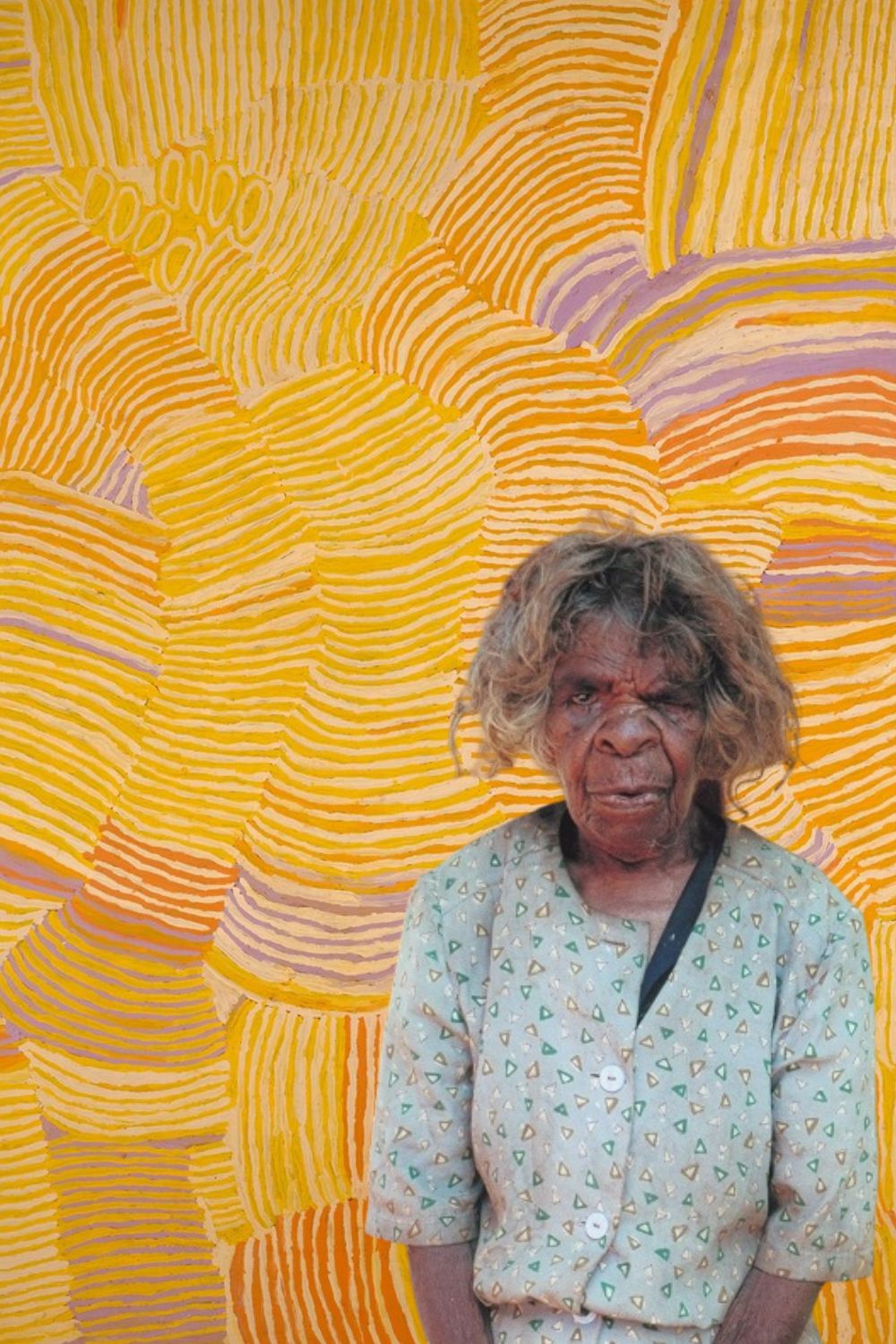
Makinti Napanangka AM (c.1922–2011) is widely regarded as one of the greatest Aboriginal artists of the modern era and one of the defining painters of contemporary Australian art. A senior Pintupi woman from the country around Lake MacDonald (Karrkurritinyja), she brought the ancient visual language of Pintupi women’s ceremony into contemporary Pintupi Art.
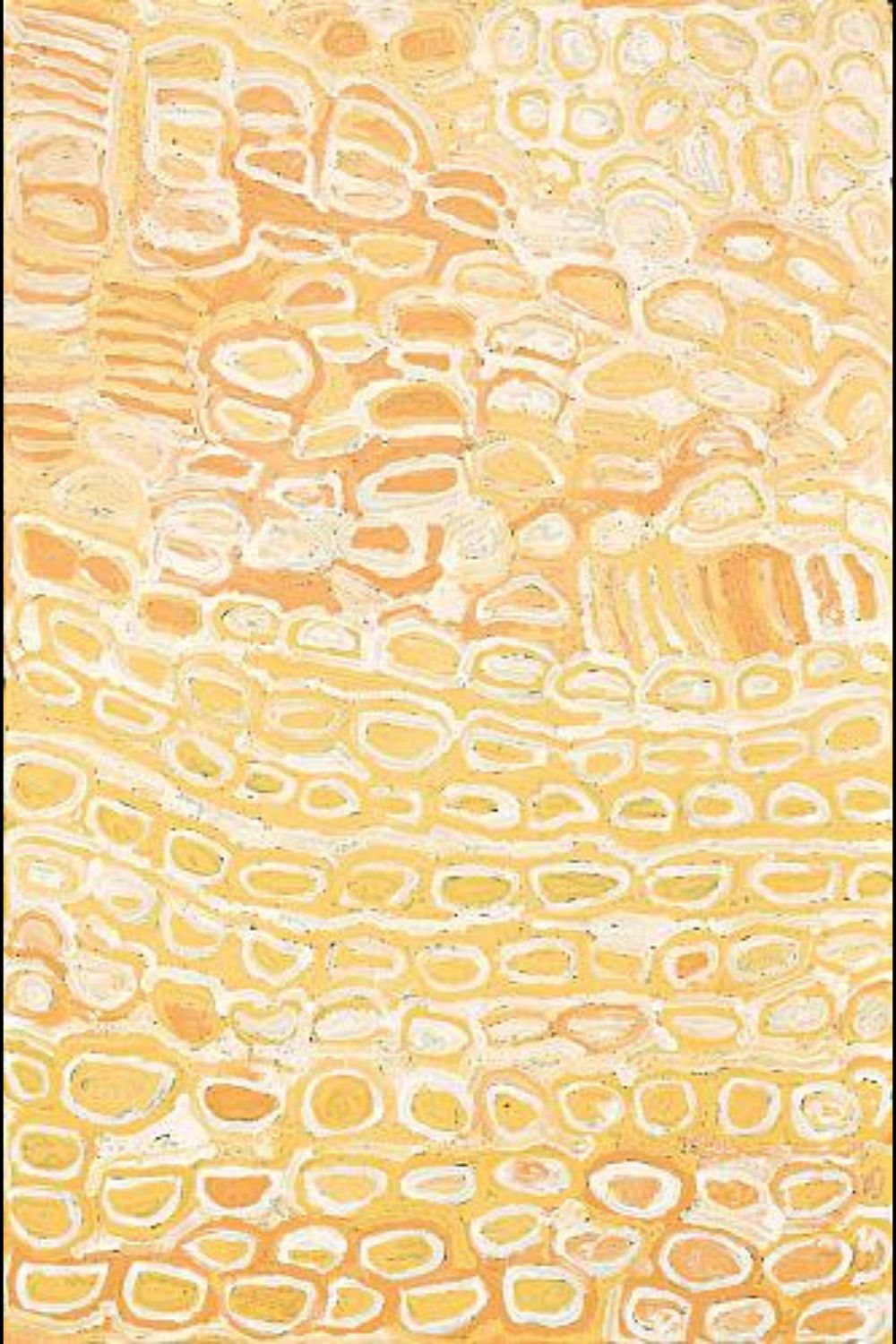
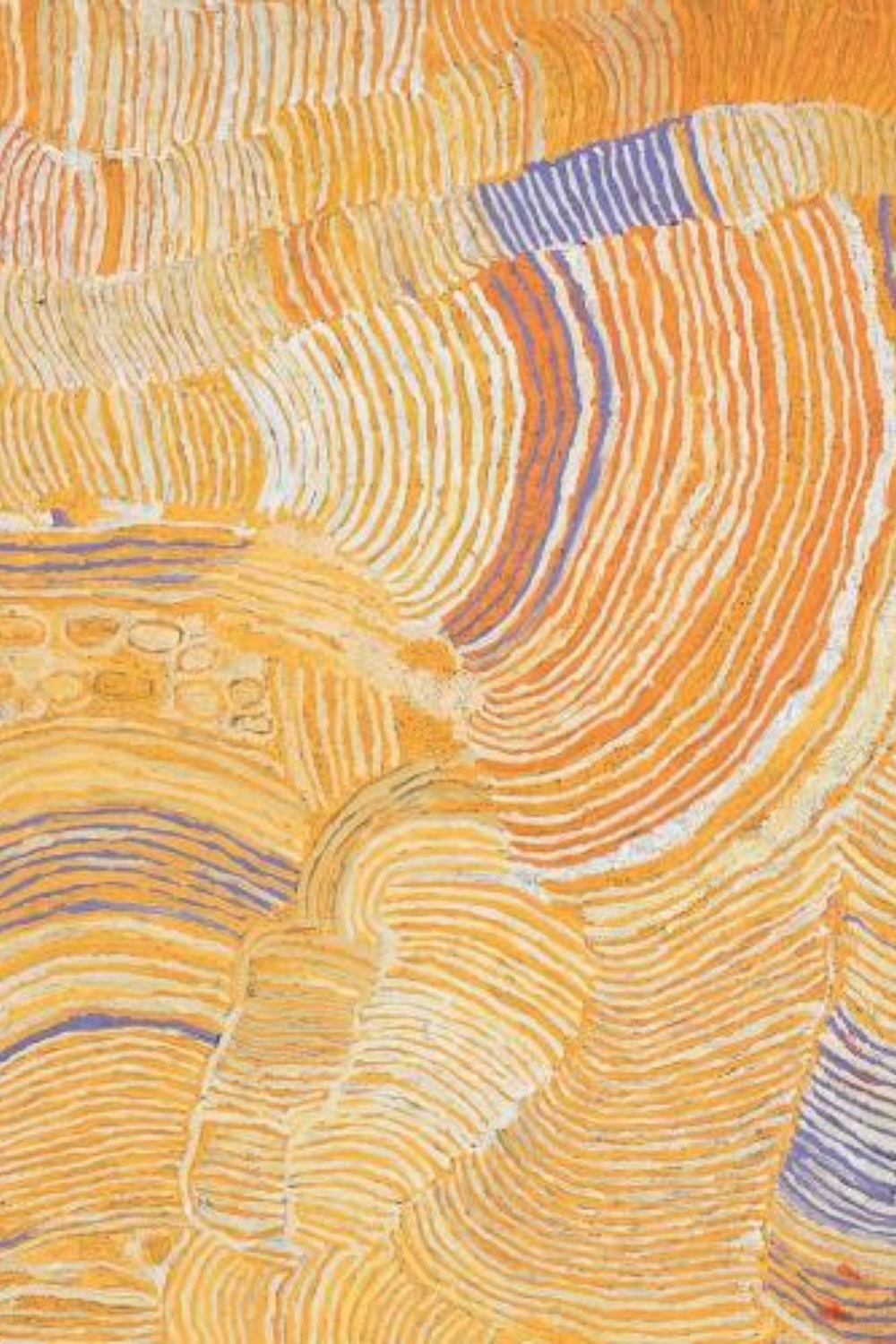
Drawing upon traditions of ceremonial body painting, spun hair-string skirts, song, dance and ancestral knowledge, Makinti created paintings unlike anything previously seen in Western Desert Art. Where many early Western Desert paintings conveyed Country through carefully organised symbols and finely applied dots, Makinti’s canvases pulse with movement. Sweeping ribbons of colour, richly layered brushwork and rhythmic surfaces evoke the physical experience of ceremony itself. As the Art Gallery of New South Wales observed, her paintings owe more to “the gesture of hand-painting ochre onto the body for women’s ceremonies” than to the meticulous application of dots.
Although Makinti did not begin painting professionally until her seventies, her rise was extraordinary. Alongside senior Pintupi women such as Naata Nungurrayi and Ningura Naparrula, she helped transform the possibilities of Western Desert painting during the 1990s and 2000s. Within little more than a decade she became one of Australia’s most celebrated Indigenous artists, won the Telstra National Aboriginal and Torres Strait Islander Art Award, was appointed a Member of the Order of Australia (AM), and entered major Australian public collections.
Want to know what your Makinti Napanangka painting is worth? Visit Makinti Napanangka Painting Value, Prices & Auction Results to compare auction results, learn what influences value, and request a confidential appraisal if you’re considering selling.
Early Life
Makinti Napanangka was born around Lake MacDonald (Karrkurritinyja) in the Western Desert, probably during the early 1920s. She belonged to the Pintupi language group and spent her childhood living traditionally on Country, learning the stories, ceremonies and responsibilities that would later become the foundation of her paintings.
She married Nyukuti Tjupurrula, the brother of fellow artist Nosepeg Tjupurrula. During the early 1940s, as prolonged drought and changing government policies drew many Western Desert families towards settlements, Makinti and her husband walked to Haasts Bluff. The family later lived at Papunya before returning closer to their ancestral lands at Walungurru (Kintore) during the Pintupi homeland movement of the early 1980s.
Makinti and Nyukuti raised four children—Ginger Tjakamarra, Narrabri Narrapayi, Jacqueline Daaru and Winnie Bernadette—several of whom also became respected artists. Her life bridged two worlds: the final generation to spend their childhood living traditionally across the Western Desert and the first generation to translate that knowledge into one of Australia’s greatest artistic movements.
Those who knew Makinti remembered her enormous enthusiasm for painting. She was often among the first artists to arrive each morning at the Papunya Tula studio at Kintore, accompanied by her camp dogs and eager to begin work. Even when deteriorating eyesight interrupted her painting, she returned with renewed vigour following cataract surgery, producing some of the most celebrated works of her career.
A New Chapter in Aboriginal Art
Makinti’s artistic career began in the mid-1990s through the groundbreaking Minyma Tjukurrpa (Women’s Dreaming) Canvas Project, which brought senior Pintupi women together to paint their ceremonial traditions on monumental collaborative canvases.
The project represented a watershed in the history of Aboriginal art. For more than twenty years the Western Desert movement had been publicly defined largely by paintings created by senior men, many of which focused on Tingari journeys and symbolic aerial views of Country. The Women’s Canvas Project revealed another equally ancient visual tradition—one grounded in women’s ceremony, body painting, dance and ancestral knowledge.
Just as importantly, it marked the emergence of senior Pintupi women as independent artists in their own right. Many had previously contributed to paintings alongside husbands and male relatives, but the project enabled their own artistic voices to be recognised for the first time. Makinti’s remarkable ability was immediately apparent. She soon began painting independently and rapidly emerged as one of Australia’s most important contemporary artists.
Makinti Napanangka’s Painting Style
Few artists possess a style that can be recognised from across a room. Makinti Napanangka is one of them.
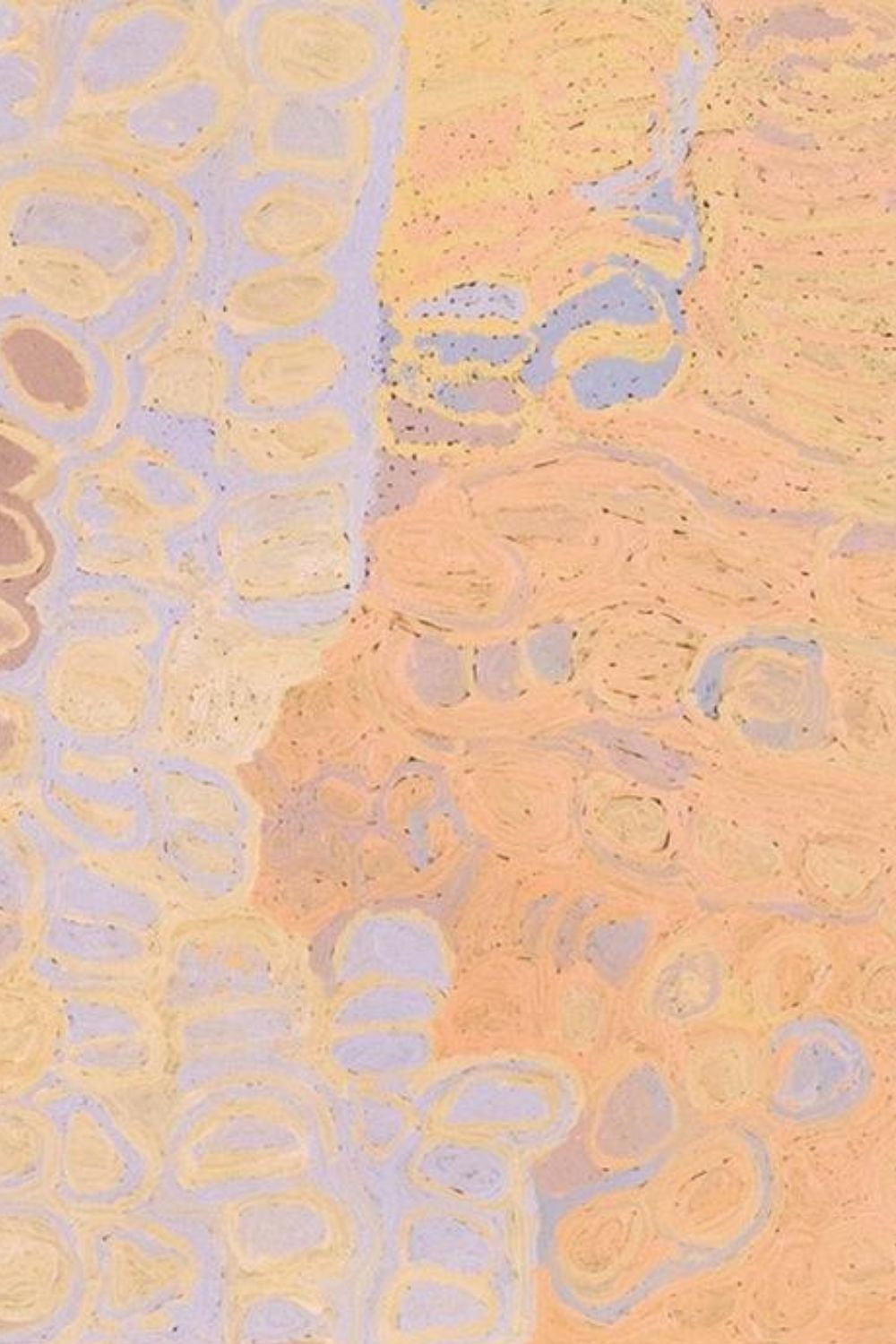
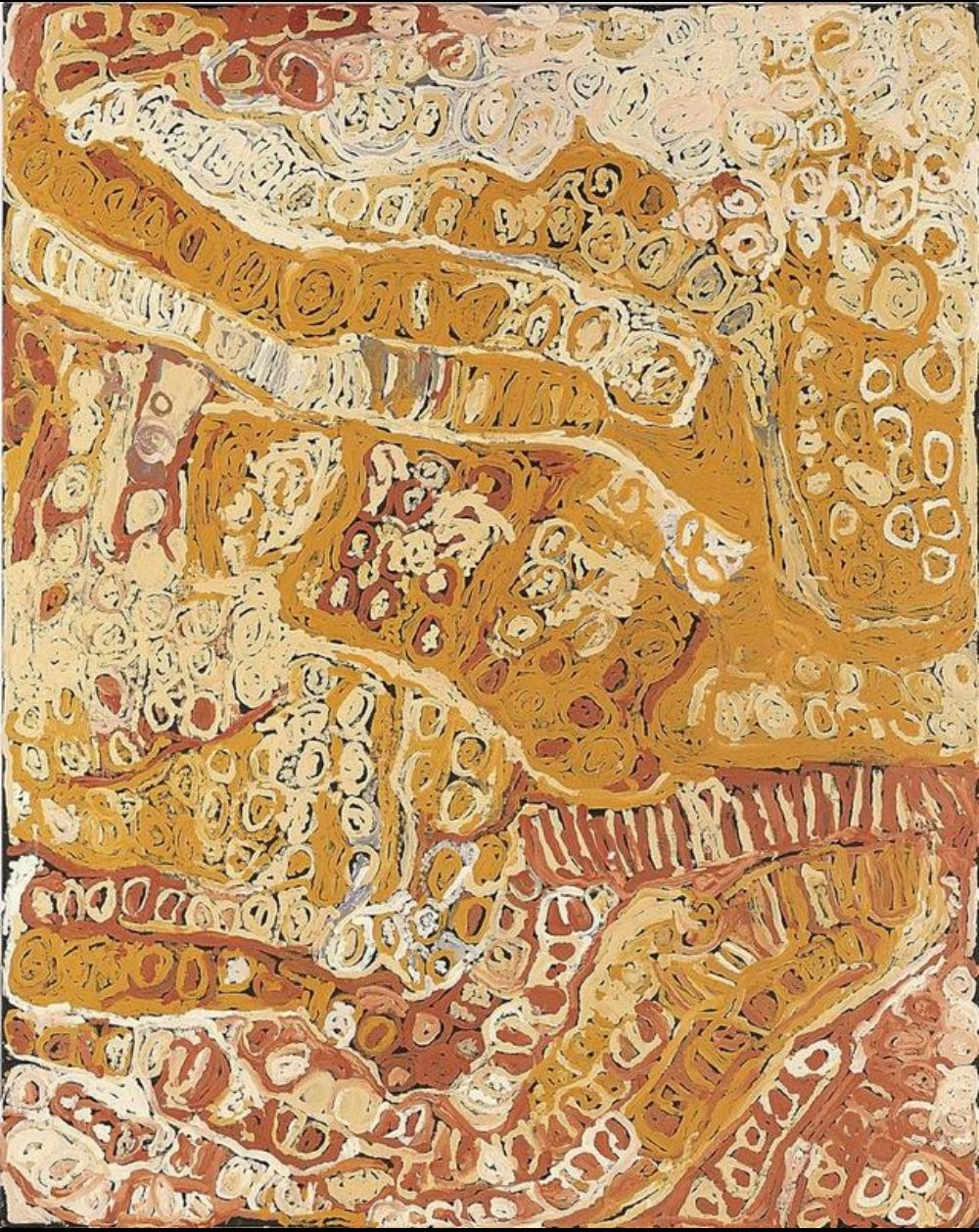
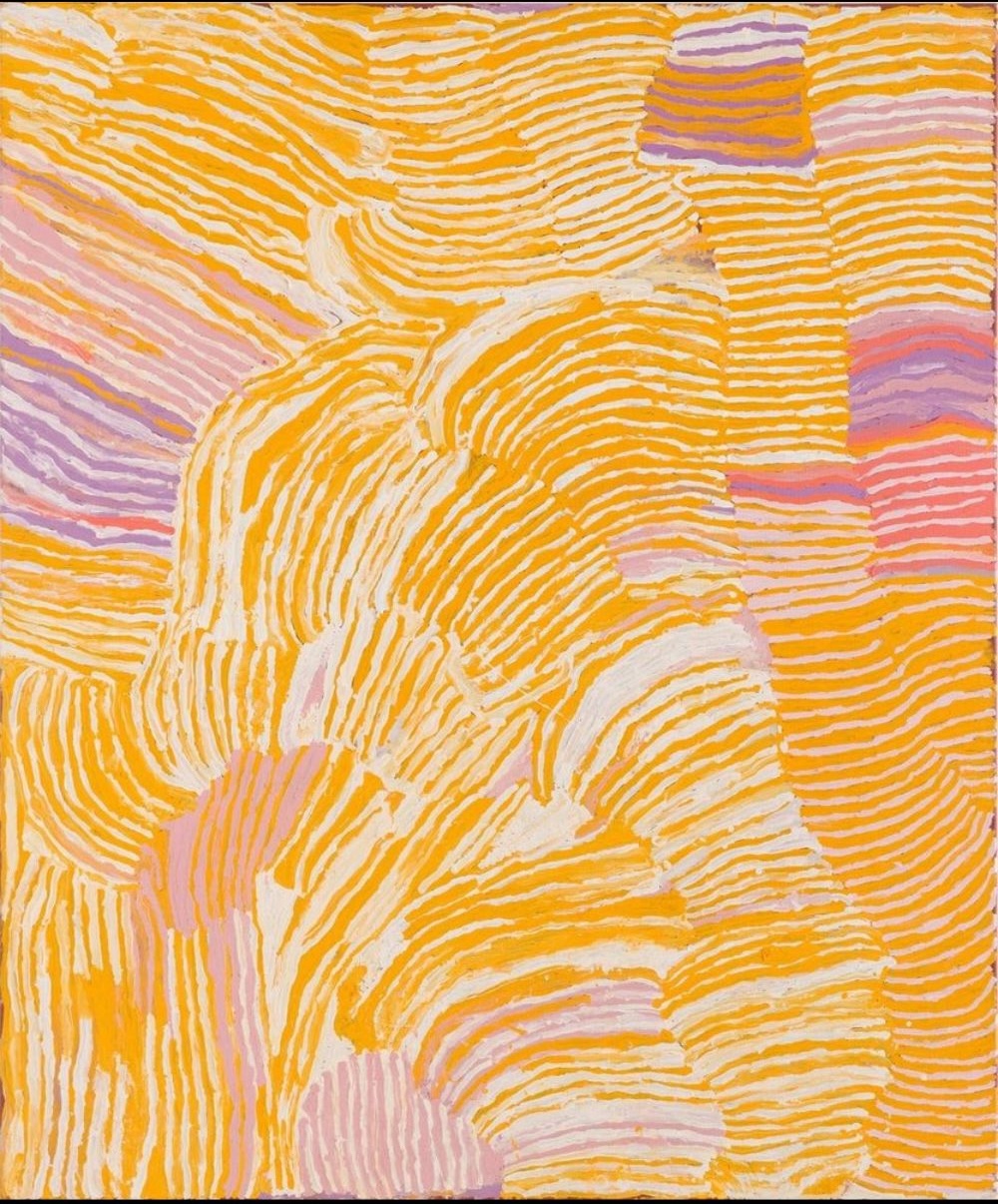
Her paintings abandon rigid geometry in favour of sweeping arcs, looping ribbons and richly textured brushstrokes that seem to move across the canvas. Rather than inviting the viewer to decode symbols, they communicate through rhythm, gesture and colour.
Her mature paintings are characterised by:
- broad, expressive brushwork
- luminous yellows, oranges, pinks, mauves and whites
- richly layered paint surfaces
- looping forms inspired by ceremonial hair-string skirts
- rhythmic repetition
- extraordinary movement and energy
- tactile surfaces
- expressive abstraction grounded in Pintupi cultural knowledge
The originality of Makinti’s paintings has fascinated curators for more than two decades. Rather than seeing them simply as another variation of Western Desert dot painting, many have recognised that they draw upon a much older artistic tradition.
The Art Gallery of New South Wales observed that her paintings owe more to “the gesture of hand-painting ochre onto the body for women’s ceremonies” than to the meticulous application of dots. Judith Ryan, Senior Curator at the National Gallery of Victoria, likewise described Makinti’s work as being concerned with “touching and sensing” rather than simply seeing. She argued that the repeated colour harmonies and textured brushstrokes create “a rhapsodic effect akin to many bodies in dance”, while the energetic lines evoke both women’s ceremonial body paint and the flowing movement of spun hair-string skirts.
This observation explains why Makinti’s paintings feel so different from those of many earlier Western Desert artists. They are not primarily maps viewed from above. They are memories of movement—of ceremony performed, songs sung, bodies painted and women dancing together on Country.
The sweeping ribbons that dominate many canvases represent nyimparra, the hand-spun hair-string used to make ceremonial belts and skirts worn during Pintupi ceremonies. As women danced, these belts swung rhythmically around the body, creating the movement that Makinti later translated into paint. Rather than recording ceremony from a distance, her paintings recreate its physical energy, transforming an ancient performative tradition into one of the most distinctive bodies of work in contemporary Australian art.
Art critic Robert Nelson described Makinti’s paintings as “sensual and chromatically effusive”, while Hetti Perkins celebrated the “hedonistic play of colour and form” across their surfaces. Together these observations reveal Makinti’s extraordinary achievement. She did not invent a new visual language; she gave contemporary expression to one that had existed for countless generations.
All images featured in this article are presented strictly for educational and informational purposes.
This website may include copyrighted material for which specific authorization has not been obtained from the copyright owner.
All such images are presumed to be the intellectual property of the respective artist or their estate, and are used in accordance with principles of fair dealing or fair use under applicable copyright law.
Women’s Ceremony and Country
Makinti’s paintings are deeply connected to the ceremonial traditions of her ancestral Country around Lake MacDonald.
Her most important subjects include:
- Kungka Kutjarra (Two Women)
- Lupulnga
- Women’s Dreaming
- Women’s Ceremony
- ceremonial hair-string skirts
- women’s body painting traditions
Rather than illustrating these subjects literally, Makinti transformed them into rhythm, movement and colour. Many paintings relate to the ancestral journeys of the Kungka Kutjarra (Two Women) and the sacred rockhole of Lupulnga, south of Kintore. According to Papunya Tula documentation, these ancestral women travelled through the region holding ceremonies before continuing towards Kaakuratintja (Lake MacDonald). The looping bands that dominate her paintings represent spun hair-string used in ceremonial belts and skirts, while the layered brushwork evokes the tactile experience of ceremonial body painting and the rhythmic movement of women dancing together on Country.
For viewers unfamiliar with Pintupi culture, the paintings possess an immediate visual power. For those who understand the traditions from which they emerge, they communicate Country, ceremony, ancestry and identity.
Why Makinti Napanangka Is Important
Makinti occupies a unique position in Australian art.
Many great Western Desert artists refined the symbolic language established during the early years of the movement. Makinti did something different. She revealed that another ancient visual tradition existed alongside it—one centred on women’s ceremony rather than men’s, on movement rather than mapping, on gesture rather than geometry.
In doing so she broadened the public understanding of Aboriginal art itself. Her paintings demonstrated that the Western Desert movement was never defined solely by dots, circles and aerial perspectives. It also contained a rich, expressive and deeply embodied visual language that had been practised by Pintupi women for countless generations before it appeared on canvas. This achievement transformed the way curators, collectors and audiences understood both Western Desert painting and the diversity of Aboriginal artistic traditions.
Further Reading & Sources
Exhibition Catalogues and Museum Publications
Art Gallery of New South Wales. Tradition Today: Indigenous Art in Australia. Sydney: Art Gallery of New South Wales, 2004.
Art Gallery of New South Wales. Papunya Tula: Genesis and Genius. Sydney: Art Gallery of New South Wales, 2000.
National Gallery of Victoria. Clemenger Contemporary Art Award 2003. Melbourne: National Gallery of Victoria, 2003. (Essay by Judith Ryan.)
Perkins, Hetti (ed.). One Sun One Moon: Aboriginal Art in Australia. Sydney: Art Gallery of New South Wales, 2007.
Perkins, Hetti et al. Tradition Today: Indigenous Art in Australia. Sydney: Art Gallery of New South Wales, 2004.
Ryan, Judith. Colour Power: Aboriginal Art Post-1984 in the Collection of the National Gallery of Victoria. Melbourne: National Gallery of Victoria.
Ryan, Judith. Essays in Clemenger Contemporary Art Award 2003 and other National Gallery of Victoria publications discussing Makinti Napanangka’s painting practice.
Books
Johnson, Vivien. Lives of the Papunya Tula Artists. Alice Springs: IAD Press.
Johnson, Vivien. Once Upon a Time in Papunya. Sydney: NewSouth Publishing.
Myers, Fred R. Painting Culture: The Making of an Aboriginal High Art. Durham: Duke University Press.
Perkins, Hetti. Tradition Today: Indigenous Art in Australia. Sydney: Art Gallery of New South Wales.
Auction Catalogues
Bonhams. Australian & Aboriginal Art auction catalogues (multiple sales).
Christie’s. Australian Aboriginal Art auction catalogues.
Deutscher and Hackett. Important Australian Indigenous Art auction catalogues.
Lawsons. Australian & Indigenous Art auction catalogues.
Lawson~Menzies. Fine Aboriginal Art auction catalogues.
Leonard Joel. Fine Art auction catalogues.
Menzies. Important Australian and International Fine Art auction catalogues.
Shapiro Auctioneers. Aboriginal Art auction catalogues.
Sotheby’s. Important Aboriginal Art, Aboriginal Art, and Aboriginal & Oceanic Art auction catalogues.
Art Centre Documentation
Papunya Tula Artists.
Certificates of Authenticity and accompanying documentation for paintings depicting:
- Lupulnga
- Kungka Kutjarra (Two Women)
- Peewee Dreaming
- Nyimparra (hair-string belts and skirts)
These certificates provide artist-approved descriptions of the ceremonial narratives and symbolism represented in Makinti Napanangka’s paintings.
Public Collections
Art Gallery of New South Wales
National Gallery of Australia
National Gallery of Victoria
Museum and Art Gallery of the Northern Territory
Queensland Art Gallery | Gallery of Modern Art
Art Gallery of South Australia
Research Used in Preparing This Page
This biography draws upon:
- public museum collection records
- exhibition catalogues
- curatorial essays by Judith Ryan, Hetti Perkins, and Robert Nelson
- Papunya Tula Artists documentation and certificates
- more than 110 documented auction records dating from 2002–2026, including provenance, exhibition history, literature and artist documentation where available.