
Timothy Cook Aboriginal Artist: Biography and painting style
1958–
Tiwi
Mananowmi, Goose Creek, Melville Island
Milikapiti (Snake Bay)
Tiwi Art
Jilamara Arts & Crafts Association
Natural earth pigments on canvas and paper, printmaking, carving and sculpture
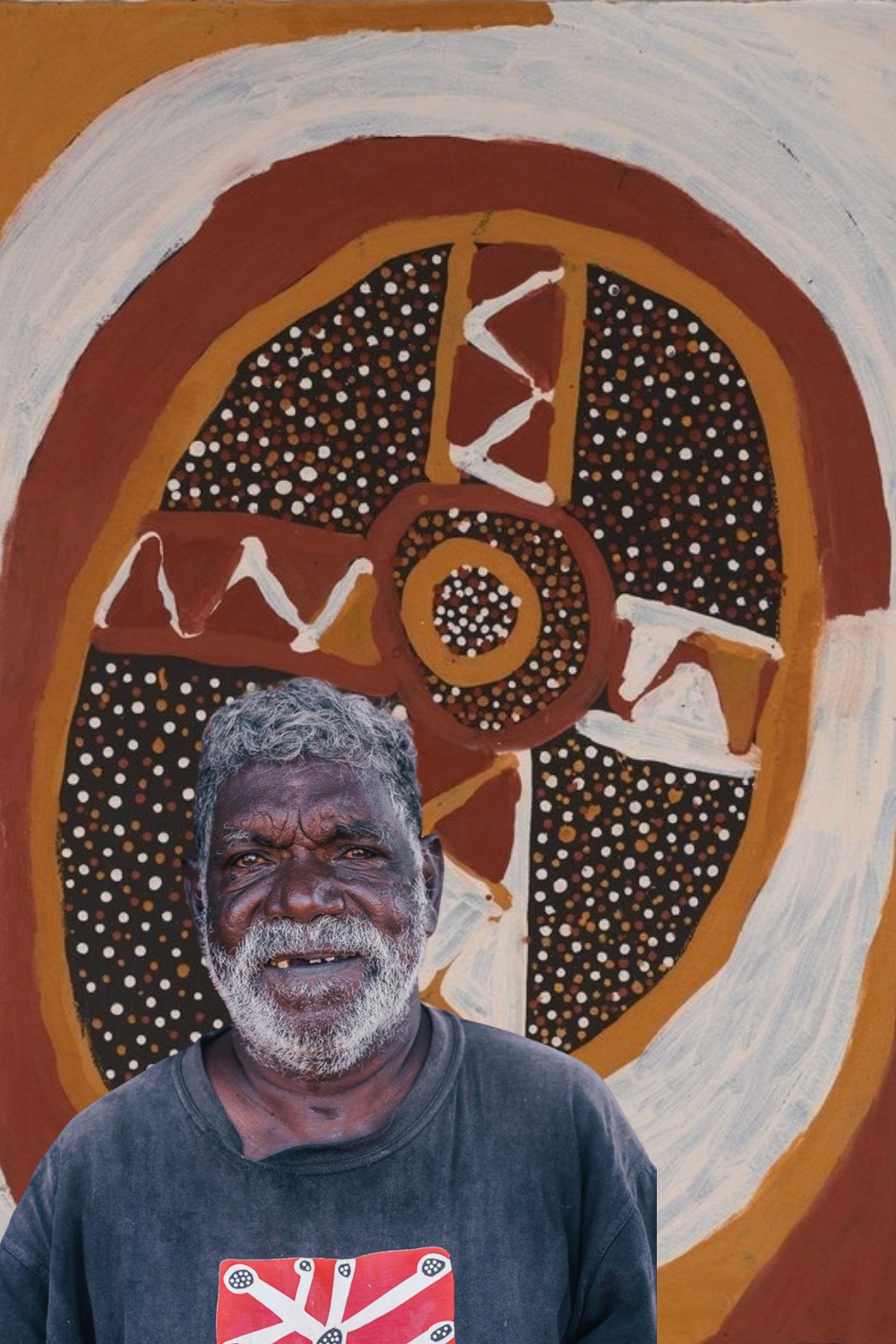
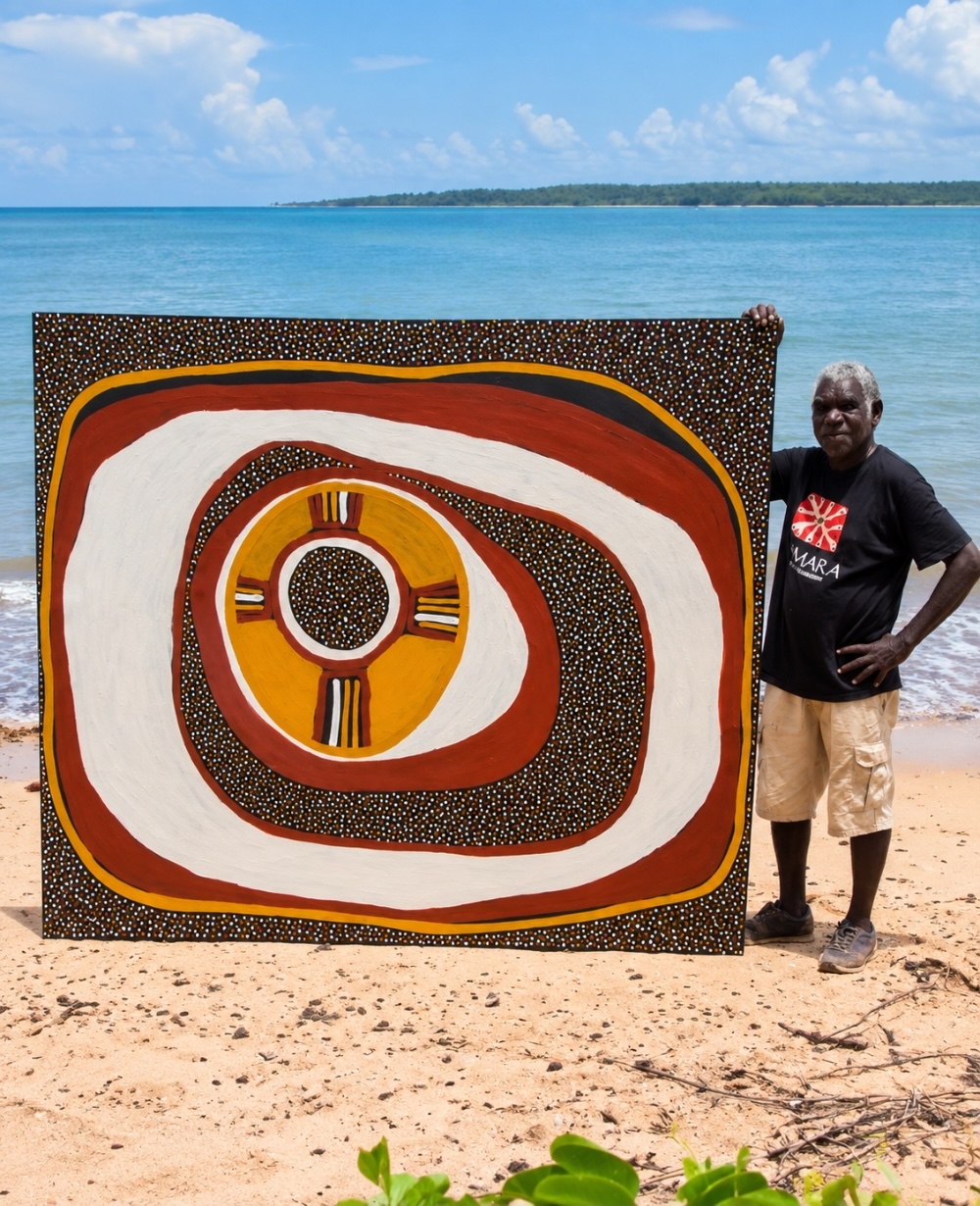
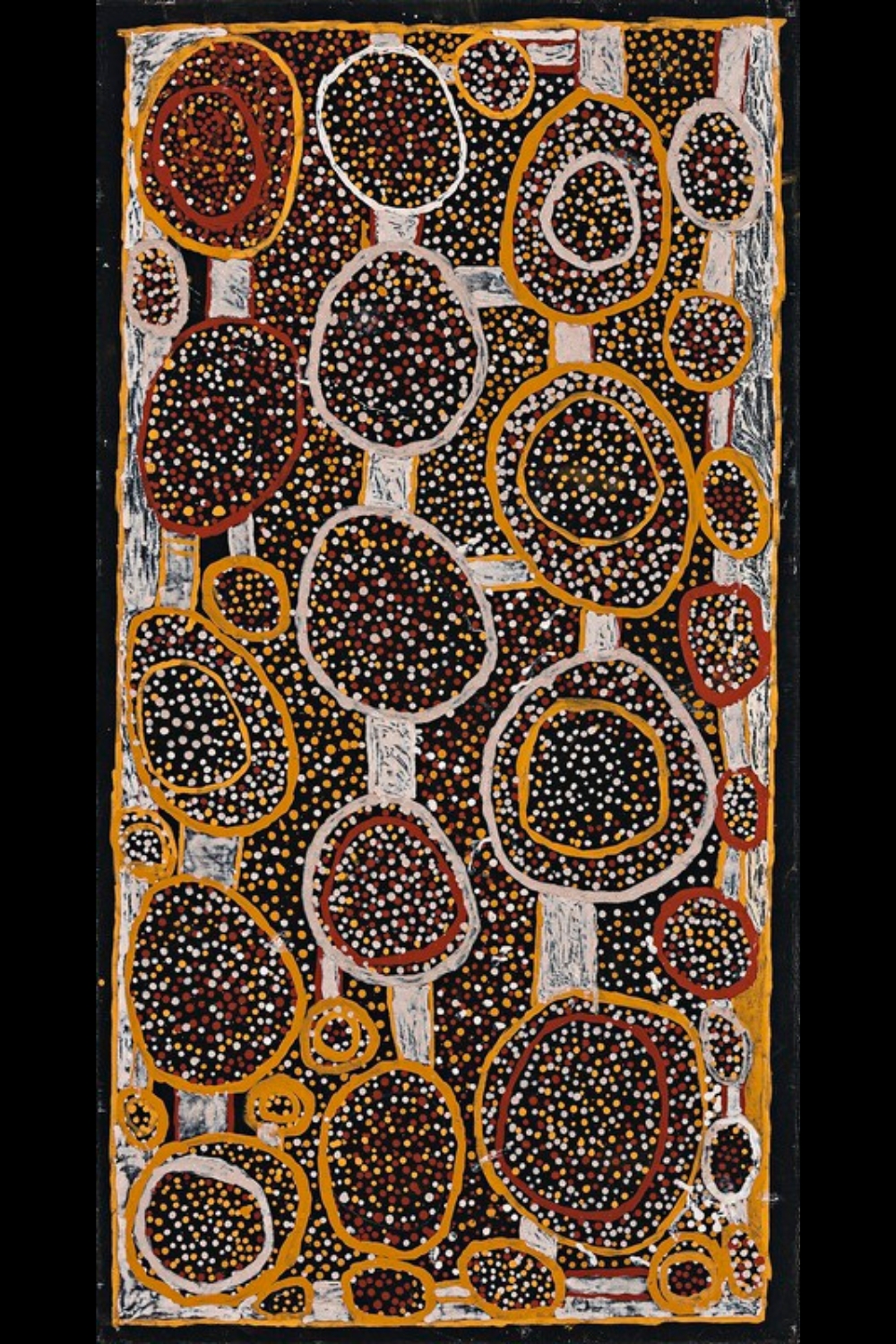
Timothy Cook is one of the leading contemporary Tiwi artists, best known for his powerful ochre paintings of Kulama, Japarra—the moon—and Japalinga—the stars. Working at Milikapiti on Melville Island, he has developed an unmistakable visual language from the jilamara designs, ceremony and cultural knowledge of the Tiwi people.
Born in 1958, Cook belongs to Mananowmi Country in the Goose Creek area and has worked through Jilamara Arts and Crafts since the late 1990s. His paintings are made with natural earth pigments collected on Tiwi Country and range from finely worked fields of dots and lines to monumental circular compositions dominated by the imagery of Kulama.
Cook’s paintings may appear abstract, but their foundations are specific. Circles can refer simultaneously to the moon, yam and ceremonial circles of Kulama; dots evoke Japalinga, the stars; while lines and other forms grow from the parlingarri jilamara—old designs—he learned from senior Tiwi people.
His highly individual interpretation of these inherited designs has made Cook one of the most recognisable artists to emerge from the Tiwi Islands.
Timothy Cook Biography
Timothy Cook was born on Melville Island in 1958. His Country is Mananowmi in the Goose Creek area, and his skin group is Marntupuni, or House Fly. He lives and works at Milikapiti, where he has created paintings, prints and carvings through Jilamara Arts and Crafts Association since the late 1990s.
Cook grew up learning parlingarri jilamara—old Tiwi designs—from senior people. These include combinations of kurluwukari (circles), pwanga (dots) and marlipinyini (lines), part of the visual language of jilamara and its relationship with ceremonial body painting.
His emergence as a painter also belongs to a particular moment in contemporary Tiwi art. When Cook began painting at Jilamara in the mid-1990s, artists were revisiting bark paintings collected at Milikapiti by anthropologist Charles Mountford in 1954. Rather than treating these historical works as designs simply to be copied, they were approached as part of a Tiwi cultural archive that could be interpreted anew. Museum of Contemporary Art curator Una Rey has described Cook as becoming one of the most radical interpreters of these earlier works.
Cook initially worked on a relatively small scale, particularly on paper, experimenting with composition and variations of inherited designs. From the late 1990s he also worked with visiting professional printmakers, developing woodcuts and etchings alongside his painting.
Kulama was already present in his work by 1999, but over the following years it became increasingly central. Earlier paintings often contain repeated or linked motifs; in his mature Kulama paintings these forms frequently coalesce into a single commanding circular image.
Cook’s cultural practice extends beyond painting. His dance is Tartuwali, or shark, and singing and dancing form part of the ceremonial world from which his paintings emerge. Cook has explained his purpose particularly directly: “I like painting for culture way” and “We teach culture.”
In 2012 his large Kulama won the overall Telstra National Aboriginal and Torres Strait Islander Art Award, bringing national recognition to a practice he had been developing for more than fifteen years.
Timothy Cook Painting Style and Subjects
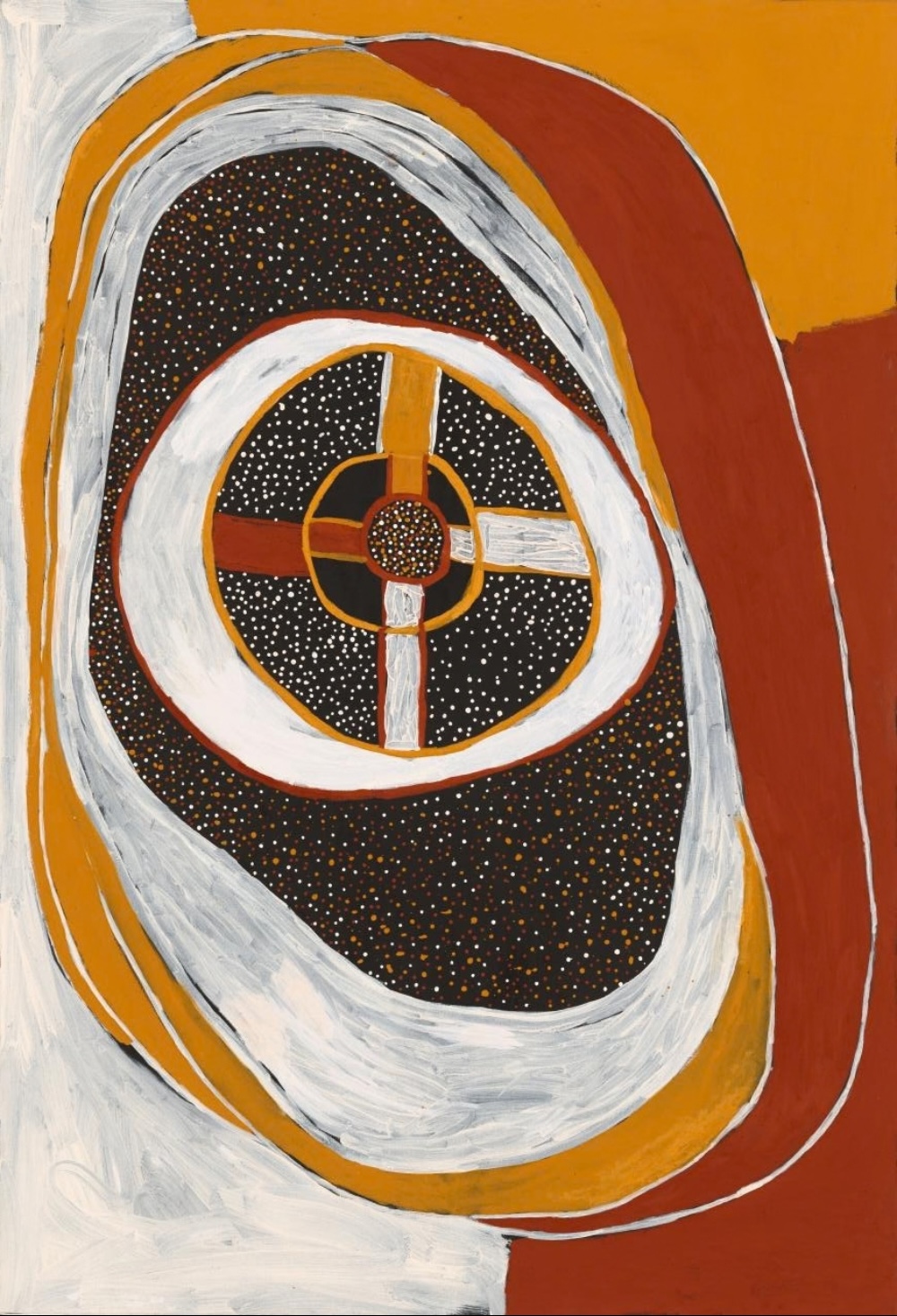
Timothy Cook paints in a loose, gestural and spacious style using natural earth pigments sourced around Milikapiti and Melville Island. His surfaces are built from circles, dots, lines, crosses and broad areas of ochre, but the irregular movement of his hand prevents the compositions from becoming mechanically geometric.
Writer Rose Vickers describes the characteristic combination of delicate lines and “blizzard-like dots” through which the eye moves across Cook’s paintings. In some works strong directional lines collide with dispersed fields of dots; in others concentric forms expand around dark central spaces. His compositions can approach symmetry without becoming completely symmetrical, producing a sense of movement rather than fixed geometric order.
Cook himself has remarked, “People recognise my paintings wherever I go.” That individuality is visible in the brushwork: the trace of his hand remains apparent across both bark and canvas.
Kulama, Moon and Stars
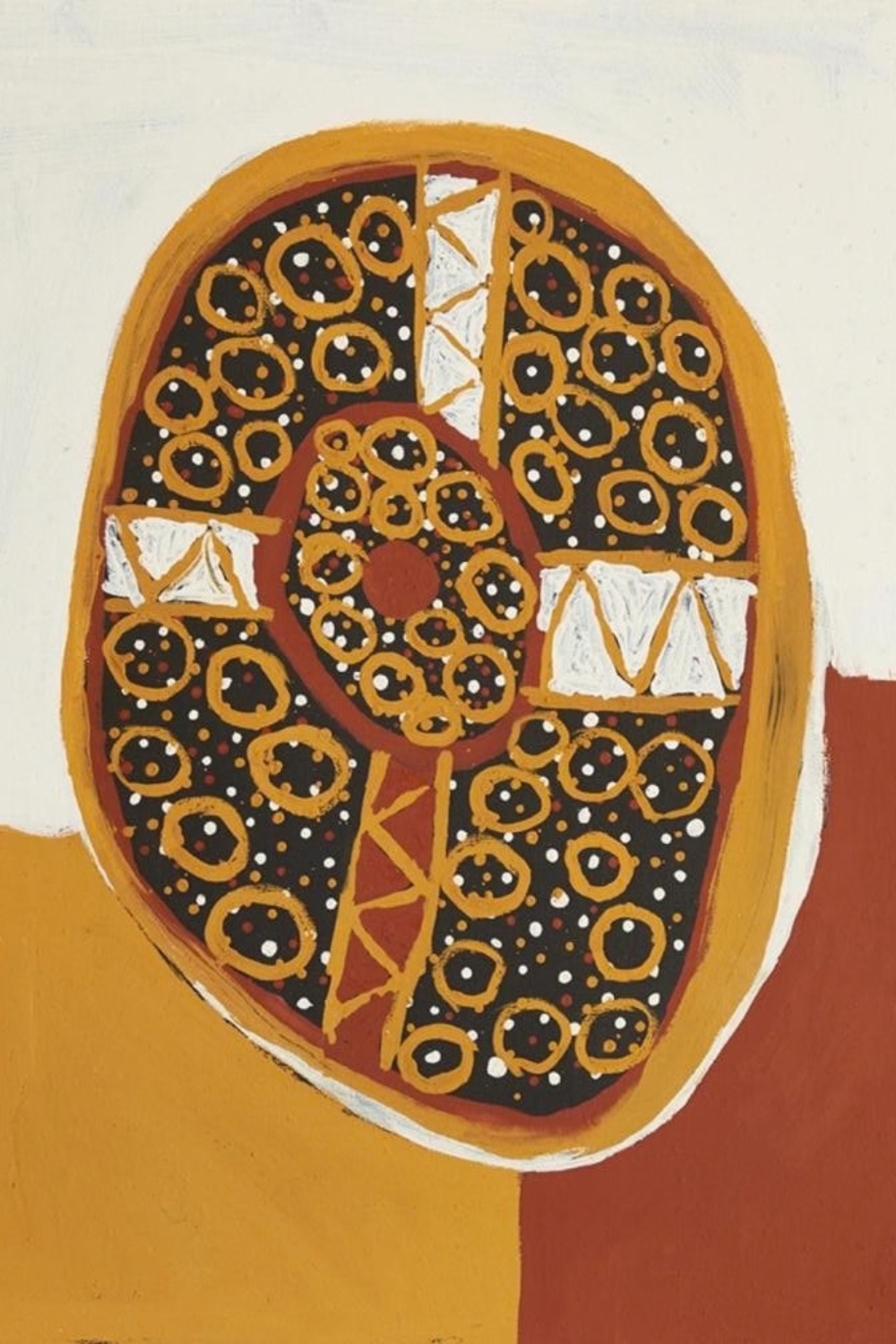
The principal subject of Cook’s mature paintings is Kulama, the Tiwi coming-of-age ceremony associated with the harvest and preparation of the kulama yam. The ceremony is signalled by the appearance of a halo around Japarra, the moon, and involves several days of singing and dancing.
The great circular structures in Cook’s Kulama paintings therefore carry several interconnected meanings. They can refer to Japarra, the kulama yam and the ceremonial circles in which ritual takes place, while pwanga, or dots, evoke Japalinga, the stars.
As Cook puts it:
“I paint Japarra, Kulama and Japalinga.”
These meanings should not be reduced to a simple vocabulary of symbols. Bruce McLean describes Cook’s central Kulama circle as carrying a “multitude of meanings and readings.” His paintings evolved from repeated and sometimes linked motifs towards increasingly commanding singular images of this circle.
The moon itself has significance beyond Kulama. Museum documentation connects Japarra with the wider Tiwi cycle of life and death and with the Pukumani narrative of Tapara, Purukapali, Waiyai and Jinani.
Jilamara and Other Subjects
Kulama is central to Cook’s mature work, but it is not his only subject.
His earlier and continuing practice includes works titled Jilamara, Pumpuni Jilamara, Jilamara – Body Design, Milikapiti Ceremonial Designs, Star and Moon, Moon and Stars, as well as images of dugong and turtle spirits. Auction records demonstrate this wider range across paintings and works on paper.
Jilamara itself originates in the body painting associated with Tiwi ceremonies, particularly Pukumani and Kulama. The designs belong to a shared Tiwi visual inheritance, but individual artists interpret them differently. Cook’s sweeping brushwork, spatial openness and increasingly monumental circular forms are distinctly his own.
Cook has also worked three-dimensionally, carving and painting tutini, the monumental poles associated with Pukumani mortuary ceremony, and producing tunga, painted bark containers. Bruce McLean has particularly praised Cook’s ability to animate these large sculptural forms through bold gestural painting, giving the poles a powerful sense of movement and ceremonial presence.
Timothy Cook Artwork Values
Works Offered at Auction: 97
Sale Rate: 57%
Highest Sale: $22,000 AUD
Median Sale Price: $2,000 AUD
For individual artworks sizes provenance and details please see the Timothy Cook value page
Why Is Timothy Cook Important?
Timothy Cook is important because he has developed an unmistakably individual artistic language from within continuing Tiwi cultural practice rather than by moving away from it.
His paintings draw upon parlingarri jilamara learned from senior Tiwi people, the ceremonial worlds of Kulama and Pukumani, and the natural ochres of Melville Island. Yet these inherited foundations have never prevented experimentation. From his small early works on paper and printmaking to his monumental Kulama paintings and painted tutini, Cook has continually reworked Tiwi visual traditions through his own hand.
This combination of inheritance and invention has been repeatedly recognised by curators and writers. Museum of Contemporary Art curator Una Rey describes Cook as one of the most radical interpreters of the historical Tiwi works that influenced the Jilamara artists, while his development from repeated motifs towards monumental singular Kulama forms demonstrates how far he has taken that visual inheritance.
Art adviser and curator Seva Frangos described Cook’s paintings as:
“powerful, arresting and fiercely contemporary whilst simultaneously evoking Tiwi culture and tradition.”
She characterises their directness as one of their defining qualities.
That contemporaneity does not make Cook’s paintings less Tiwi. The opposite is closer to the point. Kulama connects moon and earth, yam harvest and initiation, painting and dance, ancestral knowledge and contemporary life. Painting provides Cook with another means of keeping those relationships active.
As he says himself: “We teach culture.”
His importance lies in the extraordinary individuality with which he does so.
Timothy Cook in Public Collections
Timothy Cook is represented in major national and state collections across Australia, as well as institutional collections overseas. His presence in the National Gallery of Australia, NGV, QAGOMA, AGNSW, AGSA, AGWA and MAGNT reflects the recognition his work has received beyond the Tiwi Islands. The NGV strengthened its representation of Cook with the acquisition of the large Kulama (2012), while his work was subsequently included in its major TIWI exhibition.
Public and institutional collections include:
- National Gallery of Australia, Canberra
- National Gallery of Victoria, Melbourne
- Queensland Art Gallery | Gallery of Modern Art, Brisbane
- Art Gallery of New South Wales, Sydney
- Art Gallery of South Australia, Adelaide
- Art Gallery of Western Australia, Perth
- Museum of Contemporary Art Australia, Sydney
- Musée du quai Branly – Jacques Chirac, Paris
- Aboriginal Art Museum, Utrecht, Netherlands
- Artbank, Australia
- Parliament House Art Collection, Canberra
- Charles Darwin University, Darwin
- Edith Cowan University, Perth
- Murdoch University, Perth
- Wesfarmers Collection of Australian Art, Perth
- King Edward Memorial Hospital, Perth
Further Reading
Seva Frangos et al., Timothy Cook: Dancing with the Moon, UWA Publishing, 2015.
The most important dedicated publication on Cook. It includes Bruce McLean’s essay Everything Returns to Place, which examines the development of his Kulama imagery, ceremonial sculpture and relationship with Tiwi culture. The auction documentation specifically cites McLean’s discussion on pages 67–68.
Museum of Contemporary Art Australia — Collection Handbook.
Una Rey’s account provides particularly valuable material on Cook’s early development, the historical Mountford barks, his experimentation on paper and his work with printmaking.
Jilamara Arts and Crafts Association — Timothy Cook.
The most important primary source for Cook’s Country, skin group, parlingarri jilamara, Kulama, Japarra and Japalinga, together with Cook’s own explanations of painting and ceremony.
Colin and Elizabeth Laverty et al., Beyond Sacred: Recent Painting from Australia’s Remote Aboriginal Communities, Hardie Grant Books, 2008.
Includes illustrated early works by Cook and is particularly useful for understanding his paintings of the early 2000s.
National Gallery of Victoria, TIWI.
Useful for placing Cook within the broader history and continuing development of Tiwi art, ceremony and performance. Cook’s paintings and dance practice were both represented in the exhibition.