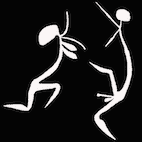
The Rainbow Serpent in Aboriginal Art
The Rainbow Serpent is a major ancestral being in Aboriginal culture, associated with creation, water, fertility, and law. It is believed to have shaped the landscape, formed rivers and waterholes, and continues to inhabit natural water sources across Australia.
Appearing across the continent under many names—such as Ngalyod in Arnhem Land, Wititj among Yolŋu people, and Wanampi in the Western Desert—the Rainbow Serpent is understood as a powerful creator that brings life but also enforces Aboriginal Law. Its presence is closely tied to rain, seasonal renewal, and the cycles that sustain Country.
The Rainbow Serpent is said to dwell in billabongs, rivers, and underground water systems. As it moved across the land in the Dreaming, it carved out rivers, created waterholes, and established sacred sites, making it central to Tjukurrpa (Dreaming) narratives and Aboriginal cosmology. In Aboriginal art, these depictions are not decorative—they express cultural authority, custodianship, and deep connections to place. For collectors and viewers, recognising the Rainbow Serpent is essential to understanding meaning, provenance, and regional style, particularly in Aboriginal bark paintings.
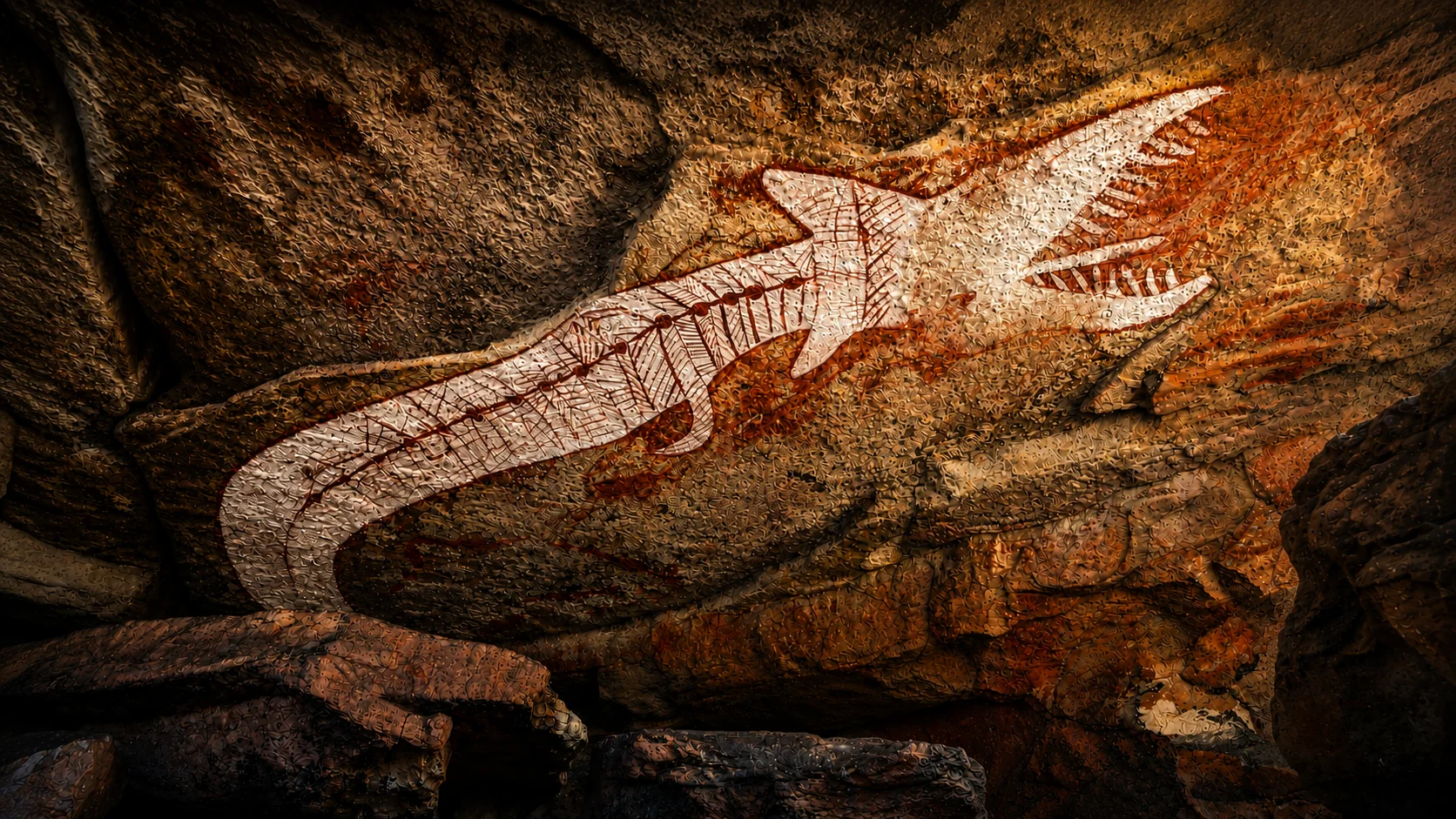
Rainbow Serpent Dreamtime Story
In the first time, when the land lay flat and silent beneath the sky, the world had no rivers, no mountains, and no waterholes. Everything slept beneath the earth, waiting. Deep below the surface, the great Rainbow Serpent rested—vast and powerful, her body holding the colours of storm, water and light. For a long time she lay still. Then, as the time of creation came, she began to move.
The earth trembled.
She pushed upward, breaking through the surface, and began to travel across the land. As she moved, her great body carved deep paths into the earth. These became the first rivers. Where she turned, the rivers bent. Where she rested, the ground sank and filled with water, forming billabongs and waterholes. Where she pressed down with force, hills and ridges rose up around her. The land took shape in her wake.
As the Rainbow Serpent travelled, she brought water with her. It flowed into the channels she had made, filling the country with life. Plants began to grow, trees took root along the riverbanks, and animals emerged to drink and move across the land. Birds filled the sky, fish swam through the new waters, and the world awakened.
The Rainbow Serpent watched over this new creation. She gave each living thing its place and its way of being, teaching people how to live with the land—where to find water, how to gather food, and how to respect the places she had formed. Some places were open, but others were sacred.
These were the first laws of the land.
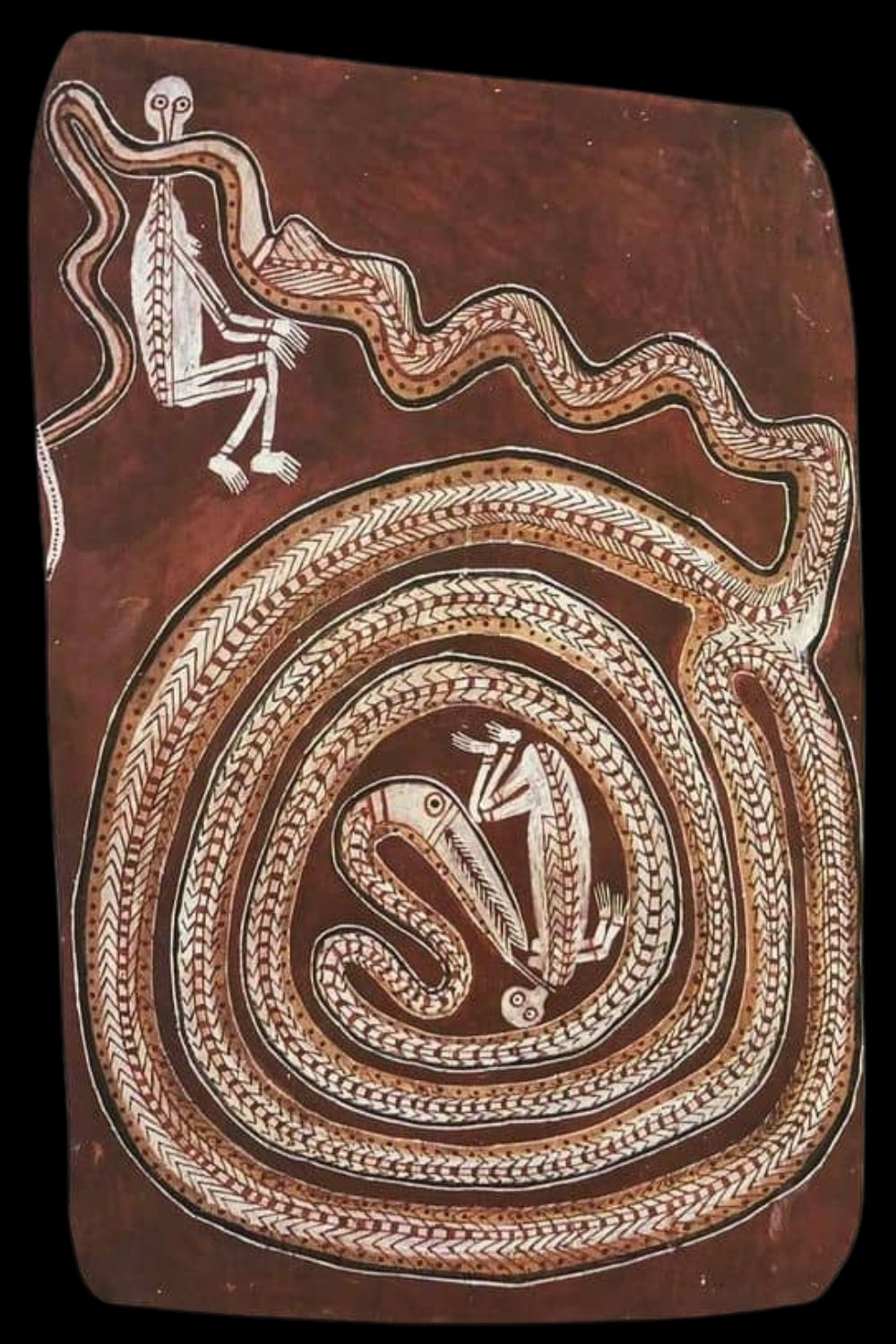
Wawilak Sisters and the Rainbow Serpent Dream Time Story
In the time that followed, two ancestral women—known as the Wawilak or Wagilag sisters—travelled across Arnhem Land, naming the plants, animals and places as they went. Through their journey, they brought order to the world, singing the country into being. As they moved toward the coast, the elder sister gave birth, and after resting, she went down to bathe with her child in a deep waterhole.
But this waterhole was the dwelling of the Rainbow Serpent.
As she entered the water, the scent of birth flowed into the pool, awakening the Serpent below. The water began to ripple, and storm clouds gathered overhead. Thunder rolled across the land. The sisters, sensing the danger, sang sacred songs through the night, calling upon their knowledge to calm what they had disturbed.
At dawn, exhausted, they fell silent.
From the depths, the Rainbow Serpent rose—vast, powerful, and filled with ancestral force. It came upon the sisters’ camp and swallowed them and the child. The land fell quiet once more.
Later, the Serpent rose into the sky carrying their story before returning them to the earth, where they became part of the landscape itself—transformed into stone, water and memory. From this came important law: a teaching about fertility, life and death, and the need to respect sacred places, especially water.
Even today, when rain falls and a rainbow stretches across the sky, it is said the Rainbow Serpent is moving between waterholes, renewing the land and reminding all who see it of the law that began in the Dreaming.
Meaning of the Rainbow Serpent in Aboriginal Art
Wanampi: The Rainbow Serpents of Piltati
In Pitjantjatjara Country, ancestral Rainbow Serpents are known as Wanampi. Tiger Palpatja‘s paintings of Wanampi Tjukurpa at Piltati provide a powerful example of how these ancestral beings are connected to particular places and the creation of geographical features.
Tiger’s Wanampi dreaming tells of two brothers and their wives, who were sisters. The women gathered food while the men remained at camp performing ceremonies. Tired of continually providing for their husbands, the sisters eventually refused to give them food.
The brothers sought revenge by transforming themselves into enormous Wanampi and travelling beneath the ground. They tricked the sisters into digging after them, and the women pursued the serpents across Country with their digging sticks.
Their digging created a trench extending approximately 25 kilometres from Aparatjara to Piltati. This became a watercourse, while at Piltati their actions created the gorge and waterways associated with the site. The brothers eventually caught and swallowed the women.
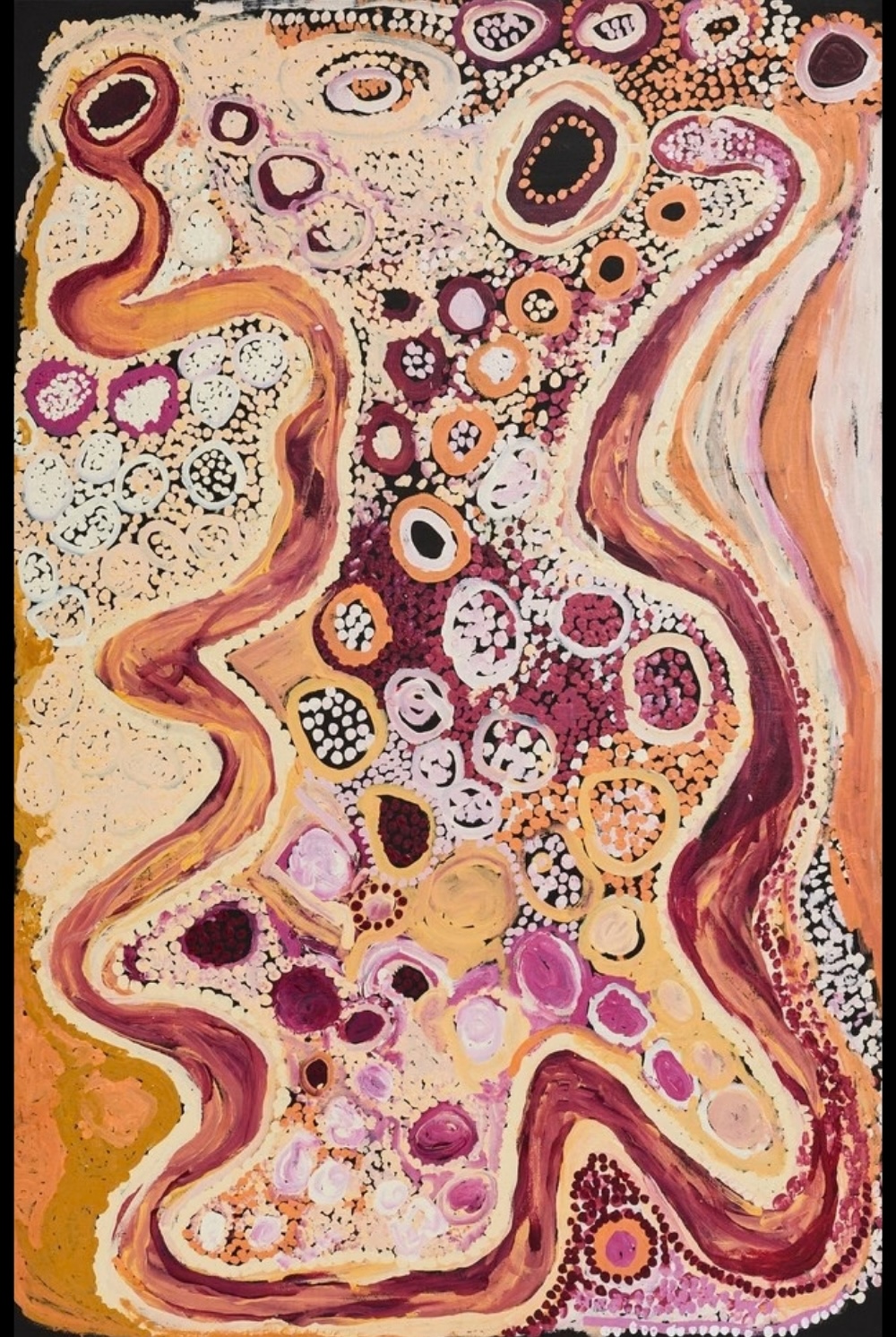
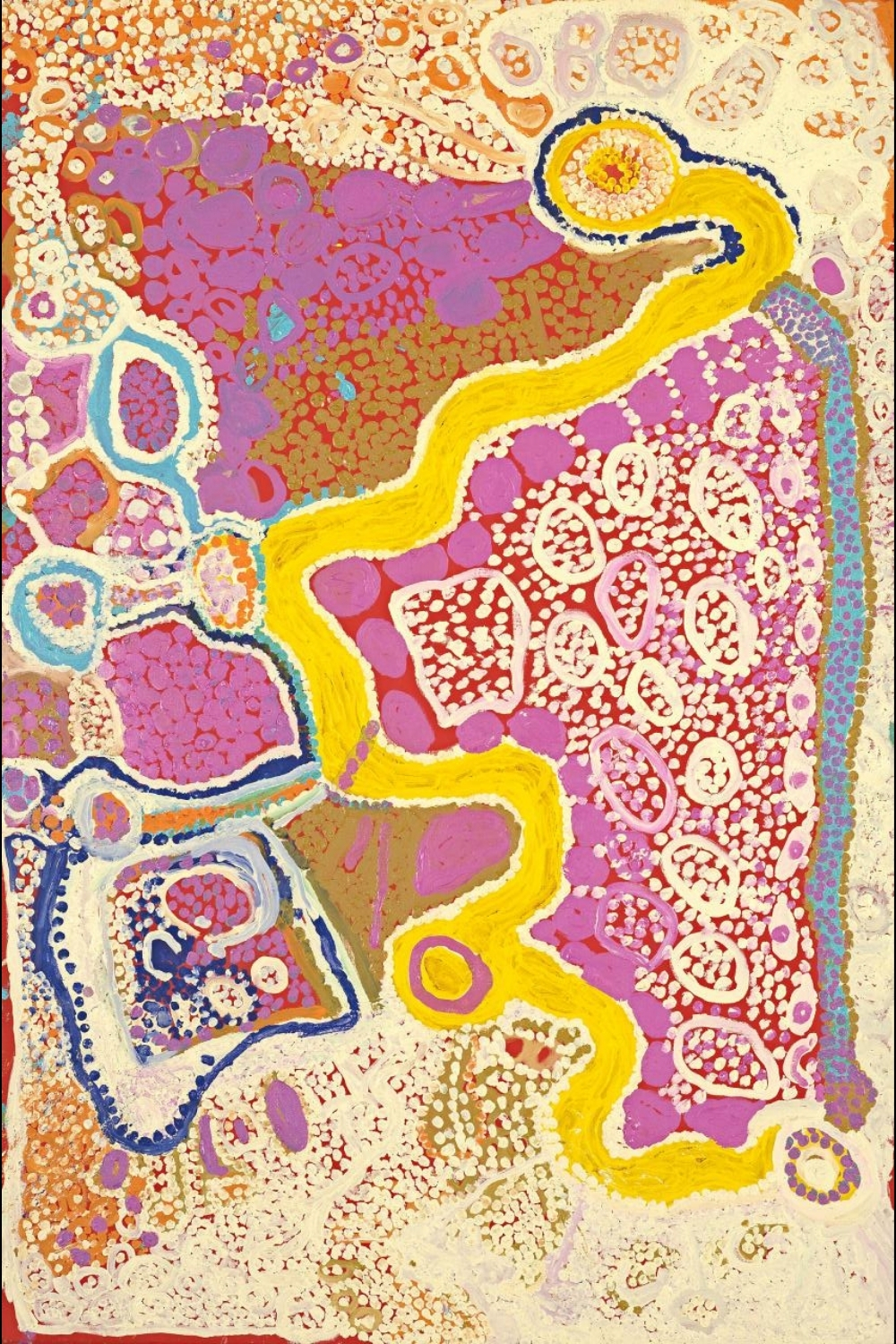
Tiger’s paintings therefore show the Rainbow Serpent as part of a specific ancestral geography. The Wanampi brothers, the sisters, the watercourse, gorge and Piltati itself belong to the same creation story: ancestral actions remain physically embedded in the landscape.
The painting opposite for example can be viewed as two waterholes connected by an underground water course or equally validly as the Rainbow serpent itself because it is the story being painted not one or the other.
Wanampi Tjukurpa (dreaming) is not confined to this one story. Different Wanampi stories belong to different places across the desert, with ancestral journeys connecting places and features of Country. The Piltati story is Tiger Palpatja’s particular expression of this much wider tradition.
Ngalyod: Rainbow Serpent in Arnhem Land Art
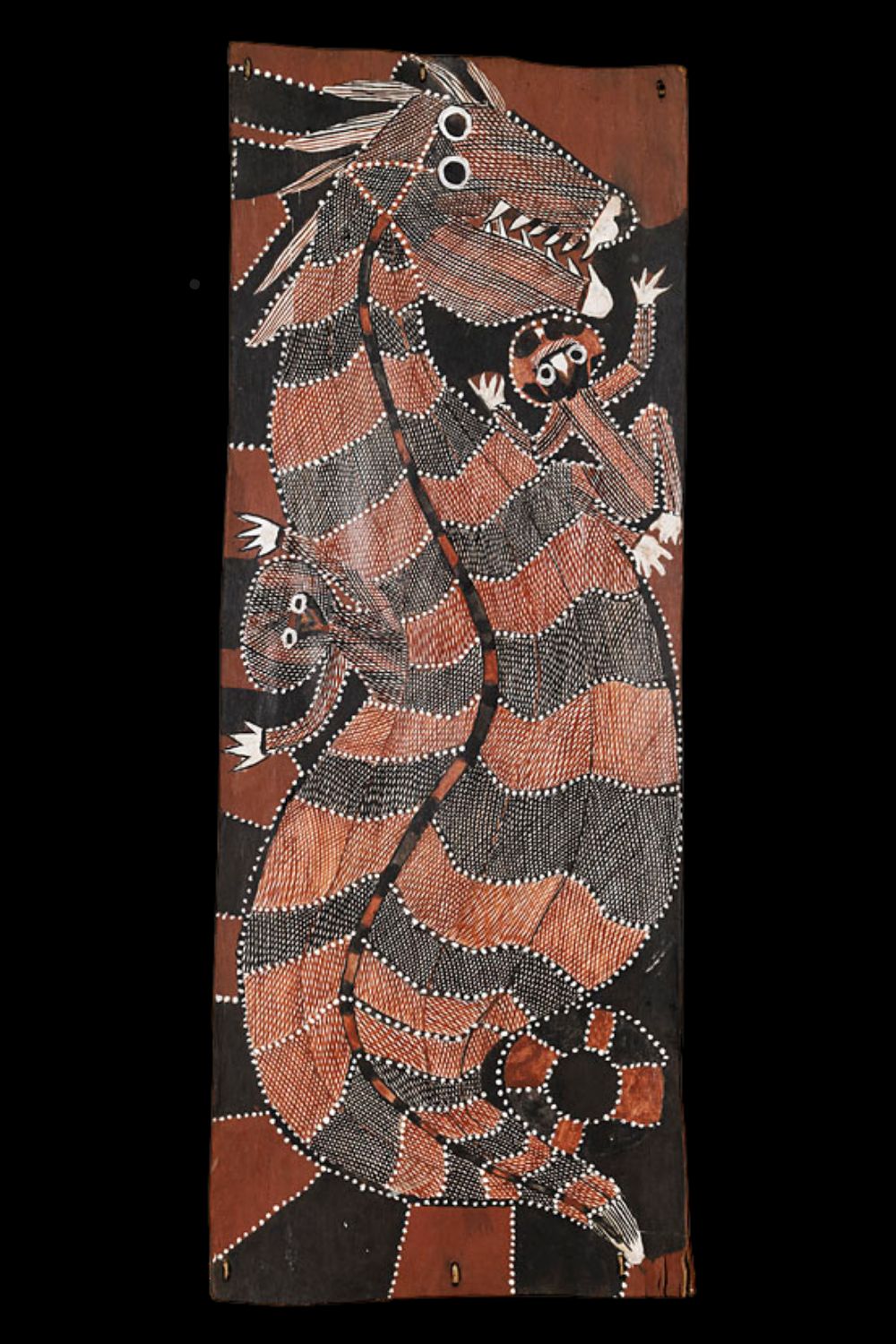
In Arnhem Land Oenpelli Aboriginal art, the Rainbow Serpent is commonly known as Ngalyod, a central figure in Kunwinjku cosmology. Ngalyod is a transformative being linked to creation, destruction, and seasonal cycles.
Ngalyod frequently appears in Aboriginal bark paintings by artists like Yirawala, particularly those using fine rarrk cross-hatching, which symbolises ancestral energy. Artists such as Lofty Bardayal Nadjamerrek have created highly refined depictions of Ngalyod, combining technical mastery with deep cultural knowledge.
The serpent is closely associated with the Wagilag Sisters story, where it consumes the sisters after they disturb a sacred waterhole—an important narrative reinforcing Aboriginal Law. In this context, the Rainbow Serpent is both creator and enforcer, capable of sustaining life or punishing transgression.
Opposite bark painting by Peter Marralwanga
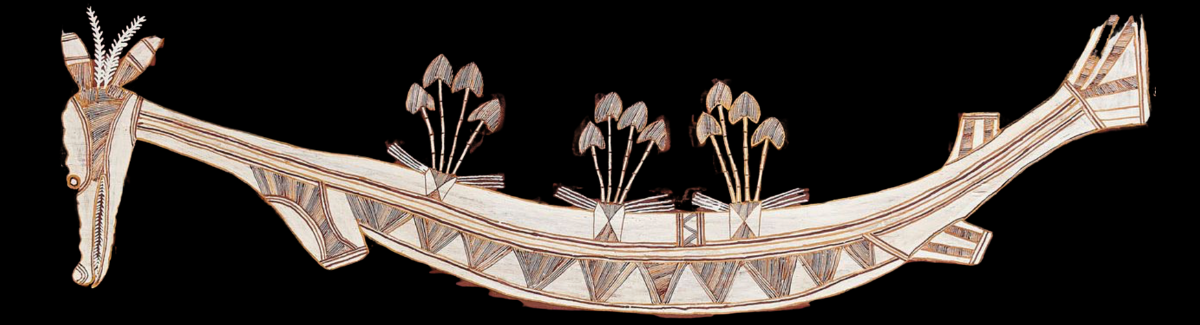
Above: Ngalyod by Lofty Nadjamerrek
Ungud: Rainbow Serpent and Wandjina in Kimberley Art
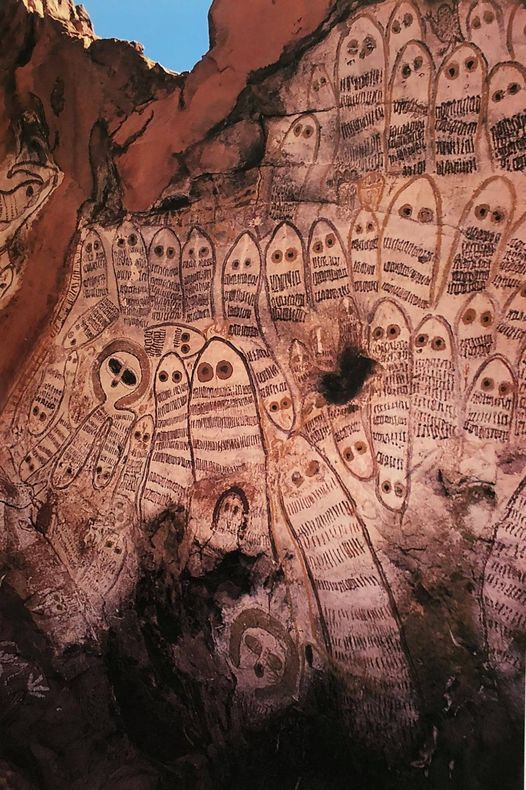
In the Kimberley region, the Rainbow Serpent is commonly known as Wunggurr or Ungud, a powerful ancestral serpent associated with water, fertility, rain and the creative forces beneath the earth. Within the Wandjina-Wunggurr belief system, the serpent is closely linked to sacred waterholes, underground springs and the spiritual power of Country
The Wandjina are associated with clouds, rain, and storms, while the Rainbow Serpent governs water in rivers, springs, and underground systems. Together, they form a complete ecological cycle—rainfall and water regeneration—central to Kimberley belief systems.
In Wandjina compositions, the serpent may appear directly or be implied through water imagery, reinforcing the relationship between sky and land. These works are among the most recognisable forms of Wandjina painting in Australian Aboriginal art.
Opposite: Kimberley Rock Art
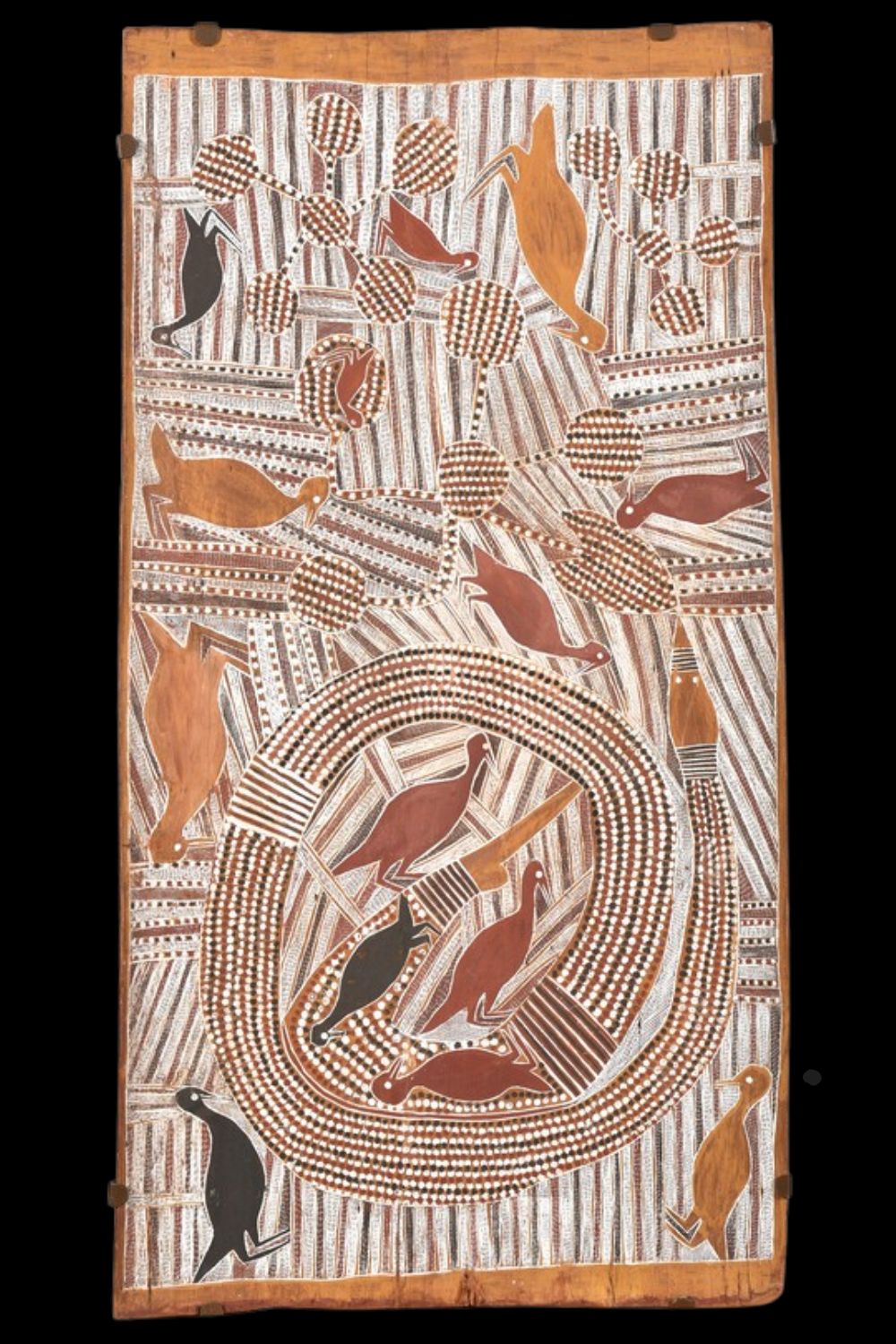
Wititj: Rainbow Serpent in Yirrkala Art
In Yirrkala Aboriginal art, the Serpent is known as Wititj, a major ancestral being in Yolŋu culture. Wititj is associated with freshwater systems, monsoonal rains, and fertility.
Like Ngalyod, Wititj appears in the Wagilag narrative, where it emerges from a waterhole bringing storms and transformation. In Yolŋu works, it is depicted using intricate rarrk patterns that encode identity, land ownership, and ceremony. These works are central to understanding Arnhem Land bark painting traditions.
Opposite: bark Painting by Mithinari Gurruwiwi
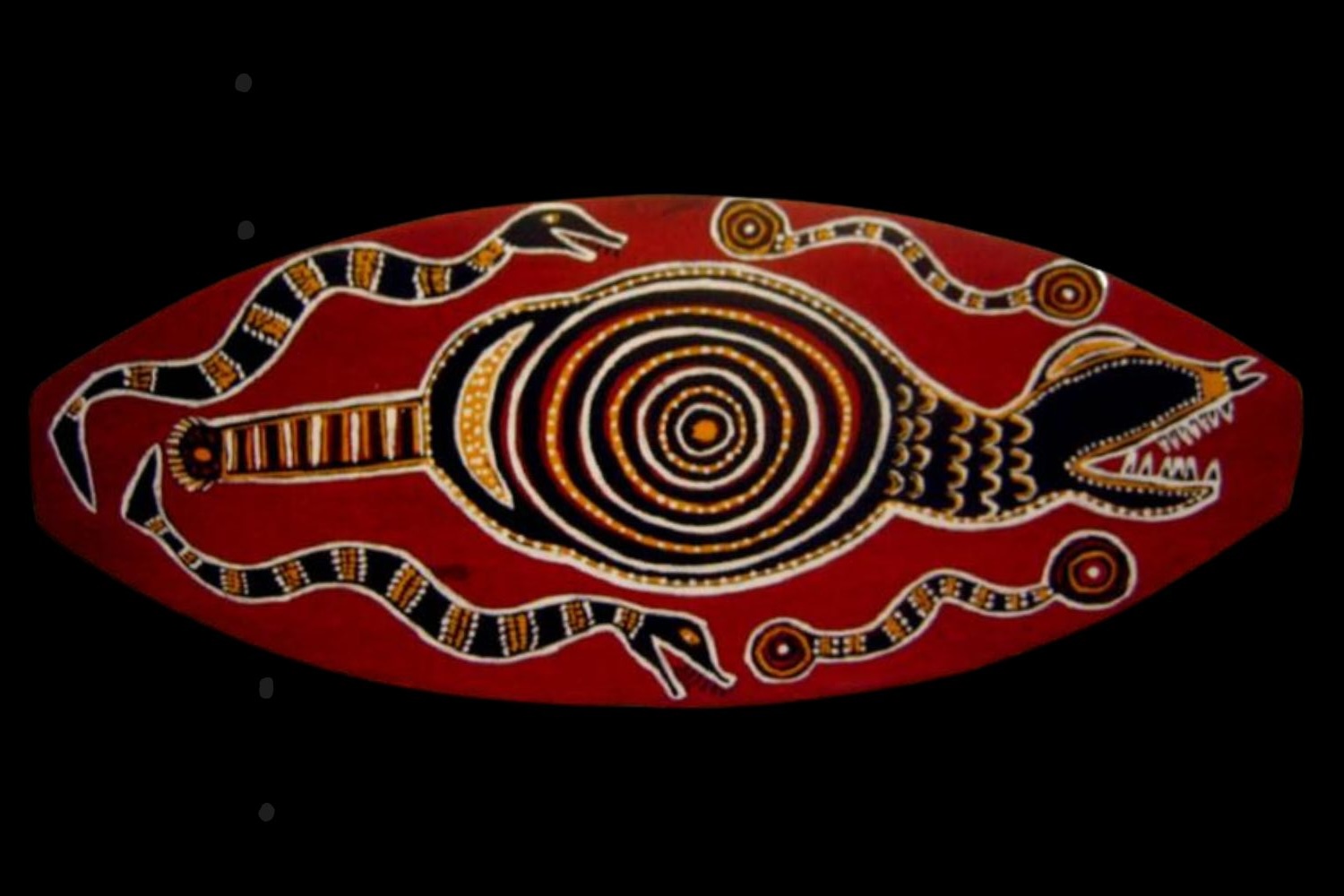
Kunmanggur: Rainbow Serpent in Port Keats Art
In the Port Keats (Wadeye) region, the Serpent is known as Kunmanggur. This tradition provides an important visual link between Arnhem Land and Central Desert art.
Here, the relationship between serpent and waterhole is explicit—the being and the site are understood as one. This clarifies why, in desert art, waterholes associated with the Rainbow Serpent are represented as concentric circles. Port Keats works are therefore critical to interpreting symbolism in Aboriginal desert painting.
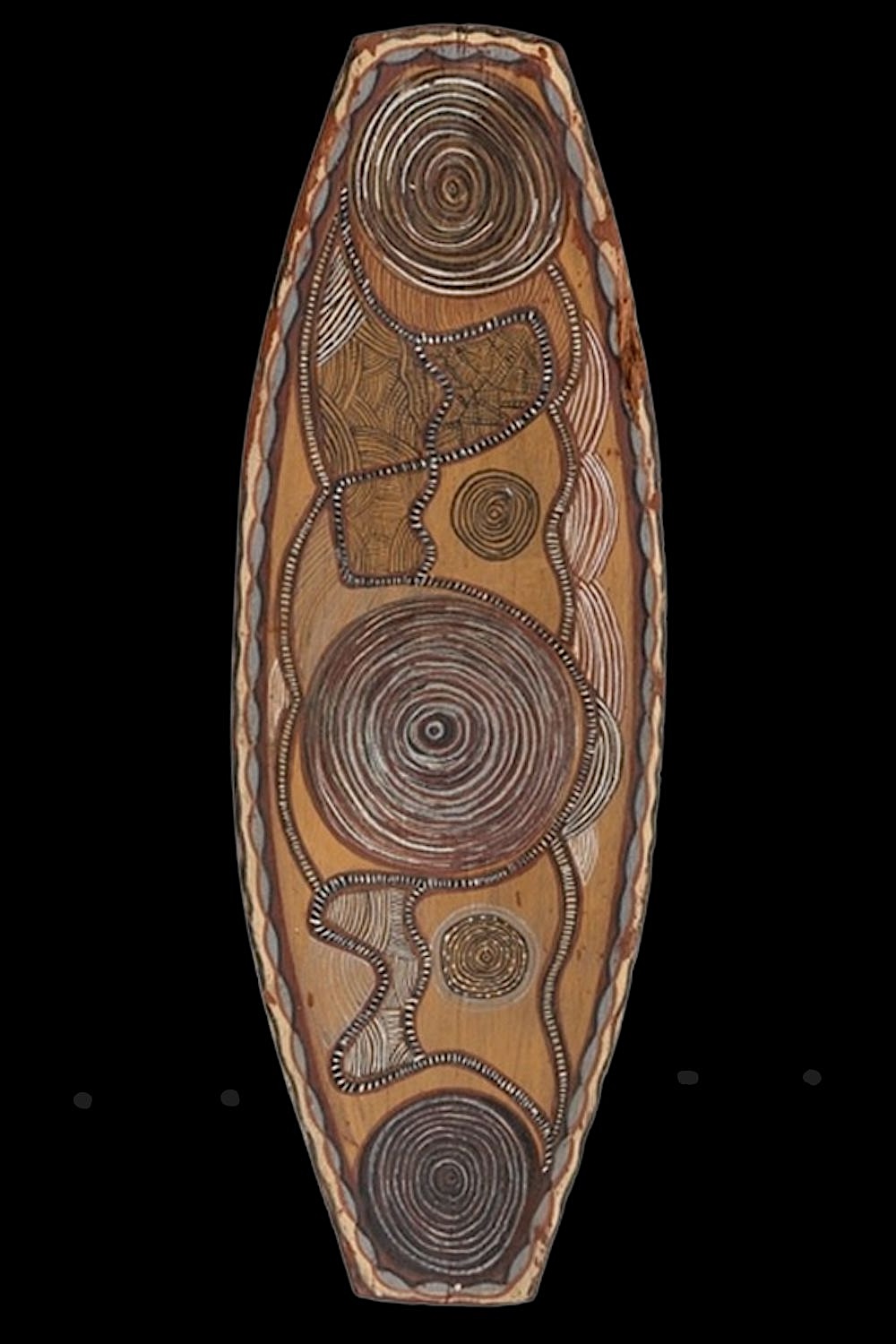
Reflections of the Rainbow Serpent
Art from Port Keats (Wadeye) provides an important key to understanding the symbolic language of Western Desert painting. Concentric circles, so common in desert art, are often interpreted simply as waterholes. While broadly correct, this explanation only captures part of their meaning.
Within Aboriginal cosmology, these waterholes are ancestral sites created and inhabited by the Rainbow Serpent. The serpent’s movement beneath the earth is understood to have formed rivers, springs, and permanent water sources, linking subterranean water with ancestral power and creation.
As a result, concentric circles represent far more than physical geography. They mark sacred places where the presence of the Rainbow Serpent remains active within the landscape. These are spiritually charged locations connected to ceremony, law, fertility, and the regeneration of Country.
Through rainmaking ceremonies and other ritual practices, this ancestral power may be invoked. In this way, the imagery functions simultaneously as a map of Country, a record of creation, and an expression of continuing spiritual authority.
Waugal (Wagyl): Rainbow Serpent of Noongar Country
The Waugal (also spelled Wagyl) is the Rainbow Serpent of the Noongar people of south-west Western Australia. Associated with water, creation, and sacred law, the Waugal is believed to have shaped the Swan River and surrounding waterways near present-day Perth.
According to Noongar tradition, the Waugal travelled across the land during the Dreaming, forming rivers, springs, and waterholes as it moved through Country. Sacred sites linked to the serpent remain spiritually important today.
The Waugal was recorded in 1836 by Francis Armstrong, interpreter for the Swan River Colony, who observed Noongar people reverently protecting rounded stones believed to be eggs laid by the serpent.
Noongar elder Clarrie Isaacs explained that the Waugal “has the power of life and death over Aborigines and demands the respect due to it.” Like many Rainbow Serpent traditions, the Waugal is both creative and dangerous, particularly when sacred laws or places are violated.
Unlike the bark painting traditions of Arnhem Land, the Waugal survives primarily through oral tradition, ceremony, and sacred geography, remaining one of the most significant creator beings in Noongar cosmology.
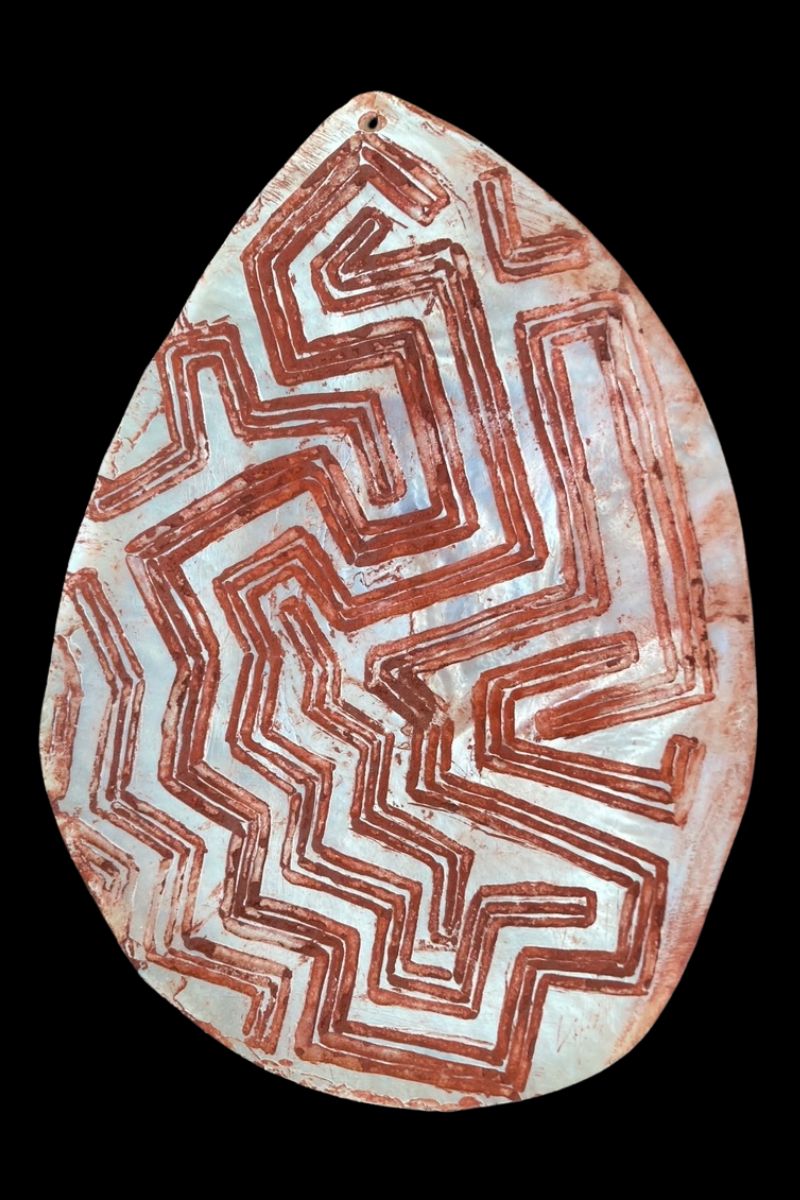
Scales of the Rainbow Serpent
In certain Aboriginal traditions, the luminous surface of pearl shell is understood to embody the presence of the Serpent, its iridescent sheen likened to the shimmering scales of this powerful ancestral being. These shells are not merely decorative objects but hold ceremonial and spiritual significance, particularly in rituals associated with water and rain.
In some rainmaking ceremonies, small fragments of Aboriginal pearl shell are deliberately broken or bitten from larger pieces and used as ritual implements. Their reflective quality is believed to invoke rain-bearing forces, reinforcing the deep connection between the Serpent, water, and the regeneration of Country.
Recommended Reading
All images featured in this article are presented strictly for educational and informational purposes.
This website may include copyrighted material for which specific authorization has not been obtained from the copyright owner.
All such images are presumed to be the intellectual property of the respective artist or their estate, and are used in accordance with principles of fair dealing or fair use under applicable copyright law.
Conclusion: The Enduring Power of the Rainbow Serpent
The Serpent in Aboriginal art remains a unifying concept across Aboriginal Australian culture, linking diverse regions through shared themes of water, creation, and law. Whether known as Ngalyod, Wititj, Kunmanggur, Wanampi, or understood through its relationship with Wandjina, it represents a continuous ancestral presence embedded within Country.
Across Arnhem Land, the Kimberley, Port Keats, and the Western Desert, its depiction reveals both regional diversity and a shared cosmological foundation. As both creator and enforcer of law, the Serpent is not merely a subject of artistic representation but a living expression of Tjukurrpa (Dreaming)—a system that governs identity, custodianship, and the relationship between people and land.
For collectors and scholars, Serpent Aboriginal art is far more than visual imagery. These works function as cultural documents, encoding knowledge, law, and connection to Country within their forms. At their highest level, they represent one of the most sophisticated and enduring traditions in Australian Aboriginal art, where landscape, spirituality, and artistic practice remain inseparably connected.
Painters of the Rainbow Serpent
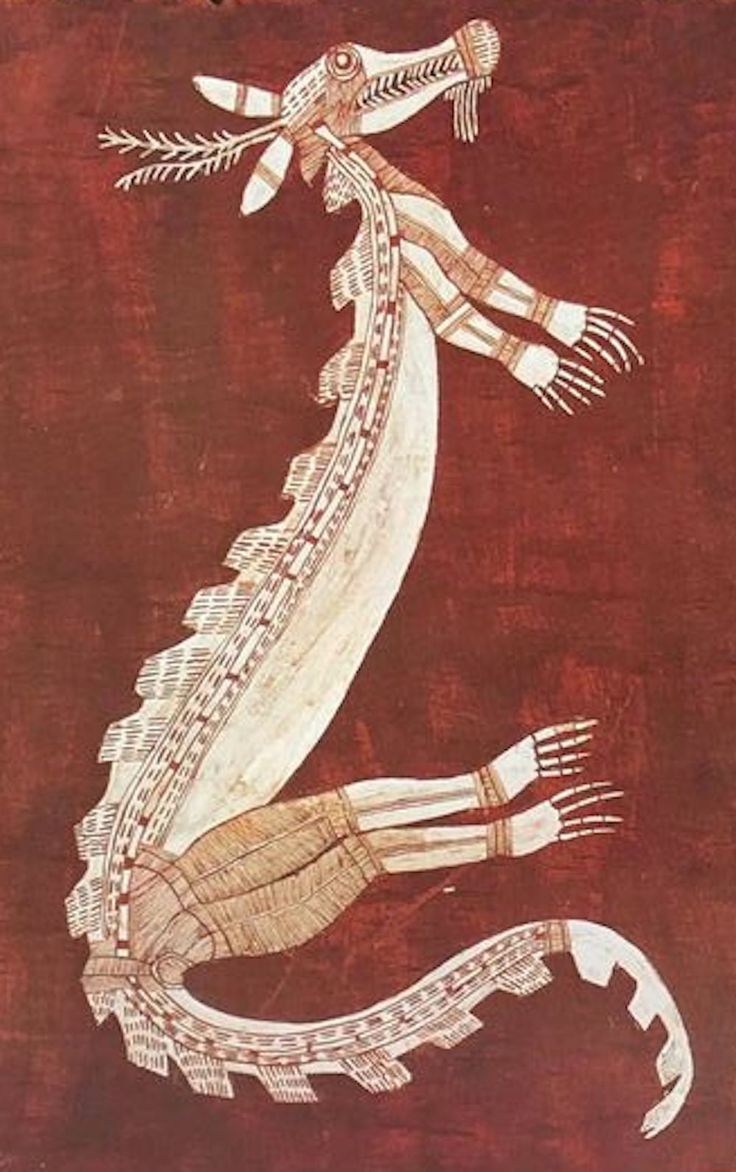
Lofty Bardayal Nadjamerrek
In the cosmology of the Kunwinjku people, there are three known Rainbow Serpents. The most ancient and powerful is Jingana, the Mother Serpent, who dwells in subterranean chambers and lily-covered billabongs, guarding the primordial balance of nature. From her belly, she birthed two sacred offspring: her son Ngalyod, with a crocodilian head and sinuous serpent body; and her daughter Ngalgunburijaimi, whose form combined serpent, crocodile, and fish.
Bobyin Nongah
Bobyin’s bark paintings are rare and culturally significant, especially for their singular focus on Kunmanggur, the Rainbow Serpent—one of the most powerful and revered ancestral beings in Aboriginal cosmology.
Yirawala
The rainbow serpent isn’t always friendly. He kills those people who offend him. Ngalyod swallows people during floods that he has created. When he regurgitates them and they are transformed into new beings by his blood. Yirawala Picasco of Arnhemland
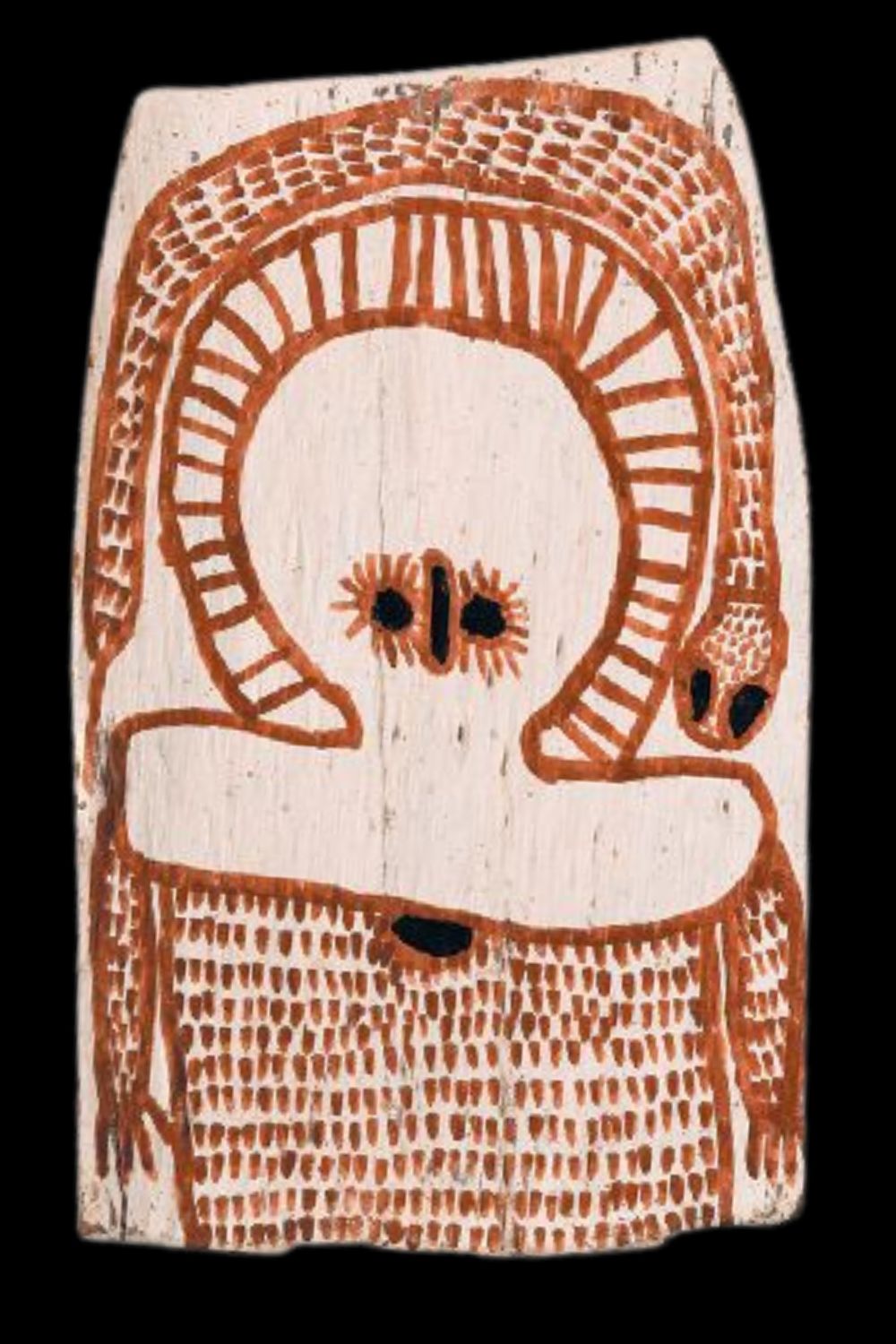
Waigin Djanghara
Waigin often depicted the Rainbow serpent in a rainbow shape above his Wandjina paintings. While Wandjina controlled the rain and storms the serpent controlled the streams floods and waterholes
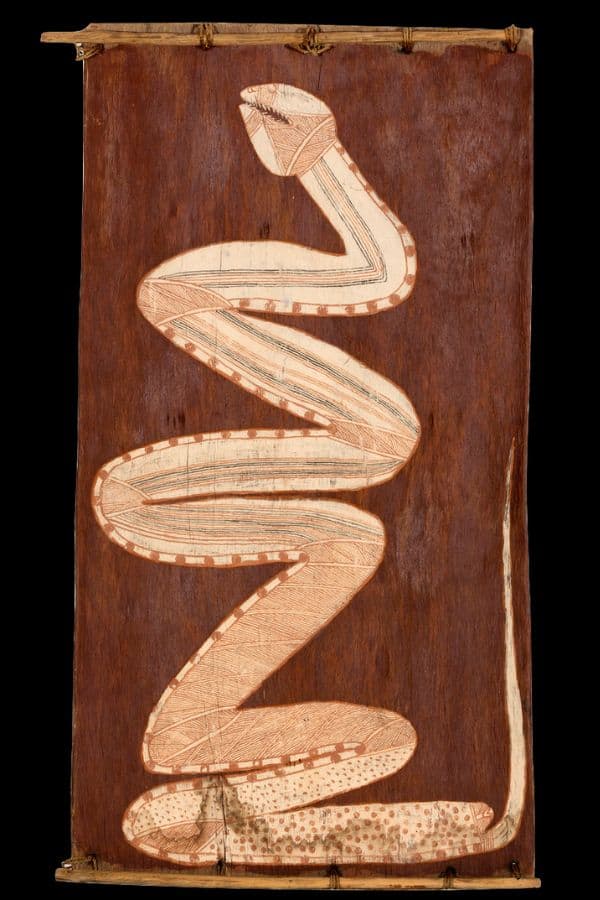
Dick Murramurra
Jingana the Mother Serpent resides in subterranean springs and lily-covered billabongs, her presence hidden yet potent. In the mythic Dreaming, it is said that Jingana surveyed the primordial world and found its creatures malformed—part human, part animal, bird, or fish.
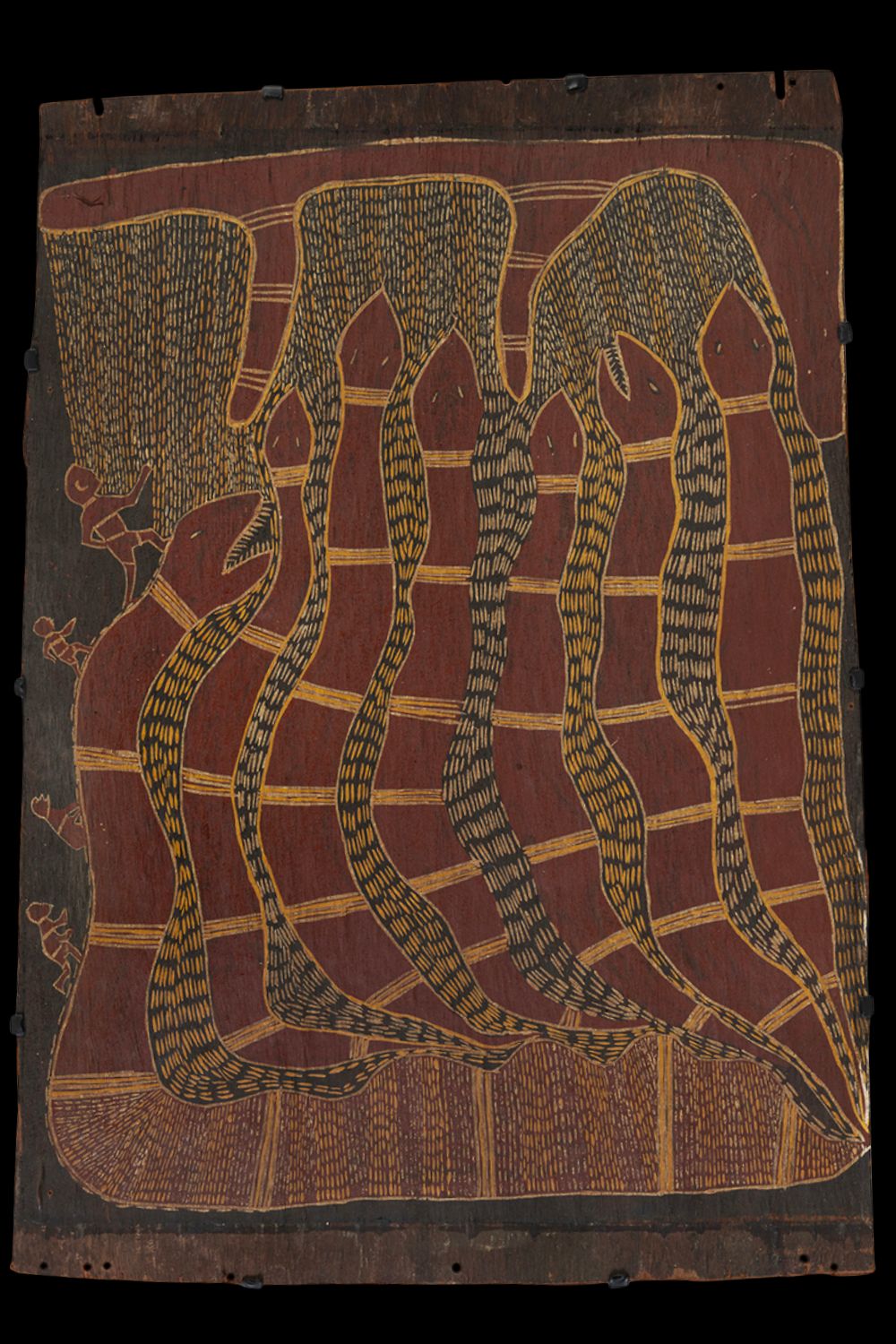
Nandabitta Maminyamandja
Unlike many mainland Arnhem Land traditions, Groote Eylandt does not appear to possess a classic Rainbow Serpent figure equivalent to Ngalyod or Julunggul. Anthropologists instead describe a powerful storm and swamp being known as Ipilja-ipilja, which may represent a local counterpart to the broader Rainbow Serpent traditions of northern Australia.
Nandibitta is one of the few artists from Groote eylandt known to have depicted the Rainbow Serpent. More about Nandibitta
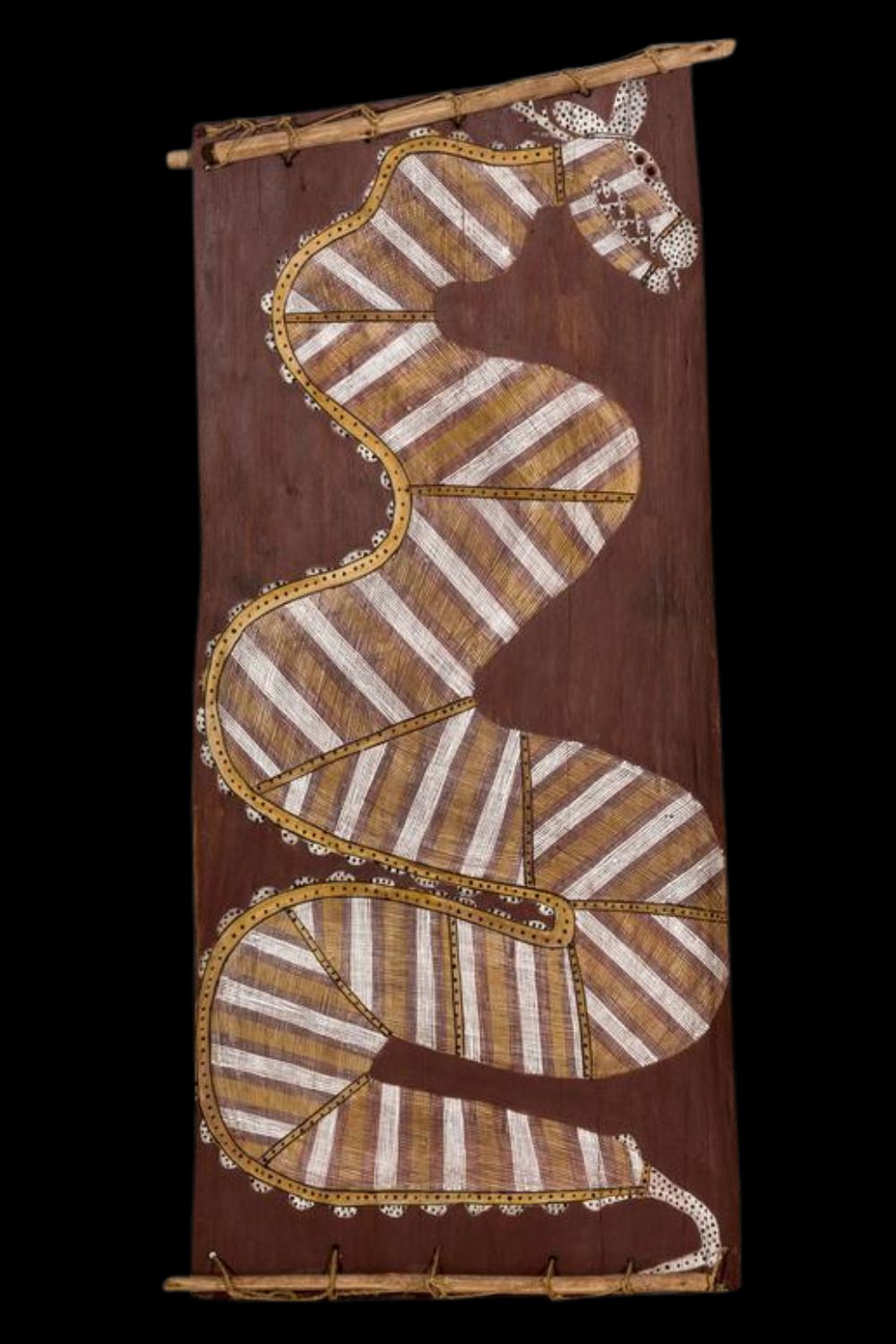
Mick Kubarrku
The serpent is deeply respected because it will swallow people who offend him. If Ngalyod swallows people during floods that he has created, he regurgitates them and they transform into new beings by his blood.
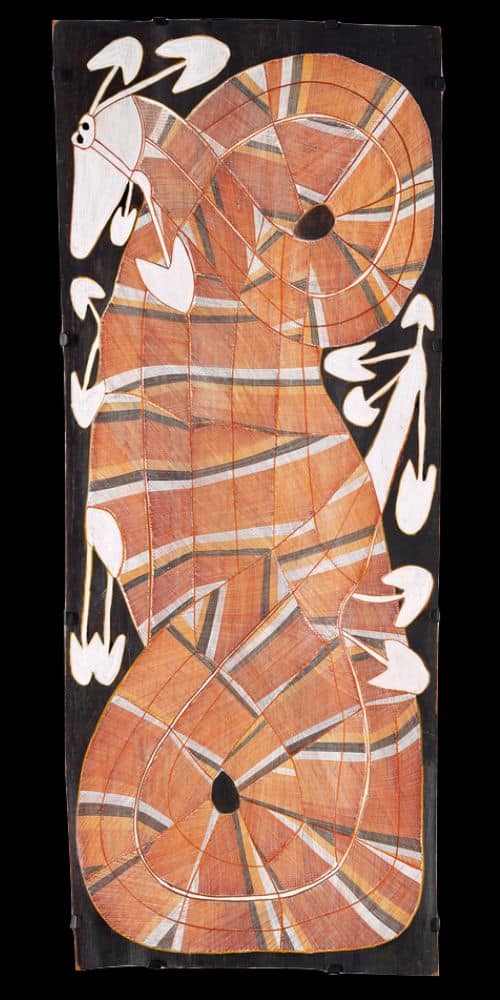
John Mawurndjul
Aboriginal people respect sacred sites where the Rainbow Serpent resides. Near these sites, cooking is not allowed. Cooking near the resting place of the great serpent will incur his wrath. Ngalyod can cause sickness, accidents and great floods, which make it easier for him to swallow his victims.
Peter Marralwanga
Ngalyod is most strongly associated with rain, monsoon seasons, and the rainbows that arc across the sky like a giant serpent. He is most active in the wet season. In the dry season, he rests in billabongs and freshwater springs. When he rests he handles the production of water plants such as waterlilies, vines, algae, and cabbage tree palms.
Peter Marralwanga: Master of Ceremonial Design and Kunwinjku Bark Painting
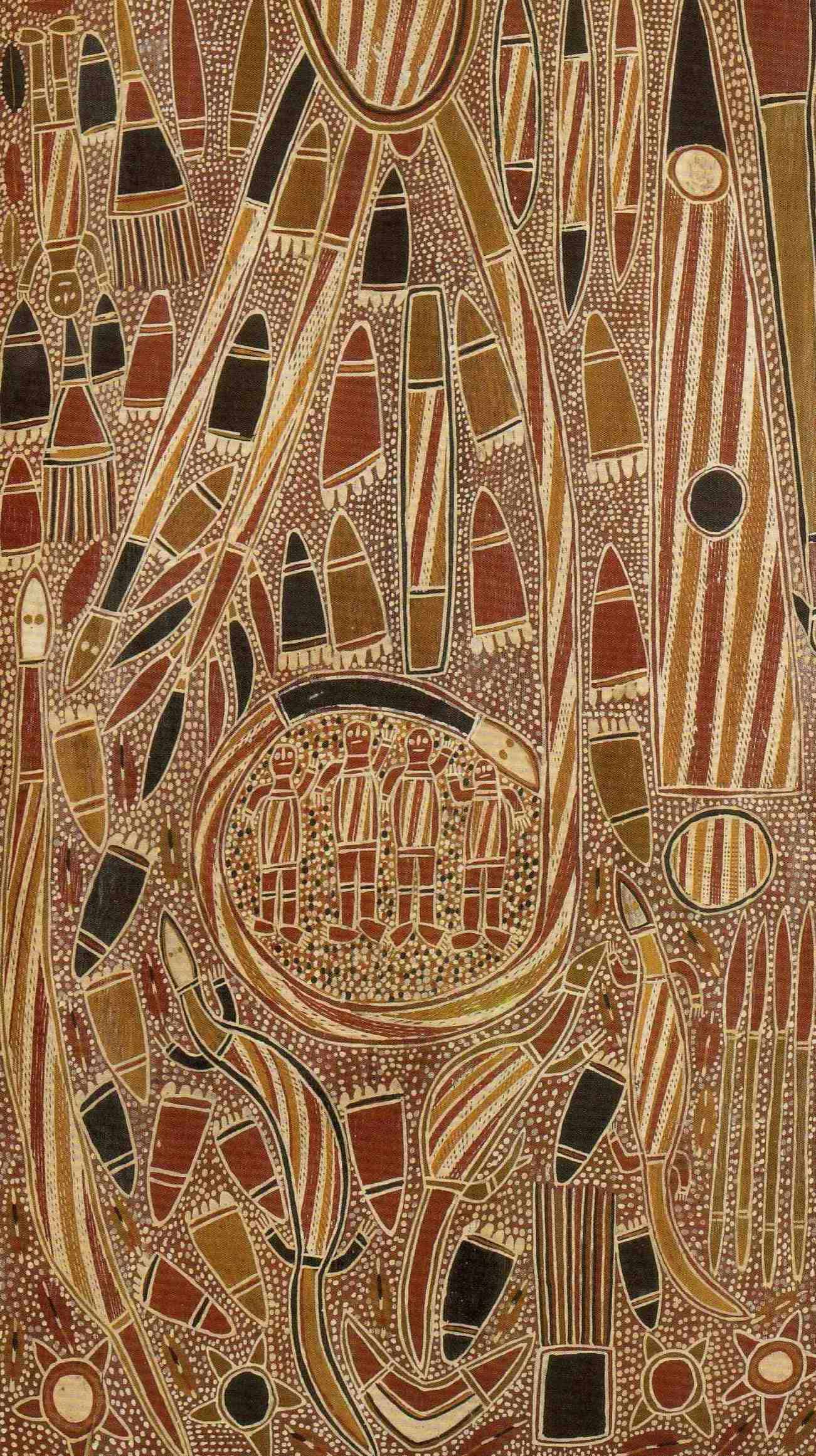
Dawidi Birritjama
Dawidi often painted the the rainbow serpent as part of the travels of the Wagilag sisters. As one of the sisters give birth near a waterhole the blood enters the sacred waters. The sisters are consumed by the serpent after transgressing his waterhole and become a part of it. The sisters transform into Yawkyawk
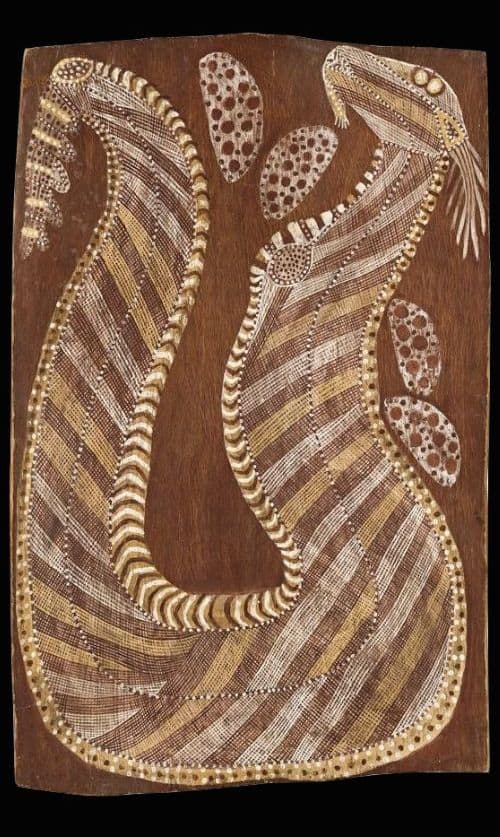
Wally Mandarrk
Aboriginal people respect sacred sites where the Rainbow Serpent resides. Near these sites, cooking is not allowed. Cooking near the resting place of the great serpent will incur his wrath.
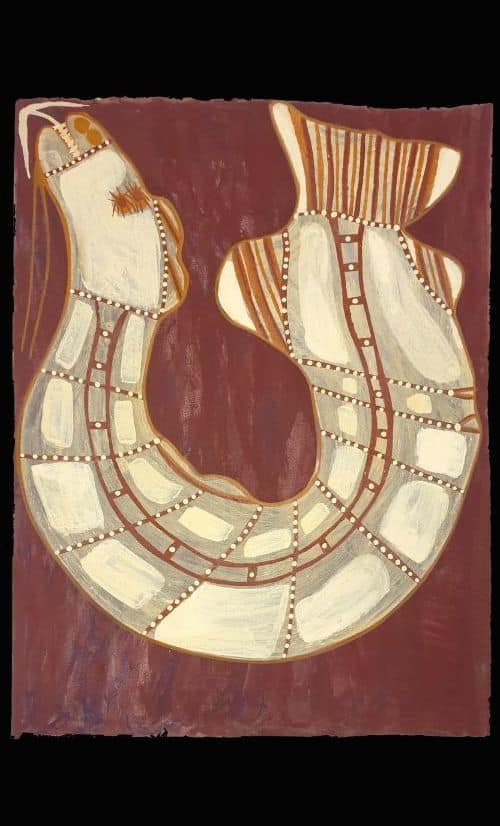
John Namerredje
Characteristics of Ngalyod vary from group to group and also depend on the site. He can change into a female serpent, and has both, powers of creation and destruction. Ngalyod is most strongly associated with rain, monsoon seasons, and the rainbows that arc across the sky like a giant serpent.
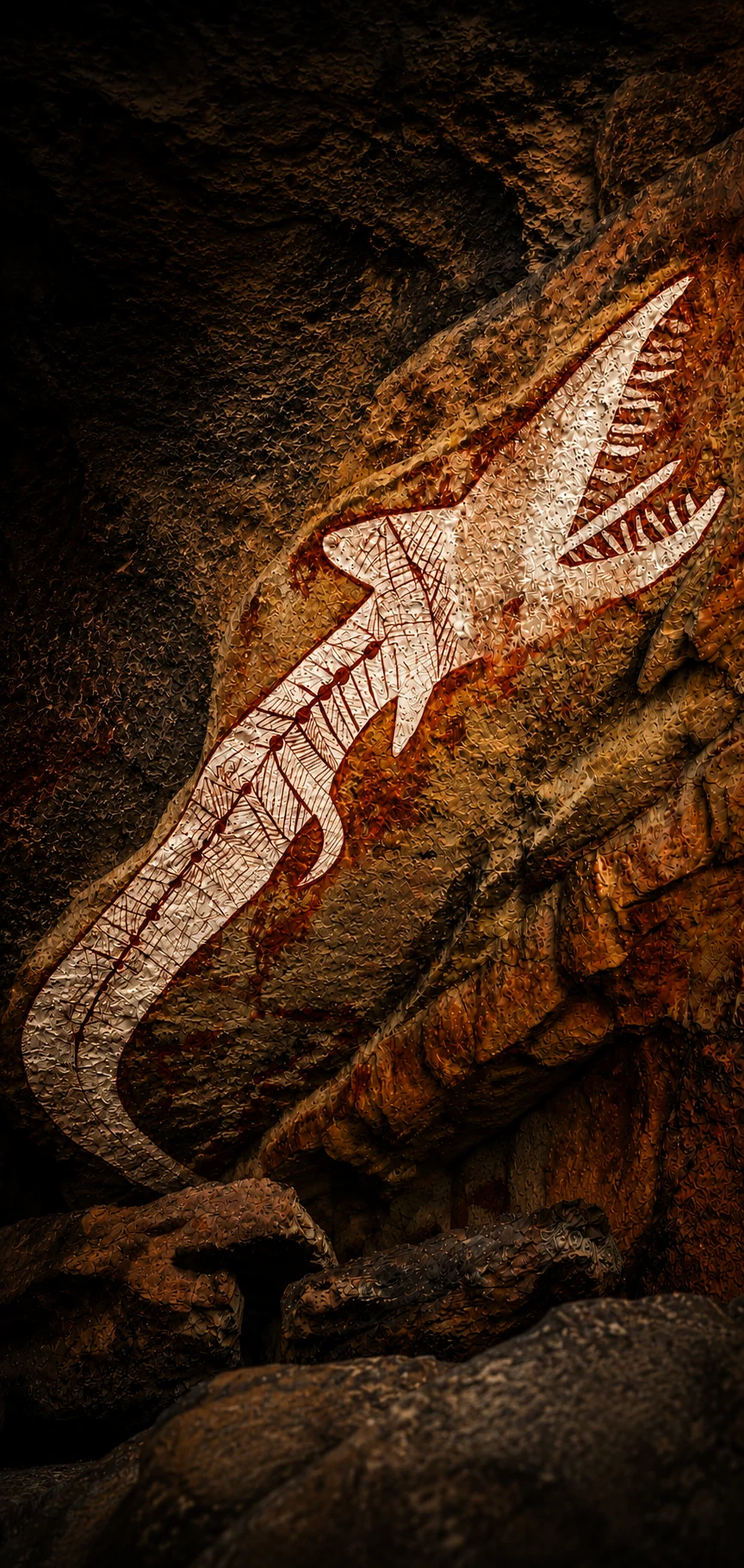
Arnhemland Rock Art
The belief in the Rainbow serpent has been around a very very long time and is represented in the rock Art of Arnhemland. These Rock art origins do not depict the rainbow serpent as a friendly diety but rather a diety that requires great respect
Frequently Asked Questions About the Rainbow Serpent
Why are Rainbow Serpent waterholes considered dangerous?
Across many Aboriginal traditions, waterholes associated with the Rainbow Serpent are regarded as spiritually powerful places requiring great respect. These sites are believed to contain ancestral presence and are often connected to ceremonial law, fertility, storms, and punishment for transgression. In Arnhem Land traditions, Ngalyod may punish those who break cultural restrictions near sacred waters.
Why are concentric circles linked to the Rainbow Serpent in Aboriginal art?
In many Western Desert and Port Keats paintings, concentric circles represent sacred waterholes created or inhabited by the Rainbow Serpent. These are not simply maps of water sources but symbolic depictions of ancestral power embedded within Country. The circles often indicate places connected to ceremony, rainmaking, and Dreaming narratives.
Is the Rainbow Serpent connected to rainmaking ceremonies?
Yes. The Rainbow Serpent is closely associated with rain, monsoonal renewal, underground water, and fertility. In some Aboriginal ceremonial traditions, sacred objects such as pearl shell were used in rituals intended to invoke rain and awaken the ancestral forces connected to water and seasonal regeneration.
What is the difference between Ngalyod, Wititj, Wanampi, and Ungud?
These are regional names and interpretations of the Rainbow Serpent found across Australia. Ngalyod belongs primarily to western Arnhem Land traditions, Wititj to Yolŋu culture in eastern Arnhem Land, Wanampi to the Western Desert, and Ungud or Wunggurr to the Kimberley. While all are linked to water and creation, each reflects distinct local cosmologies, ceremonies, and artistic traditions.
Why does the Rainbow Serpent appear differently in Arnhem Land and Western Desert art?
Arnhem Land artists often depict the Rainbow Serpent as a visible ancestral being filled with fine rarrk cross-hatching or x-ray detail. In Western Desert painting, the serpent is usually represented symbolically through concentric circles, connecting lines, and Water Dreaming compositions rather than as a literal creature.
Are Rainbow Serpent paintings sacred?
Some Rainbow Serpent paintings depict public stories suitable for wider audiences, while others may contain deeper ceremonial meanings connected to sacred sites, clan identity, or restricted knowledge. The level of cultural sensitivity varies depending on the region, artist, and subject matter.
Which Aboriginal artists are most associated with Rainbow Serpent paintings?
Important artists associated with Rainbow Serpent imagery include Yirawala, Lofty Bardayal Nadjamerrek, Peter Marralwanga, Dick Murrumurru, Mick Kubarkku, John Mawurndjul, and Johnny Warangkula Tjupurrula. Their works range from highly detailed bark paintings to abstract symbolic desert compositions.
Why is the Rainbow Serpent important to understanding Aboriginal art?
The Rainbow Serpent helps explain many recurring themes in Aboriginal art, including sacred waterholes, ancestral tracks, rainmaking, fertility, and ceremonial law. Understanding these associations allows viewers and collectors to better interpret symbolism, regional styles, and the deeper cultural meaning embedded within Aboriginal paintings.