Helicopter Tjungurrayi
c. 1947–
Kukatja
Nynmi / Pippar, Great Sandy Desert Country
Balgo, Western Australia
Balgo Art / Western Desert Art
Warlayirti Artists
Painting on canvas and printmaking
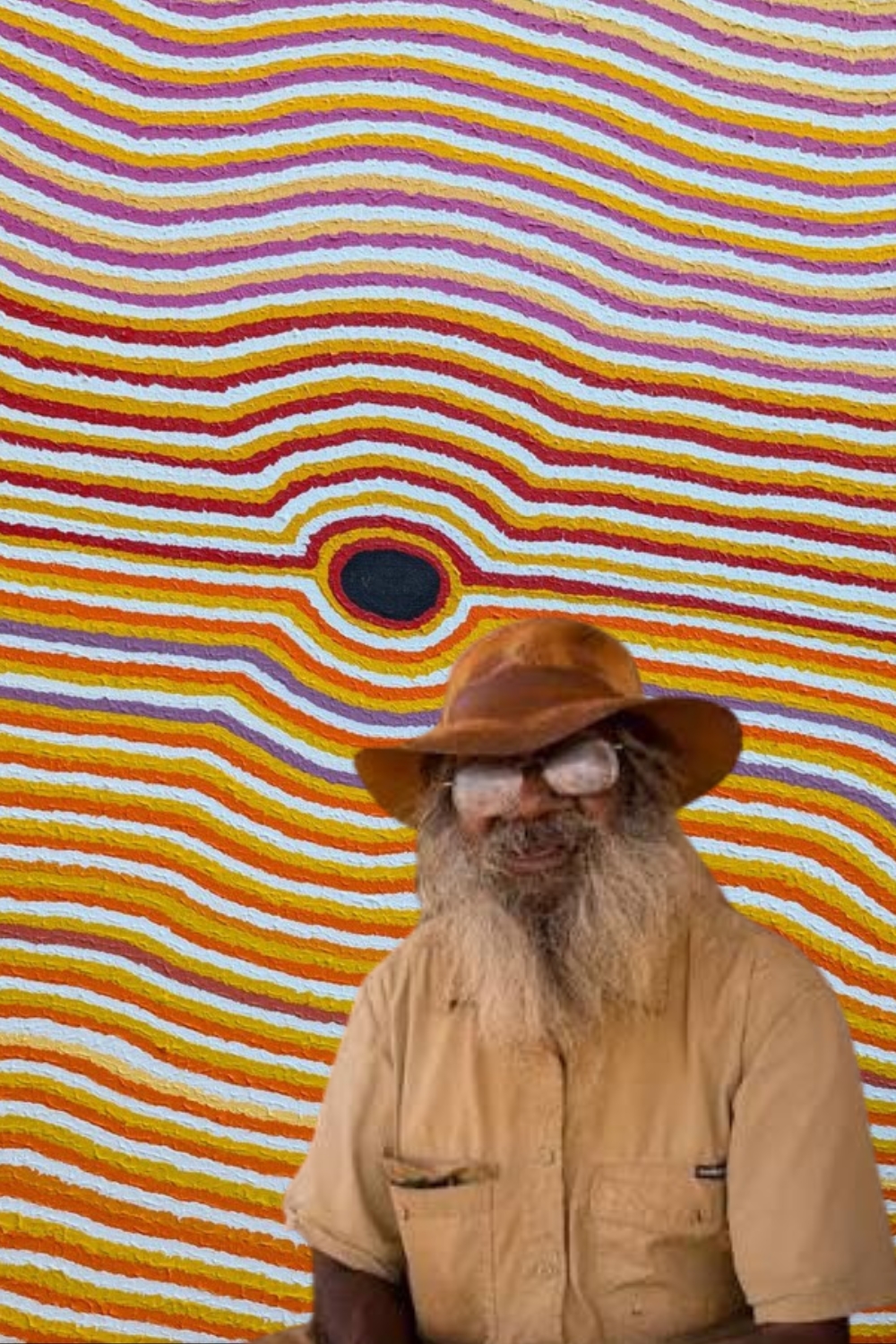
Helicopter Tjungurrayi (c.1947– ) is a senior Kukatja artist, Lawman, ceremonial singer and maparn (traditional healer), and one of the most distinctive painters associated with Balgo Art and Warlayirti Artists. His paintings are immediately recognisable for their shimmering fields of parallel dotted lines, evoking the long sandhills and important water sources of his desert Country.
Born in the Great Sandy Desert, Helicopter spent his childhood travelling with his family through Country around Nynmi and Pippar. His unusual European name dates from 1957, when, seriously ill near Natawalu (Well 40) on the Canning Stock Route, he was flown by helicopter to Balgo for medical treatment.
After settling at Balgo, he later painted alongside his wife, the important artist Lucy Napanangka Yukenbarri, before establishing his own painting career during the 1990s. His mature works combine detailed knowledge of Country with an exceptionally individual visual language built from rhythmic lines, elongated dots and textured fields of paint.
This page explores Helicopter Tjungurrayi’s life, paintings, artistic style, Country and importance within contemporary Aboriginal and Balgo art.
Helicopter Tjungurrayi Biography
Helicopter Tjungurrayi was born around 1947 in the desert country south of Balgo in Western Australia. He spent his childhood travelling with his family through the Great Sandy Desert, particularly Country associated with Nynmi and Pippar, learning the locations of soakwaters, hunting grounds and other places essential to desert life.
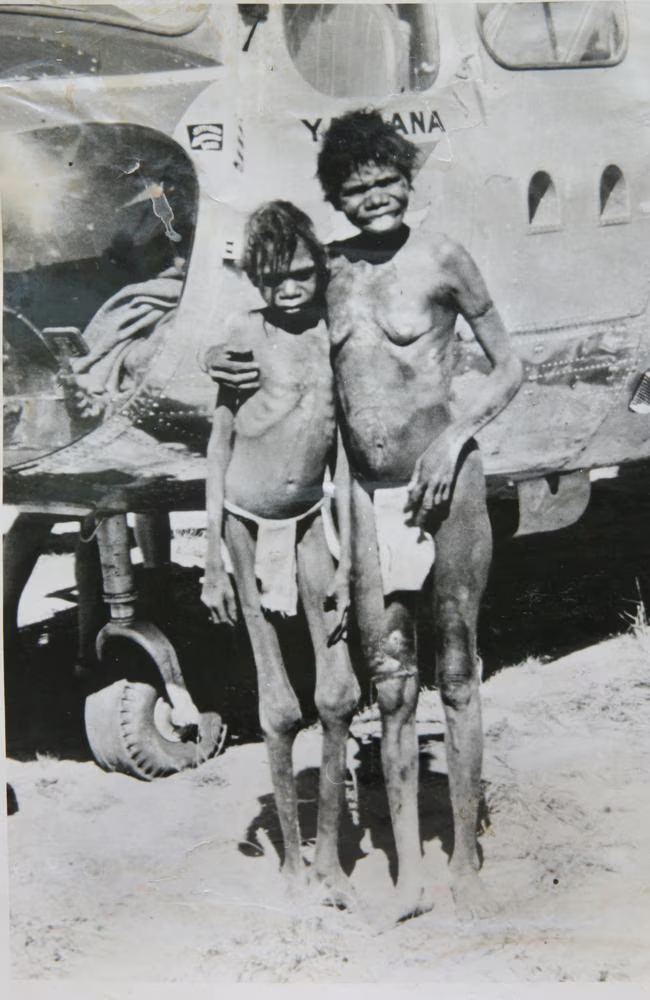
His unusual European name originates from a dramatic event in 1957. When Helicopter was about ten years old, a mineral exploration party encountered his family near Natawalu (Well 40) on the Canning Stock Route. Seriously ill, he was flown by helicopter to the Old Balgo Mission for medical treatment. Neither he nor his family had previously seen such an aircraft, and the event became the source of the name by which he has subsequently been known.
After recovering, Helicopter remained at Balgo while members of his family travelled north looking for him. His experience formed part of a wider period when Aboriginal families living independently in the surrounding desert increasingly encountered missions, exploration parties and permanent settlements.
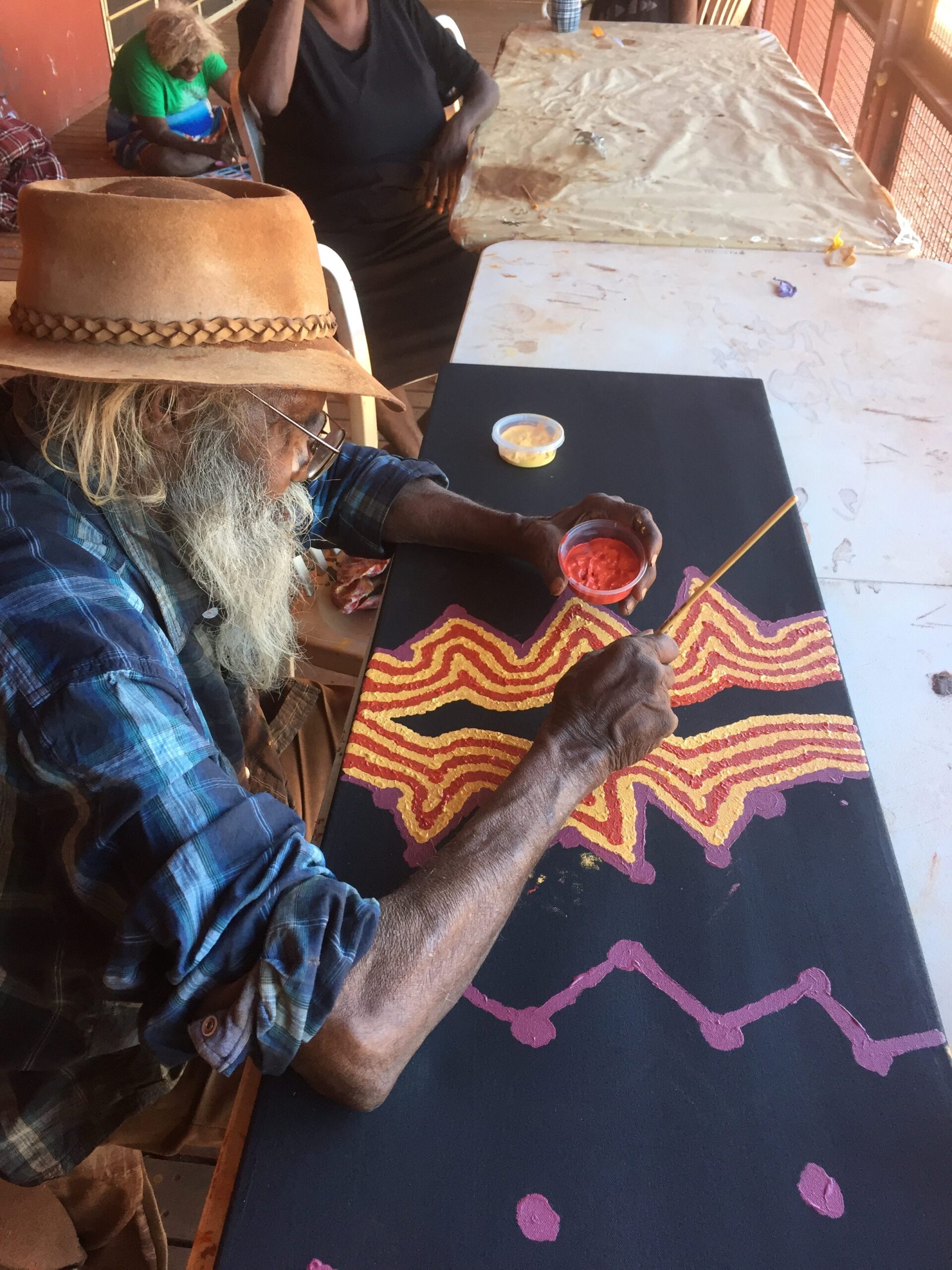
As a young man Helicopter worked for the Balgo mission, drilling for water, cutting timber, repairing windmills and travelling for supplies. He maintained his cultural responsibilities and became a senior Lawman, ceremonial singer and maparn, or traditional healer.
Helicopter married Lucy Napanangka Yukenbarri, who became one of the leading painters associated with Warlayirti Artists. During the early 1990s he worked closely with Lucy and contributed to paintings with her before establishing an independent career. By about 1994 he was producing works under his own name and developing his distinctive painting style.
His work gained wider recognition from the late 1990s. He held his first solo exhibition in 1999, returned to his desert Country in 2000 and was selected as a finalist in major national art awards, including the National Aboriginal and Torres Strait Islander Art Award. His paintings subsequently entered important Australian and international collections.
In 2022, the Western Australian Government recognised Helicopter Tjungurrayi as a State Cultural Treasure, acknowledging both his achievement as an artist and his broader importance as a senior cultural figure.
What Did Helicopter Tjungurrayi Paint?
Helicopter Tjungurrayi painted the desert Country south of Balgo that he had known since childhood, particularly places associated with Nynmi and Pippar. Recurring subjects include tali (sandhills), tjurnu (soakwaters), travelling routes and culturally important sites.
Water is especially significant within these works. In the Great Sandy Desert, knowledge of soakwaters and other reliable water sources was essential for travelling, hunting and survival. Such places could also carry ancestral and ceremonial significance.
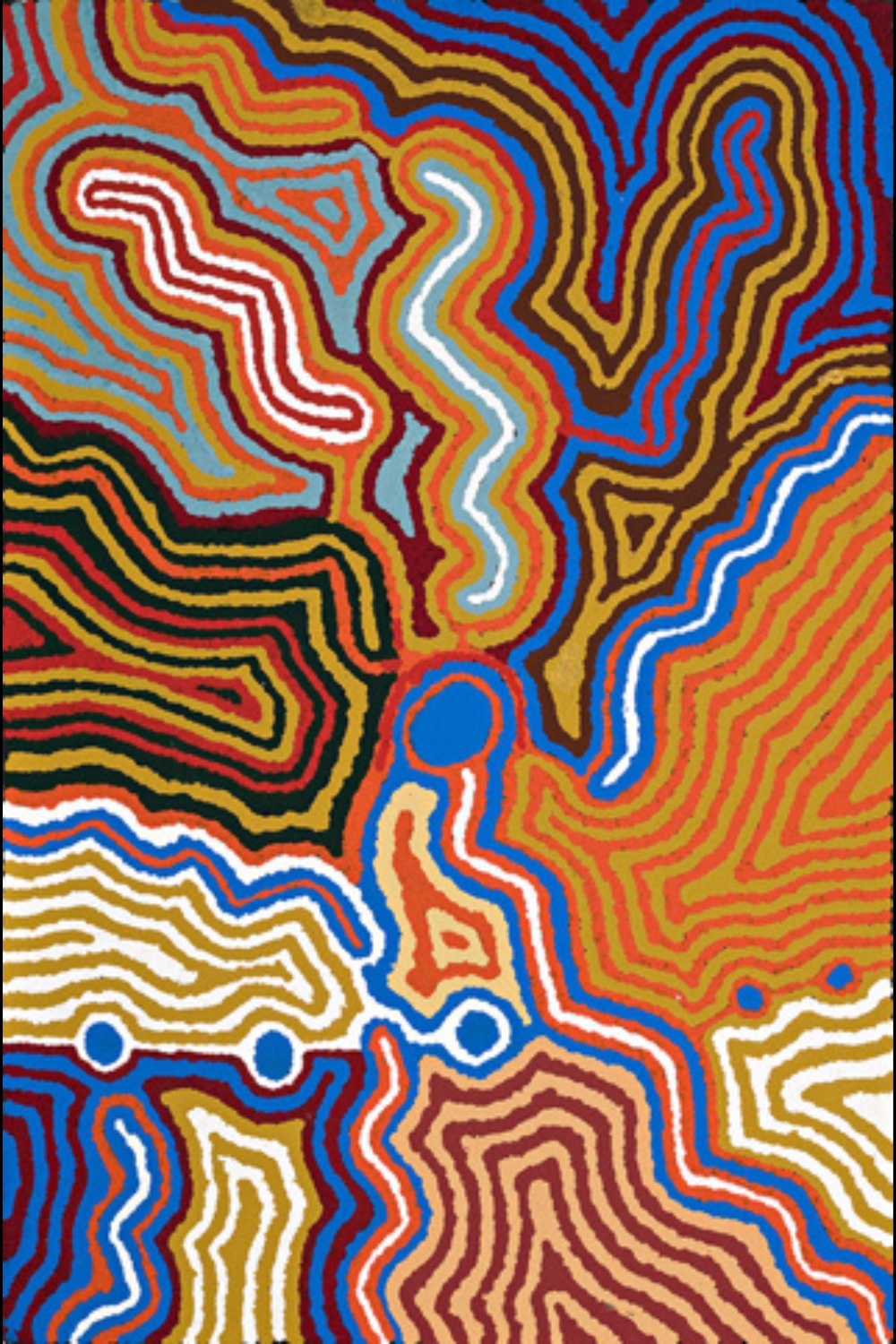
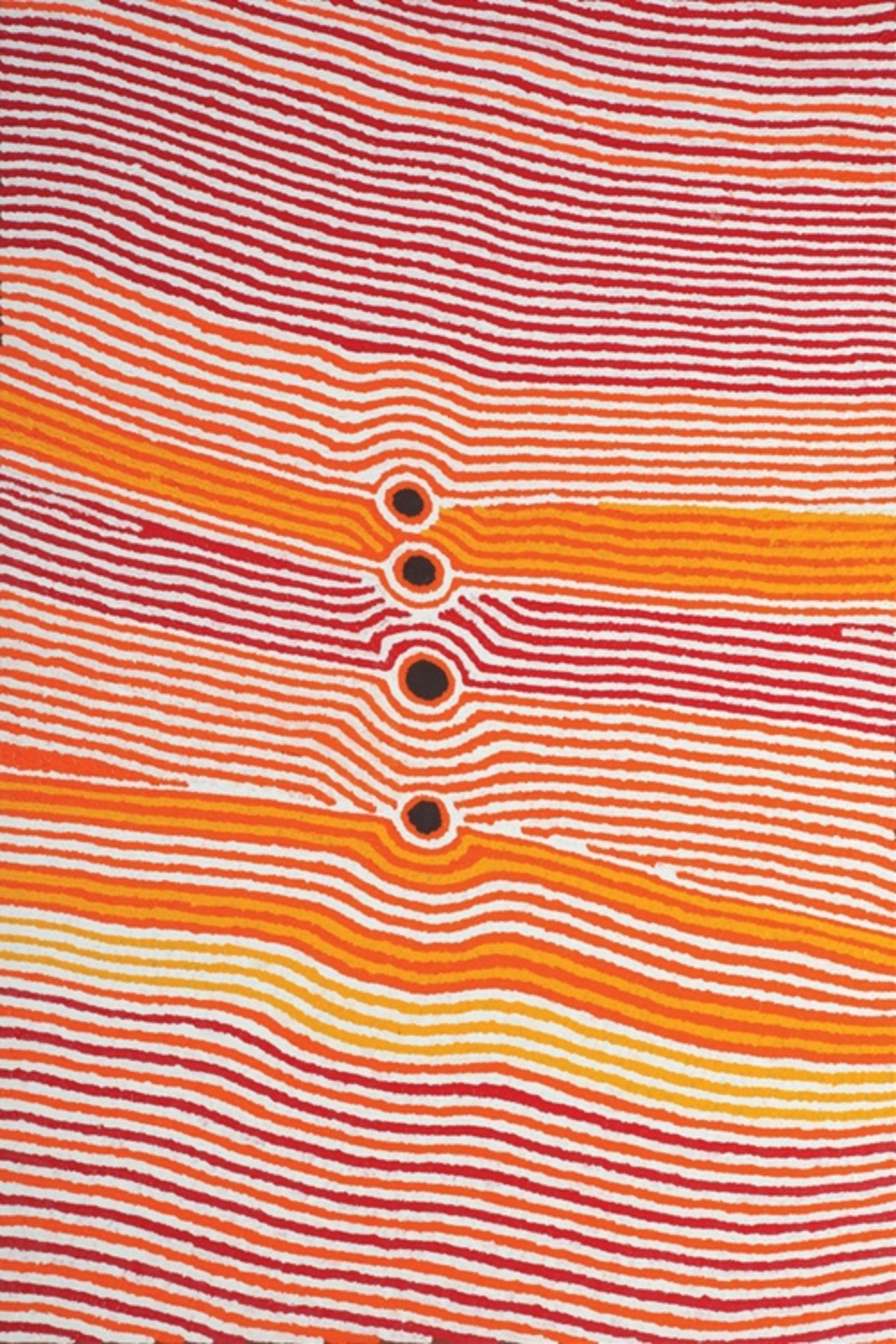
Rather than depicting the desert as it might appear in a conventional landscape painting, Helicopter represented Country conceptually. Water sources may appear as circular or enclosed forms, while surrounding bands can indicate sandhill country and the routes connecting important places.
His paintings can therefore be understood partly as visual maps of remembered Country, bringing together physical landscape, personal experience and inherited cultural knowledge.
Helicopter Tjungurrayi’s Painting Style
Helicopter Tjungurrayi developed one of the most recognisable painting styles associated with Balgo Art. His mature works are characterised by dense fields of parallel lines and elongated dots that sweep, curve and radiate across the canvas.
Instead of treating dots simply as separate marks, Helicopter often placed them so closely together that they form continuous ridges and striated bands. Thick applications of paint give the surface a pronounced physical texture, while the repeated lines create a strong sense of rhythm and movement.
These linear structures are particularly suited to his imagery of tali, the long parallel sand ridges characteristic of his Country. Circular or irregular openings within the compositions can mark tjurnu and other important places, with the surrounding lines flowing around or radiating from them.
Viewed from a distance, many of the paintings appear almost abstract, their repeated bands creating a shimmering or vibrating optical effect. At close range, individual dots, ridges and variations in the application of paint become much more apparent.
This combination of rhythmic abstraction, textured paint and knowledge of specific Country distinguishes Helicopter’s work from that of many other Balgo painters. His style is highly individual, but its forms remain grounded in the geography and cultural knowledge of the Great Sandy Desert.
Helicopter Tjungurrayi Value
Works Offered at Auction: 89
Sale Rate: 65%
Highest Sale: $10,500 AUD
Median Sale Price: $3,200 AUD
Helicopter Tjungurrayi in Public Collections
Helicopter Tjungurrayi’s work is represented in significant Australian and international collections.
Public and institutional collections holding his work include:
Further Reading
For further information on Helicopter Tjungurrayi, his Country, painting career and the circumstances that brought him to Balgo, the following sources are particularly useful.
National Museum of Australia, Yiwarra Kuju: The Canning Stock Route, 2010.
An important source for Helicopter’s early life and the 1957 encounter at Natawalu (Well 40). The Canning Stock Route project combines paintings, historical research and oral histories from artists and communities connected with the route and places Helicopter’s story within the wider history of Aboriginal people in the region.
An important companion publication to the Canning Stock Route project, bringing together Aboriginal histories, Country, family relationships and artists from communities including Balgo.
Wangkartu Dreaming: Helicopter Tjungurrayi & Lucy Yukenbarri, Whitford Fine Art, London, 2009.
An exhibition catalogue devoted to Helicopter and his wife Lucy Yukenbarri. It is particularly relevant for understanding their artistic relationship and Helicopter’s mature treatment of Wangkartu Country.
All images featured in this article are presented strictly for educational and informational purposes.
This website may include copyrighted material for which specific authorization has not been obtained from the copyright owner.
All such images are presumed to be the intellectual property of the respective artist or their estate, and are used in accordance with principles of fair dealing or fair use under applicable copyright law.