Nyapanyapa Yunupingu – The Meaning of Meaningless Paintings
c. 1945–2021
Gumatj (Yolŋu)
Yirrkala, north-east Arnhem Land, Northern Territory
Yirrkala / Buku-Larrŋgay Mulka Centre
Arnhem Land Art / Contemporary Aboriginal Art
Natural ochre bark painting / Larrakitj hollow logs / Printmaking / Digital art
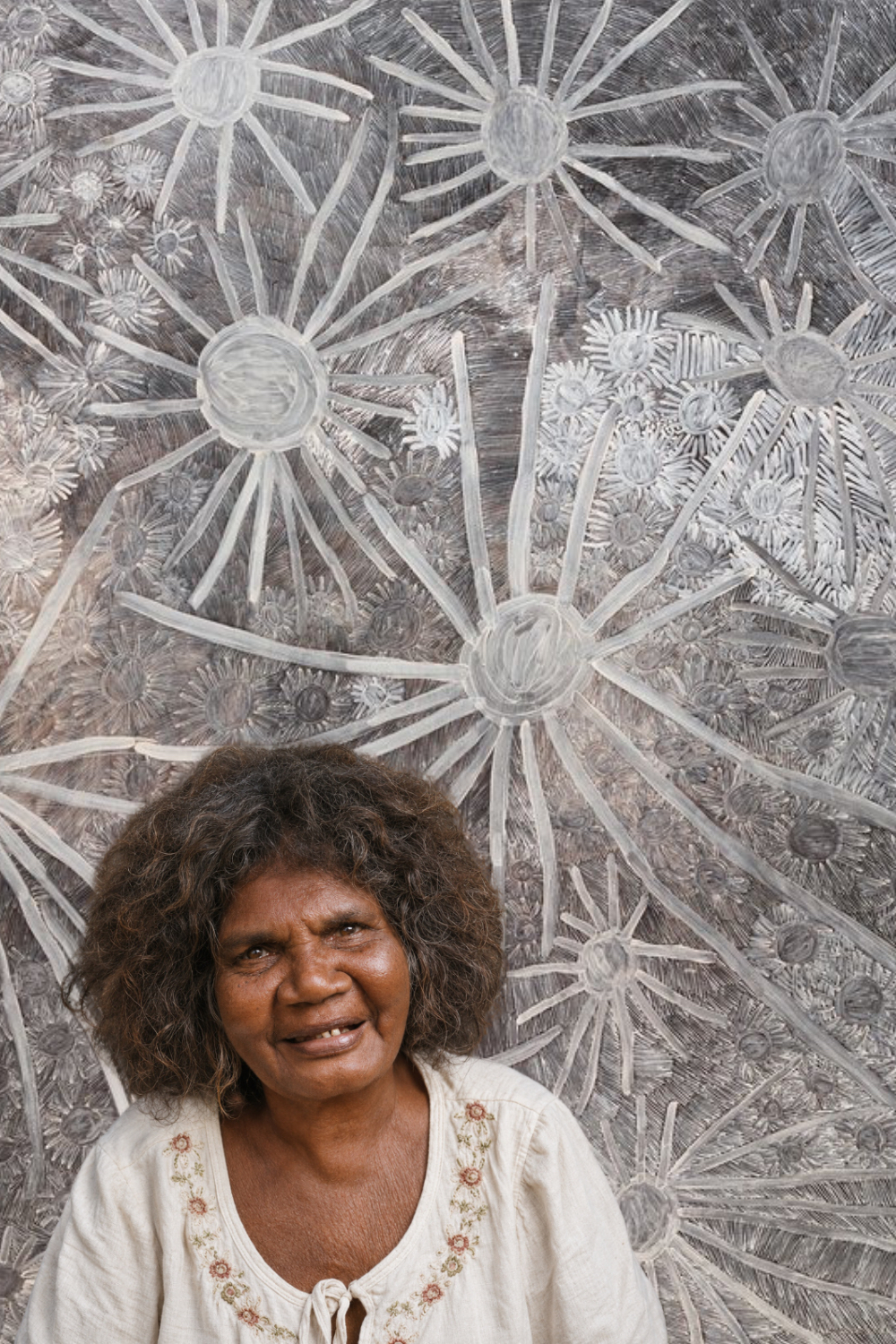
Nyapanyapa Yunupingu (c. 1945–2021) was a Gumatj Yolŋu artist from Yirrkala in north-east Arnhem Land who developed one of the most original styles in contemporary Aboriginal bark painting.
The daughter of renowned bark painter and ceremonial leader Muŋgurrawuy Yunupingu, she began painting on bark in 2007, when she was already in her sixties. Her early works depicted personal experiences, including a terrifying encounter with a water buffalo, before she developed extraordinary abstract compositions of white lines, circles and rhythmic crosshatching.
Her paintings became known as mayilimiriw (meaningless) because they did not reproduce the prescribed ancestral stories and sacred clan designs traditionally associated with Yirrkala bark painting.
Nyapanyapa challenged conventional expectations of Aboriginal art, developing an intensely personal artistic language that brought her international recognition. In 2021, she won the prestigious Wynne Prize for Garak – Night Sky, depicting the ancestral Seven Sisters.
Nyapanyapa Yunupingu Biography
Nyapanyapa Yunupingu was born around 1945 at Yirrkala in north-east Arnhem Land. Her father, Muŋgurrawuy Yunupingu, was an important ceremonial leader, bark painter and advocate for Aboriginal land rights. Her mother, Buṉay Wanambi, belonged to the Marrakulu clan.
She grew up in a remarkable artistic family. Her sisters included Gulumbu Yunupingu, celebrated for her paintings of stars, and Barrupu Yunupingu, known for depictions of ancestral fire. Her brothers included land rights leader Galarrwuy Yunupingu and musician Mandawuy Yunupingu.
During her childhood, Nyapanyapa helped herd dairy cattle and goats at the Yirrkala mission. She also watched her father painting the intricate sacred designs associated with Gumatj Country.
Although Muŋgurrawuy did not formally teach her these designs, he encouraged her artistic ambitions. Nyapanyapa later recalled:
“My father didn’t teach me. I learnt it myself. He painted as I watched his hands.”
She married Djiriny Munuŋgurr, a Djapu clan leader who died in 1977.
In 1975, Nyapanyapa was seriously injured when a water buffalo attacked her at Mutpi, near Garrthalala. She was evacuated to Darwin for medical treatment. The experience later became the subject of one of her most significant early paintings.
Nyapanyapa began printmaking at the Yirrkala Print Space in 1996, before developing her practice at the Buku-Larrŋgay Mulka Centre.
She frequently worked in the art centre’s outdoor courtyard alongside other prominent women artists, including her sisters Gulumbu and Barrupu, Nongirrna Marawili, Mulkun Wirrpanda and Dhuwarrwarr Marika.
In 2007, art centre coordinator Will Stubbs encouraged her to begin painting on bark. Her first works depicted everyday activities, personal memories and places she had visited.
Sydney gallerist Roslyn Oxley encountered Nyapanyapa painting during a visit to Yirrkala and subsequently began exhibiting her work. Her first major Sydney solo exhibition, Once Upon a Time, opened at Roslyn Oxley9 Gallery in 2008.
Around 2009, Nyapanyapa moved towards increasingly abstract compositions, establishing the distinctive visual language that would define her later career.
She continued experimenting with different materials and techniques, exhibiting nationally and internationally until shortly before her death at Yirrkala on 20 October 2021.
Nyapanyapa Yunupingu Painting Style
Traditional Yolŋu bark paintings frequently incorporate inherited miny’tji (clan designs), associated with particular ancestral beings, places and ceremonial responsibilities.
These designs often employ carefully organised rarrk (crosshatching), whose patterns and ownership carry cultural significance.
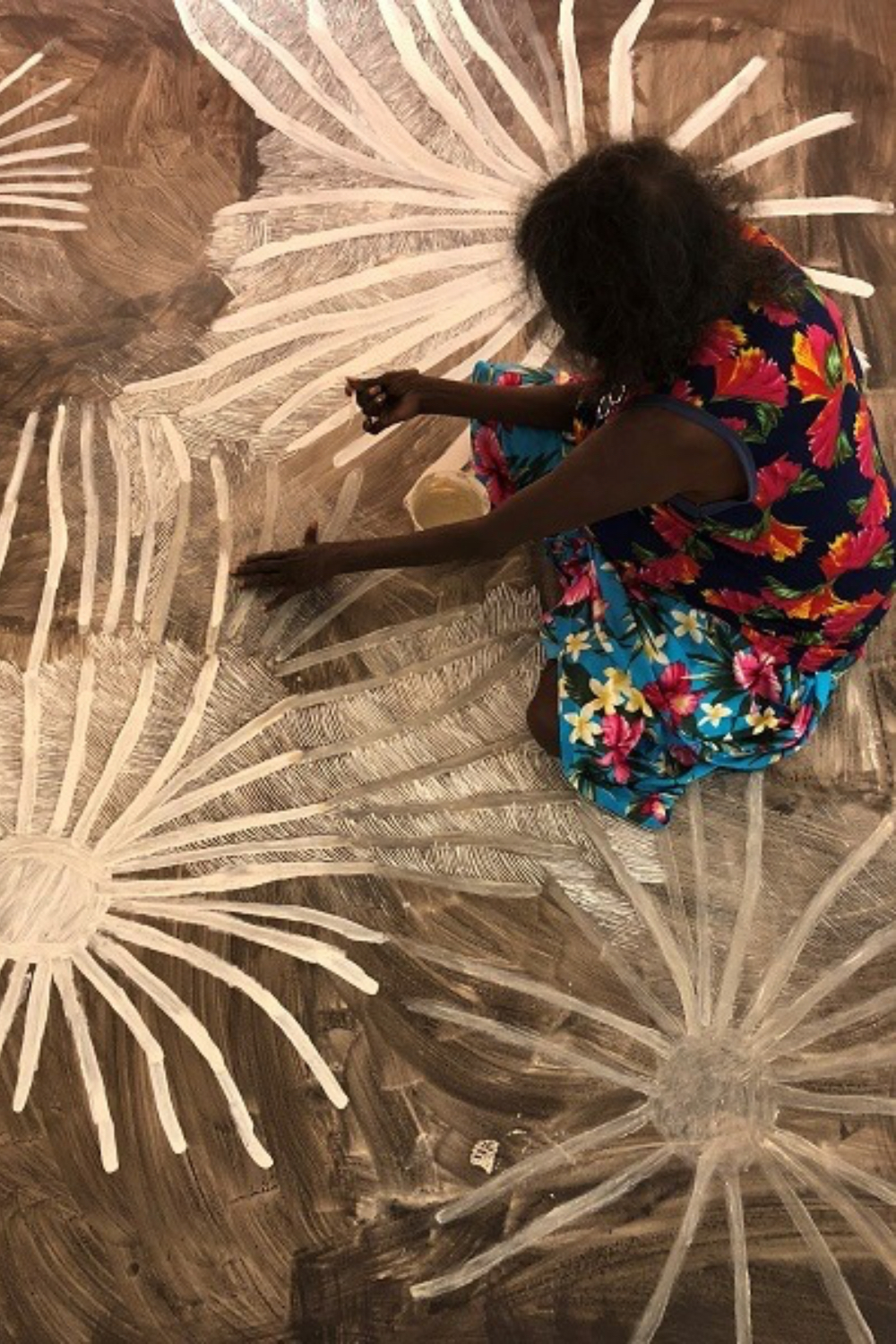
Nyapanyapa adopted the materials and technical knowledge of this tradition but developed compositions that did not depend upon predetermined ceremonial designs.
Her approach was intuitive, irregular and increasingly abstract.
Mayilimiriw – What Do Her Paintings Mean?
Beginning around 2009, Nyapanyapa developed paintings known as mayilimiriw, a Yolŋu expression generally translated as meaningless.
Other Yolŋu sometimes used the term jokingly because her compositions did not reproduce recognised sacred designs or illustrate prescribed ancestral stories.
Instead, Nyapanyapa concentrated upon the act of painting itself.
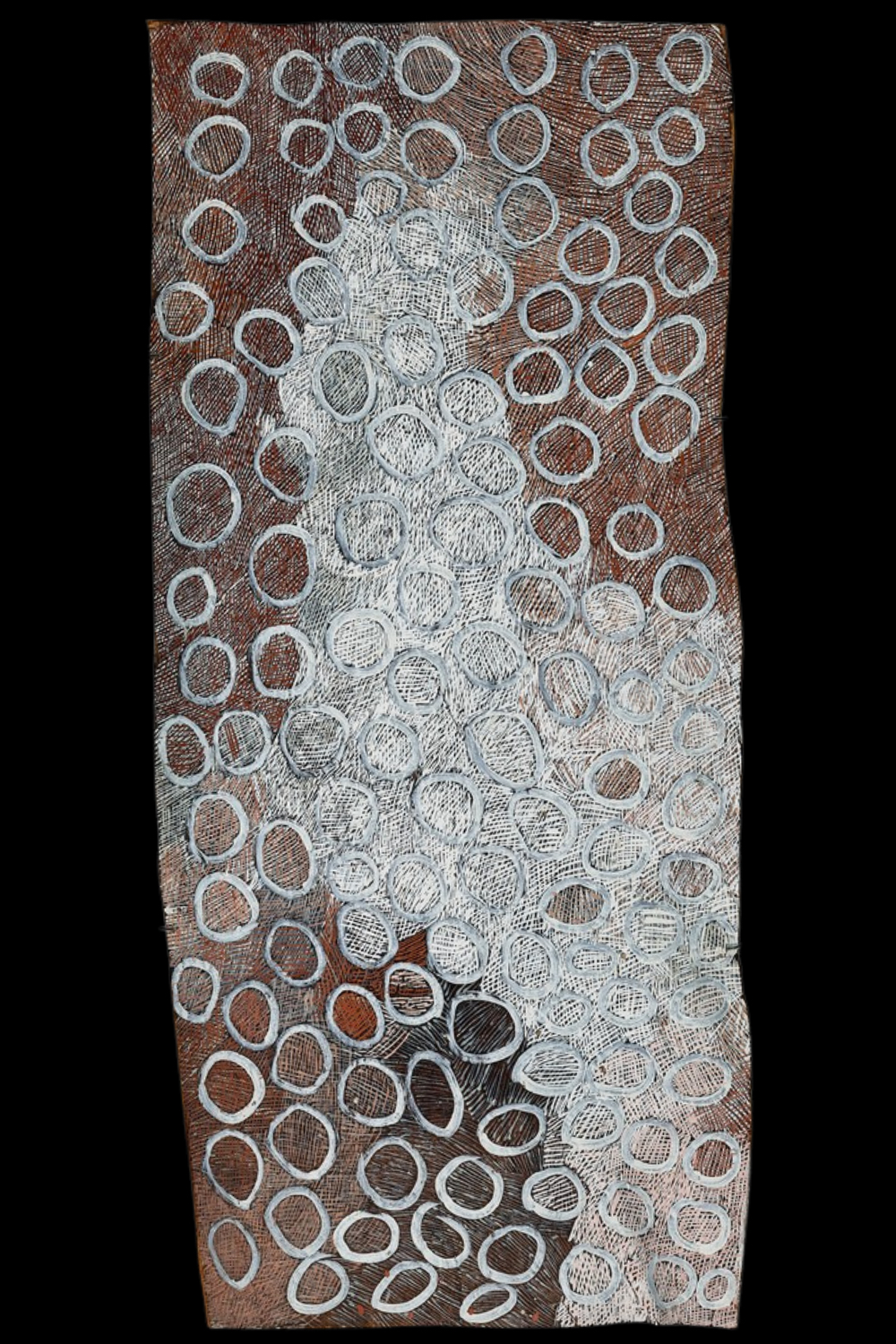
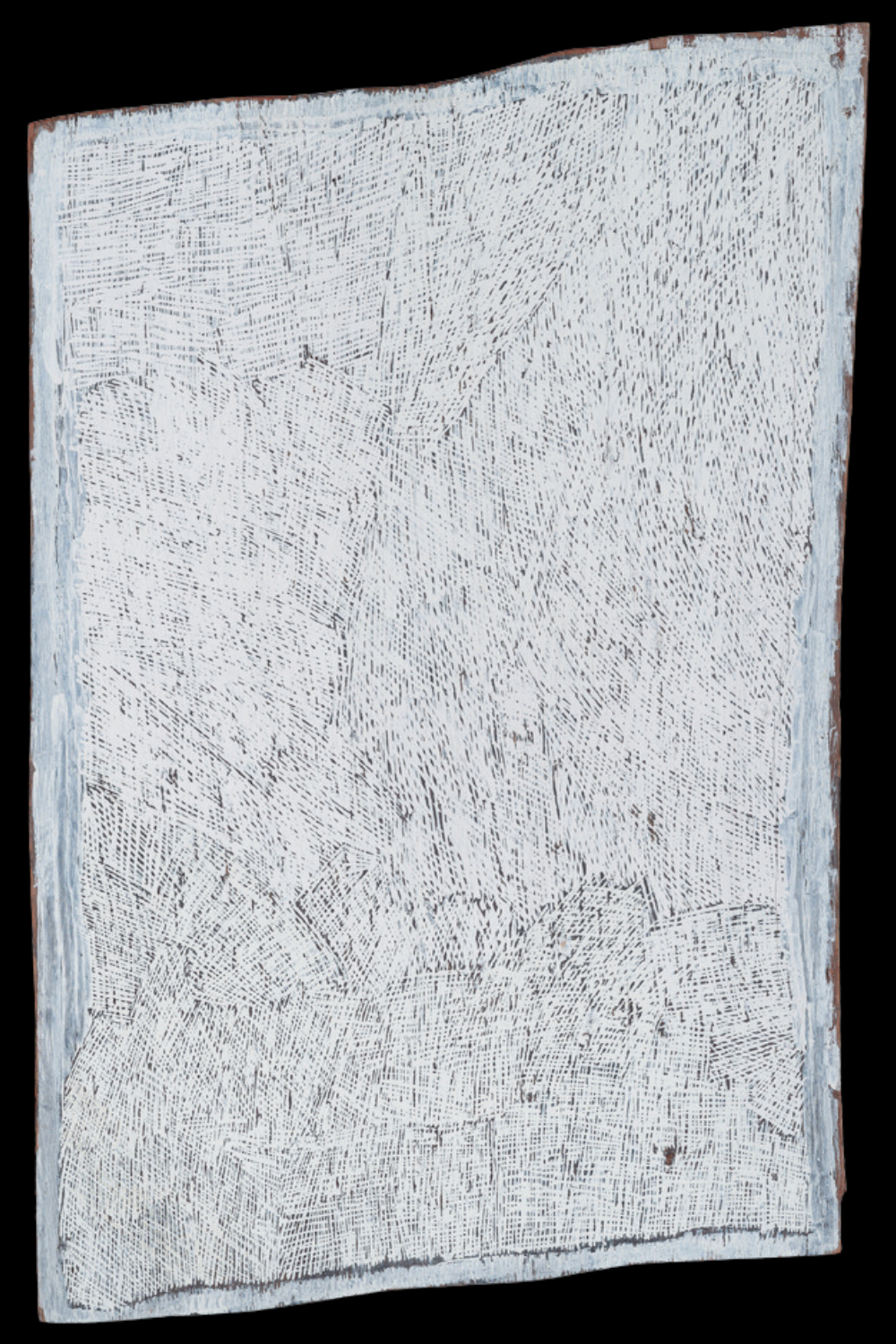
Lines cross, overlap and change direction. Circles emerge within intricate networks of hatching, while some compositions become almost entirely white.
Yet meaningless did not mean that her paintings lacked artistic or cultural significance. They remained grounded in Yolŋu materials, her family relationships and her lifelong experiences at Yirrkala.
Nyapanyapa rejected the suggestion that her markings were careless or confused:
“My lines aren’t tangled and messy, not at all.”
Her apparent spontaneity reflected artistic confidence and a highly individual understanding of composition.
Ochre, Crosshatching and White Paintings
Nyapanyapa worked primarily with natural earth pigments, including white, black, red, brown and yellow ochres.
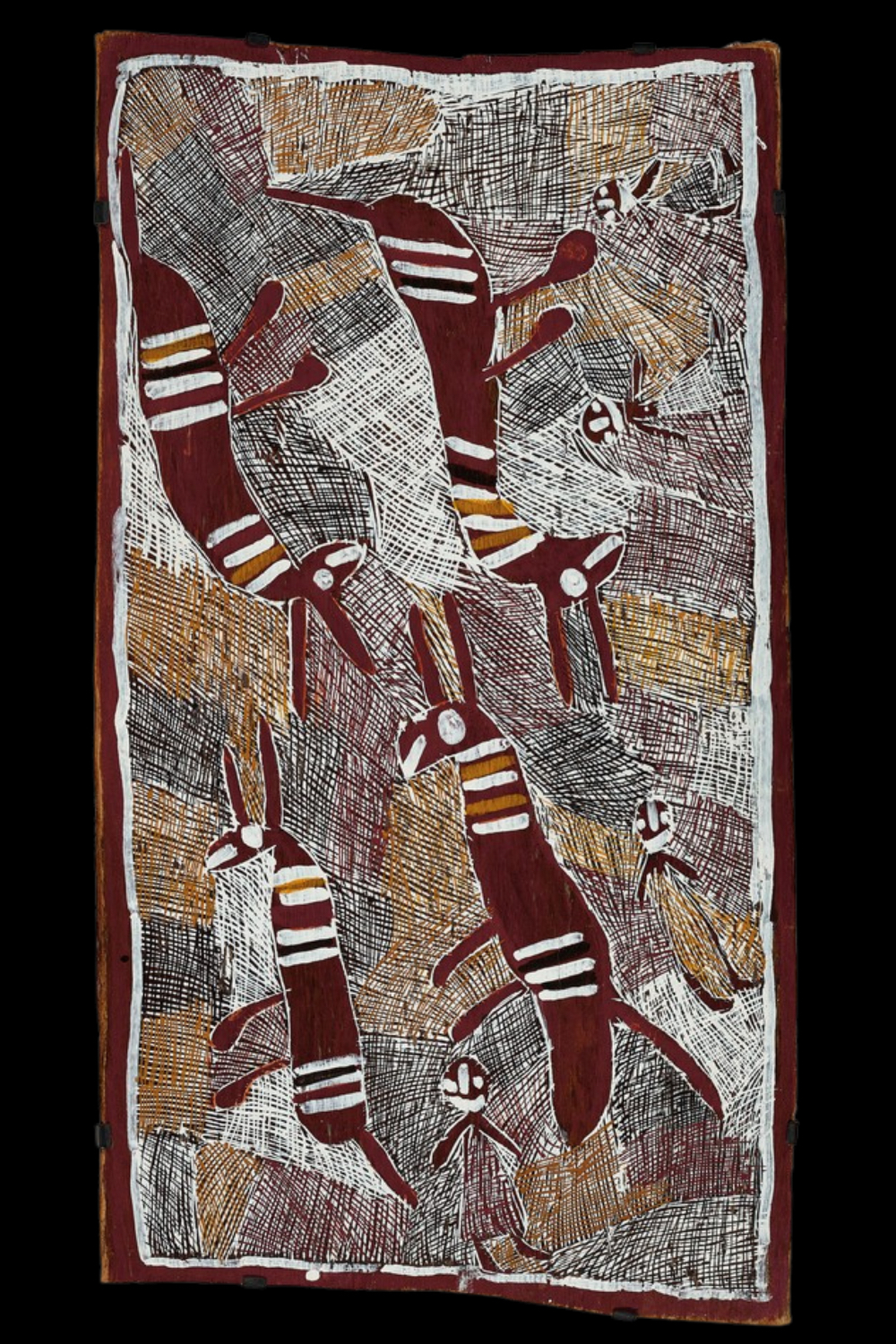
Her early figurative paintings often began with a black or red ground, upon which recognisable subjects were outlined in white. The surrounding areas were filled with carefully applied crosshatching.
Over time, these patterned backgrounds became the principal focus of her paintings.
Thousands of short strokes created richly textured surfaces, with overlapping lines producing subtle variations in colour and tone.
Her celebrated white paintings reduced the composition almost entirely to rhythmic markings. Their surfaces suggest movement, shimmering light or the changing textures of the natural world, although they do not necessarily represent these things.
Will Stubbs compared her intuitive brushwork to spontaneous Zen, recognising her ability to paint without following a predetermined composition.
Experimenting with Materials
Nyapanyapa’s creativity extended beyond traditional bark painting.
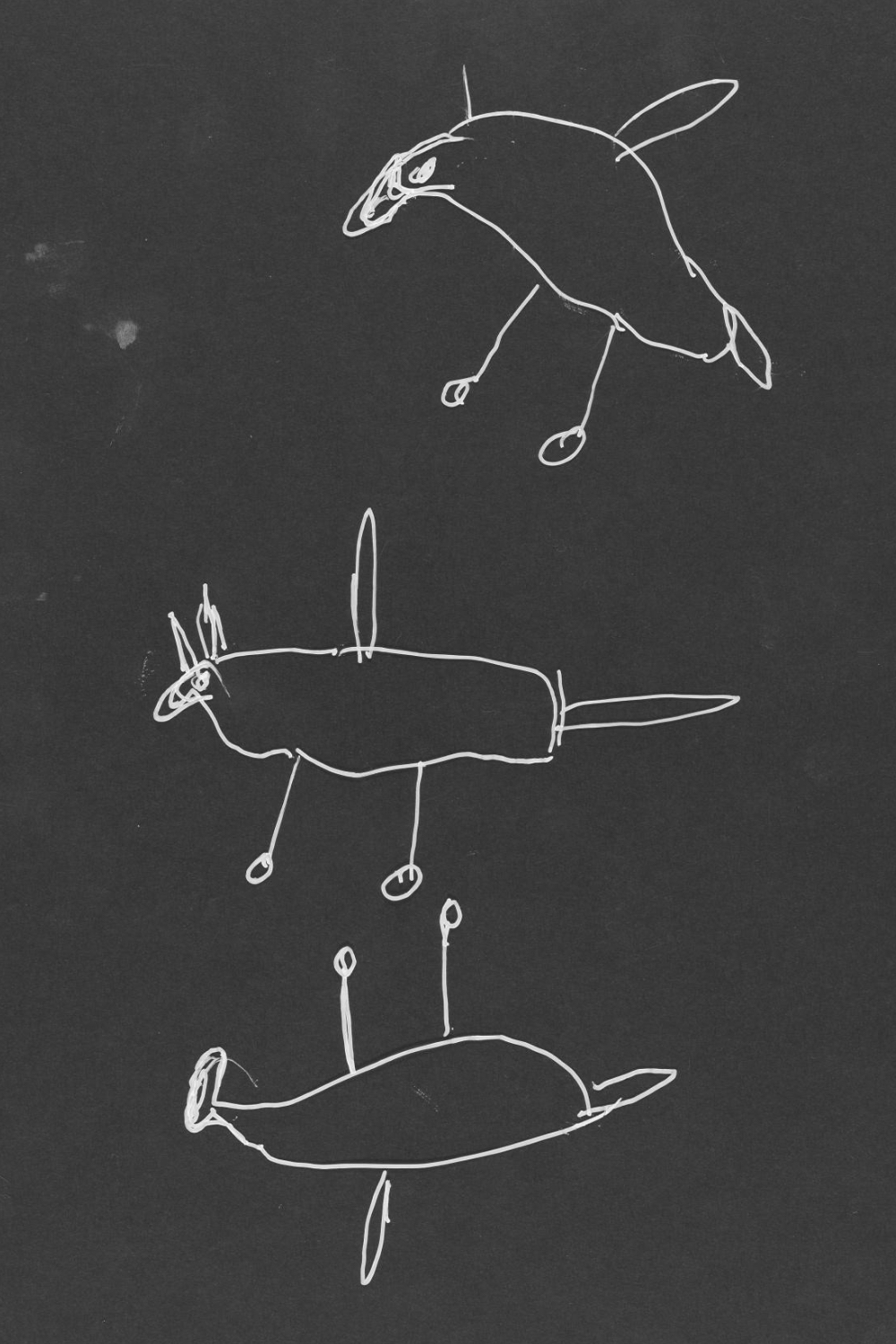
When prepared stringybark was unavailable, she experimented with discarded print proofs, paper and transparent acetate.
For the 2012 Biennale of Sydney, she produced approximately 110 drawings in white paint pen on clear acetate.
These became Light Painting, a digital artwork developed with the Mulka Project. Computer-generated sequences continually rearranged her drawings into changing projected compositions.
This experiment demonstrated her willingness to extend Yolŋu painting techniques into contemporary digital media.
Nyapanyapa Yunupingu Painting Subjects
Although best known for abstraction, Nyapanyapa’s work encompassed personal memories, everyday activities, contemporary landscapes and, eventually, ancestral subjects.
Incident at Mutpi – The Water Buffalo
Incident at Mutpi (1975) (2008) remains one of Nyapanyapa’s most historically significant artworks.
The painting depicts the water buffalo attack that nearly killed her in 1975. Accompanied by a film produced through the Mulka Project, it records a deeply personal experience rather than an inherited ancestral narrative.
The combined work received the Wandjuk Marika Memorial Three-Dimensional Award at the 2008 National Aboriginal and Torres Strait Islander Art Awards.
Around 2009, Nyapanyapa reportedly experienced a nightmare about the buffalo. Curator Luke Scholes suggested that this may have contributed to her subsequent abandonment of figurative imagery, although the connection remains an interpretation rather than an established explanation.
Her experience also inspired Nyapanyapa, a dance production choreographed by Stephen Page for Bangarra Dance Theatre in 2016.
Everyday Life and Sydney
Nyapanyapa’s earliest bark paintings depicted the world immediately around her.
Works such as Collecting Wild Apples and Hunting Stingray at Birany Birany represented food gathering and everyday activities in Arnhem Land.
Other compositions included aircraft, bulldozers, hospital visits and events around Yirrkala.
Following a visit to Sydney in 2008, she painted the Harbour Bridge, city traffic, hotel rooms and multilane highways.
These paintings reveal an artist who considered almost anything suitable for depiction, from an apple tree in Arnhem Land to the unfamiliar urban landscape of Sydney.
Gäna (Self) – Bark Paintings and Hollow Logs
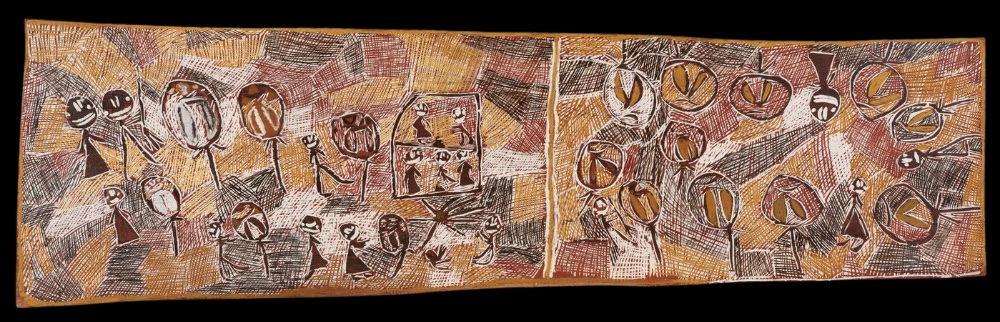
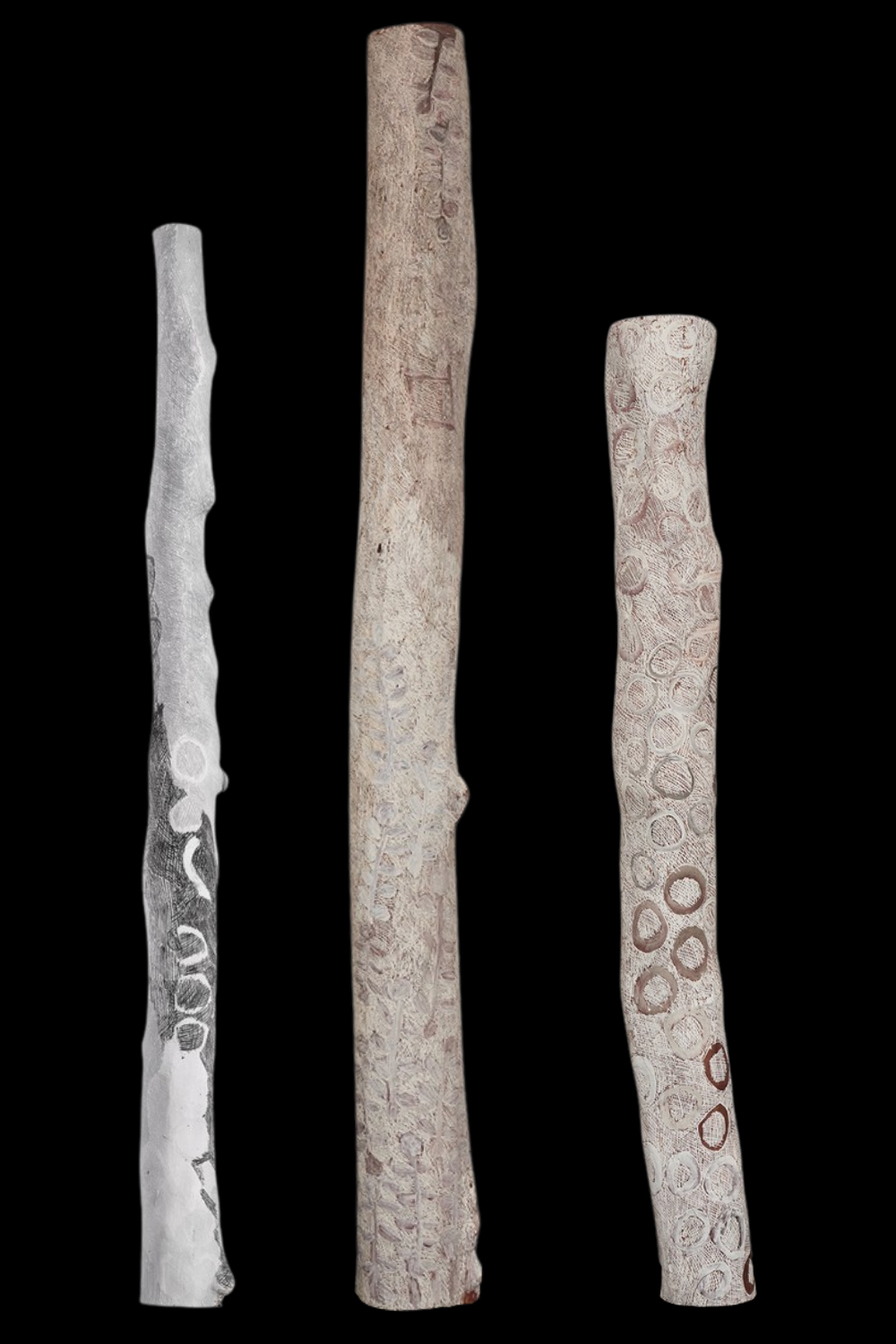
One of Nyapanyapa’s most ambitious achievements is Gäna (Self) (2009–2018), an installation held by the National Gallery of Victoria.
The work consists of sixteen irregularly shaped bark paintings and nine slender, twisting larrakitj (hollow-log mortuary sculptures).
Traditionally associated with Yolŋu mortuary ceremonies, larrakitj were decorated with inherited clan designs and used in ceremonies involving the remains of deceased relatives.
Nyapanyapa transformed these forms through her individual approach to mark-making.
Their surfaces contain white lines, circles, stippled hatching and contrasting fields of ochre. Some sections are densely patterned, while others remain comparatively open, allowing the natural irregularities of the bark and hollow logs to become part of the composition.
The installation also retains imagery associated with the place where Nyapanyapa encountered the water buffalo.
Judith Ryan of the National Gallery of Victoria interprets Gäna (Self) as a remarkable expression of the artist’s personal visual language.
Ganyu, Garak and the Seven Sisters
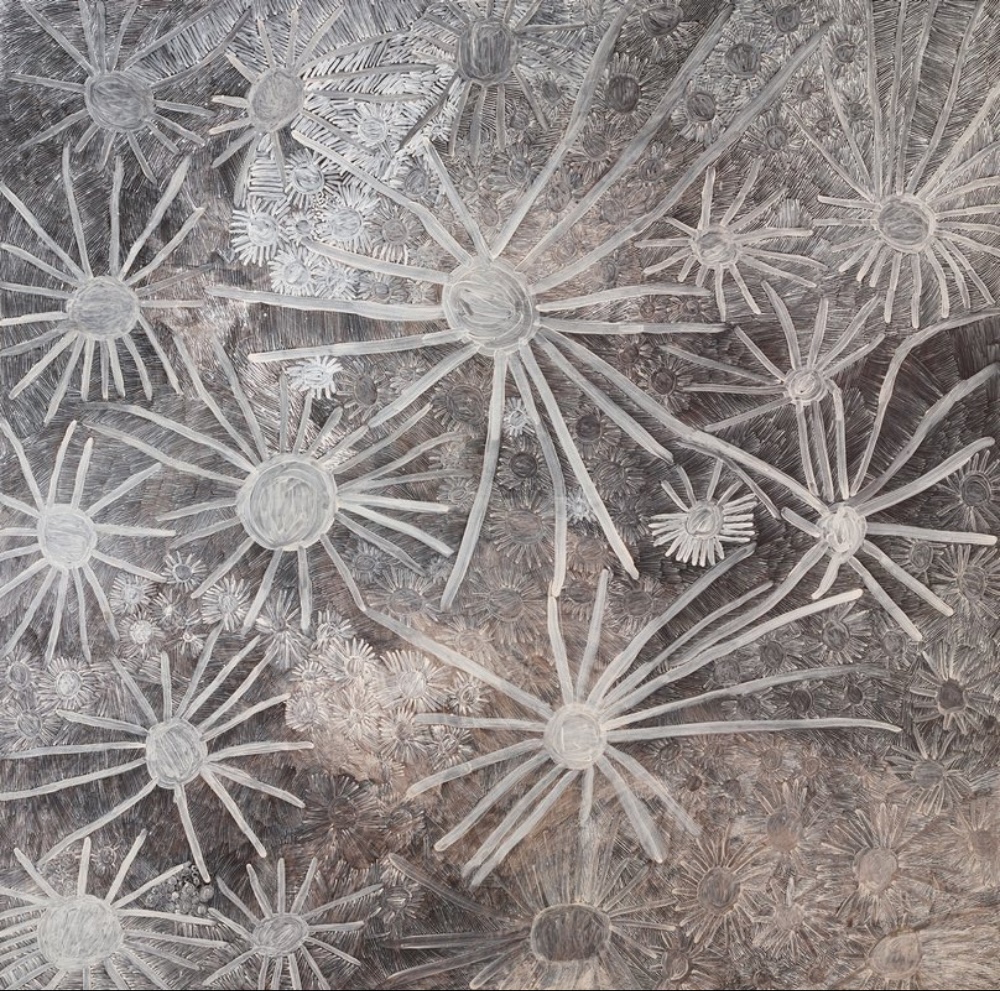
During the later years of her career, Nyapanyapa increasingly incorporated celestial imagery into her paintings.
Stars had particular significance within her artistic family. Her father Muŋgurrawuy and sister Gulumbu had both painted celestial subjects associated with Gumatj ancestral knowledge.
Following Gulumbu’s death in 2012, Nyapanyapa presented My Sister’s Ceremony in 2014. Her 2019 exhibition Ganyufurther explored fields of stars scattered across dark backgrounds.
This development culminated in Garak – Night Sky (2020), which won the 2021 Wynne Prize.
The painting depicts Djulpan (the Seven Sisters), associated with the Pleiades star cluster.
After years of creating paintings that avoided prescribed ancestral narratives, Nyapanyapa returned to a subject closely connected with her family’s artistic traditions.
Rather than adopting an established composition, she expressed this ancestral imagery through the distinctive visual language she had developed over many years.
Why Is Nyapanyapa Yunupingu Important?
Nyapanyapa Yunupingu transformed the possibilities of contemporary Yolŋu bark painting by developing a personal artistic language that did not depend upon reproducing prescribed ancestral designs.
Her intuitive compositions challenged expectations of Aboriginal art while remaining grounded in the materials, techniques and artistic traditions of Yirrkala.
Alongside artists such as Emily Kame Kngwarreye and Sally Gabori, she demonstrated that a major artistic career could emerge late in life.
Her international success also contributed to the growing recognition of women artists at Yirrkala, establishing her as an important figure in contemporary Australian art.
Exhibitions, Awards and Public Collections
Nyapanyapa’s first major Sydney solo exhibition, Once Upon a Time, was held at Roslyn Oxley9 Gallery in 2008.
She subsequently participated in the Biennale of Sydney in 2012 and 2016, and Marking the Infinite: Contemporary Women Artists from Aboriginal Australia, which toured internationally.
In 2017, her painting Lines received the Bark Painting Award at the National Aboriginal and Torres Strait Islander Art Awards.
Her installation Gäna (Self) was exhibited at Art Basel Hong Kong in 2018.
In 2020, the Museum and Art Gallery of the Northern Territory presented The Moment Eternal: Nyapanyapa Yunupiŋu, a major retrospective featuring more than sixty works.
In 2021, she won the Wynne Prize and participated in the National Gallery of Victoria’s Bark Ladies: Eleven Artists from Yirrkala.
Her work is represented in major public collections, including the National Gallery of Australia, National Gallery of Victoria, Art Gallery of New South Wales, Art Gallery of Western Australia, Museum and Art Gallery of the Northern Territory, Charles Darwin University, Museum of New Zealand Te Papa Tongarewa and Fondation Opale in Switzerland.
Further Reading
Luke Scholes (ed.). The Moment Eternal: Nyapanyapa Yunupiŋu. Museum and Art Gallery of the Northern Territory, Darwin, 2020. Major retrospective catalogue documenting her life and artistic development.
Judith Ryan. Nyapanyapa Yunupingu: Gäna (Self). National Gallery of Victoria. Discussion of her painting techniques and unconventional use of bark and hollow logs.
Louise Martin-Chew. “Nyapanyapa Yunupingu.” Artist Profile, Issue 47, 2019, pp. 70–77. Includes recollections from Will Stubbs and Luke Scholes.
Franchesca Cubillo. Undisclosed: 2nd National Indigenous Art Triennial. National Gallery of Australia, Canberra, 2012.
National Gallery of Australia. Know My Name: Australian Women Artists 1900 to Now. Includes discussion of Nyapanyapa’s contribution to contemporary Australian art.
All images featured in this article are presented strictly for educational and informational purposes.
This website may include copyrighted material for which specific authorization has not been obtained from the copyright owner.
All such images are presumed to be the intellectual property of the respective artist or their estate, and are used in accordance with principles of fair dealing or fair use under applicable copyright law.