
Wimmitji Tjapangarti: Balgo Aboriginal Artist
Wimmitji Tjapangarti
c. 1924–2000
Kukatja
Kutakutal, Great Sandy Desert
Balgo
Balgo Art / Western Desert Art
Warlayirti Artists
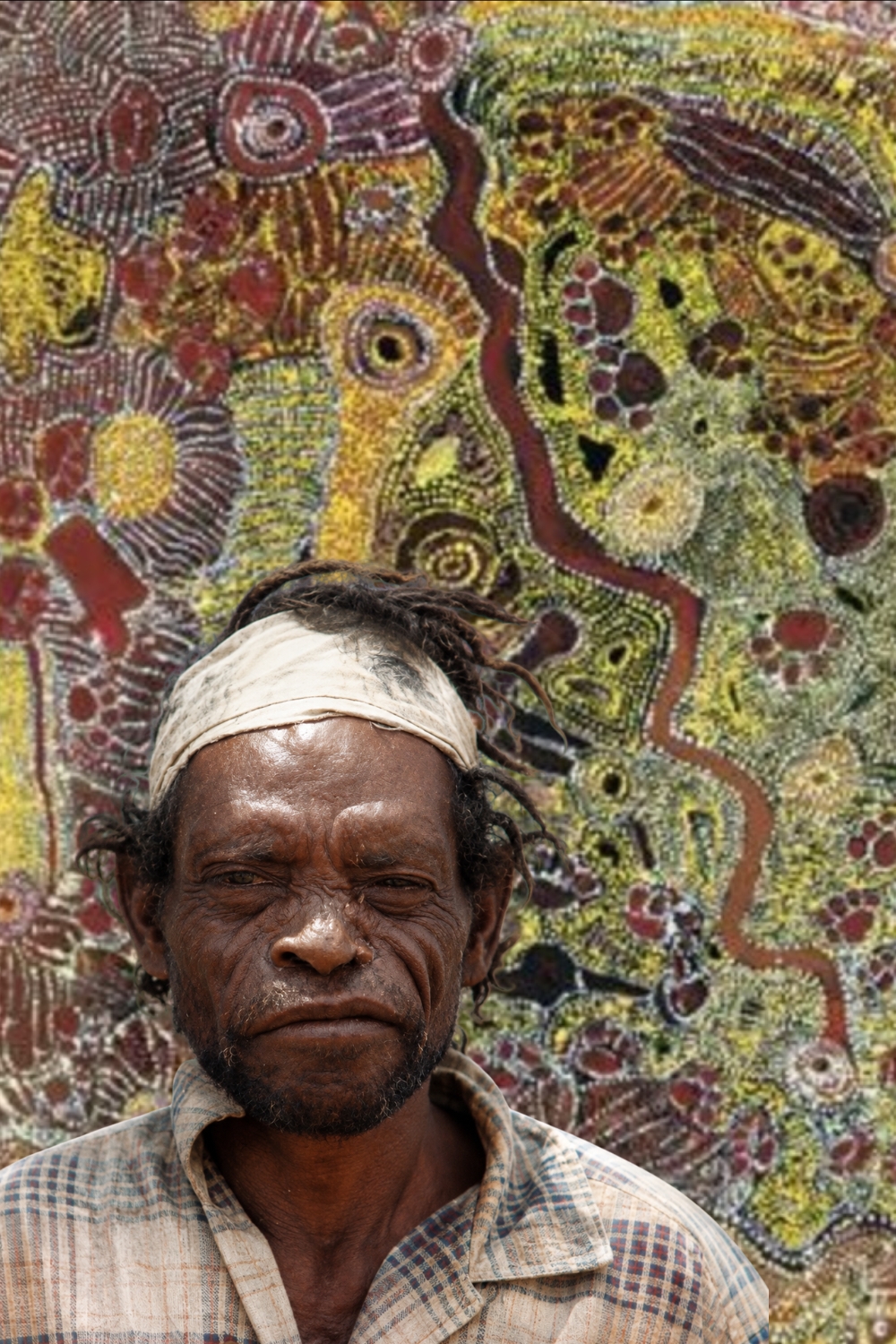
Wimmitji Tjapangarti (c.1924–2000) was a senior desert man, traditional healer and one of the foundational artists of Balgo Art at Wirrimanu in Western Australia. His name is also recorded as Wimmitji Tjapangati and Wimmitji Tjapangardi.
Born at Kutakutal, southwest of Balgo, Wimmitji spent much of his early life travelling through the Great Sandy Desert and was reportedly the last of his family group to settle at the old Balgo mission, around 1959. The Country he later painted was therefore a landscape he had travelled through, camped within and learned through lived experience.
Long before becoming known as a Western desert artist, Wimmitji was a respected mapan (traditional healer) and senior cultural authority with extensive knowledge of Country, ceremony and ancestral narratives.
Around 1981–82, he was among a small group of senior men who began producing public acrylic paintings of ancestral subjects at Balgo. His work appeared in the landmark 1986 exhibition Art from the Great Sandy Desert at the Art Gallery of Western Australia. He later painted through Warlayirti Artists, frequently collaborating with his wife, Eubena Nampitjin.
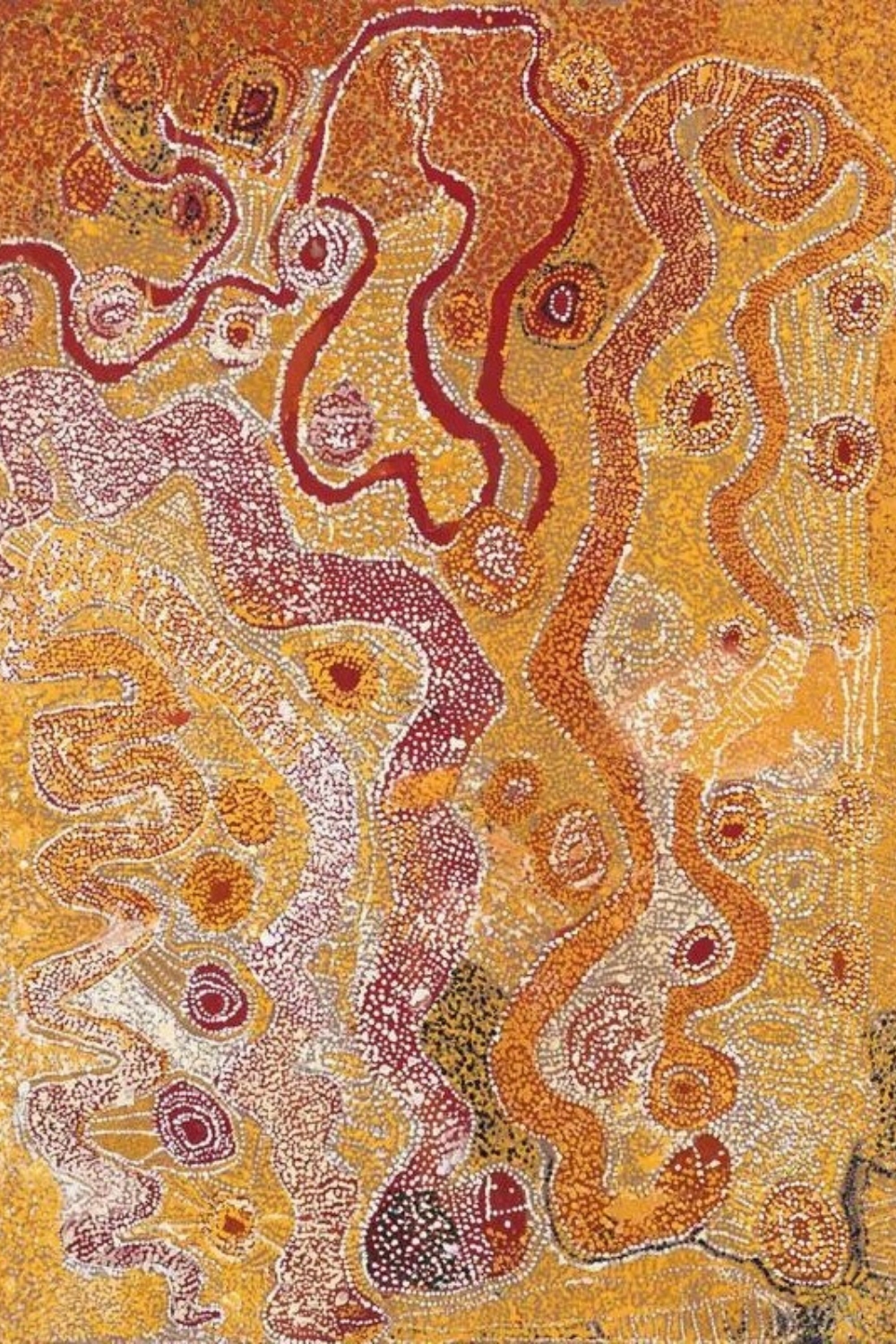
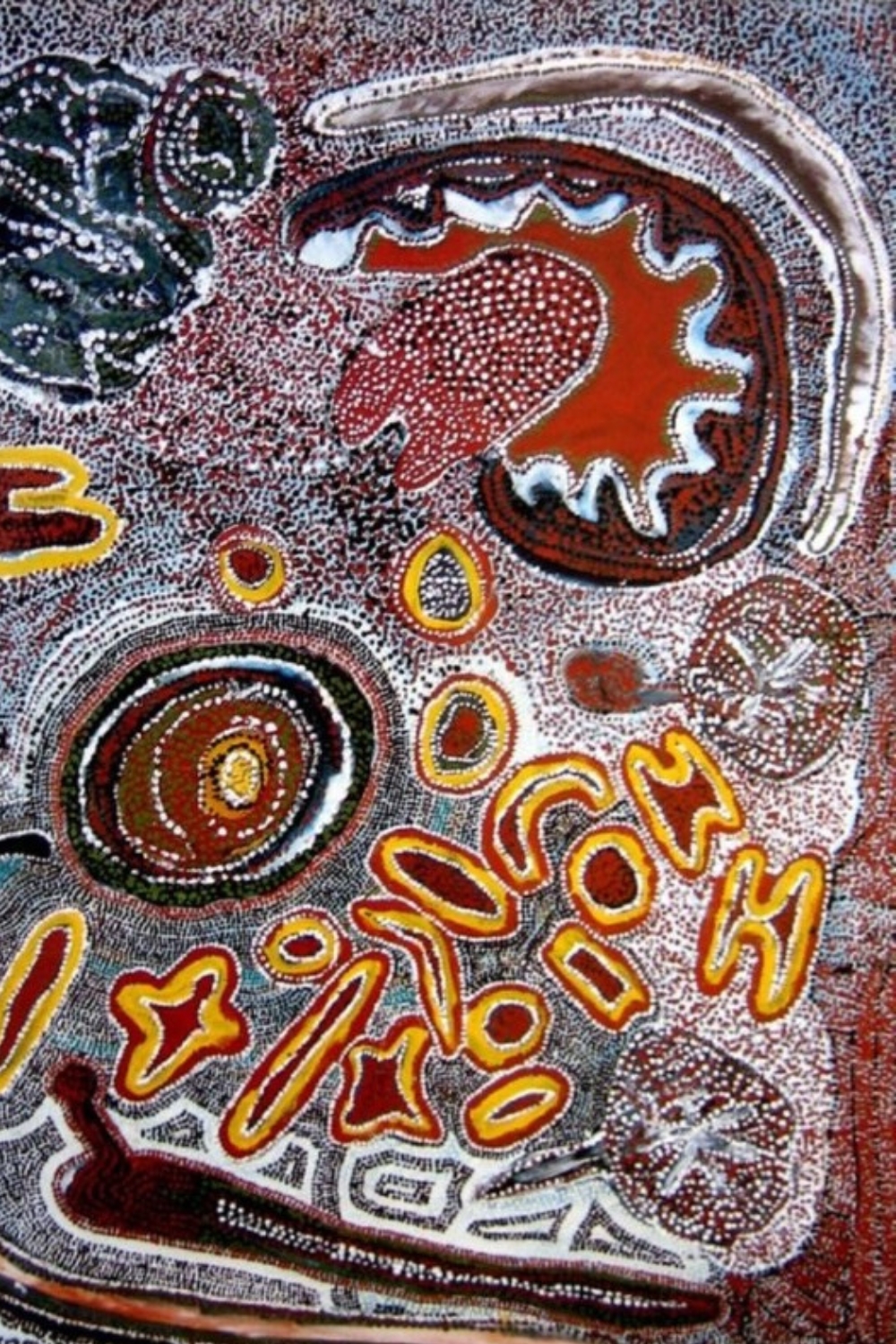
Wimmitji’s paintings are distinguished by dense, irregular dotting, ancestral pathways and an earth-based palette. He sometimes applied paint with his fingers rather than a brush, maintaining a connection with ceremonial body painting and designs made in sand. His distinctive approach influenced Eubena and other members of the first generation of Balgo painters.
Wimmitji Tjapangarti Value
For images of many of Wimmitji artworks and the value of those artworks please see the Wimmitji Tjapangarti Value Page
Wimmitji Tjapangarti Biography
Wimmitji Tjapangarti was born around 1924 at Kutakutal in the Great Sandy Desert. His Country extended south of Balgo towards the Canning Stock Route, with connections to Lirrwarti, the Stansmore Ranges and Jupiter Well. He grew up travelling through this landscape, learning its waterholes, creeks, travelling routes, ancestral places and ceremonial knowledge from senior people.
Wimmitji remained in the desert comparatively late. In 1957 he was at Natawalu, or Well 40 on the Canning Stock Route, when members of his extended family encountered the helicopter associated with the evacuation of the young Helicopter Tjungurrayi. Wimmitji subsequently travelled north and by the late 1950s had settled at Balgo, where he became an influential member of a community bringing together several desert language groups.
Long before becoming known as a painter, Wimmitji was a respected mapan, or traditional healer, with extensive ceremonial and ancestral knowledge. Original Warlayirti documentation for Water Dreaming, 1989, for example, identifies him as guardian of the important Ikarra Water Dreaming site and a keeper of its Law.
His knowledge also made him an important source for researchers. Wimmitji assisted anthropologists Ronald and Catherine Berndt, who recorded ancestral narratives related by him, some of which were later published in their 1989 anthology The Speaking Land: Myth and Story in Aboriginal Australia. He worked with Father Anthony Peile on research into Aboriginal understandings of the body and traditional healing and contributed to the compilation of a Kukatja-English dictionary.
When acrylic painting emerged at Papunya during the early 1970s, senior men at Balgo were initially cautious about producing comparable works for public viewing because ceremonial designs could contain restricted knowledge. Wimmitji nevertheless produced paintings privately in connection with the Berndts’ research. In 1981–82 he became one of a small group of senior Balgo men to produce some of the first public acrylic paintings of ancestral subjects.
His work was included in the landmark 1986 Art from the Great Sandy Desert exhibition at the Art Gallery of Western Australia, which helped bring the emerging Balgo painting movement to wider attention. Wimmitji began painting more regularly after Michael Rae became coordinator of Warlayirti Artists in 1988.
By this period Wimmitji was also working closely with his wife, Eubena Nampitjin, whom he had married during the 1970s. In the late 1980s they developed an important artistic partnership, frequently collaborating on paintings, particularly when depicting Country over which they shared ancestral rights. They sometimes worked directly on one another’s paintings, making the relationship between their early styles particularly close.
Wimmitji’s influence extended beyond their collaboration. His distinctive approach to painting influenced Eubena, her daughter Ena Gimme Nungurrayi, and several other artists of the first generation of Balgo painters. As Eubena subsequently developed her own increasingly expressive style, their partnership became an important part of the formative history of contemporary Balgo Art.
What Did Wimmitji Tjapangarti Paint?
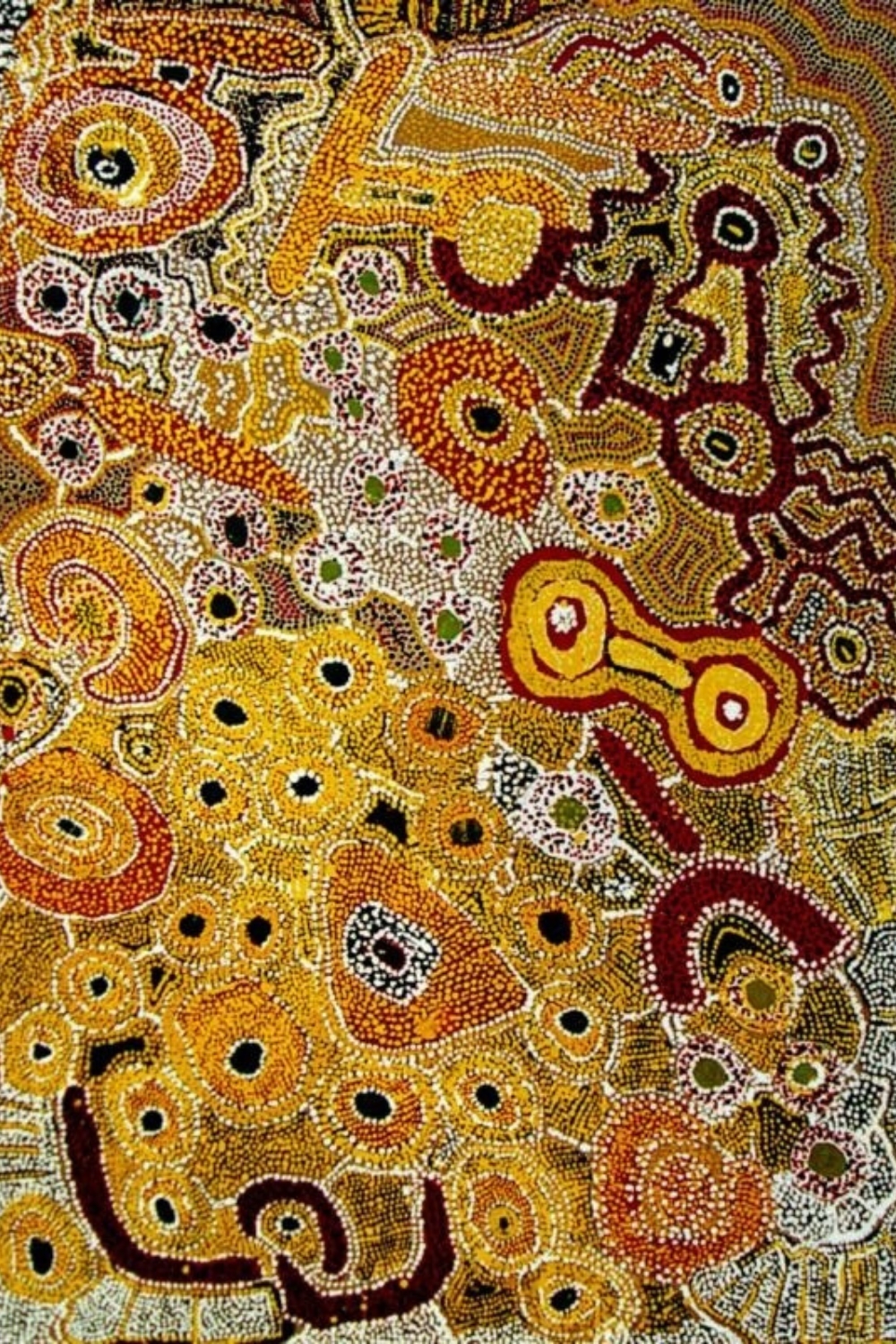
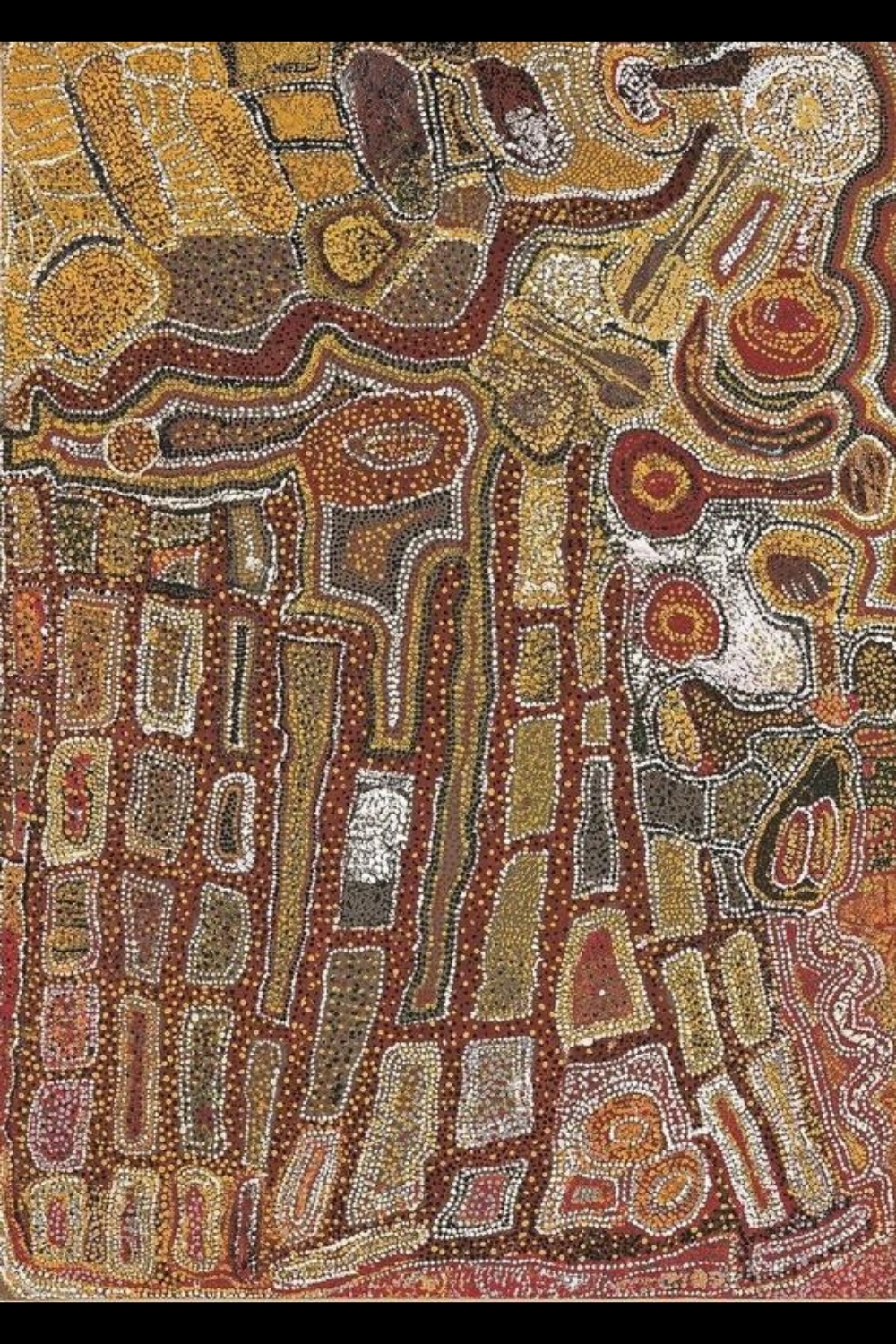
Wimmitji principally painted Country and the ancestral events through which its features and significance were understood. His subjects included Tingari journeys, Wati Kutjarra or Two Men, Rainbow Snake, Water Dreaming, Dingo, Bush Turkey and ancestral women, together with particular waterholes and areas of Country.
This was Country Wimmitji knew through experience. A waterhole could simultaneously be a source of water, a family camping place, an ancestral site and a ceremonial place remembered through songs and dances. His paintings therefore combine physical geography, ancestral narrative and personal knowledge of the land.
Titles such as Artist’s Country should not be understood simply as landscapes. Wilatarnpalpar, 1990, for example, was described by Warlayirti as a mythological map showing Wati Kutjarra journeys, waterholes and the Rainbow Snake. Artist’s Country (Wantjanmurra), 1992 depicts rockholes, creeks, hills and bilby burrows in Country where Wimmitji had been raised and initiated into Law.
Tingari ancestral activity appears repeatedly in his work, although his compositions differ from the more ordered circle-and-line structures of some Western Desert Tingari painters. Art historian John Carty observed that Wimmitji stretched and redirected familiar structures as he followed ancestral movement through Country.
He also rarely painted a place in exactly the same way twice. Returning to the same Country could produce an entirely different composition representing another part of its story.
His paintings can therefore be understood as visual mnemonics for larger bodies of knowledge. Places and pathways visible on the canvas evoke ancestral narratives, songs and ceremonies whose fuller meanings remain beyond the painting.
Wimmitji Tjapangarti’s Painting Style
Wimmitji’s mature paintings are recognisable for their dense surfaces, complex dotting, irregular pathways and tactile application of paint.
Christine Watson described his distinctive dotting as sometimes appearing to reflect the actual textures of the ground. Circles, tracks and pathways emerge from densely accumulated fields of paint, creating surfaces that can appear almost topographical.
His marks could also reproduce ways of drawing directly in the desert. In Dingo and Rainbow Snake Dreaming, 1990, white dotted lines indicate ancestral journeys while dingo paw prints cross the composition. Their form imitates the way a dingo footprint can be drawn in sand using the fingertips and thumb.
Painting With His Fingers
One of the most revealing features of Wimmitji’s technique was his use of his fingers to apply acrylic paint.
Rather than treating canvas painting as completely separate from older desert art forms, he sometimes preferred finger application because it more closely recalled the processes used in ceremonial body painting and designs made in sand.
His paintings can therefore be understood not simply as traditional imagery transferred onto canvas, but as an attempt to incorporate a new material into an existing desert artistic tradition.
Colour
Wimmitji also maintained a relatively restrained palette.
Although Balgo artists gained access to increasingly brilliant acrylic colours during the late 1980s, he generally remained closer to red, yellow, black and white, introducing other colours sparingly.
This gives his paintings a distinctly different character from the brilliant pinks, oranges, greens and purples that became associated with later Balgo painting.
Importance of Wimmitji Tjapangarti
Wimmitji Tjapangarti is important because his life provides a direct connection between traditional desert knowledge and the emergence of contemporary Balgo painting.
He had lived and travelled through the Country he later painted and was a mapan, or traditional healer, and ceremonial authority responsible for important places and knowledge. Before acrylic painting became established at Balgo, he had already helped anthropologists and linguists document aspects of desert culture.
When Wimmitji began painting publicly, he carried this knowledge into a new medium while maintaining connections with older practices of body painting, sand drawing and marking the ground. He was among the small group of senior men who helped establish public painting at Balgo in the early 1980s and negotiate how ancestral subjects could appropriately be represented for outsiders.
His importance was recognised early. Wimmitji’s work appeared in the landmark 1986 Art from the Great Sandy Desert exhibition at the Art Gallery of Western Australia, which helped introduce Balgo painting to a wider audience. His work subsequently gained international exposure. Artist’s Father’s Country, 1990, for example, was included in Aratjara: Art of the First Australians, which travelled to Düsseldorf, the Hayward Gallery in London and Louisiana Museum in Denmark during 1993–94.
His influence also extended beyond his own paintings. Through his artistic partnership with Eubena Nampitjin, and his influence on her daughter Ena Gimme Nungurrayi and other early Warlayirti artists, Wimmitji contributed to the development of the distinctive painting tradition that emerged at Balgo.
Failing eyesight severely curtailed his painting during the 1990s, leaving a relatively small body of work. Its size, however, understates his historical significance.
Wimmitji Tjapangarti should be regarded as one of the foundational figures of Balgo Art — a senior cultural authority whose knowledge of Country, ceremony and ancestral narratives helped shape the movement before its extraordinary flowering during the 1990s and its growing international recognition.
Wimmitji Tjapangarti in Public Collections
Further Reading
Carty, John. Balgo: Creating Country. UWA Publishing, Crawley, 2021.
Probably the most important modern source for understanding Wimmitji artistically. Carty discusses the development of Balgo painting and Wimmitji’s relationship between movement through Country, memory and composition. His analysis of Wimmitji’s paintings as pathways developed through ancestral movement is particularly useful. A recent essay by John Kean specifically directs readers to Carty’s discussion of Wimmitji on pp. 93–94.
Healy, Jacqueline (ed.). Warlayirti: The Art of Balgo. RMIT Gallery, Melbourne, 2014.
Major exhibition catalogue produced with Warlayirti Artists and based partly on research in the Warlayirti archives. It places Wimmitji among the important formative artists of Balgo and examines the development of the movement from the early 1980s. Your values material specifically identifies Wimmitji’s Kurra, 1992 as illustrated on p. 70, cat. 61.
Watson, Christine. “Eubena Nampitjin and Wimmitji Tjapangarti,” in Anne Brody (ed.), Stories: Eleven Aboriginal Artists. Craftsman House, Sydney, 1997.
One of the most directly relevant published essays. Watson discusses Wimmitji and Eubena together and is the source for important observations about Wimmitji’s complex dotting, surface treatment, traditional palette and influence on Eubena. Your values document specifically cites Watson at p. 52.
Cowan, James. Balgo: New Directions. Craftsman House, Sydney, 1999.
Important study of the emergence and development of Balgo painting. Particularly useful for placing Wimmitji within the broader stylistic development of Warlayirti Artists. Artist’s Country (Wantjanmurra), 1992 is illustrated on p. 115.
O’Ferrall, Michael. Art from the Great Sandy Desert. Art Gallery of Western Australia, Perth, 1986/87.
Historically essential because this was the landmark exhibition that first presented Balgo painting as a significant distinct movement. Wimmitji was one of its important early artists. Later RMIT research describes the exhibition as the watershed that brought Balgo art wider recognition.
Berndt, Ronald M. and Catherine H. Berndt. The Speaking Land: Myth and Story in Aboriginal Australia. Penguin Books, 1989.
Not an art book, but particularly valuable for Wimmitji’s biography because the Berndts recorded ancestral narratives from him before his mature painting career. The auction scholarship explicitly states that some of Wimmitji’s narratives appear in this book.
Peile, Anthony. Body and Soul: An Aboriginal View.
Important background reading for understanding Wimmitji as a mapan rather than simply as a painter. Wimmitji worked closely with Father Anthony Peile on Kukatja understandings of the body, health and traditional healing. John Carty’s later catalogue essay specifically identifies Wimmitji as a consultant for this research.
All images featured in this article are presented strictly for educational and informational purposes.
This website may include copyrighted material for which specific authorization has not been obtained from the copyright owner.
All such images are presumed to be the intellectual property of the respective artist or their estate, and are used in accordance with principles of fair dealing or fair use under applicable copyright law.