
Tjungkara Ken: The Painter and the Seven Sisters songline
1969-
Pitjantjatjara
Amata and western APY Lands
Amata, South Australia
APY Lands / Western Desert Art
Tjala Arts
Ngayuku Ngura (My Country), Kungkarangkalpa Tjukurpa (Seven Sisters), Tjala Tjukurpa (Honey Ant)
Painting Synthetic polymer paint on linen
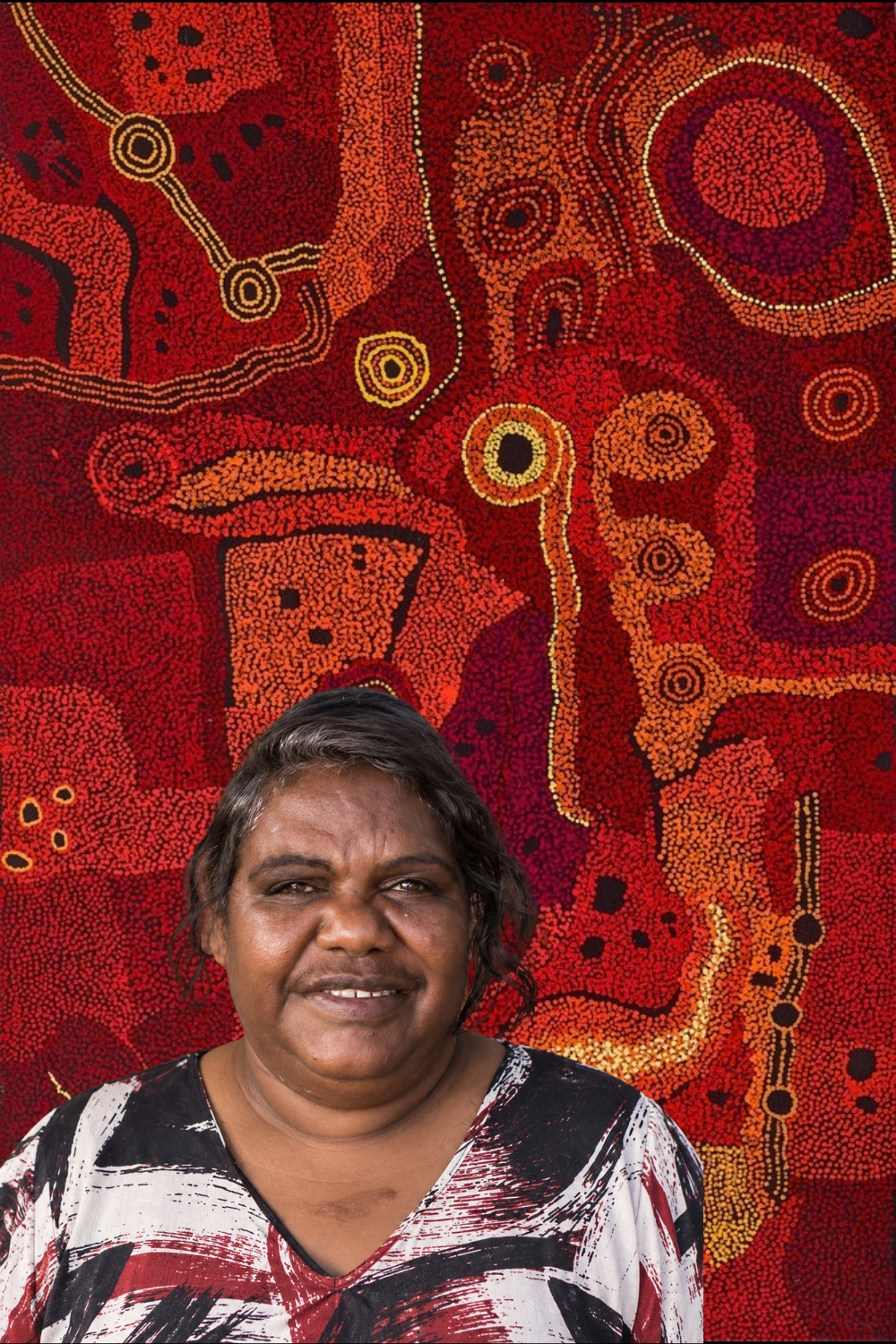
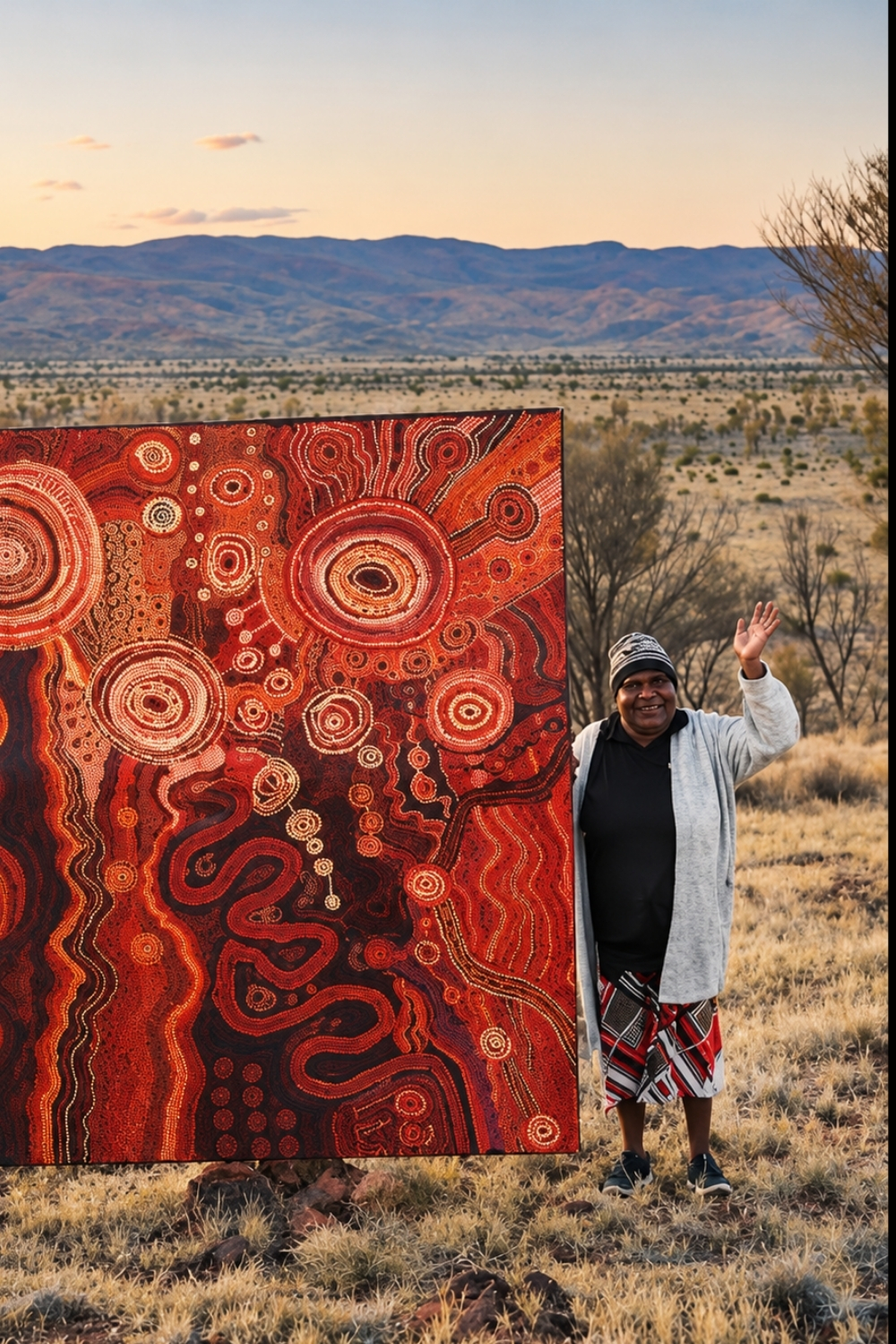
Tjungkara Ken is a leading Pitjantjatjara artist from Amata in the APY Lands Art Movement in South Australia. She began painting during the formative years of Minymaku Arts, now Tjala Arts, and has developed a distinctive practice grounded in Country and the Tjukurpa inherited through both her mother’s and father’s families.
Two great subjects run through her mature work. Ngayuku Ngura — My Country was particularly important as Ken emerged nationally around 2008–12, while Kungkarangkalpa Tjukurpa — Seven Sisters songline has become one of the continuing subjects for which she is best known.
Ken paints Country through repeated marks, parallel lines, strong colour and shifting areas of movement. She has described the perspective within her paintings as being “like looking down from the top, like looking from an aeroplane.” Yet these works are not conventional aerial landscapes. Rockholes, rivers, ranges, ancestral journeys and Tjukurpa bring physical Country and inherited cultural knowledge together.
Her career encompasses both individual painting and major collaborative works with her sisters. As a member of the Ken Sisters Collaborative, she shared the 2016 Wynne Prize for Seven Sisters. In 2017 she was an Archibald Prize finalist with Kungkarangkalpa tjukurpa (Seven Sisters dreaming), a self-portrait, representing herself not through a conventional physical likeness but through Country and Tjukurpa.
Tjungkara Ken Biography
Tjungkara Ken was born in 1969 and lives at Amata in the Aṉangu Pitjantjatjara Yankunytjatjara Lands of north-west South Australia. A Pitjantjatjara woman, she is the youngest of nine children of artists Mick Wikilyiri and Paniny Mick.
Ken grew up within a large family whose cultural responsibilities extend across the western APY Lands. Through her mother she is connected with Country around Wingellina and Ngintaka Tjukurpa, while through her father she inherited knowledge of the Apara story. These family relationships would later become important subjects within her painting.
Ken began painting in 1997, during the early years of Minymaku Arts at Amata. She was among the younger generation of women working through the art centre and was exhibiting by the end of the decade. Minymaku Arts subsequently became Tjala Arts, the Amata art centre with which Ken’s career remains closely associated.
Although she had already been painting for about a decade, her national profile increased substantially from around 2008. By 2010 her work was appearing in major exhibitions including Desert Mob and the National Aboriginal and Torres Strait Islander Art Award, while the Art Gallery of South Australia acquired her work and included it in Desert Country: Contemporary Aboriginal Painting.
Ken also developed an important collaborative practice with four of her sisters—Yaritji Young, Freda Brady, Sandra Ken and Maringka Tunkin. Working as the Ken Sisters Collaborative, they won the 2016 Wynne Prize at the Art Gallery of New South Wales with Seven Sisters.
Individual recognition followed. In 2017 Ken was an Archibald Prize finalist with Kungkarangkalpa tjukurpa (Seven Sisters dreaming), a self-portrait. She was a Wynne Prize finalist in 2019, and in 2021 her Seven Sisters received the Roberts Family Aboriginal and Torres Strait Islander Prize within the Wynne Prize.
Ken continues to live and work at Amata. Her career now spans nearly three decades, from the formative years of Minymaku Arts to the national prominence of contemporary painting from the APY Lands.
Tjungkara Ken Painting Technique
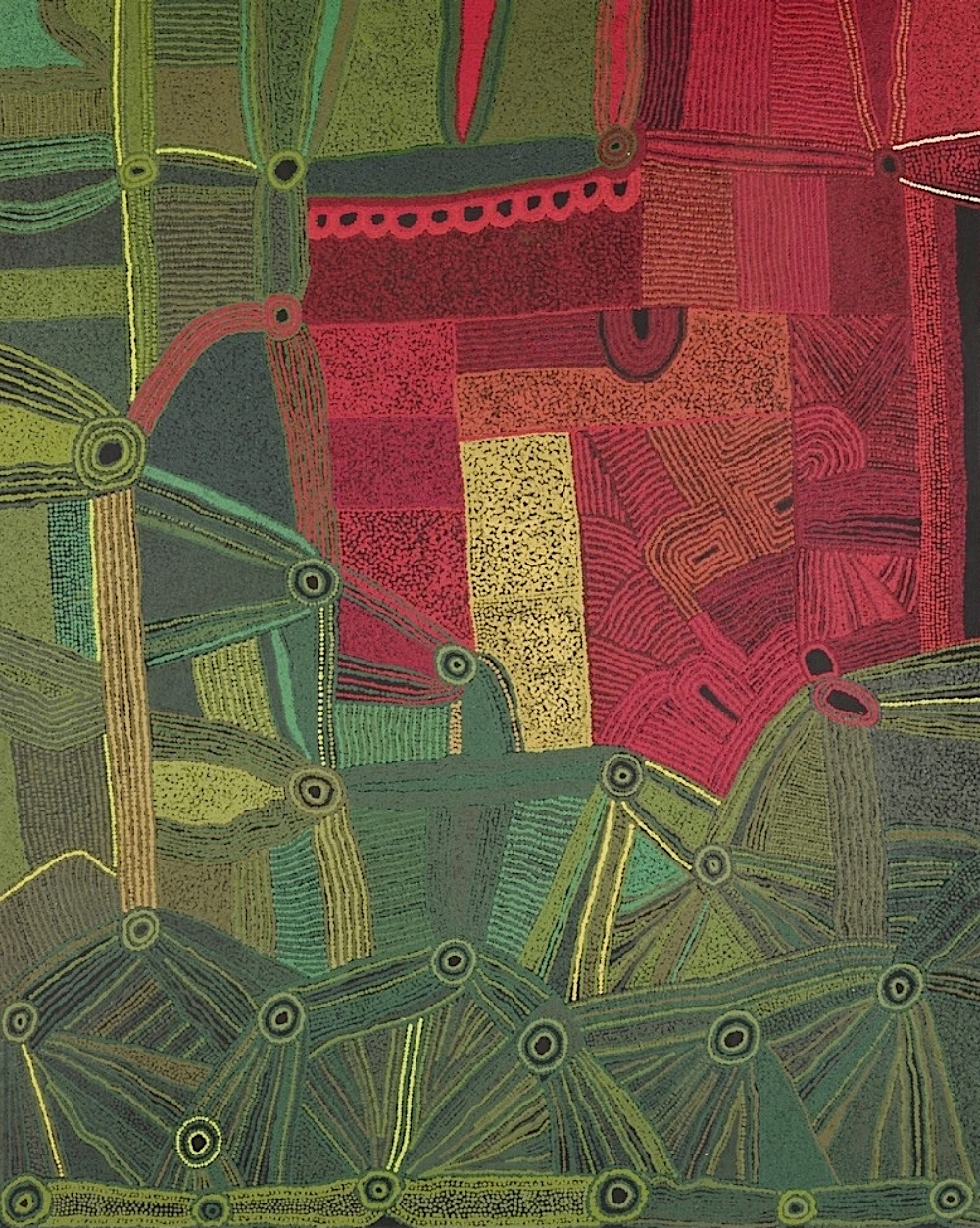
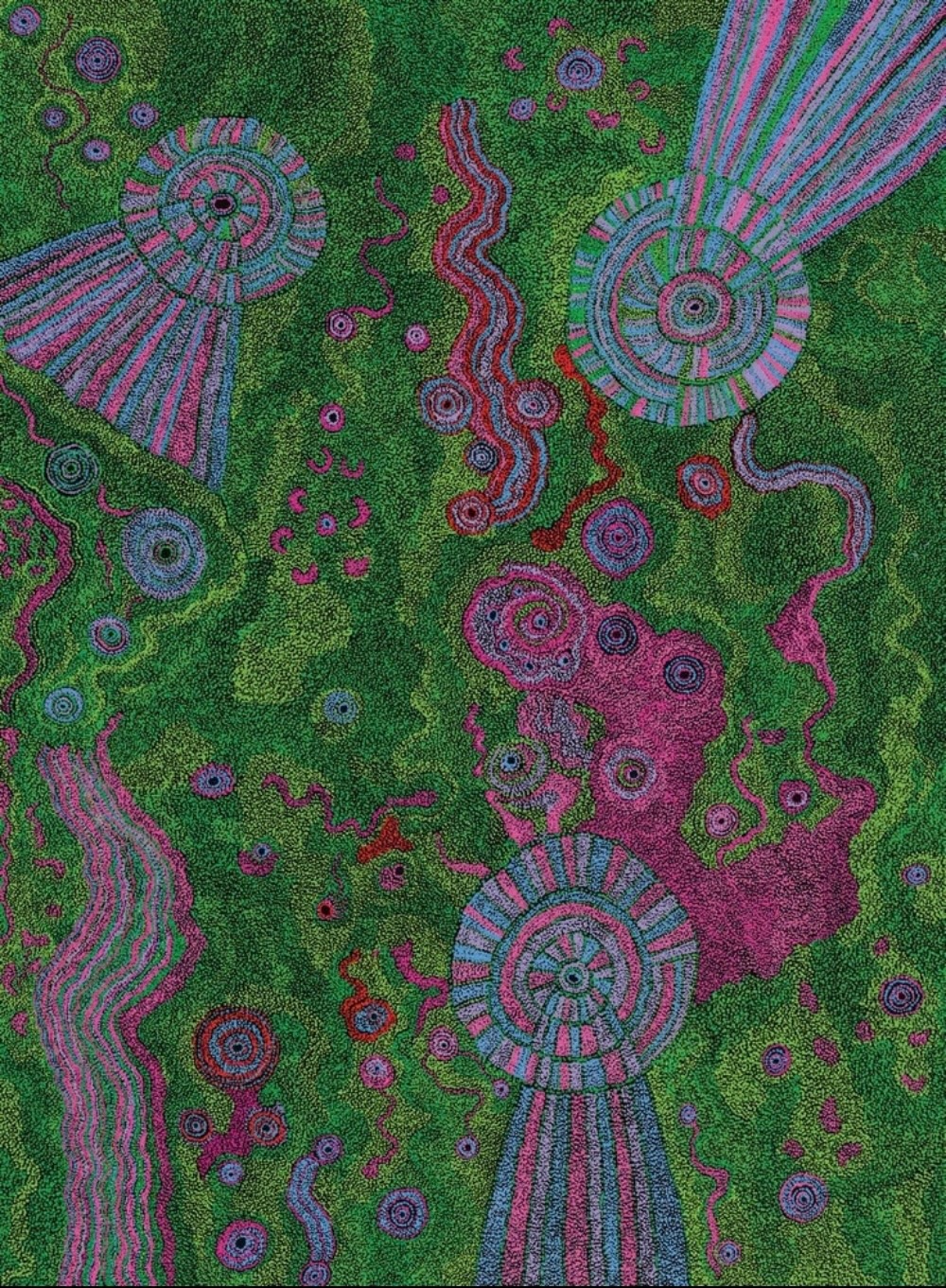
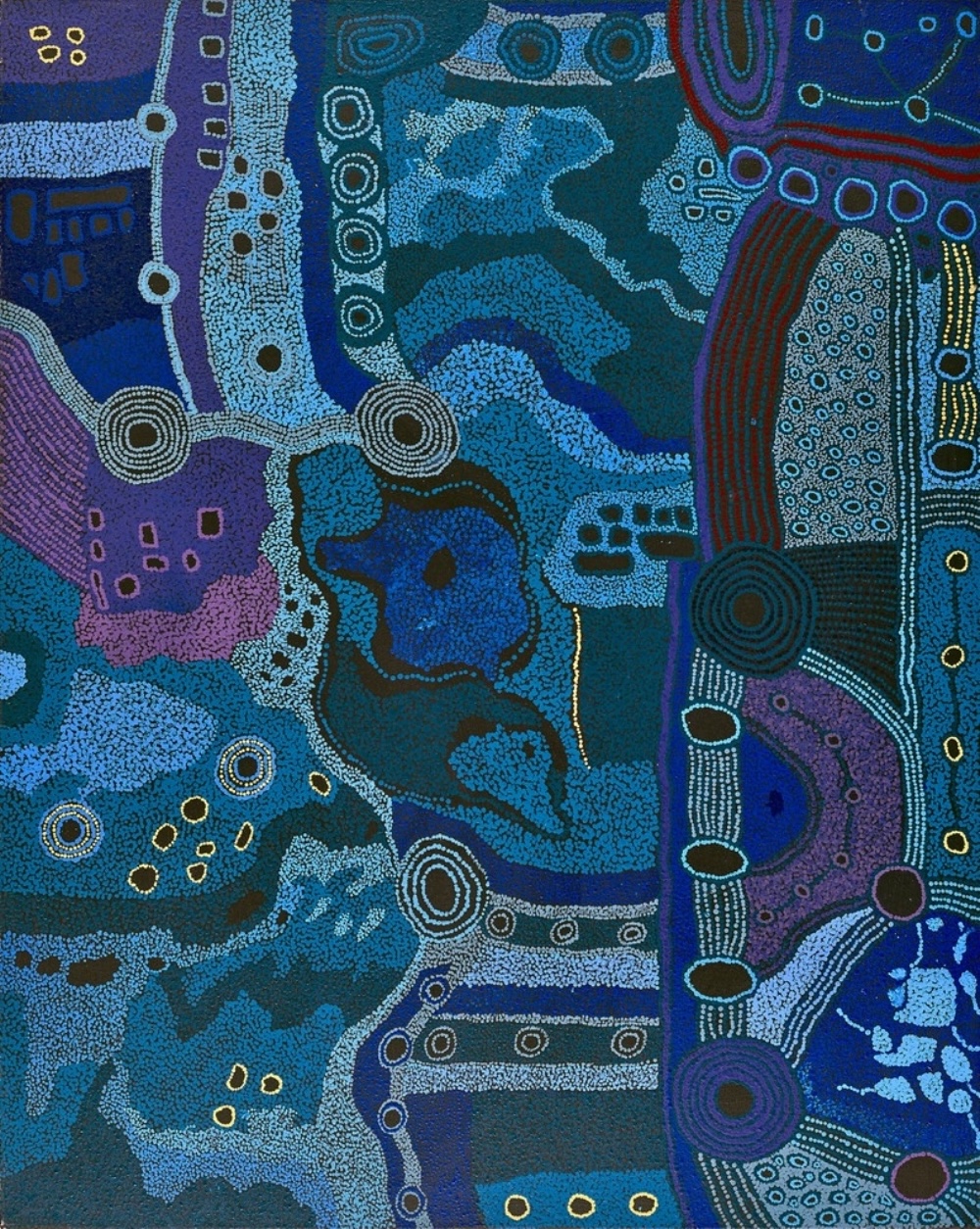
Tjungkara Ken builds her paintings through waka waka (dots), parallel lines, changing directions and intense colour, with repeated marks gathering into larger patterns and movements.
Her method of applying paint is distinctive:
“Now that I know how to do really good paintings, I only paint with punu sticks and not a brush.”
Using punu sticks, Ken varies the density, direction and colour of her marks.
She has compared the perspective within her paintings to:
“looking down from the top, like looking from an aeroplane.”road movements of colour and pattern.
This helps explain compositions without a conventional horizon, where forms and pathways spread across the canvas to present different areas of Country.
In 2017, Ken and her sister Yaritji Young responded to paintings by Ben Quilty at Sydney Contemporary. Ken recognised a relationship between Quilty’s palette-knife marks and her own waka waka, highlighting the importance of colour, movement, scale, energy, depth and contrast in her work.
Scale reinforces these effects. Ken has produced Seven Sisters paintings measuring approximately 198 × 198 cm in 2011 and 200 × 240 cm in 2018. On these large canvases, individual marks combine into broad movements of colour and pattern.
Tjungkara Ken Painting Style and Subjects
Tjungkara Ken’s paintings are grounded in Country and Tjukurpa inherited through her family. Two subjects dominate her documented mature work: Ngayuku Ngura (My Country) and Kungkarangkalpa Tjukurpa (Seven Sisters), alongside paintings of Tjala Tjukurpa, Ngintaka Dreaming and Apara.
Ngayuku Ngura — My Country
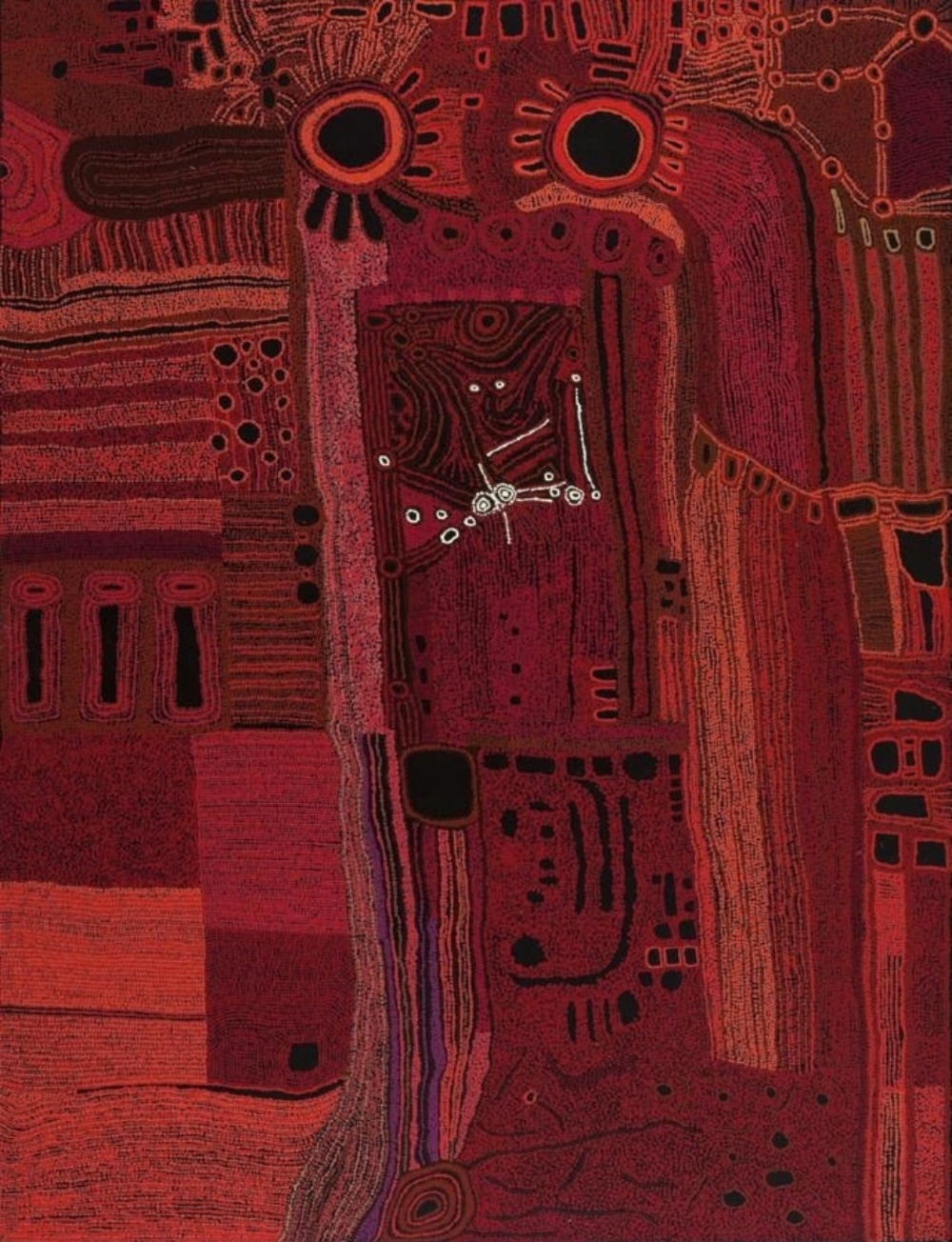
Ngayuku Ngura, meaning My Country, was central to Ken’s emergence as a nationally recognised artist. Paintings bearing the title are documented from 2008, 2009, 2010 and 2012, establishing it as a sustained body of work.
Ken describes ngura directly: “I do paintings about my country. That’s ngura—rockholes and the land, the hills and big creek beds.”
Tjala Arts documentation for a 2009 Untitled Ngayuku Ngura (My Country) similarly explains that “the different colours and designs represent variations in the landscape.”
Aboriginal art specialist Wally Caruana described Ken’s Ngayuku Ngura paintings as representing Country in its “vastness and changing topography.” He identified freshwater rockholes, rivers and mountain ranges, with circles, squares and ovals referring to sites, travelling lines connecting places and arcs indicating people. Parallel lines suggest different landforms, while the intensity of Ken’s colour conveys the fertility of Country, rather than an empty or barren desert..
Kungkarangkalpa Tjukurpa — Seven Sisters
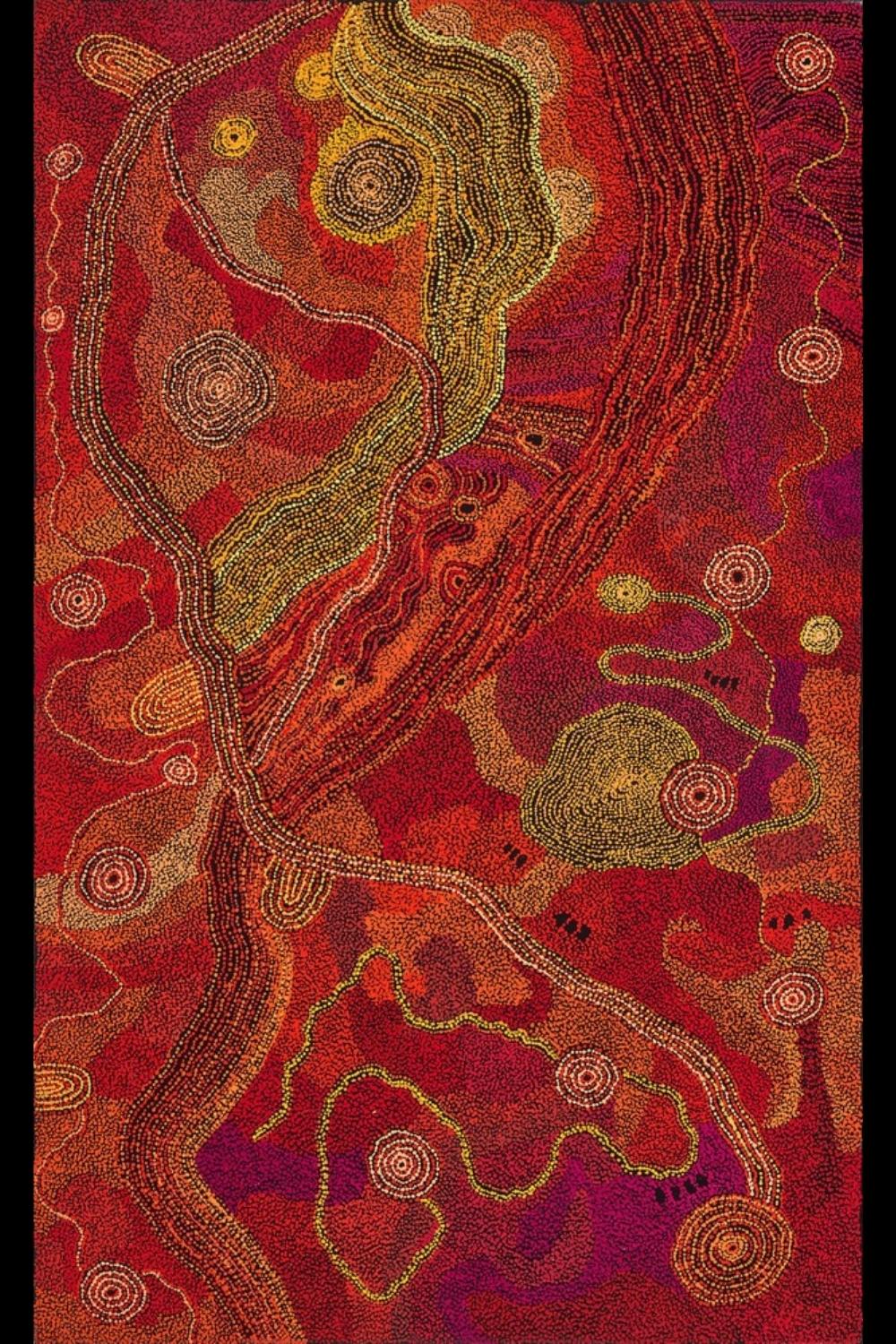
Kungkarangkalpa Tjukurpa, or Seven Sisters, is Ken’s other major continuing subject. Documented paintings date from 2010 and 2011 through 2015, 2018, 2021 and 2022.
For Ken, Kungkarangkalpa and Country are closely connected. Tjala Arts documentation accompanying a 2010 Seven Sisters states that she had depicted her Country, with different colours and designs representing variations in the landscape. Country and Tjukurpa are therefore not separate subjects: ancestral narrative is embedded within Country.
This relationship became particularly powerful in Ken’s 2017 Archibald Prize entry, Kungkarangkalpa tjukurpa (Seven Sisters dreaming), a self-portrait. Rather than depicting her physical appearance, Ken represented herself through Kungkarangkalpa and Country, bringing together identity, ancestral inheritance and place.
Seven Sisters is also central to her collaborative practice, including the Ken Sisters’ Seven Sisters, which won the 2016 Wynne Prize.
Tjala Tjukurpa, Ngintaka and Apara
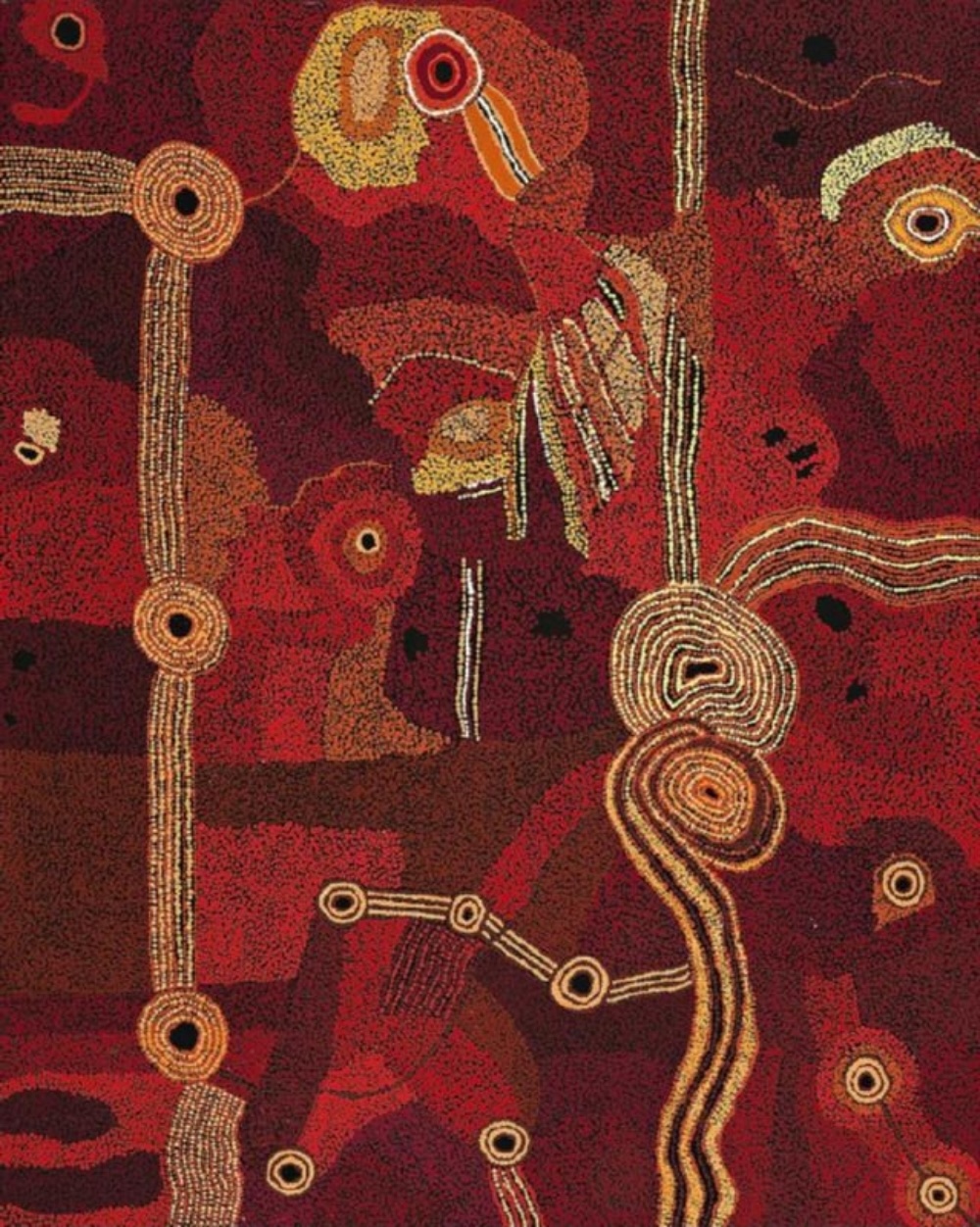
Ken’s other documented subjects include Tjala Tjukurpa (Honey Ant Story), represented by a substantial 2008 painting documented through Tjala Arts.
She also paints Ngintaka Dreaming, associated with her mother’s Country around Wingellina, and the Apara storyinherited through her father’s side.
As Ken explains:
“I hold my father’s story, I hold my mother’s story.”
Across these subjects, Ken’s paintings express particular relationships between family, Country and inherited Tjukurpa.
The Ken Sisters
Tjungkara Ken also works collaboratively with four of her sisters: Yaritji Young, Freda Brady, Sandra Ken and Maringka Tunkin. Together they are known as the Ken Sisters Collaborative.
Curator Lisa Slade has provided one of the most useful interpretations of their practice. Rather than viewing collaborative painting as five artists simply contributing separate sections to a canvas, Slade describes a responsive process in which the marks of one sister may provoke the marks of another.
She likens this exchange to an ancestral “call and response.” For Slade, painting also has a mnemonic function: the process of working together can activate memory and cultural knowledge. She describes the sisters’ recurring subjects, particularly Kungkarangkalpa Tjukurpa (Seven Sisters) and Tjala Tjukurpa (Honey Ant), as familial subjects that are their “birthright and their bond.”
This helps explain why Seven Sisters should not simply be described as a popular theme within Ken’s work. It belongs to a network of family relationships, inherited knowledge and shared responsibility.
The sisters themselves describe painting together as a process of learning and teaching, through which knowledge can pass between sisters and onwards to younger women.
Why Tjungkara Ken is Important
Tjungkara Ken occupies an important position in contemporary APY Lands Art. Her career extends from the formative years of Minymaku Arts at Amata in the late 1990s through the emergence of Tjala Arts as a major centre of APY painting.
Her Ngayuku Ngura paintings brought increasing national recognition by 2010, while Kungkarangkalpa became another sustained subject of her mature career.
Ken’s significance also lies in the relationship between individual and collaborative practice. With her sisters Yaritji Young, Freda Brady, Sandra Ken and Maringka Tunkin, she developed a collective practice grounded in family, shared Country and Tjukurpa. Their monumental Seven Sisters won the 2016 Wynne Prize, bringing major national recognition to the Ken Sisters.
This collaboration also crosses generations. In 2017, the five sisters painted the three-panel Kangkura-KangkuraKu Tjukurpa – A Sister’s Story with their mother, Paniny Mick, expressing the transmission of cultural and artistic knowledge within the family.
Ken has achieved substantial recognition individually. Her 2017 Archibald Prize finalist, Kungkarangkalpa tjukurpa (Seven Sisters dreaming), a self-portrait, represented identity through Country and ancestral story rather than physical likeness. She was a Wynne Prize finalist in 2019, and her Seven Sisters received the Roberts Family Aboriginal and Torres Strait Islander Prize within the 2021 Wynne Prize.
Ken’s own words connect these strands of her practice:
“I hold my father’s story, I hold my mother’s story.”
Her individual and collaborative paintings are ultimately connected by the same relationships between family, Country and inherited Tjukurpa.
Tjungkara Ken value and auction results
Works Offered at Auction: 63
Sale Rate: 56%
Highest Sale: $20,000 AUD
Median Sale Price: $3,000 AUD
For individual artworks, sizes provenance and more please visit the Tjungkara Ken values support page (not yet constructed)
Tjungkara Ken in Public Collections
Tjungkara Ken’s presence in major Australian public collections reflects both sides of her career: her individual practice as a painter of Country and Tjukurpa, and her collaborative work with the Ken Sisters.
The Art Gallery of South Australia was an important early institutional supporter. Its Ngayuku Ngura – My Country was featured in Desert Country: Contemporary Aboriginal Painting, while the collection also includes the monumental Ken family collaboration Kangkura-KangkuraKu Tjukurpa – A Sister’s Story.
Ken’s work is represented in:
Further Reading
Art Gallery of New South Wales — Tjungkara Ken, Kungkarangkalpa tjukurpa (Seven Sisters dreaming), a self-portrait, Archibald Prize 2017; Ken Sisters, Seven Sisters, Wynne Prize 2016.
Art Gallery of South Australia — Tjungkara Ken collection records; Lisa Slade’s writing on the Ken Sisters; Desert Country: Contemporary Aboriginal Painting; and Kangkura-KangkuraKu Tjukurpa – A Sister’s Story.
National Gallery of Australia — Tjungkara Ken and Ken Family Collaborative collection and exhibition material, including Know My Name.
National Museum of Australia — Songlines: Tracking the Seven Sisters.
Museum and Art Gallery of the Northern Territory — National Aboriginal and Torres Strait Islander Art Award records, including Ken’s 2010 Ngayuku Ngura – My Country.
Tjungkara Ken — Ken Tjungkara, Art & Artist Files (Australia and New Zealand). Artist file devoted to Tjungkara Ken.
Ananguku Arts and Culture Aboriginal Corporation — Tjukurpa Pulkatjara: The Power of the Law, Wakefield Press, 2010, p. 66, Tjungkara Ken.
Wally Caruana — catalogue commentary accompanying Ngayuku Ngura – My Country, 2010.
All images featured in this article are presented strictly for educational and informational purposes.
This website may include copyrighted material for which specific authorization has not been obtained from the copyright owner.
All such images are presumed to be the intellectual property of the respective artist or their estate, and are used in accordance with principles of fair dealing or fair use under applicable copyright law.