Gloria Petyarre: Biography, Painting Style and Importance
c. 1942–2021
Anmatyerre
Atnangkere Country, Utopia
Utopia / Central Australia
Utopia Art / Western Desert Art
Batik and painting on canvas
Gloria Tamerre Petyarre was one of the leading artists of the Utopia movement and a restless experimenter throughout her artistic life. An Anmatyerre woman from the Utopia region northeast of Alice Springs, she first gained recognition through the Utopia women’s batik movement before beginning to paint on canvas in the late 1980s. Her subjects came from her Country and cultural responsibilities and included Awelye, Arnkerrthe or Mountain Devil Lizard, Bush Medicine, grasses, seeds and other plant imagery.
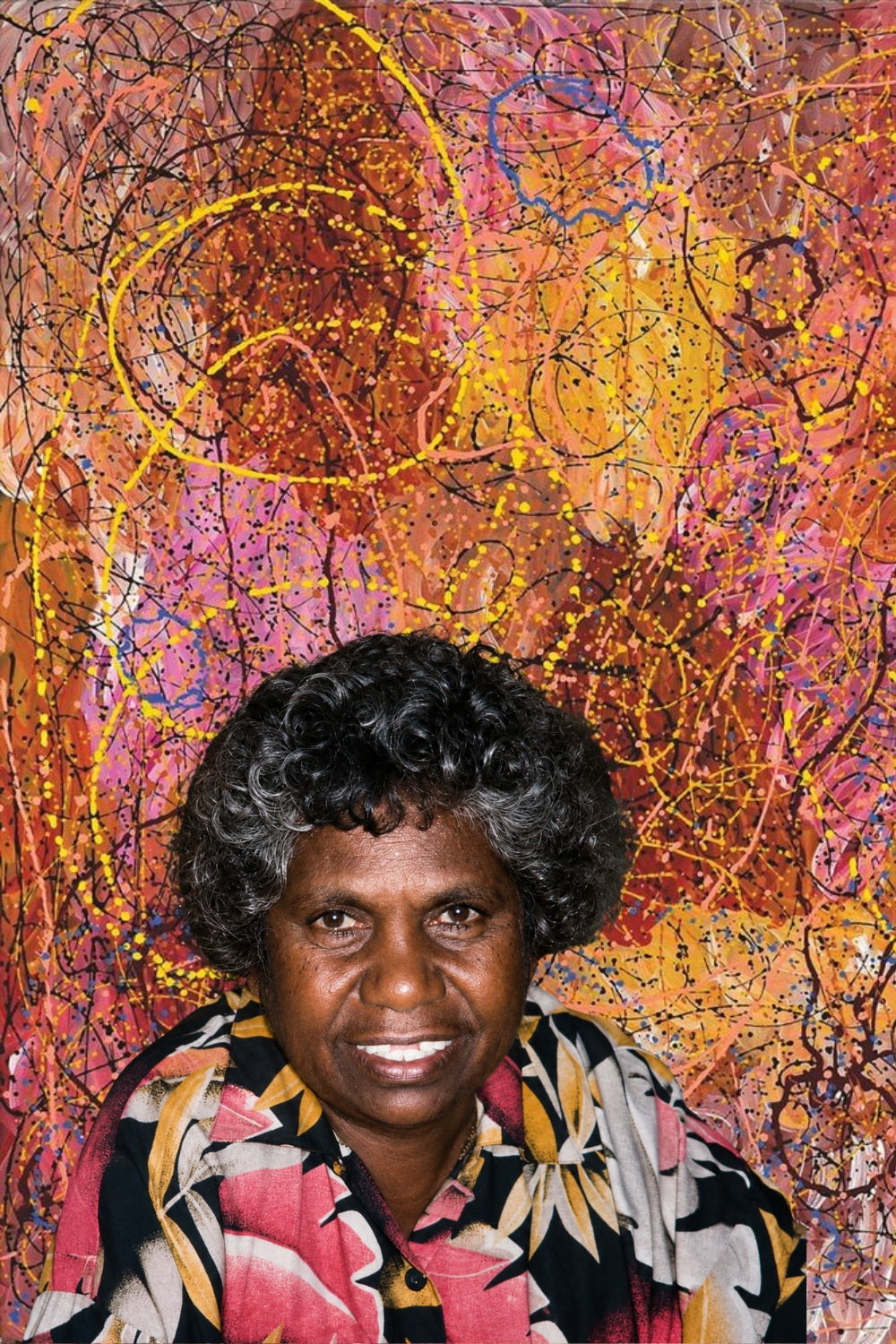
What distinguishes Petyarre’s career is not one particular style, but her continual reinvention of how these subjects could be painted. She experimented with line, dots, colour, scale, texture and repeated brush marks. Ceremonial body-paint designs became bold abstractions; Arnkerrthe could be expressed through lines, intricate dots or swirling marks; and repeated brushstrokes eventually developed into the flowing Leaves paintings for which she became famous.
In 1999, Leaves won the Wynne Prize at the Art Gallery of New South Wales, making Petyarre the first Aboriginal artist to receive the award. Yet the Wynne painting was not the sudden invention of a new style. It was one result of a lifetime of experimentation that had begun long before she painted on canvas and continued throughout her career.
For individual artwork provenance size and auction results please see the support page Gloria Petyarre Values
If you own a Gloria Tamerre Petyarre painting and would like to know its value, or are considering selling, see our Gloria Petyarre value guide. It explains how collectors assess quality, rarity, provenance, condition and size, and includes auction results to help place individual works into context.
Gloria Petyarre Biography
Gloria Tamerre Petyarre was born around 1945 in the Utopia region, about 270 kilometres northeast of Alice Springs. An Anmatyerre woman associated with Atnangkere Country, she later lived at Mulga Bore, also known as Akaye Soakage. Published sources differ on her exact year of birth.
Gloria was one of seven sisters, many of whom became significant artists, including Kathleen, Violet, Nancy and Myrtle Petyarre and Ada Bird Petyarre. She grew up with the songs, stories and women’s ceremonial practices of her Country. During Awelye, designs were painted across women’s bodies, and these lines and patterns later became an important foundation for her art. Her subjects included Awelye, Arnkerrthe or Mountain Devil Lizard, grasses, seeds and plant growth.
Gloria married Ronnie Price Mpetyane, who also became an artist. They lived at Mulga Bore and had a large extended family.
Her public artistic career began in 1977 when she joined the Utopia women’s batik program. It brought together an extraordinary generation of artists, including Emily Kame Kngwarreye, Kathleen Petyarre and Minnie Pwerle
Gloria learned batik techniques from Yipati, a Pitjantjatjara artist from Ernabella, and craft instructor Suzie Bryce, with Jenny Green later becoming an important facilitator. Working with hot wax and dye provided a new way of expressing designs connected with ceremony and Country. Gloria worked in batik for about a decade and exhibited with the Utopia women in Australia and overseas.
In 1988 she joined the CAAMA-sponsored Utopia Women’s Paintings: The First Works on Canvas, A Summer Project 1988–89. Acrylic opened new possibilities in scale, colour, texture and mark-making, beginning an extraordinary period of experimentation.
Her reputation grew rapidly. In 1990–91 she travelled to Ireland, London and India representing the Utopia women with Utopia – A Picture Story, and in 1991 held her first solo exhibition at Utopia Art Sydney.
Rather than abandoning earlier subjects, Gloria repeatedly reinvented them through changes in line, dots, colour and repeated brush marks. This continuing experimentation became one of the defining characteristics of her career.
In 1999 her Leaves won the Wynne Prize at the Art Gallery of New South Wales, making Petyarre the first Aboriginal artist to win the award.
Gloria continued painting for many years, returning to Awelye, Arnkerrthe, plant growth and Leaves while continually changing how she represented them. She died in June 2021, leaving a career that extended from ceremonial body designs and batik to internationally recognised painting.
Gloria Petyarre Painting Style and Evolution
Gloria Petyarre’s development can be followed particularly clearly from her early paintings to her later works. Lines, dots and symbols gradually give way to line alone; dots become fields of tone; and eventually the repeated leaf becomes her principal means of creating movement and colour.
1. Traditional lines, dots and symbols
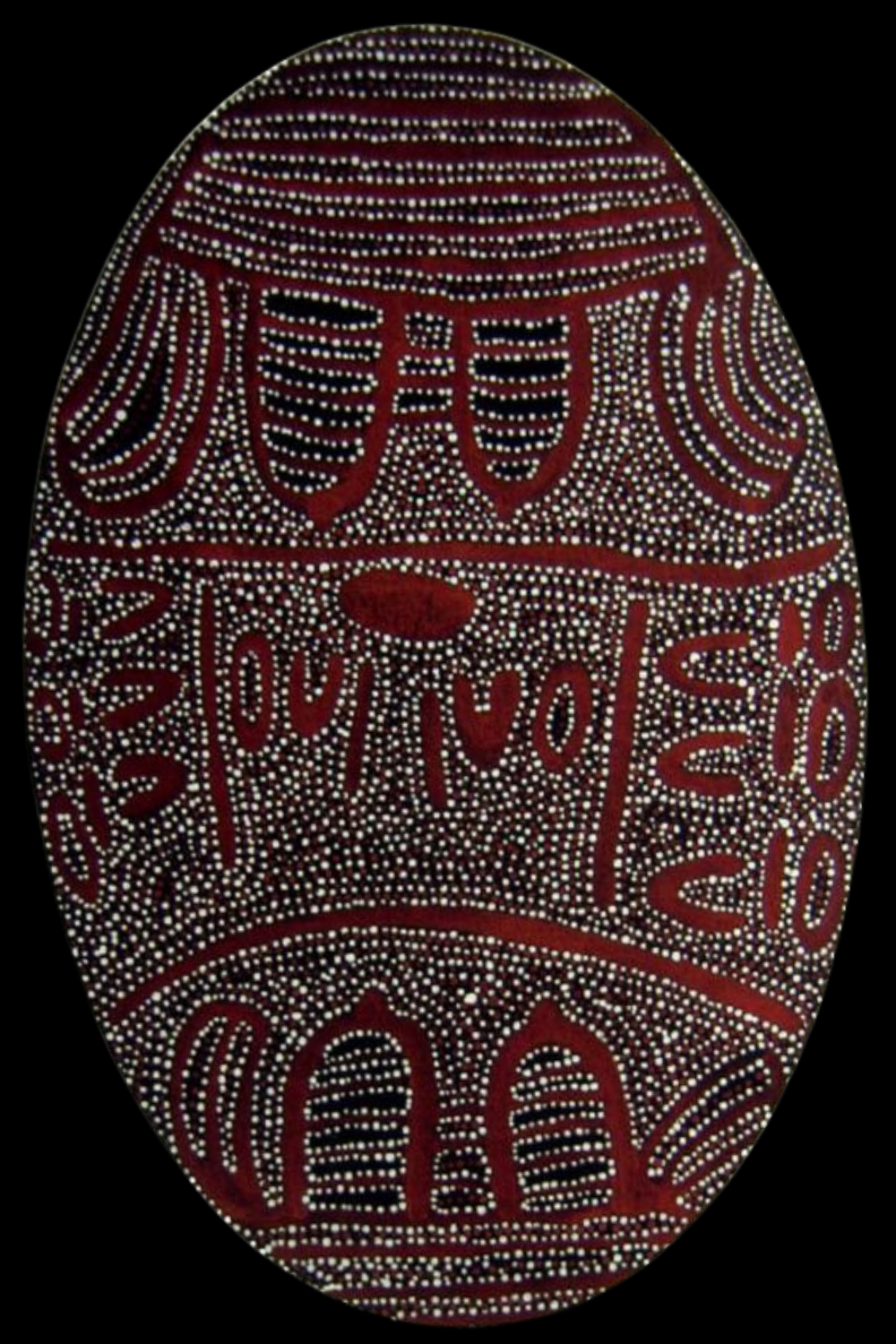
Petyarre’s early works use red, white, black and earth colours, with lines and dots constructing distinct symbols and ceremonial designs. These paintings have the closest visual relationship to the Awelye body-painting designs from which much of her early painted vocabulary developed.
2. Lines surrounded by dots
The composition then becomes simpler. Lines remain dominant and are accompanied by dots, but no longer need to form separate symbols. Repeated lines spread across the canvas while dotting reinforces their direction, turning the composition into a continuous field of pattern.
3. Line without dots
Dots can then disappear almost completely. Parallel and curving lines carry the composition through repetition, direction and spacing. The ceremonial vocabulary has been reduced to its essentials: line itself has become sufficient.
4. Poured and dripped paint
By the mid-1990s Petyarre was also experimenting with poured, dripped and freely drawn paint. Looping lines cross and overlap in energetic all-over compositions that can invite comparison with Jackson Pollock, although they emerge from a very different artistic and cultural tradition.
5. Fine dot fields
At the opposite extreme are works composed almost entirely of extremely fine dots. Strong outlines disappear and subtle forms emerge through changes in the size, density and concentration of the dots. The dots no longer surround the composition; they create it.
6. Development of the leaf paintings
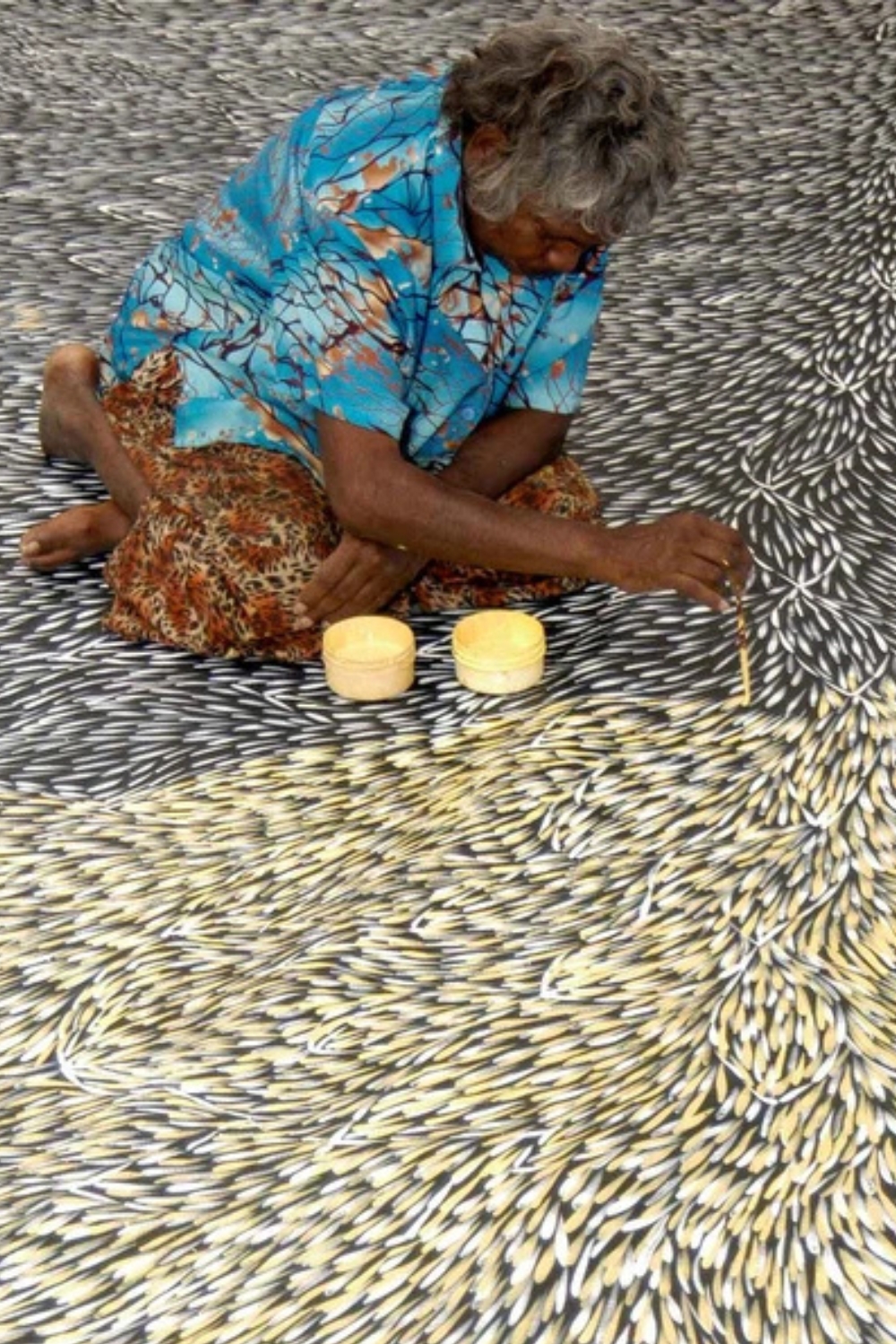
Petyarre was painting leaves by 1994, initially as relatively independent marks. By around 1997, she increasingly organised them directionally, with groups of leaves turning, dividing and converging. This created the flowing movement that became characteristic of her celebrated Bush Medicine Leaves paintings.
7. Larger, tonal leaves
From around 2010, the leaves become larger, looser and more painterly. Individual strokes increasingly contain variations of colour and tone, eventually developing into broad marks of yellow, green, blue, red and pink. The individual brushstroke, rather than the mass of repeated leaves, becomes increasingly prominent.
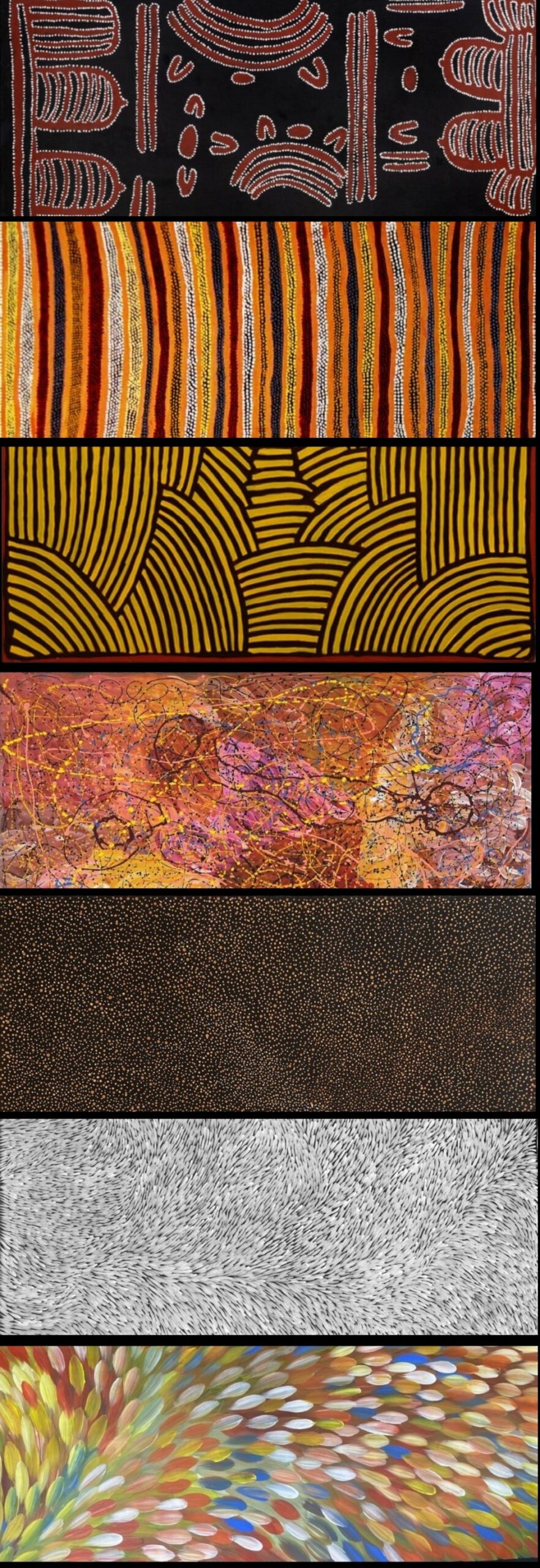
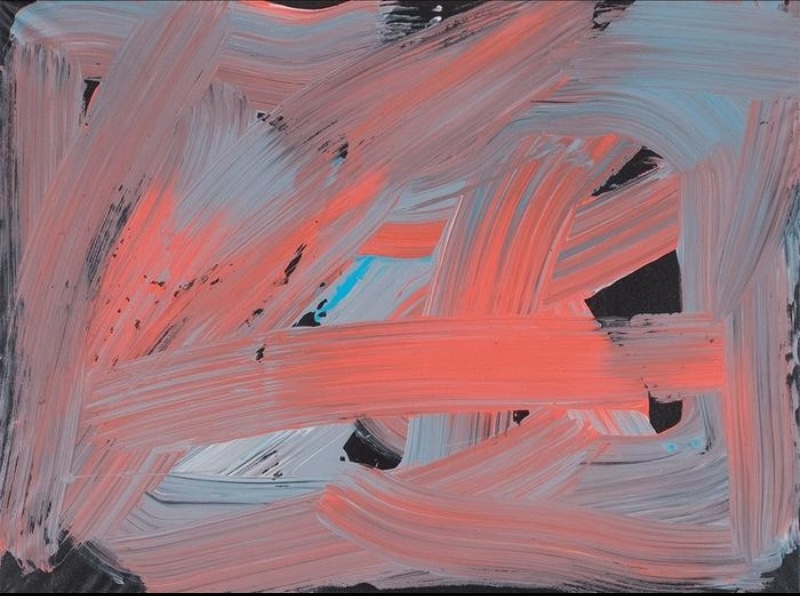
Gloria Petyarre’s evolution was not a simple progression from one style to the next. Like Emily Kame Kngwarreye, she frequently returned to earlier approaches, combined elements from different periods, or took her work in entirely new directions. The seven broad styles outlined here therefore represent major strands within her work rather than a complete chronology. Petyarre was a remarkably experimental artist, continually exploring new ways of applying and organising paint — at times even abandoning conventional brushes and painting with a mop.
Gloria Petyarre’s Importance
Gloria Petyarre was one of the most important artists to emerge from Utopia. Her career spanned the transition from the Utopia women’s batik movement to canvas, where she became an exceptionally experimental painter.
She worked with ceremonial-derived designs, dots, parallel lines, dense fields of marks, poured and dripped paint, Mountain Devil Lizard designs and, most famously, repeated leaf-shaped brushstrokes. Her Bush Medicine Leaves paintings transformed the leaf into a means of creating movement, with changes in direction, density and colour making the surface appear to ripple and flow.
Her national standing was confirmed in 1999 when she became the first Aboriginal artist to win the Wynne Prize at the Art Gallery of New South Wales.
Like Emily Kame Kngwarreye, Petyarre never settled permanently into one successful style. She returned to earlier ideas, combined them with new techniques and continued experimenting. This combination of cultural continuity and artistic invention established her as one of the most distinctive painters of the Utopia movement.
Gloria Petyarre’s Importance
Gloria Petyarre was one of the most important artists to emerge from Utopia. Her career spanned the transition from the Utopia women’s batik movement to canvas, where she became an exceptionally experimental painter.
She worked with ceremonial-derived designs, dots, parallel lines, dense fields of marks, poured and dripped paint, Mountain Devil Lizard designs and, most famously, repeated leaf-shaped brushstrokes. Her Bush Medicine Leaves paintings transformed the leaf into a means of creating movement, with changes in direction, density and colour making the surface appear to ripple and flow.
Her national standing was confirmed in 1999 when she became the first Aboriginal artist to win the Wynne Prize at the Art Gallery of New South Wales.
Like Emily Kame Kngwarreye, Petyarre never settled permanently into one successful style. She returned to earlier ideas, combined them with new techniques and continued experimenting. This combination of cultural continuity and artistic invention established her as one of the most distinctive painters of the Utopia movement.
Gloria Petyarre value artworks and auction results
Works Offered at Auction: 1262
Sale Rate: 55%
Highest Sale: $65,000 AUD
Median Sale Price: $1,400 AUD
For individual artwork provenance size and auction results please see the support page Gloria Petyarre Values
Gloria Petyarre in Public Collections
Gloria Petyarre’s work is represented in major public and institutional collections in Australia and internationally, including:
Gloria Petyarre in Public Collections
Gloria Petyarre’s work is represented in major public and institutional collections in Australia and internationally, including:
- Gloria Petyarre. A publication devoted specifically to Gloria Petyarre and her work, and therefore an important reference for her biography, subjects and development as an artist
- Brody, Anne Marie, Utopia: A Picture Story: 88 Silk Batiks from the Robert Holmes à Court Collection, Heytesbury Holdings, Perth, 1990. An important source for the Utopia batik movement in which Petyarre first gained recognition.
- Boulter, Michael, The Art of Utopia: A New Direction in Contemporary Aboriginal Art, Craftsman House, Sydney, 1991.
- Hodges, Christopher, Gloria Tamerre Petyarre, Campbelltown City Bicentennial Art Gallery, 1998. A particularly relevant catalogue devoted to Petyarre and her work.
- Biddle, Jennifer Loureide, Breasts, Bodies, Canvas: Central Desert Art as Experience, UNSW Press, Sydney, 2007. Useful for understanding the relationship between body painting, performance and canvas painting in Central Desert art.
- Nicholls, Christine, “An Introduction to the Women Painters of Utopia, Northern Territory,” Journal of the Anthropological Society of South Australia, vol. 32, nos 1–2, 1999, pp. 1–27.
- Ryan, Judith, “Abstraction, Meaning and Essence in Aboriginal Art,” Art and Australia, vol. 35, no. 1, 1997, pp. 74–81.
- Mythology and Reality: Contemporary Aboriginal Desert Art from the Gabrielle Pizzi Collection, Heide Museum of Modern Art, 2004. Includes Petyarre within the wider development of contemporary desert painting.
All images featured in this article are presented strictly for educational and informational purposes.
This website may include copyrighted material for which specific authorization has not been obtained from the copyright owner.
All such images are presumed to be the intellectual property of the respective artist or their estate, and are used in accordance with principles of fair dealing or fair use under applicable copyright law.