Hector Jandany – Gija Artist of the East Kimberley
c.1929–2006
Also known as Hector Sundaloo, Sunderloo, Jandaloo and Chundaloo
Gija
Ngarrgooroon Country, East Kimberley
Warmun and Texas Downs
East Kimberley Art / Kimberley Ochre Painting
Waringarri Aboriginal Arts / Warmun Art Centre
Natural earth pigments on canvas, board and paper
Hector Jandany (c.1929–2006) was a senior Gija cultural leader, painter and one of the pioneering figures of the Warmun art movement in the East Kimberley. Alongside artists including Rover Thomas, Paddy Jaminji, George Mung Mung, Jack Britten and later Queenie McKenzie, he belonged to the generation from which the distinctive Warmun ochre painting movement emerged.
Jandany was an early painter and participant in the Gurirr Gurirr, or Krill Krill, ceremonial tradition, contributing paintings for boards used in performances. From 1979 he was also closely involved with the Warmun Bough Shed School, where paintings and drawings were used to teach children Ngarrangkarni, Gija language and culture. Ceremony and cultural education therefore lie at the foundations of his painting practice.
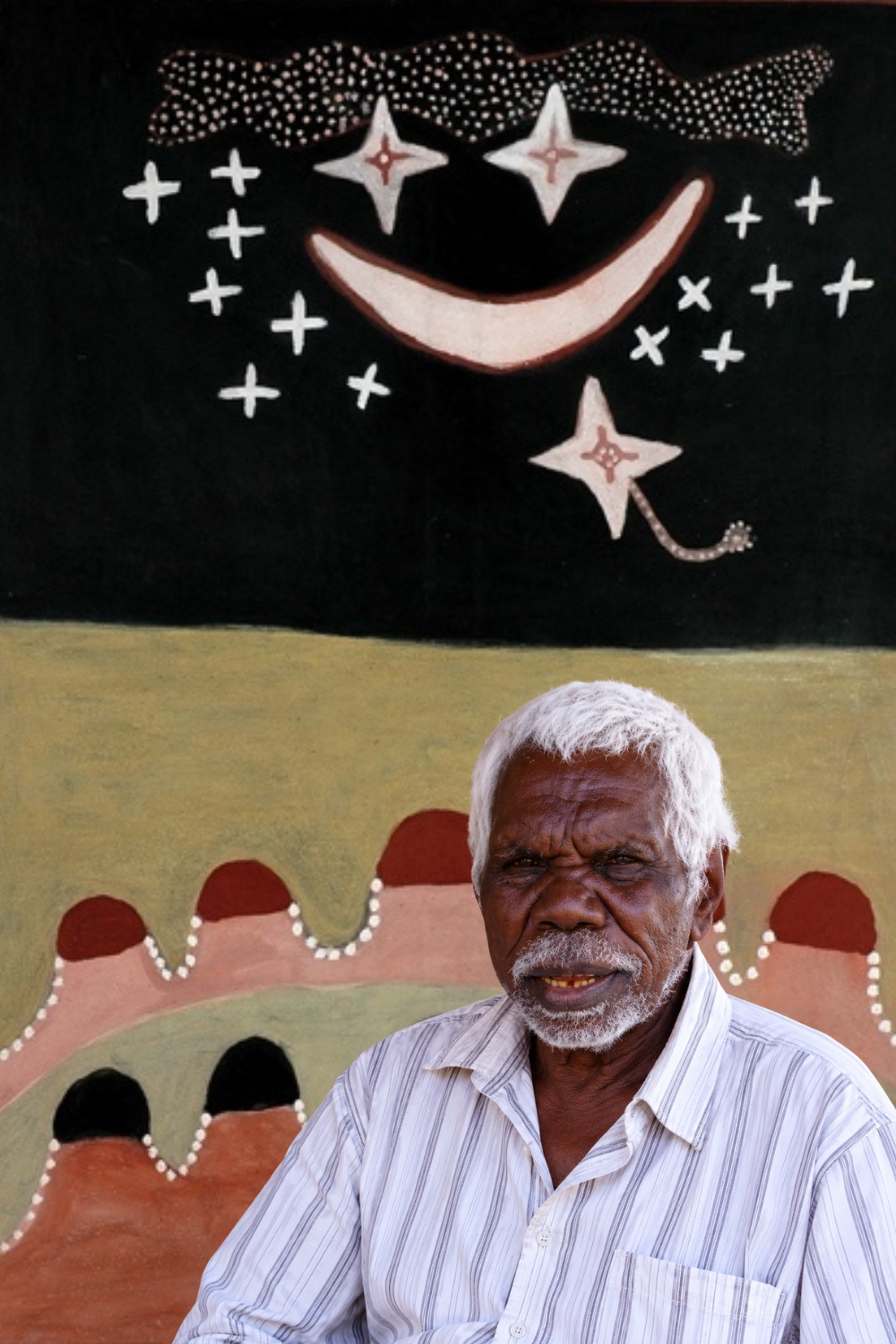
Working predominantly in natural earth pigments, Jandany developed a highly individual style characterised by restrained colour, irregular hill forms, open space and unexpected figurative elements. His subjects include Ngarrgooroon Country and Texas Downs, ancestral beings, animals, ceremony, stars and the night sky. He also developed a remarkable synthesis of Gija Law and Christianity, most famously in Ascension, 1993, now in the National Gallery of Australia.
For addirtional artworks dimensions provenance and auction prices see the Hector Jandany Value support Page
Hector Jandany Biography
Hector Jandany was born at Warmun, formerly Turkey Creek, around 1929. His father was a Miriwoong man from Newry who died when Hector was a baby. His mother was a Gija woman born at Warmun whose Country was Ngarrgooroon, north of Purnululu or the Bungle Bungles. This maternal Country became one of the principal subjects of his paintings.
His mother later married a man from Springvale Station whom Jandany respected as a father. At about ten, relatives took him through his biological father’s Country around Argyle, Newry, Mistake Creek and Texas Downs. He stayed with relatives for extended periods and began working as a stockman while still young.
Jandany subsequently spent many years at Texas Downs Station, mustering cattle and working as a camp cook. Travelling through the region gave him detailed knowledge of particular places and enabled him to participate in ceremonial life. Over these years he acquired extensive knowledge of Ngarrangkarni and became known as a particularly good storyteller.
Station life changed considerably around the period when equal wages were introduced for Aboriginal pastoral workers. When Jimmy Klein, the Texas Downs manager and Jandany’s brother-in-law, retired, many people moved towards Wyndham or Warmun. Jandany found employment in Wyndham as a cook before eventually returning to Warmun.
Gurirr Gurirr and the Beginnings of Warmun Painting
Jandany’s involvement with Gurirr Gurirr, also known as Goorirr Goorirr or Krill Krill, places him close to the beginnings of contemporary Warmun painting. The ceremonial cycle revealed to Rover Thomas combined song, performance and painted boards depicting spirits, places and events. During performances these boards were carried across the shoulders of dancers.
Jandany was not simply influenced by this development later. He was one of its early painters and participants. Sources identify Paddy Jaminji, Hector Jandany, George Mung Mung and Rover Thomas among the first painters associated with Gurirr Gurirr, while other accounts specifically record Jandany contributing paintings for the ceremonial boards.
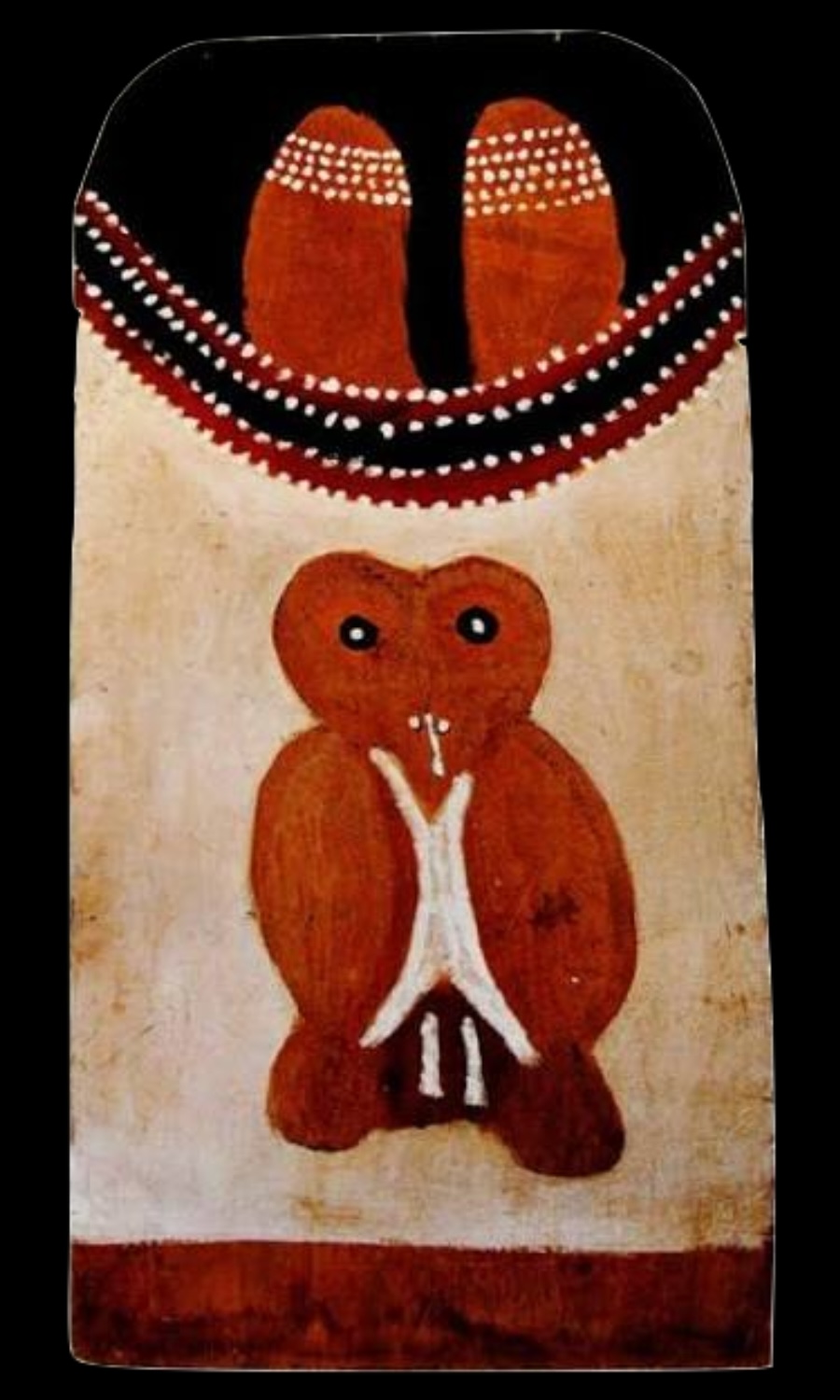
His connection continued well beyond the formative period. Jandany produced Krill Krill boards in 1994, including ancestral owl imagery. Works by Jandany and other Warmun artists were subsequently included in Gurirr Gurirr: Visual Art and Performance by Artists from Warmun and Doon Doon, W.A. at the Museum of Contemporary Art, Sydney, in 1996.
This ceremonial background is important because Gurirr Gurirr helped establish the relationship between ochre painting, Country, ancestral narrative and performance that became fundamental to the emerging Warmun painting movement.
The Bough Shed School
A second important strand of Jandany’s early painting developed through education. When the Bough Shed School opened at Warmun in 1979, with assistance from the Catholic Church, Jandany returned to the community and became chairman of the school, remaining closely involved for many years.
Together with senior people including his close friend Left Hand George and George Mung Mung, he produced paintings and drawings through which children could learn Ngarrangkarni, Gija language and culture. The school developed a form of “two-way” education in which local cultural knowledge remained part of children’s formal education.
Jandany began exhibiting consistently from 1990, with his work subsequently circulating through organisations including Waringarri Aboriginal Arts, Warmun Traditional Artists, Jirrawun Arts and Warmun Art Centre. His influence continued through younger artists; his granddaughter Charlene Carrington recalled sitting with Jandany and Jack Britten, watching them paint and learning traditional methods of preparing and binding ochres.
Hector Jandany Painting Style and Subjects
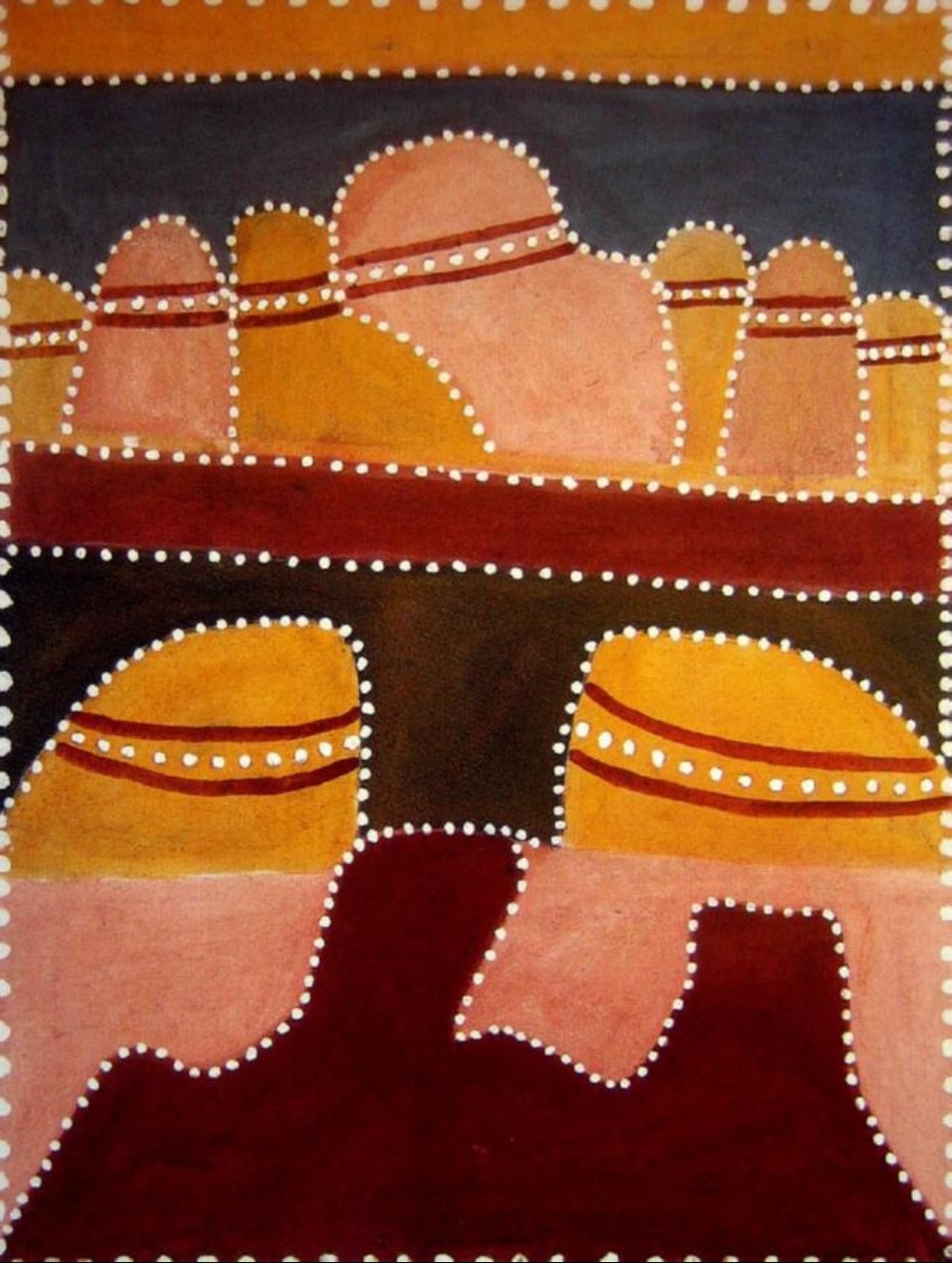
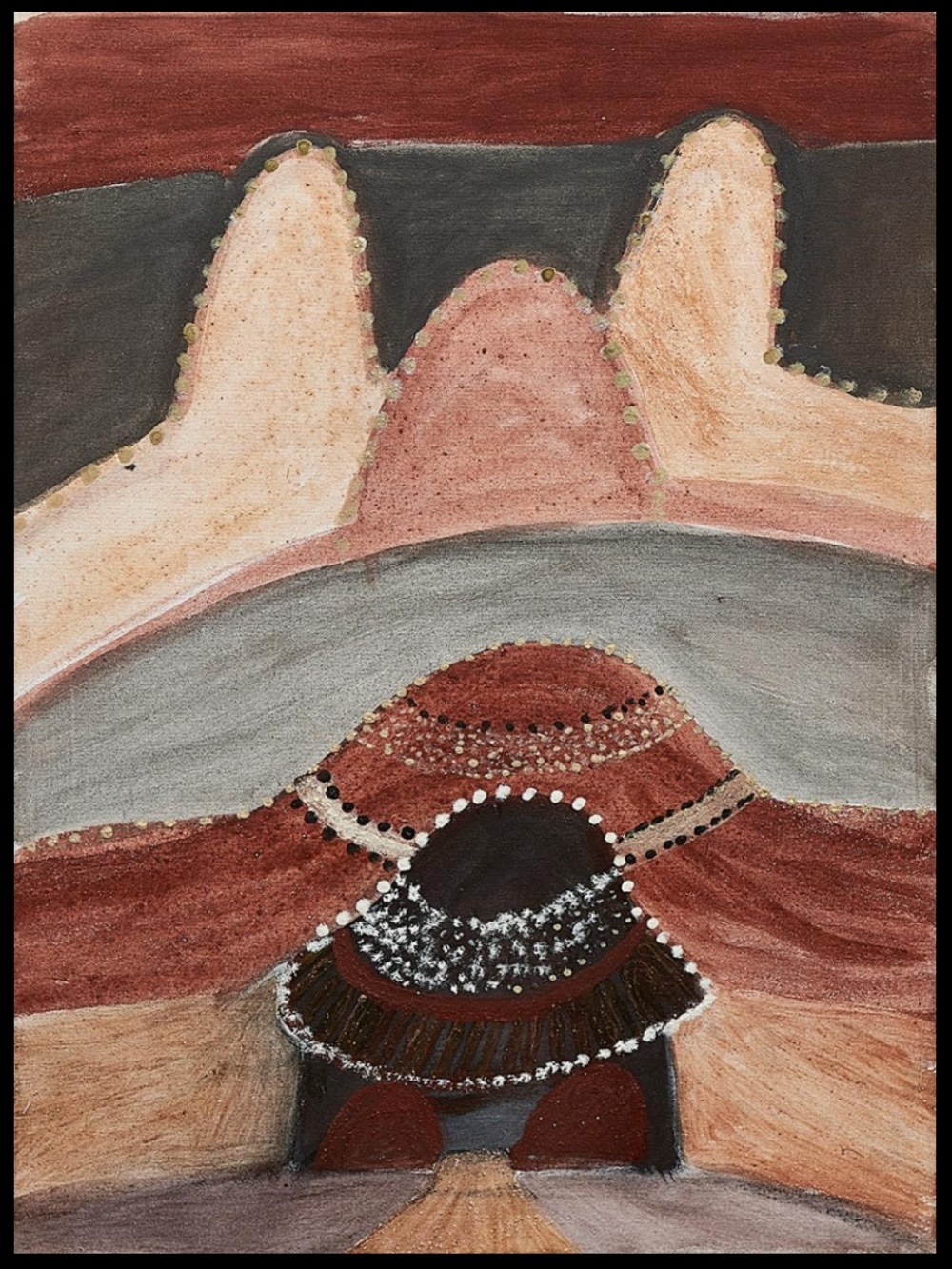
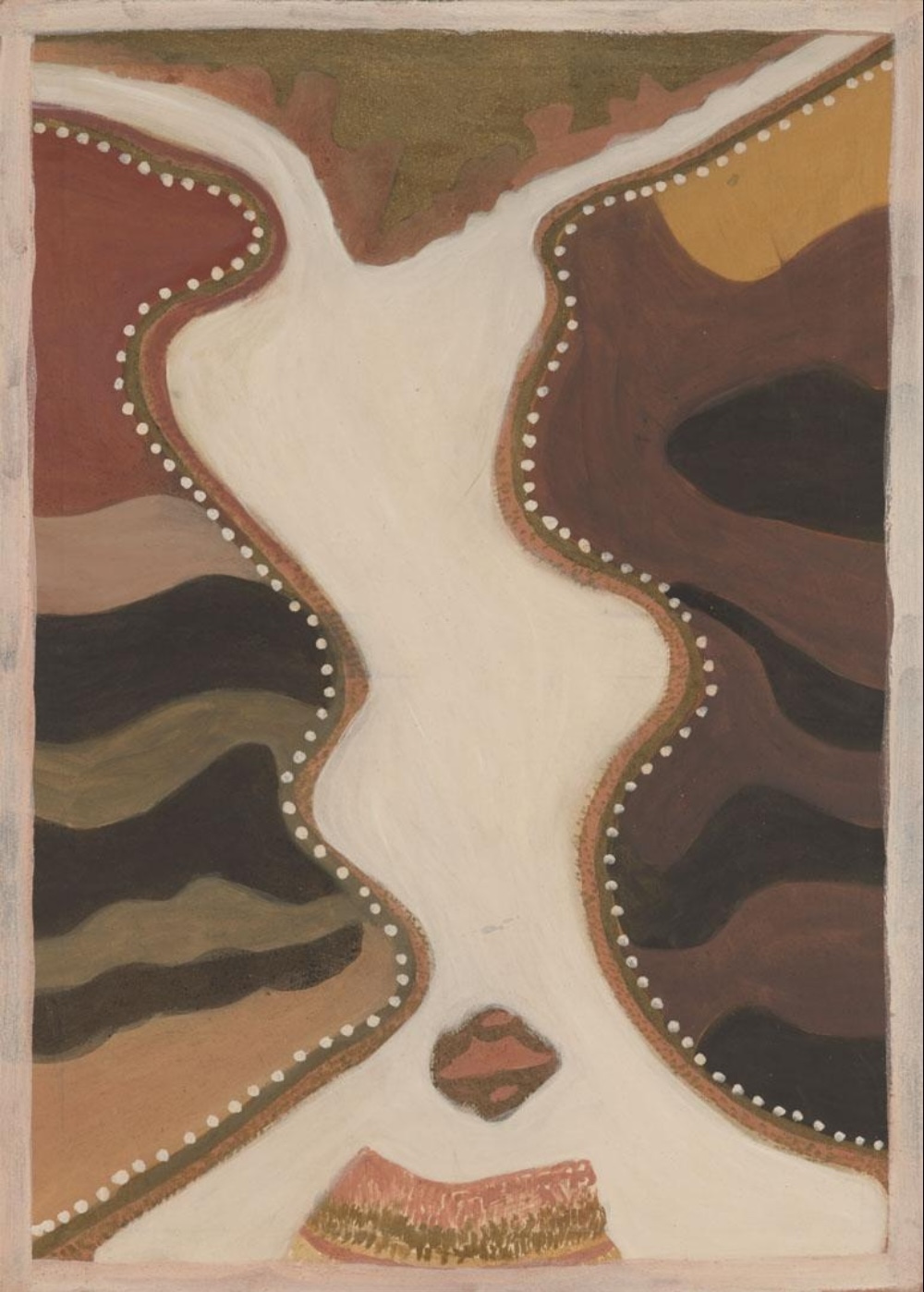
Jandany developed one of the most distinctive styles within Warmun painting. Working predominantly with natural ochres and earth pigments, he favoured subdued colour and sombre tones. The Art Gallery of Western Australia identifies these as characteristic, while curator Judith Ryan noted his isolation of mountains as separate shapes against dark grounds, giving individual landforms unusual visual presence.
His deceptively simple compositions reduce hills to rounded or irregular masses surrounded by open ground, with tracks, waterholes, animals, spirits and figures providing further structure. Contemporary commentary describes his quirky figurative imagery, irregular hill formations and instinctive spatial geometry. Rather than dense decoration, Jandany relied on shape, separation and empty space to convey Country, ceremony and spirituality.
The physical surface was equally distinctive. Jandany applied thin washes of earth pigment before rubbing, sanding and smoothing them, sometimes with a stone. Jeremy Eccles records that his grandfather had taught him to prepare rock surfaces for cave painting with a smooth stone, a practice Jandany later adapted to canvas by scraping back layers to reveal paler ochres. These soft, rubbed and weathered surfaces became particularly characteristic of his later work. Jandany expressed the connection between ochre and Country simply: “you can feel that paint, you can feel that country.”
Ngarrgooroon and Texas Downs
Ngarrgooroon Country, his mother’s traditional estate north of Purnululu, was central to Jandany’s art. Works such as Wirdim (Red Butte), Ngarrgooroon Country, 2000, and Ngarrgooroon Country, 2001, demonstrate its continuing importance throughout his mature career.
These paintings are not conventional landscapes. Hills, waterholes and tracks identify particular places while simultaneously carrying personal, ancestral, historical and ceremonial knowledge. Texas Downs, where Jandany had travelled and worked for much of his life, provided another major group of subjects, including Gardagoon and Winifred Springs.
Some works preserve remarkably specific knowledge. Diawun, 1997, concerns a place where Jandany and other men made wax from spinifex grass beneath boab trees. The wax was used to secure spearheads to bamboo poles. Such paintings encompass Country, plants, technology, work, memory and cultural practice, rather than simply representing “Dreaming landscapes.”
Animals, Ancestors and the Night Sky
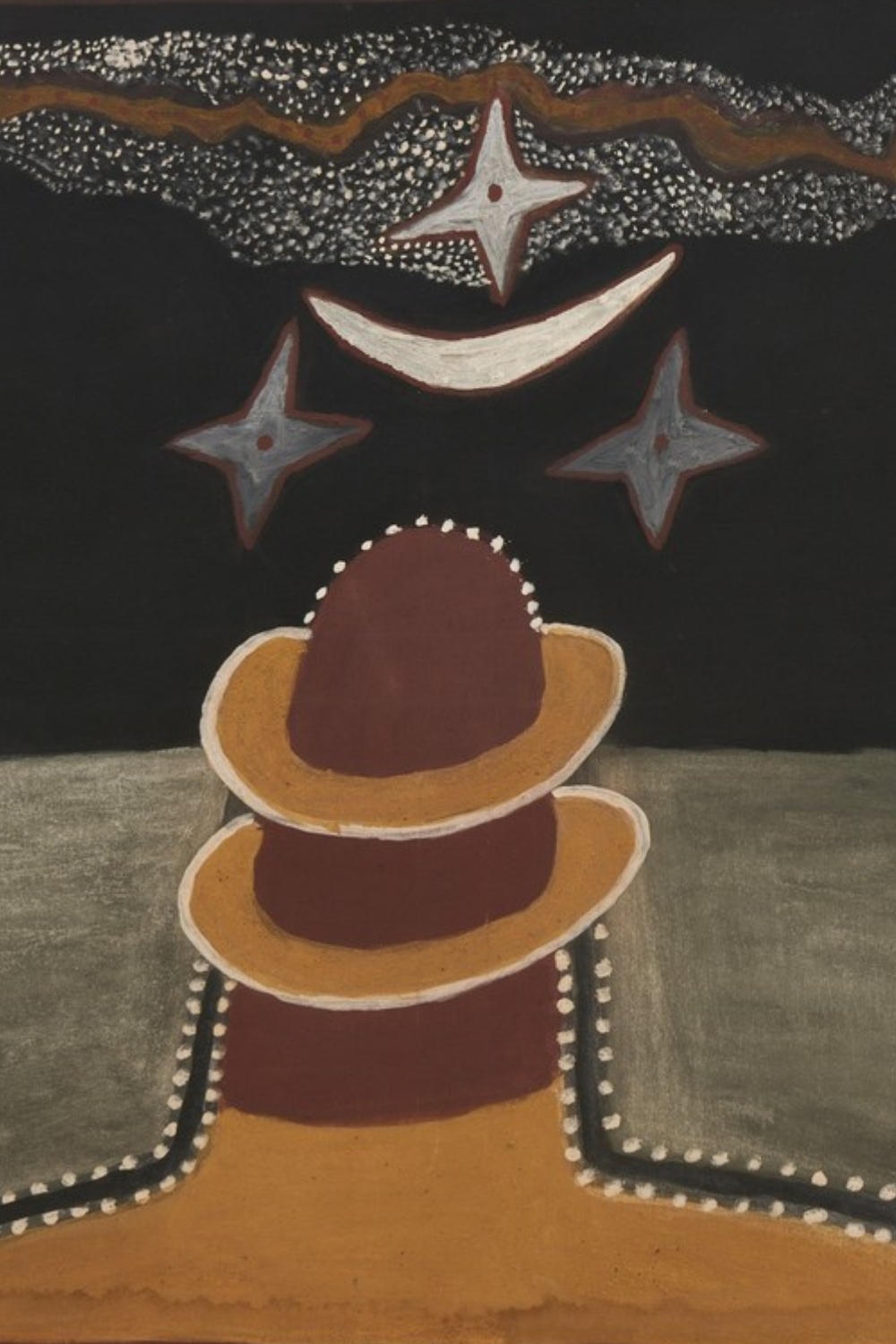
Jandany’s subjects extend well beyond hills, tracks and waterholes to encompass animals, ancestral beings, ceremony and the night sky. His works include Woogoon (Frogs), Big Bull Goanna, Kurrawarrine – Scorpion Dreaming, The Night Sky and Morning Stars, Tjewiball (Long Tail Comet), Where the Star Fell Down in the Dreamtime and Big Full Moon – Karrngin.
The ancestral owl, Dumbuny, associated with Gurirr Gurirr, became particularly personal for Jandany. His 1994 ceremony boards depict simplified owl figures against sparse ochre grounds, while in 2005 he represented himself as Dumbuny between a black and a white tree. Jeremy Eccles records that while Jandany was in hospital an owl appeared outside the Warmun Art Centre; following his death, younger artists painted birds in his memory and the community revived the Gurirr Gurirr ceremony.
Moon and star imagery also connects Jandany with a wider Gija tradition. He painted Garnkeny (Moon man), 1993, while fellow Warmun artist Mabel Juli became particularly renowned for her Garnkiny doo Wardel (Moon and Star) paintings.
Together these works show that Country in Jandany’s art encompasses not simply the physical landscape but animals, ancestral beings, ceremony, stars, moon and the Ngarrangkarni events that connect them.
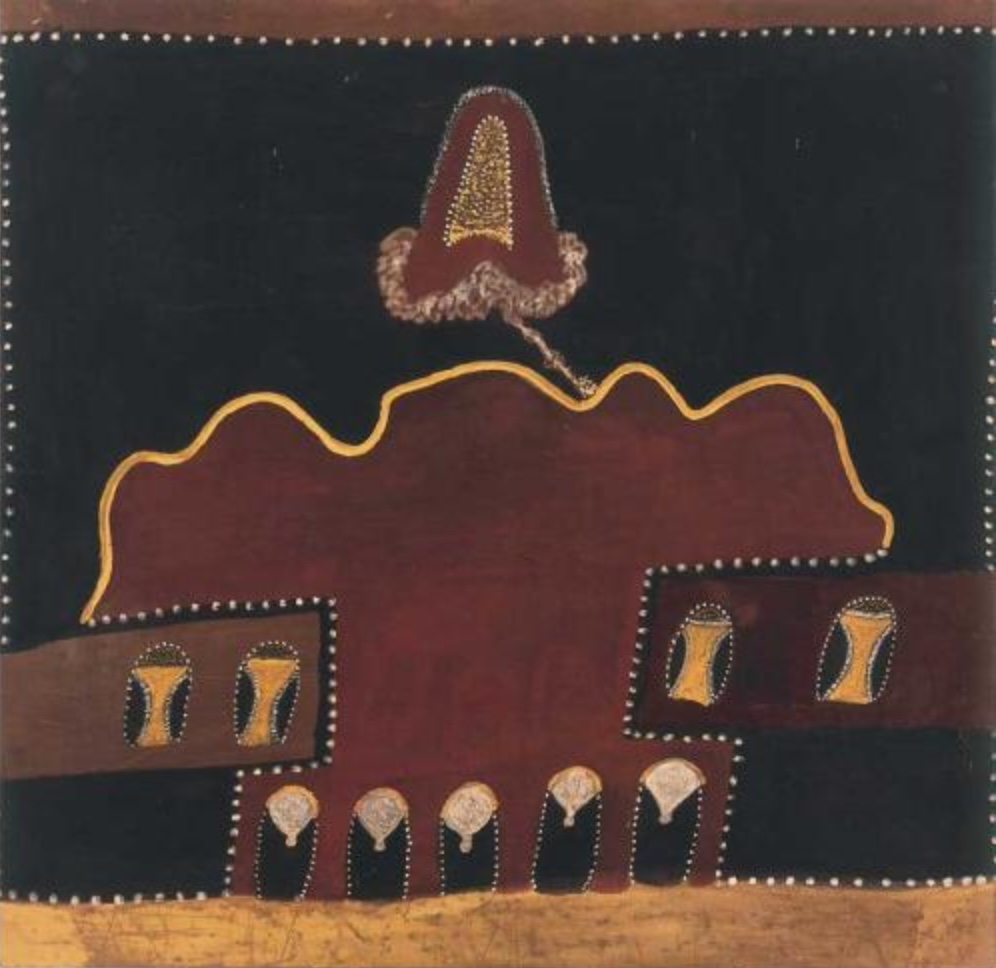
Gija Law and Christianity
One of the most unusual aspects of Jandany’s art is his combination of Christian narratives with Gija spiritual understanding. He developed a personal religious philosophy in which Gospel stories existed alongside Gija Law, Country and Ngarrangkarni.
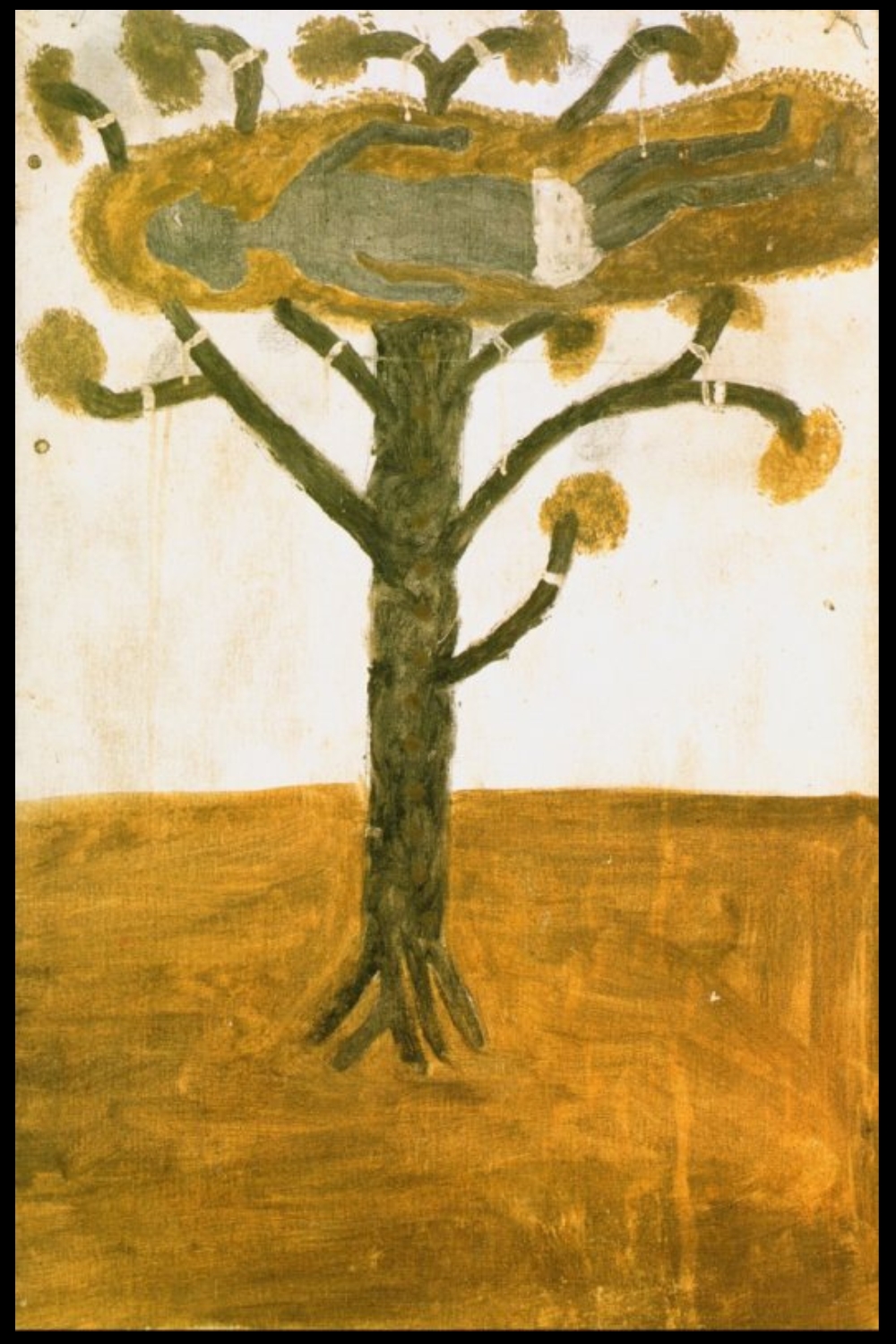
This synthesis appeared early. Around the time of the Bough Shed School, Jandany painted The Dead Christ in a Tree, depicting Christ lying horizontally in a spare black tree awaiting Gija burial ceremonies—placing the Crucifixion within a Gija ceremonial context.
The outstanding later example is Ascension, 1993, acquired by the National Gallery of Australia and described by the Gallery as arguably his most significant painting. Spirits prepare fire and fish while Jesus shares his final meal with his friends; smoke then rises behind a hill and carries Jesus to Heaven. Through fire, food, smoke, spirits, hills and Country, Jandany brings the Christian narrative into his own spiritual world.
Christian subjects also extended beyond canvas. In 1993 he produced Mary and Joseph, wooden figures painted with earth pigments.
Hector Jandany’s Importance
Hector Jandany’s importance lies in the convergence of ceremony, cultural education and contemporary painting. His early involvement as a painter and participant in Gurirr Gurirr places him close to one of the principal sources of contemporary Warmun painting, while his work at the Bough Shed School from 1979 demonstrates how painting simultaneously functioned as a means of transmitting Ngarrangkarni, language and knowledge of Country.
Rather than simply adopting an established Warmun style, Jandany developed a highly individual body of work encompassing Country, ceremony, animals, traditional practices, celestial events and a distinctive meeting of Gija and Christian spirituality. His influence also extended to younger generations of Warmun artists.
Although he never achieved the secondary-market prominence of Rover Thomas or Queenie McKenzie, this understates his historical position. Jandany belongs close to the foundations of the movement itself: a senior Gija storyteller and cultural leader, an early Gurirr Gurirr painter and participant, a long-serving educator, and a distinctive artist who helped carry knowledge from ceremony and Country into contemporary Warmun painting.
Hector Jandany’s Value and Auction results
Works Offered at Auction: 149
Sale Rate: 53%
Highest Sale: $140,000 AUD
Median Sale Price: $2,200 AUD
For artworks dimensions provenance and auction prices see Hector Jandany Value Page
In Public Collections
Hector Jandany’s work is represented in major Australian public collections, including:
- National Gallery of Australia, Canberra — including Ascension, 1993, described by the NGA as arguably his most significant painting.
- National Gallery of Victoria, Melbourne — holds at least six works, including Gayirriwariny Mountain Range, Bush Ant Dreaming, Milky Way Dreaming, Night Sky, Quiet Time Dreaming, A Dreaming Place, Bungle Bungle and Big Turtle.
- Art Gallery of Western Australia, Perth — including Goodarrinyarrin, Jallijgewaren and Ngarrljawun, 2001, and Ngarrgooroon, 2002.
- Queensland Art Gallery | Gallery of Modern Art, Brisbane — including Wirdim (Red Butte), Ngarrgooroon Country, 2000, and Ngarrgooroon Country, 2001.
- Art Gallery of New South Wales, Sydney — collection records include Goondarrinngarrin, 2001.
- Geelong Gallery, Victoria — including Garnkeny (Moon Man), 1993
Further Reading
- Jeremy Eccles, “Hector Jandany,” Art & Australia, Vol. 44, No. 3, 2007. Probably the most useful single article specifically about Jandany. It discusses his Gija and Christian beliefs, painting technique, relationship with Country and the distinctive character of his work.
- Franchesca Cubillo and Wally Caruana (eds), Aboriginal and Torres Strait Islander Art: Collection Highlights, National Gallery of Australia, 2010. Includes discussion of Jandany’s Ascension, 1993, and the relationship between Gija belief, the Gospel story and Warmun’s two-way education program. The NGA also provides its Jandany material online.
- Hetti Perkins, True Stories: Art of the East Kimberley, Art Gallery of New South Wales, 2003. Important for placing Jandany alongside Rover Thomas, Paddy Jaminji, George Mung Mung, Queenie McKenzie, Jack Britten, Paddy Bedford and other artists responsible for the development of East Kimberley painting.
- Judith Ryan, Images of Power: Aboriginal Art of the Kimberley, National Gallery of Victoria, 1993. A major reference for understanding the development and aesthetics of East Kimberley painting and particularly useful context for Jandany’s restrained ochre palette and treatment of Country.
All images featured in this article are presented strictly for educational and informational purposes.
This website may include copyrighted material for which specific authorization has not been obtained from the copyright owner.
All such images are presumed to be the intellectual property of the respective artist or their estate, and are used in accordance with principles of fair dealing or fair use under applicable copyright law.