
Judy Watson Napangardi: Biography painting style and importance
c. 1925–2016
Warlpiri
Mina Mina, ancestral women’s Country
Yuendumu / Nyirripi
Warlpiri Art / Western Desert Art
Warlukurlangu Artists
Painting on canvas
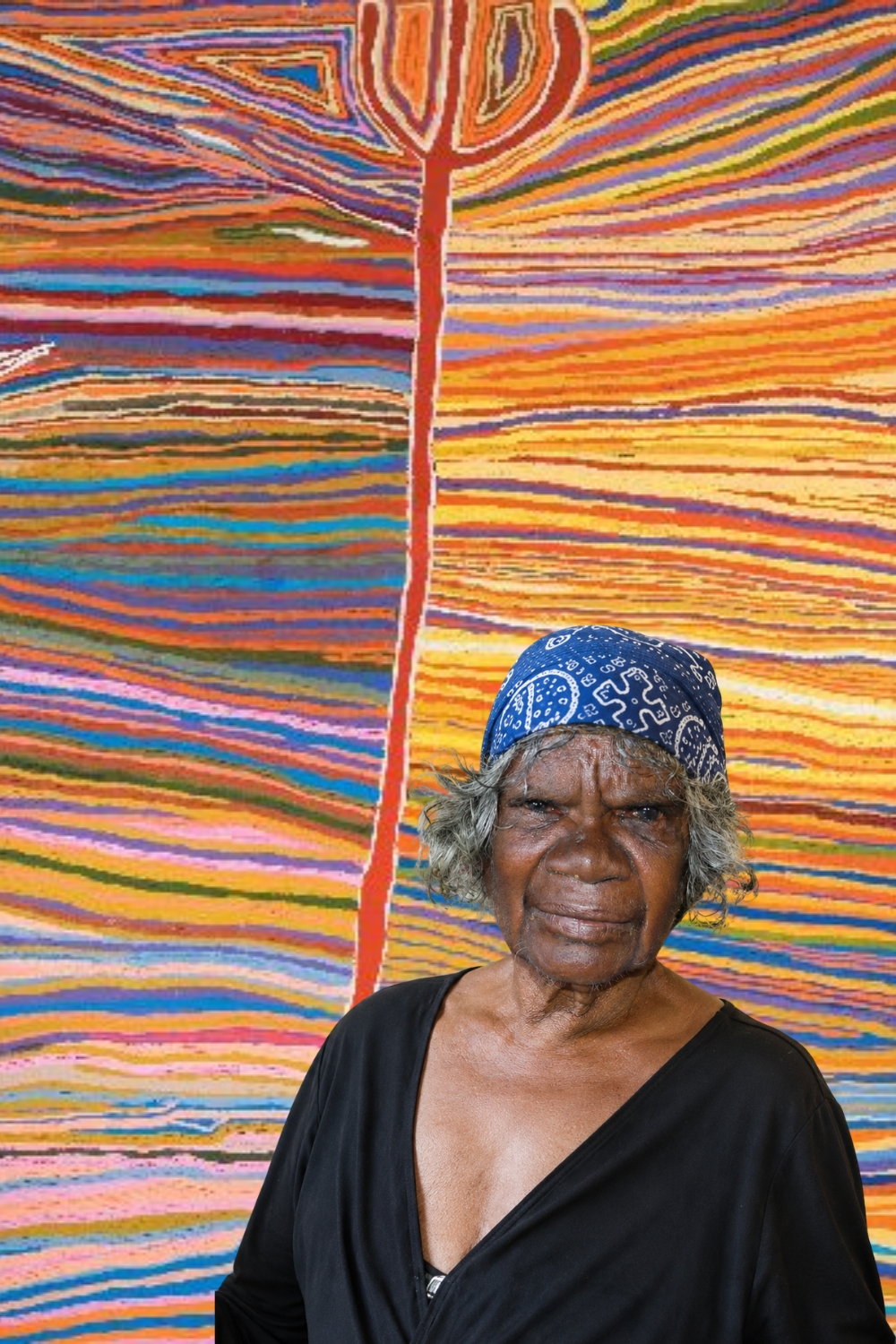
Judy Watson Napangardi (c.1925–2016) was a major Warlpiri artist and one of the most distinctive women painters of the Western Desert Art movement. Based at Yuendumu in the Northern Territory, she became best known for paintings of Mina Mina Jukurrpa, the ancestral journeys of women through Country west of Yuendumu. She learned to paint from her elder sister, Maggie Watson Napangardi, and the two painted alongside one another at Warlukurlangu Artists before Judy developed a striking visual language of her own.
Her mature paintings are recognised by brilliant colour, sweeping lines and thousands of elongated or “dragged” dots. These marks create rippling fields of movement through which imagery associated with women, digging sticks, ngalyipi (snake vine), food, ceremony and ancestral journeys appears and disappears.
Judy had travelled through much of this Country as a young woman, giving her an intimate geographical and cultural knowledge of the places represented in her paintings. Through colour, rhythm and movement, she transformed Mina Mina Jukurrpa into one of the most distinctive bodies of work in contemporary Warlpiri art.
For more detailed research into why Judy Napangardi Watson paintings are valuable, which periods and styles collectors favour, and previous auction results, see my Judy Napangardi Watson Art Values page.
Judy Watson Napangardi Biography and Painting Career
Judy Watson Napangardi was born around 1925 at Yarungkanji on Mount Doreen Station, northwest of Yuendumu in the Northern Territory. She belonged to a generation of Warlpiri people who spent much of their early lives travelling across ancestral Country before permanent settlement.
As a young girl, Judy travelled long distances on foot with her family through Mina Mina, Yingipurlangu and surrounding areas. Her family lived from the resources of Country, gathering bush tomatoes, bush plums and other plant foods and hunting animals including sand goanna. The places, plants and ancestral narratives Judy encountered during these years would later become central to her paintings.
Judy was the younger sister of the important Warlpiri artist Maggie Watson Napangardi, who taught her to paint. The sisters painted alongside one another at Warlukurlangu Artists at Yuendumu before Judy gradually developed a highly individual visual language of her own.
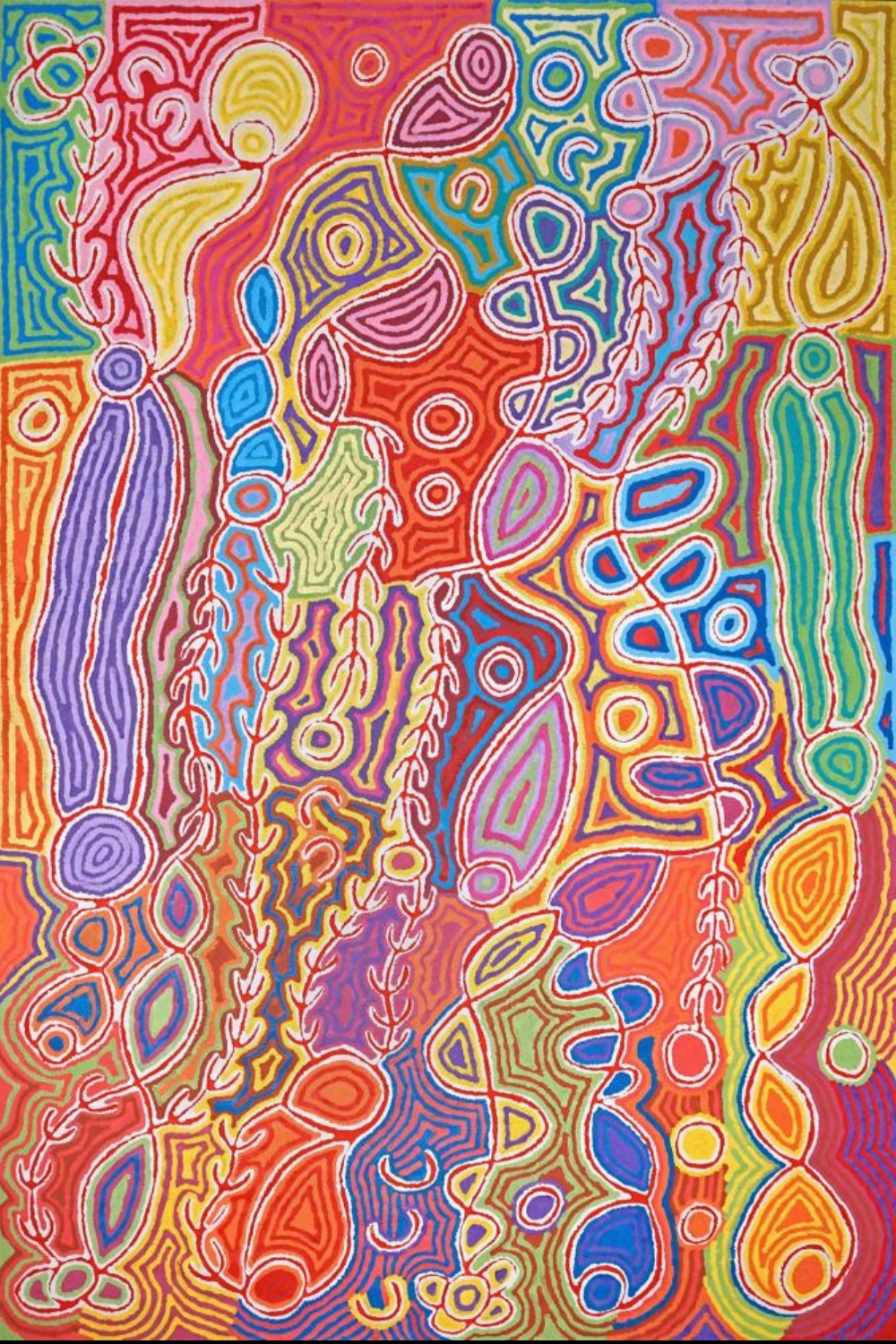
Judy’s earlier paintings employed recognisable Western Desert iconography associated with women’s ancestral narratives, Country and ceremony. As her work developed, however, these individual symbols became increasingly absorbed into the overall composition. Lines became ribbons, dots became elongated strokes, and thousands of repeated marks spread across the canvas in great fields of colour and movement.
By the mid-1990s, Judy had developed the distinctive style for which she became best known. Her paintings could appear increasingly abstract, yet continued to retain kurruwarri—visual details connecting the work with particular places, ancestral journeys, ceremony and song.
This development became one of the defining characteristics of Judy Watson Napangardi’s art: increasing visual abstraction did not mean decreasing cultural specificity. Instead, inherited Warlpiri imagery was transformed into an individual visual language of rhythm, colour and movement.
What Did Judy Watson Napangardi Paint?
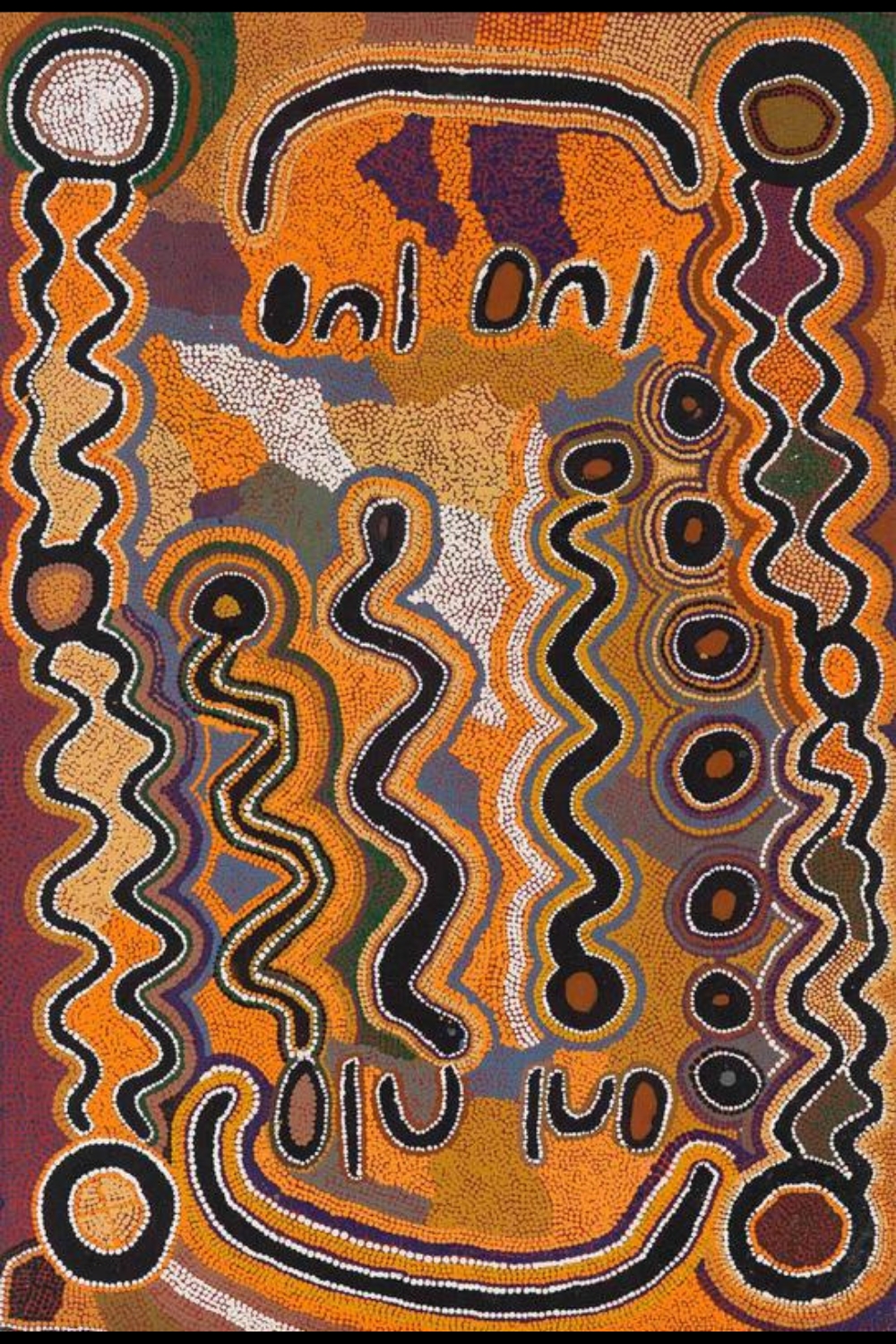
Judy Watson Napangardi painted the Country, ancestral journeys and ceremonial knowledge of Warlpiri women, particularly those associated with Mina Mina, an important women’s ceremonial site far west of Yuendumu, near Lake Mackay and the Western Australian border.
The ancestral narrative associated with Mina Mina concerns a group of women who danced there before travelling east across the desert. As they danced, karlangu, or digging sticks, emerged from the ground. The women collected them and continued their journey, dancing, performing ceremonies, gathering food and collecting ngalyipi, or snake vine.
Their journey connected numerous places including Karntakurlangu, Janyinki, Parapurnta, Kimayi and Munyuparntiparnti before continuing beyond Warlpiri Country towards Coniston and Alcoota.
Judy’s paintings therefore concern much more than a single place. They evoke movement through Country and an interconnected ancestral geography of places, pathways, plants, foods, ceremonial objects and women’s activities. Her documented subjects include Mina Mina, Karnta Jukurrpa or Women’s Dreaming, ngalyipi or snake vine, hairstring, jintiparnta or native desert truffle, kurrkara or desert oak, Janyinki and karlangu or digging sticks.
Symbols in Judy Watson Napangardi’s Paintings
There is no universal dictionary for interpreting Aboriginal symbols; meanings depend on the artist, Country, narrative and individual painting. In documented examples of Judy’s work, however, particular motifs have been identified.
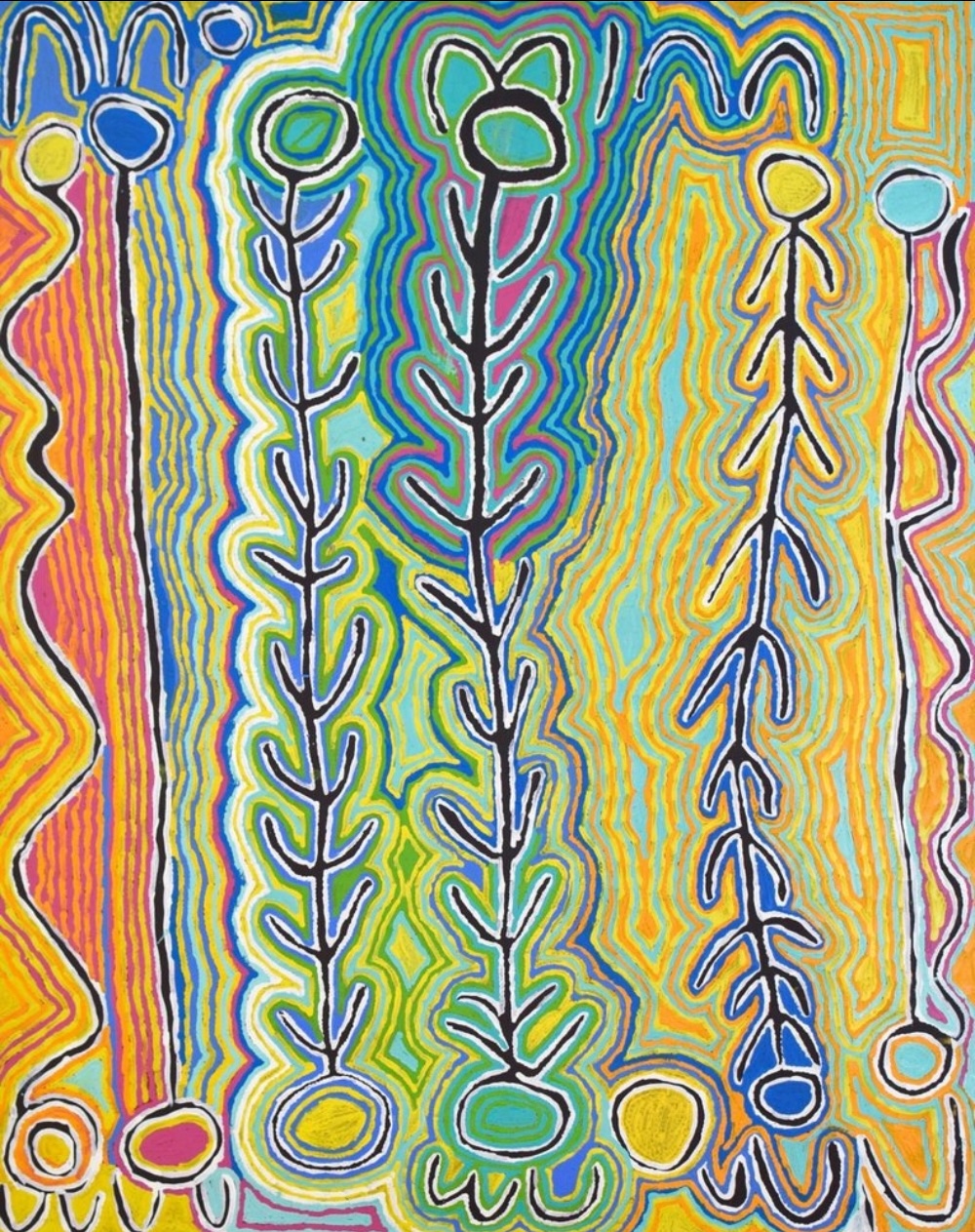
Sinuous lines can represent ngalyipi, or snake vine; concentric circles may represent jintiparnta, an edible desert truffle; and straight lines can depict karlangu, or digging sticks. In some paintings, U-shaped forms represent women, while circular forms may represent food or coolamons.
These motifs work together to evoke the women, places, resources and ceremonies associated with the larger ancestral journey.
Ngalyipi, Hairstring and Ceremony
Ngalyipi (Tinospora smilacina) is a rope-like climbing plant with practical, medicinal and ceremonial uses. The ancestral women gathered it during their journey from Mina Mina, and in Judy’s paintings it can appear as long, interweaving lines.
Hairstring, associated with women’s ceremony, is another recurring subject. Rather than depicting it literally, Judy could incorporate its significance into flowing bands and rippling fields of marks.
In both cases, symbol and style become difficult to separate. Elements carrying particular meanings also contribute to the rhythm of the composition: the ancestral women travelled through Country, and Judy’s paintings themselves appear to move.
Judy Watson Napangardi’s Painting Style
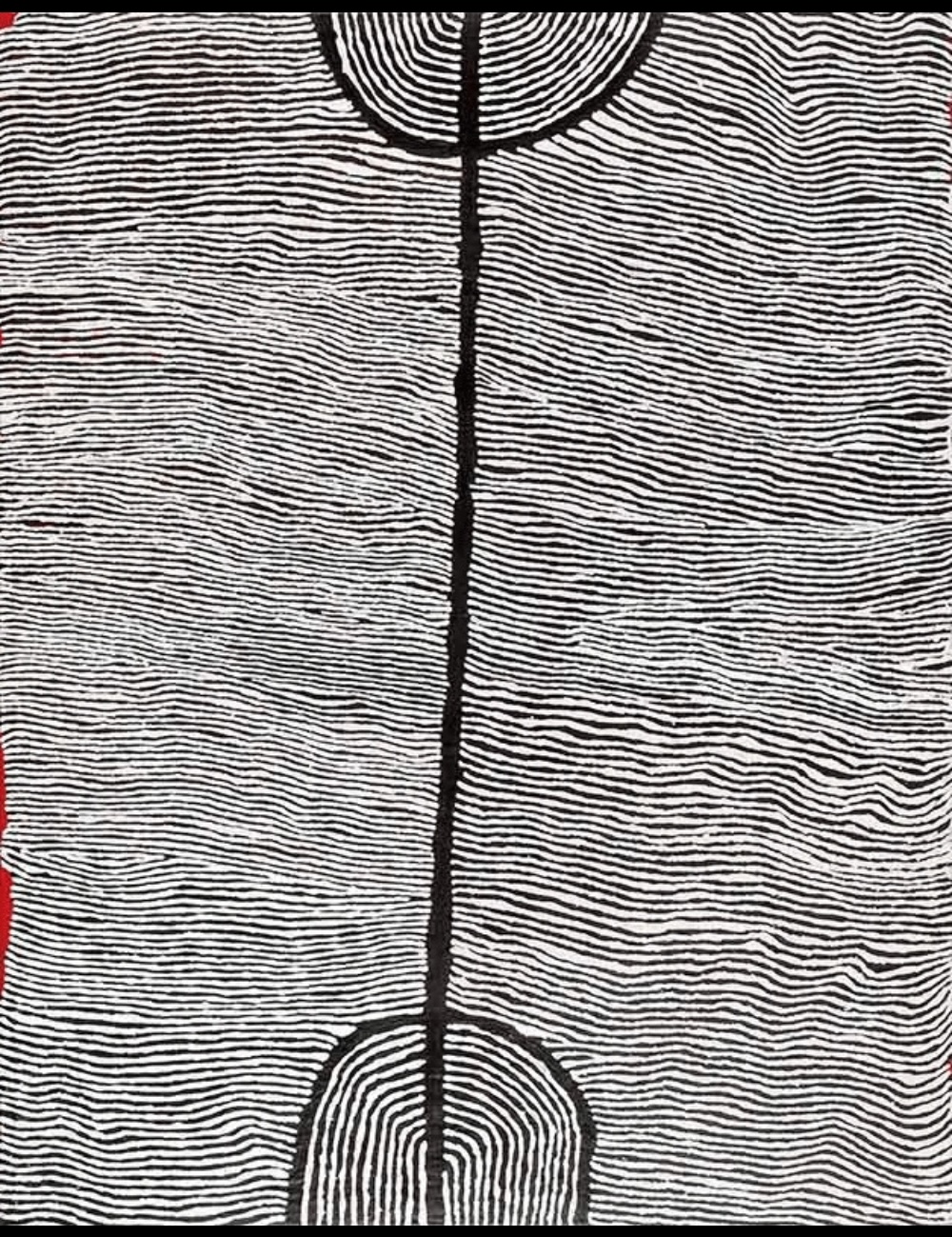
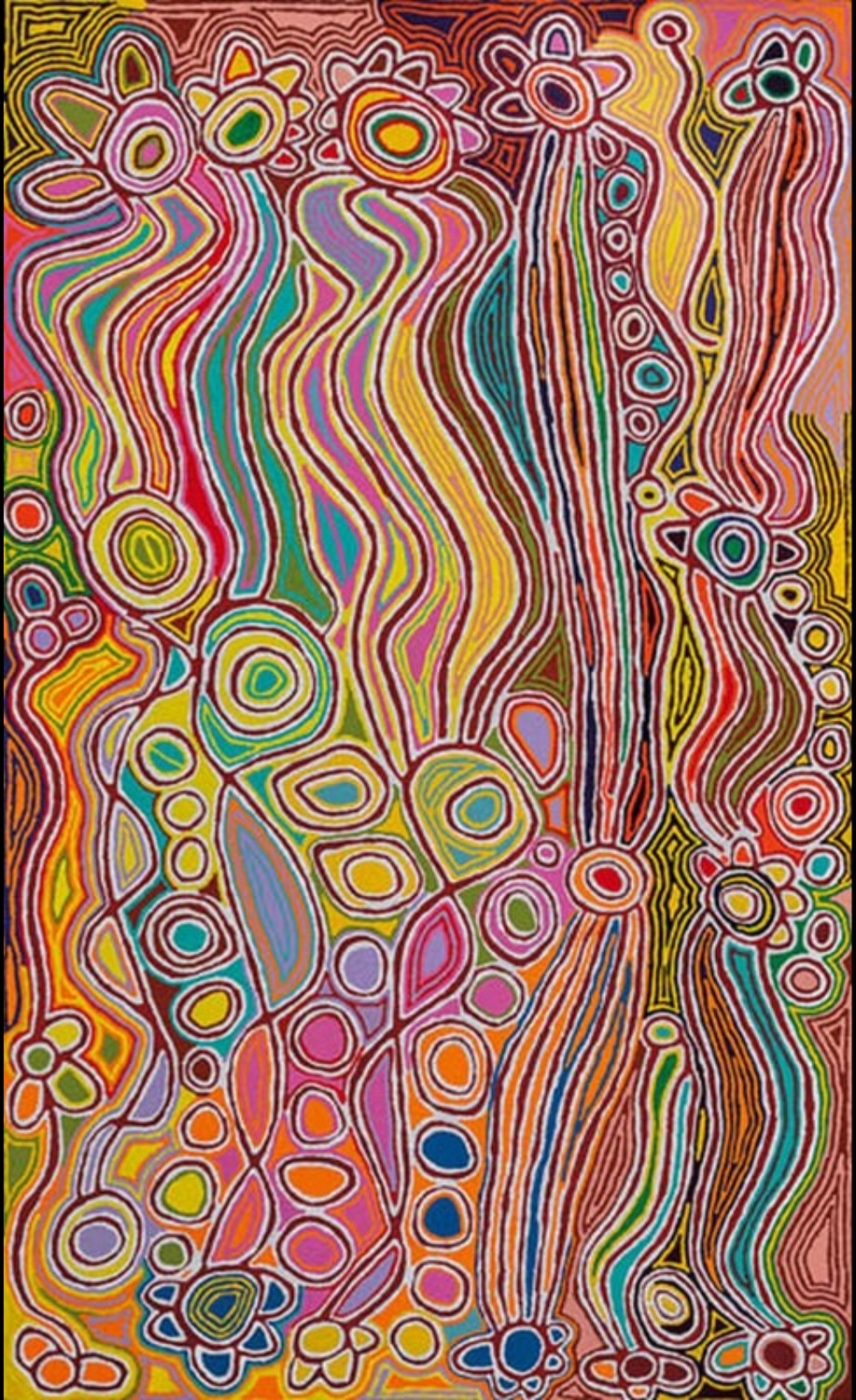
Judy Watson Napangardi’s mature paintings are immediately recognisable for their combination of brilliant colour, rhythmic movement.
Her paintings commonly feature:
- elongated rather than perfectly circular dots
- dense fields of repeated marks
- sweeping curvilinear lines
- rippling bands moving across the canvas
- brilliant reds, oranges, yellows, blues, purples and white
- layered surfaces that appear to shimmer
- traditional motifs absorbed into larger abstract structures
The most distinctive feature is Judy’s treatment of the dot. Rather than repeatedly placing neat circular dots onto the surface, she often pulled or dragged the loaded brush slightly across the canvas, producing thousands of elongated marks.
Individually these marks are simple brushstrokes. Across a large canvas, however, they form extraordinary rippling surfaces. Lines weave through fields of colour, bands expand and contract, and repeated marks create the impression of movement passing across the painting.
This sense of movement is particularly appropriate to Judy’s paintings of Mina Mina and the journeys of ancestral women. Catalogue descriptions of her work connect these rippling surfaces with women dancing and travelling through Country. The dragged dot therefore does more than create texture: it allows movement itself to become part of the painting’s visual language.
Colour and Movement
Colour is equally important to Judy’s mature style. Unlike artists who worked predominantly within restricted palettes, she frequently embraced brilliant combinations of red, orange, yellow, blue, purple, pink and white.
She used these colours rhythmically rather than simply to describe the physical appearance of the desert. Warm and cool passages advance and retreat across the surface, while neighbouring colours intensify one another. Combined with her elongated dots and sweeping lines, colour gives many of her paintings an extraordinary sense of optical movement.
This interaction between colour, repetition, line and rhythm helps explain why Judy’s mature paintings can appear highly abstract while remaining connected to particular places and ancestral narratives. Traditional motifs were not necessarily removed as her style developed; increasingly, they became absorbed into the larger movement of the composition.
Judy Watson Napangardi’s Importance
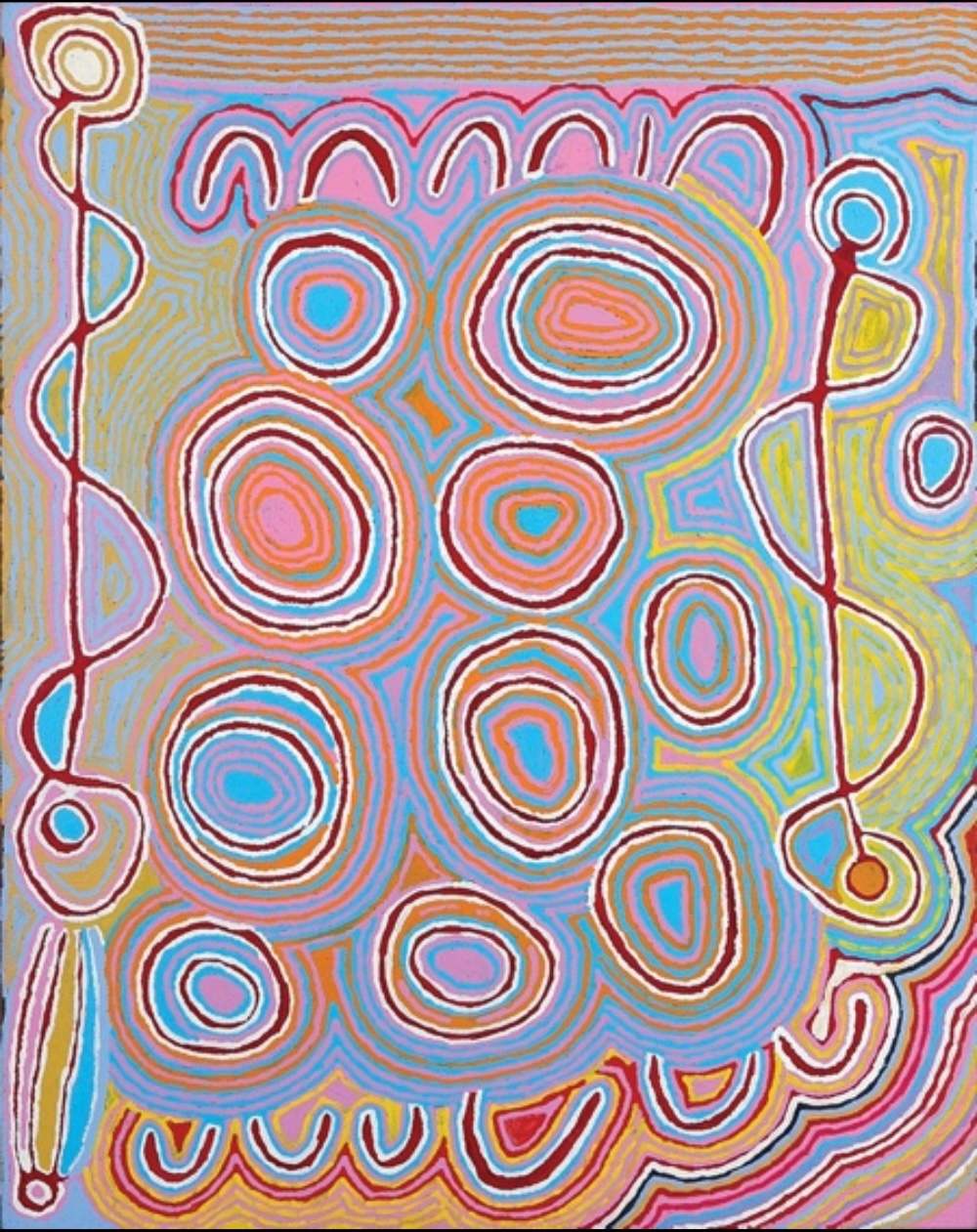
Judy Watson Napangardi occupies an important place in contemporary Warlpiri art because she developed a highly individual visual language while remaining closely connected to Country, ancestral journeys and ceremonial knowledge.
In her mature paintings, inherited imagery became increasingly absorbed into larger compositions. Snake vine became sinuous movement, ancestral journeys became rhythmic repetition, and ceremonial narratives were expressed through sweeping lines and fields of elongated dots.
Rather than simply representing places through individual symbols, Judy’s paintings evoke movement through Country. Colour, line and repetition became inseparable from the ancestral narratives to which the works referred.
This combination of cultural continuity and artistic innovation allowed Judy to create paintings that appear highly abstract while remaining grounded in particular Warlpiri places and traditions. It established her as one of the most distinctive artists of the Yuendumu painting movement.
Judy Watson Napangardi in Major Public Collections
Judy Watson Napangardi’s work is represented in important Australian public collections, reflecting the institutional recognition she achieved during her career.
Collections holding her work include:
- Art Gallery of New South Wales, Sydney
- Queensland Art Gallery
- Flinders University Museum of Art, Adelaide
- Australian Parliament House Art Collection, Canberra
Her paintings and prints in these collections include subjects central to her career, particularly Mina Mina, Women’s Dreaming and Hairstring, providing an important public record of her distinctive contribution to contemporary Warlpiri art.
Further Reading
For readers interested in Judy Watson Napangardi and the development of contemporary Warlpiri painting, the following publications provide useful biographical, artistic and cultural context:
- Christine Nicholls, “The Three Napangardis: To the Memory of Maggie Napangardi Watson,” in Judith Ryan (ed.), Colour Power: Aboriginal Art Post 1984 in the Collection of the National Gallery of Victoria, National Gallery of Victoria, Melbourne, 2004, pp. 123–125.
- Marie Geissler, “Judy Watson Napangardi,” Craft Arts International, 2007–08.
- Howard Morphy, Aboriginal Art, Phaidon Press, London, 1998.
- Howard Morphy and Margo Smith Boles (eds.), Art from the Land: Dialogues with the Kluge-Ruhe Collection of Australian Aboriginal Art, University of Virginia Press, Charlottesville, 1999.
- Australian National University, Crossing Cultures: Art from the Boxer Collection, Drill Hall Gallery, Australian National University, Canberra, 2000.
- Margo Birnberg and Janusz B. Kreczmanski, Aboriginal Artists: Dictionary of Biographies, J.B. Publishing, 2004.
All images featured in this article are presented strictly for educational and informational purposes.
This website may include copyrighted material for which specific authorization has not been obtained from the copyright owner.
All such images are presumed to be the intellectual property of the respective artist or their estate, and are used in accordance with principles of fair dealing or fair use under applicable copyright law.