
Sunfly Tjampitjin: Biography and painting style
c. 1916–1996
Kukatja
Murrunpa, Alec Ross Ranges, north-west of Lake Mackay
Yagga Yagga / Balgo
Balgo Art / Western Desert Art
Warlayirti Artists
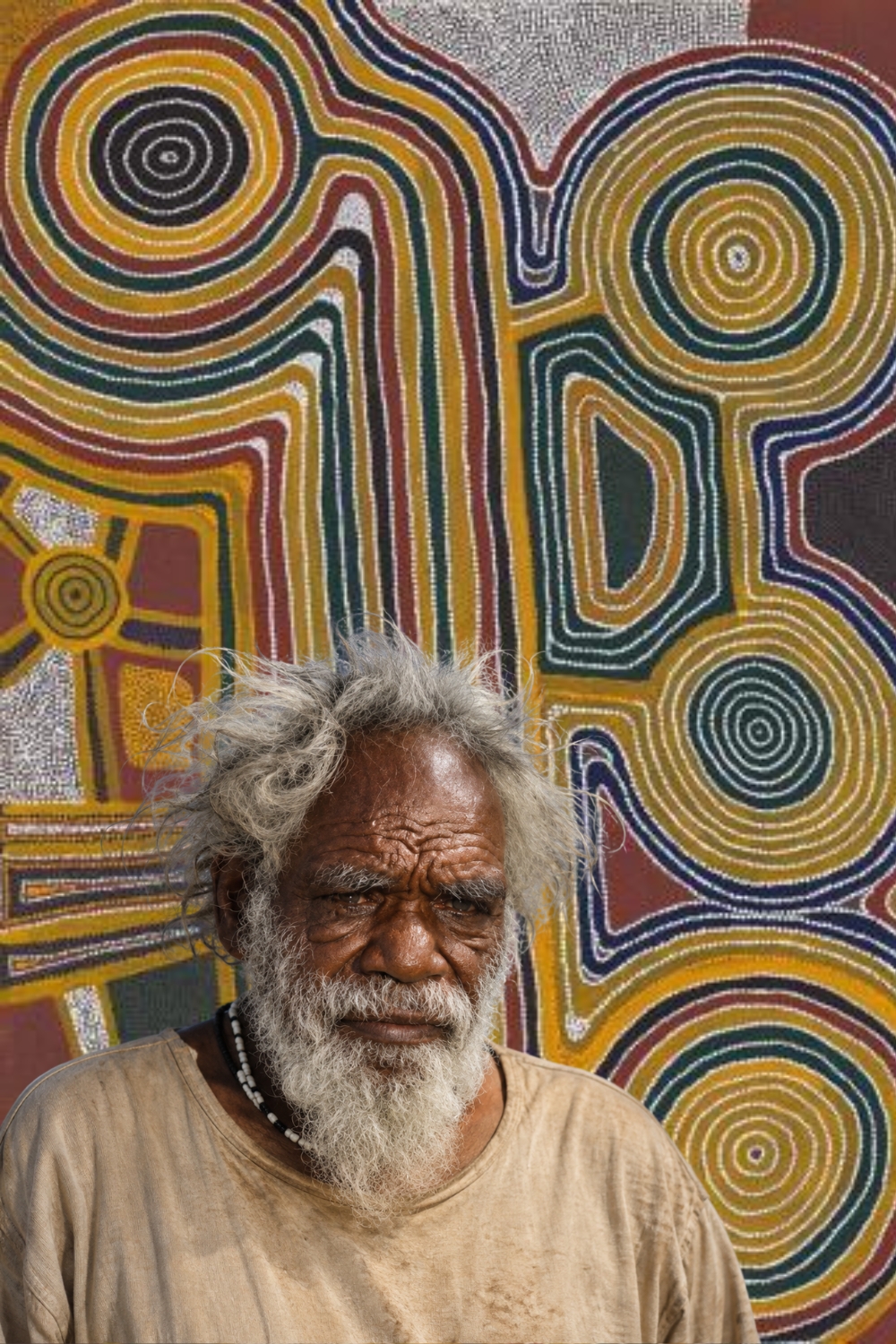
Murtiyarru Sunfly Tjampitjin (c.1916–1996) was a senior Kukatja lawman and one of the foundational painters of the Balgo Art movement. Like Wimmitji Tjapangarti and Eubena Nampitjin he belonged to the first generation of Balgo Hills elders who began transferring knowledge of Country, ancestral journeys and ceremonial places onto permanent painting surfaces during the early 1980s.
Born around Murrunpa in the Alec Ross Ranges, north-west of Lake Mackay, Sunfly became a senior custodian of men’s Tingari Law. His paintings encompass Tingari traditions, Luurnpa, the Kingfisher ancestral being, water places and ceremonial sites associated with his Country.
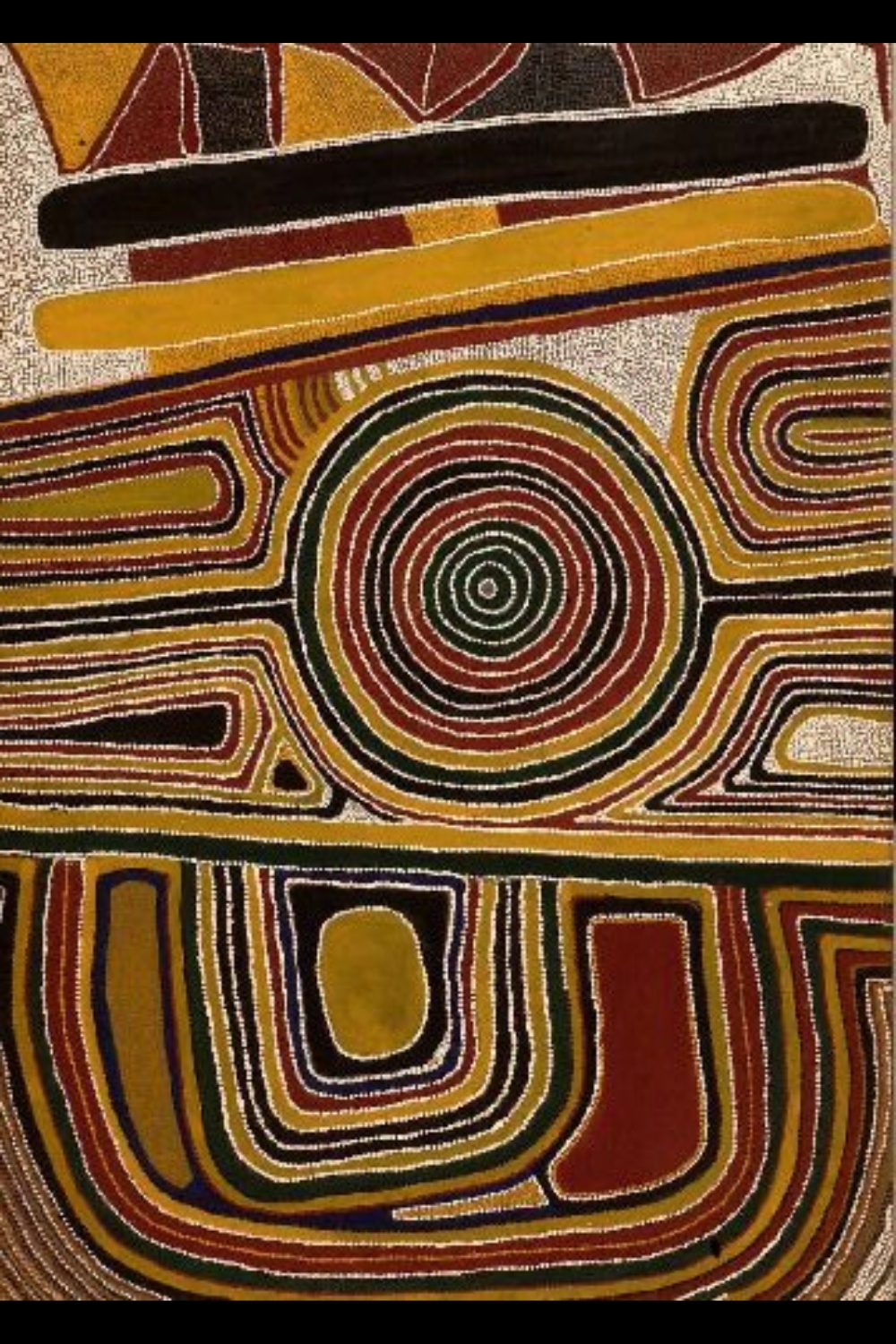
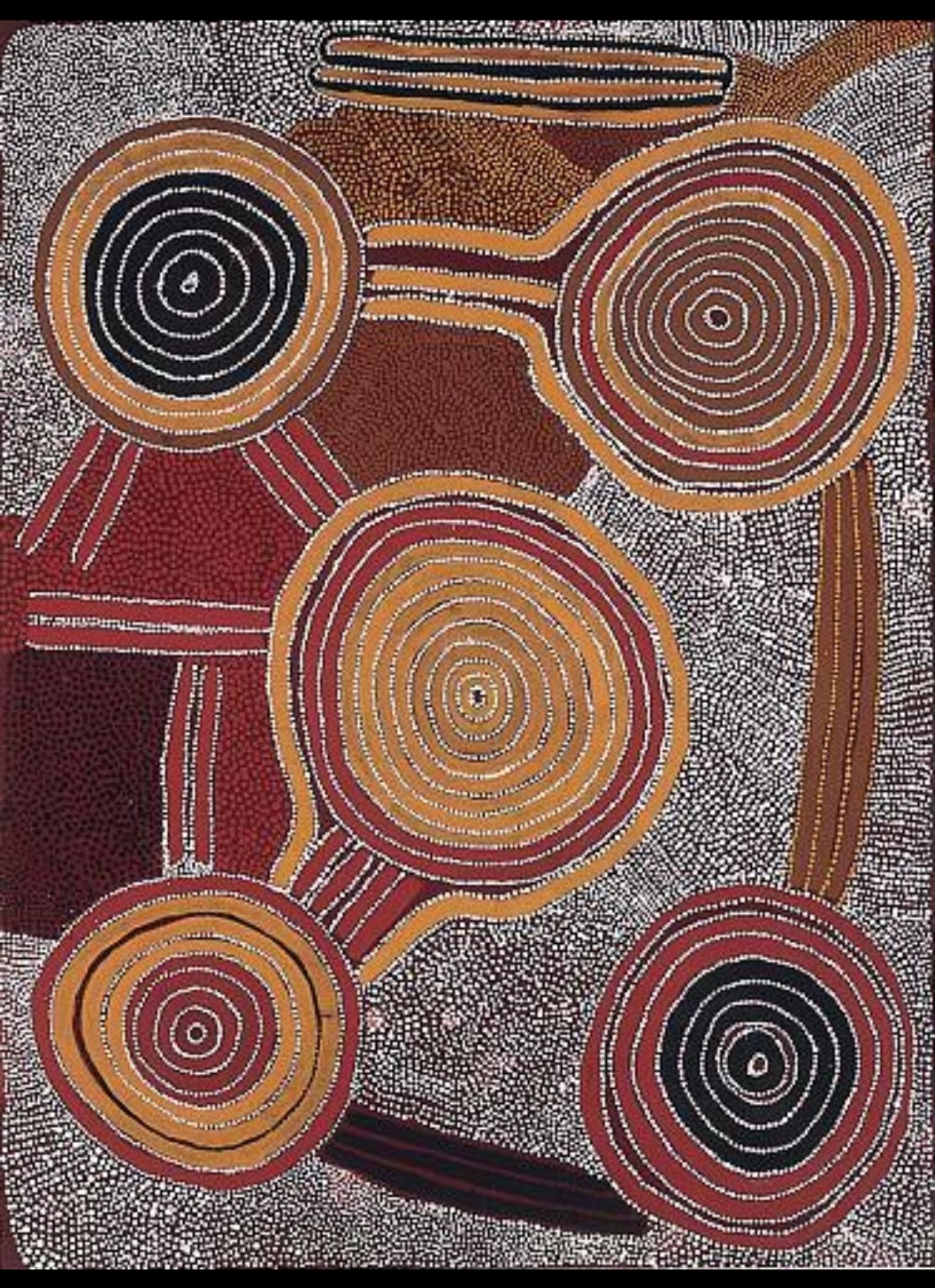
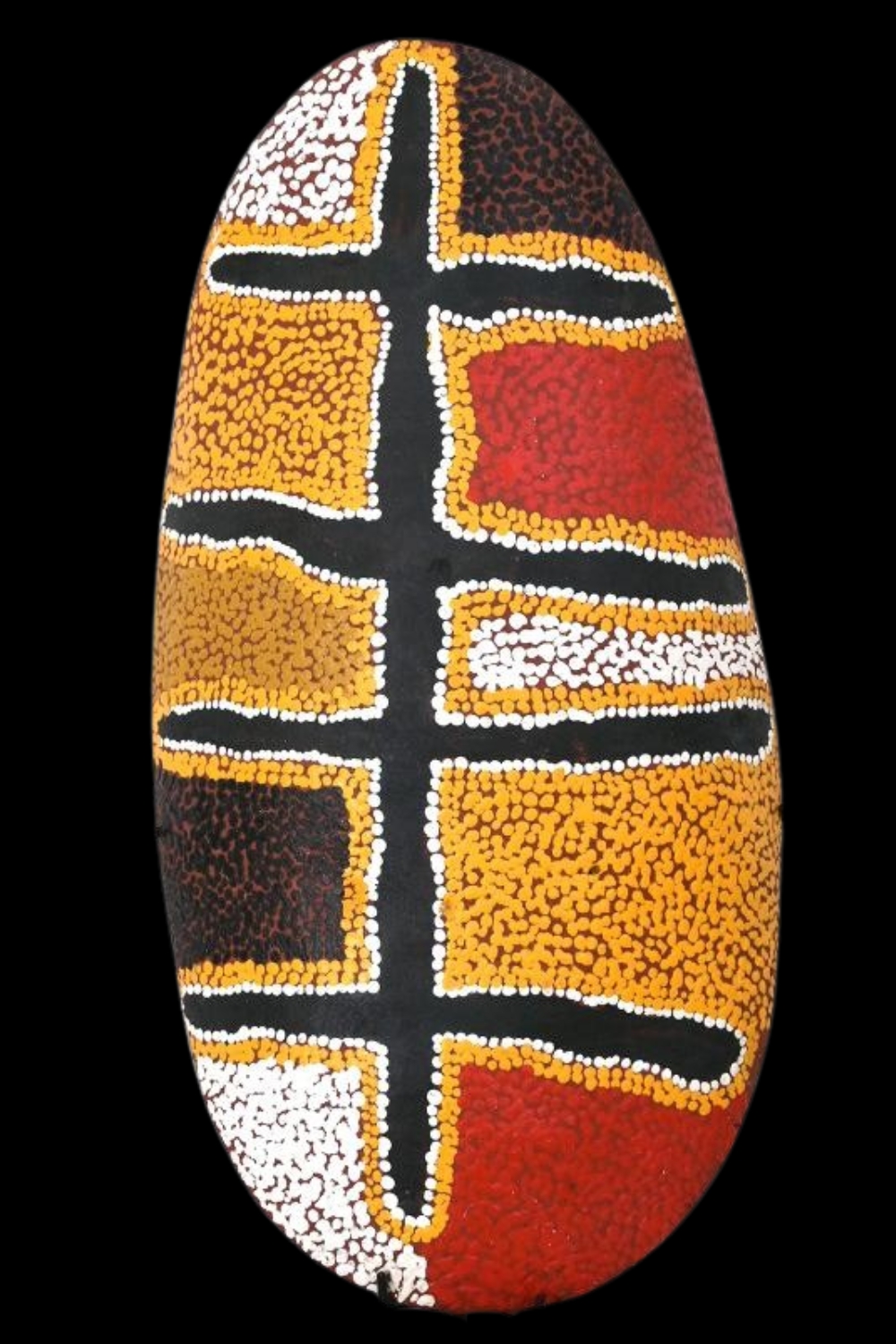
His distinctive paintings use bold circles, enclosed forms and pathways to represent waterholes, significant places and ancestral movements, creating powerful visual mappings of Country.
Sunfly participated in the formative years of Balgo painting and featured prominently in the landmark Art from the Great Sandy Desert exhibition at the Art Gallery of Western Australia in 1986. He married Bai Bai Napangarti and is recognised as one of the senior artists who helped establish Balgo painting as a major movement in contemporary Aboriginal Australian art.
Sunfly Tjampitjin Value
For people who want to see more images of this artists works and the values achieved at auction
Biography
Sunfly Tjampitjin, also recorded as Murtiyarru Sunfly Tjampitjin, was born around 1916 in the Great Sandy Desert. He was a Kukatja man whose Country extended through the desert south of Balgo, particularly around Murrunpa in the Alec Ross Ranges at the northern end of Lake Mackay.
Sunfly grew up before many Aboriginal families from the region settled permanently at missions and communities. His knowledge of Country came through travelling between water sources, hunting, observing seasonal changes and learning the ancestral histories and ceremonial responsibilities associated with particular places.
He became a senior Kukatja lawman and ceremonial leader and is identified in documentation associated with his paintings as the senior custodian of sacred men’s Tingari Law for his region. His cultural authority was therefore established long before he became known as an artist.
Murrunpa held particular personal and ceremonial importance. It was Sunfly’sconception site, and late in life he established an outstation there. Paintings such as Men’s Law at Artist’s Country at Murunpa, 1991 consequently have an autobiographical dimension, bringing together his own life, ancestral history and ceremonial responsibility for Country.
Sunfly’s cultural knowledge was also recognised by anthropologists working in the Balgo region. He worked for many years with Ronald Berndt, assisting in the recording of ancestral narratives and designs. Ronald and Catherine Berndt had conducted fieldwork at Balgo from the late 1950s and later contributed to research surrounding the 1986 exhibition Art from the Great Sandy Desert.
Sunfly was already in his sixties when contemporary painting began developing at Balgo. He reportedly participated in an early exhibition of Balgo art at the Shinju Matsuri Festival in Broome in 1981 and five years later featured prominently in Art from the Great Sandy Desert at the Art Gallery of Western Australia, which brought the emerging Balgo painters to national attention.
Surviving works demonstrate that he was painting before the establishment of Warlayirti Artists. Murum, 1985 is one early example, while a substantial painting was commissioned directly from him by Duncan Kentish in 1986. Warlayirti Artists was established in 1987, providing a formal art centre for the developing Balgo movement.
Sunfly nevertheless continued to live and paint away from the main community at Yagga Yagga, approximately 120 kilometres into the sandhill country south of Balgo. Early art coordinators travelled there to collect his paintings. This relative isolation from the larger group of Balgo artists may also have contributed to the development of his highly individual
What Did Sunfly Tjampitjin Paint?
Sunfly principally painted his Country and the ancestral and ceremonial knowledge embedded within it. His subjects include waterholes, soakwaters, caves, salt lakes, sandhills and travelling routes, together with ancestral journeys and men’s ceremonial Law.
Tingari Men’s Law was particularly important. Documentation for Artist’s Own Country, 1989 identifies Sunfly as the senior custodian of men’s Tingari Law in the region, giving him specific authority for the knowledge represented in such paintings.
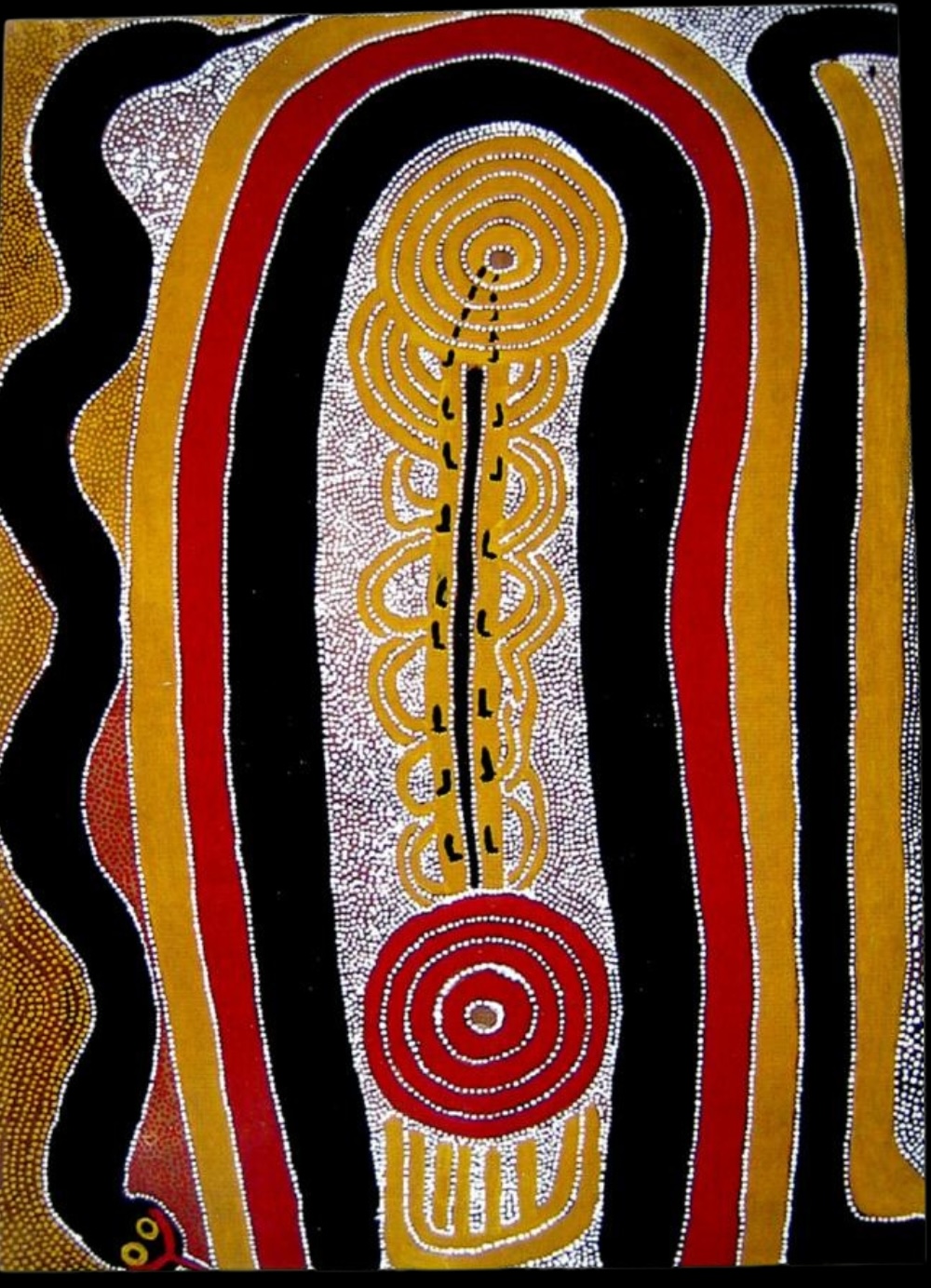
Another major subject was Luurnpa, the Kingfisher ancestral being, whose journeys created and transformed places across the desert. Sunfly represented these travels through interconnected sites, pathways and geometric forms rather than naturalistic images of the bird.
His paintings also describe ceremonial places and the physical character of Country. Poyarri, 1988 concerns an important soakwater, while Men’s Law at Artist’s Country at Murunpa, 1991 depicts initiates and features of the surrounding landscape.
Sunfly also painted Wanayarra, the Rainbow Snake, small-bird ancestral journeys and women’s sites. Although his paintings can resemble maps, their broader subject is Country as physical landscape, ancestral history and Law.
Sunfly Tjampitjin’s Painting Style
Sunfly developed one of the most distinctive visual languages among the first generation of Balgo painters. His compositions are dominated by large circles, enclosed geometric forms and strong connecting pathways, organised through parallel lines, bands of colour and selective dotting. Unlike artists who used dense all-over dotting, Sunfly often employed dots to define boundaries and emphasise particular forms.
His paintings can appear strikingly architectural and monumental, even when relatively small. Yet their geometry is not simply abstract design. In Men’s Law at Artist’s Country at Murunpa, joined inverted U-shaped forms represent two young initiates, while surrounding elements refer to a sandhill, rocky outcrops and water soakages. In Poyarri, circles indicate important water places connected by ancestral pathways. The geometry is therefore a means of representing Country and the cultural relationships embedded within it.
Sunfly’s residence at Yagga Yagga, away from the larger group of painters at Balgo, may have contributed to his individuality. His mature works rely on strongly articulated forms, controlled linear structures, selective dotting and bold areas of positive and negative space, producing a visual language immediately recognisable as his own.
Why Is Sunfly Tjampitjin Important?
Sunfly Tjampitjin is important as one of the senior Kukatja artists who helped shape Balgo painting during its formative years. He brought detailed knowledge of men’s Tingari Law, ancestral journeys and the geography of the Lake Mackay region into a distinctive visual language of monumental circles, pathways and geometric forms.
His paintings can appear strikingly abstract, yet they refer to actual water sources, sandhills, rocky ranges and ceremonial places, as well as the ancestral journeys connecting them. Sunfly’s achievement was to translate this complex cultural geography into paintings that were immediately recognisable as his own.
His work also became important to the wider recognition of Balgo Art. Men’s Law at Artist’s Country at Murunpa, 1991 travelled in the major Aratjara: Art of the First Australians exhibition through Europe and was later exhibited at the Museum of Contemporary Art in Sydney and the Art Gallery of New South Wales.
Public Collections
- National Gallery of Australia,
- National Gallery of Victoria,
- Art Gallery of Western Australia
- Queensland Art Gallery
Sunfly’s significance therefore lies in both his role in the emergence of Balgo Art and the highly individual way he transformed Kukatja knowledge of Country into contemporary painting. He stands as one of the foundational artists through whom the cultural geography of the Great Sandy Desert became part of modern Australian art.
Further Reading on Sunfly Tjampitjin
The following publications and institutional resources provide further information on Sunfly Tjampitjin, the emergence of Balgo Art, Warlayirti Artists and the cultural context of painting at Wirrimanu.
James Cowan, Wirrimanu: Aboriginal Art from the Balgo Hills, Craftsman House, Sydney, 1994.
An important early study of Balgo painting produced while many of the movement’s founding artists were still active. It includes Sunfly’s Yapinti – Pinki Dreaming, 1991 and is particularly useful for understanding the artists, Country and distinctive visual language emerging at Balgo during the late 1980s and early 1990s.
James Cowan, Balgo: New Directions, Craftsman House, Sydney, 1999.
Examines the development of Balgo painting as artists increasingly developed highly individual approaches to colour, form and ancestral geography. Sunfly’s Men’s Law at Artist’s Country at Murunpa, 1991 is illustrated in the publication.
Jacqueline Healy (ed.), Warlayirti: The Art of Balgo, RMIT Gallery, Melbourne, 2014.
A major reassessment of the history of Balgo painting developed in collaboration with Warlayirti Artists. Drawing upon archival material and interviews, the project examines the beginnings of painting at Balgo, the 1986 Art from the Great Sandy Desert exhibition and the role of senior figures including Sunfly in the early movement.
Catalogue for the major exhibition held in Kyoto and Tokyo through which Balgo painting reached an important international audience. Sunfly’s Travels of the Goanna Men in the Artist’s Country, 1990and The Kingfisher Ancestral Spirit’s Travels in the Artist’s Country, 1990 were included and illustrated.
Bernhard Lüthi et al., Aratjara: Art of the First Australians, DuMont, Cologne, 1993.
Catalogue accompanying one of the most important international exhibitions of Aboriginal Australian art of the period. Sunfly’s Men’s Law at Artist’s Country at Murunpa, 1991 was included as catalogue no. 118 and illustrated on p.272. The exhibition travelled through Germany, Britain and Denmark.
All images featured in this article are presented strictly for educational and informational purposes.
This website may include copyrighted material for which specific authorization has not been obtained from the copyright owner.
All such images are presumed to be the intellectual property of the respective artist or their estate, and are used in accordance with principles of fair dealing or fair use under applicable copyright law.