
Tommy Watson: Master of Colour and Country
c. 1935–2017
Pitjantjatjara
Anamarapiti / Irrunytju, ancestral Country
Irrunytju (Wingellina)
Ngaanyatjarra Art / Western Desert Art
Irrunytju Arts
Painting on canva
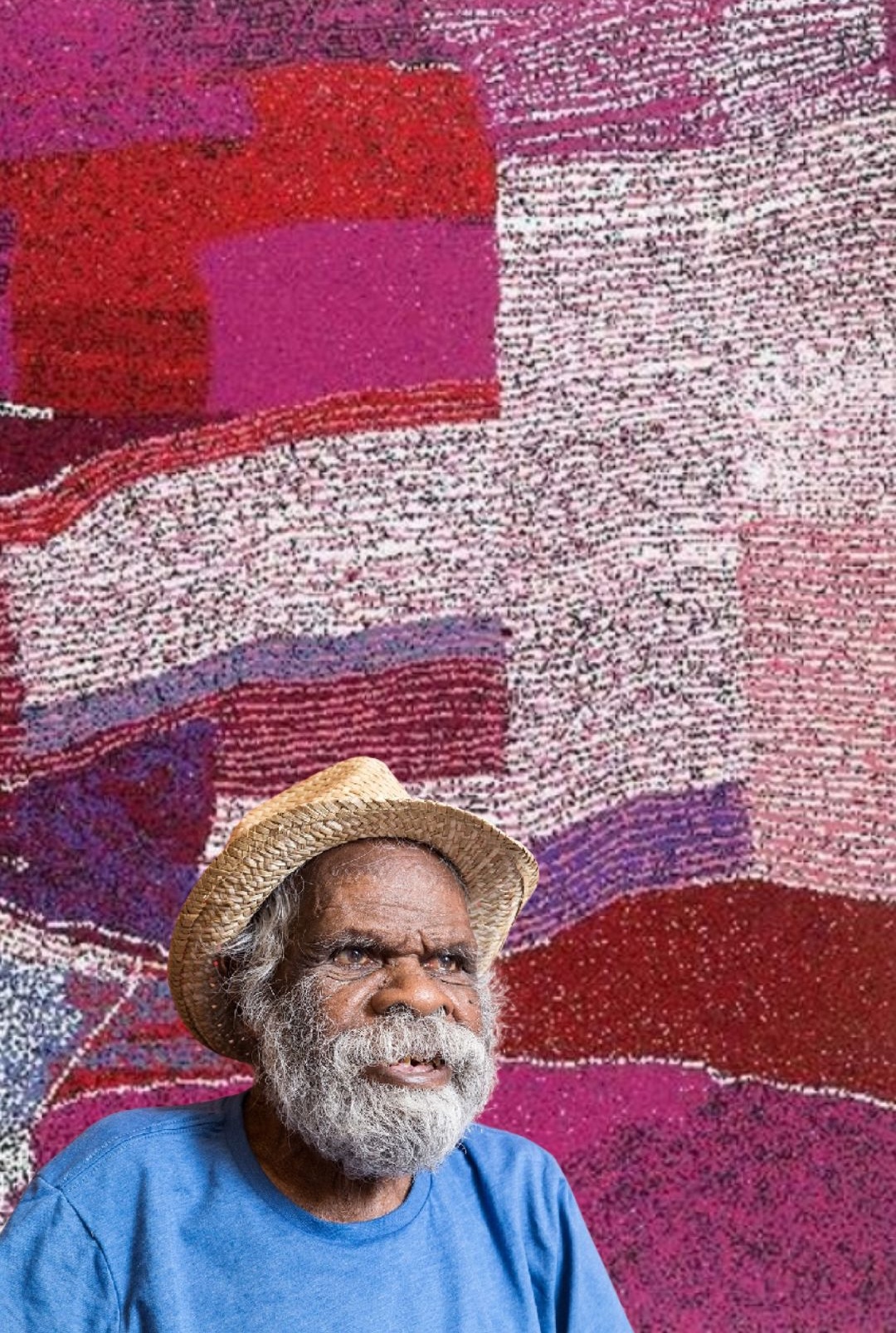
Tommy Watson (Yannima Pikarli Watson, c.1935–2017) transformed the visual language of Western Desert painting by replacing traditional iconography with vast fields of luminous colour. A senior Pitjantjatjara Law man of the Karimara skin group from Anamarapiti, near present-day Irrunytju (Wingellina) in the Ngaanyatjarra Lands of Western Australia, he began painting professionally only in his late sixties yet rapidly became one of Australia’s most celebrated contemporary Aboriginal artists.
Rather than relying on the concentric circles and travelling lines that had become synonymous with Western Desert painting, Watson developed richly layered surfaces of shimmering colour that evoke the heat, light and spiritual presence of Country while deliberately concealing restricted ceremonial knowledge. Within only a few years of taking up painting, his work entered Australia’s leading public collections and was commissioned for permanent installation at the Musée du quai Branly in Paris, establishing him among the most important Aboriginal painters of the twenty-first century.
Want to know what a Tommy Watson painting is worth? Explore auction results, learn what factors influence the value of his artworks, browse examples from different periods of his career, or find out how to sell a Tommy Watson painting on the Tommy Watson Painting Values page
Early Life
Tommy Watson was born around 1935 at Anamarapiti, west of present-day Irrunytju near the junction of Western Australia, South Australia and the Northern Territory. He spent his childhood living a traditional nomadic life, travelling from waterhole to waterhole with his family, hunting, gathering and learning how to survive in one of Australia’s harshest desert environments. Under the guidance of his father and later his adoptive family, he acquired an intimate knowledge of water sources, food plants, ceremonial sites and the social and spiritual laws that governed Pitjantjatjara life.
His mother died when he was an infant and his father died when Tommy was about seven years old. He was subsequently adopted by his father’s first cousin, Nicodemus Watson, and spent time at Ernabella Mission before returning to live on his ancestral Country. His Aboriginal names, Yannima and Pikarli, both refer to places near his birthplace, reflecting the enduring connection between his identity and Country.
Watson later explained this lifelong connection simply:
“My grandfather’s country, grandmother’s country. When they were alive, they would take me around the country, when I was a kid. That’s why we look after country, go out whenever we can. See if the rock holes are good.”
Although he encountered the emerging Western Desert painting movement during the early 1970s, he did not begin painting himself for another three decades. During those years he worked as a stockman and labourer, helped build wells and stockyards, assisted with work around Uluru, witnessed Albert Namatjira painting at Hermannsburg and later visited Papunya as the first generation of Western Desert painters established a new artistic movement. These experiences gave him a unique perspective on the development of contemporary Aboriginal art long before he became an artist himself.
Tommy Watson’s Painting Career
Tommy Watson began painting in 2001 following the establishment of Irrunytju Arts. Unlike most celebrated artists, he arrived fully formed. Rather than spending decades developing his style, he brought a lifetime of cultural authority and ceremonial knowledge directly into contemporary painting.
His success was immediate. Within a year he had been selected as a finalist in the Telstra National Aboriginal and Torres Strait Islander Art Awards, followed by exhibitions at Desert Mob and rapidly increasing demand from collectors. In remarkably little time he had established himself as one of the leading painters of the Western Desert.
His career can be viewed in three distinct phases.
Today his paintings are represented in Australia’s major public collections, including the National Gallery of Australia, National Gallery of Victoria, Art Gallery of New South Wales, Art Gallery of South Australia and the Art Gallery of Western Australia.
Tommy Watson’s Painting Style
Tommy Watson created one of the most distinctive styles in contemporary Aboriginal art.
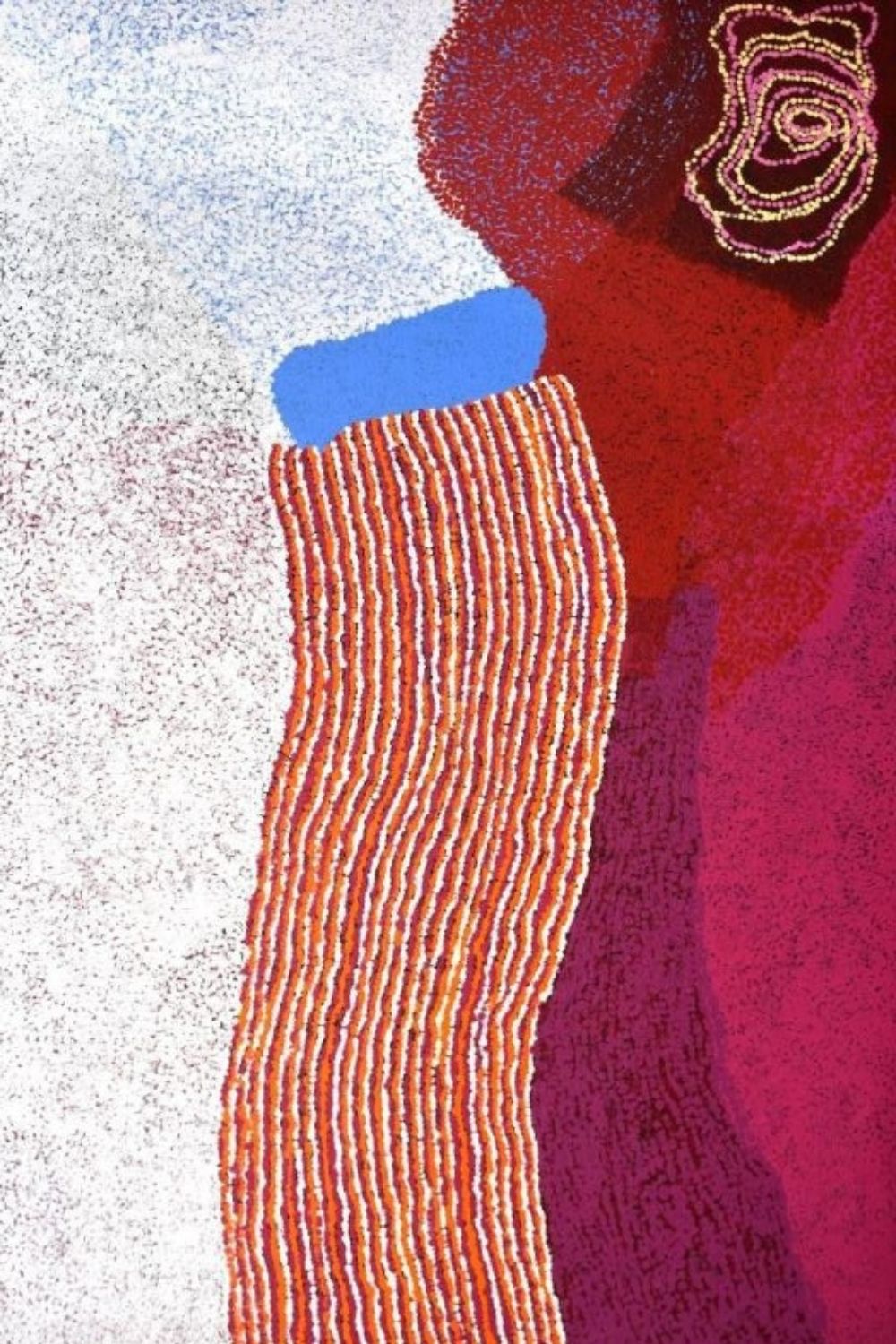
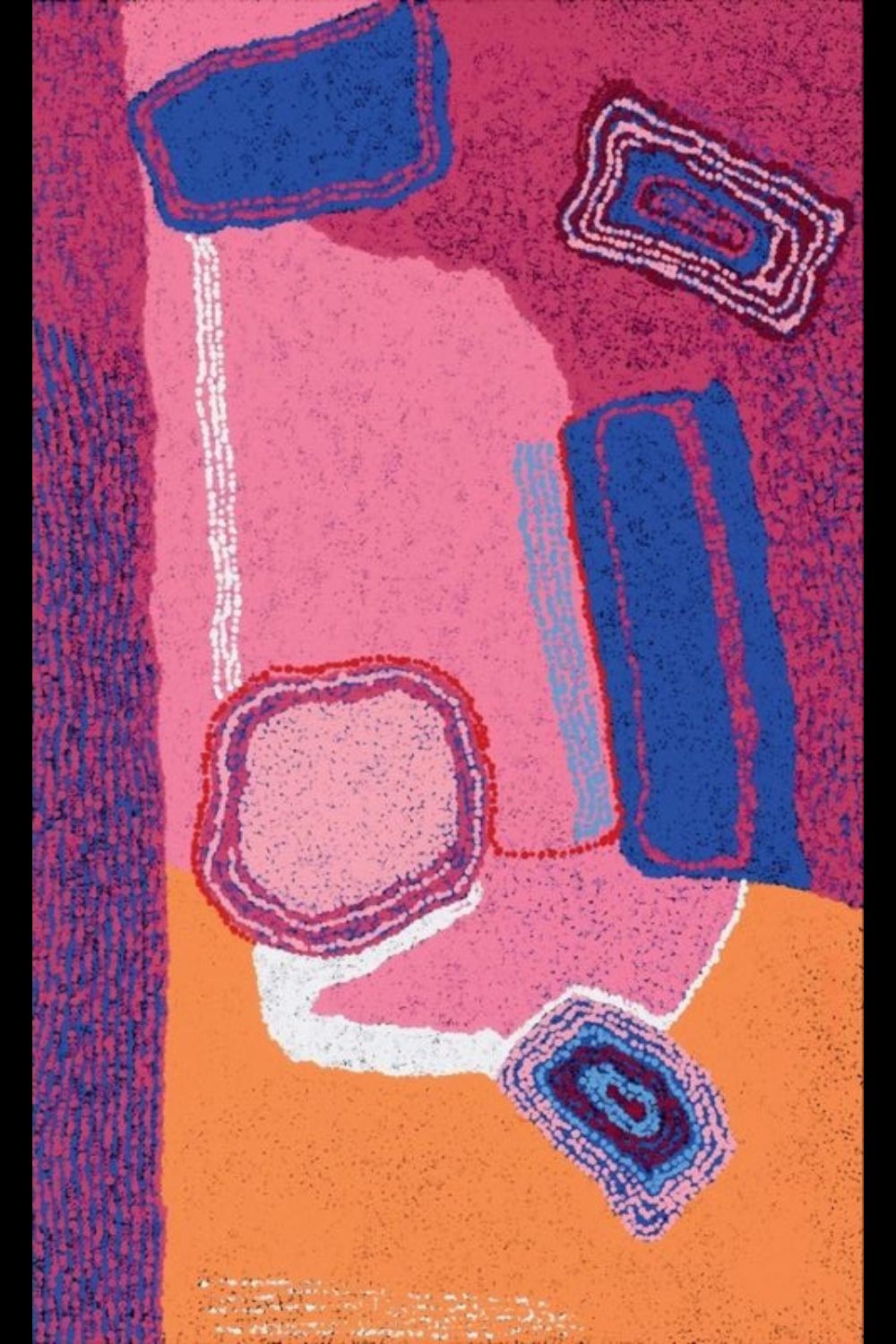
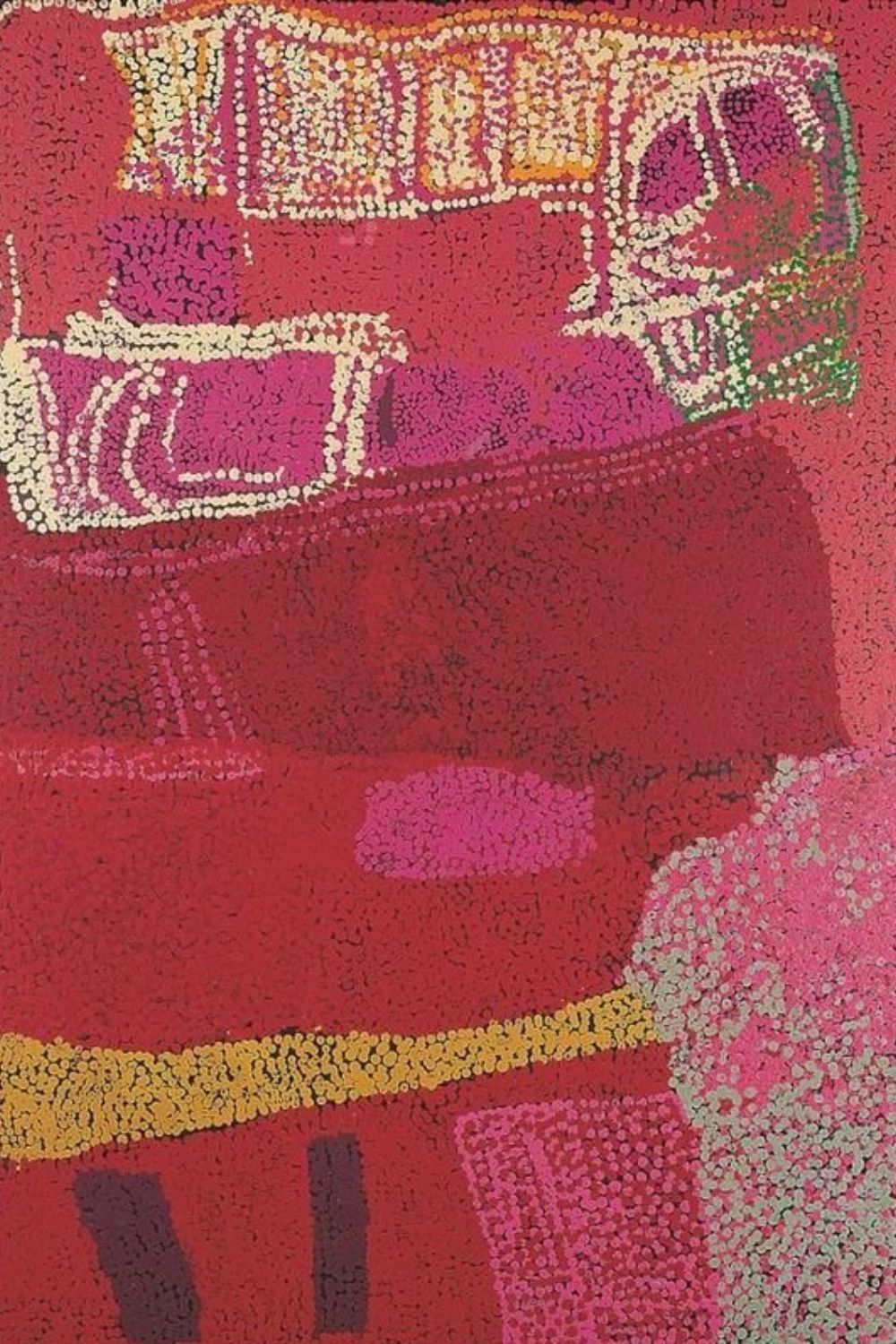
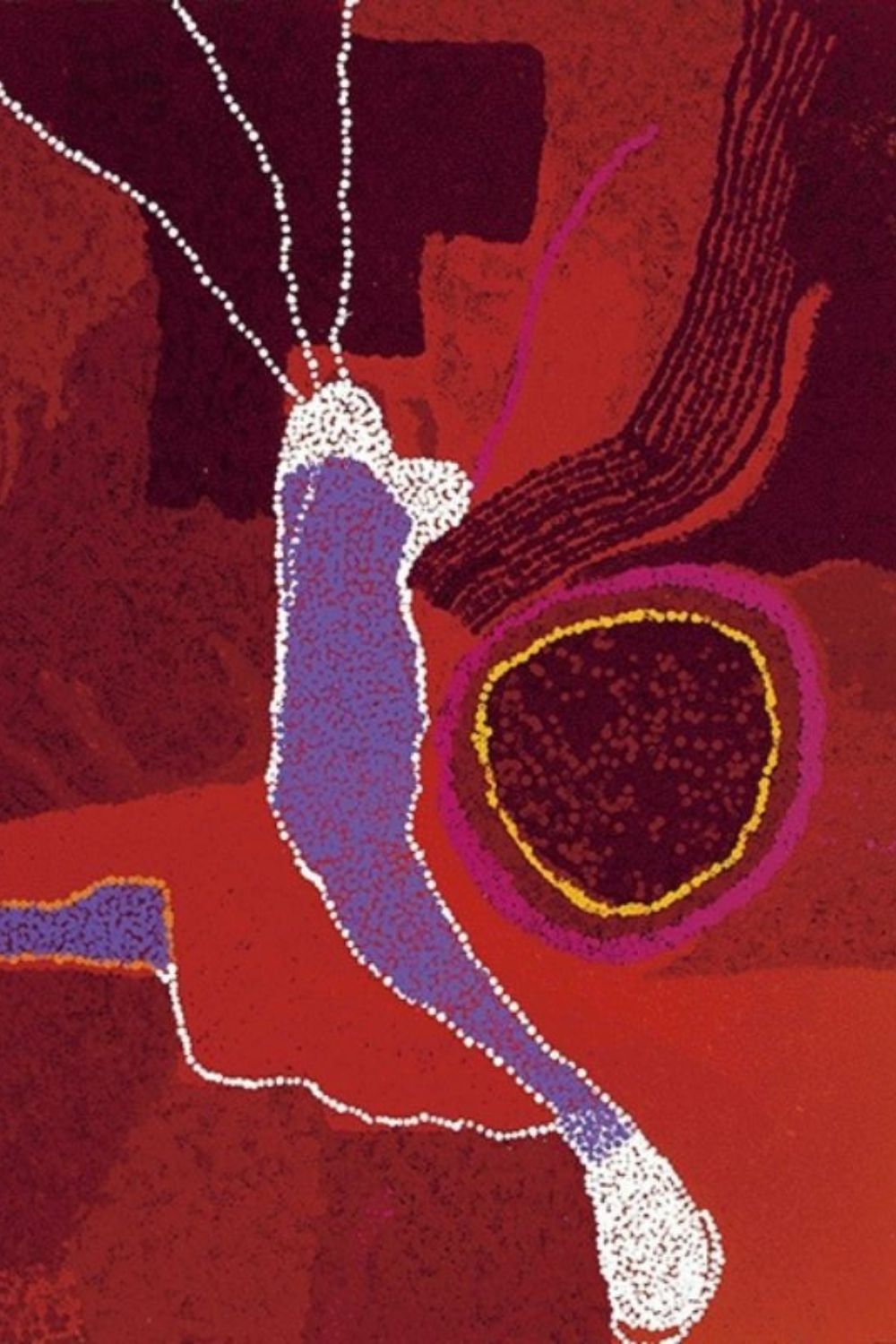
Rather than describing Country through recognisable ceremonial symbols, he painted vast atmospheric fields built from thousands of irregular dots layered over one another. As colours accumulate they shimmer across the surface, producing extraordinary depth and luminosity.
His paintings are characterised by:
- dense overlapping fields of dotting
- brilliant reds, oranges, burgundies, pinks, violets and blues
- rich colour layering that creates remarkable optical depth
- expansive compositions with few recognisable symbols
- subtle rhythms suggesting dry creek beds, spinifex plains and sand dunes
- an emphasis on atmosphere rather than description
Art historian Mary Knight observed that Watson used “layers of vibrant colours” to create “sumptuous layers of coloured dots which ripple and surge across the canvas”, suggesting the contours of the desert landscape rather than illustrating it directly.
Perhaps the defining achievement of Watson’s work is that it communicates the spiritual presence of Country without revealing restricted cultural knowledge.
Where many Western Desert artists employed concentric circles and travelling lines to identify specific sites, Watson largely abandoned these devices. Colour itself became the visual language of Country. His paintings evoke the intensity of desert light, the shimmer of heat across spinifex plains and the enduring presence of ancestral landscapes through painterly abstraction rather than literal representation.
Judith Ryan of the National Gallery of Victoria described Watson’s paintings as “inward and liturgical”, noting that they possess an “incandescence” reminiscent of the earliest Pintupi paintings.
Watching Watson paint was itself said to resemble a ceremonial performance, with rhythmic dotting accompanied by chanting connected to his ancestral Dreaming.
Related Artists
Tommy Watson was a founding artist of Irrunytju Arts, where he worked alongside Ningura Napurrula and helped establish the distinctive painting movement that emerged from the Ngaanyatjarra Lands.
Earlier in life he had encountered many of the pioneers of the Western Desert movement, including Uta Uta Tjangala and Shorty Lungkata Tjungurrayi, although he developed an entirely individual artistic language rather than following their styles.
His paintings are frequently discussed alongside those of Emily Kame Kngwarreye, Paddy Bedford and John Mawurndjul. While each worked within different cultural traditions, all transformed profound cultural knowledge into highly original contemporary art.
Tommy Watson’s Legacy
Tommy Watson demonstrated that Western Desert painting could move beyond descriptive iconography while remaining firmly grounded in traditional knowledge.
By replacing familiar ceremonial symbols with luminous fields of colour, he created a visual language that is immediately recognisable yet deeply respectful of cultural protocols. His paintings expanded international perceptions of Aboriginal art, proving that works rooted in ancient Country and Law could stand comfortably alongside the world’s great traditions of abstract painting.
Today he is widely regarded as one of the most influential Aboriginal artists of the twenty-first century.
Tommy Watson Painting Values
Collectors continue to seek Tommy Watson’s paintings for their exceptional colour, scale and importance within contemporary Aboriginal art.
Related: Tommy Watson Painting Values.
Looking to Sell a Tommy Watson Painting?
If you own a painting by Tommy Watson and are considering selling it, I’d be happy to help.
Please send clear photographs of the front and back of the painting, its dimensions, any provenance or certificates, and details of its condition. I can provide an informal assessment and discuss purchasing the work if appropriate.
Further Reading & Sources
Books
Geissler, Marie, and Ken McGregor. Yannima Pikarli Tommy Watson. Melbourne: Macmillan Art Publishing, 2010.
Johnson, Vivien. Lives of the Papunya Tula Artists. Alice Springs: IAD Press.
Johnson, Vivien. Once Upon a Time in Papunya. Sydney: NewSouth Publishing.
Knight, Mary. Irrunytju Arts. Perth: Craftsouth, 2006.
Myers, Fred R. Painting Culture: The Making of an Aboriginal High Art. Durham: Duke University Press.
Exhibition Catalogues and Museum Publications
National Gallery of Victoria. Colour Power: Aboriginal Art Post-1984 in the Collection of the National Gallery of Victoria. Melbourne: National Gallery of Victoria. (Essay by Judith Ryan.)
National Gallery of Victoria. Land Marks: Indigenous Australian Art from the National Gallery of Victoria. Melbourne: National Gallery of Victoria.
Musée du quai Branly exhibition and architectural publications documenting the permanent Indigenous Australian commission (including Tommy Watson’s installation).
Desert Mob exhibition catalogues, Araluen Arts Centre, Alice Springs.
National Aboriginal and Torres Strait Islander Art Awards (NATSIAA) exhibition catalogues, Museum and Art Gallery of the Northern Territory.
Auction Catalogues
Art Leven (formerly Cooee Art). Indigenous Fine Art auction catalogues.
Bonhams. Australian & Aboriginal Art auction catalogues.
Davidson Auctions. Australian & International Art auction catalogues.
Deutscher and Hackett. Important Aboriginal + Oceanic Art and Important Australian Indigenous Art auction catalogues.
Gibson’s. Australian & International Art auction catalogues.
Lawsons. Australian Indigenous Art and Aboriginal Art & Artefacts auction catalogues.
Lawson~Menzies. Fine Aboriginal Art and Important Australian Aboriginal Art auction catalogues.
Leonard Joel. Indigenous Art and Fine Art auction catalogues.
Menzies. Important Australian & International Art auction catalogues.
Shapiro Auctioneers. Aboriginal Art, Indigenous Art and Modern & Contemporary Art auction catalogues.
Sotheby’s. Important Aboriginal Art, Aboriginal Art and Aboriginal & Oceanic Art auction catalogues.
Theodore Bruce Auctioneers & Valuers. Fine Aboriginal, Tribal & Oceanic Art auction catalogues.
Art Centre and Gallery Documentation
Irrunytju Arts documentation and Certificates of Authenticity.
Agathon Galleries catalogues and Certificates of Authenticity.
Yanda Aboriginal Art catalogues, artist statements and Certificates of Authenticity.
Red Sand Art Gallery catalogues and accompanying artist documentation.
Documentation accompanying paintings depicting places including:
- Anamarapiti
- Wipu
- Iyarka
- Pukara
- Ngayuku Ngura (My Country)
- Utjuri Pukara
- Walawuru Tjukurpa (Eagle Dreaming)
These certificates provide artist-approved descriptions of Tommy Watson’s Country, ancestral narratives and the places represented within his paintings.
Public Collections
Art Gallery of New South Wales
Art Gallery of South Australia
Art Gallery of Western Australia
Museum and Art Gallery of the Northern Territory
Musée du quai Branly, Paris
Research Used in Preparing This Page
This biography draws upon:
- public museum collection records
- exhibition catalogues and curatorial essays by Judith Ryan and other museum specialists
- the monograph Yannima Pikarli Tommy Watson by Ken McGregor and Marie Geissler
- Irrunytju Arts by Mary Knight
- Irrunytju Arts, Agathon Galleries and Yanda Aboriginal Art documentation
- artist statements, certificates of authenticity and exhibition material accompanying Tommy Watson’s paintings
- more than 95 documented auction records dating from 2005–2026, including provenance, exhibition history, literature references and artist documentation where available.
All images featured in this article are presented strictly for educational and informational purposes.
This website may include copyrighted material for which specific authorization has not been obtained from the copyright owner.
All such images are presumed to be the intellectual property of the respective artist or their estate, and are used in accordance with principles of fair dealing or fair use under applicable copyright law.