
Naata Nungurrayi: Biography, Paintings & Painting Style
c. 1932
Pintupi
Kumilnga, west of the Pollock Hills, Gibson Desert
Papunya / Kintore
Pintupi Art / Western Desert Art
Papunya Tula Artists
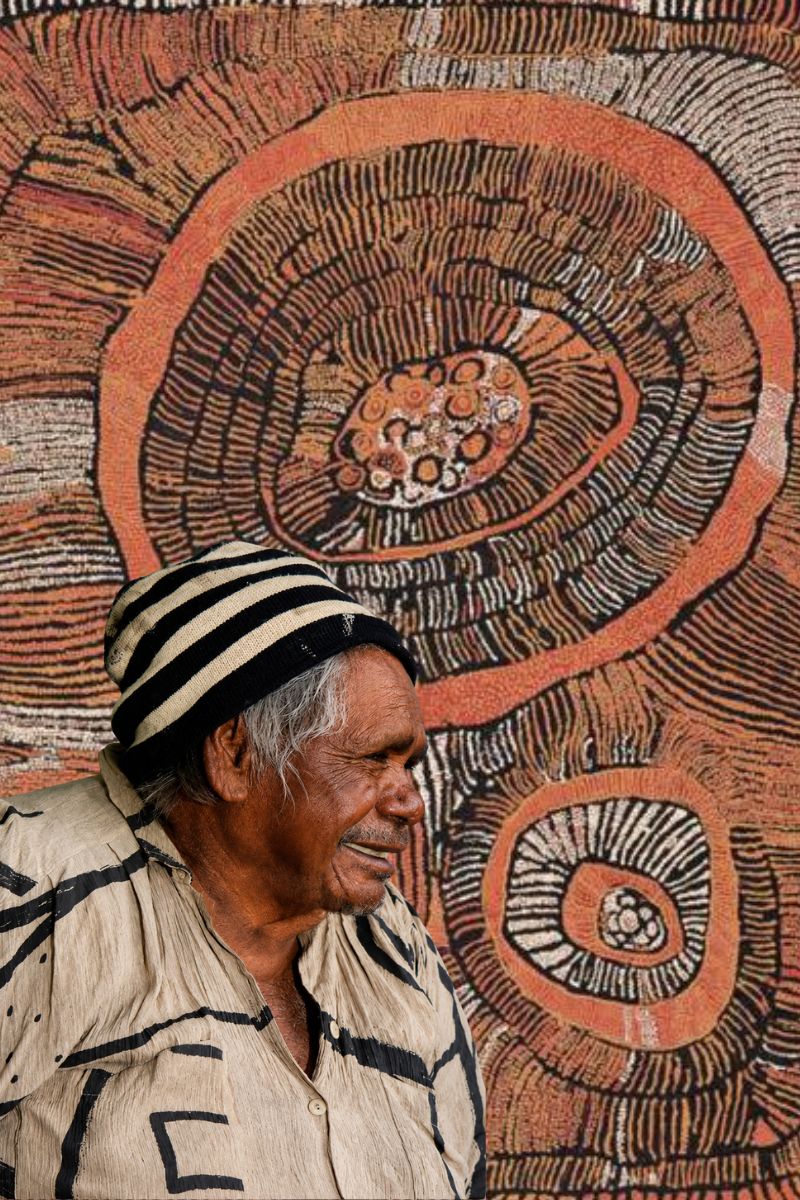
Naata Nungurrayi transformed the ceremonial landscapes of Pintupi Country into a distinctive abstract language of flowing colour, delicate dotting and painterly restraint. Her paintings evoke the sandhills, rockholes, soakages and women’s ceremonial journeys associated with Marrapinti, Unkunya and Ngaminya, balancing geometry with painterly freedom to convey the vastness and quiet power of the Western Desert.
A senior Pintupi woman, Naata belonged to an exceptional artistic generation and family. She was the sister of artist George Tjungurrayi and Nancy Nungurrayi, while her son Kenny Williams Tjampitjinpa also became a painter. Alongside senior women such as Makinti Napanangka and Ningura Gibson Naparrula, she helped establish Pintupi women as major figures in contemporary Western Desert Art.
Although Naata did not begin painting professionally until her sixties, she rapidly became one of Pintupi Arts leading painters. Rather than allowing bold concentric forms to dominate her compositions, she used sweeping bands, restrained colour and delicate dotting to evoke the sandhills and ceremonial geography of Pintupi Country. Today she is recognised as one of the defining Pintupi women artists of her generation.
Want to know what your Naata Nungurrayi painting is worth? Visit Naata Nungurrayi Painting Value, Prices & Auction Results to compare auction results, learn what influences value, and request a confidential appraisal if you’re considering selling.
Early Life
Naata Nungurrayi was born around 1932 at Kumilnga, west of the Pollock Hills in the Gibson Desert of Western Australia. She belonged to the Pintupi people and spent her childhood living a traditional nomadic life across one of Australia’s most remote desert regions.
Like many Pintupi families, she maintained a close connection to ancestral Country until the early 1960s, when government patrols encouraged the remaining desert groups to move into settlements. Her family eventually relocated to Papunya before later settling at Kintore during the homeland movement of the early 1980s, allowing them to return much closer to their traditional lands.
These experiences profoundly shaped the paintings she would later create. Rather than depicting the Western Desert as an empty landscape, Naata portrayed it as a living cultural geography, where sandhills, rockholes, soakages and ceremonial sites formed an interconnected ancestral world. This deep understanding of Country became the foundation of the distinctive visual language for which she is now celebrated.
Becoming an Artist
Unlike many first-generation Papunya painters, Naata began painting relatively late in life.
She commenced painting for Papunya Tula Artists in 1996 after being encouraged by arts coordinator Marina Strocchi. Her natural ability became apparent almost immediately. Within only a few years her paintings were being acquired by major collectors and exhibited nationally and internationally.
Her emergence coincided with a remarkable period in Western Desert art, when senior Pintupi women were increasingly bringing their own ceremonial knowledge and perspectives into contemporary painting. Rather than simply extending the visual language established by the founding Papunya painters, Naata developed an unmistakably personal style that transformed familiar desert forms into sophisticated works of abstraction.
By 2003 one of her paintings had been selected for an Australia Post international stamp issue, and in 2004 she was named among Australian Art Collector magazine’s 50 Most Collectable Australian Artists.
Naata Nungurrayi Painting Style
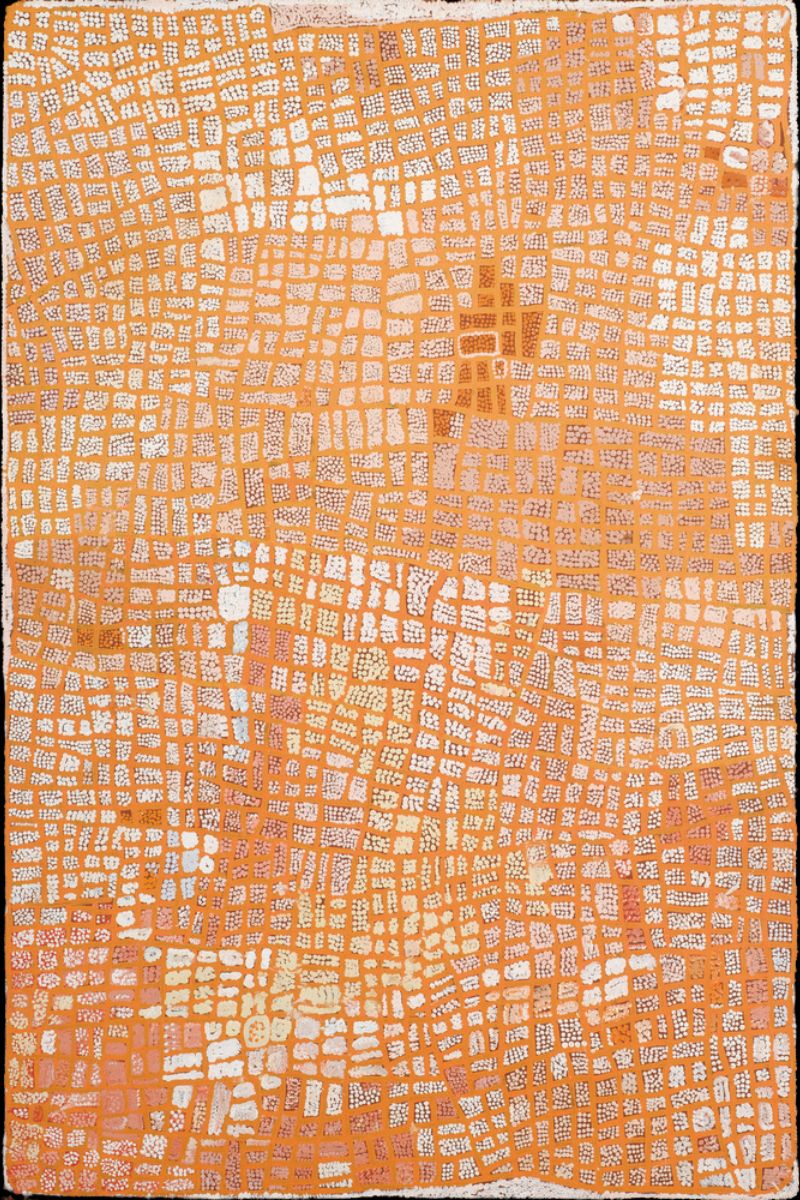
Naata Nungurrayi’s paintings are among the most lyrical and refined expressions of the Western Desert tradition.
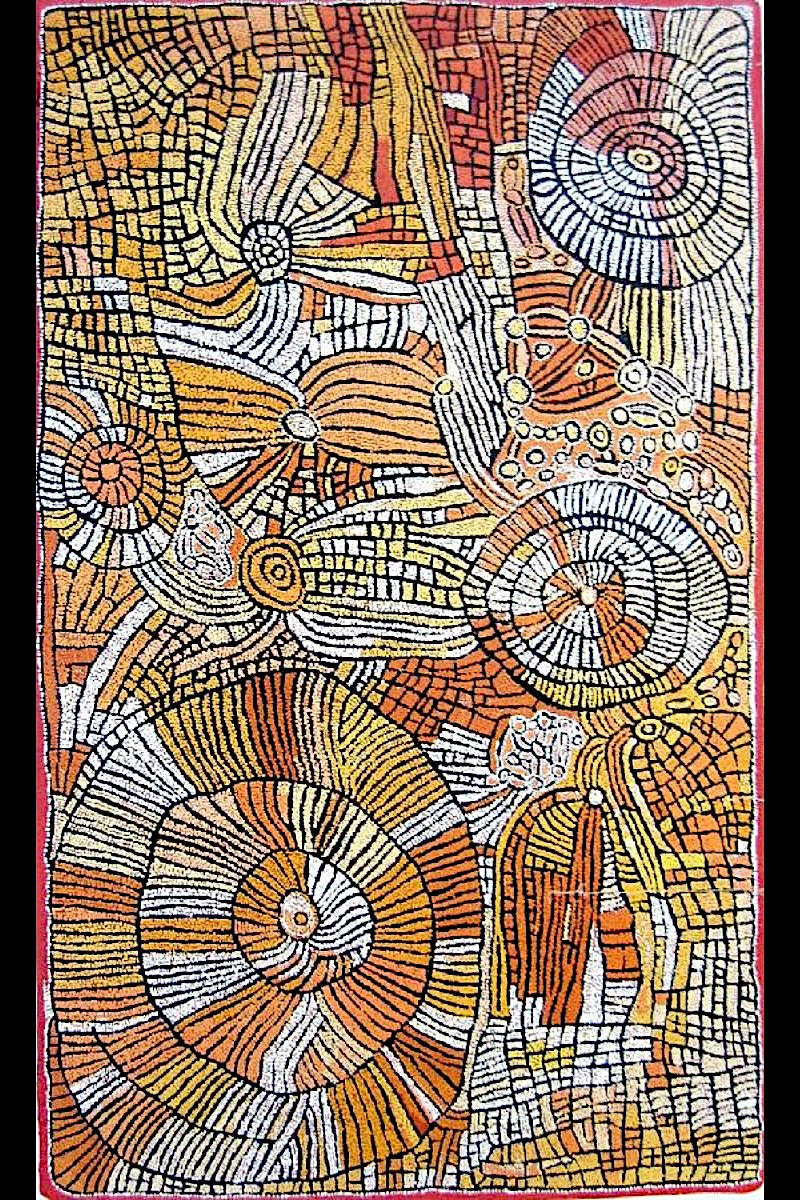
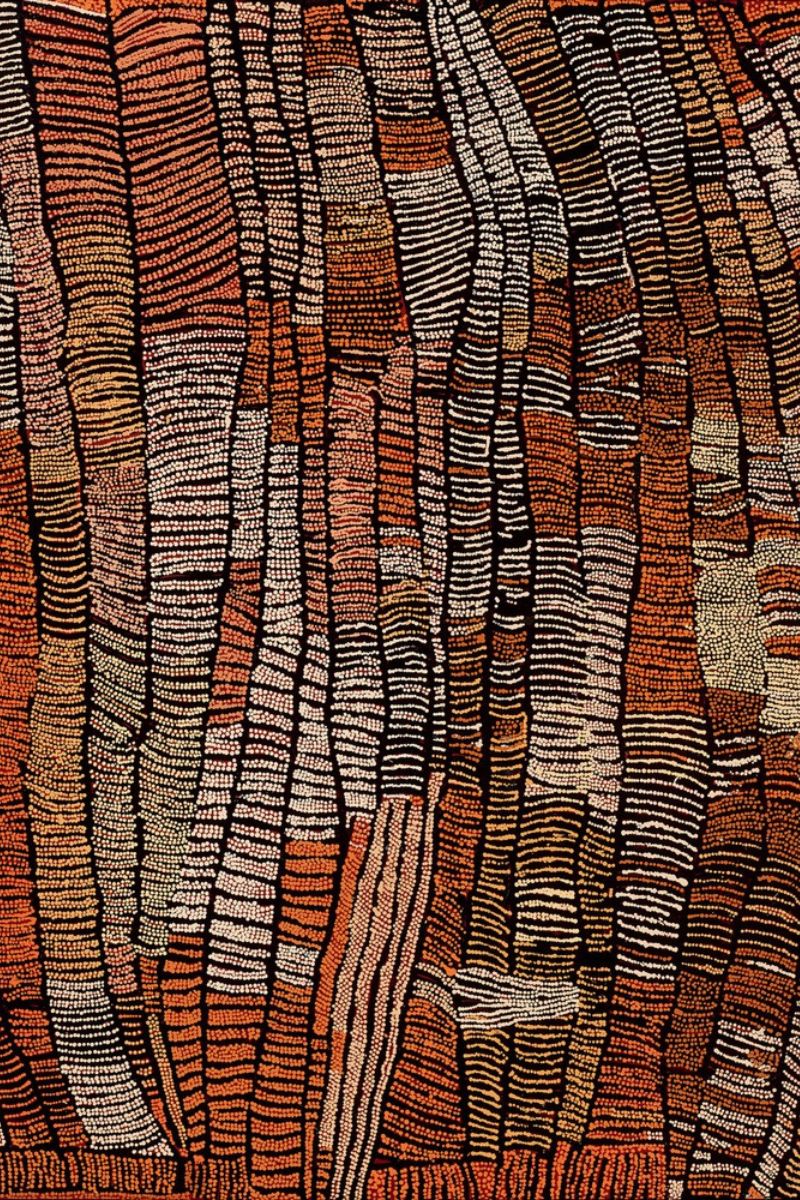
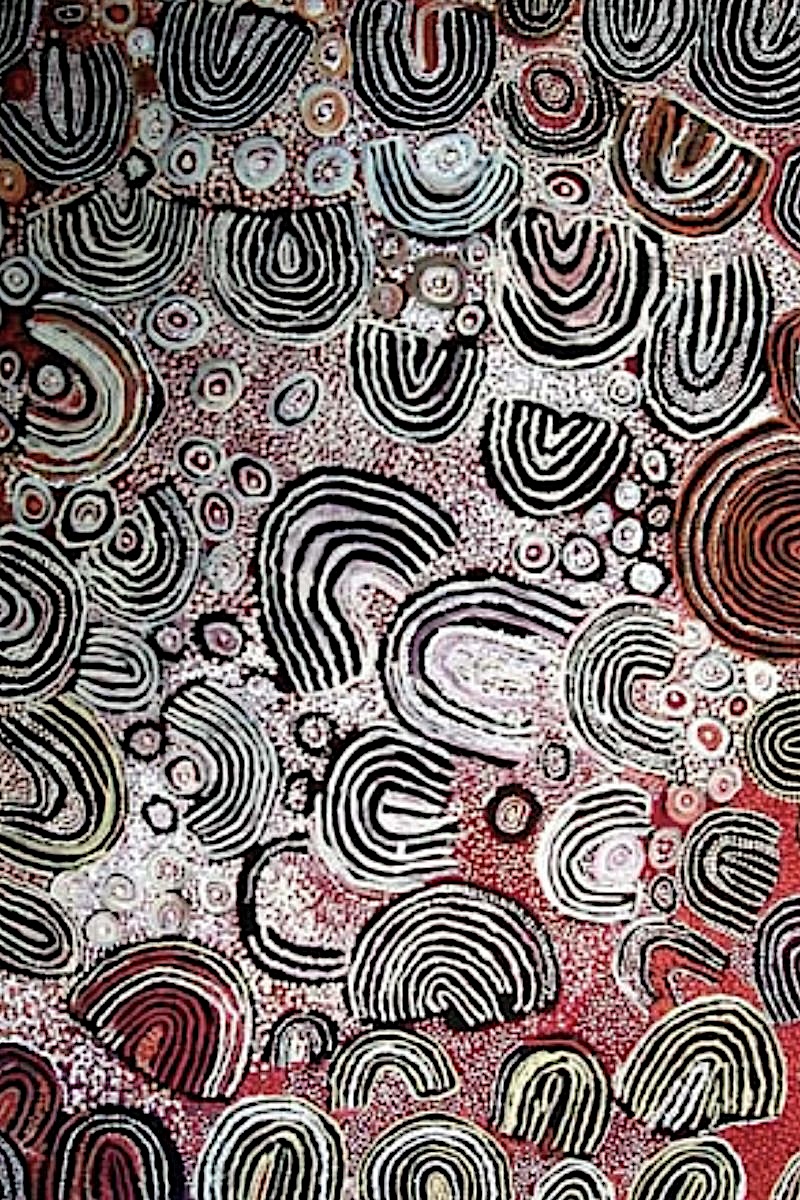
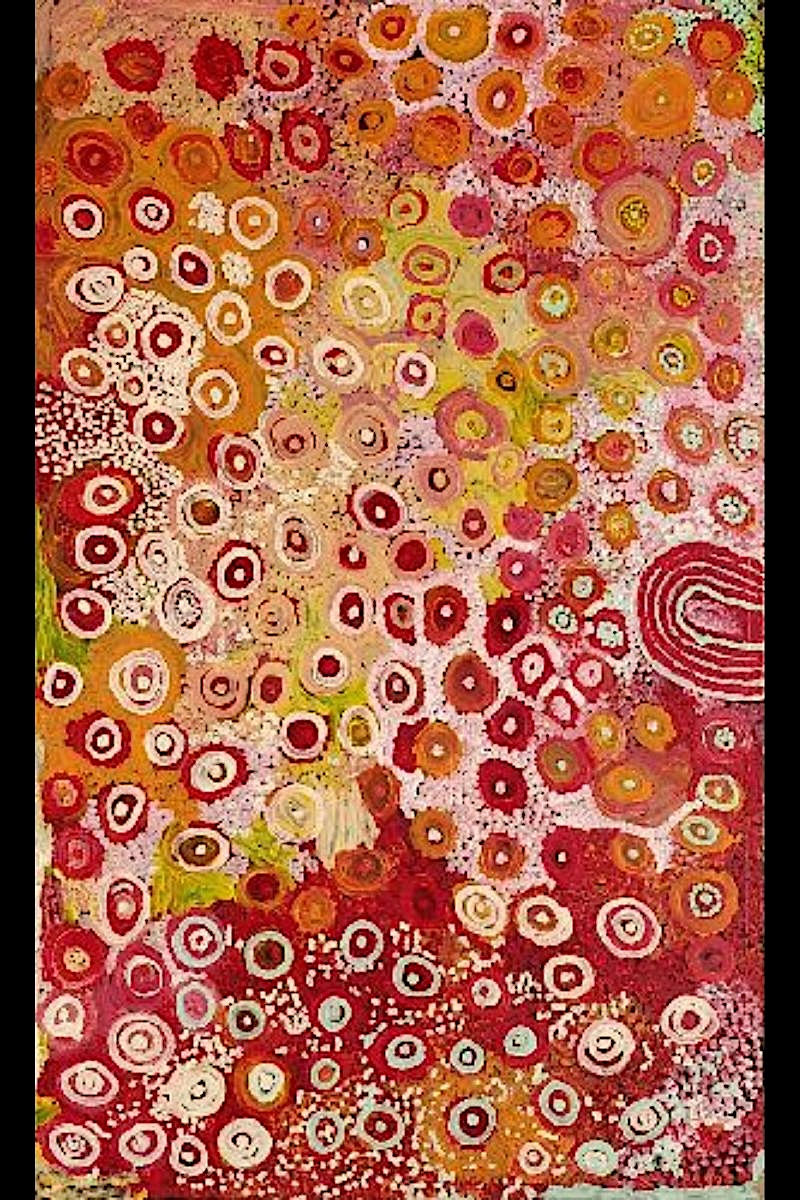
Where many Papunya artists organised their compositions around concentric circles connected by travelling lines, Naata increasingly focused on the undulating tali—the long parallel sandhills that dominate the Gibson Desert. These sweeping bands became the defining motif of her work, flowing rhythmically across the canvas like waves of wind-blown desert. Rather than simply adopting the visual language established by earlier Pintupi painters, she expanded it, transforming the rolling landscape itself into a sophisticated form of abstraction while remaining deeply grounded in Pintupi cultural knowledge.
Her paintings are characterised by:
- flowing parallel bands representing desert sandhills
- exceptionally fine, delicate dotting
- restrained palettes of creams, pale ochres, soft oranges, muted reds and white
- broad, spacious compositions
- subtle tonal transitions rather than dramatic contrast
- gentle rhythmic movement across the picture surface
- a remarkable balance between geometry and painterly freedom
- sophisticated use of positive and negative space
- richly textured paint surfaces.
Rather than describing the desert topographically, Naata distilled its essential rhythms into elegant abstract compositions. Her parallel bands rise and fall across the canvas in long rhythmic sequences that evoke shifting dunes, shimmering heat and the immense scale of the Western Desert. These linear structures also reflect the east–west alignment of the tali, the dominant landforms that shaped travel across Pintupi Country for countless generations.
Unlike many contemporary abstract painters, however, these compositions are never purely formal exercises. Every line, colour and movement remains grounded in specific places, ancestral journeys and women’s ceremonial knowledge connected to Country around Marrapinti, Karilywarranya, Wanku and other significant Pintupi sites. Her paintings present an aerial understanding of Country in which sandhills, rockholes, soakages, vegetation and ceremonial places become part of a single interconnected cultural landscape.
Naata also explored the physical qualities of paint itself. She frequently applied acrylic in thick, textured layers and experimented with different tools, including both ends of the paintbrush and even twigs gathered from nearby trees. Rather than simply depicting the desert, she modelled its surface, creating paintings whose tactile qualities echo the undulating sandhills and textured earth of her ancestral Country. This increasingly painterly approach gave her works an immediacy and physical presence rarely matched within the Western Desert movement.
The subtlety of her colour is equally important. Rather than relying on strong contrasts, Naata continually varied closely related tones across the painting’s surface. Soft creams, ochres and muted reds dissolve into thousands of individual dots that shimmer with changing light, creating luminous fields of colour whose quiet harmony reflects both the beauty of the desert and the enduring presence of ancestral Country
Expert Commentary
Curators and historians have consistently recognised Naata’s distinctive contribution to Australian art.
Art historian Adrian Newstead observed that her paintings successfully combined “the carefully composed geometric style” developed by the founding Pintupi painters with “the looser technique and more painterly organic style introduced by the women.” He also described her restrained colour palette as creating “a calming softness” and wrote that her compositions possess “a spacious sense of harmony and inclusiveness,” concluding that her works consistently “bordered on the sublime.”
The National Gallery of Victoria has highlighted the remarkable subtlety of her technique, noting that rather than relying on only a few colours, Naata continually varied her palette across the painting’s surface, creating luminous fields of colour whose seemingly spontaneous marks reconnect the artist with significant women’s Country.
Curator Tina Baum has described Naata as a respected Elder whose paintings communicate both the beauty of Country and the depth of Pintupi cultural knowledge, while Luke Scholes has praised her rare painterly gift and her ability to evoke the living presence of the Western Desert through layered gestural forms.
Although each commentator approaches her work from a different perspective, they repeatedly identify the same qualities: harmony, spaciousness, lyrical movement and a profound sense of calm.
All images featured in this article are presented strictly for educational and informational purposes.
This website may include copyrighted material for which specific authorization has not been obtained from the copyright owner.
All such images are presumed to be the intellectual property of the respective artist or their estate, and are used in accordance with principles of fair dealing or fair use under applicable copyright law.
Legacy
Naata Nungurrayi occupies a distinctive place in the history of Western Desert painting. While the first Papunya artists transformed ceremonial iconography into contemporary art, Naata demonstrated that the ceremonial landscape itself could become an equally powerful language of abstraction. Drawing on the landforms, sacred sites and women’s journeys of Pintupi Country, she created paintings that are immediately recognisable yet profoundly grounded in cultural knowledge.
Her compositions reveal that abstraction need not be separated from place. Flowing bands of colour, shimmering fields of dots and subtle tonal harmonies evoke the sandhills, rockholes, soakages and ceremonial pathways of Country, transforming them into paintings of remarkable lyricism while remaining inseparable from the ancestral landscapes that inspired them.
Today her works are represented in major public and private collections throughout Australia and overseas. Their enduring appeal lies not only in their extraordinary beauty but also in their quiet authority. Through remarkable restraint, balance and painterly sensitivity, Naata Nungurrayi transformed the ceremonial landscapes of Pintupi Country into one of the most elegant and distinctive abstract languages in contemporary Australian art.
Further Reading & Sources
Exhibition Catalogues and Museum Publications
Art Gallery of South Australia. Desert Country. Adelaide: Art Gallery of South Australia, 2010.
Lane, Carly (curator). unDisclosed: 2nd National Indigenous Art Triennial. Canberra: National Gallery of Australia, 2012.
Laverty, Colin and Elizabeth Laverty et al. Beyond Sacred: Recent Painting from Australia’s Remote Aboriginal Communities: The Collection of Colin and Elizabeth Laverty. Melbourne: Hardie Grant Books, 2008.
Laverty, Colin and Elizabeth Laverty et al. Beyond Sacred: Australian Aboriginal Art: The Collection of Colin and Elizabeth Laverty. Second edition. Melbourne: Kleimeyer Industries, 2011.
National Gallery of Victoria. Collection records and curatorial documentation for paintings by Naata Nungurrayi, including Women’s Dreaming at Marrapinti, Designs Associated with Unkunya, Designs Associated with Ngaminya and Women’s Dreaming at Tjulturunga.
Papunya Tula Artists. Tjukurrpa Palurukutu, Kutjupawana Palyantjanya—Same Stories, a New Way. Alice Springs: Papunya Tula Artists, 2009.
Simon, Chris. Naata Nungurrayi: The Late Works. Alice Springs: Yanda Aboriginal Art, 2016.
The National Gallery of Australia’s unDisclosed exhibition is particularly valuable because it includes Naata’s own account of travelling through Marrapinti, Unkunya and surrounding Pintupi Country with her family, and of painting the women’s Kanaputa story associated with these places.
Books
Johnson, Vivien. Lives of the Papunya Tula Artists. Alice Springs: IAD Press.
Johnson, Vivien. Once Upon a Time in Papunya. Sydney: NewSouth Publishing.
Laverty, Colin and Elizabeth Laverty et al. Beyond Sacred: Recent Painting from Australia’s Remote Aboriginal Communities. Melbourne: Hardie Grant Books, 2008.
Myers, Fred R. Painting Culture: The Making of an Aboriginal High Art. Durham: Duke University Press.
Ryan, Judith. “Shock of the Ancient Made New.” In Beyond Sacred: Recent Painting from Australia’s Remote Aboriginal Communities. Melbourne: Hardie Grant Books, 2008.
These publications provide broader historical context for Papunya painting, the emergence of Pintupi women artists and the development of contemporary Western Desert art. The Laverty collection books are especially relevant because they reproduce and discuss several important paintings by Naata from the early 2000s.
Curatorial and Scholarly Essays
Lane, Carly. Curatorial material for unDisclosed: 2nd National Indigenous Art Triennial. National Gallery of Australia, 2012.
Newstead, Adrian. Catalogue essays and artist commentary discussing Naata Nungurrayi’s colour, compositional harmony, textured application of paint and combination of Pintupi geometry with the more organic painting practice developed by Western Desert women.
Ryan, Judith. Essays examining the formal innovation and contemporary significance of Western Desert painting.
Scholes, Luke. “Naata Nungurrayi, from Kintore (Walungurru).” Catalogue essay in Beyond Sacred: Aboriginal Art—The Laverty Collection. Deutscher and Hackett, Sydney, 2015.
Luke Scholes’s essay is among the most useful critical discussions of Naata’s work. It identifies the early 2000s as an important period of experimentation in which her earlier circle-and-line constructions gave way to increasingly open, textural and painterly compositions.
Auction Catalogues
Art Leven, formerly Cooee Art. Indigenous Fine Art and Aboriginal Works of Art auction catalogues.
Bonhams. Important Australian Art, Aboriginal Art and The Laverty Collection auction catalogues.
Christie’s. Australian Aboriginal Art auction catalogues.
Davidson Auctions. Australian and Indigenous art auction catalogues.
Deutscher and Hackett. Important Australian Indigenous Art, The Laverty Collection and Beyond Sacred: Aboriginal Art—The Laverty Collection auction catalogues.
Elder Fine Art. Aboriginal and Australian art auction catalogues.
Lawsons and Lawson~Menzies. Fine Aboriginal Art, Australian Aboriginal Art and Indigenous Art auction catalogues.
Leonard Joel. Indigenous Art and Aboriginal Art auction catalogues.
Menzies. Important Australian and International Art and Australian and International Fine Art and Sculpture auction catalogues.
Mossgreen. Fine Aboriginal Art, Australian Indigenous and Oceanic Art and major private-collection auction catalogues.
Shapiro Auctioneers. Indigenous Art and Aboriginal Art auction catalogues.
Sotheby’s. Important Aboriginal Art, Aboriginal Art and Aboriginal and Oceanic Art auction catalogues.
These catalogues preserve extensive information about the provenance, exhibition history, literature, iconography and creation of individual paintings. Several documented works were accompanied by photographs showing Naata painting them, sometimes recording each stage of their development.
Art Centre and Gallery Documentation
Papunya Tula Artists.
Certificates of authenticity and accompanying documentation for paintings depicting designs associated with:
- Marrapinti
- Ngaminya
- Yunala
- Unkunya
- Karrilwarra or Karrinwarra
- Tjuluyurrnga
- Tjuntulpul
- Wirrulnga
- women’s ceremonial journeys through Kiwirrkura, Wala Wala and surrounding Pintupi Country.
These certificates provide detailed descriptions of the places, landforms and ancestral events represented in Naata’s paintings. They identify motifs including:
- tali, or sandhills
- rockholes and soakage-water sites
- groups of women represented by U-shaped forms
- travelling routes through Country
- kampurarrpa, or desert raisins
- yunala, the edible roots of the bush banana or silky pear vine
- the making of nose-bones at Marrapinti
- women singing and dancing during ceremonies associated with particular sites.
Yanda Aboriginal Art.
Certificates, working photographs and exhibition documentation relating to Naata’s later paintings, including Naata Nungurrayi: The Late Works, 2016.
Gallery Gabrielle Pizzi, Utopia Art Sydney, Flinders Lane Gallery, Japingka Gallery and other exhibiting galleries also produced labels, catalogues and documentation associated with important paintings by Naata.
Collaborative Painting and Community History
Naata participated in the monumental 1999 Kintore women’s collaborative painting Marrapinti, Umari, Tjintjintjin, together with Tjunkiya Napaltjarri, Pirrmangka Napanangka and her sister Nancy Nungurrayi.
The work was created as part of the Western Desert Dialysis Appeal. Paintings donated by leading Papunya Tula artists helped raise more than $1 million and contributed to the establishment of the Aboriginal-controlled dialysis service now known as Purple House.
This collaboration is an important part of Naata’s history because it places her within the wider community of senior Pintupi women painters and demonstrates the direct social impact achieved through their art.
Public Collections
Art Gallery of South Australia
National Gallery of Australia
National Gallery of Victoria
The National Gallery of Victoria holds a particularly substantial group of Naata Nungurrayi’s paintings, including works associated with Marrapinti, Unkunya, Ngaminya, Yumari and Tjulturunga. The National Gallery of Australia acquired an important 2010 painting and selected Naata as one of the 20 artists represented in the second National Indigenous Art Triennial, unDisclosed. The Art Gallery of South Australia holds prints from the 2009 Same Stories, a New Way project, including works associated with Marrapinti, Ngaminya and Karrilwarra.
Her paintings have also appeared in important institutional and private collections and exhibitions in Australia, Europe, New Zealand and the United States, including the Colin and Elizabeth Laverty Collection.
Research Used in Preparing This Page
This biography draws upon:
- public museum collection records
- National Gallery of Australia exhibition archives
- exhibition catalogues and curatorial essays
- Naata Nungurrayi’s recorded account of her life and Country
- Papunya Tula Artists certificates and artwork documentation
- Yanda Aboriginal Art certificates, catalogues and working photographs
- publications relating to the Colin and Elizabeth Laverty Collection
- essays and catalogue commentary by Adrian Newstead, Luke Scholes, Judith Ryan and Carly Lane
- documented records of the 1999 Western Desert Dialysis Appeal
- more than 100 auction records dating from the late 1990s to 2025, including provenance, exhibition history, published references, certificates of authenticity and photographs of Naata creating individual works where available.
The artwork documentation was particularly important in identifying the specific Pintupi sites, landforms, ceremonial journeys and women’s narratives represented in Naata’s paintings. Auction and exhibition records also reveal the development of her style from relatively structured circle-and-line compositions into the spacious, textural and increasingly painterly works for which she became best known.