Patrick Tjungurrayi: Biography and painting style
c. 1935–2017
Pintupi
Yalangerri (Jupiter Well / Well 33), Western Australia
Balgo / Kiwirrkurra
Balgo Art / Pintupi Art / Western Desert Art
Warlayirti Artists / Papunya Tula Artists
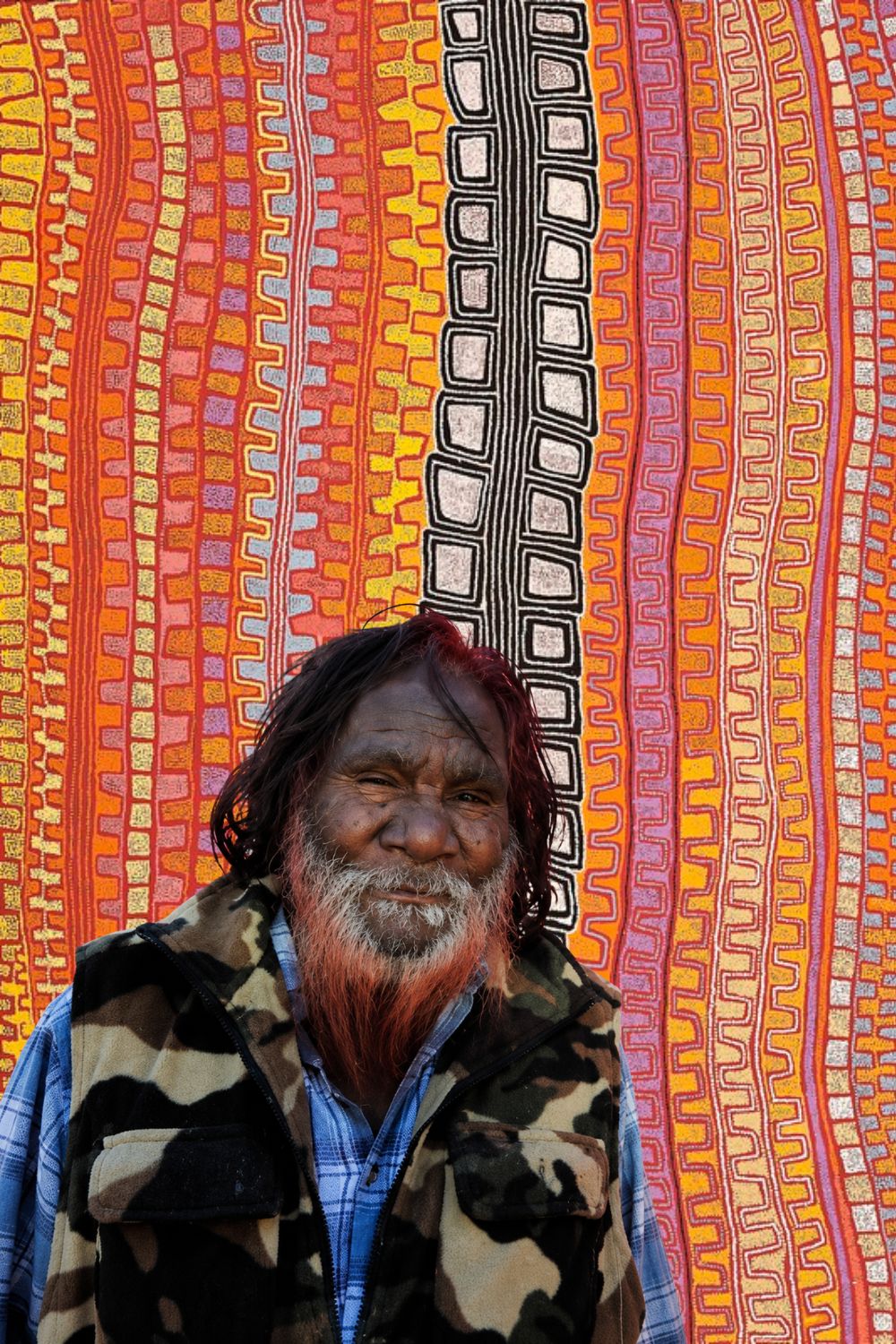
Patrick (Olodoodi) Tjungurrayi (c.1935–2017) united two of the defining traditions in Western Desert Art. Beginning his artistic career his younger sister Elizabeth Nyumi at Warlayirti Artists in Balgo Art before later joining Papunya Tula Artists, he combined the rich colour and expressive energy of Balgo with the disciplined geometry of Pintupi Art to create one of the most sophisticated abstract styles in contemporary Aboriginal art. As a senior Pintupi Law man who spent his early life living traditionally in the Great Sandy and Gibson Deserts, Patrick painted with exceptional cultural authority, transforming Tingari narratives into shimmering fields of diamonds, lozenges and rhythmic grids that evoke the spiritual power of Country rather than describe it literally.
Unlike many Western Desert artists whose paintings are structured around concentric circles, Patrick progressively reduced his imagery to finely balanced networks of parallel lines and geometric forms that appear to vibrate across the canvas. In this movement towards increasingly refined abstraction, his work can be considered alongside fellow Pintupi artists George Tjungurrayi, Turkey Tolson Tjupurrula and Ronnie Tjampitjinpa, although each developed a distinctly individual visual language. Patrick’s mature works demonstrate extraordinary technical control while remaining deeply grounded in traditional law, creating paintings that reward prolonged contemplation rather than immediate interpretation. His achievements were recognised nationally in 2008 when he won the inaugural Western Australian Indigenous Art Award, cementing his reputation as one of Australia’s leading Aboriginal painters.
Patrick Tjungurrayi Value
Patrick Tjungurrayi’s paintings range from early Balgo works to highly sought-after Papunya Tula masterpieces. Values vary according to the period, size, provenance, condition and subject. Learn what influences the value of Patrick Tjungurrayi’s paintings, view auction results and discover current market trends on the Patrick Tjungurrayi Painting Values page.
Biography
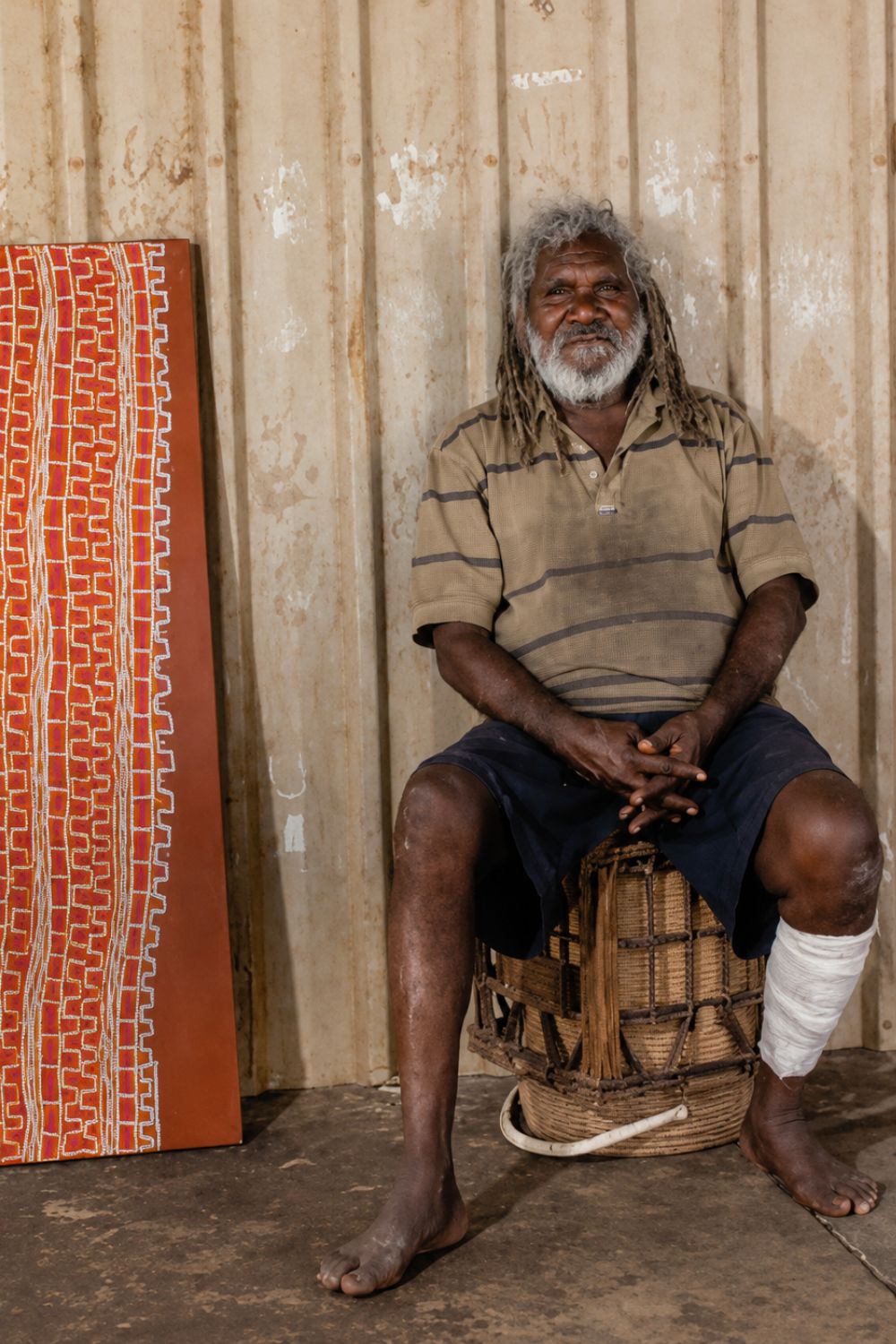
Patrick (also recorded as Olodoodi or Alatuti Tjungurrayi) was born around the mid-1930s near Yalangerri (Jupiter Well, Well 33) on the Canning Stock Route in Western Australia. As with many Aboriginal people born in the Western Desert before sustained European contact, his exact birth year was never formally recorded. He belonged to the Pintupi people and spent his childhood living a traditional nomadic life, travelling through Country according to seasonal resources, ceremony and family responsibilities.
Patrick belonged to the last generation of Pintupi people to grow up almost entirely in the desert before moving into settlement. During the late 1950s his family walked out of the Western Desert to Balgo Mission as part of the broader migration that reshaped Aboriginal life across central Australia. There he worked constructing the mission church and other community buildings while maintaining his ceremonial responsibilities and connection to Country.responsibility.
He was also part of one of Balgo’s most important artistic families. Patrick was the younger brother of Brandy Tjungurrayi, husband of Miriam Olodoodi, and brother-in-law of celebrated artists Elizabeth Nyumi Nungurrayi and Lucy Yukenbarri. Together they formed an important network linking Balgo with the Pintupi homelands further south.
Throughout his life Patrick remained a highly respected senior Law man responsible for important ceremonial knowledge associated with his Country. This cultural authority distinguishes his paintings, which are not simply aesthetic interpretations of the landscape but visual expressions of Tjukurrpa grounded in lived cultural responsibility.
Painting Career
Patrick began painting professionally during the mid-1980s with Warlayirti Artists shortly after the establishment of the Balgo art movement. His earliest paintings display many of the characteristics associated with Balgo art, including vibrant colour, energetic compositions and expressive brushwork.
In the early 1990s he returned closer to his ancestral Country around Kiwirrkurra and began painting regularly for Papunya Tula Artists. Rather than abandoning the visual language he had developed at Balgo, Patrick initially painted in different styles depending on the community in which he was working. Over time these two approaches gradually merged. The rich colour associated with Balgo became integrated with the disciplined geometry and visual restraint of the Pintupi tradition, producing a highly individual style unlike that of either community alone.
This synthesis became Patrick’s greatest artistic achievement. His mature paintings demonstrate that the colour traditions of Balgo and the geometric abstraction of Papunya Tula were not competing artistic languages but complementary expressions of the same Western Desert culture.
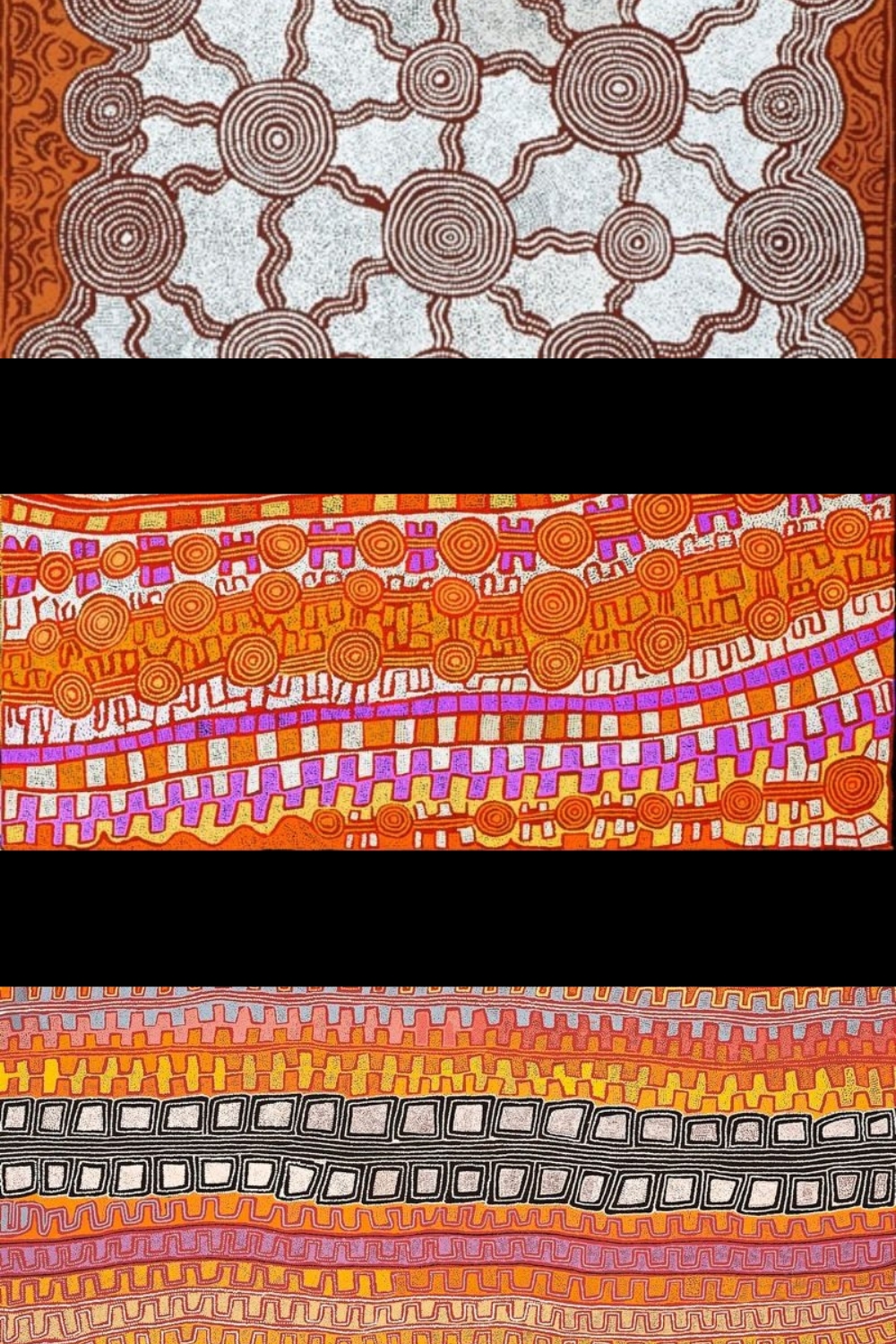
Painting Style
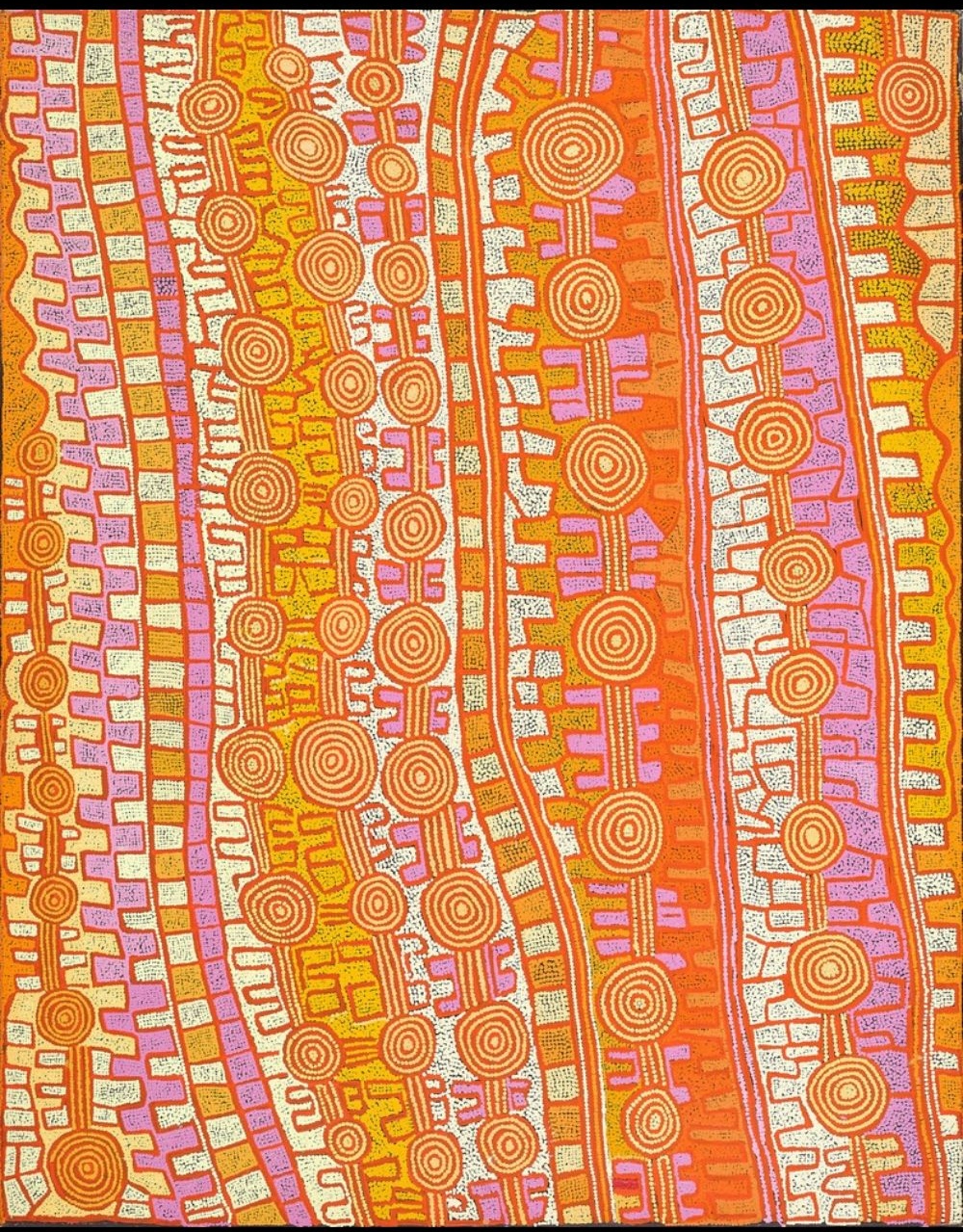
Patrick Tjungurrayi’s mature paintings are among the finest examples of geometric abstraction produced within the Western Desert movement.
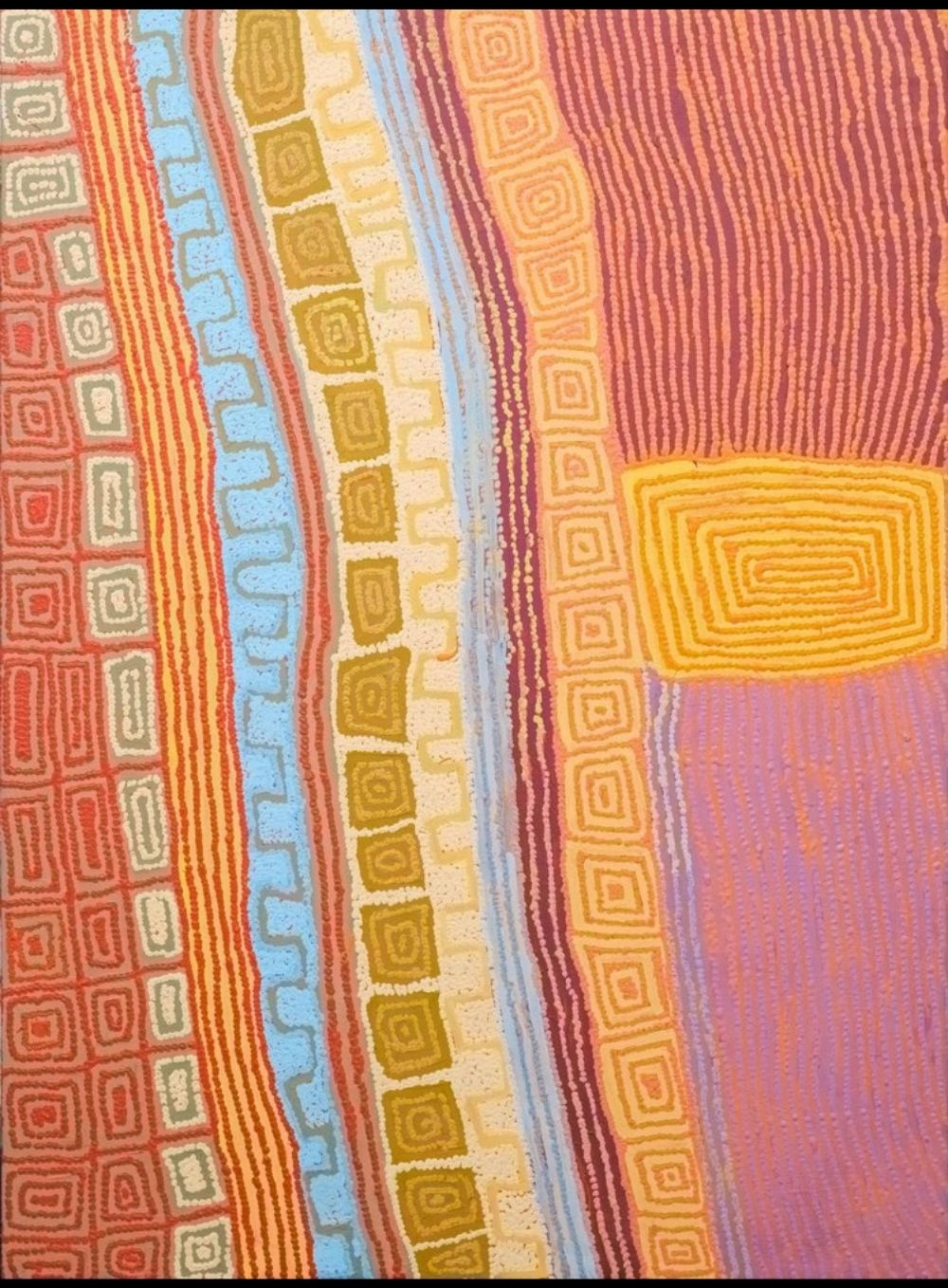
Rather than relying upon large concentric circles or densely dotted fields, he constructed his compositions from carefully organised networks of repeated linear forms. Parallel bands, diamonds, lozenges and rectilinear grids pulse rhythmically across the canvas, creating powerful optical effects that seem to shimmer as the viewer moves.
His paintings are distinguished by:
- finely balanced geometric compositions
- repeated diamond and lozenge motifs
- rhythmic rectilinear grids
- exceptional optical vibration
- remarkably precise and even brushwork
- restrained yet luminous colour palettes
- extraordinary visual harmony
- minimal reliance on concentric circles
Although highly abstract, these paintings are not exercises in formal design. Their structure derives from ceremonial knowledge associated with the Tingari ancestors and the ritual designs connected with their journeys across the Western Desert. Rather than functioning as maps in the conventional sense, Patrick’s paintings express relationships between ancestral beings, ceremony and Country through repeated visual rhythms. The surface itself becomes a manifestation of Tjukurrpa, allowing the viewer to experience the spiritual presence of Country through abstraction.
His finest paintings reveal extraordinary technical control. What initially appears simple gradually unfolds into subtle variations of line, spacing and colour that create remarkable depth, movement and visual intensity.
Subjects
Patrick repeatedly painted places associated with the Tingari Cycle and his own ancestral Country surrounding Jupiter Well and the western Pintupi lands.
Common subjects include:
- Tingari
- Warriya
- Myilili
- Ngarru
- Puntujtalka (Jupiter Well)
- Tjintal
- Marnpanga
- Kallianku
- Palipalintjanya
- Putinjana Rain Dreaming
- Wanawarra (Rainbow Serpent)
Rather than depicting a wide variety of unrelated Dreamings, Patrick continually revisited this interconnected ceremonial landscape throughout his career. By returning to the same ancestral sites over several decades, he explored increasingly refined ways of expressing Tingari narratives through geometric abstraction, each painting becoming another interpretation of the spiritual relationships embedded within his Country.
Artistic Importance and Legacy
Patrick Tjungurrayi occupies a unique position in the history of contemporary Aboriginal art because he successfully united two of the major Western Desert painting traditions. Few artists moved so convincingly between Balgo and Papunya Tula while maintaining such a distinctive personal style. By combining the rich colour traditions of Balgo with the disciplined geometry of the Pintupi school, he developed a visual language of exceptional optical intensity, formal elegance and profound cultural authority.
As both a senior Law man and an artist of remarkable originality, Patrick transformed ceremonial knowledge into some of the most sophisticated abstract paintings produced within the Western Desert movement. His mature works demonstrate that Balgo’s expressive colour and the geometric restraint of Pintupi painting were not separate artistic languages but complementary expressions of the same cultural tradition.
Patrick’s influence extended well beyond his paintings. He was an important custodian of Pintupi knowledge and ceremony and, in later life, became a passionate advocate for improved dialysis services for Aboriginal people living in remote communities through the Purple House initiative. Today his paintings are represented in major Australian public collections and continue to be sought after by museums and collectors for their rare combination of cultural significance, technical mastery and visual sophistication. Together, they stand among the defining achievements of late twentieth- and early twenty-first-century Western Desert art.
Public Collections
- Art Gallery of New South Wales, Sydney
- Queensland Art Gallery | Gallery of Modern Art, Brisbane
- National Museum of Australia
- Museum and Art Gallery of the Northern Territory, Darwin
- Artbank
- National Portrait Gallery (portrait collection)
International Public Collections
- Harvard Art Museums, USA
- Hood Museum of Art, USA
You could optionally add a separate section for notable private and corporate collections:
Selected Private Collections
- Luciano Benetton Collection, Venice
- Kerry Stokes Collection, Perth
- Holmes à Court Collection, Perth
- Pat Corrigan Collection, Sydney
- The Luczo Family Collection, USA
- The Kelton Collection, USA
Further Reading
- Carty, John, Hetti Perkins & Sarah Brown (eds). Beyond Borders: Patrick Tjungurrayi. University of Western Australia Publishing, 2021. The definitive publication on Patrick Tjungurrayi’s life, art and advocacy for the Purple House dialysis service. It combines biography, art history and cultural context and is the single most important reference on the artist.
- Johnson, Vivien. Aboriginal Artists of the Western Desert: A Biographical Dictionary. Craftsman House, revised editions. The standard biographical reference for Western Desert artists, including Patrick Tjungurrayi’s early career and his movement between Balgo and Kiwirrkurra.
- McLean, Ian. Naata Nungurrayi; Muni (Rita) Simpson; Spinifex Artists Group; Patrick Tjungurrayi. Art Gallery of Western Australia, 2008. Published to accompany the Western Australian Indigenous Art Awards, this catalogue examines Patrick’s paintings within the context of contemporary Western Australian Aboriginal art.
- Perkins, Hetti & Hannah Fink (eds). Papunya Tula: Genesis and Genius. Art Gallery of New South Wales, 2000. An essential history of the Papunya Tula movement and the artistic traditions from which Patrick’s mature geometric style emerged.
- Myers, Fred R. Painting Culture: The Making of an Aboriginal High Art. Duke University Press, 2002. A landmark anthropological study explaining how Pintupi painting expresses Tjukurrpa, Country and social relationships, providing important context for understanding Patrick’s abstraction.
- Bardon, Geoffrey & James Bardon. Papunya: A Place Made After the Story. Miegunyah Press, 2004. The definitive account of the origins of the Western Desert painting movement and the development of Papunya Tula Artists.
- Johnson, Vivien. Lives of the Papunya Tula Artists. IAD Press, 2008. Biographical essays on many of the senior Papunya Tula painters who worked alongside Patrick Tjungurrayi and shaped the movement.
- Morphy, Howard. Aboriginal Art. Phaidon Press, 1998. A foundational introduction to Aboriginal art that explains the relationship between ancestral knowledge, symbolism and artistic practice across Australia.
- SmithDavidson Gallery. Patrick Olodoodi Tjungurrayi – Bibliography. A useful online bibliography listing museum collections, publications and exhibition references relating to Patrick’s work.
All images featured in this article are presented strictly for educational and informational purposes.
This website may include copyrighted material for which specific authorization has not been obtained from the copyright owner.
All such images are presumed to be the intellectual property of the respective artist or their estate, and are used in accordance with principles of fair dealing or fair use under applicable copyright law.