
Tom Djäwa — Aboriginal Bark Painter and Ceremonial Leader
c.1905–1980
Gupapuyŋu
Daygurrgurr / Yirritja
Djiliwirri, Buckingham Bay, Arnhem Land
Milingimbi, Crocodile Islands
Bark painting, carved wooden sculpture
Wild honey, Murayana, mokuy, djalambu, crabs, goannas and ancestral waterholes
Tom Djäwa was one of the most important Aboriginal bark painters and ceremonial leaders associated with Milingimbi Island in Central Arnhem Land.
A senior man of the Daygurrgurr clan of the Gupapuyŋu people, Djäwa was renowned for his knowledge of ancestral law, distinctive bark paintings and finely decorated wooden sculptures. His work depicts ancestral beings, sacred honey designs, animals, waterholes and mortuary ceremonies.
Djäwa played a central role in establishing Milingimbi as an important centre of Central Arnhem Land Art during the 1950s and 1960s. His paintings are represented in major Australian and international museum collections.
Biography of Tom Djäwa
Tom Djäwa (c.1905–1980), also known as Djäwa Daygurrgurr, was born at Djiliwirri, near Buckingham Bay in Central Arnhem Land. He belonged to the Daygurrgurr clan of the Gupapuyŋu people and the Yirritja moiety. His Country encompassed coastal wetlands, freshwater places and paperbark forests central to Gupapuyŋu ceremonial traditions.
His father was Narritjnarritj; through his Djambarrpuyŋu mother, Djäwa maintained Dhuwa moiety relationships and rights to particular ceremonial designs beyond those of his father’s clan.
Following the establishment of the Methodist mission at Milingimbi in 1923, mainland and island communities gathered there, fostering ceremonial and artistic exchange. By the early 1950s, Djäwa held authority as a liya-ngärra’mirri (senior ceremonial leader) and dalkarramirri (ceremonial song leader), with responsibilities extending to related clans.
He worked closely with Reverend Edgar Wells, mission superintendent from 1949 to 1959. Wells supported bark painting and sculpture, while Djäwa saw artistic production as a source of income and support for ceremonial life. He encouraged visiting clan leaders and artists, helping establish Milingimbi as a major bark-painting centre. In 1954, he was among six Aboriginal men who performed ceremonial dances before Queen Elizabeth II in Toowoomba.
Djäwa collaborated with researchers and collectors including Karel Kupka, Alice Moyle, Beulah Lowe and Edward Lehman Ruhe. He recorded traditional songs and appeared in Cecil Holmes’s Faces in the Sun (1963) and Djalambu(1964), the latter documenting a re-enactment of mortuary ceremonies for his father.
During the 1970s, he shared knowledge of Yolŋu law and clan relationships with anthropologist Ian Keen, while restricting outsiders’ access to sacred ceremonial paintings.
Following Yilkari Kitani’s death in 1956, Djäwa assisted his nephew, Djulwarak Dawidi, with Liyagalawumirr leadership responsibilities. Dawidi received separate artistic instruction from Dhawadanygulili.
Djäwa’s sons continued aspects of his legacy. Dr Joe Gumbula (1954–2015) worked with international museums to reconnect historical collections with their ancestral Country, while Joe Dhamanydji continued the family’s painting and ceremonial traditions at Milingimbi.
Tom Djäwa’s Sculpture and Painting Style
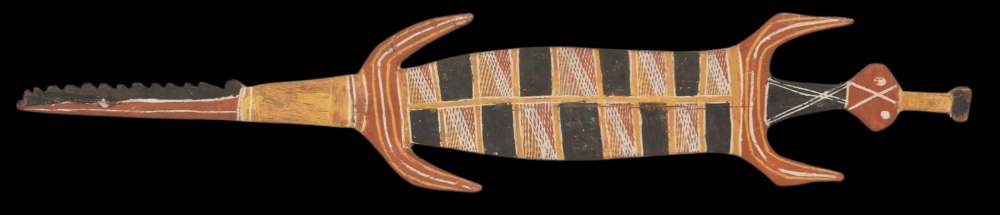
Tom Djäwa was an accomplished sculptor and bark painter, producing carved wooden spirit figures, ceremonial objects and animal sculptures at Milingimbi during the 1950s and 1960s.
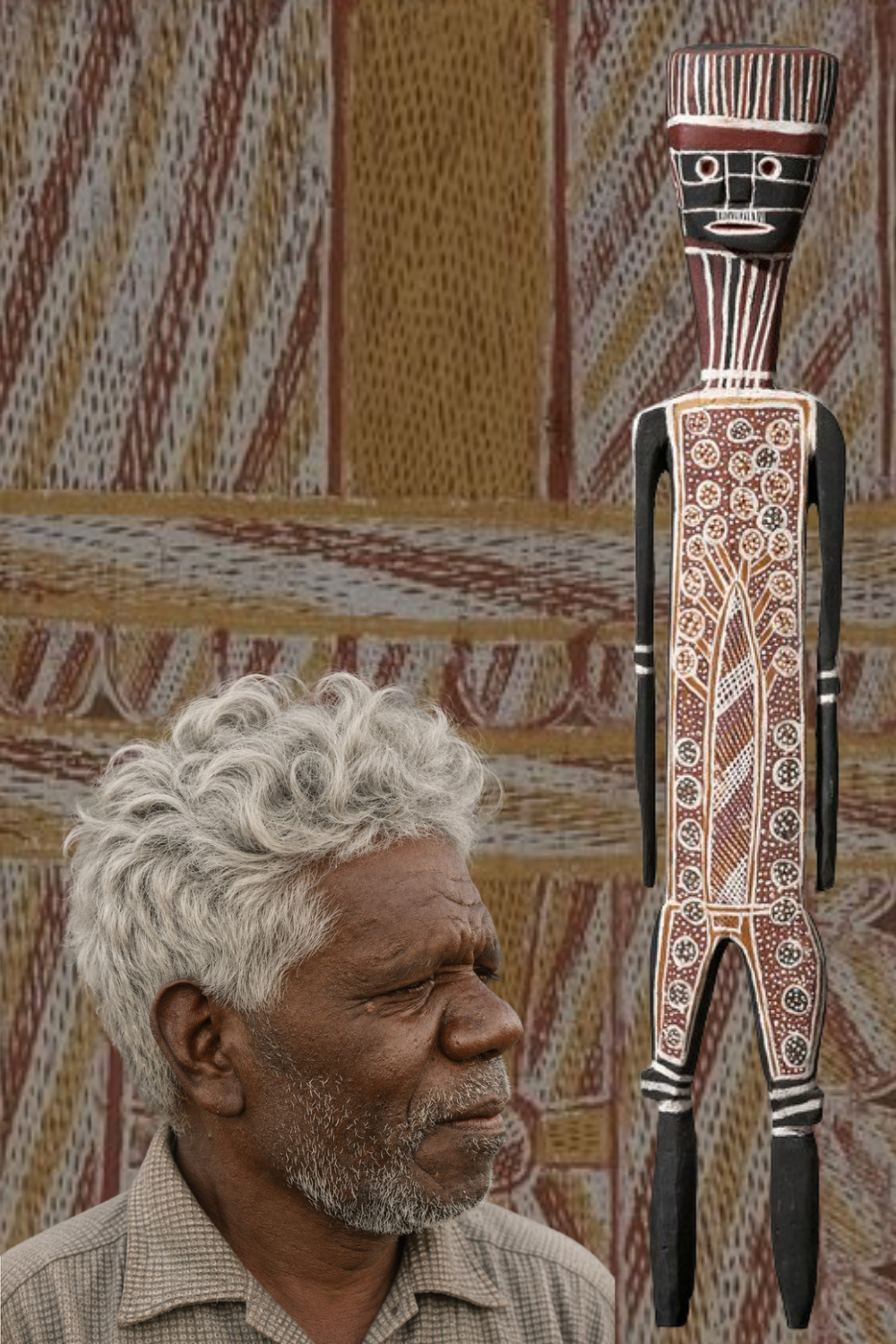
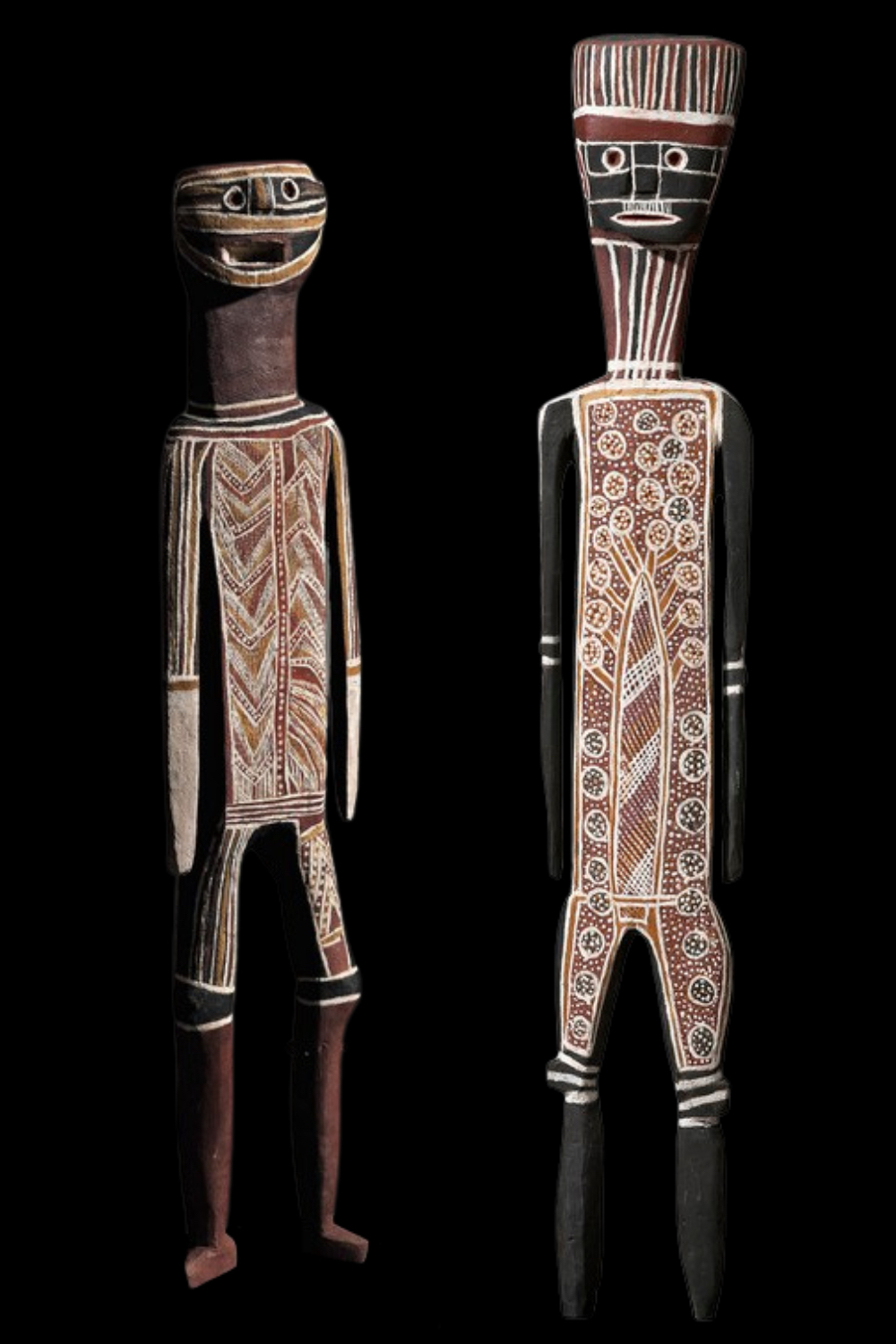
His most distinctive sculptures were mokuy (spirits of the deceased), elongated wooden figures with stylised heads, prominent eyes and slender bodies decorated with natural earth pigments.
A notable Ceremonial Mokuy Figure (c.1960), standing one metre high, features a black face outlined in white, with geometric markings, stripes and crosshatching across its neck and torso. These patterns relate to miny’tji (inherited clan designs) associated with Gupapuyŋu ancestral traditions.
Djäwa also carved birds, turtles, ceremonial skull representations and spirit boats. His Crocodile Spirit Boat (1964) depicts crocodiles inside the hull, with turtles, catfish and a snake decorating the exterior.
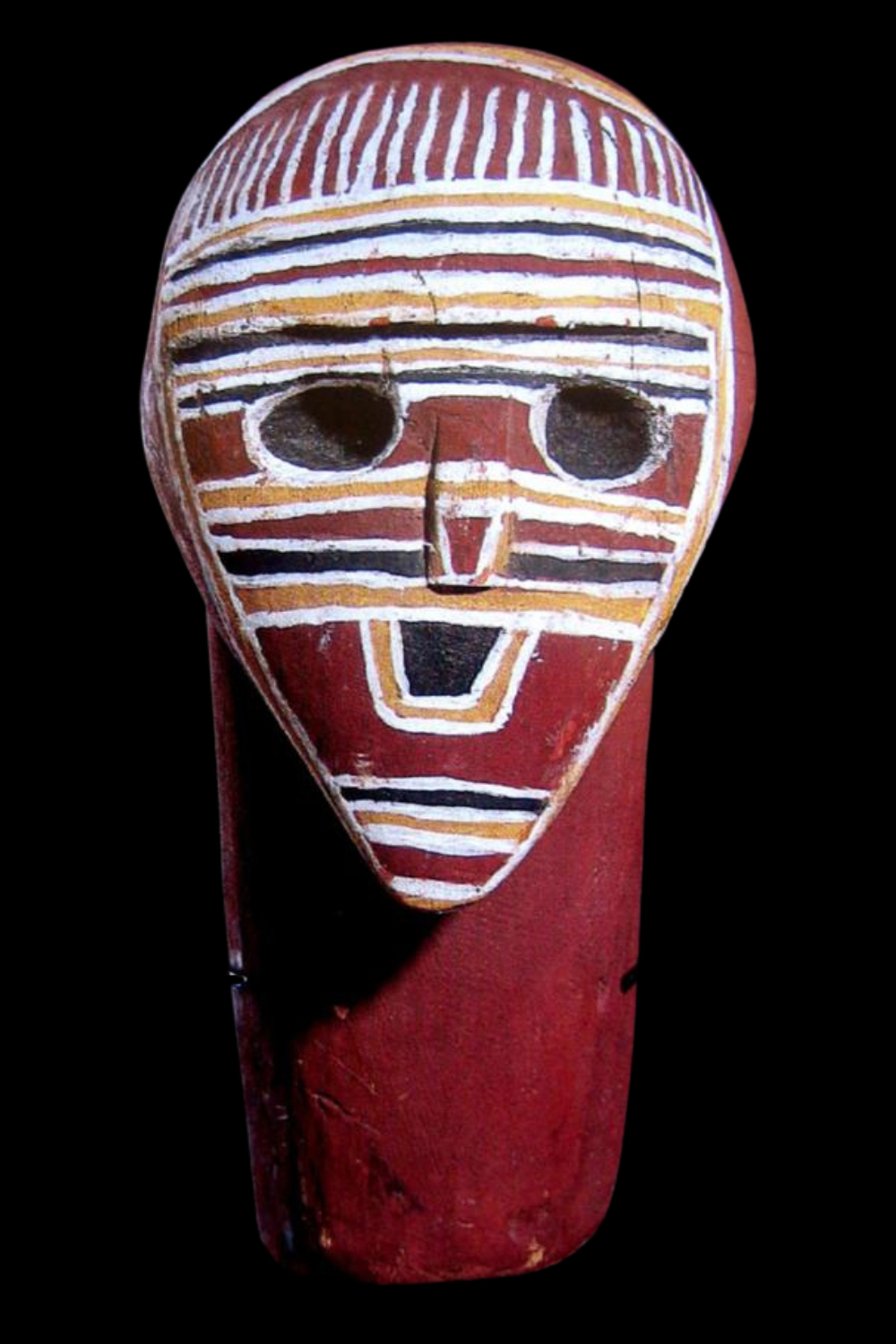
His sculptures included objects associated with mortuary ceremonies, notably a carved Djalambu Ceremonial Skull (1962), reportedly presented to a filmmaker following the recording of a hollow-log funeral ceremony.
Like his contemporary Lipundja, Djäwa adapted inherited painting designs to three-dimensional forms.
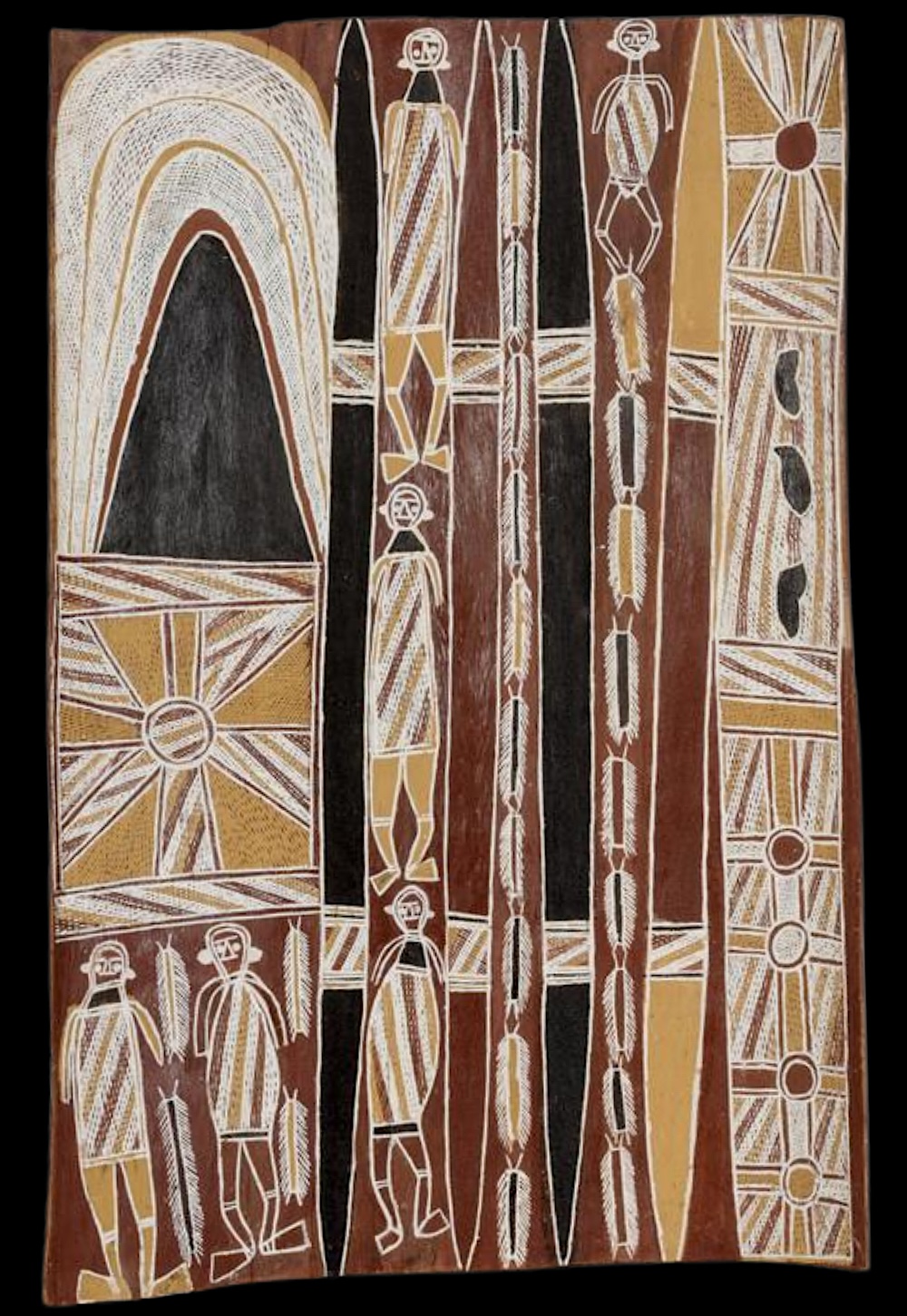
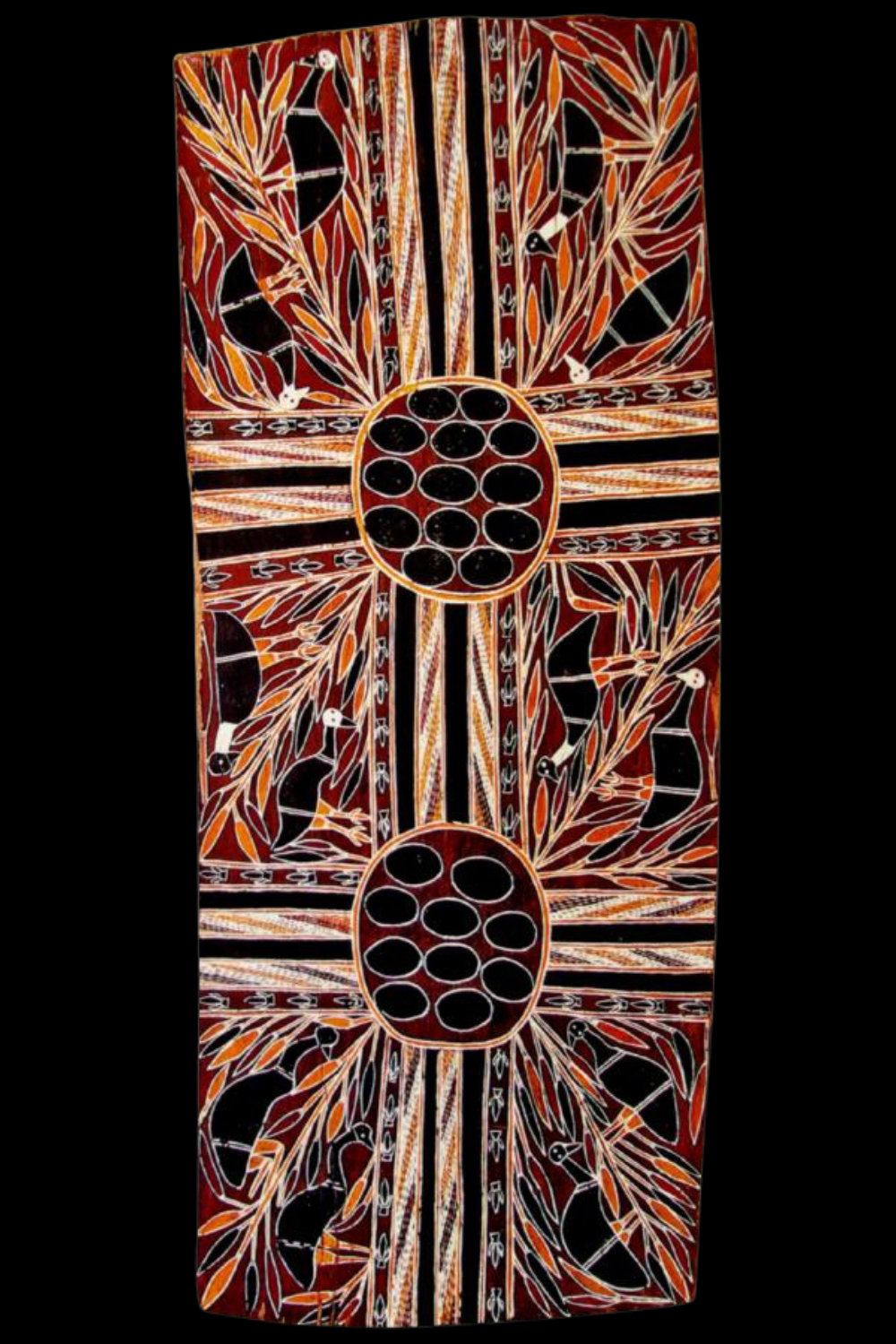
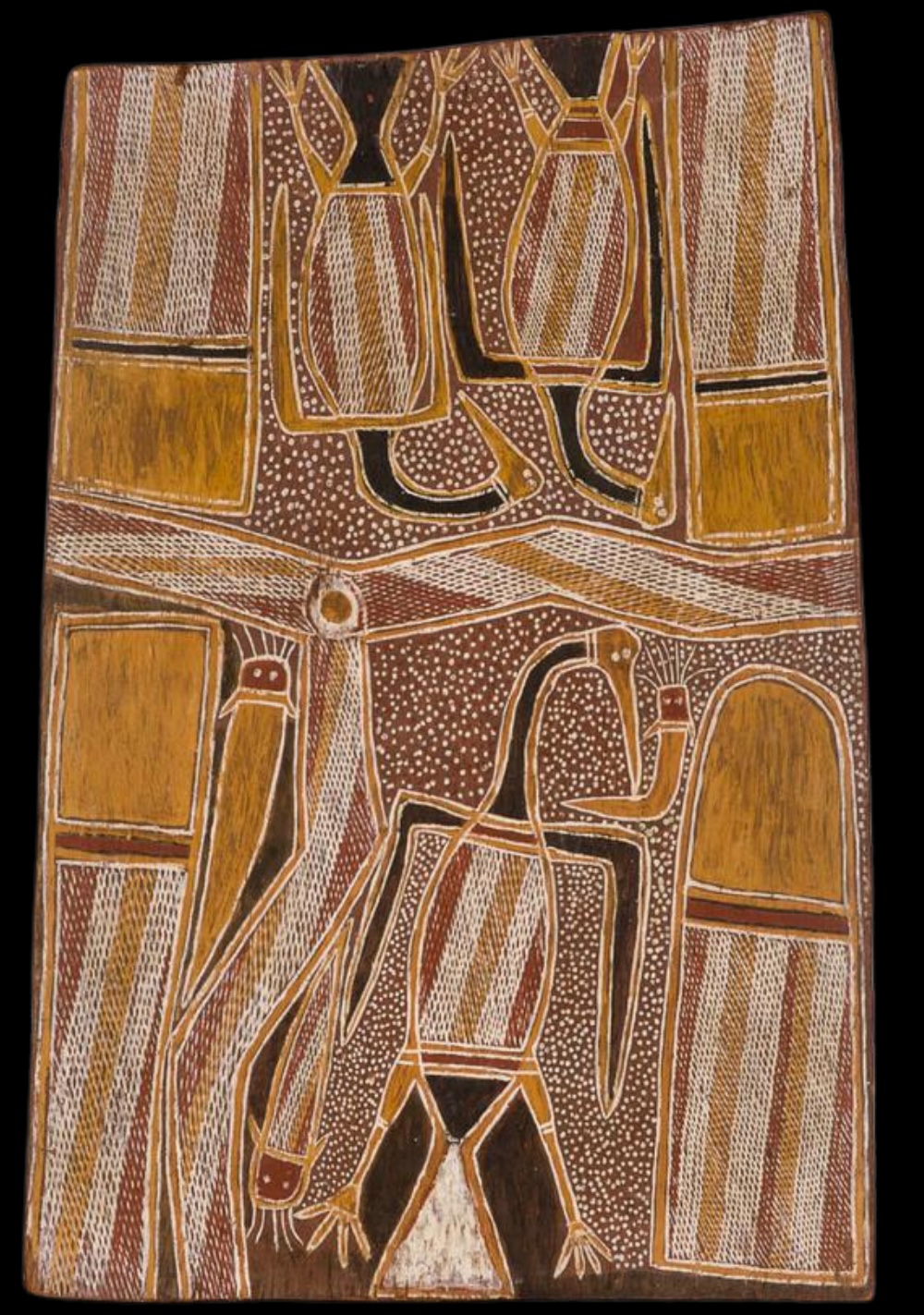
His bark paintings employed similar pigments and geometric patterns, ranging from individual ancestral animals to elaborate compositions incorporating sacred objects and intricate crosshatching.
Major Sculptural and Painting Subjects of Tom Djäwa
Mokuy — Carved Spirit Figures
Among Tom Djäwa’s most distinctive works are his carved wooden mokuy (spirits of the deceased), produced at Milingimbi during the 1950s and 1960s.
In Yolŋu belief, mokuy are spirits associated with death, sometimes regarded as dangerous presences capable of troubling the living. Their representation in sculpture belongs to a broader tradition of mortuary imagery in Arnhem Land.
Djäwa’s Ceremonial Mokuy Figure (c.1960), standing one metre high, has an elongated body, stylised facial features and carefully painted geometric designs. Natural red, white and black pigments decorate its head, neck and torso, reflecting the relationship between sculpture and ceremonial body painting.
These imposing figures demonstrate how inherited clan designs could be transformed into three-dimensional representations of ancestral and spiritual beings.
Djäwa’s son, George Milaypuma, continued this sculptural tradition, carving Murayana mokuy figures in cottonwood and decorating them with Gupapuyŋu clan designs inherited from his father.
Murayana — The Ancestral Hunter
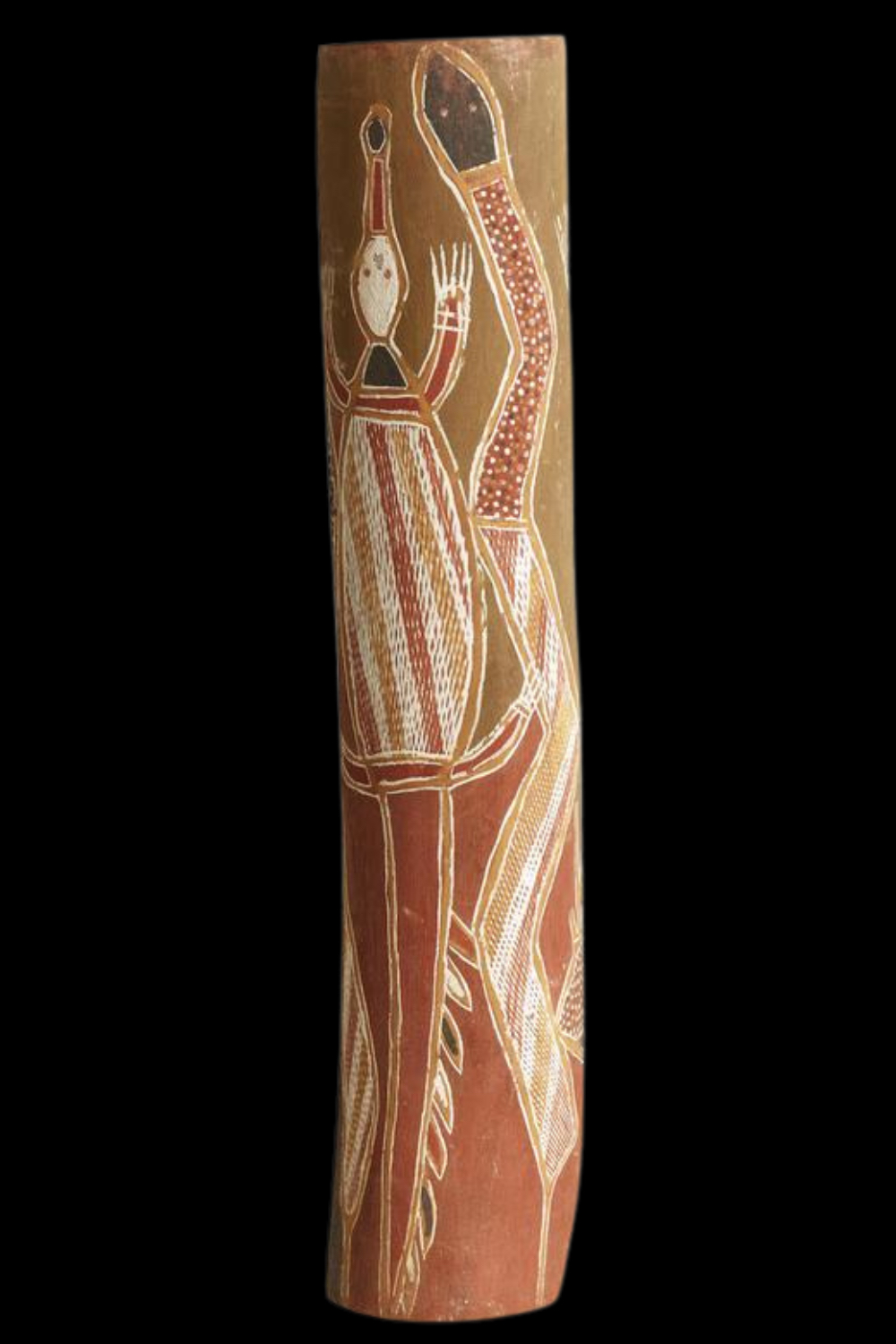
Murayana was one of Djäwa’s principal ancestral subjects, associated with the Daygurrgurr Gupapuyŋu clan and its Country around Djiliwirri.
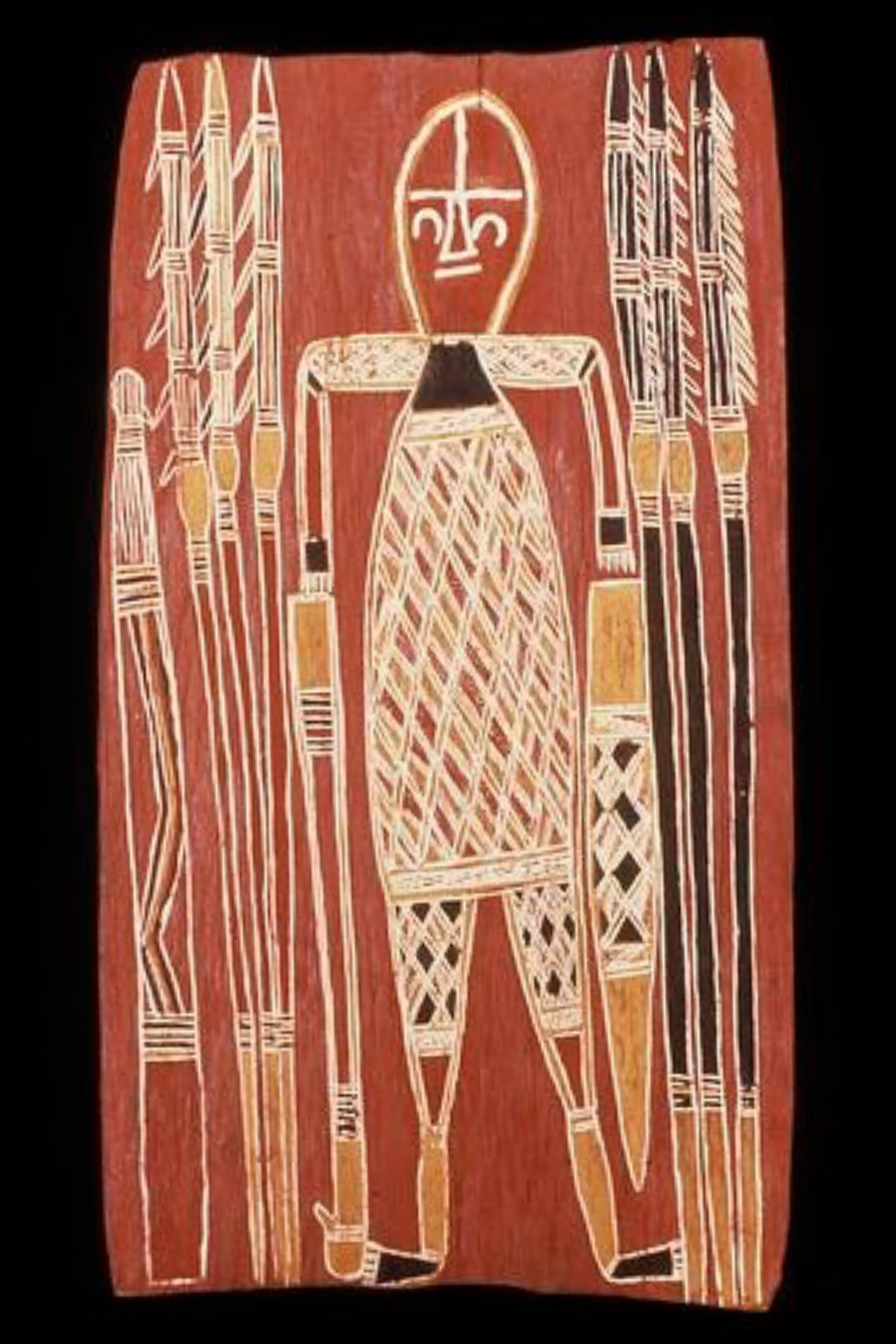
A powerful spirit-being connected with hunting, native-bee honey and ceremonial traditions, Murayana appears in several of Djäwa’s bark paintings.
An example collected by Reverend Edgar Wells around 1950 depicts Murayana carrying barbed spears and spearthrowers. His body is covered with diamond-shaped designs representing the hive of the native bee.
Another painting, Murayana — Spirit of the Dead, is held in the Kluge-Ruhe Collection at the University of Virginia.
These works connect the distinctive figurative imagery of Murayana with the inherited geometric clan designs of the Gupapuyŋu people.
Djalambu — Hollow-Log Coffins and Mortuary Ceremony
Mortuary ceremonies were central to Djäwa’s artistic and ceremonial responsibilities.
The djalumbu (hollow-log mortuary container) was associated with the treatment of the deceased and the continuing relationship between ancestral identity, the dead and their Country.
Djäwa produced painted wooden objects connected with these traditions, including a Djalambu Ceremonial Skull (1962), reportedly presented to a filmmaker following the recording of a hollow-log mortuary ceremony at Milingimbi.
His painting The Burala Rite (1972) depicts a hollow-log coffin surrounded by burala (bullroarers), together with a catfish and long-necked turtle.
Herringbone designs on the ceremonial objects represent catfish bones, while the sound of the bullroarers was associated with a bird diving towards water.
These works demonstrate how carving, painting, ancestral imagery and ceremonial performance were closely interconnected.
Sacred Honey — The Sugarbag Design
Native-bee honey, or sugarbag, was an important subject in Djäwa’s Gupapuyŋu paintings.
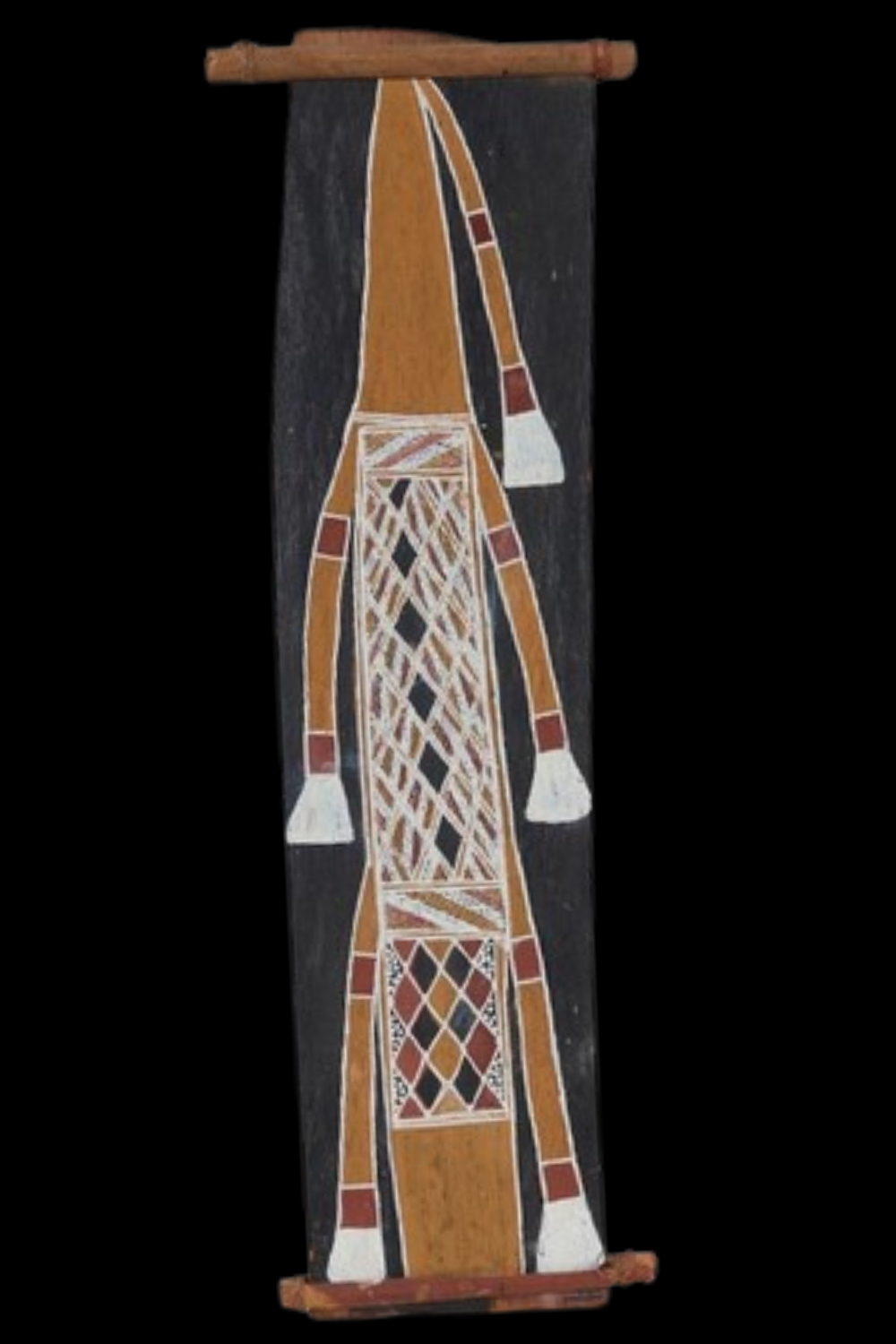
Untitled (Honey or Sugar Bag Madayin) (1975) depicts a tree associated with a sacred honey tradition. Accompanying notes identify its ceremonial name as Ganiny.
The centre represents the honey-bearing interior, while the lower section depicts raki (fibre or string). Hanging forms represent flowers visited by bees.
The design is associated with the ancestral beings Dhupiditj and Ditjpuditj and was connected with the ŋärra (Yirritja ceremonial tradition).
Related honey designs became prominent in the bark paintings of Jimmy Wululu, another important Gupapuyŋu artist from Milingimbi.
Tom Djäwa in Public Collections
Tom Djäwa’s bark paintings and carved wooden sculptures are represented in major Australian and international museum collections. His works preserve important examples of Gupapuyŋu ancestral imagery, ceremonial designs and the distinctive sculptural traditions of Milingimbi.
His work is represented in:
The National Gallery of Australia holds Waterholes (1946), while Museums Victoria preserves early paintings of Murayana collected by Reverend Edgar Wells. The Kluge-Ruhe Collection includes Murayana — Spirit of the Dead and The Burala Rite (1972).
Further Reading
- Louise Hamby and Dr Gumbula, Development of Collecting at the Milingimbi Mission, in Strings of Connectedness. Australian National University Press. Important research into Djäwa’s ceremonial leadership, family and museum collections.
- Cara Pinchbeck, Lindy Allen and Louise Hamby, Art from Milingimbi: Taking Memories Back. Art Gallery of New South Wales, 2016. An important study of Milingimbi artists, their works and continuing cultural relationships.
- National Museum of Australia, Old Masters: Australia’s Great Bark Artists. Biographical information and major paintings by Djäwa and his contemporaries.
- Museums Victoria, Murayana — Ancestral Hunter, c.1950. Museum catalogue with cultural interpretation informed by Djäwa’s son Dr Joe Gumbula.
- Helen Groger-Wurm, Australian Aboriginal Bark Paintings and Their Mythological Interpretation. Australian Institute of Aboriginal Studies, Canberra, 1973. Includes paintings by Djäwa and other Gupapuyŋu artists.
- Milingimbi Art & Culture, Milingimbi Artists and Cultural Traditions. Contemporary information about the continuation of Gupapuyŋu painting traditions through Djäwa’s descendants.
All images featured in this article are presented strictly for educational and informational purposes.
This website may include copyrighted material for which specific authorization has not been obtained from the copyright owner.
All such images are presumed to be the intellectual property of the respective artist or their estate, and are used in accordance with principles of fair dealing or fair use under applicable copyright law.