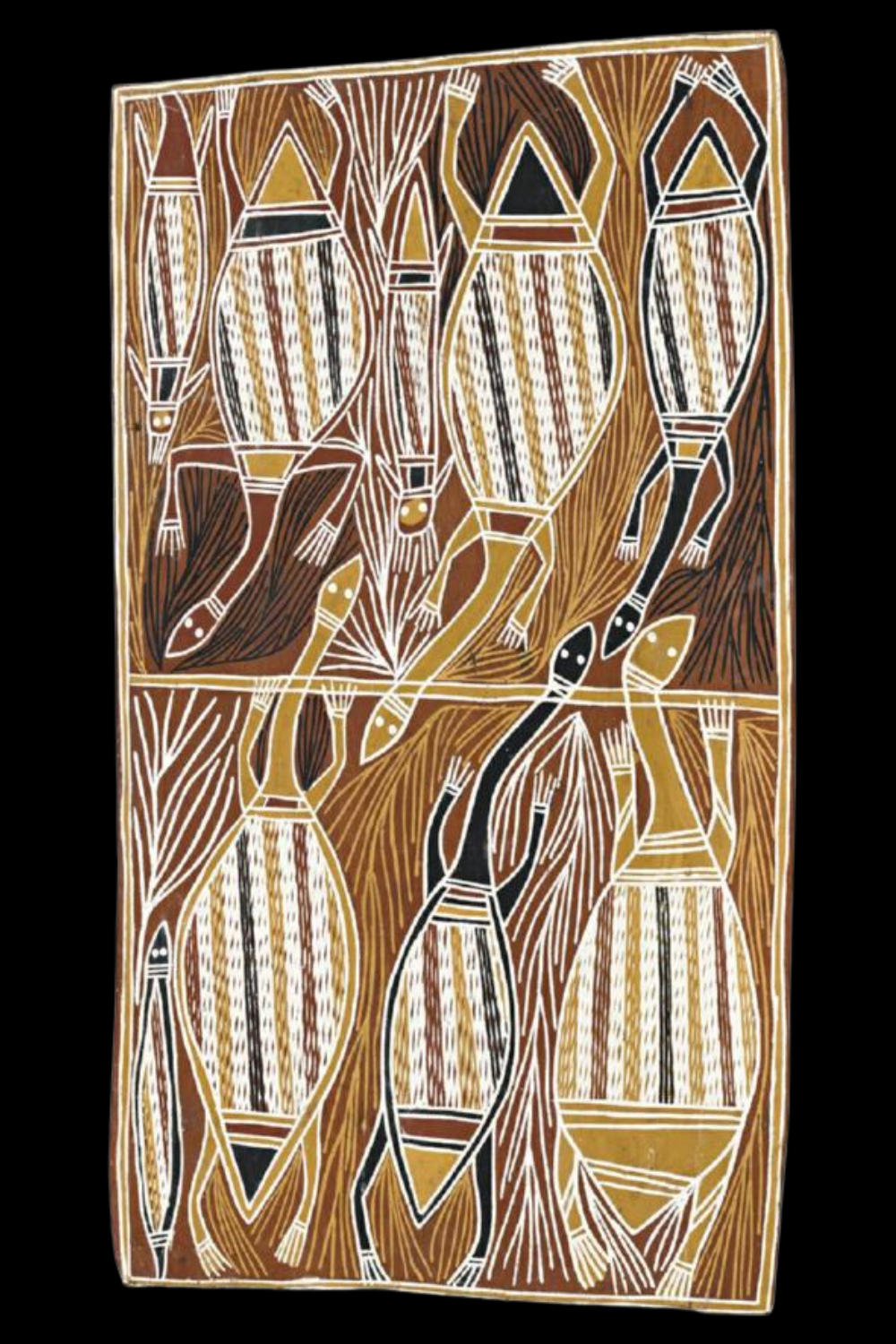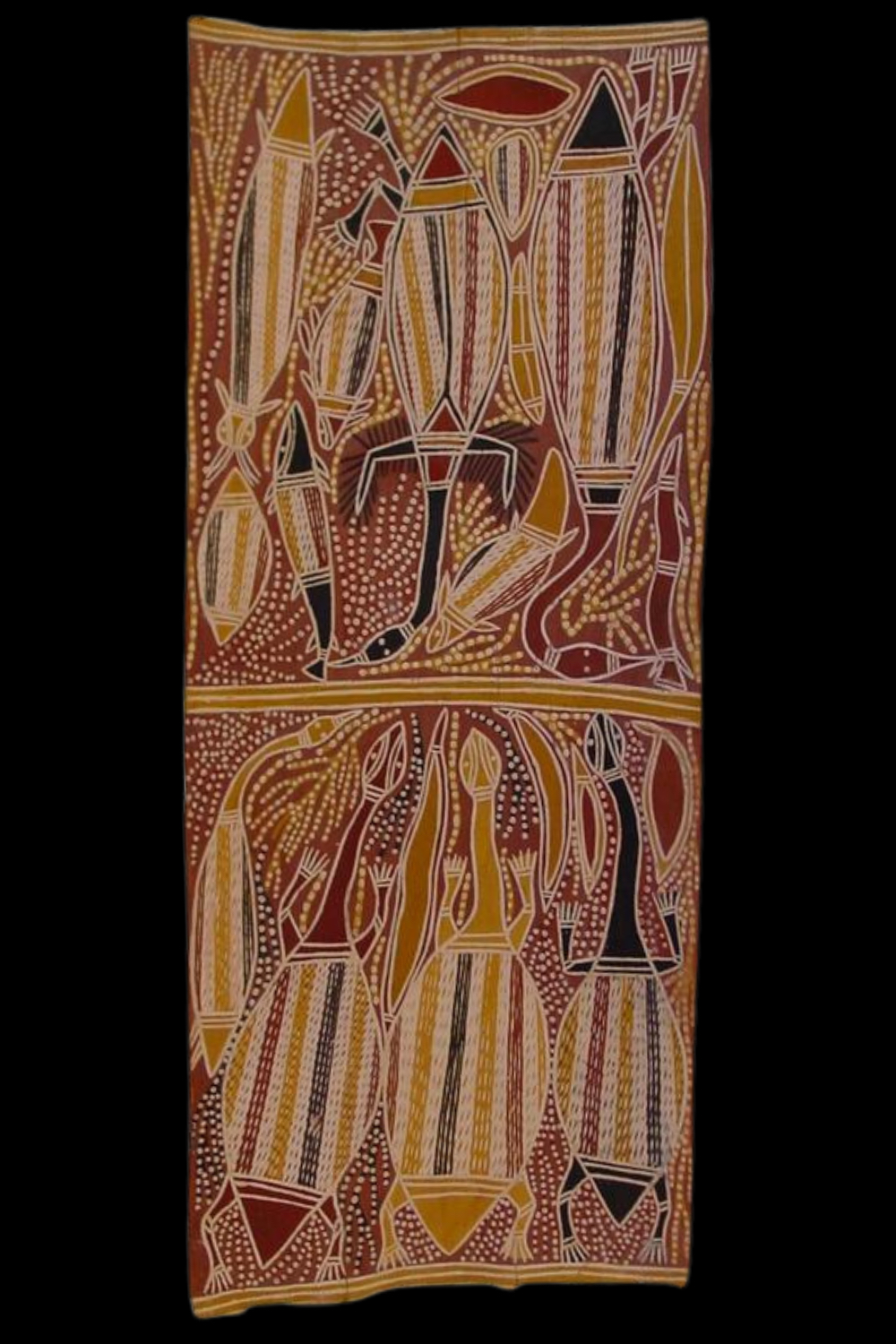
John Bulunbulun: Master of Ganalbiŋu Bark Painting
1946–2010
Ganalbiŋu (Ganalbingu)
Gurrambakurramba clan · Yirritja moiety
Ngaliyindi, Arafura Swamp, Central Arnhem Land
Maningrida / Gamerdi / Wurdeja
Central Arnhem Land Art
Maningrida Arts & Culture
John Bulunbulun (1946–2010), also known as Johnny Bulun Bulun, was one of the most accomplished bark painters and ceremonial leaders of Central Arnhem Land.
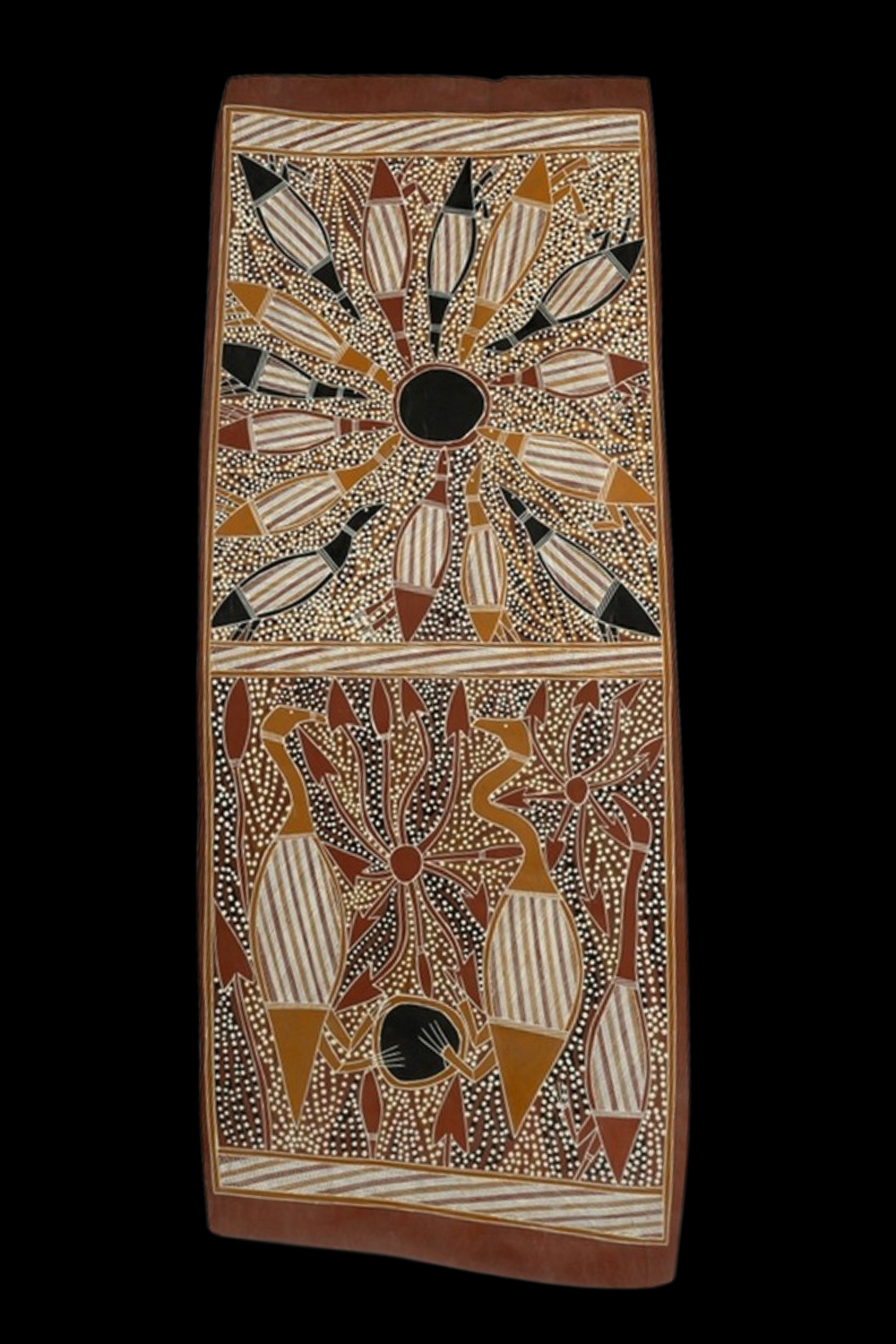
Renowned for his exceptionally fine crosshatching, balanced compositions and representations of ancestral animals, Bulunbulun transformed inherited Ganalbiŋu ceremonial designs into some of the region’s most sophisticated bark paintings.
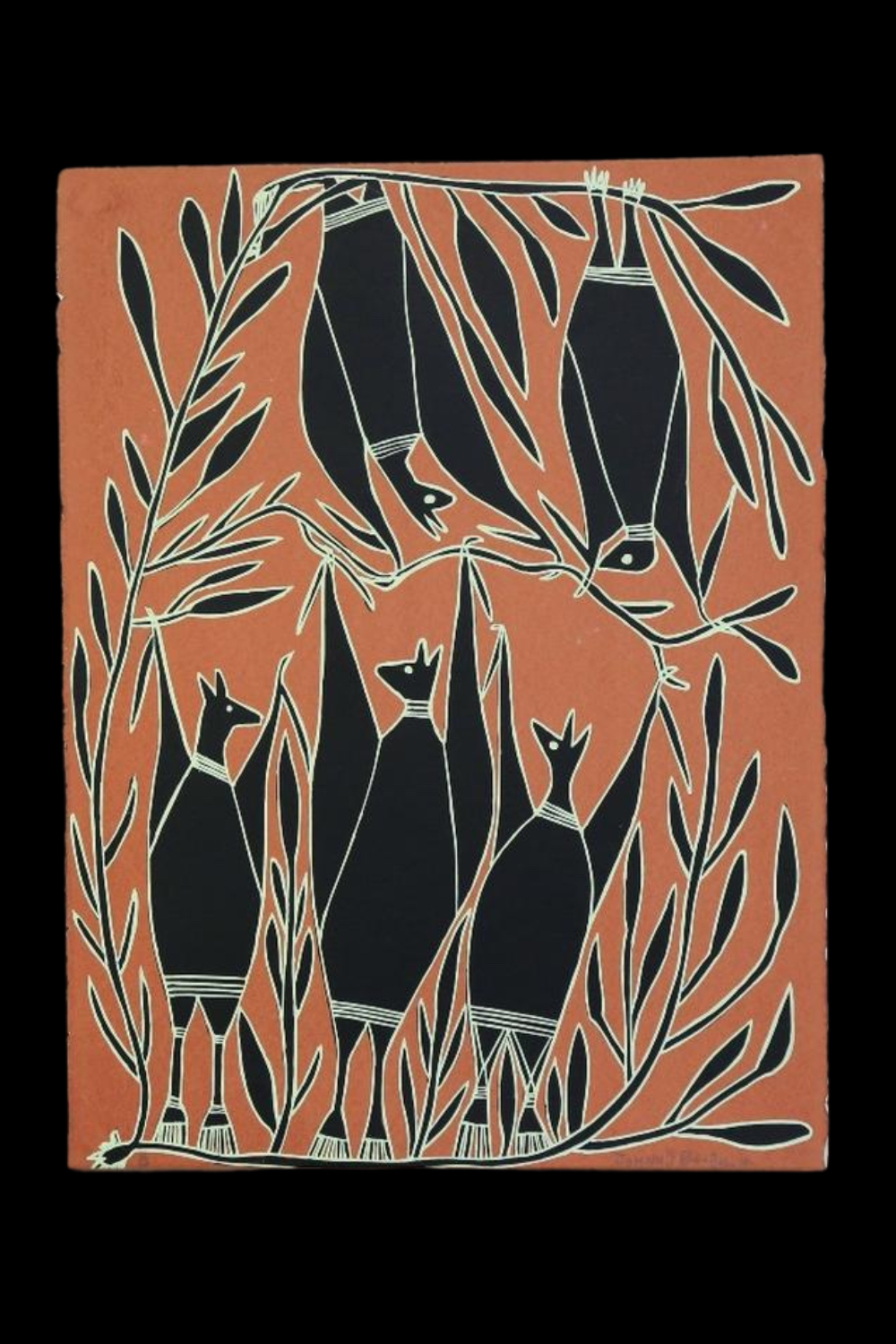
His subjects included the magpie goose, long-necked turtle, sacred waterholes and ancestral beings of the Arafura Swamp. He was also a pioneering Aboriginal printmaker and a leading advocate for Indigenous intellectual property rights.
In 2001, he won the Telstra Bark Painting Award, and in 2004 received the Australia Council’s prestigious Red Ochre Award for lifetime achievement.
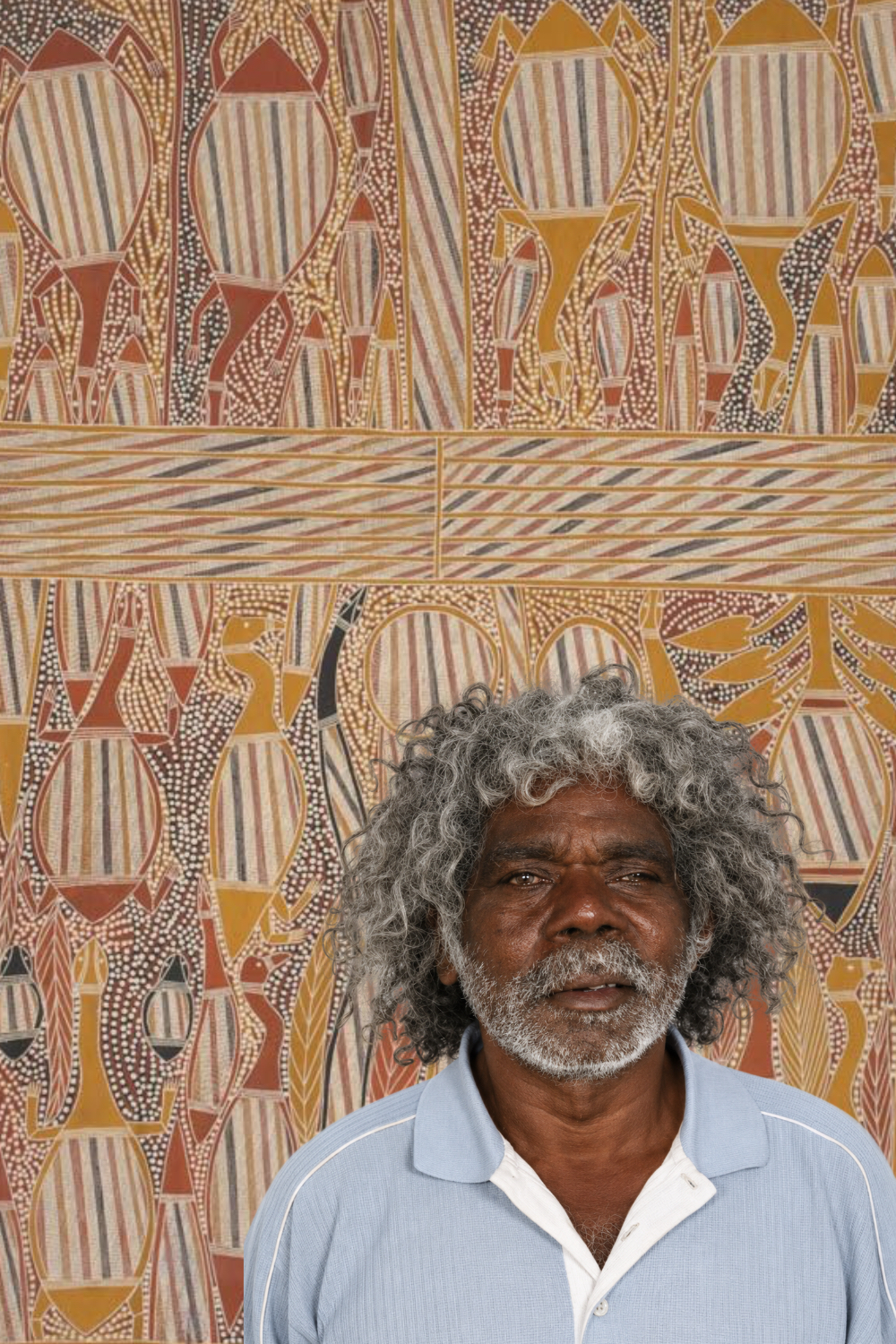
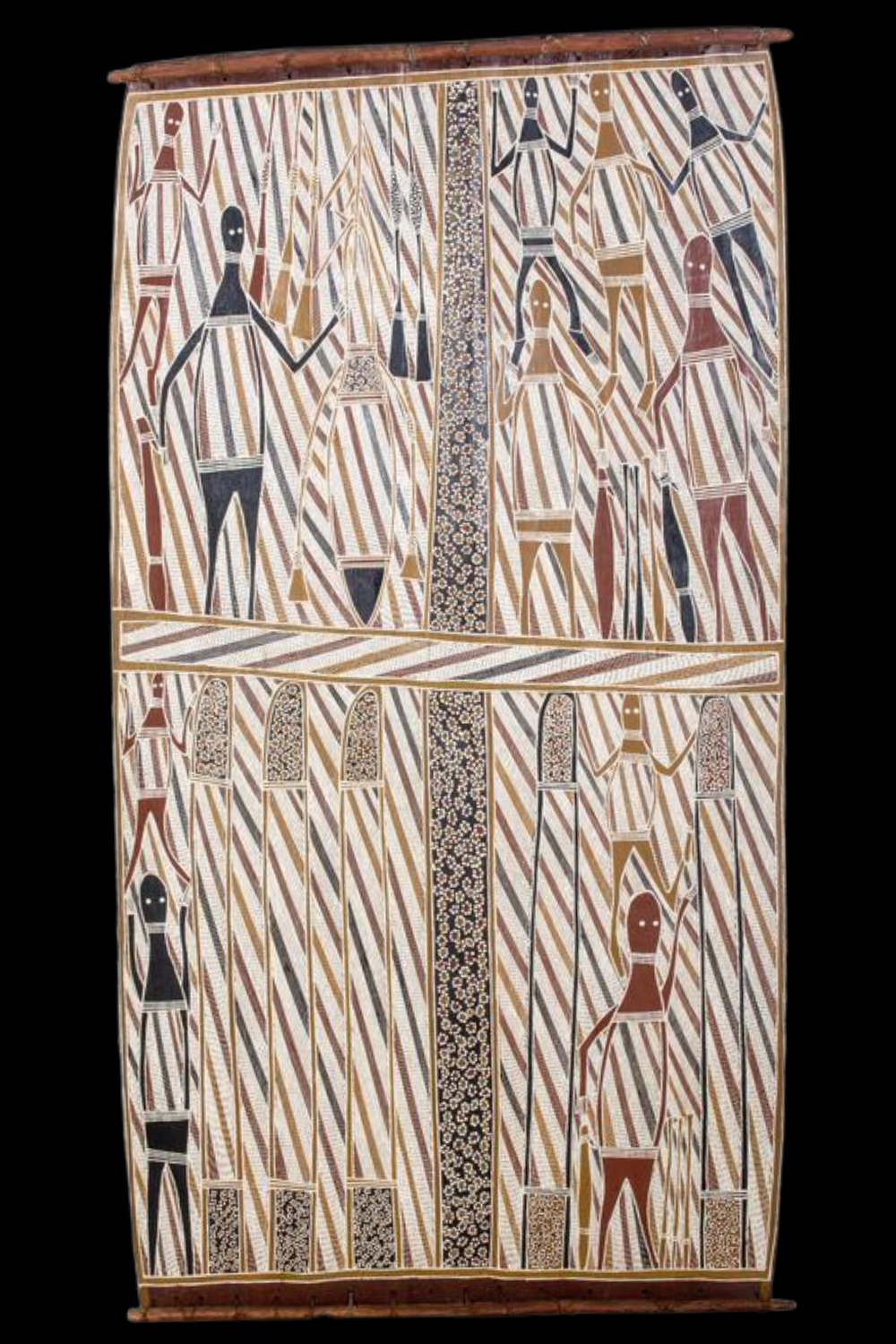
Biography of John Bulunbulun
John Bulunbulun was born in 1946 near Ngaliyindi, in the Arafura Swamp region of Central Arnhem Land. He belonged to the Gurrambakurramba clan of the Ganalbiŋu people and the Yirritja moiety.
The Arafura Swamp is an extensive freshwater landscape of billabongs, seasonal floodplains and paperbark forests. Its magpie geese, long-necked turtles, flying foxes and aquatic creatures feature prominently in the ancestral traditions that became central to Bulunbulun’s paintings.
He grew up at Milingimbi Island and Bulman, experiencing both traditional Aboriginal life and the expanding mission and settlement systems of Arnhem Land.
His father, Ngarritj, and uncle Peter Bandjurldjurl taught him painting and carving. He also received ceremonial instruction from George Milpurrurru, whom he regarded as his second father.
His education extended beyond artistic technique. The authority to reproduce particular ancestral designs depended upon inherited relationships with Country, ceremonial knowledge and the guidance of senior custodians.
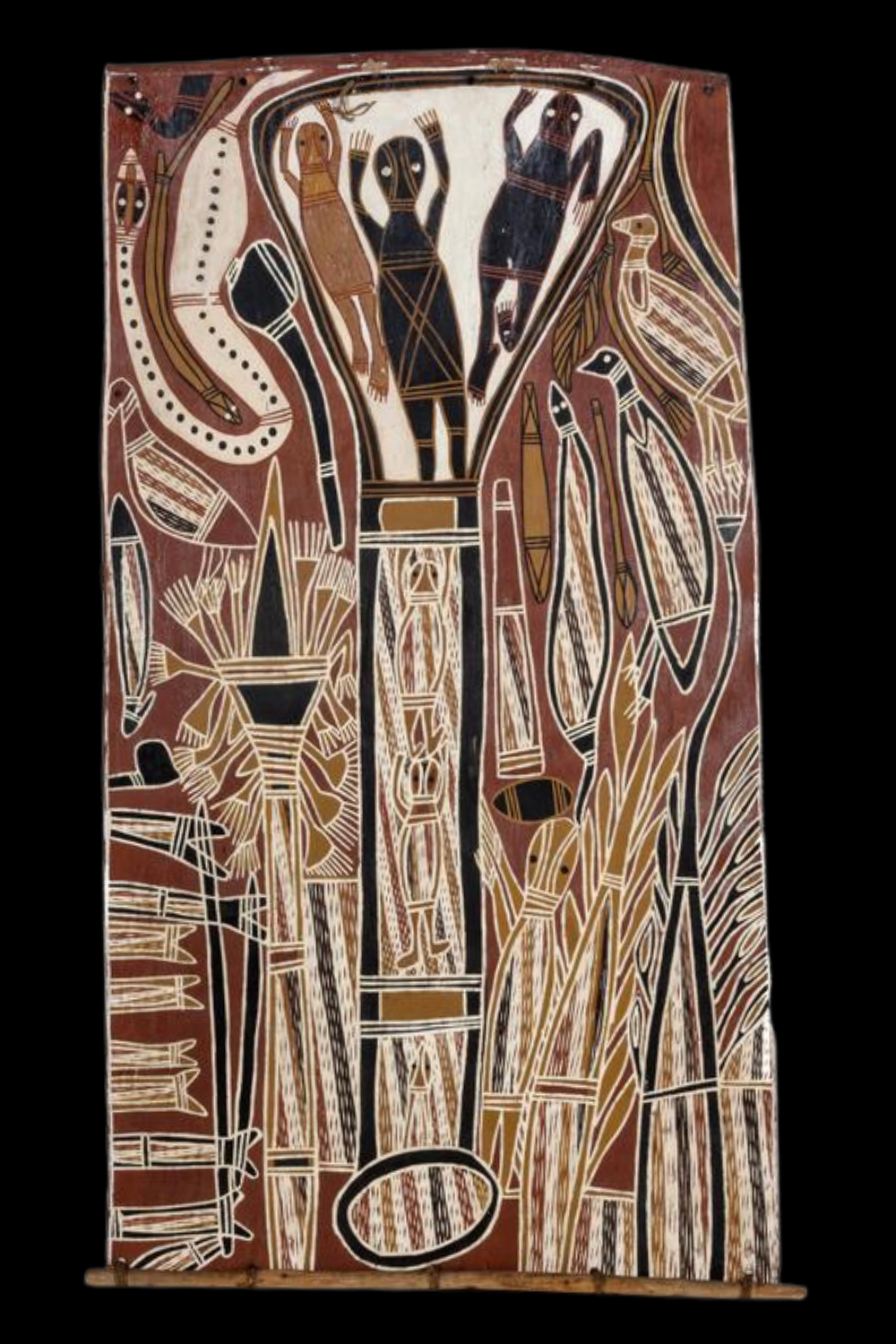
Bulunbulun eventually became an important ceremonial leader responsible for Marradjiri (ceremonies associated with childbirth), Djapi (boys’ initiation ceremonies) and Murrkundjeh (mortuary ceremonies). He was also recognised as an accomplished ceremonial singer and traditional healer. Bulunbulun also produced painted wooden funerary poles associated with Ganalbiŋu mortuary traditions. His Mudukundja — Flying Fox Pattern (1989), a painted wooden pole measuring 208 cm high, demonstrates his participation in the wider tradition of Aboriginal hollow-log coffins and ceremonial sculpture in Central Arnhem Land.
Following his initiation, Bulunbulun moved with his family to Nangalala and subsequently to Maningrida after his father’s death. He temporarily abandoned painting while grieving and supported himself through various occupations, including carpentry, plumbing, sawmill work and driving cattle.
He later resumed painting under the guidance of his uncles and became the first Aboriginal artworker at the emerging Maningrida art centre.
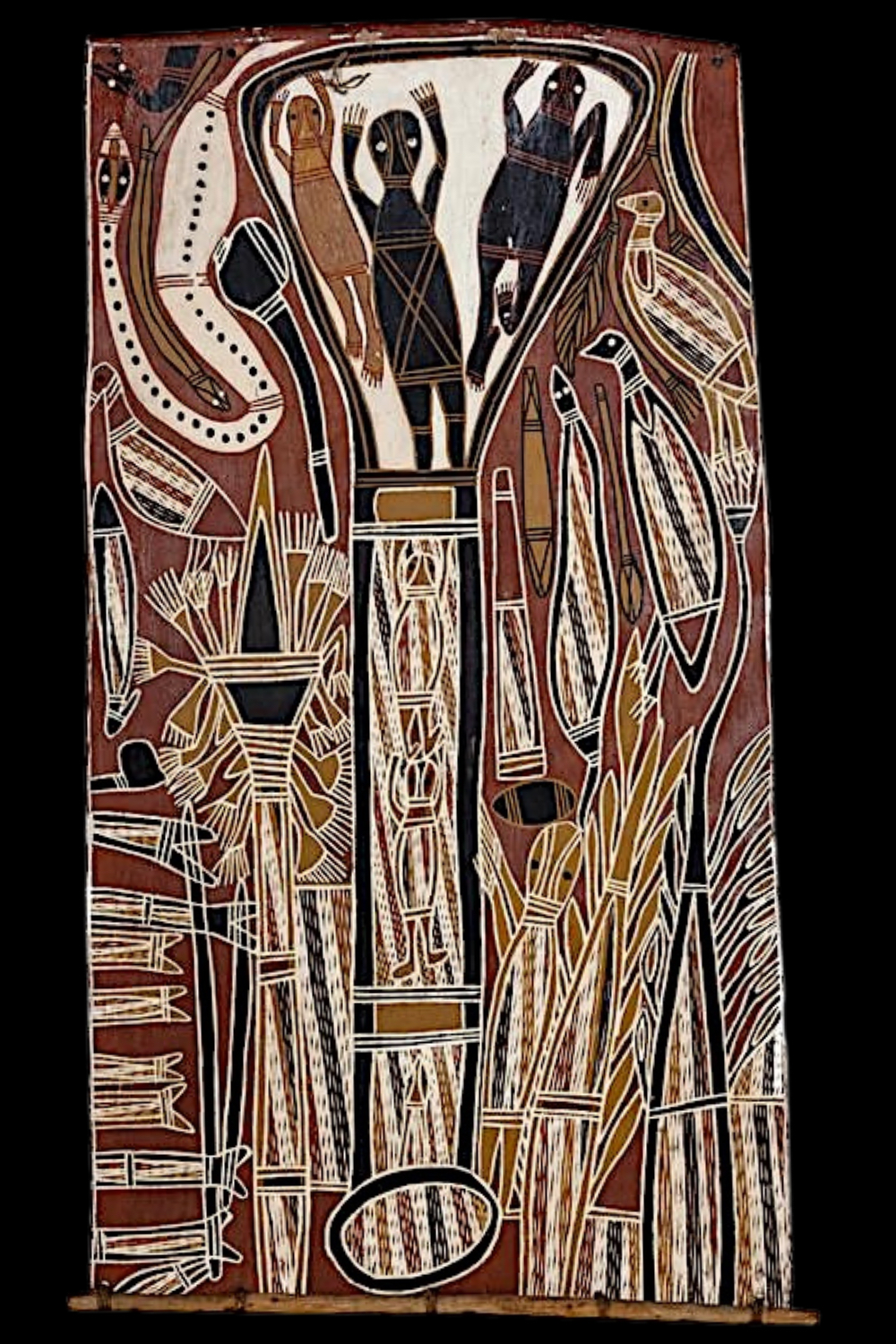
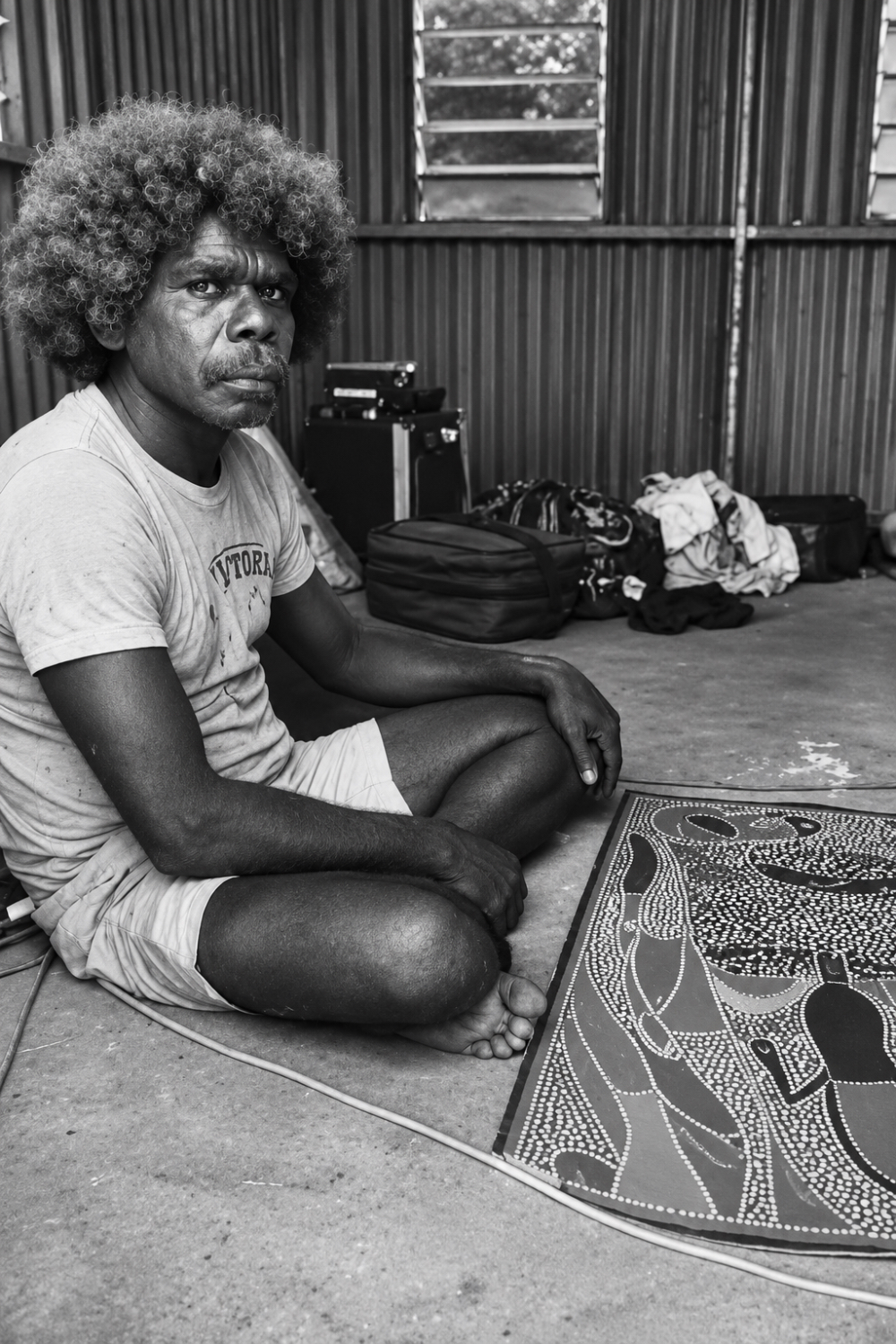
His earliest paintings are not precisely dated, although a turtle painting attributed to approximately 1967 carries an inscription indicating that it was collected in 1969. By the early 1970s, he was developing a professional career as a bark painter.
During the late 1970s, Bulunbulun moved with his first wife, Nelly, to her Country at Gamerdi, near the Blyth River. Nelly was the sister of Jack Wunuwun, an accomplished Arnhem Land painter whose artistic approach influenced Bulunbulun’s development.
At Gamerdi and neighbouring Wurdeja, Bulunbulun worked alongside Wunuwun, Michael Ngalabiya, Michael Gadjarwala, Jimmy An.gunguna and Tommy Gondorra Steele.
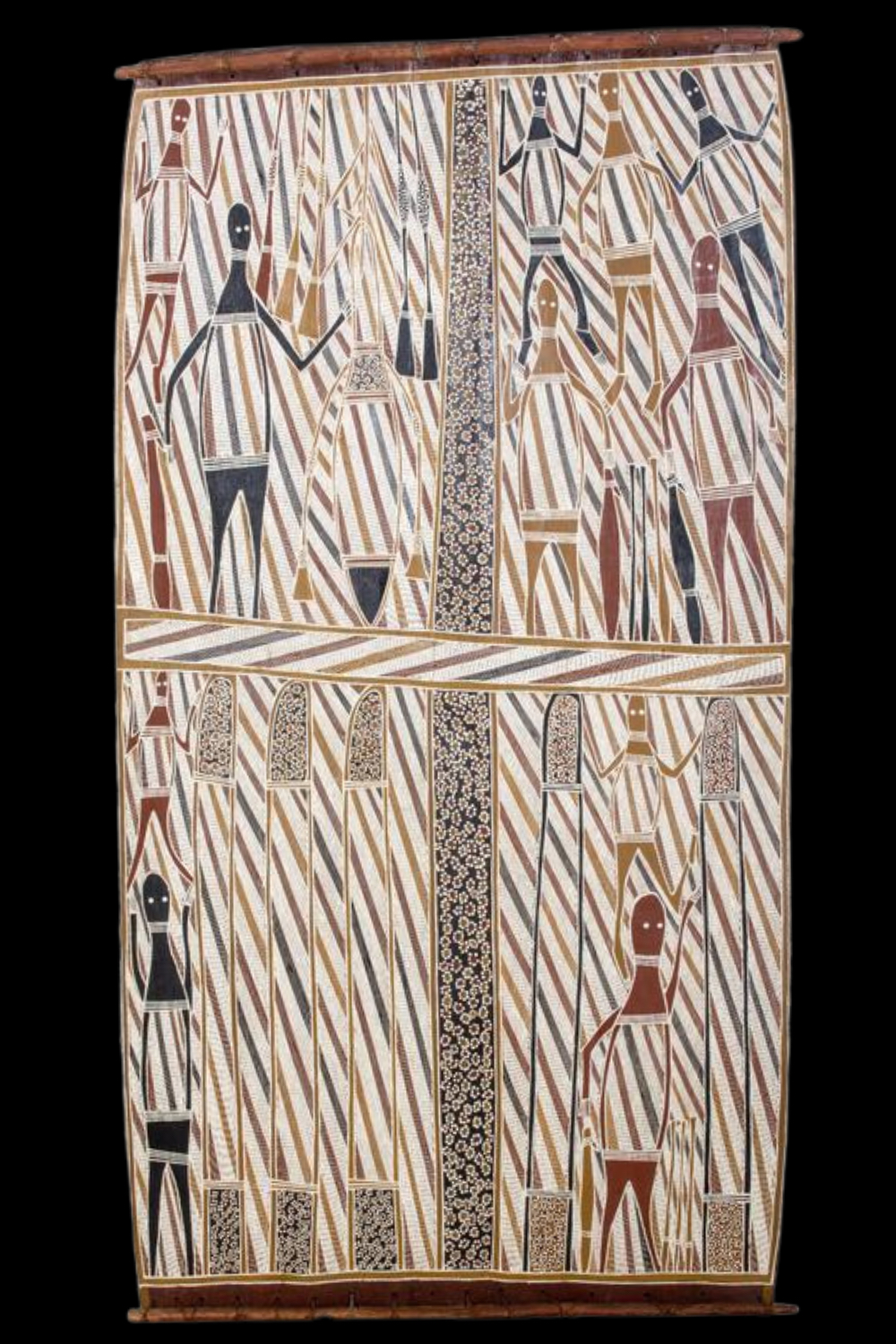
This artistic environment contributed to the refinement of his mature style, characterised by carefully balanced compositions, precise drawing and exceptionally fine rarrk (crosshatching).
By the 1980s, Bulunbulun had established a reputation as one of Central Arnhem Land’s most accomplished bark painters, combining ancestral animals, sacred waterholes and ceremonial designs in increasingly sophisticated compositions.
John Bulunbulun Painting Style
Bulunbulun’s paintings are distinguished by their controlled composition, delicate linework and complex arrangements of ancestral imagery.
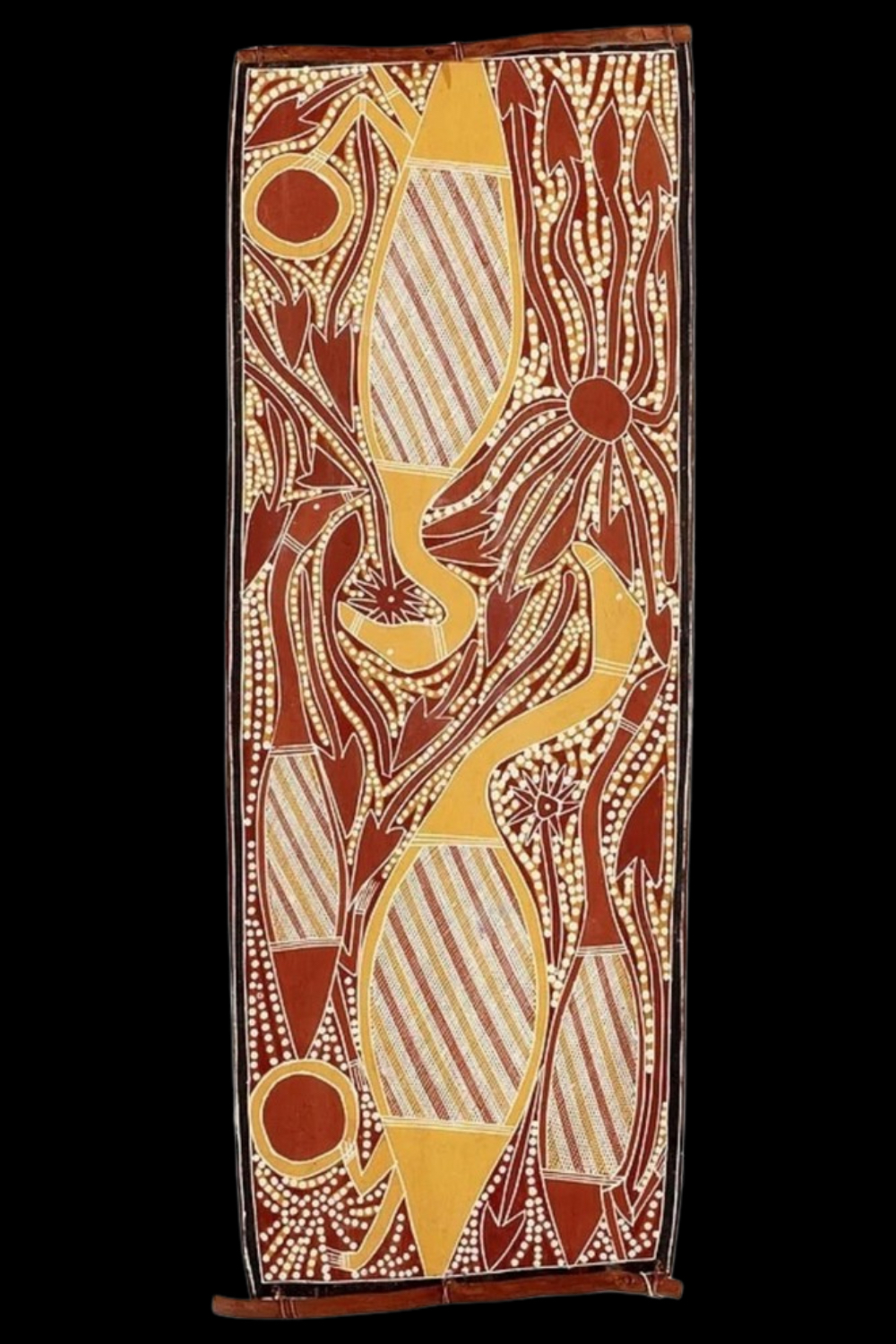
Unlike painters who filled the background with continuous crosshatching, he frequently contrasted areas of finely patterned detail with broad fields of red, yellow, black or white pigment.
Animal figures might appear individually or be repeated across the composition. Their bodies were often elongated, their outlines carefully articulated and their internal forms divided by precise geometric designs.
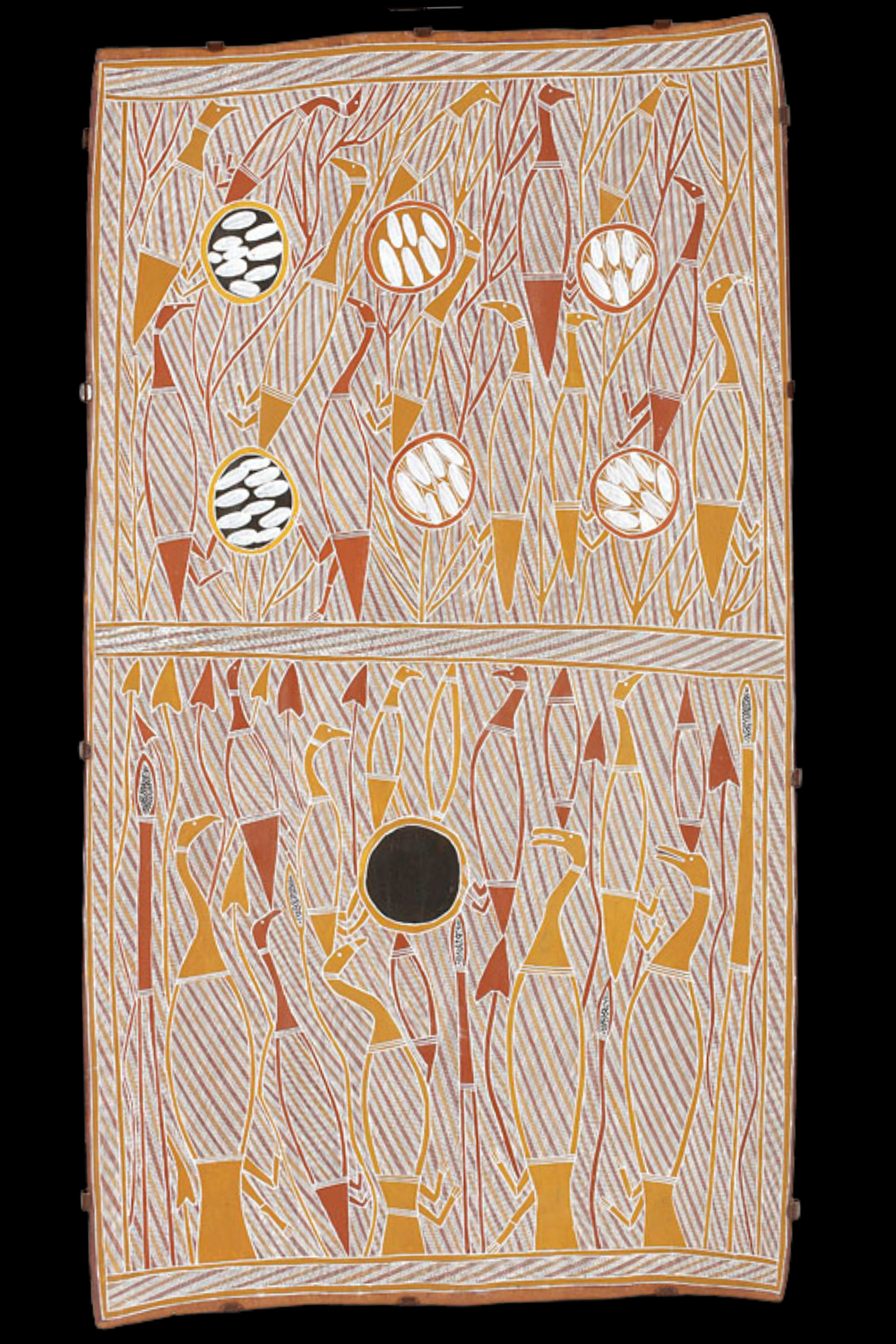
The repetition of magpie geese, turtles or other creatures created visual rhythm while expressing relationships between ancestral beings, waterholes and ceremonial Country.
Curator Wally Caruana, discussing Bulunbulun’s Creatures of the Arafura Swamp, observed that the animals were represented more like ceremonial objects than naturalistic creatures.
This is fundamental to understanding his work. The paintings are not simply illustrations of swamp wildlife. Their figures and designs embody ancestral relationships through which Country, language and ceremonial law were established.
In 1989, curator Margie West placed Bulunbulun among the finest practitioners of his art form, recognising the originality and refinement of his individual painting style.
Djon Mundine, who had observed him working, described his deliberate approach to composition and the intense concentration required to complete his most intricate paintings.
Major Painting Subjects — The Arafura Swamp
Like George Milpurrurru, John Bulunbulun drew his principal painting subjects from the ancestral traditions of the Arafura Swamp in Central Arnhem Land.
Both Ganalbiŋu artists depicted magpie geese, long-necked turtles, flying foxes and water snakes, but their paintings reflected different lineage responsibilities and ceremonial knowledge.
While Milpurrurru was particularly associated with Ngalyindi and its ancestral flying fox traditions, Bulunbulun frequently depicted Djulibinyamurr, a sacred waterhole associated with Barnda (long-necked turtle) and the creation of Ganalbiŋu Country.
These creatures were ancestral beings whose journeys established sacred places, language and ceremonial law. Bulunbulun expressed their significance through animal figures, intricate rarrk (crosshatching) and inherited clan designs.
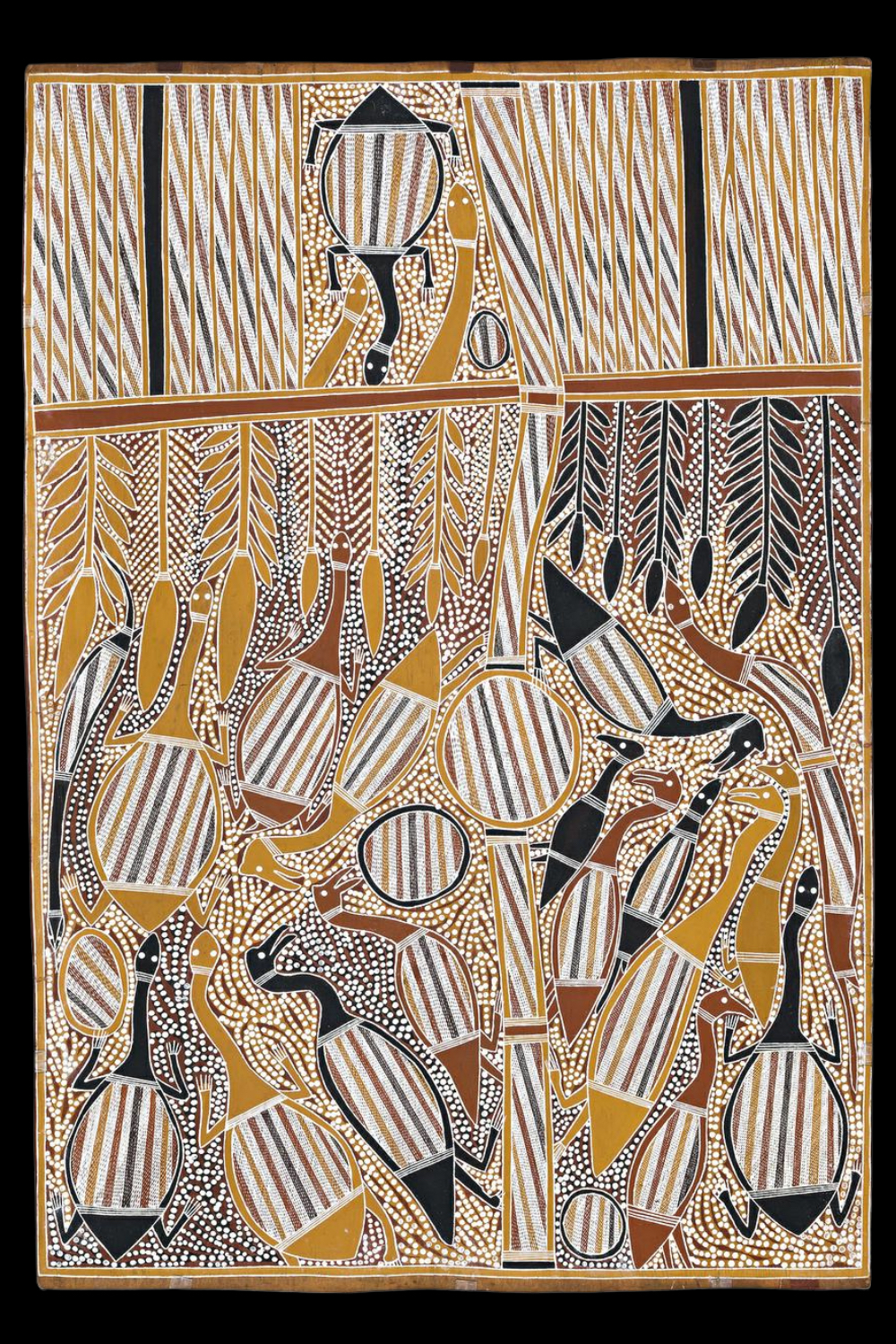
Gumang — The Ancestral Magpie Goose
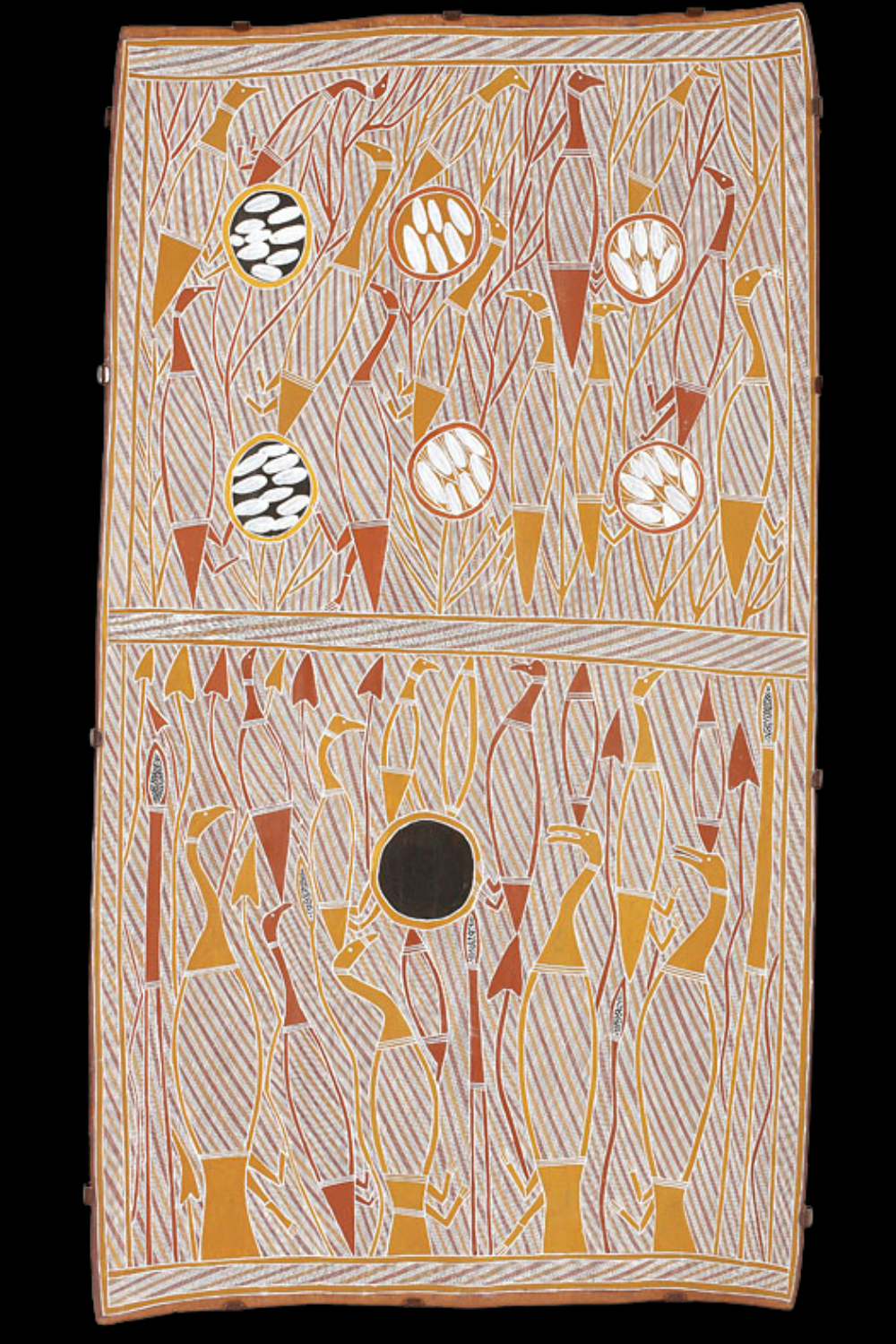
Gumang (magpie goose) was one of John Bulunbulun’s most important ancestral subjects, closely associated with the freshwater wetlands and sacred waterholes of the Arafura Swamp.
Although magpie geese were an important traditional food source, their significance within Ganalbiŋu culture extended to ancestral creation, ceremonial law and relationships between people and Country.
Bulunbulun frequently depicted groups of geese surrounded by waterlilies, eggs, nests and other aquatic creatures. His compositions combined rhythmic arrangements of birds with intricate geometric patterns and exceptionally fine rarrk(crosshatching).
Although George Milpurrurru painted related ancestral subjects, their interpretations were recognisably different. Researcher Joseph Reser identified distinctions in their treatment of birds’ heads, beaks, eggs, nests and crosshatching, reflecting different ancestral responsibilities and individual artistic styles.
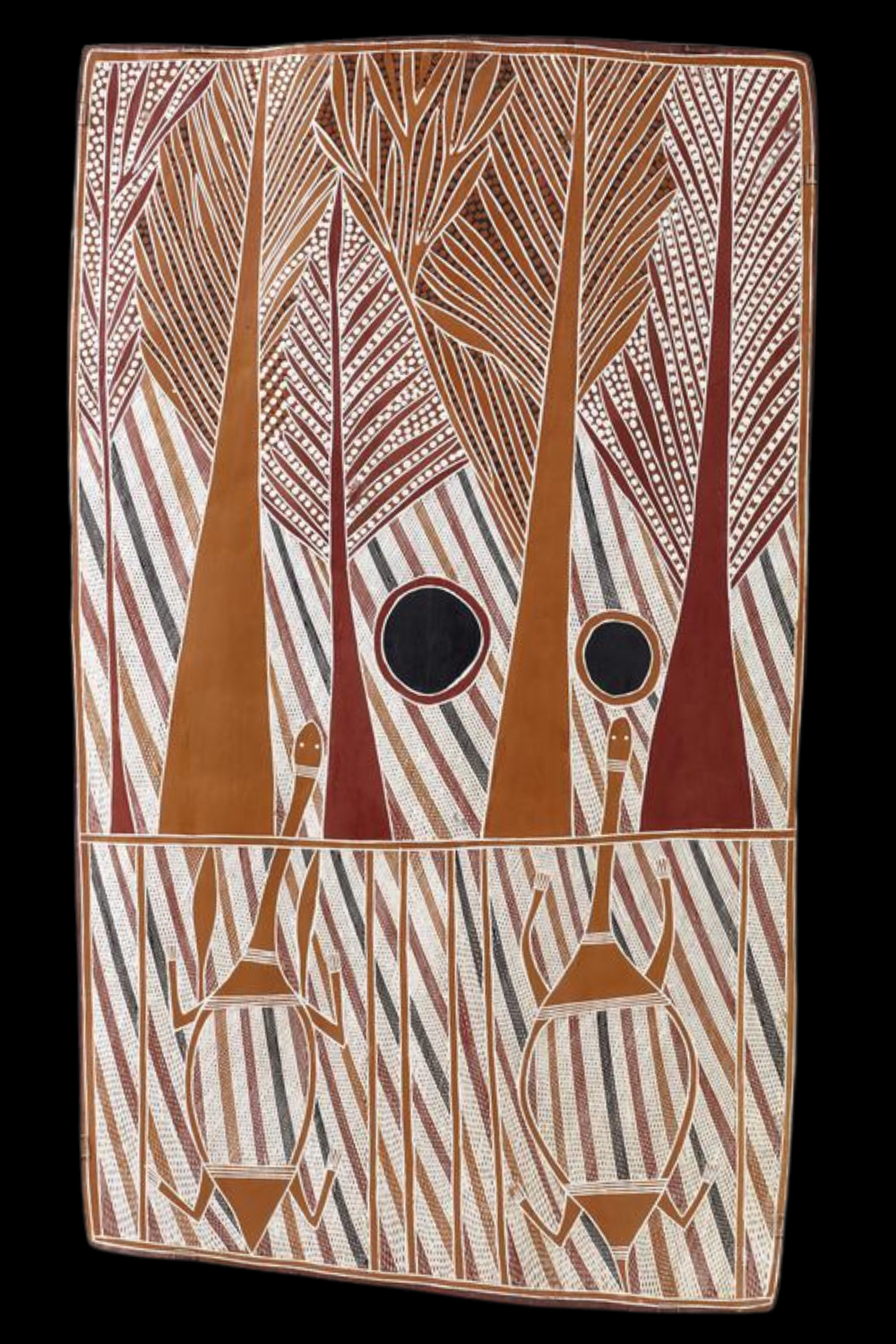
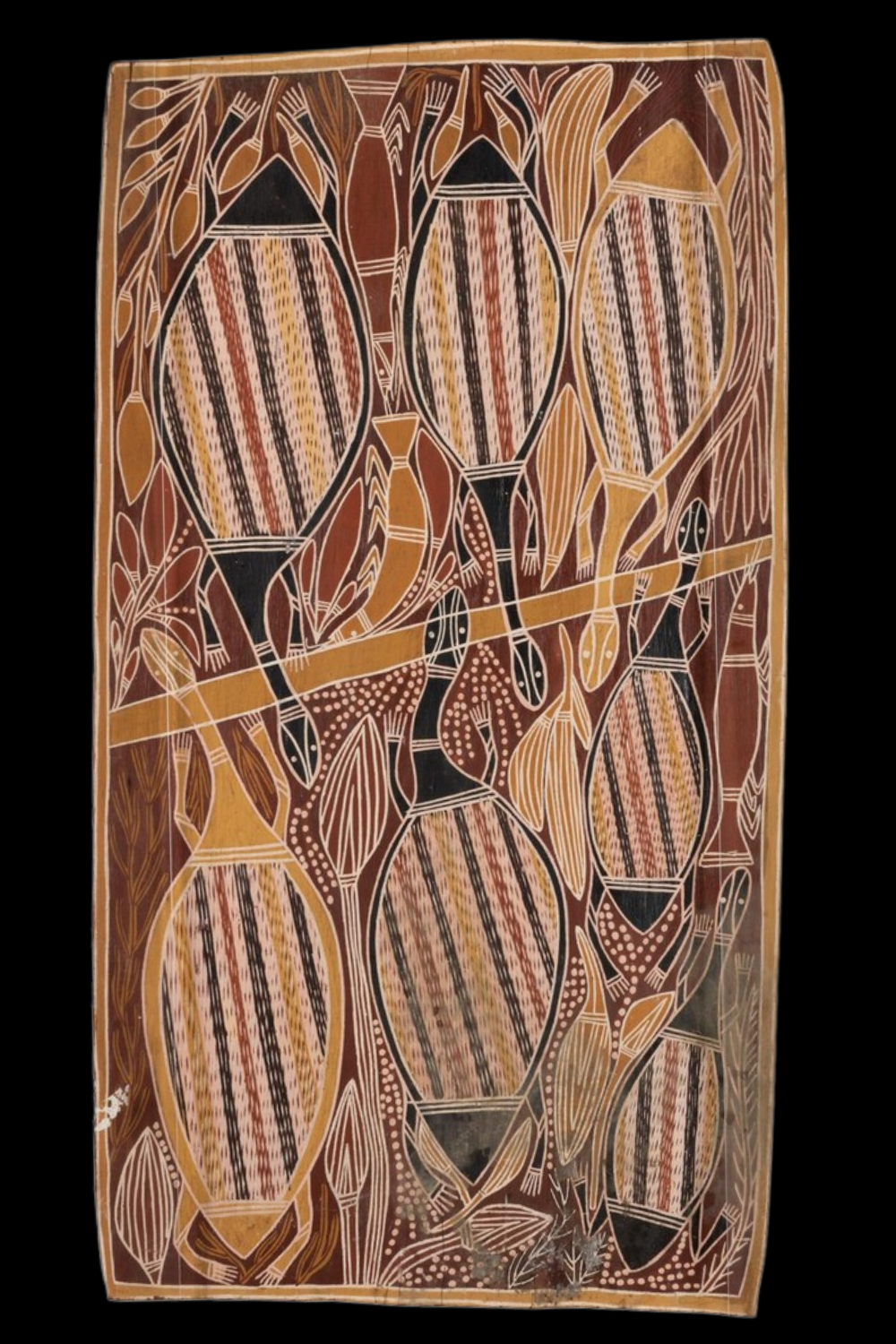
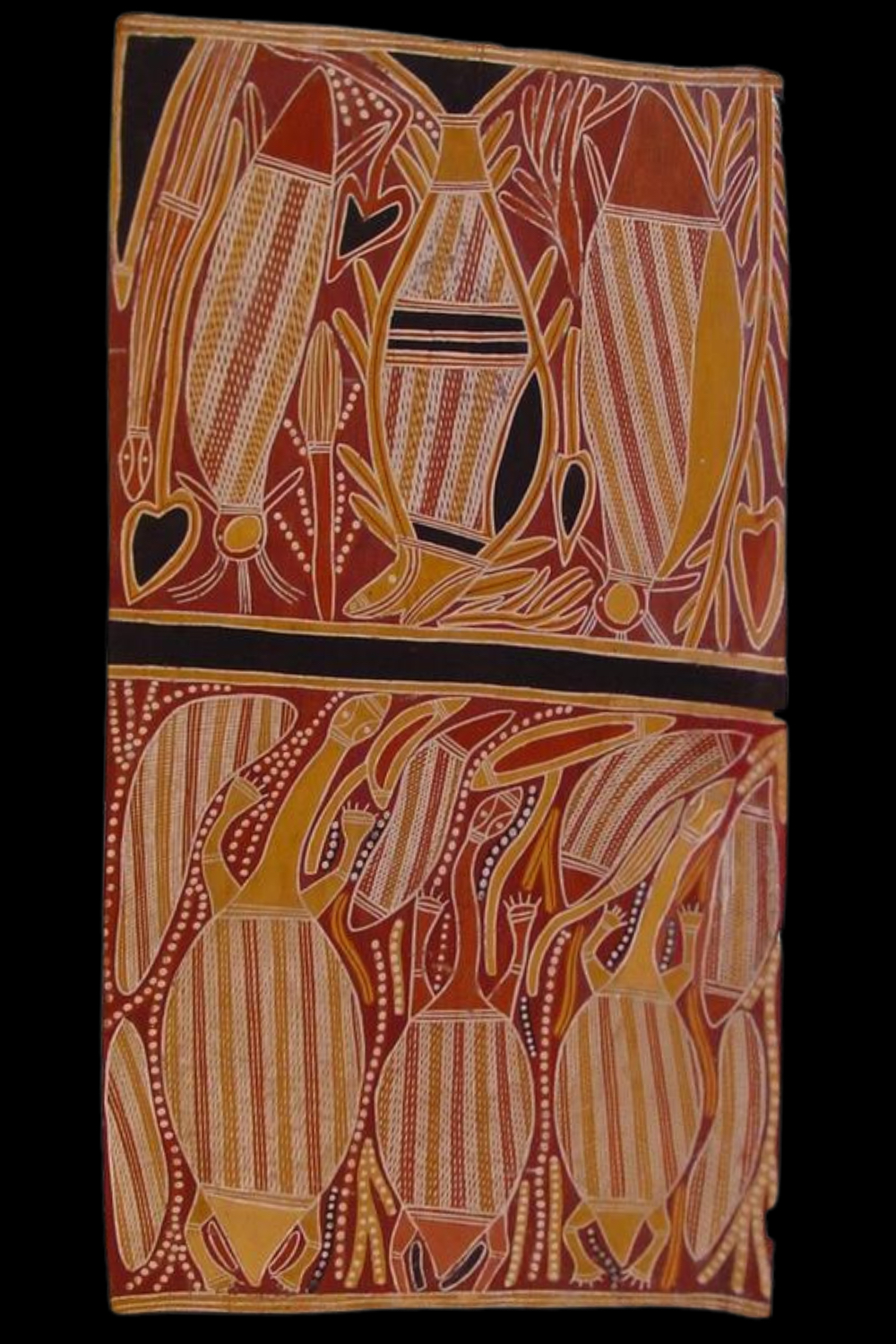
Banda — The Long-Necked Turtle
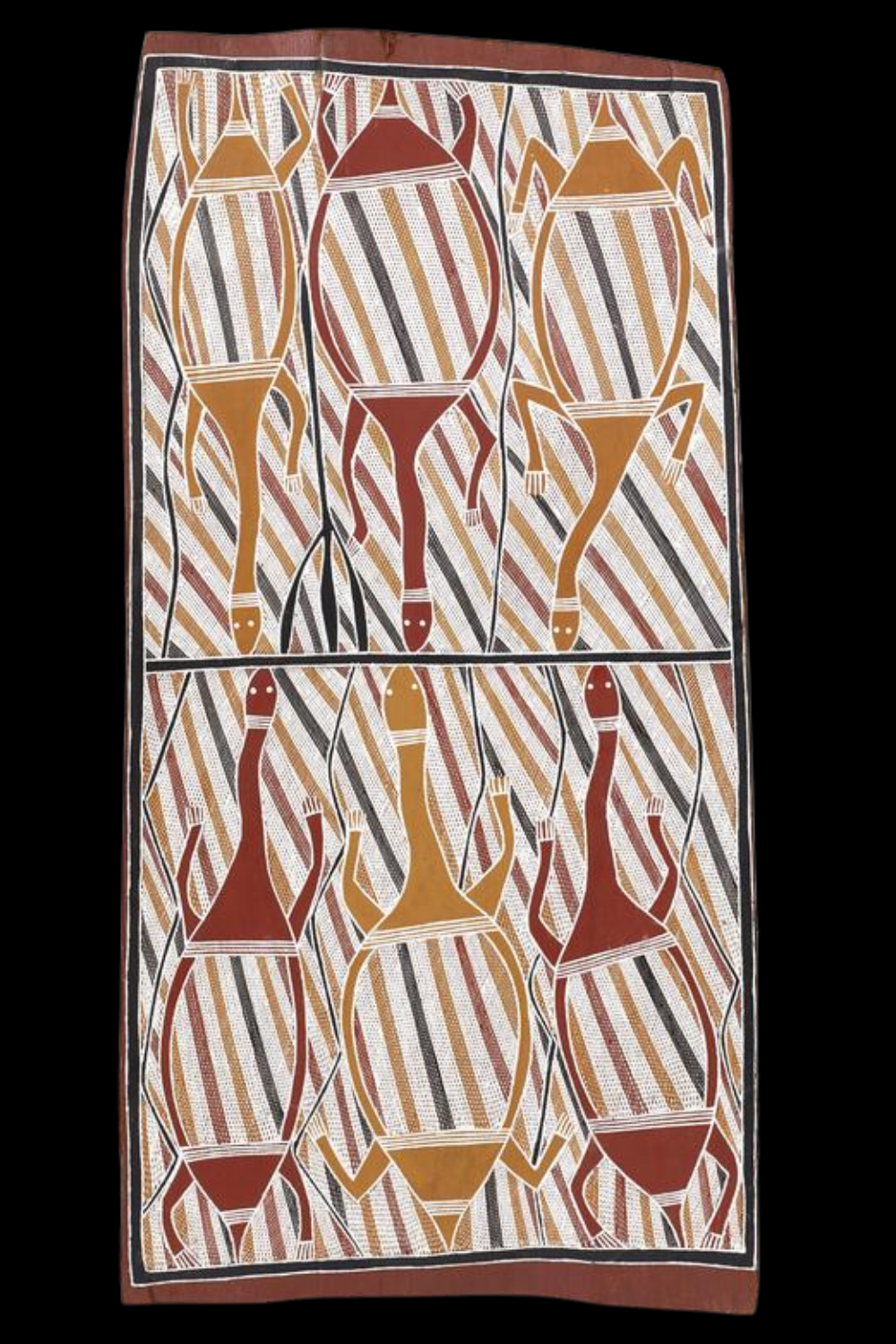
Banda (long-necked turtle), also identified as Guwaynang and Girrk Girrk in artwork documentation, was another central subject in Bulunbulun’s paintings.
In Ganalbiŋu ancestral traditions, turtle beings travelled across Country, creating freshwater channels, billabongs and sacred places.
An original Maningrida Arts & Crafts label accompanying Banda – Long-necked Tortoise, exhibited at Hogarth Galleries in 1987, describes the ancestral turtle travelling through dry Country towards Djirringi. There, Banda broke through the ground with its head to reach a billabong.
These paintings demonstrate how Bulunbulun transformed ancestral geography into complex visual compositions. His animals are not merely representations of wildlife but ancestral beings whose journeys shaped the landscape and established enduring cultural relationships.
Dakaljitbarra — Sacred Country and Ceremonial Designs
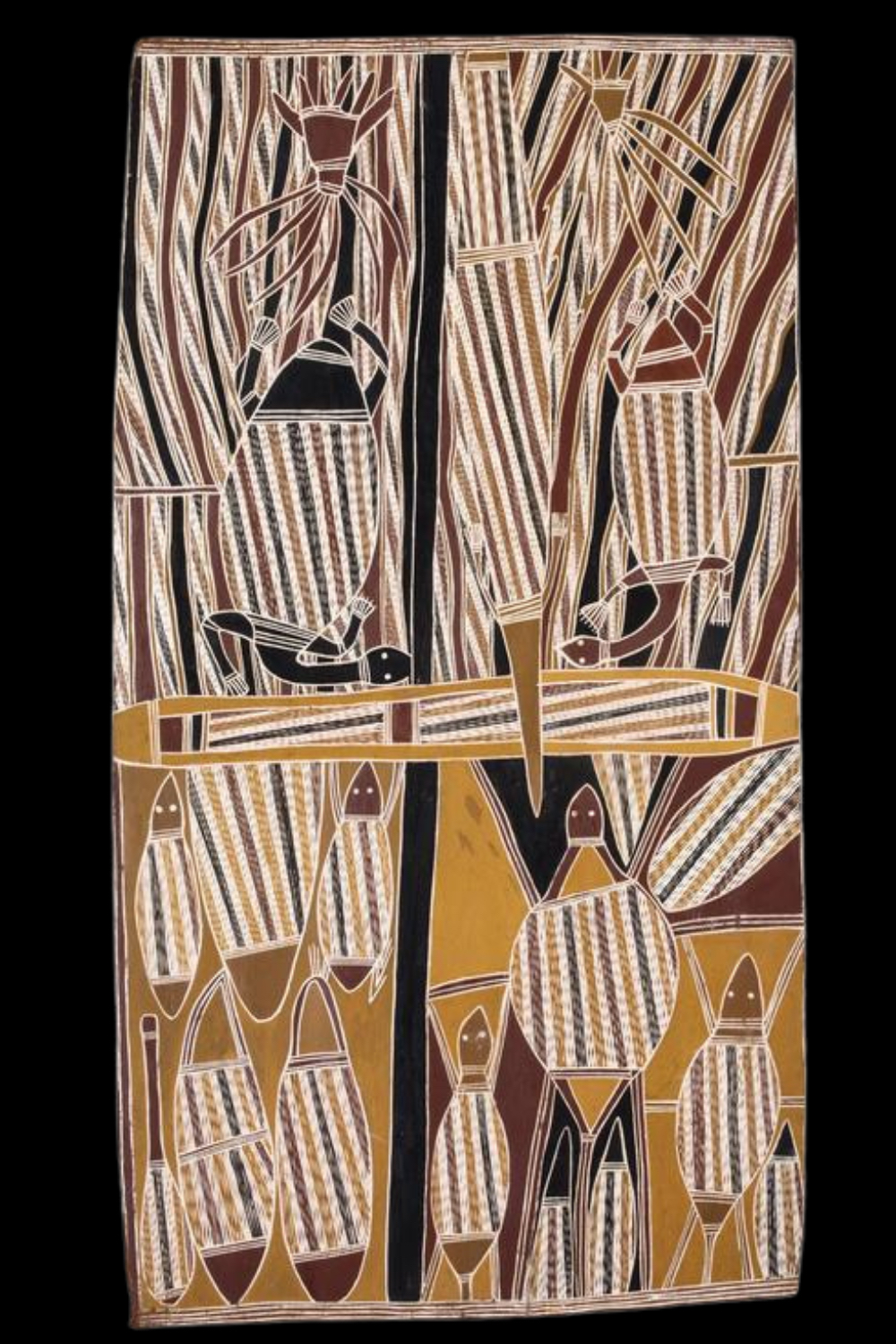
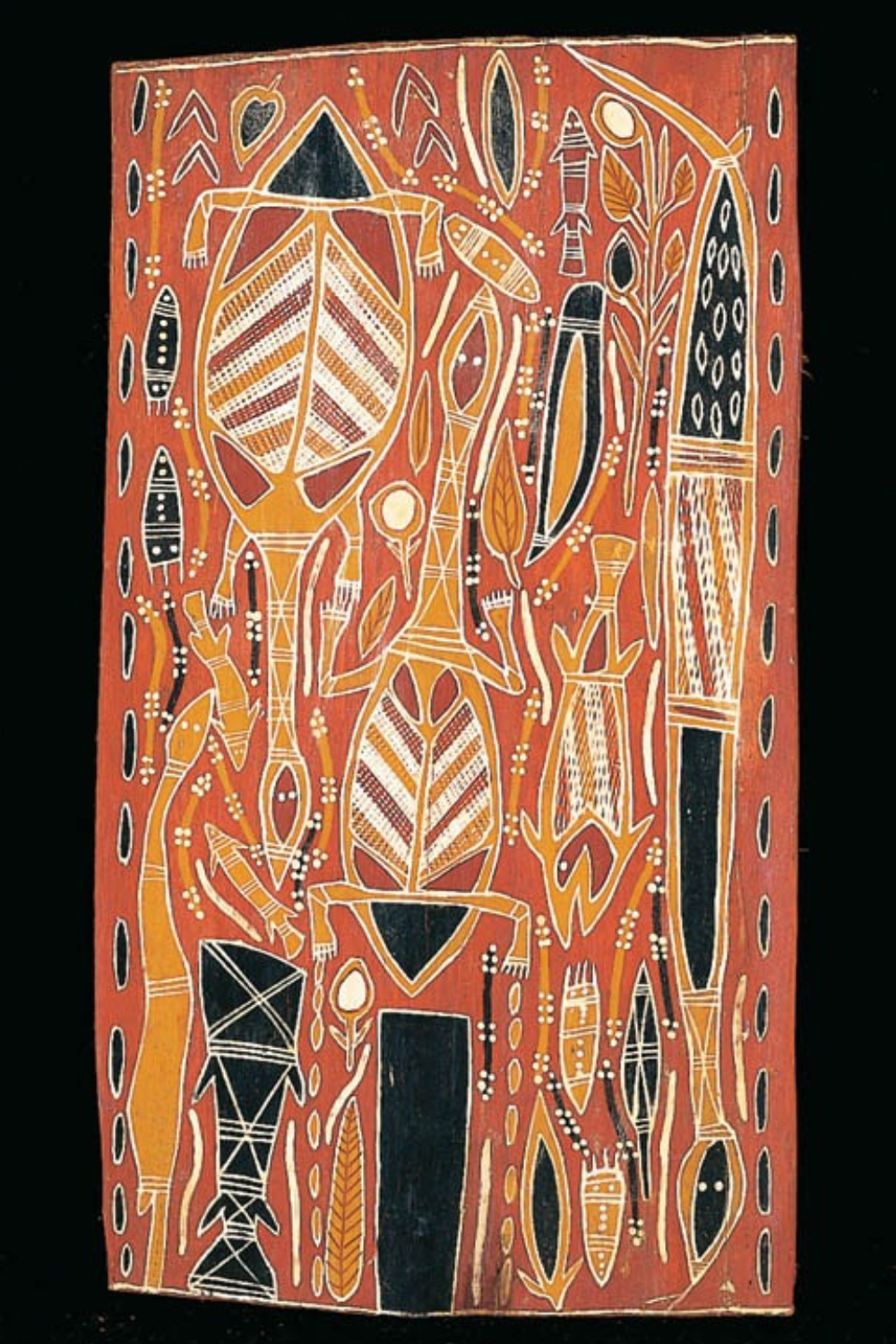
John Bulunbulun’s Dakaljitbarra exemplifies his sophisticated interpretation of the ancestral traditions and ceremonial knowledge of Ganalbiŋu Country in Central Arnhem Land.
The bark painting combines stylised ancestral figures with intricate geometric patterns and exceptionally fine rarrk(crosshatching). Its carefully organised composition uses natural red, yellow, black and white ochres to create rhythmic contrasts between figurative and abstract designs.
Bulunbulun’s paintings of sacred Country frequently depicted waterholes, ancestral animals and the ceremonial relationships connecting people to particular places. These included Barnda (long-necked turtle), Gumang (magpie goose), water snakes and other beings associated with the Arafura Swamp.
Art historian Wally Caruana explained that such ancestral imagery could express the creation of Country and the establishment of language and ceremonial law, rather than merely representing animals or landscape features.
Dakaljitbarra demonstrates Bulunbulun’s ability to transform inherited cultural knowledge into a highly individual visual language, combining precise draughtsmanship with the authority of Ganalbiŋu ceremonial traditions.
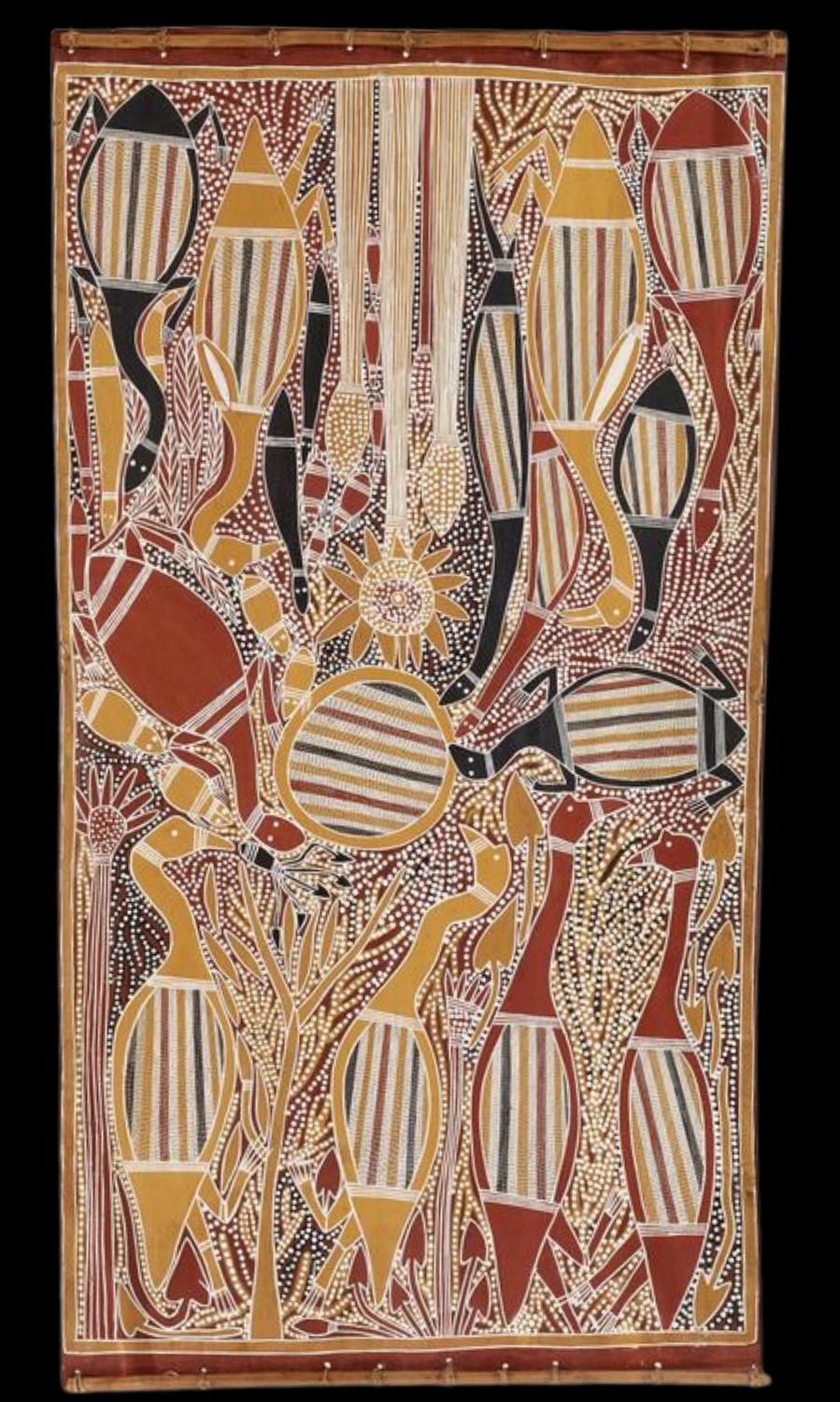
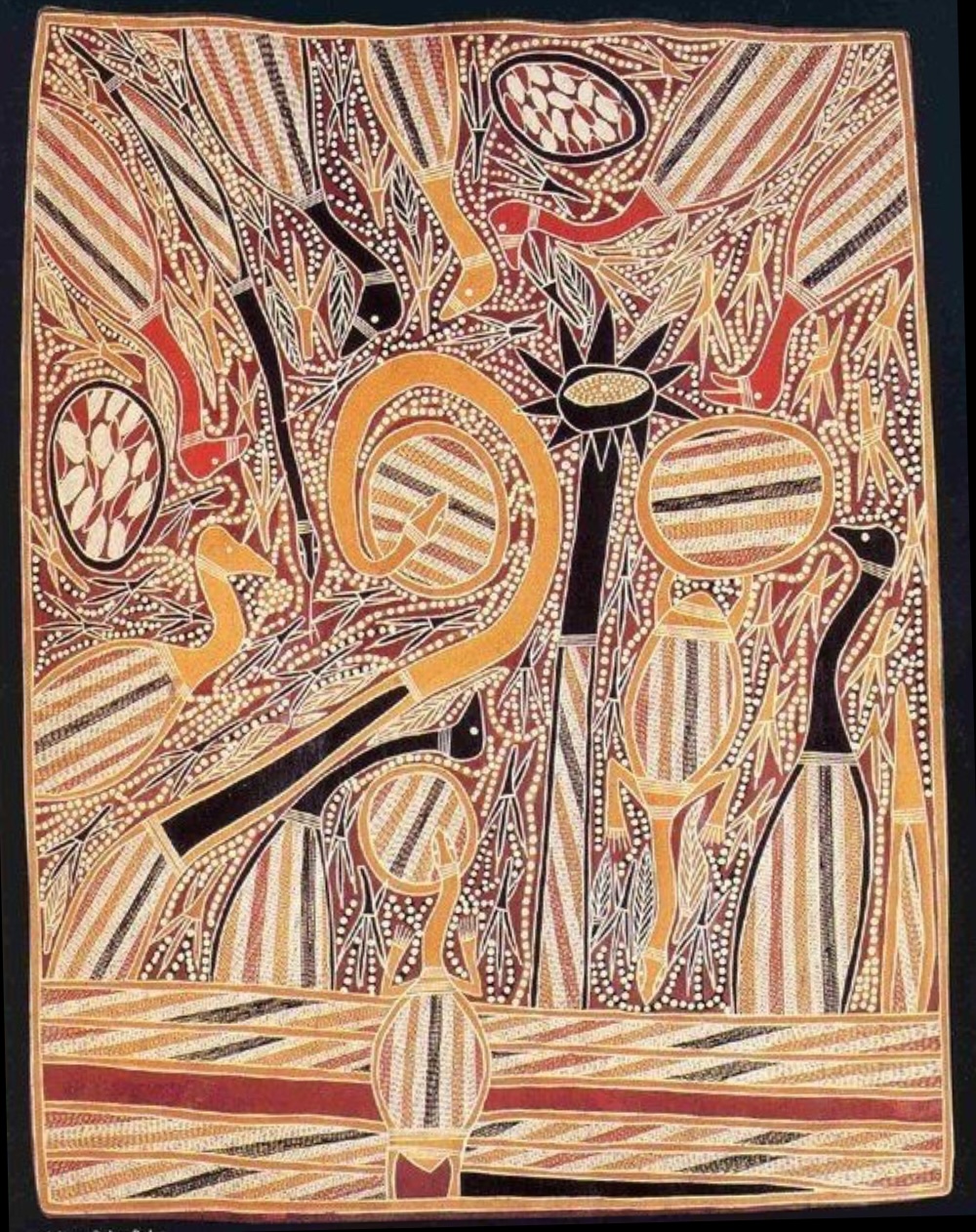
Magpie Geese and Water Lilies — The Landmark Copyright Case
John Bulunbulun’s Magpie Geese and Water Lilies at the Waterhole (1978) depicts Djulibinyamurr, a sacred Ganalbiŋu waterhole where Barnda (ancestral long-necked turtle) established Country, language and ceremonial law.
Painted with senior custodians’ permission, the bark was acquired by the Northern Territory Museum of Arts and Sciences.
In 1996, Bulunbulun discovered that R & T Textiles had reproduced his imagery without permission on fabric printed in Indonesia. Some 7,600 metres were imported, including material used for Northern Territory government uniforms.
The company admitted infringement, but the proceedings continued over Ganalbiŋu communal cultural rights. George Milpurrurru, Bulunbulun’s ceremonial mentor and kinsman, joined the proceedings as the second applicant, arguing that the Ganalbiŋu people held an equitable interest in the copyright arising from their communal ownership of ancestral knowledge.
In 1998, the Federal Court recognised Bulunbulun’s obligations to protect that knowledge but declined to recognise communal ownership of the copyright itself.
Over 2,000 metres of surrendered fabric were subsequently used in Ganalbiŋu ceremonies. The judgment became a landmark in Indigenous intellectual property law.
Brandy Tjungurrayi Value and Auction results
Works Offered at Auction: 65
Sale Rate: 68%
Highest Sale: $10,000 AUD
Median Sale Price: $1,000 AUD
John Bulunbulun in Public Collections
Bulunbulun’s artworks are represented in major Australian and international collections, including:
- National Gallery of Australia, Canberra
- National Gallery of Victoria, Melbourne
- Art Gallery of New South Wales, Sydney
- Queensland Art Gallery, Brisbane
These collections encompass bark paintings, prints, ceremonial objects and major compositions documenting the ancestral traditions of the Arafura Swamp.

Further Reading
-
NETS Victoria. John Bulunbulun – Artist Biography. Detailed account of his childhood, ceremonial responsibilities, artistic development and association with Jack Wunuwun.
-
Wally Caruana (2014). Seeing Barks. National Museum of Australia. Expert interpretation of Arnhem Land bark painting, including Bulunbulun’s ancestral imagery and ceremonial designs.
-
Diane Moon (2017). Sung into Being: Aboriginal Masterworks 1984–94. Queensland Art Gallery. Discusses Bulunbulun’s Murrukundja Manikay series and the Makassan ceremonial traditions.
-
Howard Morphy (1991). Ancestral Connections: Art and an Aboriginal System of Knowledge. University of Chicago Press. Anthropological examination of Yolŋu art, ancestral knowledge and the cultural authority to paint.
-
Terri Janke (2003). Minding Culture: Case Studies on Intellectual Property and Traditional Cultural Expressions. World Intellectual Property Organization. Case Study 3, pp. 51–67, examines Bulun Bulun v R & T Textiles and Indigenous communal cultural rights.
-
Margie West (2001). Telstra Presents the 18th National Aboriginal & Torres Strait Islander Art Award. Museum and Art Gallery of the Northern Territory, Darwin. Includes Bulunbulun’s award-winning Magpie Geese, illustrated on page 8.
All images in this article are for educational purposes only.
This site may contain copyrighted material the use of which was not specified by the copyright owner.
Bulunbulun artwork Images
The following images are of the Artworks of Bulunbulun. It is not a complete list of his works. They do however give a good idea of the style and above all the variety of this Aboriginal Artist.