Pukumani Poles (Tutini) – Tiwi Ceremonial Sculpture
Pukumani poles, known to the Tiwi as tutini (ceremonial poles), are carved and painted wooden sculptures associated with mourning on Bathurst and Melville Islands, north of Darwin. Their powerful vertical forms and contrasting ochre designs make them one of Australia’s most distinctive sculptural traditions.
Often called grave posts, traditional tutini have a broader purpose. Relatives commission them for the final Pukumani ceremony, where they feature in song and dance before being placed at a burial site. Other poles are created specifically for exhibition. The distinction is essential to understanding their cultural and artistic significance.
For the wider artistic context, see Tiwi Art.
What Are Pukumani Poles?
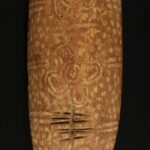
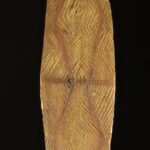
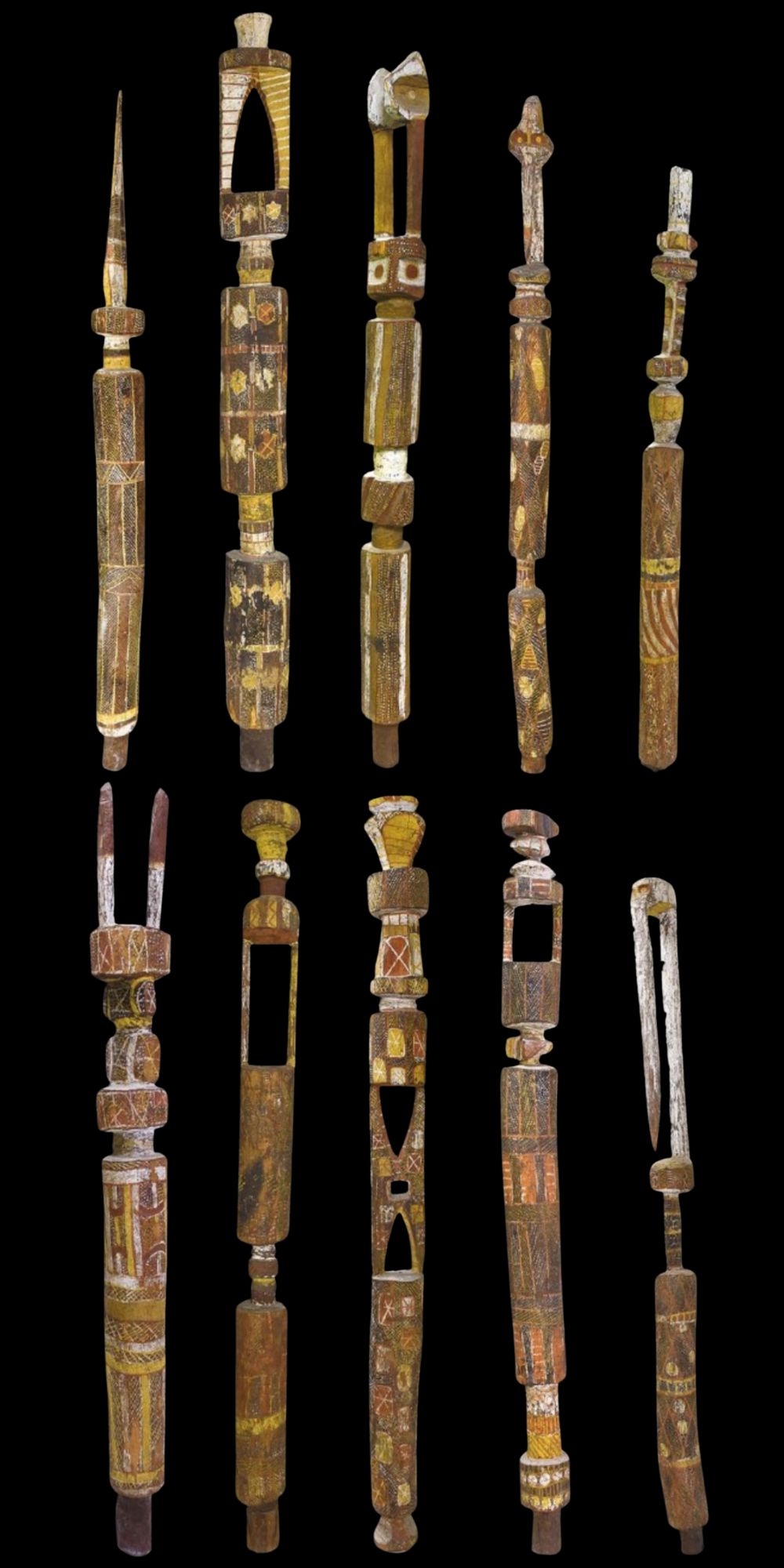
A tutini is carved from a tree trunk, sometimes as a slender column and sometimes with projecting arms, heads, collars or elaborate geometric forms. Painted bands emphasise the contours, so each post has an individual silhouette and rhythm.
Pukumani is commonly translated as taboo, but the word encompasses the restrictions, obligations and ceremonies associated with death and mourning. Tutini names the carved poles, rather than the ceremony itself.
The sculptures honour the deceased, acknowledge their relationships and assist the spirit’s passage from the living world. They are understood as gifts to the spirit, not merely representations of a person, and their setting gives them a significance that cannot be separated from ceremony.
They can evoke human figures without being literal portraits. Tiwi elder Paddy Freddy has explained an interpretation in which poles with projecting arms represent men, while poles with a head alone represent women. Such interpretations should not be imposed on every example without knowing its particular context.
The Origins of Pukumani
Tiwi ancestral tradition connects Pukumani to Purukuparli and the first death. During Parlingarri (the ancestral past), Purukuparli’s infant son Jinani died after being left exposed to the sun. Purukuparli declared that death would thereafter be part of human existence and established the first mourning ceremony.
The story explains why relatives must farewell the dead through prescribed responsibilities. It provides the ancestral foundation for tutini without requiring every sculptor to repeat one standard design.
Versions of the story appear in Tiwi painting, sculpture and performance, but the purpose here is to explain the poles rather than recount the complete ancestral narrative.
The Pukumani Ceremony
Pukumani is not simply the initial funeral. Tiwi artist and cultural authority Pedro Wonaeamirri explains that burial and cleansing take place first. Relatives then enter a period of mourning, traditionally observing restrictions on work, ordinary activities and speaking the deceased person’s name.
The final ceremony generally occurs months later, sometimes after six months or a year.
Commissioning and Preparing the Poles
The deceased’s in-laws traditionally undertake much of the work for the final ceremony. They are commissioned to make tutini, prepare the ceremonial ground and construct a shelter. Wonaeamirri describes a preliminary ceremony at which relatives present the workers with tools, fire-making equipment and white ochre through prescribed dances.
This makes the poles more than individual works of craftsmanship. Their creation involves kinship obligations, particular responsibilities and payments between families.
The workers also prepare decorated tunga (bark containers) and other objects used during mourning. Those preparations establish the ceremonial setting in which the finished poles will be seen, rather than treating carving, singing and dancing as separate activities.
The Final Farewell
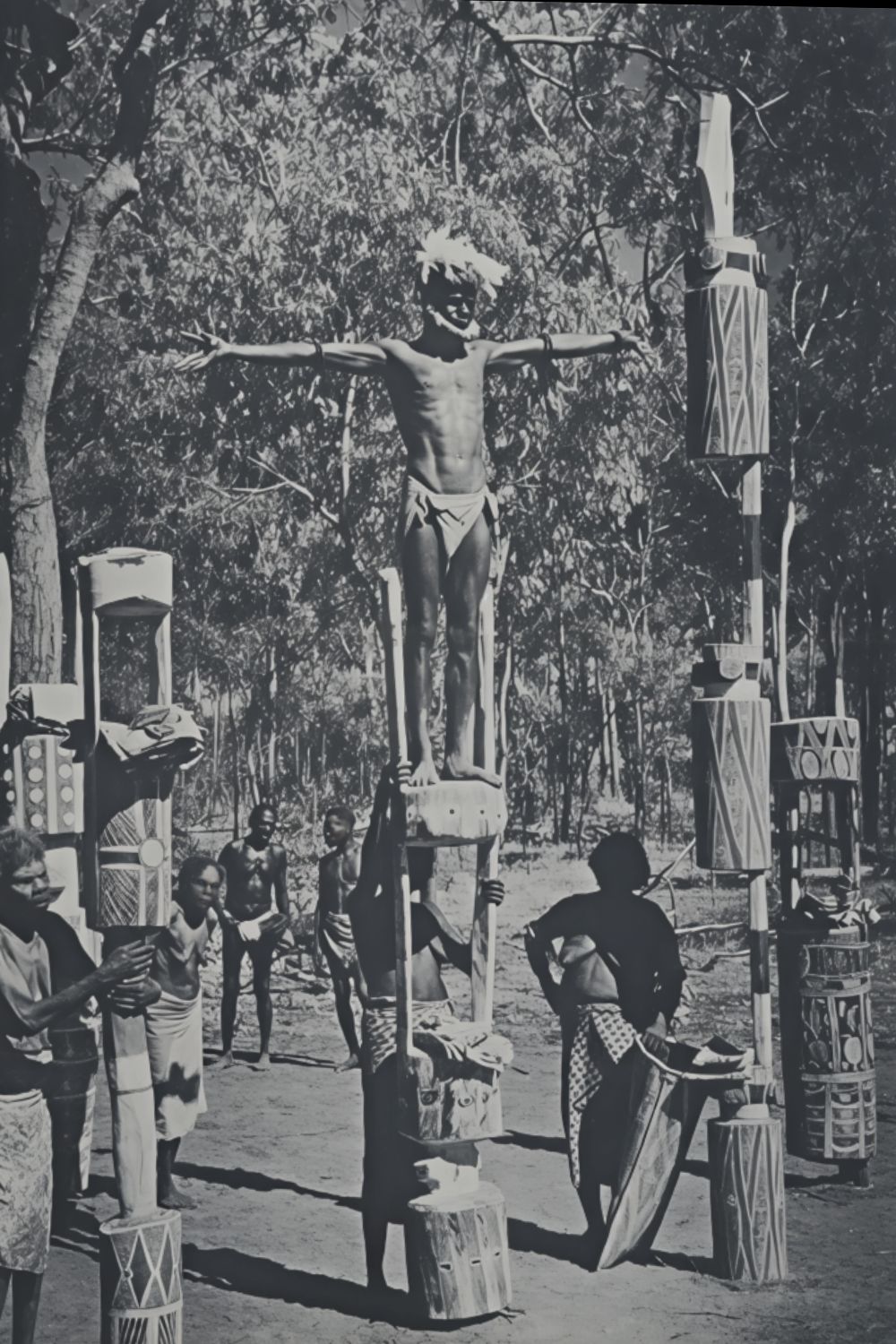
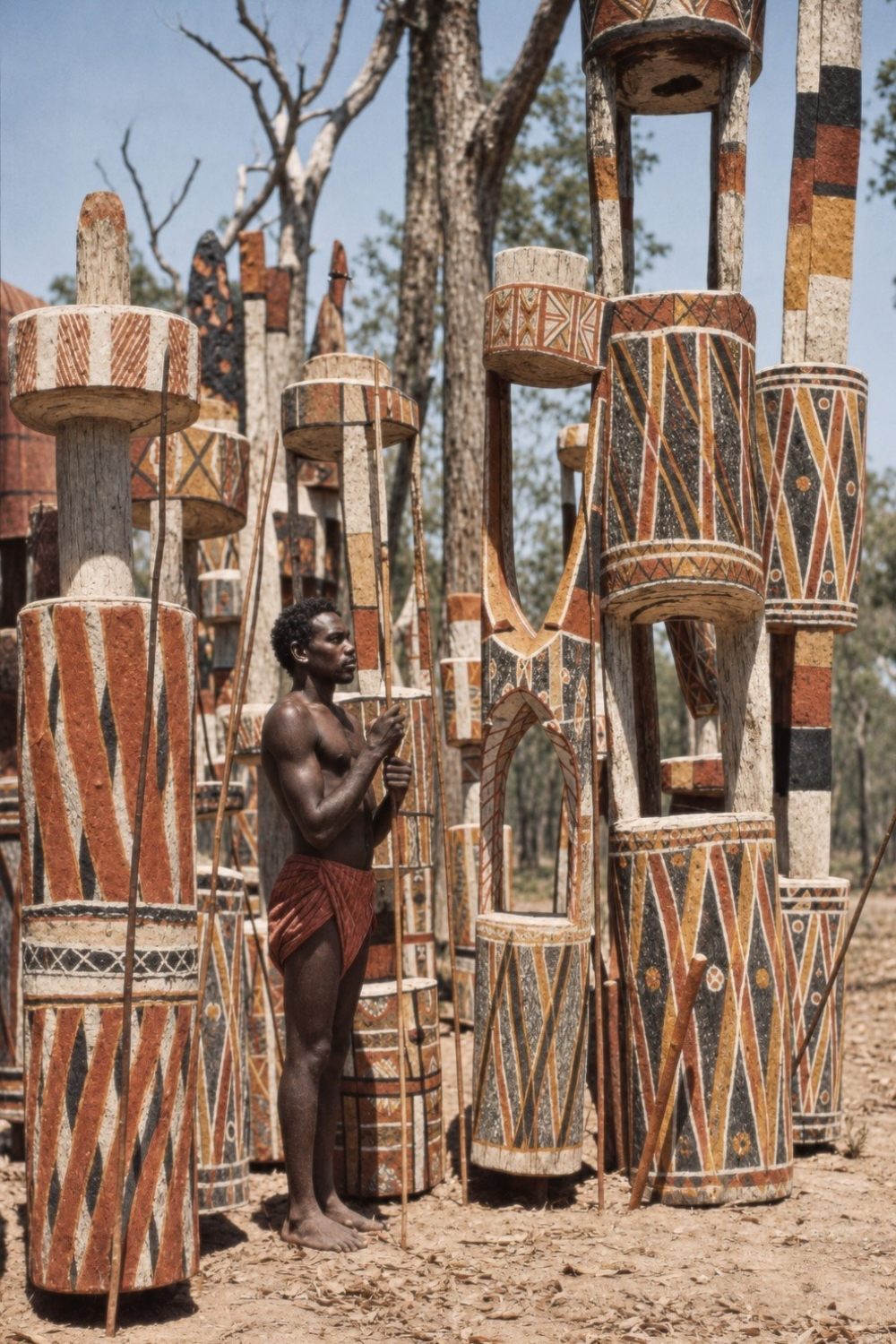
The completed poles are first erected in a prepared ceremonial area. Relatives attend with body painting and ornaments, performing yoi (ceremonial dances) with singing and rhythmic handclapping.
Their movements around and towards the poles commemorate the deceased and express family relationships.
The number of poles is not fixed. The Australian Museum records that as many as twelve tutini may be made and displayed for a Pukumani ceremony. Their number and arrangement depend on the particular circumstances rather than a universal rule.
A grouping of poles can therefore be understood as a collective ceremonial installation, not simply a row of identical markers.
After the final observances, the workers receive payment or gifts. The ceremony brings mourning restrictions to a close and helps the spirit find its way to the ancestral world.
Traditionally, the poles are then transferred to the burial site and erected around it. They thus move from ceremonial participants to memorial presences, while remaining connected to the family and Country of the deceased.
Why “Grave Posts” Is an Incomplete Description
The label grave posts is widespread in museum catalogues and older accounts. It is understandable because traditional poles are commonly placed around graves after the ceremony. Yet the label names their destination, not the work they perform beforehand.
Unlike headstones, tutini are commissioned through kinship relationships, made for ritual performances and only subsequently placed at the burial site.
Research also records instances in which poles were erected on ancestral Country rather than at the original place of burial.
Nor are traditional poles intended as permanent monuments. Their painted surfaces fade, their timber weathers and they gradually return to the earth. Wonaeamirri explains that the poles are not to be repainted or replaced by another family.
Crucially, many examples in galleries were never made for a funeral. Describing every exhibited tutini as a grave post can incorrectly suggest that it once marked someone’s burial.
Pukumani poles or tutini are therefore more accurate terms for the wider sculptural tradition.
Carving and Painting Tutini
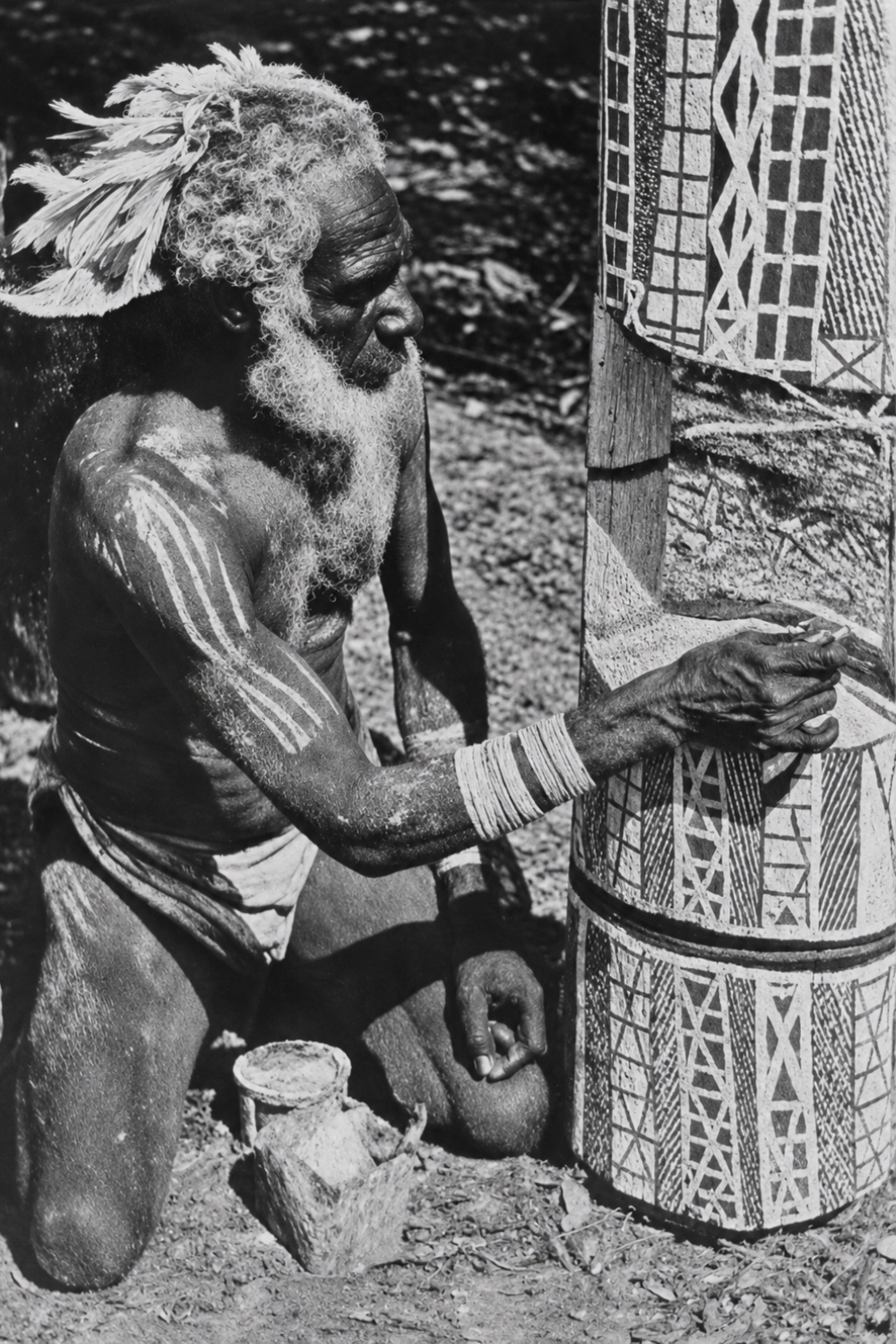
Traditional carvers often selected bloodwood, shaping tree trunks with axes and other tools. By removing and retaining sections of wood they created cylinders, shoulders, projections and recessed forms.
Some poles suggest a standing figure, while others appear almost architectural.
Painted decoration employs red, yellow, white and black. Natural ochres provide the earth colours; heating yellow ochre can produce red, while charcoal supplies black.
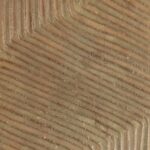
Broad blocks of colour, fine lines and geometric patterns follow the sculptural profile, making the pole visually striking from several viewpoints.
The designs belong to jilamara (ceremonial painting designs), a tradition also seen in body painting and other Tiwi objects.
Their arrangement reflects individual artistic decisions within cultural practice. No single dictionary of circles, dots and lines can reliably explain every pole.
The Historic Pukumani Commission of 1958
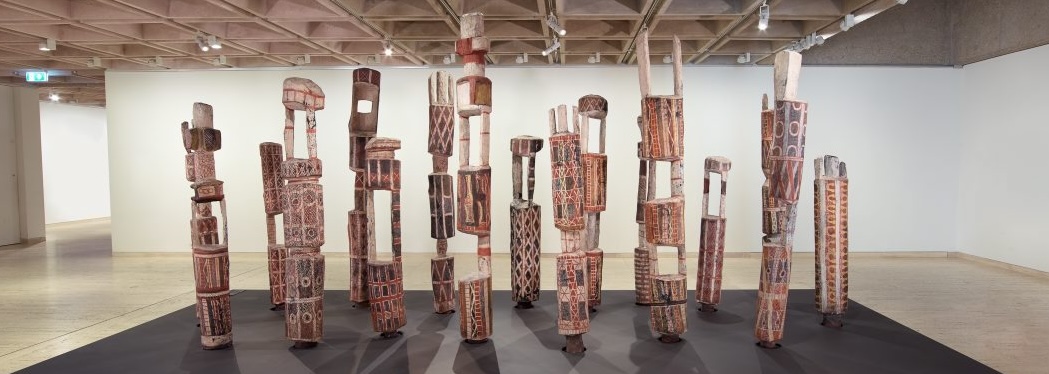
In October 1958, seventeen Pukumani poles were commissioned at Milikapiti on Melville Island through Tony Tuckson of the Art Gallery of New South Wales and collector Dr Stuart Scougall.
The participating artists were Laurie Nelson Mungatopi, Bob One Apuatimi, Jack Yarunga, Don Burakmadjua, Charlie Quiet Kwangdini and a sixth artist whose name was not recorded. The gallery acquired the sculptures in 1959.
The commission marked an important change: these poles were made expressly for exhibition, not removed from a burial ground.
Artists selected durable ironwood (Erythrophleum chlorostachys) instead of bloodwood commonly associated with traditional ceremonial examples.
The choice reflected the expectation that gallery sculptures would survive longer, although timber alone cannot establish an object’s original purpose.
Together, the seventeen sculptures demonstrated the variety and sophistication of Tiwi carving to a national audience. They also challenged the assumption that Aboriginal ceremonial forms belonged only in ethnographic collections.
Their known history makes them a particularly clear example of tutini made as artworks rather than grave markers.
This is a useful distinction for collectors: resemblance to a ceremonial form does not establish that a sculpture actually participated in a Pukumani.
Contemporary Pukumani Sculpture
Tiwi artists continued to carve tutini for both ceremonial settings and art collections. Their individual approaches to height, shape and painted design reveal considerable stylistic freedom.
Enraeld Munkara made distinctive carved poles, including a documented example dating to 1954. Tommy Mungatopi, also known for bark painting, produced substantial painted tutini.
Mani Luki Wommatakimmi, nicknamed Harry Carpenter, was an accomplished woodworker whose poles featured in the National Gallery of Victoria’s TIWI exhibition.
Declan Apuatimi developed elaborate ironwood sculptures incorporating projecting sections and, sometimes, multiple faces.
Paddy Henry Ripijingimpi combined strong carved forms with carefully organised ochre designs.
Kitty Kantilla made early ironwood tutini alongside the simplified human figures for which she later became well known.
Their works show a living sculptural tradition, but ceremonial poles commissioned for a particular death should still be distinguished from sculptures produced for public display.
Pukumani Poles in Collections
Pukumani poles are held in Australian and international museums, but their histories differ substantially.
Some were commissioned directly from artists; others were collected from ceremonial settings, including burial places. The latter raise important questions of provenance, cultural authority and the wishes of Tiwi families.
An older museum label reading grave post should therefore not be treated as proof of ceremonial use.
The place of collection, artist, date and original purpose all matter. Where such information is missing, responsible cataloguing should acknowledge uncertainty rather than supplying a ceremonial history on the basis of appearance.
The documented 1958 commission offers a useful contrast with poles whose circumstances of removal are less clearly recorded.
Traditional tutini help families honour the deceased through prescribed ceremonies; exhibition sculptures carry the distinctive Tiwi carving tradition into another context.
Recognising both is essential to appreciating these works as more than grave markers.
All images in this article are for educational purposes only.
This site may contain copyrighted material the use of which was not specified by the copyright owner.
Aboriginal Weapons and Artifacts Articles