
Is Aboriginal Art the Oldest in the World?
No. The oldest securely dated surviving painting currently known is a negative hand stencil from Liang Metanduno Cave in Sulawesi, Indonesia. Uranium-series dating of mineral deposits covering the stencil indicates a minimum age of 67,800 years, making it the earliest securely dated painting presently known to have been created by Homo sapiens.¹
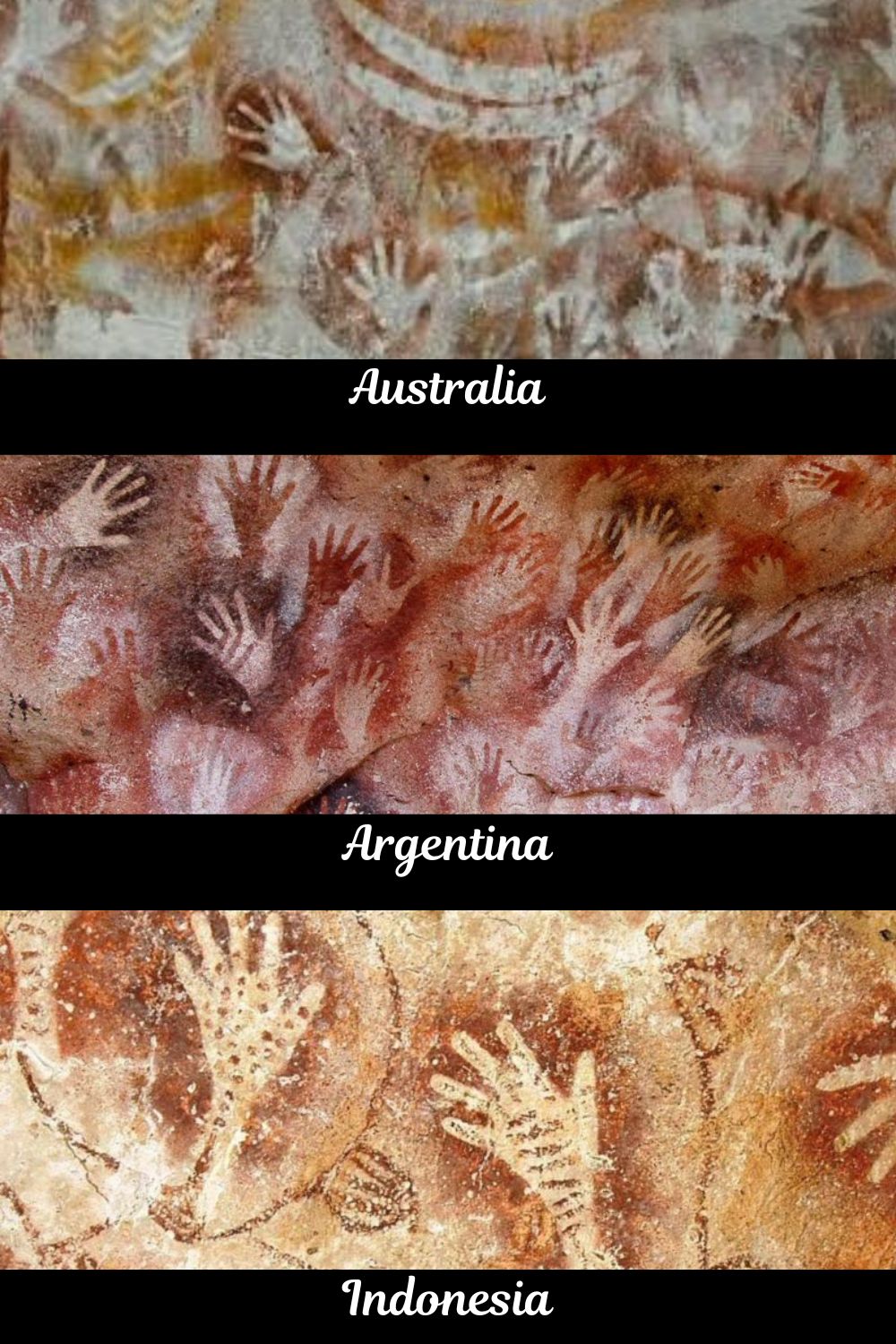
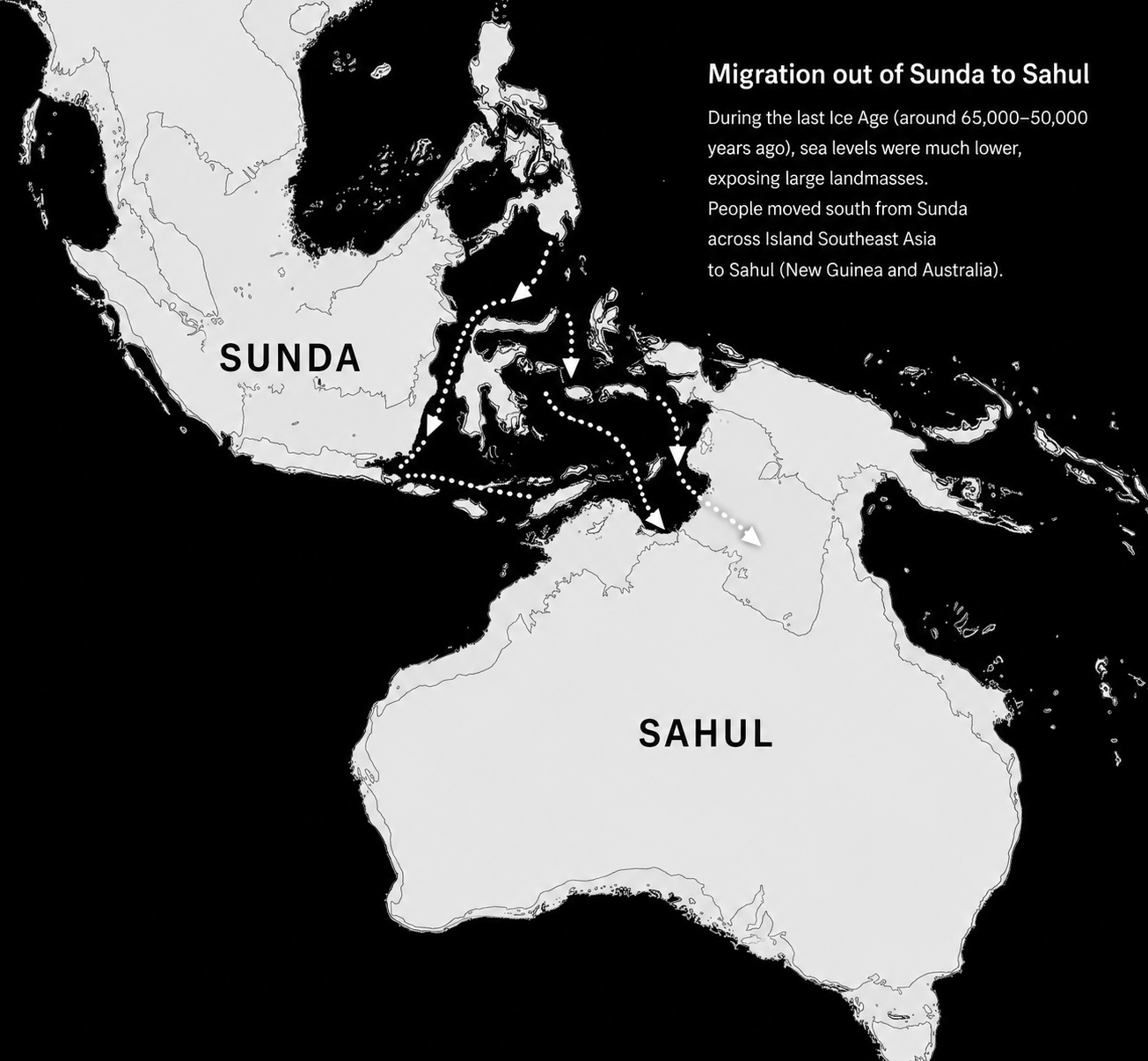
The ancestors of Aboriginal Australians reached the Ice Age continent of Sahul around 65,000 years ago after migrating from Sunda across the islands of Wallacea. Like all human populations, they arrived with fully developed cultures that included languages, kinship systems, beliefs, technologies, ecological knowledge, symbolic behaviour and artistic practices. Similar negative hand stencils occur in Europe, Sulawesi and Australia. Their widespread distribution suggests that this ancient painting technique may already have formed part of the behavioural repertoire of early modern humans before the settlement of Sahul, although a direct archaeological link between the Sulawesi hand stencils and later Aboriginal rock art has not been demonstrated.
Archaeological excavations at Madjedbebe rock shelter in Arnhem Land show that Aboriginal people were collecting, grinding and using ochre pigments from the earliest known occupation of Australia around 65,000 years ago. Although no surviving Australian paintings of that age have yet been identified, the archaeological evidence demonstrates that the materials and technological knowledge required to produce paintings were already present.² ³
Although Aboriginal art is not the oldest surviving painting created by Homo sapiens, it forms part of the world’s oldest continuing culture. Over tens of thousands of years, Aboriginal artistic expression developed into diverse forms including rock art, body painting, ceremonial designs, bark painting, carved objects and, more recently, canvas painting. Today these traditions remain living expressions of Country, culture and ancestral knowledge, making Aboriginal art one of the world’s oldest and most enduring artistic traditions.⁴⁻⁶
Note
¹ If intentionally created markings on a surface are accepted as art, then engraved shells attributed to Homo erectus predate the earliest known paintings by more than 300,000 years. Likewise, evidence from Europe indicates that Neanderthals created painted cave motifs before the arrival of modern humans. Whether these earlier examples should be classified as “art” remains the subject of scholarly debate. By contrast, the Sulawesi hand stencil is universally recognised as a painting.
What is the oldest Aboriginal Painting?
Discover the Aboriginal Hand stencils in Canarvon Gorge Rock Art
Negative Hand Stencils: One of Humanity’s Oldest Artistic Traditions
Negative hand stencils are among the oldest and most widespread forms of human artistic expression. They are created by placing a hand against a rock surface and blowing or spraying pigment around it, leaving the outline of the hand as a permanent image. Examples have been discovered on every inhabited continent, including Australia, Indonesia, Europe, South America and Africa, demonstrating that this simple yet powerful technique has been shared by human societies for tens of thousands of years.
The oldest securely dated hand stencils are found in Liang Metanduno Cave on the Indonesian island of Sulawesi, where uranium-series dating of mineral deposits over the paintings indicates a minimum age of 67,800 years. Similar hand stencils occur throughout Australia, particularly in Arnhem Land, the Kimberley and Cape York, where they form part of the world’s oldest continuing cultural tradition. The famous Cueva de las Manos in Argentina preserves hundreds of hand stencils dating to around 9,000–13,000 years ago, while numerous examples are also known from Ice Age caves in France and Spain.
The remarkable geographical distribution of hand stencils suggests that the technique originated very early in the history of Homo sapiens, probably before modern humans dispersed across Eurasia and into Australia. As people migrated out of Africa, they appear to have carried this artistic tradition with them, adapting it to local cultures over thousands of generations. The similarity of the technique across continents does not necessarily indicate direct cultural contact but rather the survival of an ancient shared behavioural tradition.
Even more intriguing is the possibility that the origins of hand stencilling may predate our own species. In several caves in Spain, uranium-series dating has shown that simple painted motifs are more than 64,000 years old, predating the arrival of modern humans in Europe and indicating that they were created by Neanderthals. These paintings include red disks, lines and ladder-like signs, although no unequivocal Neanderthal hand stencils have yet been identified. If Neanderthals also produced hand stencils, the tradition could extend back well beyond 70,000 years. At present, however, this remains an informed possibility rather than an established fact.
Whether created by early modern humans alone or inherited from an even deeper shared ancestry, negative hand stencils represent one of the oldest surviving artistic traditions on Earth. Their enduring presence across continents provides a remarkable reminder that the human impulse to leave a mark, proclaim identity and engage symbolically with the world has deep roots stretching back to the earliest chapters of our history.
References used for researching
Is Aboriginal Art the Oldest in the World?
- Oktaviana, A. A., et al. (2025). The oldest known cave art from Sulawesi, Indonesia. Nature.
- Clarkson, C., et al. (2017). Human occupation of northern Australia by 65,000 years ago. Nature.
- David, B., et al. (2021). Early human occupation of Madjedbebe and the archaeological sequence. Nature Human Behaviour.
- Australian Institute of Aboriginal and Torres Strait Islander Studies (AIATSIS). Aboriginal and Torres Strait Islander cultures are the world’s oldest continuing cultures.
- National Museum of Australia. First Peoples have occupied Australia for at least 65,000 years.
- National Gallery of Australia. Aboriginal and Torres Strait Islander Art.
All images in this article are for educational purposes only.
This site may contain copyrighted material the use of which was not specified by the copyright owner.