Is All Aboriginal Art Dot Painting?
No. Dot painting is only one of many Aboriginal Australian artistic traditions. Aboriginal art varies enormously between regions, communities and individual artists.
The widespread association between Aboriginal art and dots largely reflects the success and visibility of Western Desert Art since the 1970s. The modern movement emerged at Papunya in 1971, where artists transferred designs associated with Country, ceremony, body painting and ground painting onto Papunya boards. Dot painting is most strongly associated today with Central and Western Desert art, not Aboriginal art across Australia as a whole.
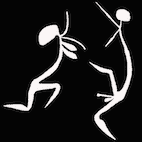
Importantly, Papunya artists did not invent the dot. The Art Gallery of South Australia notes that dotting already occurred in Aboriginal sand drawing, Aboriginal Rock Art and ceremonial body decoration.
The claim that dots were invented simply to hide sacred information is also misleading. Anthropologist Fred Myers and Papunya specialist Vivien Johnson have both demonstrated a more complicated history.
What Aboriginal Art Isn’t Dot Painting?
The work of three very different Aboriginal artists demonstrates why Aboriginal art cannot be defined by dots.
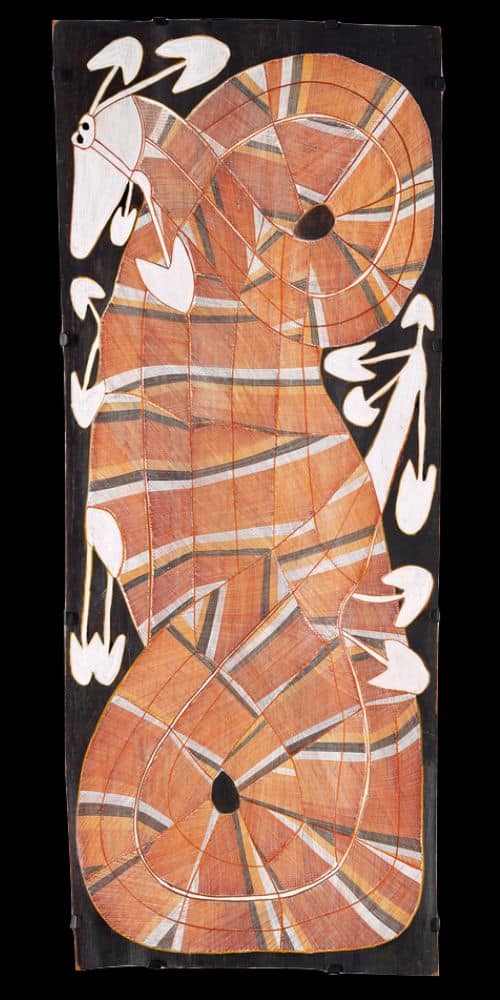
Arnhem Land artist John Mawurndjul paints with natural earth pigments, developing intricate fields of fine cross-hatching, commonly called rarrk. His bark paintings can be built from thousands of carefully controlled lines rather than dots, continuing and transforming artistic traditions associated with Kuninjku Country and ceremony.
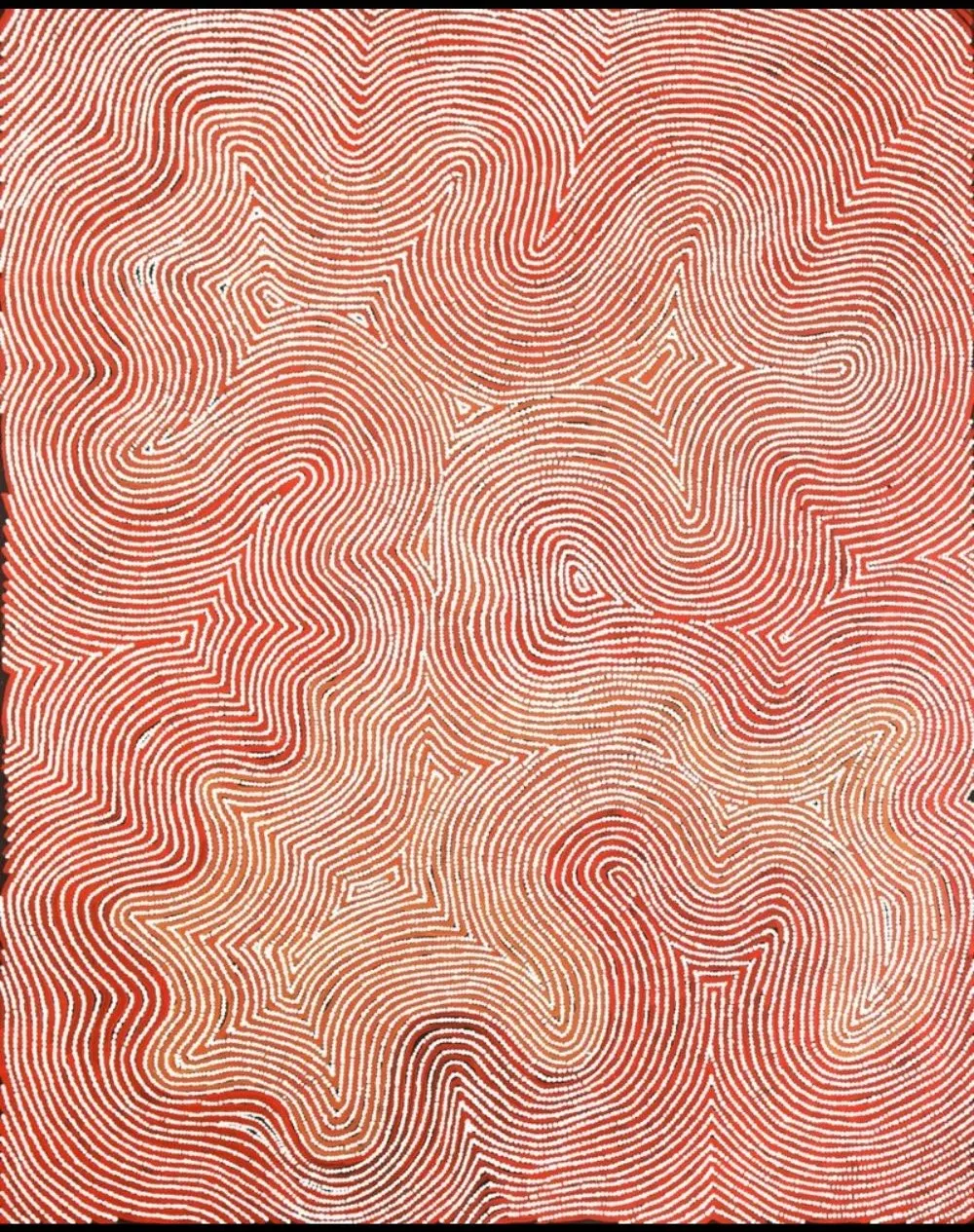
Warlimpirrnga Tjapaltjarri, a Pintupi artist of the Western Desert, provides an important counterexample from within the region most associated with dot painting. Many of his mature paintings are dominated by tightly controlled parallel lines that create powerful optical movement across the canvas. His work demonstrates that even Western Desert Art cannot simply be classified as dot painting.
Albert Namatjira developed a completely different visual language. Working primarily in watercolour, he became famous for luminous paintings of the ranges, riverbeds, ghost gums and distant mountains of Central Australia. His landscapes are immediately recognisable as the work of the Hermannsburg School and bear little visual resemblance to Western Desert dot painting.
Mawurndjul’s cross-hatching, Warlimpirrnga’s rhythmic lines and Namatjira’s watercolour landscapes are all Aboriginal art. There is no single Aboriginal painting style, and dots are only one technique within a much larger and more diverse artistic history.
References used for researching
Is Aboriginal Art the Oldest in the World?
Core references
Art Gallery of South Australia — “Curators and the Collection: To dot or not to dot”
All images in this article are for educational purposes only.
This site may contain copyrighted material the use of which was not specified by the copyright owner.