Alma Webou: Biography Painting style and subjects
c.1928–2009
Yulparija / Yulparitja
Pinkalakara, Great Sandy Desert, Western Australia
Bidyadanga (La Grange), Kimberley coast
Yulparija Art / Contemporary Aboriginal Art
Short St Gallery, Broome
Alma Webou (Kalaju) was a senior Yulparija Aboriginal artist whose paintings depict Pinkalakara, her ancestral homeland in the Great Sandy Desert of Western Australia. Beginning her artistic career in her seventies, she became one of the distinctive painters associated with the Bidyadanga Aboriginal art movement.
Born near Joanna Spring, Webou spent her childhood living traditionally in the desert before severe drought forced her family to relocate to Bidyadanga on the Kimberley coast.
Her paintings range from intricate networks of dots and irregular markings to bold, almost minimalist fields of brilliant colour. Although highly abstract, they represent specific places, waterholes, bush foods and memories of her ancestral Country.
Alongside Jan Billycan and other senior Yulparija painters, Webou helped establish an important new direction in Contemporary Aboriginal Art.
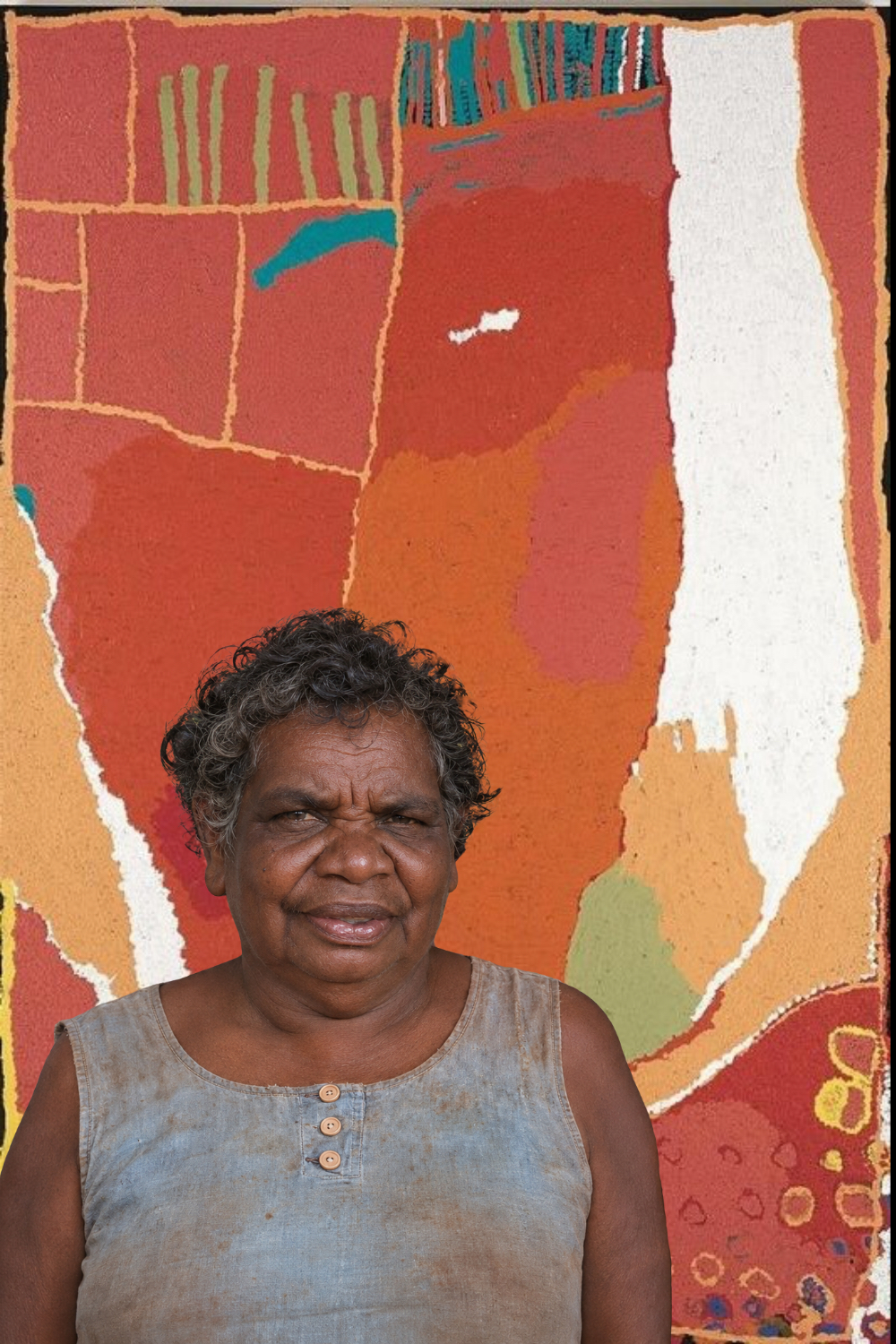
Alma Webou Biography
Alma Webou was born around 1928 at Pinkalakara in the western Great Sandy Desert, although the National Gallery of Victoria records her birth as approximately 1920. She belonged to the Yulparija language group and had the skin name Milangka.
Pinkalakara was her mother’s Country, situated near Joanna Spring, Anna Plains Station and the Canning Stock Route. Webou grew up travelling with her family between water sources, gathering bush foods and learning the ancestral knowledge associated with her Country.
Her childhood was marked by personal tragedy. Her mother and sister died at Pinkalakara, and these losses remained deeply connected with her memories of the place. Webou became a respected senior law woman, maintaining cultural knowledge and responsibilities inherited through her family.
During the 1960s, prolonged drought severely affected the western Great Sandy Desert. As water sources became increasingly unreliable, Webou left with her husband and children during the late 1960s or early 1970s, eventually settling at Bidyadanga, formerly La Grange Mission, south of Broome.
Her artistic career emerged from the development of contemporary Yulparija painting at Bidyadanga around the beginning of the twenty-first century.
The younger artist Daniel Walbidi played an important role in establishing the movement. Recognising the cultural knowledge held by senior desert people, he encouraged them to record their Country through painting.
In 1999, Walbidi approached Emily Rohr of Short St Gallery in Broome seeking support. Rohr, together with Sister Pat Sealey and other supporters, helped provide painting materials and opportunities for the elders to work on paper and canvas.
Among the emerging artists were Alma Webou, Jan Billycan, Weaver Jack, Donald Moko and Lydia Balbal.
Webou began painting seriously around 2002–2003, when she was already in her seventies. Despite her late introduction to contemporary painting materials, she quickly developed a confident and individual style.
Her earliest documented exhibition was Manyiljara at Short St Gallery in 2003. During 2004, her paintings appeared in exhibitions across Australia, including the 21st Telstra National Aboriginal and Torres Strait Islander Art Award and Colour Power: Aboriginal Art Post 1984 at the National Gallery of Victoria.
In 2005, Short St Gallery presented her first documented solo exhibition, Pinkalarta, at Mary’s Place in Sydney. Her paintings also appeared at World Expo in Aichi, Japan.
Further recognition followed with the 23rd Telstra Art Award in 2006 and Desert Heart at Nevill Keating Gallery in London in 2007.
Webou continued painting until the final years of her life. She died on 18 July 2009, leaving a distinctive body of work produced during an artistic career of approximately seven years.
Alma Webou Painting Style
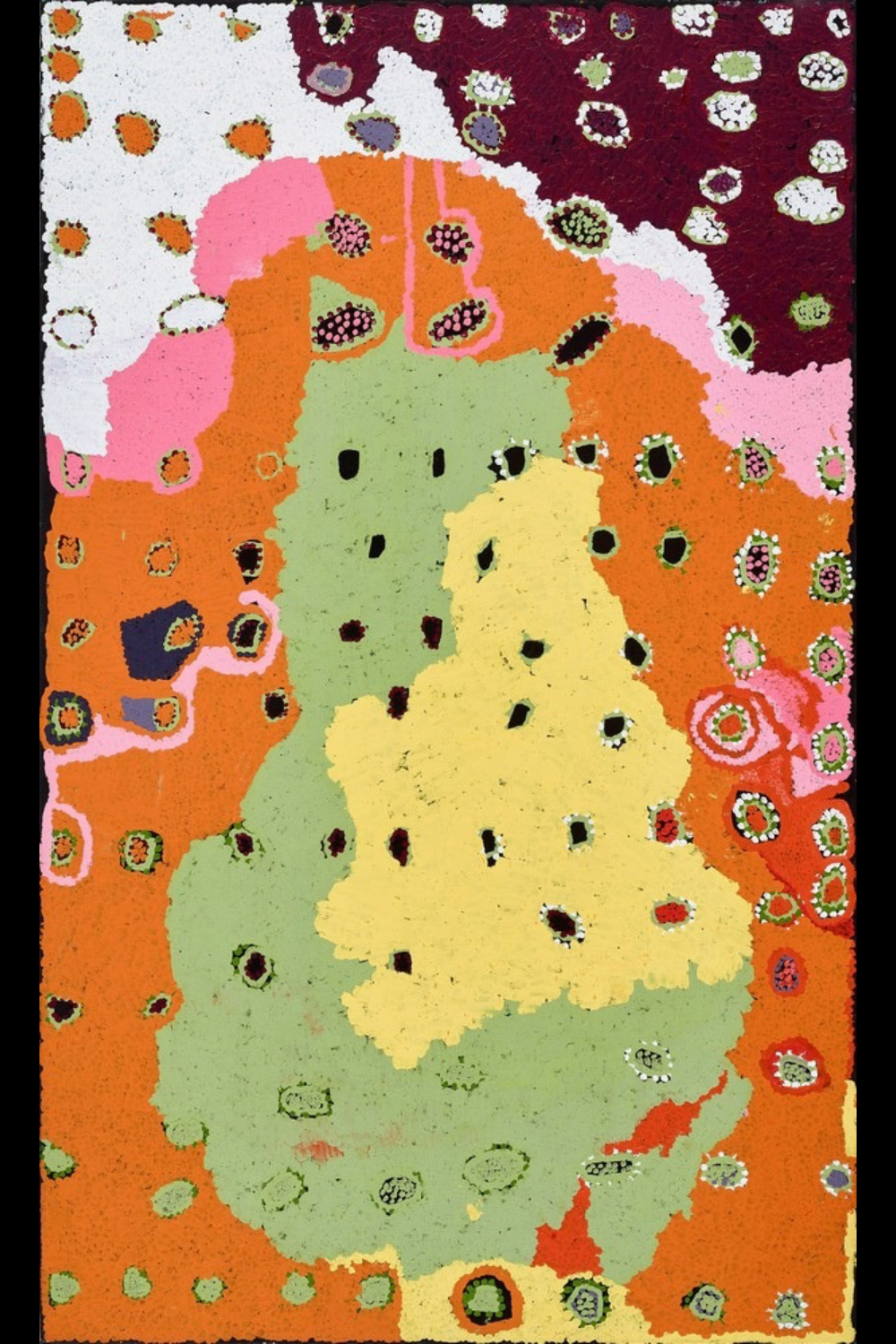
Alma Webou developed two contrasting approaches to painting: densely patterned compositions constructed from repeated markings and bold colour-field paintings dominated by large irregular shapes.
Both represented her ancestral Country, although their visual appearances differed considerably.
Dense Dotting and Intricate Patterns
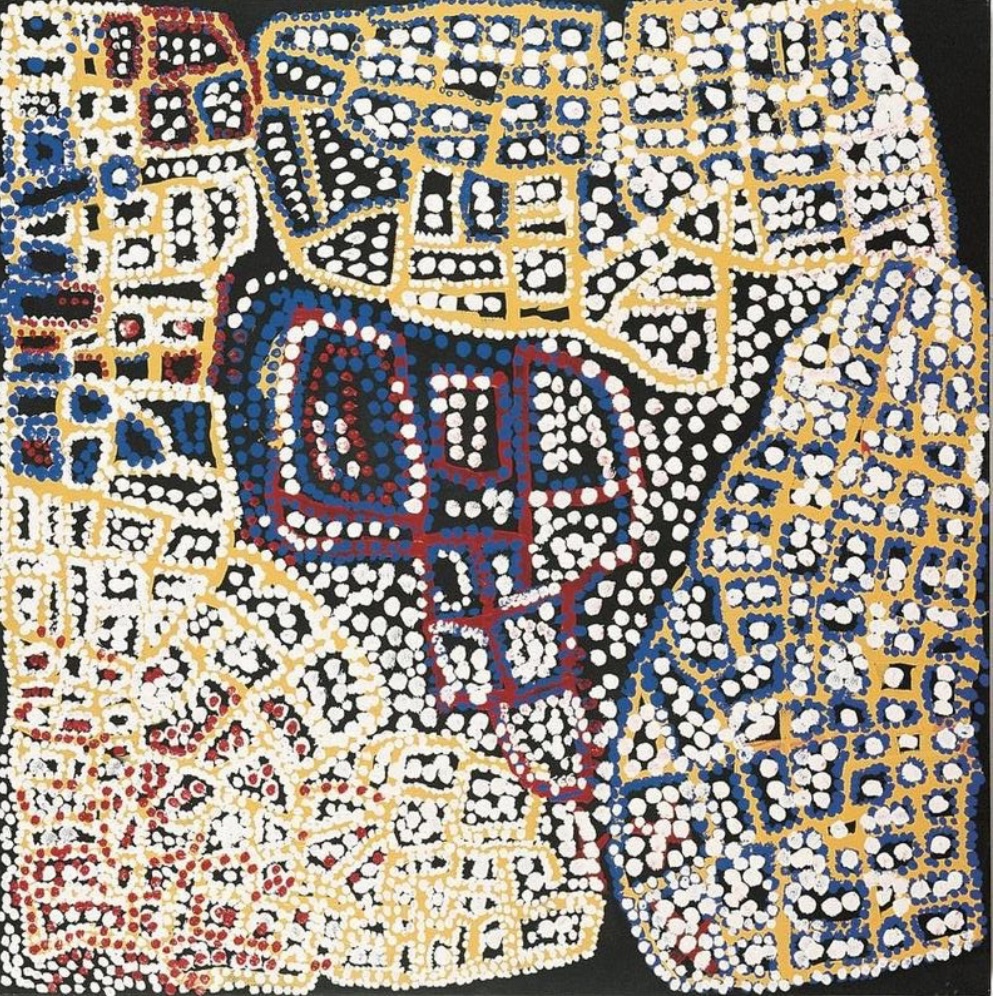
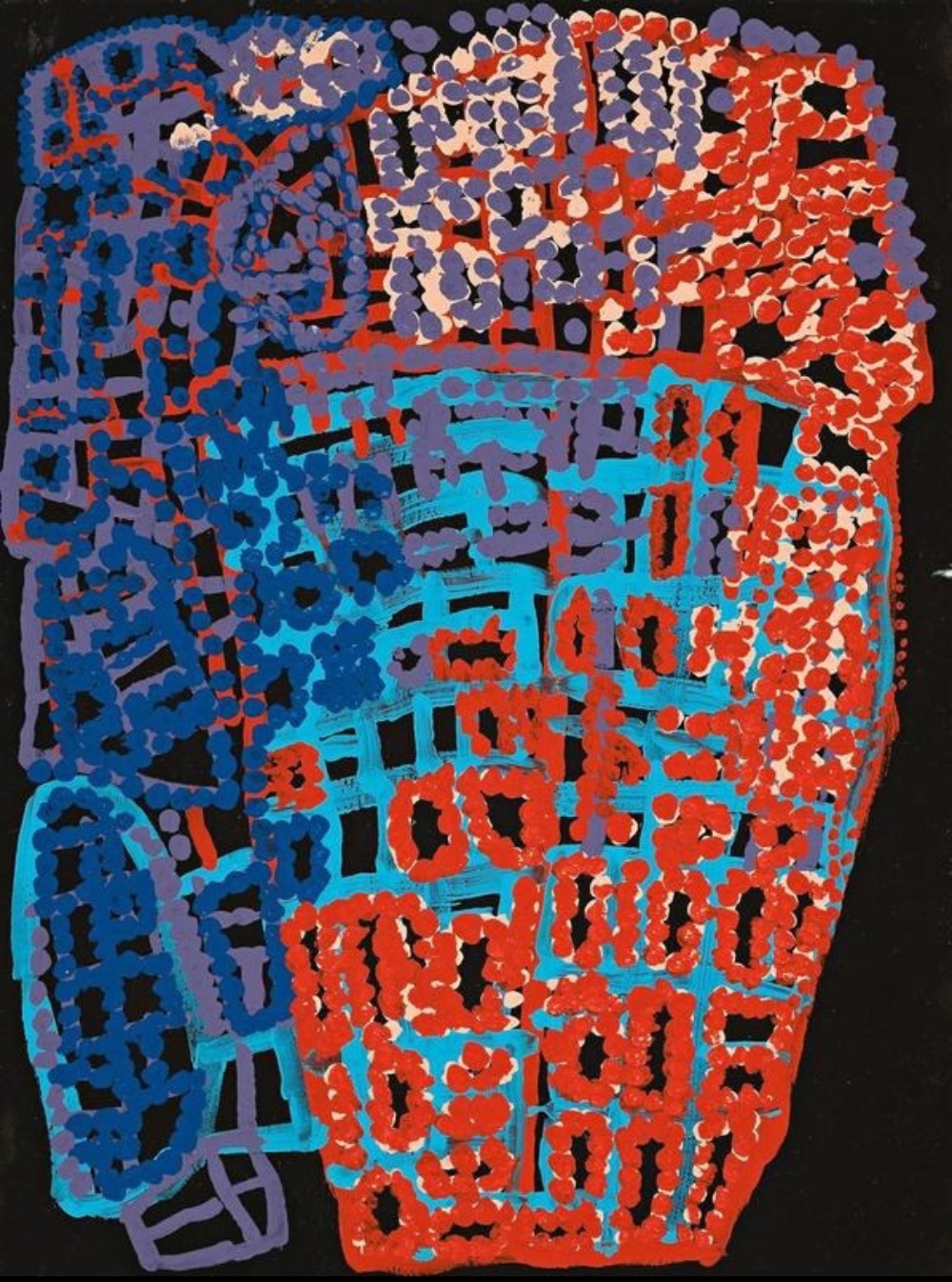
Many of Webou’s paintings feature tightly arranged dots, short lines and irregular outlined forms.
White, yellow, orange, turquoise and red frequently contrast against black, dark blue or purple backgrounds.
Her marks vary in size, direction and spacing, creating intricate networks of interlocking shapes and repeated patterns.
Some compositions suggest an aerial understanding of Country, although their precise meanings depend upon the individual painting.
Pinkalakara (2004), formerly in the Laverty Collection, demonstrates this approach. Its richly worked surface creates considerable visual complexity through the repetition of relatively simple forms.
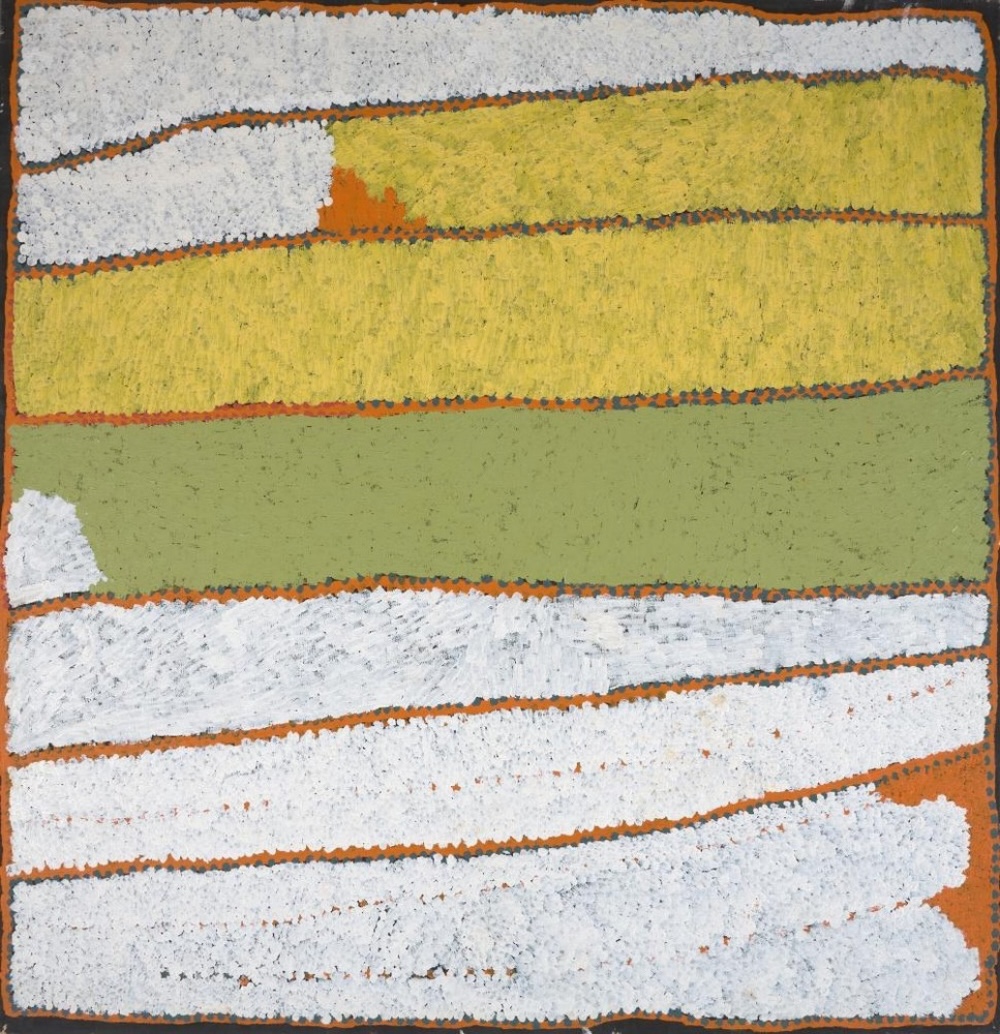
Bold Colour-Field Paintings
Other paintings are strikingly different.
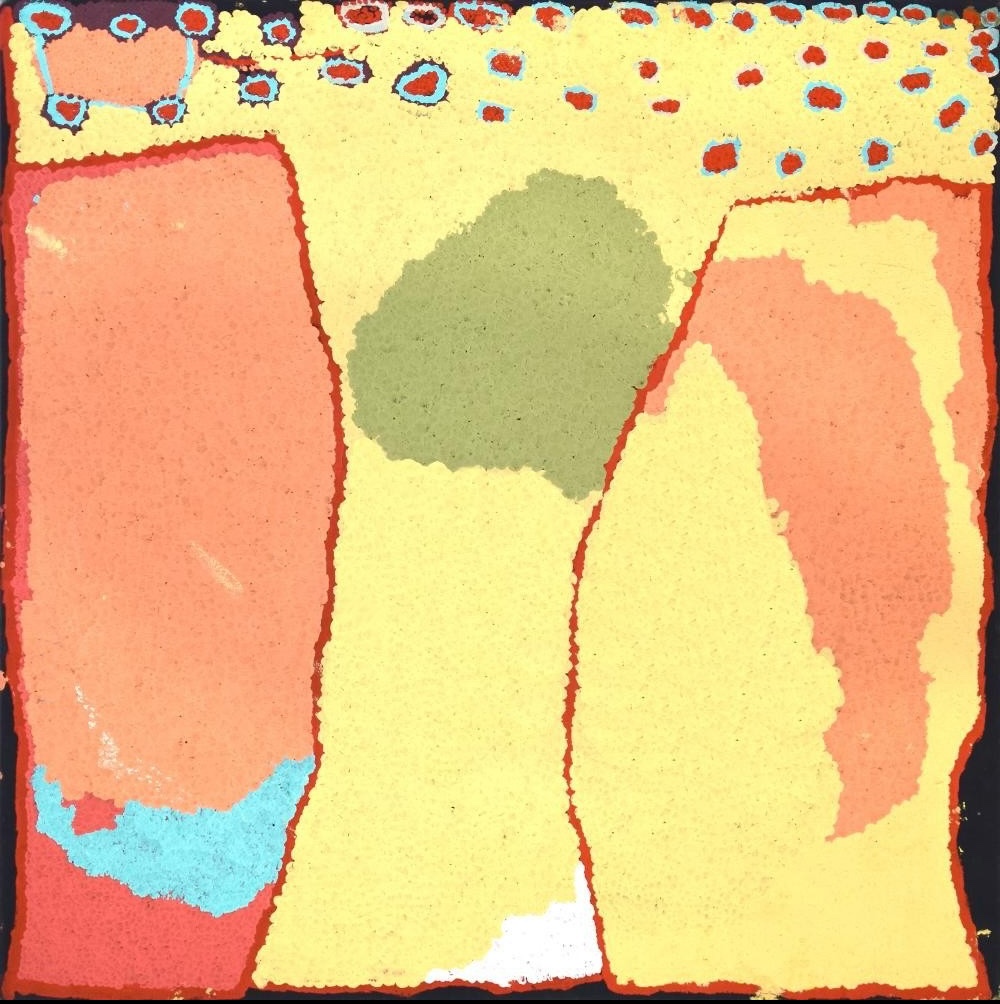
Webou used large, irregular areas of red, orange, yellow, green, pink and turquoise, often separated by thin lines or contrasting shapes.
Individual dots become less prominent, while the arrangement and interaction of coloured areas determine the composition.
Her Pinkalakara (2006), measuring 179 × 119 cm and formerly in the Laverty Collection, is an outstanding example.
Large areas of red and orange dominate the painting, interrupted by lighter forms and contrasting colours.
These simplified compositions were not necessarily a later development. Webou produced both densely patterned and colour-field paintings during the middle years of her career.
Colour and Individual Expression
The Art Gallery of New South Wales characterised Bidyadanga painting as combining desert imagery with a bright coastal palette.
Webou’s use of brilliant colour distinguishes her work from many earlier examples of Western Desert Art.
Emily Rohr contrasted Webou’s densely dotted compositions with Jan Billycan’s broad, gestural brushwork.
Although the Bidyadanga artists shared experiences of displacement and attachment to desert Country, each developed a highly individual painting language.
Webou worked principally with synthetic polymer paint on canvas and linen, although paintings on paper and plywood are also documented.
Alma Webou Painting Subjects
Webou concentrated overwhelmingly on one ancestral location: Pinkalakara.
Her paintings explored its landscape, waterholes, bush foods, salt lakes and sand dunes. The meanings of individual compositions are best understood through her own recorded explanations.
Pinkalakara or Pinkalarta — Her Ancestral Homeland
Pinkalakara was the defining subject of Webou’s artistic career.
The name appears in painting titles as Pinkalakara, Pinkalarta and occasionally Pinkarlarta, reflecting variations in spelling and transcription.
Her paintings combine different elements of this landscape into abstract compositions, sometimes densely patterned and sometimes dominated by broad fields of colour.
The subject carried profound emotional significance.
Short St Gallery recorded that Webou sometimes cried while painting Pinkalarta, remembering relatives who had died and the Country she had been forced to leave.
Her paintings were therefore both expressions of ancestral responsibility and intensely personal recollections of her childhood homeland.
Mayi — Bush Foods
Mayi (bush food) was an important subject in Webou’s paintings.
Traditional desert life required intimate knowledge of edible plants, their seasonal availability and the places where they could be gathered.
Webou repeatedly recalled the abundance of bush foods at Pinkalakara.
An accompanying certificate for Pinkalakara (2004), formerly in the Ainsworth Collection, specifically identifies the painting as representing bush foods growing in her mother’s Country.
Its densely arranged forms and contrasting colours evoke the resources and vitality of this remembered landscape.
Individual shapes cannot necessarily be identified as particular plant species without supporting documentation.
Why Alma Webou Is Important
Alma Webou belonged to the pioneering generation of Yulparija painters who established the Bidyadanga movement.
Her paintings demonstrate how ancestral knowledge could be expressed through a highly individual contemporary visual language.
Having lived for decades away from Pinkalakara, she retained detailed memories of its landscape, water sources and bush foods. Painting enabled her to maintain and communicate aspects of this relationship with Country.
Her combination of intricate patterning and bold colour fields also demonstrated the stylistic diversity of Bidyadanga painting.
Webou achieved substantial recognition during her short career. Her inclusion in the National Gallery of Victoria’s Colour Power exhibition and subsequent representation in major public collections established her contribution to contemporary Aboriginal art.
Her paintings were collected by Colin and Elizabeth Laverty and Ann Lewis, among Australia’s notable collectors of contemporary art.
Emily Rohr recalled that Ann Lewis recognised a sadness within Webou’s paintings that was not immediately apparent to every viewer.
This emotional complexity remains one of the most compelling aspects of her work: paintings filled with brilliant colour that also preserve memories of displacement and personal loss.
Alma Webou in Public Collections
Alma Webou’s paintings are represented in important Australian public collections, including:
- National Gallery of Victoria, Melbourne— Seven catalogued paintings, including Pinkalakara (2003) and Pinkalarta (2007).
- Art Gallery of New South Wales, Sydney— Two Pinkalarta paintings acquired in 2007.
- National Gallery of Australia, Canberra
- Museum and Art Gallery of the Northern Territory, Darwin
- Broken Hill Regional Art Gallery, New South Wales
- Newcastle Art Gallery, New South Wales— Pinkalarta (2006), acquired in 2012.
Her work is also associated with the Laverty, Myer, Sam Barry and Harvey Wagner collections.
Further Reading
Short St Gallery, Alma Webou (Kalaju). Biography, artist statements and exhibition history.
National Gallery of Victoria, Alma Webou Collection. Paintings, dates, materials and acquisition details.
National Gallery of Victoria, Colour Power: Aboriginal Art Post 1984, 2004–2005. An important exhibition examining experimentation with colour in contemporary Aboriginal art.
Emily Rohr, Bidyadanga, Deutscher and Hackett, 2017. Critical discussion of the Bidyadanga artists and their distinctive painting styles.
Colin and Elizabeth Laverty, Beyond Sacred: Recent Painting from Australia’s Remote Aboriginal Communities, 2008. Includes illustrated paintings by Webou.
Deutscher and Hackett, Pinkalakara (2006). Provenance, exhibition history and literature references for a major painting.
All images featured in this article are presented strictly for educational and informational purposes.
This website may include copyrighted material for which specific authorization has not been obtained from the copyright owner.
All such images are presumed to be the intellectual property of the respective artist or their estate, and are used in accordance with principles of fair dealing or fair use under applicable copyright law.