
George Tjangala
c. 1940–1997
Luritja / Anmatyerre
Mayilnpa, Northern Territory
Papunya
Papunya Art / Western Desert Art
Papunya Tula Artists
Painting on board and canvas
George Tjangala (c.1940–1997), was a Luritja and Anmatyerre artist associated with the first generation of the Papunya Art movement. Living at Papunya during the formative years of the early 1970s, he worked alongside many of the pioneering Western Desert artists before painting for Papunya Tula Artists over several decades.
George Tjangala is one of the lesser-known artists of the Papunya movement. Like Old Tutuma Tjapangati, Charlie Ward and Charlie Egalie, his contribution to the birth of Western Desert Art has often been overshadowed by more widely recognised pioneers such as Mick Namarari Tjapaltjarri, Johnny Warangkula Tjupurrula and John Kipara Tjakamarra.
George Tjangala is recognised as an early Papunya artist whose contribution extended beyond painting. During the 1980s, he helped researchers identify artists and interpret the Dreaming stories depicted on many of the earliest Papunya Boards, preserving important knowledge about the beginnings of contemporary Aboriginal art.
If you own a painting by George Tjangala and would like to know more about it or obtain an indication of its current market value, please feel free to contact me.
Biography
Language group: Luritja / Anmatyerre
Born: c.1940, Mayilnpa, Northern Territory
Died: 1997
George Tjangala was born around 1940 near Mayilnpa, west of Alice Springs, on Luritja and Anmatyerre Country. Before becoming a full-time artist, he worked as a police tracker at Papunya, a role that relied upon his extensive knowledge of the Western Desert landscape and traditional tracking skills. His years at Papunya coincided with the emergence of the contemporary Aboriginal art movement that began in 1971.
Although George Tjangala is not recorded among the artists who painted Geoffrey Bardon’s famous Honey Ant School mural, he was part of the first generation of Papunya painters. Art historian Vivien Johnson describes him as an associate of the original group of artists, placing him among the senior men who helped establish the early years of Papunya Tula Artists.
Throughout the 1970s and 1980s he painted for Papunya Tula Artists, the Aboriginal-owned company established in 1972 to market Western Desert paintings. During the early 1980s he also spent time living at an outstation on his wife’s Country before dividing his time between Papunya and Alice Springs, where he occasionally painted through the Centre for Aboriginal Artists. He continued painting until his death in 1997.
One of George Tjangala’s most significant contributions came away from the easel. During the mid-1980s, researchers documenting the Australian Museum’s collection of early Papunya Boards consulted him, together with other senior artists, to identify painters, explain Dreaming stories and interpret the symbolism contained within many of the earliest boards. Much of what is now publicly understood about these historic paintings was confirmed through these consultations, making his cultural knowledge an important part of the historical record.
George Tjangala’s Painting Style
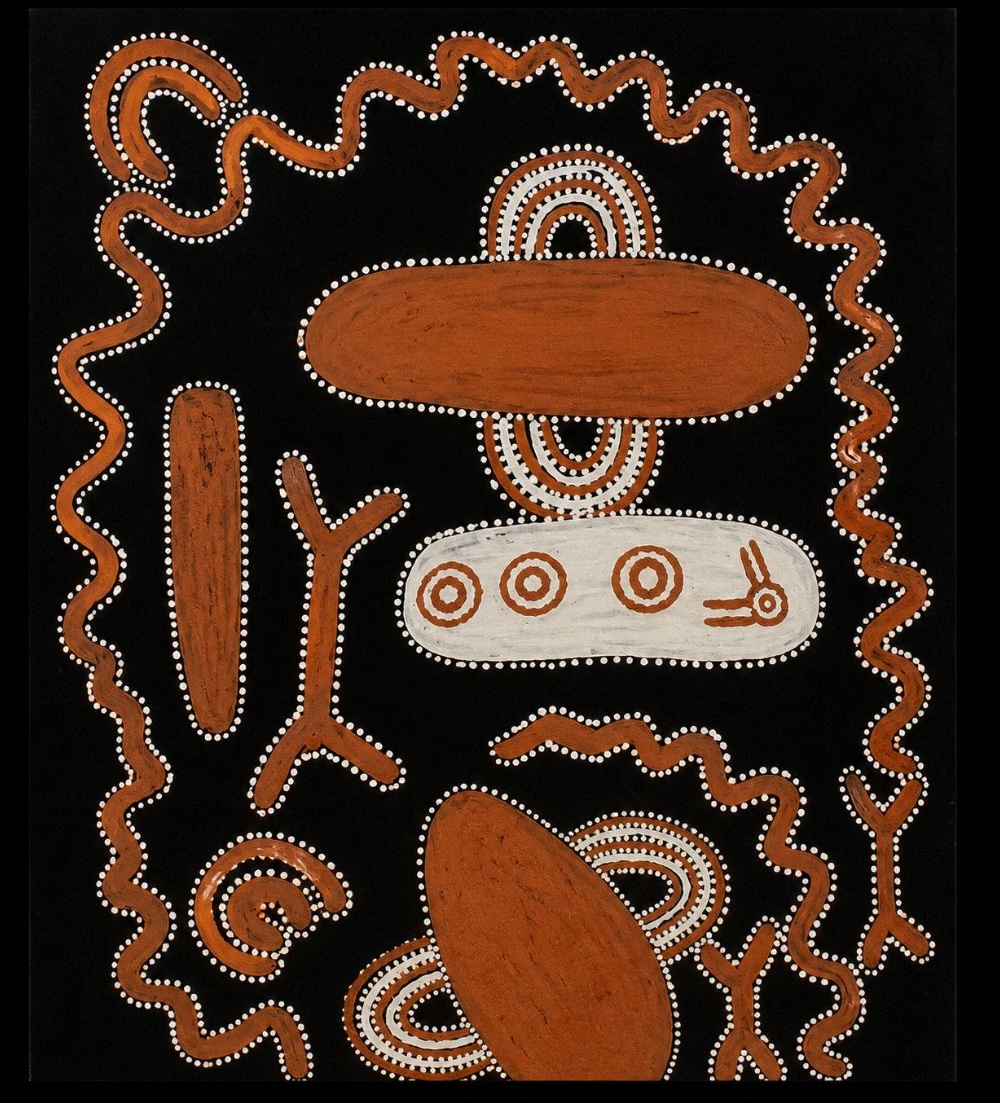
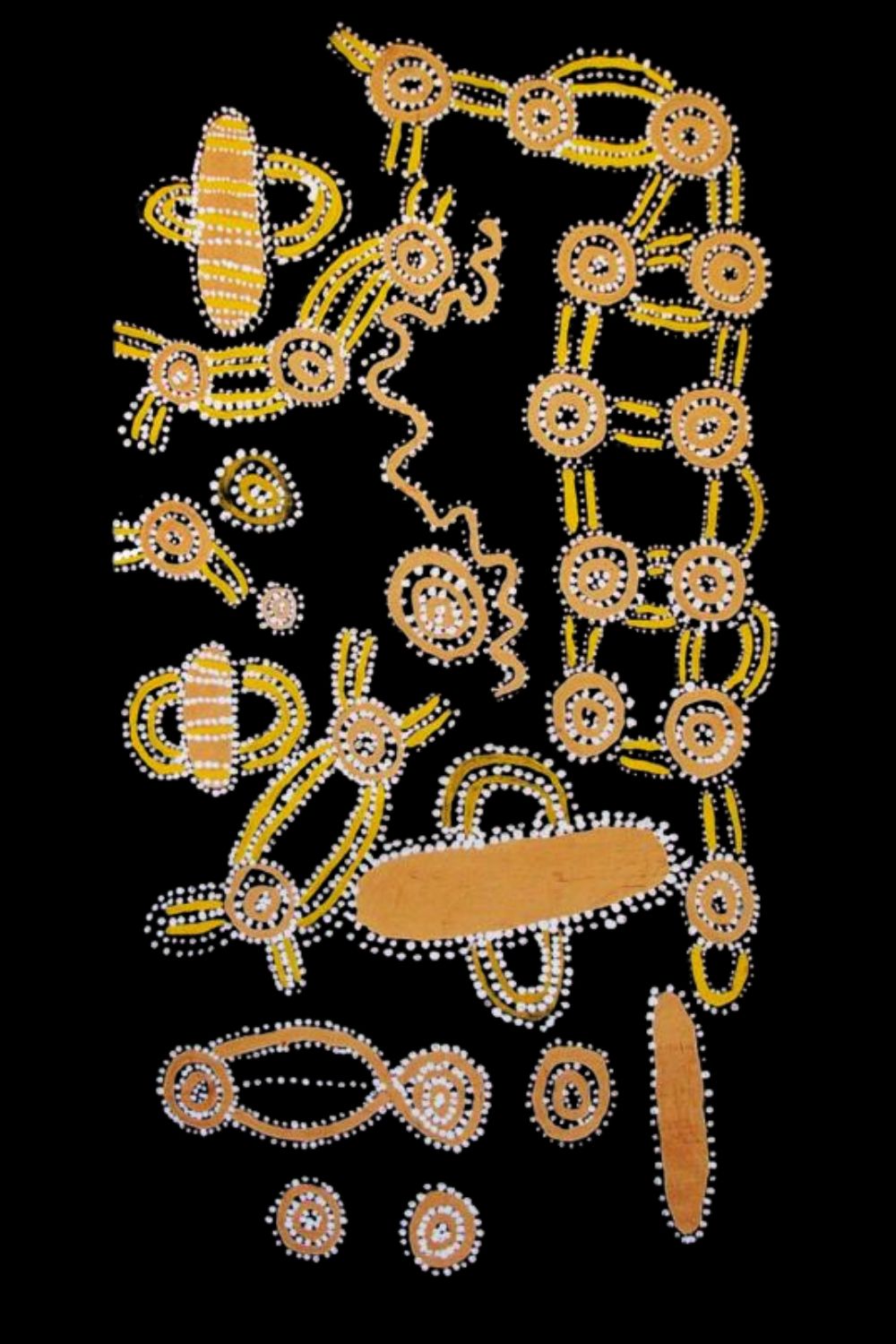
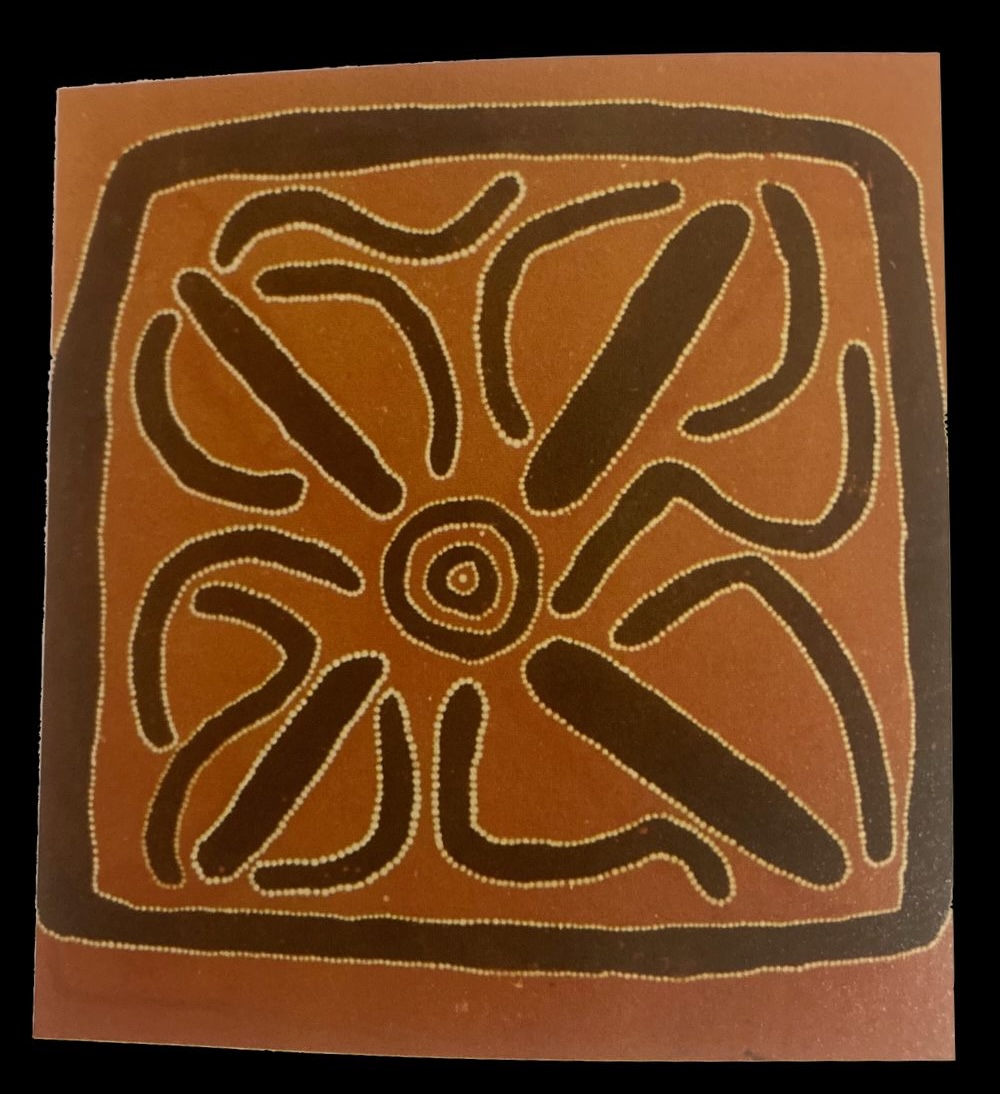
Relatively few paintings by George Tjangala have been published, making it difficult to define a single characteristic style with confidence. His known works nevertheless remain closely aligned with the visual language developed during the formative years of Papunya Art.
Typical features include:
- concentric circles representing ceremonial sites and waterholes
- connecting lines recording ancestral journeys across Country
- balanced geometric arrangements of traditional Western Desert symbols
- restrained palettes dominated by ochres, black, white and earthy reds
- increasing use of dotting in later works while retaining strong underlying linear compositions.
His recorded Dreamings include Water Snake Dreaming, Spider Dreaming, bush tucker and plant Dreamings. Unlike many later Pintupi artists whose paintings became dominated by Tingari narratives, George Tjangala’s documented subjects reflect a broader range of ancestral beings and ecological knowledge connected with his Country.
Because relatively few authenticated works have been published in museum collections or exhibition catalogues, any assessment of his artistic development remains provisional. Additional documented works may provide a clearer understanding of his stylistic evolution.
George Tjangala Paintings for Sale & Artwork Value
George Tjangala’s paintings appear only occasionally on the secondary market. Compared with many first-generation Papunya artists, his documented body of work is relatively small, making authenticated examples considerably rarer than those by artists such as Johnny Warangkula Tjupurrula, Kaapa Mbitjana Tjampitjinpa or Clifford Possum Tjapaltjarri. Very few of his paintings have been reproduced in books or museum catalogues, making secure provenance particularly important when assessing both authenticity and value.
The value of a George Tjangala painting depends primarily on its age, provenance, condition, subject matter and exhibition history. Collectors generally place the greatest value on early works with documented Papunya Tula provenance, exhibition or publication history, inclusion in recognised collections and strong, well-preserved condition.
Although George Tjangala never achieved the public profile of some of his contemporaries, his paintings are valued for their historical association with the formative years of the Papunya Art movement. His long association with Papunya Tula Artists, the relative scarcity of documented works and his recognised role in helping researchers identify and interpret the earliest Papunya Boards all contribute to collector interest. Because comparatively few works have appeared at public auction, establishing market value often requires comparison with privately sold examples together with a careful assessment of provenance and authenticity.
Legacy
George Tjangala occupies a distinctive place in the history of Western Desert Art. Although never one of the movement’s most commercially recognised artists, he belonged to the generation that transformed ceremonial designs into one of Australia’s most significant contemporary art movements.
His legacy extends beyond the paintings he produced. Through his involvement in identifying and interpreting early Papunya Boards during the 1980s, he helped preserve the stories, symbolism and authorship of works that are now regarded as the foundation of contemporary Aboriginal art.
Today, authenticated paintings by George Tjangala remain uncommon. Their rarity, combined with his association with the first generation of Papunya artists, ensures continuing interest from collectors of early Western Desert art.
All images in this article are for educational purposes only.
This site may contain copyrighted material the use of which was not specified by the copyright owner.