
Polly Ngale: Biography, Painting Style and Importance
C. 1936–2022
Anmatyerre
Ahalpere (Arlparra) Country, Central Australia
Camel Camp, Utopia, Northern Territory
Utopia Art / Western Desert Art
Utopia Women’s Batik Group / Delmore Gallery
Polly Ngale (c. 1936–2022), also known as Poly Ngal or Polly Kngale, was a senior Anmatyerre artist from the Utopia Art Movement in Central Australia, celebrated for her richly coloured Bush Plum paintings.
Her principal subject was Anwekety (conkerberry or bush plum), a plant associated with her ancestral Country at Ahalpere. Through thousands of overlapping dots, Polly evoked the flowering, ripening and dispersal of bush plum seeds, transforming the changing desert landscape into luminous fields of colour.
Alongside her sisters Kathleen Ngale and Angelina Pwerle, Polly was a senior custodian of the Bush Plum Dreaming. Although the sisters shared this ancestral subject, Polly developed an unusually loose, expressive painting technique distinguished by dense layers of colour and atmospheric compositions.
She belonged to the pioneering generation of Utopia women who began working in batik during the late 1970s before helping establish one of the most important movements in contemporary Aboriginal Australian painting.
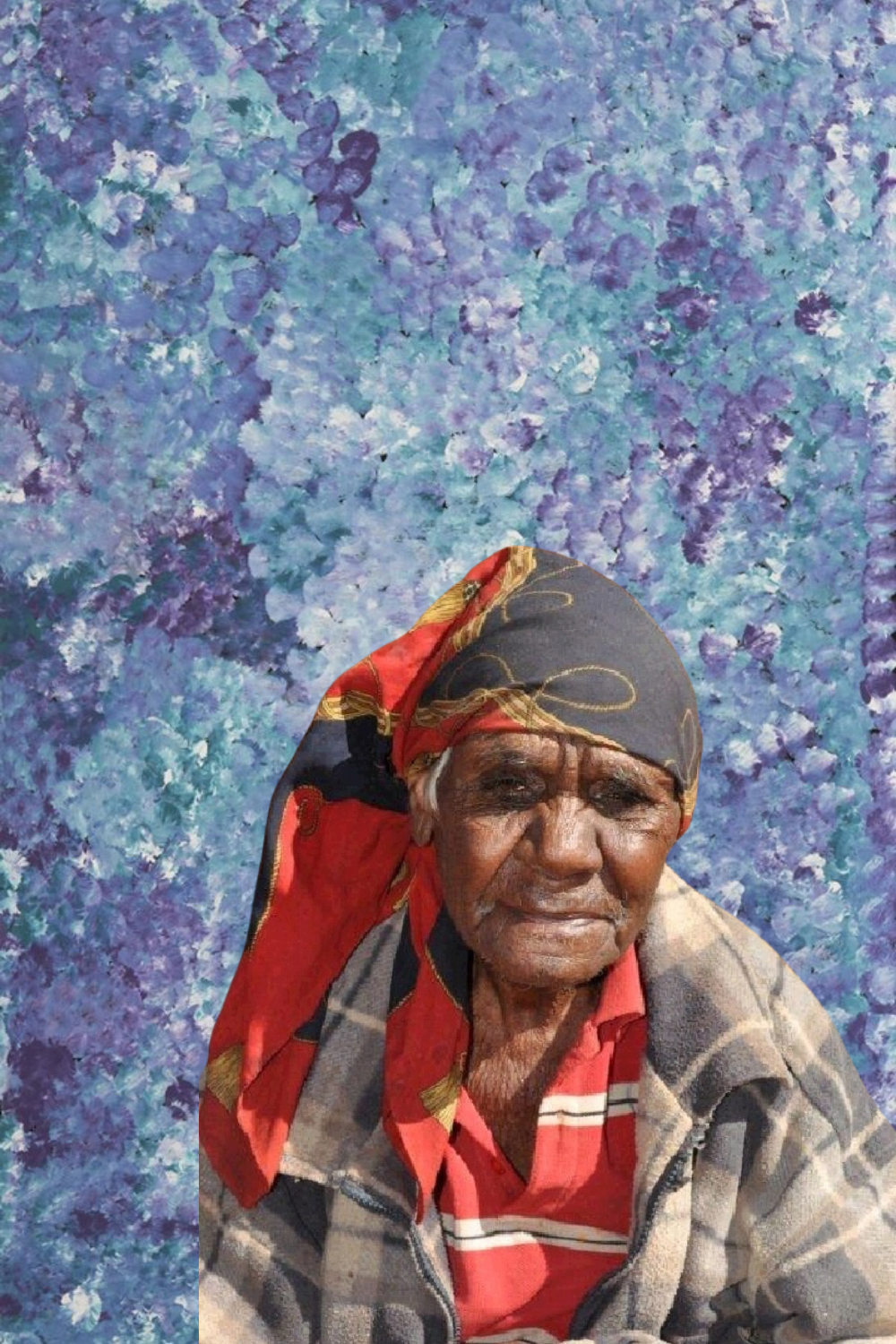
Polly Ngale Biography
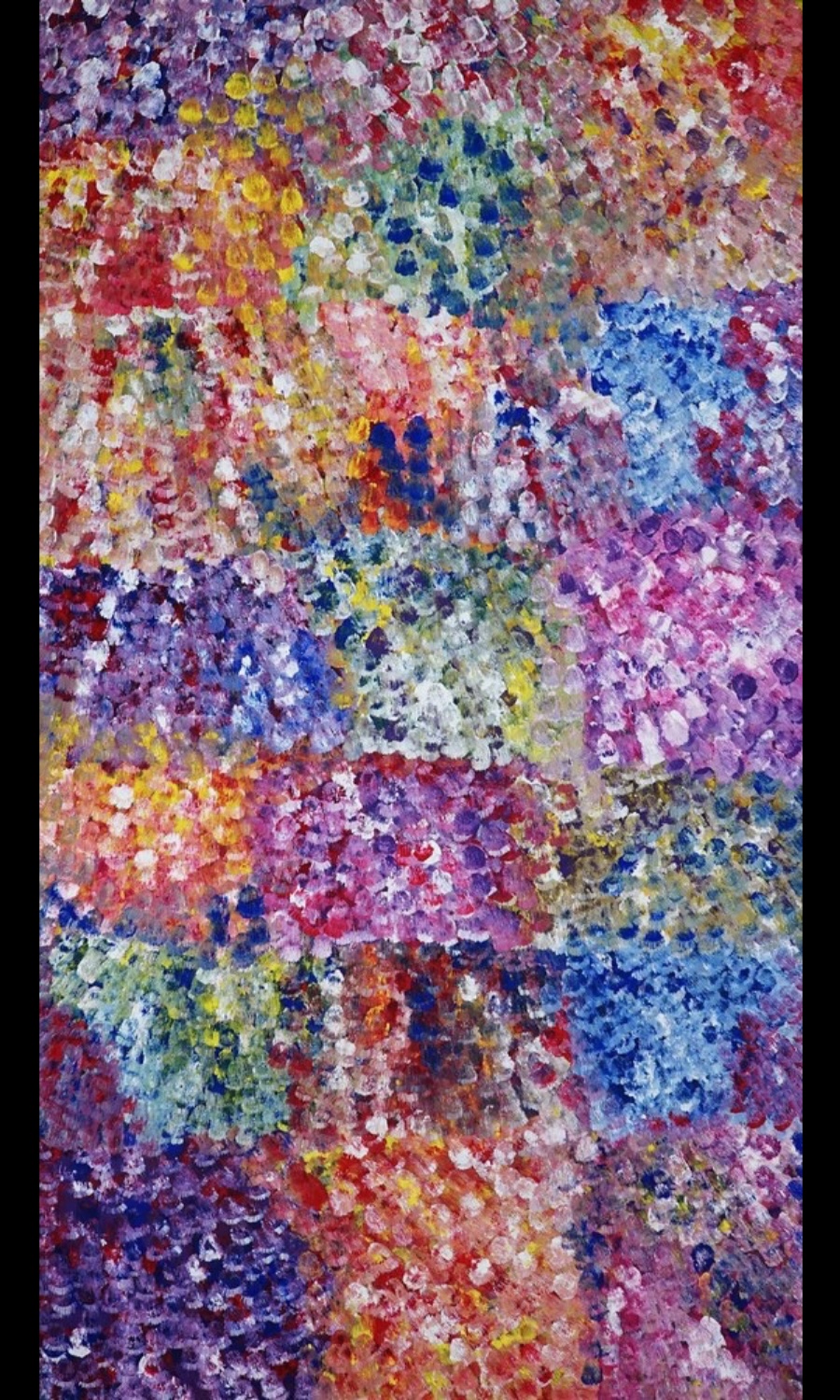
Childhood and Ancestral Country
Polly Ngale was born around 1936 in the Utopia region, northeast of Alice Springs, although some records give her birth date as approximately 1940.
She was an Anmatyerre woman whose father’s Country was Ahalpere, also recorded as Alparra or Arlparra. Her mother’s Country was Ngwelay, known as Kurrajong Bore.
Polly grew up within the network of Aboriginal homelands that make up Utopia, learning the seasonal availability of bush foods, the location of important places and the ancestral knowledge associated with her Country.
Women gathered edible fruits, roots and seeds, passing knowledge between generations through everyday activities, ceremony, songs and stories.
Of particular importance was Anwekety, the bush plum that grows across parts of Central Australia.
The plant produces fragrant white flowers followed by small berries that ripen after rain. Its fruit was an important traditional food, but its significance extended beyond its practical use.
For Polly and her family, the bush plum belonged to an ancestral tradition encompassing Country, ceremony and responsibilities inherited from earlier generations.
As a young woman, Polly learned the traditions of Aboriginal body painting associated with women’s awelye (ceremony). The ochre designs applied to the body expressed ancestral knowledge and responsibilities for Country, forming part of the cultural foundations of her later batik and acrylic paintings.
Family and Cultural Responsibilities
Polly lived at Camel Camp, Utopia, with her extended family. She married Ray Yeramba, and several of their children subsequently became artists.
Her daughters included Josie Kunoth Petyarre, Bessie Purvis Petyarre and Kate Petyarre, who continued artistic traditions associated with their family and Country.
Polly’s sisters Kathleen Ngale, Angelina Pwerle and Maisy Ngale also belonged to this extended community of artists.
Polly, Kathleen and Angelina shared custodial responsibilities relating to the Bush Plum Dreaming at Ahalpere. These responsibilities involved maintaining ceremonial knowledge and passing an understanding of Country to younger generations.
The sisters were closely associated throughout their artistic lives. Polly and Kathleen sometimes worked together, sharing techniques and cultural knowledge while developing distinct approaches to painting.
Polly also worked alongside Emily Kame Kngwarreye, whose extraordinary career would bring international attention to the Utopia movement.
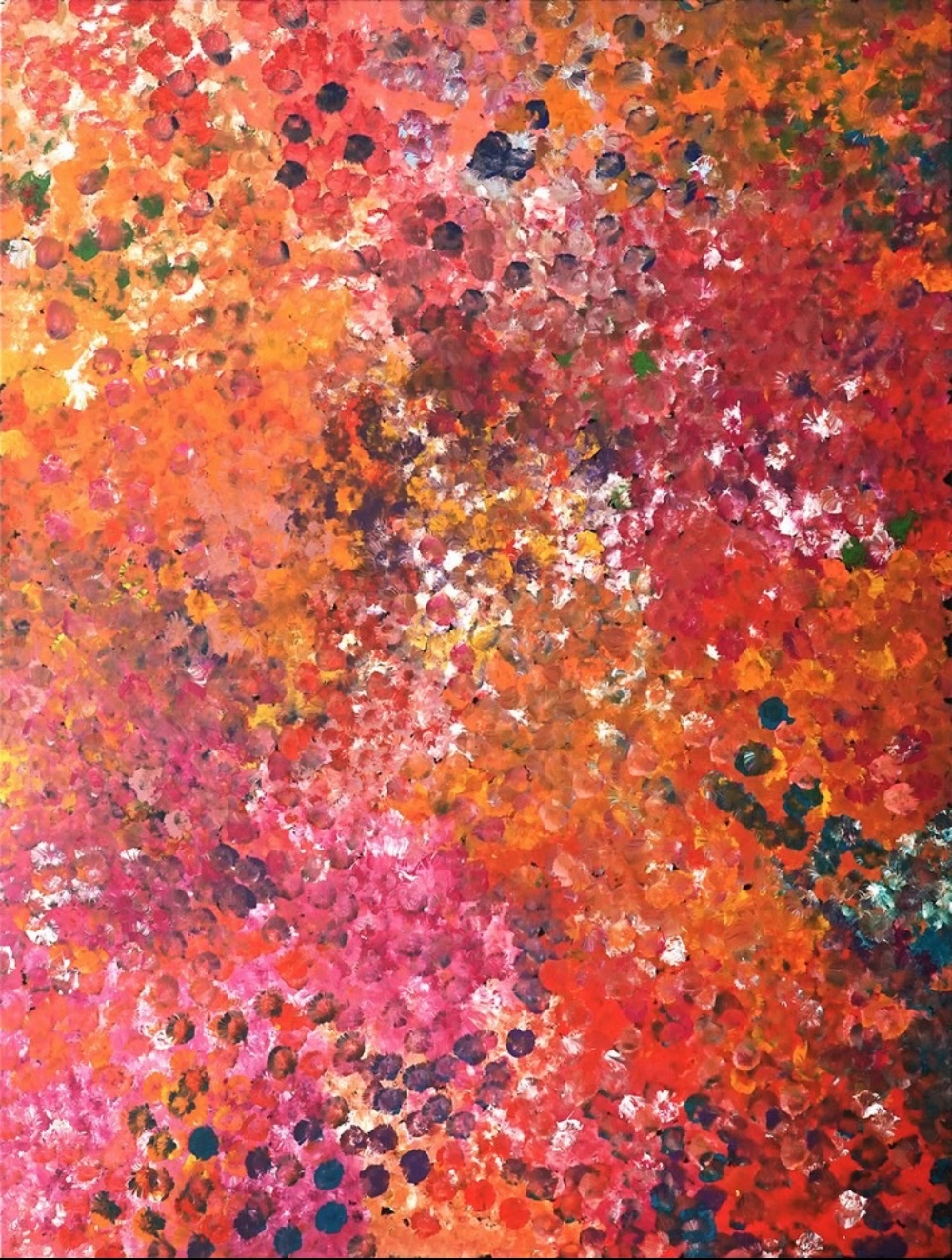
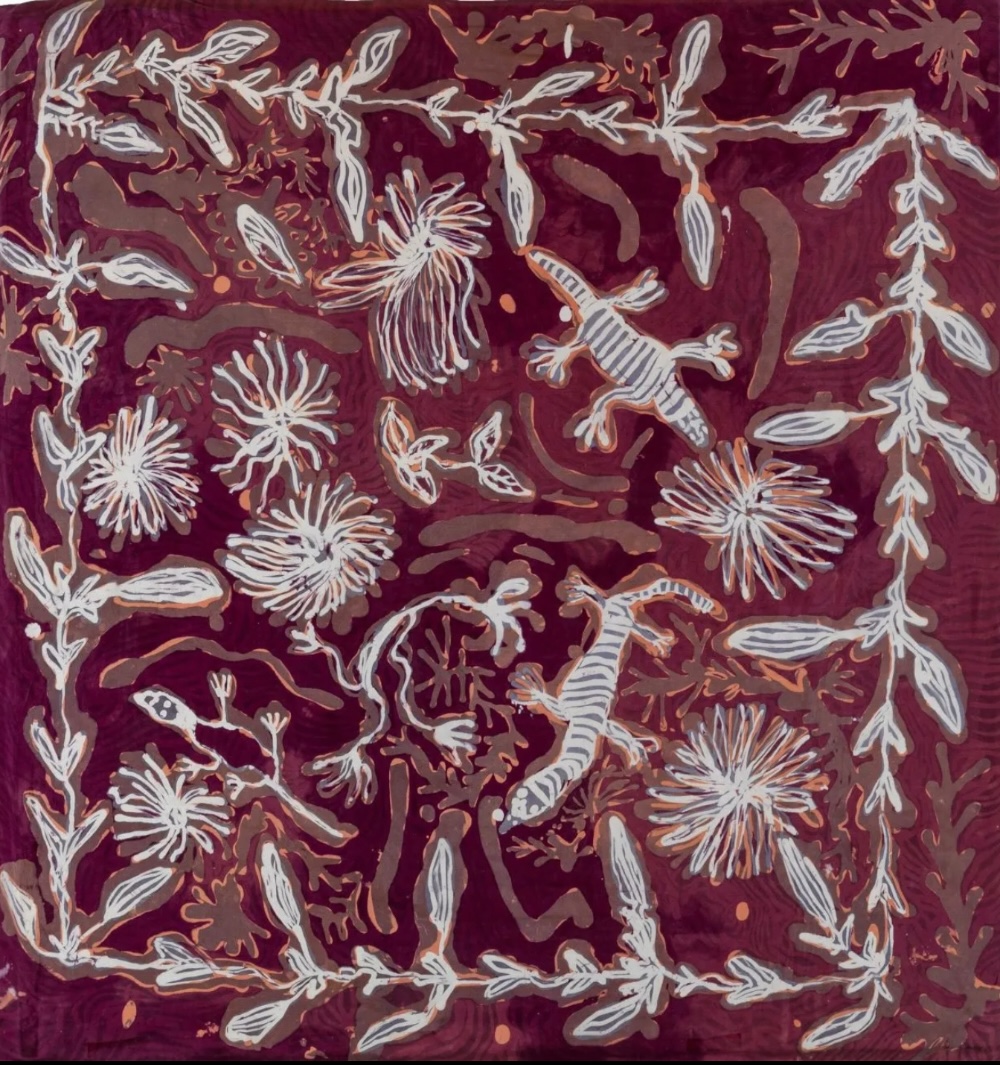
Batik by Poly Ngale
The Utopia Batik Movement
Polly’s commercial artistic career began during the late 1970s, when Aboriginal women at Utopia started experimenting with batik.
Batik involves applying hot wax to fabric to resist dyes. Successive applications of wax and colour allow artists to create intricate designs, overlapping patterns and richly coloured surfaces.
The early workshops involved instructors including Suzie Bryce, Pitjantjatjara artist Yipati and Jenny Green.
Polly became an enthusiastic participant, producing silk designs inspired by the plants, ancestral stories and ceremonial traditions of her Country.
Her early experience with batik was particularly important to her subsequent painting style.
Working with wax and dye encouraged experimentation with colour, repeated marks and the relationship between individual motifs and the overall surface.
Polly also wore some of the colourful silk fabrics she produced, including as headscarves.
The Utopia women’s batik movement brought Polly into contact with an extraordinary generation of artists, including Emily Kame Kngwarreye, Gloria Petyarre, Ada Bird Petyarre and Kathleen Petyarre. Working across the Utopia homelands, these women developed individual approaches to colour, pattern and ancestral designs that would later influence their acrylic paintings.
Their work culminated in Utopia: A Picture Story, a collection of 88 silk batiks acquired by the Holmes à Court Collection and subsequently exhibited internationally.
From Batik to Acrylic Painting
During the 1988–89 CAAMA Summer Project, Utopia women began working extensively with acrylic paints on canvas.
The resulting paintings were exhibited in Utopia Women’s Paintings: The First Works on Canvas at the S. H. Ervin Gallery in Sydney in 1989.
For Polly, the transition provided an opportunity to develop the colour layering she had explored in batik on a different surface.
She began producing acrylic paintings associated with her Ahalpere Country, working through art advisers and galleries including Delmore Gallery and Lauraine Diggins Fine Art.
Her paintings developed increasingly complex surfaces in which thousands of marks accumulated into glowing concentrations of colour.
Polly also participated in printmaking. An untitled woodcut from the Utopia Suite (1990), now held by the Art Gallery of South Australia, demonstrates her involvement in the early diversification of Utopia art.
By the early 2000s, Polly had established a recognisable painting style.
Her work was included in the 2003 National Aboriginal and Torres Strait Islander Art Award, and she exhibited internationally, including in Paris and Tokyo.
In 2002, Two Sisters: Kathleen and Polly Ngale at Lauraine Diggins Fine Art in Melbourne celebrated the artistic relationship between the sisters.
Polly continued painting into her later years and died in Alice Springs on 21 August 2022.
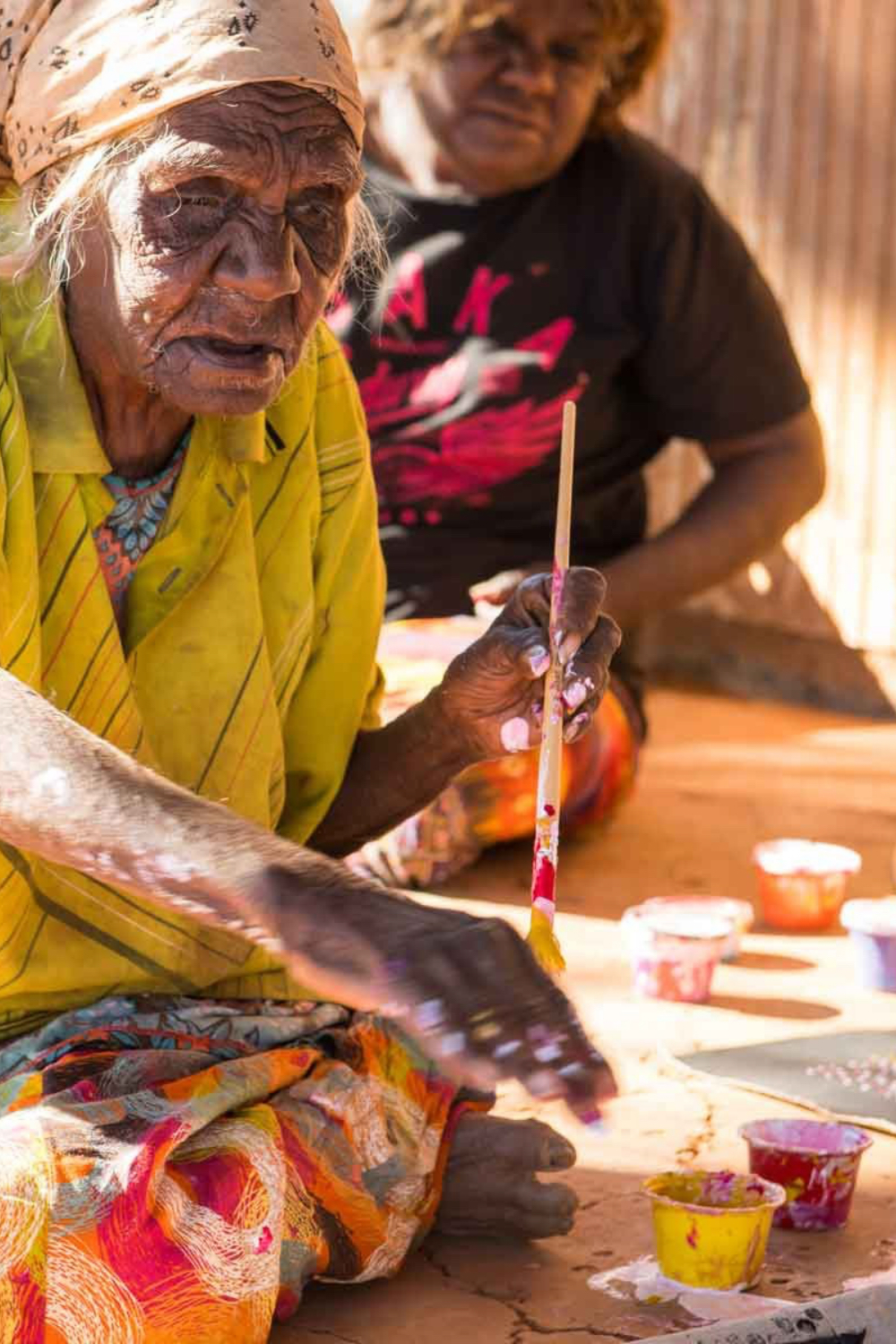
Polly Ngale Painting Style
Polly Ngale developed a distinctive painting style characterised by expressive dotting, overlapping colours and luminous, atmospheric compositions. Rather than arranging dots into regular patterns, she allowed marks to merge into dense concentrations of colour, creating paintings that appear almost abstract while remaining rooted in the natural and ceremonial world of Ahalpere Country.
Polly built her paintings through successive layers of dots, often partially obscuring earlier colours. These accumulated marks create depth and movement, suggesting clusters of vegetation, scattered seeds and shifting light. Her technique ranged from extremely fine dotting to larger, irregular brush marks arranged in loose streams and patches. Art Leven emphasises the sensual, atmospheric quality of her work, which sometimes recalls the expressive mark-making of Emily Kame Kngwarreye.
Colour was central to Polly’s interpretation of Country. Her combinations of yellows, oranges, pinks, reds and purples reflect the seasonal transformation of the bush plum. Following rain, the plant produces white flowers and green berries that gradually ripen into darker reddish-purple fruit. Rather than illustrating individual plants, Polly used these changing colours to evoke the abundance and regeneration of her ancestral landscape.
Although Polly shared the Bush Plum Dreaming with her sisters Kathleen Ngale and Angelina Pwerle, their painting styles differed. Kathleen favoured closely integrated layers of delicate colour, while Angelina became renowned for exceptionally fine, concentrated dotting. Polly’s approach was generally freer and more expressive, with overlapping dots merging into richly textured fields. Her distinctive achievement was to make colour and atmosphere, rather than individual marks, the dominant visual experience, contributing to the remarkable diversity of Utopia Art.
Polly Ngale Painting Subjects
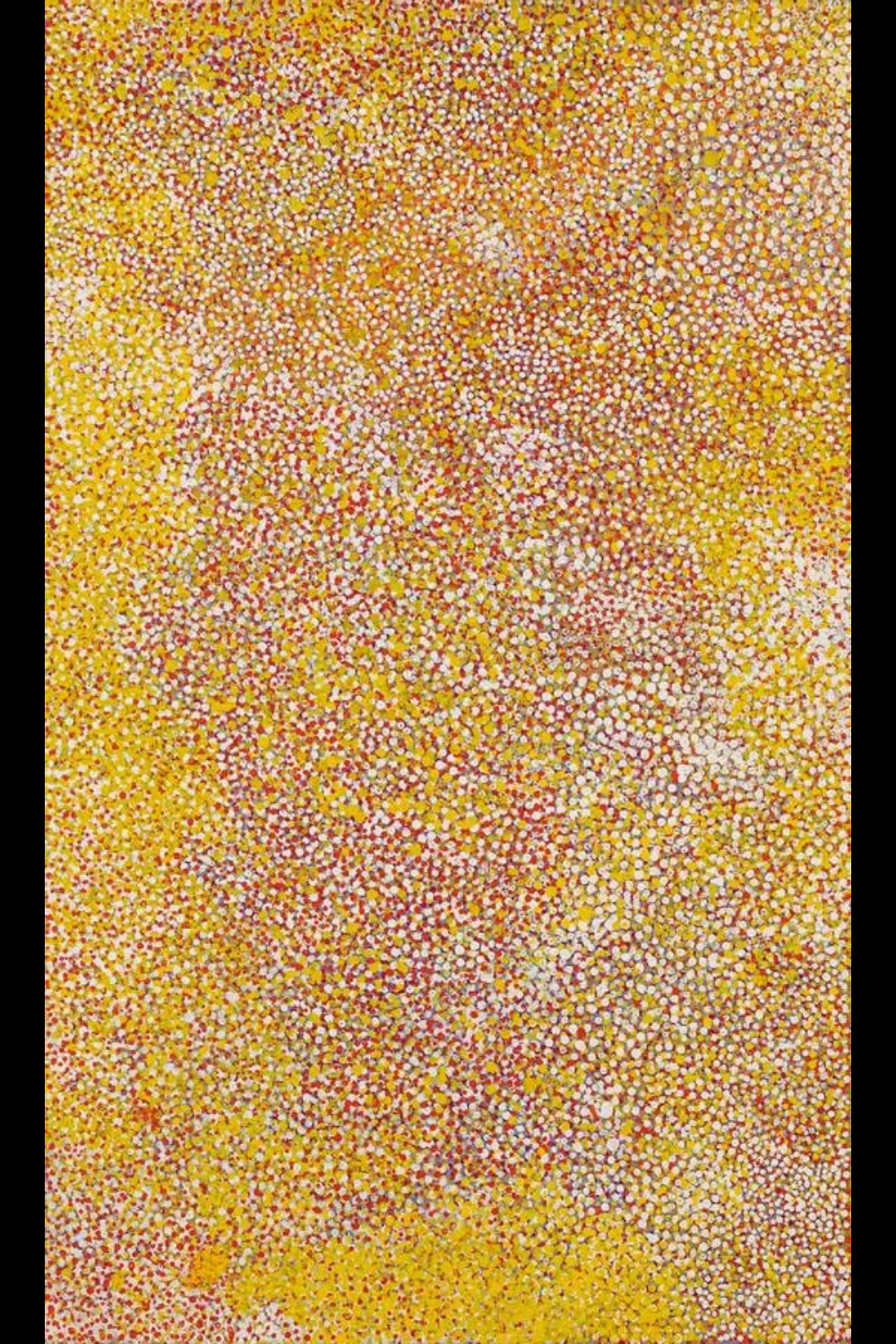
Bush Plum Country (2006) — Ancestral Country
Bush Plum Country (2006) is a significant example of Polly Ngale’s principal artistic subject.
The painting concerns Anwekety (bush plum), whose ancestral significance was central to Polly’s relationship with Ahalpere Country.
According to the Bush Plum Dreaming recorded in gallery accounts, ancestral winds carried seeds across Anmatyerre land, spreading the plant throughout the countryside.
The continued fertility of the bush plum was associated with women’s ceremonies involving songs, dances and ceremonial body designs.
In Bush Plum Country, Polly creates a dense field of pinks, yellows, ochres and purples through overlapping applications of paint.
The accumulated marks evoke the abundance of bush plum seeds, flowers and fruit without depicting individual bushes.
Their arrangement also recalls the patterns associated with women’s ceremonial traditions.
The painting is therefore more than a representation of vegetation. It expresses Polly’s inherited relationship with Country and the ancestral knowledge through which the bush plum remains culturally significant.
Its documented creation at Atneltyeye provides a specific geographical connection between the painting and the broader Utopia homelands.
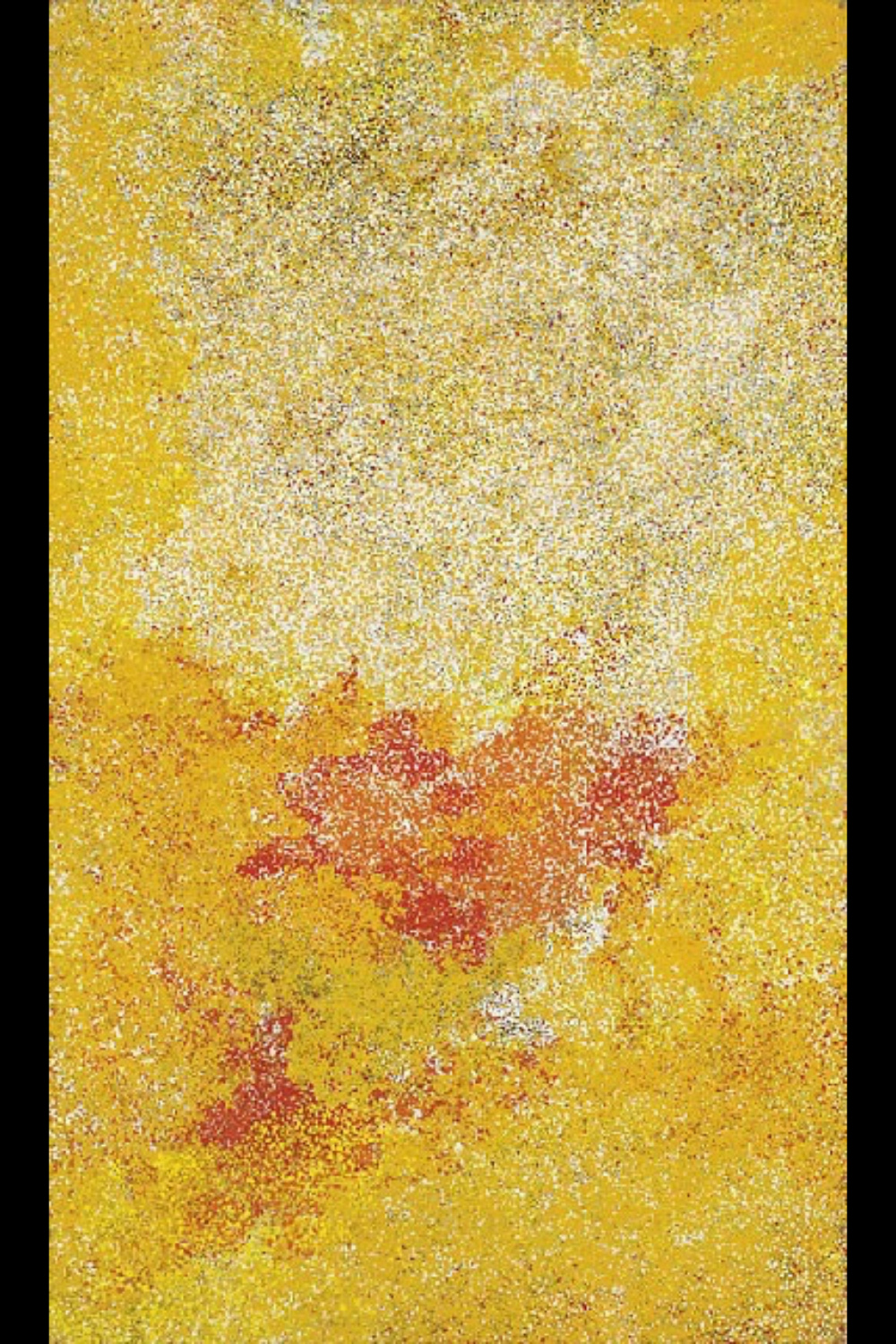
Emu Seed Country (2007) — Seeds and Desert Food
Emu Seed Country (2007) demonstrates how Polly’s paintings extended beyond the fruit of the bush plum to encompass relationships between vegetation and desert animals.
Polly frequently painted bright yellow seeds associated with the plants growing across her Country. Gallery accounts describe these seeds as an important food source for emus.
The painting presents a luminous yellow landscape interrupted by concentrations of pink, orange and pale ochre.
Repeated marks accumulate into irregular formations, evoking seeds scattered among the vegetation.
Rather than painting recognisable emus, Polly concentrates on the food-producing landscape with which the birds are associated.
The composition demonstrates how apparently abstract marks can communicate relationships between plants, animals and the ecology of Central Australia.
A related painting, Emu seed country (2006), measuring 119 × 199 cm, entered the Queensland Art Gallery | Gallery of Modern Art collection in 2008 through a gift from Lauraine Diggins.
Together, these works show that the subject of seeds and their abundance occupied an established place within Polly’s painting practice.
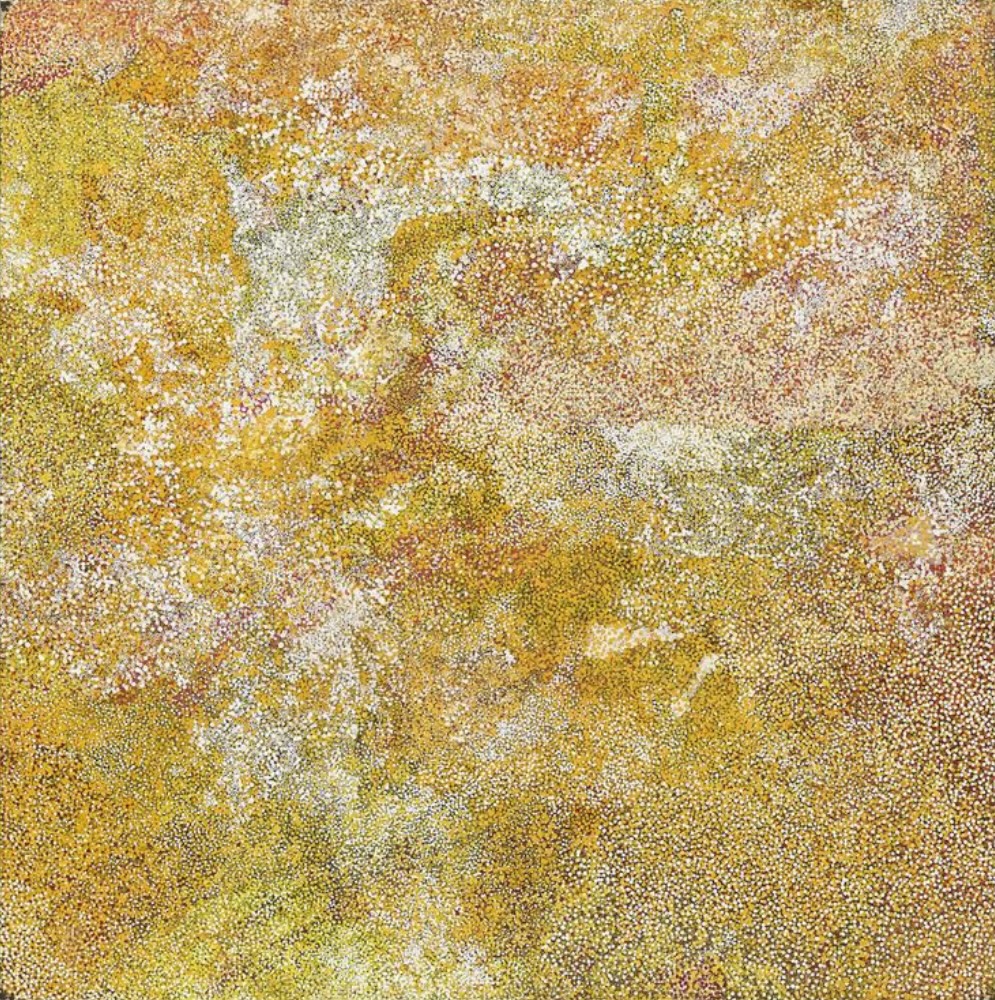
Flowers of My Country (2003) — Flowering and Seasonal Change
Flowers of My Country (2003) provides another perspective on Polly’s relationship with the vegetation of her homeland.
The painting is composed of softly interwoven pinks, oranges, yellows and pale colours, creating a richly textured surface.
Small dots merge with broader patches of pigment, suggesting concentrations of flowering vegetation across the landscape.
Following seasonal rain, many Central Australian plants produce flowers and new growth, temporarily transforming the appearance of otherwise dry Country.
Polly’s painting can be understood in relation to these changes, although the original catalogue does not identify a particular flower species.
The work does not attempt to describe individual blossoms. Instead, the accumulated colours evoke the broader visual experience of flowering Country.
The painting also reveals Polly’s ability to balance dense mark-making with a remarkably open and fluid composition.
While her subject remains grounded in personal knowledge of the landscape, the resulting image approaches abstraction through the expressive use of colour.
Polly Ngale’s Value and Auction results
Works Offered at Auction: 242
Sale Rate: 46%
Highest Sale: $12,000 AUD
Median Sale Price: $1,000 AUD
Polly Ngale’s Importance in Aboriginal Art
Polly Ngale belonged to the pioneering generation of Utopia artists who transformed traditional ceremonial knowledge into batik and acrylic painting, establishing one of Australia’s most distinctive Aboriginal art movements.
Working alongside Emily Kame Kngwarreye, Gloria Petyarre and her sisters Kathleen Ngale and Angelina Pwerle, Polly developed an individual style distinguished by expressive dotting, layered colour and atmospheric compositions.
Her paintings demonstrate that Aboriginal dot painting is not governed by a universal symbolic system. Rather than representing individual fruits or seeds, her accumulated marks evoke the abundance, seasonal change and ancestral significance of Bush Plum Country.
Through her artistic innovation, cultural knowledge and connection to younger generations of painters, Polly helped establish the enduring legacy of the Utopia movement.
Polly Ngale Exhibitions and Public Collections
Polly Ngale’s paintings and batiks were exhibited in Australia and internationally, beginning with the formative exhibitions of the Utopia movement.
Selected Exhibitions
- 1989: Utopia Women’s Paintings: The First Works on Canvas, S. H. Ervin Gallery, Sydney.
- 1990: Utopia: A Picture Story, Holmes à Court Collection, international touring exhibition.
- 2000: Arts d’Australie, Paris.
- 2002: Two Sisters: Kathleen and Polly Ngale, Lauraine Diggins Fine Art, Melbourne.
- 2003: 20th National Aboriginal and Torres Strait Islander Art Award, Darwin.
- 2008: Emily Kngwarreye and Her Legacy, Hillside Forum Daikanyama, Tokyo.
- 2014: Dot Code: Desert Artists, Japingka Gallery, Fremantle.
- 2016: Camel Camp & Beyond, Japingka Gallery, Fremantle.
- 2019: Polly Ngale – Arnwetky, Kate Owen Gallery, Sydney.
- 2020: Polly Ngale & Kathleen Ngale: Bush Plum Dreaming, Japingka Gallery, Fremantle.
- 2021: Ngale Sisters, Mitchell Fine Art, Brisbane.
Polly was a finalist in the 2003 National Aboriginal and Torres Strait Islander Art Award and the 2021 Calleen Art Award. Gallery records also report an Honourable Mention in the 2004 National Aboriginal and Torres Strait Islander Art Award.
Public and Significant Collections
Works by Polly Ngale are documented in, or reported as belonging to, the following collections:
- Art Gallery of South Australia, Adelaide
- Art Gallery of New South Wales, Sydney
- Holmes à Court Collection, Western Australia
- Shepparton Art Museum, Victoria
- World Bank Art Collection, Washington, DC
- Mbantua Gallery Collection, Alice Springs
The Queensland Art Gallery holds Emu seed country (2006), while the Art Gallery of South Australia holds an untitled woodcut from the Utopia Suite (1990).
These works demonstrate the breadth of Polly’s practice, encompassing printmaking as well as the acrylic paintings for which she is best known.
Further Reading
Brody, Anne Marie. Utopia Women’s Paintings: The First Works on Canvas, A Summer Project 1988–89. Heytesbury Holdings, Perth, 1989.
Brody, Anne Marie. Utopia: A Picture Story: 88 Silk Batiks from the Robert Holmes à Court Collection. Heytesbury Holdings, Perth, 1990.
Birnberg, Margo, and Janusz B. Kreczmanski. Aboriginal Artists Dictionary of Biographies: Central Desert, Western Desert and Kimberley Region. JB Publishing, 2004.
Queensland Art Gallery | Gallery of Modern Art. Emu seed country (2006). Collection record.
Art Gallery of South Australia. Polly Ngale, Untitled, from the Utopia Suite (1990).
Art Leven. Poly Ngal: Artist Biography. Specialist commentary on her painting technique and contribution to Utopia art.
All images featured in this article are presented strictly for educational and informational purposes.
This website may include copyrighted material for which specific authorization has not been obtained from the copyright owner.
All such images are presumed to be the intellectual property of the respective artist or their estate, and are used in accordance with principles of fair dealing or fair use under applicable copyright law.