
Kathleen Ngale: Biography and Painting Style
1934–2021
Eastern Anmatyerre
Arlperre / Arlparra Country, Central Australia
Camel Camp, Utopia
Utopia Art / Eastern Desert Art
Utopia Batik / Delmore Gallery / Urapuntja Artists
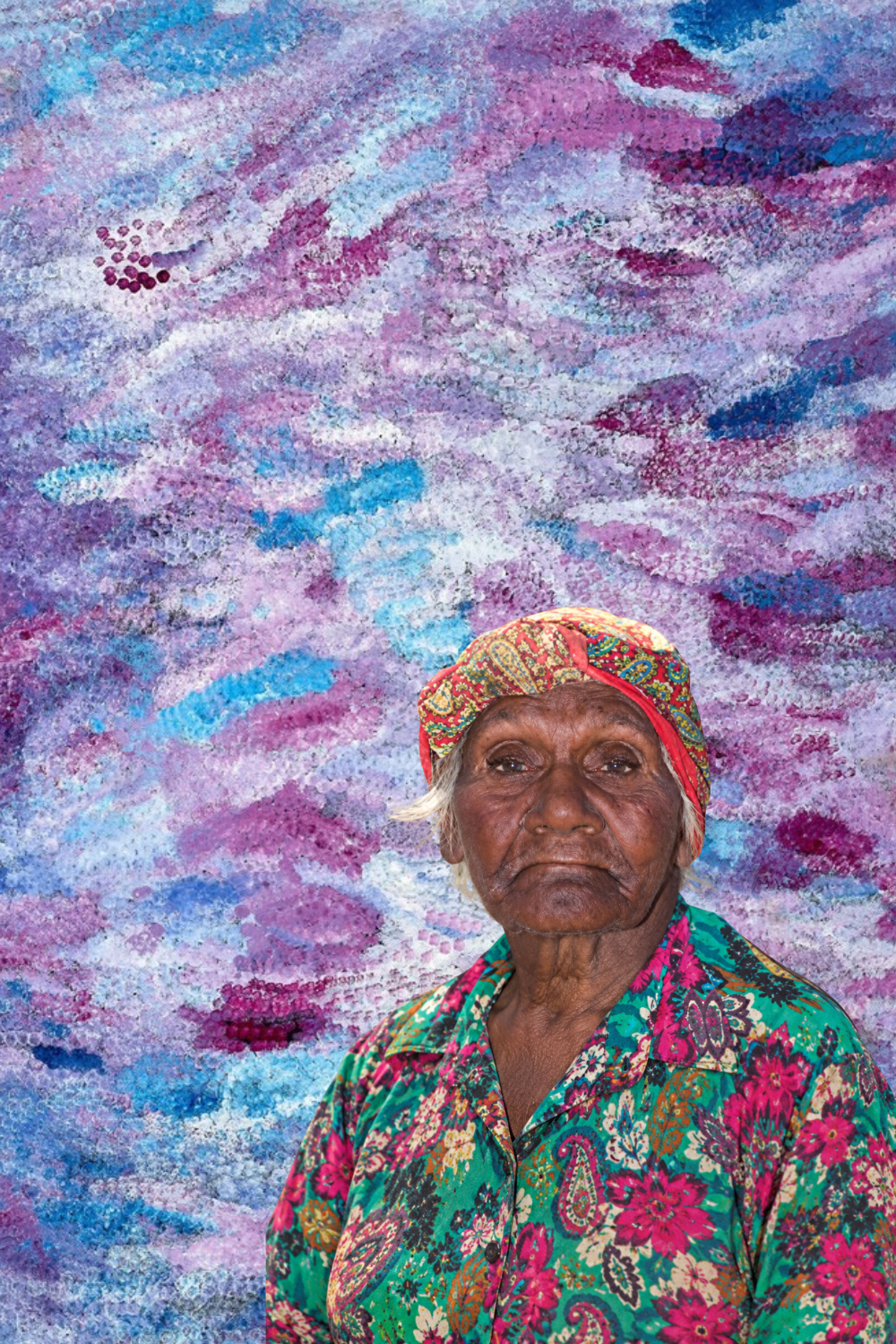
Kathleen Ngale, also known as Kathleen Kngale or Kathleen Ngal, was one of the most accomplished painters of the Utopia Art Movement in Central Australia. A senior Eastern Anmatyerre ceremonial woman from Arlperre Country, she became renowned for luminous Bush Plum paintings in which thousands of overlapping dots create extraordinary fields of colour, depth and movement.
Her principal subject was Anwekety (Bush Plum Dreaming), associated with the ancestral landscape around Arlparra. Kathleen shared responsibilities for this Dreaming with her sisters Polly Ngale and Angelina Pwerle, although each developed a distinctive painting style. Their works evoke the flowering and ripening of the bush plum, ancestral sites, food-gathering grounds and the transformation of Country following rain.
Kathleen belonged to the pioneering generation of Utopia women who began working in batik during the late 1970s. She subsequently developed an individual painting style distinguished by translucent layers of white, pink, lavender, blue and purple. Although her work is sometimes compared with that of Emily Kame Kngwarreye, Kathleen’s carefully orchestrated colour and extraordinarily controlled mark-making established a distinctive artistic identity.
Her paintings have been exhibited internationally and acquired by major Australian public galleries. She was a finalist in the 2000 and 2008 National Aboriginal and Torres Strait Islander Art Awards and the 2008 Wynne Prize for Landscape Painting.
Kathleen Ngale Value
Works Offered at Auction: 59
Sale Rate: 71%
Highest Sale: $60,000 AUD
Median Sale Price: $3,950 AUD
Kathleen Ngale Biography
Kathleen Ngale was born around 1934 in the Utopia region, northeast of Alice Springs, although sources disagree about her precise birth year. She grew up in the country surrounding Arlparra and Camel Camp, learning the seasonal availability of bush foods, the locations of water sources and the ancestral narratives associated with particular places.
Her childhood was shaped by traditional Eastern Anmatyerre life. Women gathered bush foods, prepared for ceremonies and passed cultural knowledge between generations through song, dance and storytelling.
Kathleen remembered watching her mother and aunties prepare for women’s ceremonies. Their bodies were anointed with oil and decorated with ochre designs associated with ancestral beings and Country. These traditions of Aboriginal body painting established her familiarity with painting long before she encountered European artistic materials.
Kathleen became a senior custodian of the Bush Plum Dreaming associated with Arlperre. Her responsibilities included maintaining ceremonial knowledge and teaching younger generations about their Country.
She lived at Camel Camp with her husband, Motorbike Paddy Ngale, who worked as a stockman and later became known for his wooden artefacts and paintings. Their children included Elizabeth, Andy, Janie and Matthew Mpetyane.
Kathleen belonged to an extraordinary family of Utopia artists. Her sisters included Polly Ngale, Angelina Ngale and Maisie Ngale. Polly and Angelina also painted the Bush Plum Dreaming, although each developed a distinctive technique.
Art historian Dr Marie Geissler identifies Kathleen and her sisters as nieces of Emily Kame Kngwarreye. The women worked within the same artistic environment, sharing cultural knowledge while developing their individual approaches to painting.
The Utopia Batik Movement
Kathleen Ngale’s commercial artistic career began in the late 1970s when women at Utopia were introduced to batik, a technique using hot wax and dyes to create designs on fabric. In 1978, the Utopia Women’s Batik Group was established, eventually involving more than eighty women.
Kathleen worked in batik alongside her sisters Polly Ngale and Angelina Pwerle, as well as fellow Utopia artists Emily Kame Kngwarreye, Kathleen Petyarre, Gloria Petyarre and Ada Bird Petyarre. These women helped establish the batik tradition from which contemporary Utopia painting emerged.
For these women, batik provided a new medium for expressing ancestral knowledge, ceremonial body-painting designs and the plants and animals associated with their Country.
Kathleen’s batiks were included in Utopia – A Picture Story, the landmark collection of 88 silk batiks acquired by the Holmes à Court Collection in 1988.
The movement established the foundations of contemporary Utopia painting. When acrylics on canvas were introduced in 1988–89, Kathleen and many of her contemporaries carried their knowledge of colour, layered pattern and ceremonial design into a new artistic medium.
From Batik to Acrylic Painting
In 1988–89, the CAAMA Summer Project, associated with art adviser Rodney Gooch, introduced acrylic painting on canvas to many Utopia women.
Kathleen began producing acrylic paintings in 1989. Some of her earliest canvases were made through Delmore Gallery, established by Don and Janet Holt at Delmore Downs.
These first paintings were relatively formal and structured, reflecting the women’s ceremonial body-painting designs she had known since childhood.
During the 1990s, Kathleen became increasingly adventurous. Her compositions grew less rigid, and she experimented with increasingly complex relationships between colour, dotting and the painted surface.
By the late 1990s, she had developed the delicate, atmospheric style for which she became internationally recognised.
Her paintings were exhibited in Australia and overseas, including Paris, London, Milan and the United States. In 2002 she exhibited alongside her sister Polly in Two Sisters: Kathleen and Polly Ngal at Lauraine Diggins Fine Art in Melbourne.
Kathleen’s international reputation continued to grow during the following decade. Her paintings entered public collections, and in 2008 she became a finalist in the Wynne Prize for Landscape Painting.
Later Life
Kathleen continued living at Camel Camp with her extended family. Despite the international recognition of her paintings, her later years were marked by serious difficulties.
In 2017, ABC journalist Neda Vanovac reported that Kathleen, then elderly and unable to walk, was living in inadequate conditions without sufficient aged-care assistance. The report prompted public concern about the treatment of elderly Aboriginal people living on remote homelands.
Kathleen subsequently received a wheelchair and a donated bed, although her family continued advocating for better services.
She died in 2021, leaving a significant body of paintings and an important artistic and cultural legacy.
Kathleen Ngale Painting Style
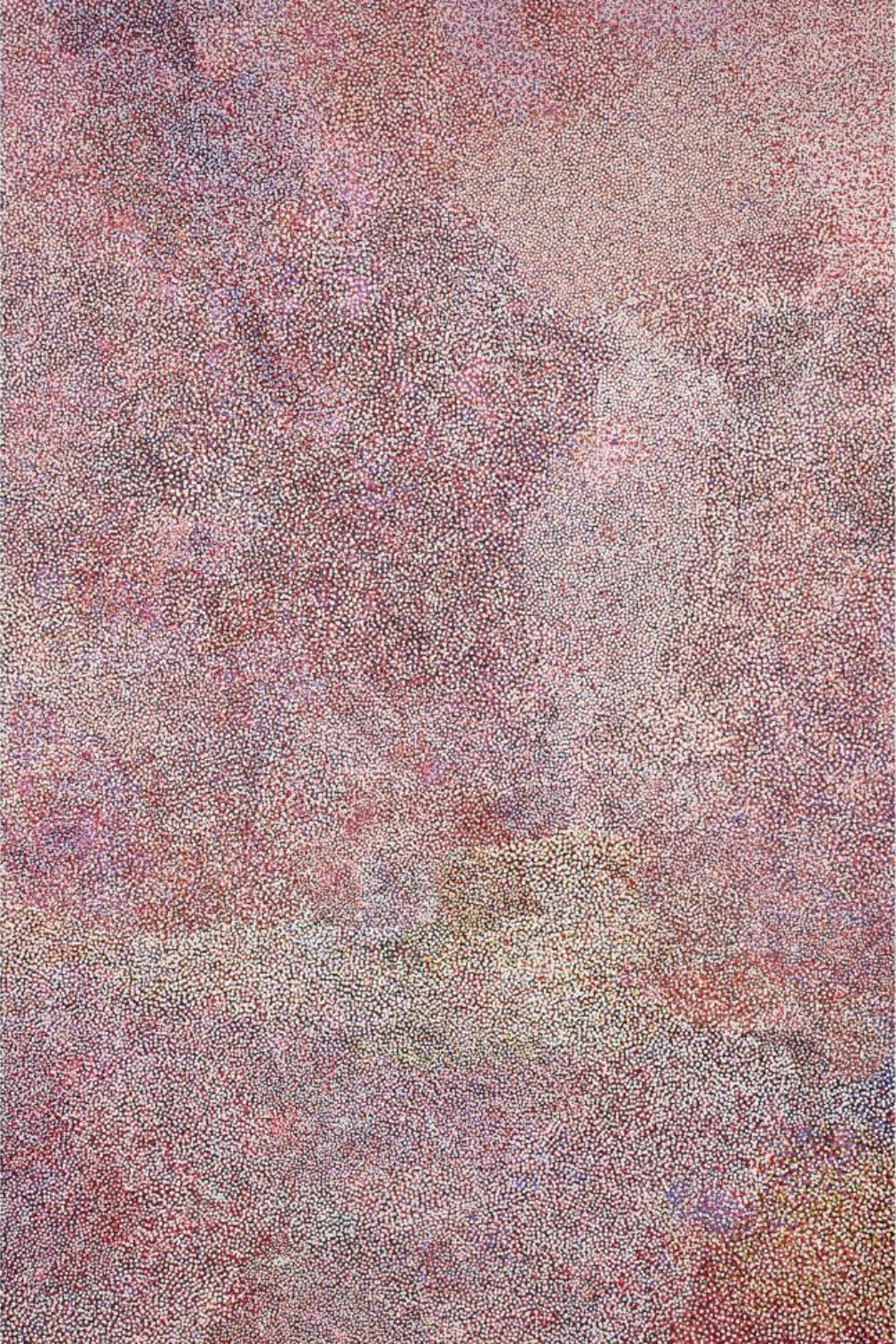
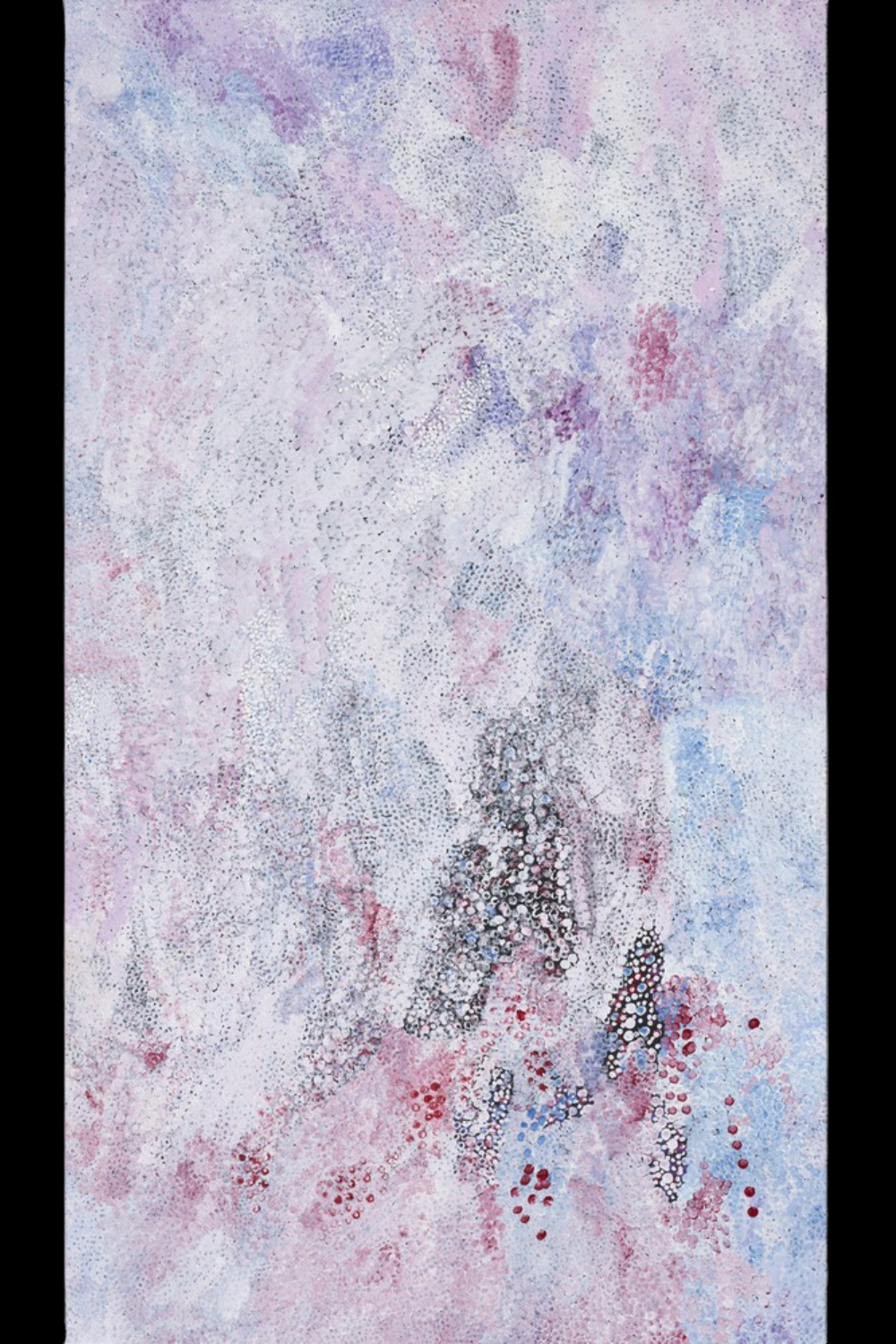
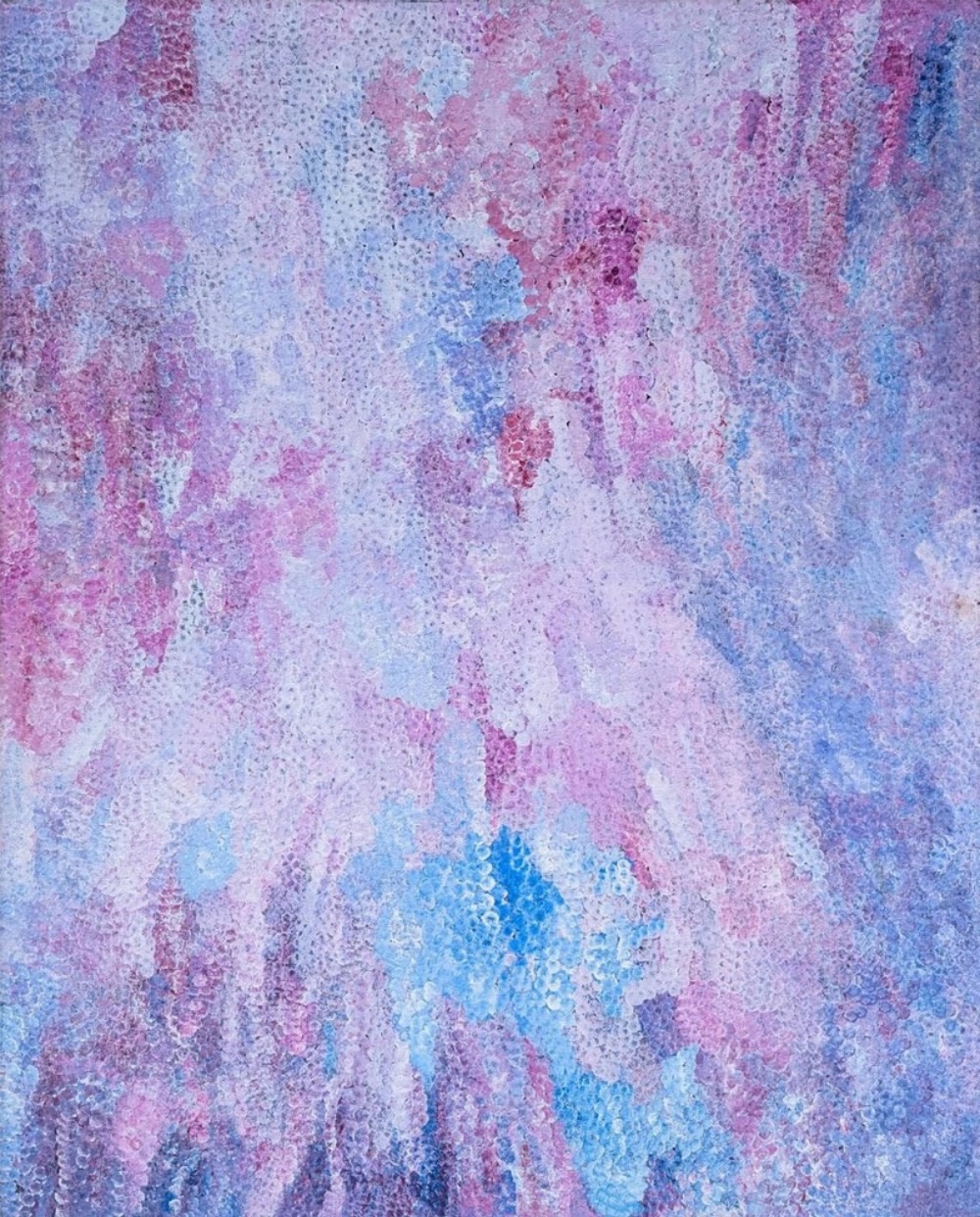
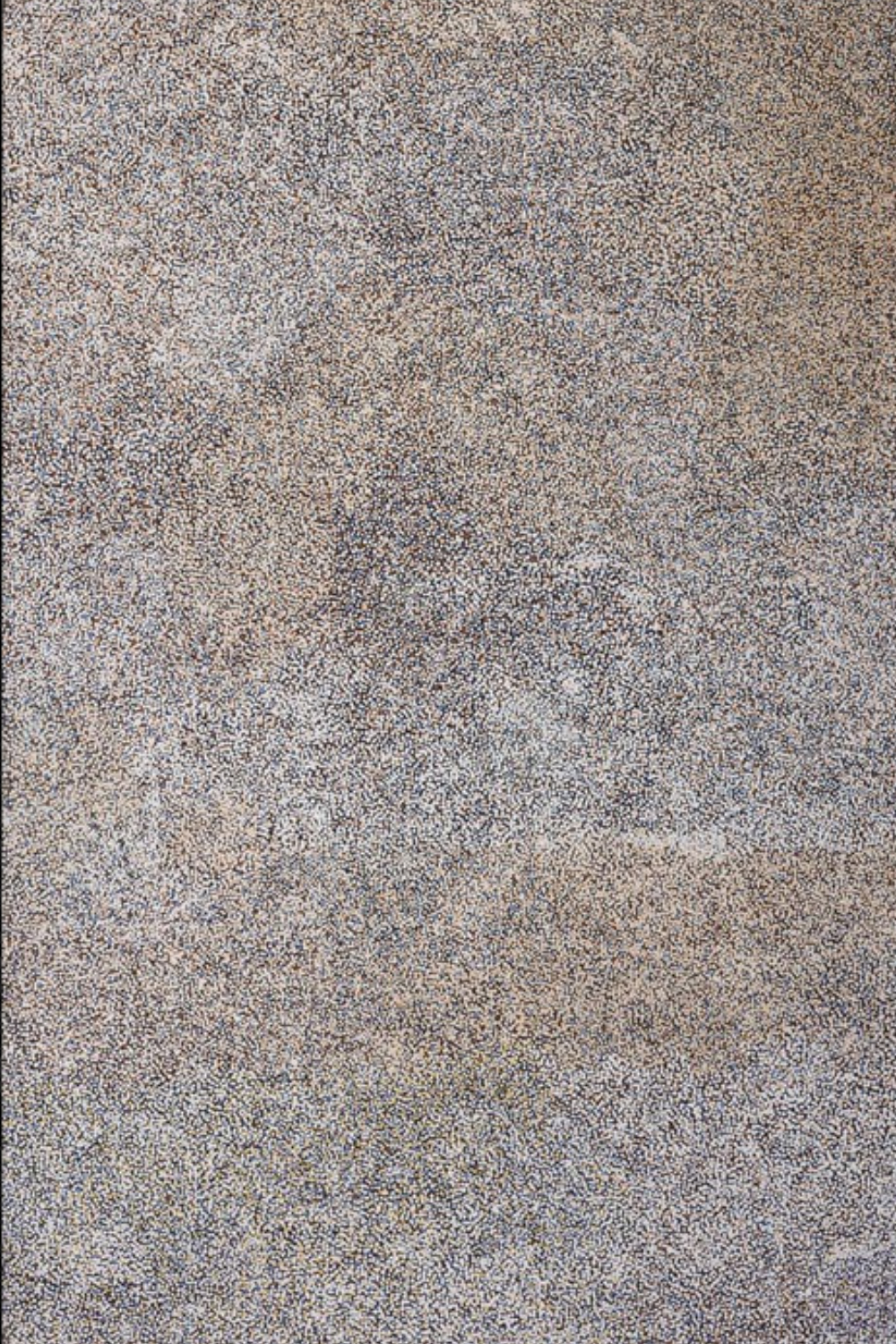
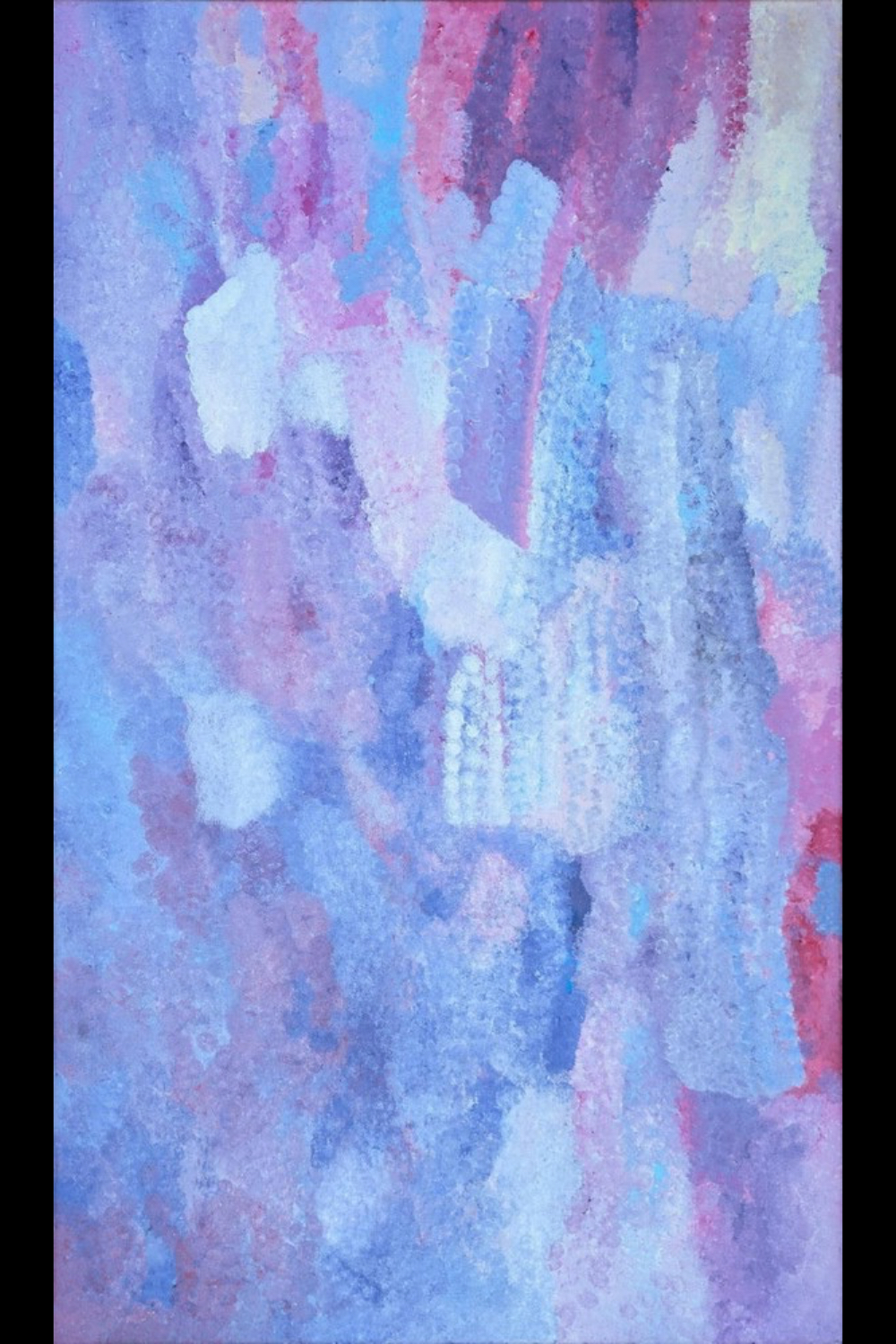
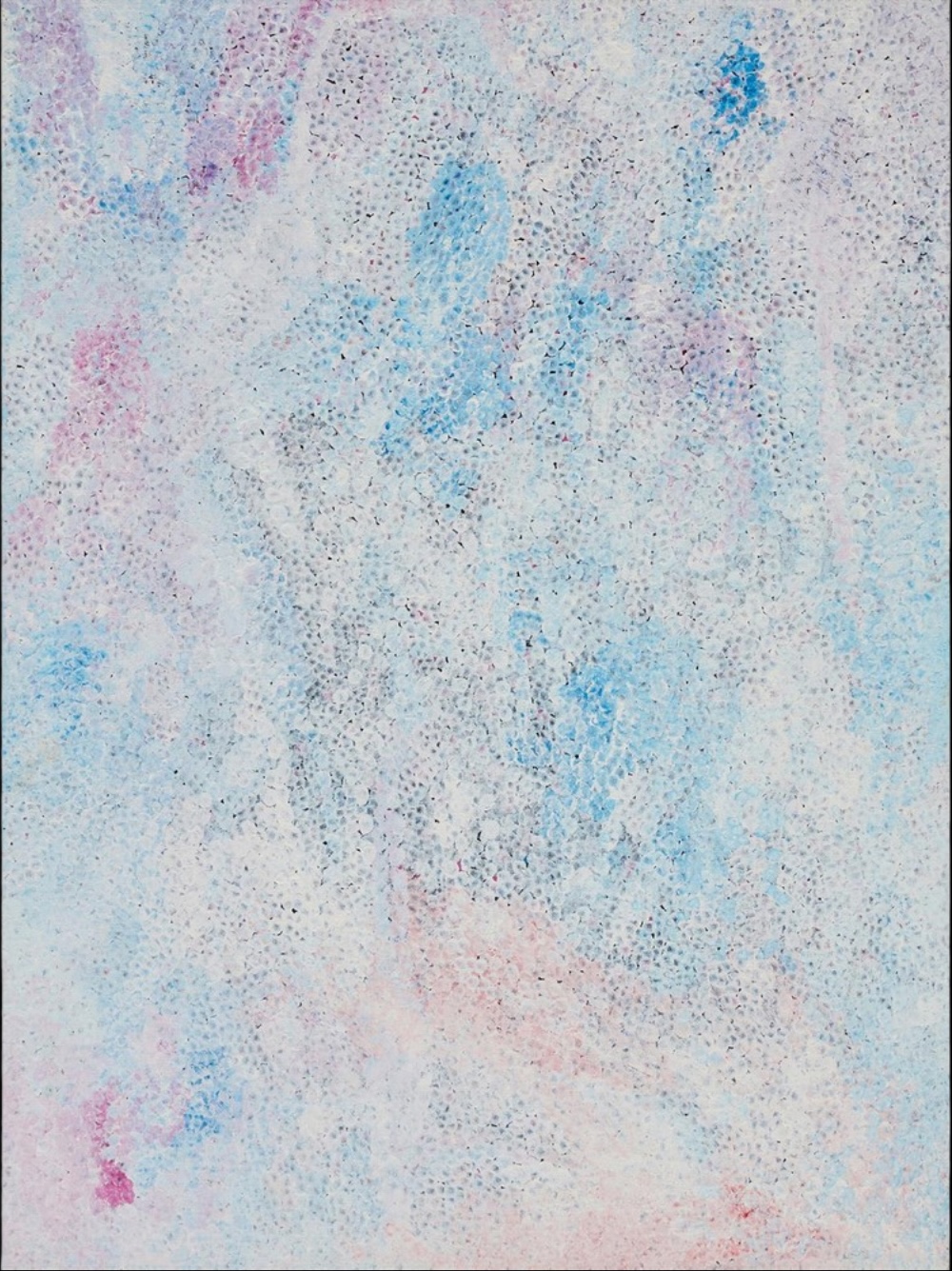
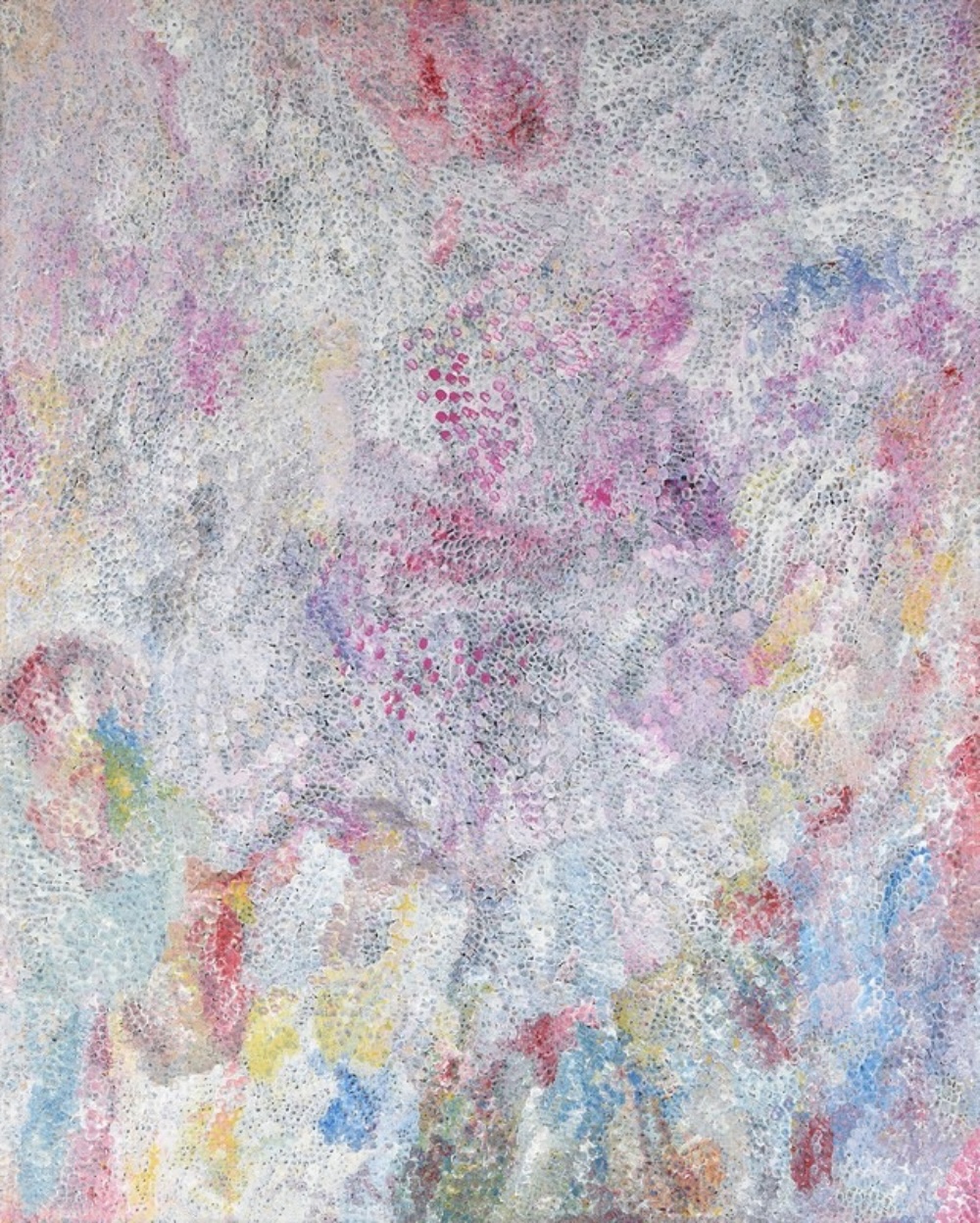
Kathleen Ngale developed one of Utopia’s most distinctive painting styles. Her mature canvases combine thousands of layered dots and brush marks into luminous fields of pink, white, lavender, blue and purple. Viewed closely, they reveal intricate individual marks; from a distance, they resemble clouds of colour floating across Country.
Her earliest acrylic paintings drew upon women’s ceremonial body-painting designs, or awelye, using relatively structured compositions. During the 1990s, she moved towards increasingly fluid arrangements and complex colour layering.
Kathleen applied pale pinks, creams and whites over richer reds, yellows, blues and purples, allowing earlier colours to remain visible. Art historian Professor Sasha Grishin identified this technique as central to her achievement, creating extraordinary depth and an illusion of vast space through variations in colour, density and transparency.
Individual marks suggest blossoms, seeds, grasses, dried leaves and ripening bush plums. Collectively, they evoke the immense landscapes of Arlperre Country.
Her technique remained varied. Alongside delicate dotting, she employed larger brush marks, sweeping colour and strong linear forms. A 2009 French auction catalogue also records her applying paint with a small stick. Her palette developed from restrained whites and muted tones towards increasingly vivid oranges, pinks, purples, blues and yellows.
Dr Marie Geissler distinguished Kathleen’s precise, controlled pointillism from the spontaneous, forceful gestures of Emily Kame Kngwarreye. Both evoked boundless Country through distinctly individual approaches.
Kathleen’s finest paintings transform apparently abstract colour into expressions of the flowers, fruits, vegetation, geography and ceremonial significance of her homeland.
Kathleen Ngale Painting Subjects
Anwekety — Bush Plum Dreaming
The great subject of Kathleen Ngale’s paintings was Anwekety, the Bush Plum or Conkerberry Dreaming associated with Arlperre Country. For Kathleen, the bush plum was more than a source of food. It was an ancestral inheritance whose continued flowering and fruiting were connected to the ceremonial responsibilities of its custodians.
The bush plum (Carissa lanceolata) produces small edible fruits that ripen to dark purple or black. Following sufficient rainfall, its white flowers and fruit can appear in abundance across parts of Central Australia.
Accounts of the Anwekety Dreaming from Utopia describe ancestral winds carrying bush plum seeds across Country. Where the seeds settled, plants grew, fruited and produced further seeds, spreading the bush plum throughout the landscape.
For Kathleen, this ancestral Country was also a living source of food. Knowledge of where the plants grew, when they fruited and how rainfall affected their abundance had helped sustain generations of her family.
Her paintings bring together this physical landscape with ancestral history, women’s ceremony and the continuing regeneration of the bush plum.
Singing the Bush Plum into Life
Kathleen believed women’s ceremonies helped maintain the fertility of the bush plum. Singing, dancing and body painting were not simply commemorations of ancestral events but were understood to encourage the plant’s continued growth and fruiting.
Kathleen and her sisters Polly and Angelina inherited ceremonial responsibilities for Anwekety. They decorated their bodies with ochre, sang ancestral songs and performed dances associated with the Bush Plum Dreaming.
Anthropologists Spencer and Gillen documented similar Central Australian beliefs in 1899, describing ceremonies intended to increase the abundance of particular plants and animals. Their accounts concerned different communities but demonstrate the wider belief in ceremony’s power to influence nature.
In drought-prone Arlperre Country, where heavy rains could transform the landscape into abundant bush-food grounds, maintaining this ancestral relationship was especially important.
Delmore Gallery records that Kathleen sometimes sang the Bush Plum Dreaming while painting, connecting her art directly with her inherited ceremonial knowledge.
How Kathleen Depicted the Bush Plum
Kathleen transformed her ancestral knowledge into luminous paintings of extraordinary colour and delicacy.
Thousands of overlapping marks evoke flowering bushes, ripening fruit, seeds and Arlperre Country. White dots suggest blossoms, while underlying pinks, purples, reds and yellows express seasonal change. Collectively, these marks convey the landscape’s abundance rather than representing individual plants.
Her paintings also incorporate knowledge of ancestral sites, food-gathering grounds and women’s ceremonial places, without functioning as conventional maps.
Her monumental Bush Plum Country (2008), measuring 199 × 297 cm, was a finalist in the Wynne Prize and subsequently loaned to Shepparton Art Gallery from 2008 to 2011.
Kathleen described her homeland:
“Pretty, pretty country, my country, all my country, Arlparra, bush plum, flowers, all the flowers, white flowers coming out now all over my country.”
Her paintings expressed not simply the beauty of desert vegetation but her enduring ancestral relationship with Country.
Kathleen Ngale’s Importance
Kathleen Ngale was one of Utopia’s outstanding painters, transforming the Bush Plum Dreaming into a distinctive artistic language recognised internationally. Her achievement demonstrated how ancestral knowledge could inspire innovative contemporary art without losing its cultural foundations.
Although Emily Kame Kngwarreye became Utopia’s most celebrated artist, Kathleen and her sisters Polly Ngale and Angelina Pwerle developed remarkably different interpretations of their shared Bush Plum Dreaming. Polly favoured expressive layers of colour, Angelina created shimmering surfaces of minute marks, while Kathleen achieved extraordinary depth through carefully controlled dots and translucent colour.
Kathleen’s particular contribution was the extraordinary subtlety of her paintings, which could evoke immense landscapes through delicate variations of colour and texture.
Her legacy lies in both her artistic originality and her role in establishing Utopia as one of Australia’s most important centres of contemporary Aboriginal art.
Awards, Exhibitions and Collections
Kathleen Ngale received significant recognition during her career, including:
- 2000 — Finalist, 17th National Aboriginal and Torres Strait Islander Art Award
- 2008 — Finalist, 25th National Aboriginal and Torres Strait Islander Art Award
- 2008 — Finalist, Wynne Prize for Landscape Painting, Art Gallery of New South Wales
Selected Exhibitions
- 1992 — Modern Art – Ancient Icon, World Bank, Washington DC
- 2001 — Bush Plum Dreaming, Indigenart, Perth
- 2002 — Two Sisters: Kathleen and Polly Ngal, Lauraine Diggins Fine Art, Melbourne
- 2002 — Australian Modern, Fondazione Mudima, Milan
- 2005 — Memory as Landscape, October Gallery, London
- 2006 — Senior Women of Utopia, GalleryG, Brisbane
- 2008 — Emily Kngwarreye and Her Legacy, Tokyo
- 2009 — Songlines XXI: Paintings from Utopia, Rebecca Hossack Gallery, London
- 2010 — The Ngal Sisters: Painting Country, Lauraine Diggins Fine Art, Melbourne
- 2017 — Utopia: The Artists of Delmore Downs, Yaama Ganu Gallery, Moree
- 2018 — Beyond the Veil, Olsen Gruin Gallery, New York
- 2020 — Polly Ngale & Kathleen Ngale: Bush Plum Dreaming, Japingka Gallery, Fremantle
- 2025 — The Ancient PRESENT II, FireWorks Gallery, Brisbane
Public Collections
Kathleen Ngale’s paintings are represented in major Australian public collections, including:
- National Gallery of Australia, Canberra — Bush Plum Flowers, 2004, and other paintings.
- National Gallery of Victoria, Melbourne — Wild Plum, 1998, and Anekwetj (Bush Plum), 2005.
- Queensland Art Gallery | Gallery of Modern Art, Brisbane — Bush Plum Country, 2006, and Untitled, 2010.
- Art Gallery of South Australia, Adelaide
- Art Gallery of Western Australia, Perth
Further Reading
- Dr Marie Geissler, Utopia in the Spotlight, 2025. Discussion of Kathleen’s painting style, cultural knowledge and relationship with Emily Kame Kngwarreye.
- Delmore Gallery, Kathleen Ngale (Kngale). Firsthand gallery account of her stylistic development and the cultural importance of the Bush Plum Dreaming.
- Queensland Art Gallery | Gallery of Modern Art, Untitled, 2010. Institutional interpretation of her painting and a recorded statement by the artist.
- Art Leven, Kathleen Ngal. Biography, awards, exhibitions and selected works.
- Neda Vanovac, ABC News, 2017. Reporting on Kathleen’s later life and the difficulties faced by elderly residents of the Utopia homelands.
All images featured in this article are presented strictly for educational and informational purposes.
This website may include copyrighted material for which specific authorization has not been obtained from the copyright owner.
All such images are presumed to be the intellectual property of the respective artist or their estate, and are used in accordance with principles of fair dealing or fair use under applicable copyright law.