
Maringka Baker: Biography, Painting Style and Importance
c. 1952
Pitjantjatjara
Kaliumpil, Western Australia
Irrunytju, Kata Ala and Kuru Ala
Kanpi, South Australia
Tjungu Palya
Acrylic on canvas and linen
Maringka Baker (born c. 1952) is a senior Pitjantjatjara Aboriginal artist and one of the most distinctive painters associated with APY Lands Art. Born at Kaliumpil rockhole in Western Australia, she began painting professionally in 2004 and became recognised for her intricate compositions, remarkable use of colour and powerful interpretations of ancestral Country.
Orphaned as a child, Maringka was raised by Anmanari Brown, a pioneering artist of the Irrunytju painting movement. Her paintings draw upon the desert Country of her childhood and important ancestral stories, particularly the Minyma Kutjara (Two Sisters) and Kungkarrakalpa (Seven Sisters) Tjukurpa.
Her work is represented in the National Gallery of Australia, National Gallery of Victoria and Seattle Art Museum. Her selection for Culture Warriors, the inaugural National Indigenous Art Triennial in 2007, brought national recognition just three years after she began painting professionally.
Maringka’s career connects two important Western Desert painting communities. Raised by Irrunytju Arts founder Anmanari Brown, she was closely associated with the artistic community of Tommy Watson and Wingu Tingima. She later settled at Kanpi with Douglas Baker, a relative of Jimmy Baker, and became a leading painter at Tjungu Palya. These relationships connect her to the family and artistic networks that shaped contemporary Pitjantjatjara painting.
In 2009, Maringka joined Wingu Tingima, Jimmy Baker and seven other artists in the Tjungu Palya Print Series, a collection of ten screenprints produced with Basil Hall Editions. The National Gallery of Australia subsequently acquired a complete folio, recognising the collective achievements of the Nyapari painting community
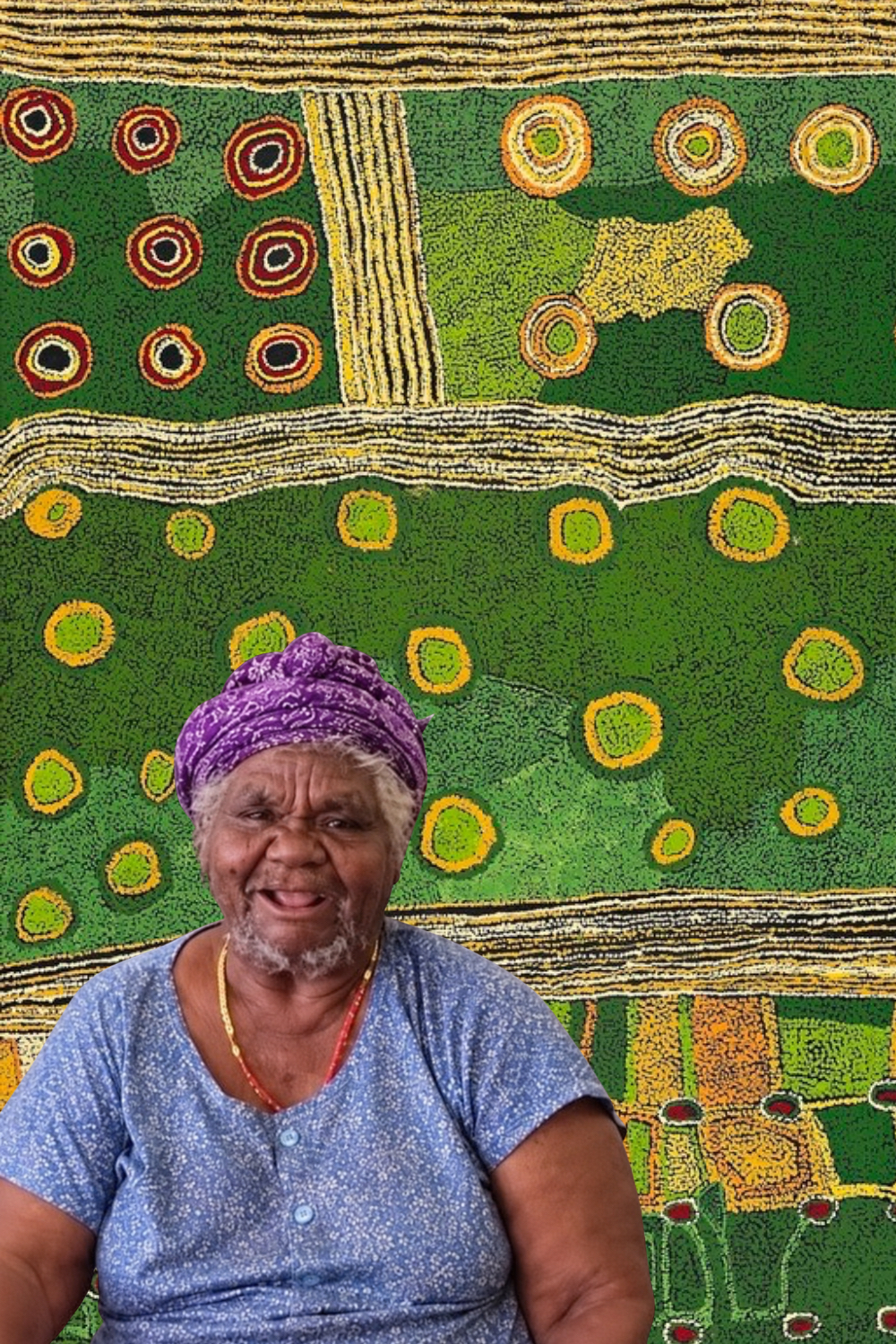
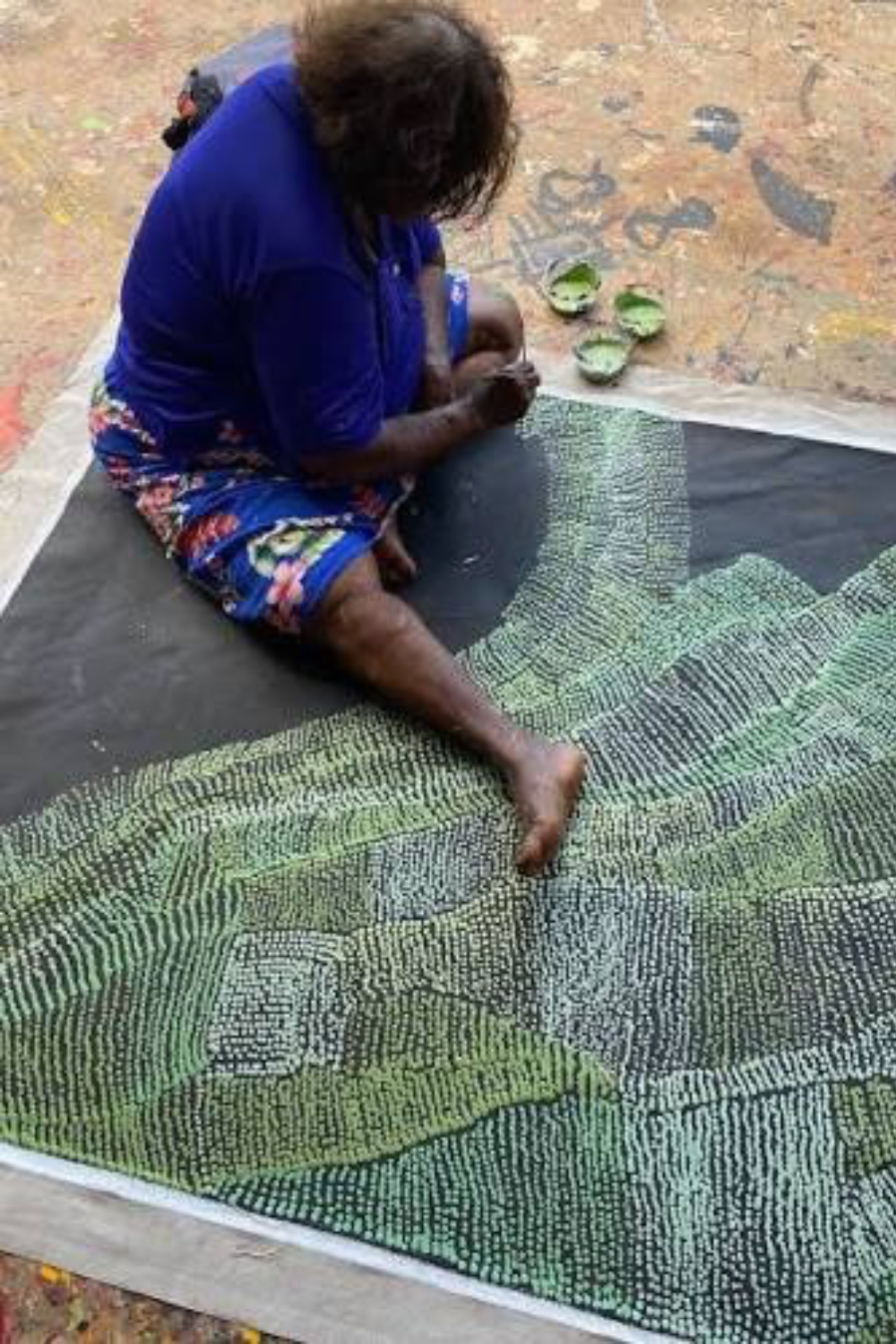
Maringka Baker Biography
Maringka Baker was born around 1952 at Kaliumpil, a rockhole and traditional camping place in Western Australia near the South Australian border.
She spent her early childhood travelling through the desert with her family, learning the locations of waterholes, seasonal food sources and places associated with ancestral Tjukurpa.
Both her parents died when she was young. She was subsequently raised by Anmanari Brown and her husband, together with members of their extended family.
Maringka recalled these experiences in the documentation accompanying her painting Kampurarpa Piti (2007):
“When I was a child I travelled around with the Brown family. My parents passed away when I was young and Anmanari and her husband looked after me.”
Maringka attended primary school at Warburton Mission in Western Australia. She later ran away with her brother to join relatives at Ernabella in South Australia.
She subsequently moved to Fregon (Kaltjiti), where she completed her education and began teaching. Later she obtained a qualification in community health and worked at the clinic at Irrunytju (Wingellina).
These experiences gave Maringka connections to several communities across the western APY Lands and adjoining Western Australian desert.
Becoming an Artist
Maringka began painting through Ninuku Artists in 2004, although her connections with the emerging painting movement at Irrunytju began earlier.
Around 2000, senior women at Irrunytju, including Anmanari Brown and Wingu Tingima, established a small enterprise selling second-hand clothes and bush medicines. Encouraged by Amanda Dent, their activities expanded into acrylic painting.
The early Irrunytju art movement also included Tommy Watson, whose paintings developed an entirely individual interpretation of Western Desert Country.
Following changes at Irrunytju, Amanda Dent and Brian Hallett helped establish Tjungu Palya at Nyapari, representing artists from Nyapari, Kanpi and surrounding communities.
Maringka became one of its principal painters.
Her recognition came remarkably quickly. By 2006 she was exhibiting in Melbourne, and the following year her paintings appeared in Culture Warriors at the National Gallery of Australia.
Maringka belonged to a generation of senior Pitjantjatjara painters who began working in acrylics comparatively late in life, bringing decades of cultural knowledge to a new artistic medium.
Maringka Baker Painting Style
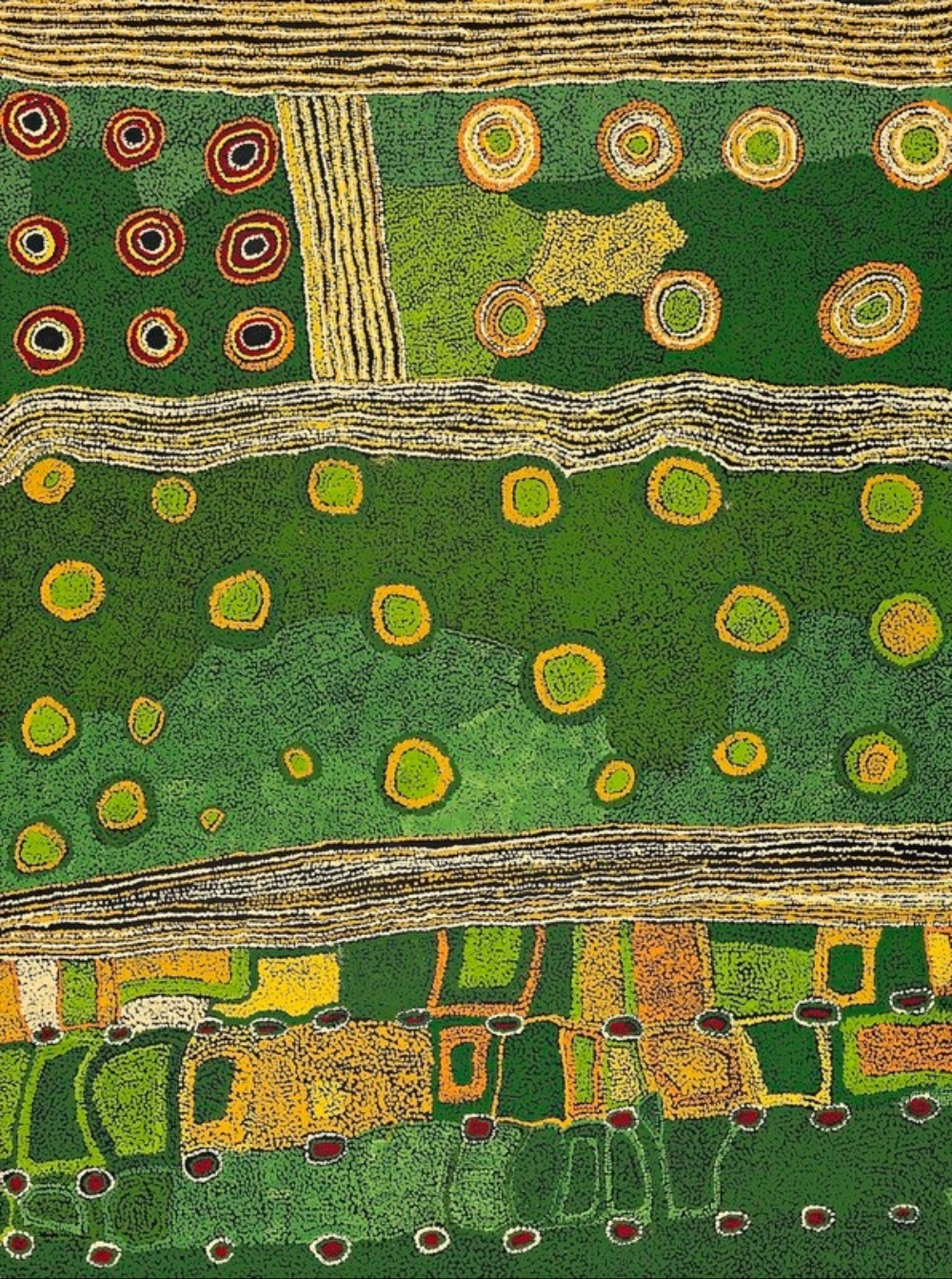
Maringka Baker developed a distinctive style characterised by luminous colour, intricate dotting and complex arrangements of circles, flowing bands and irregular geometric shapes.
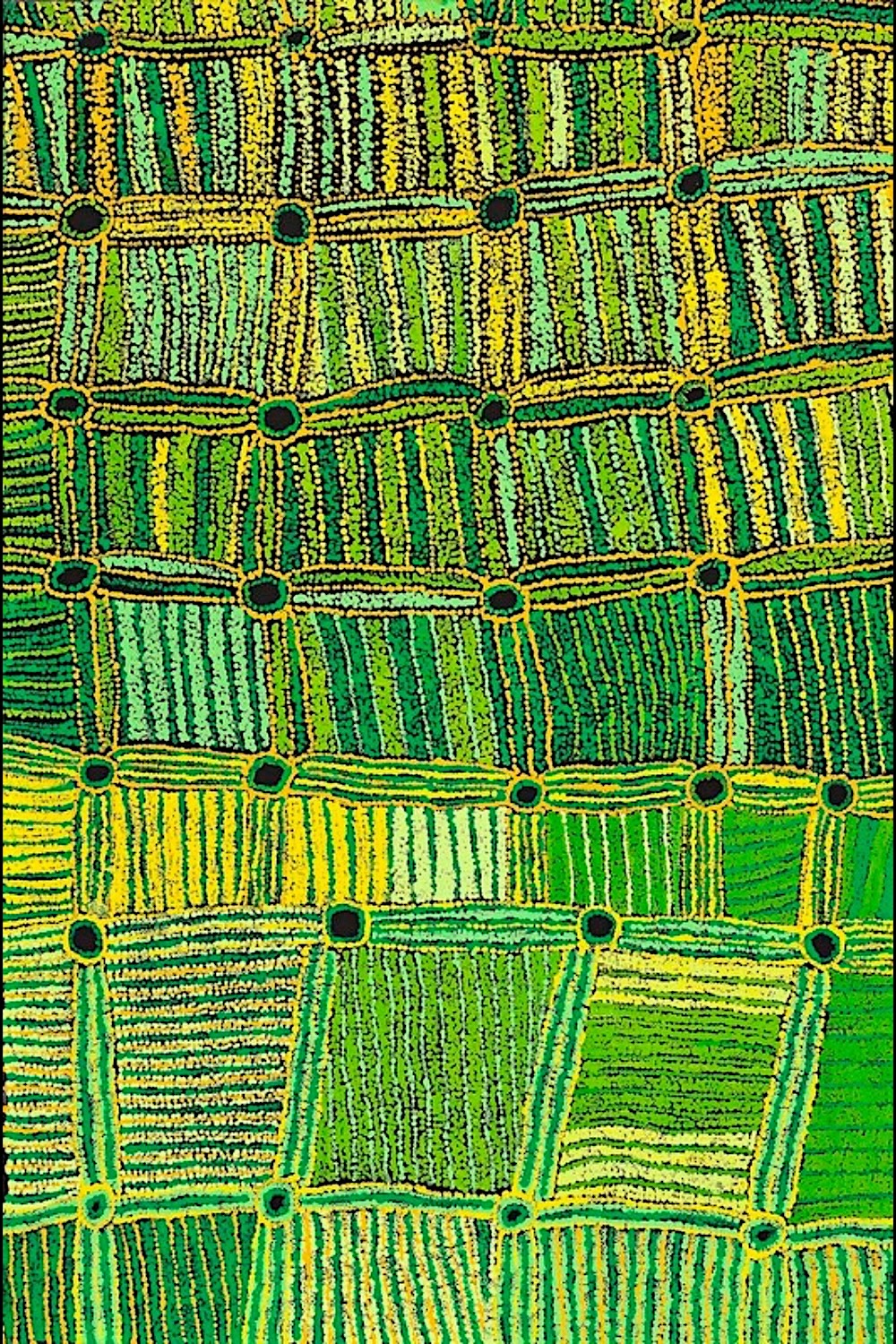
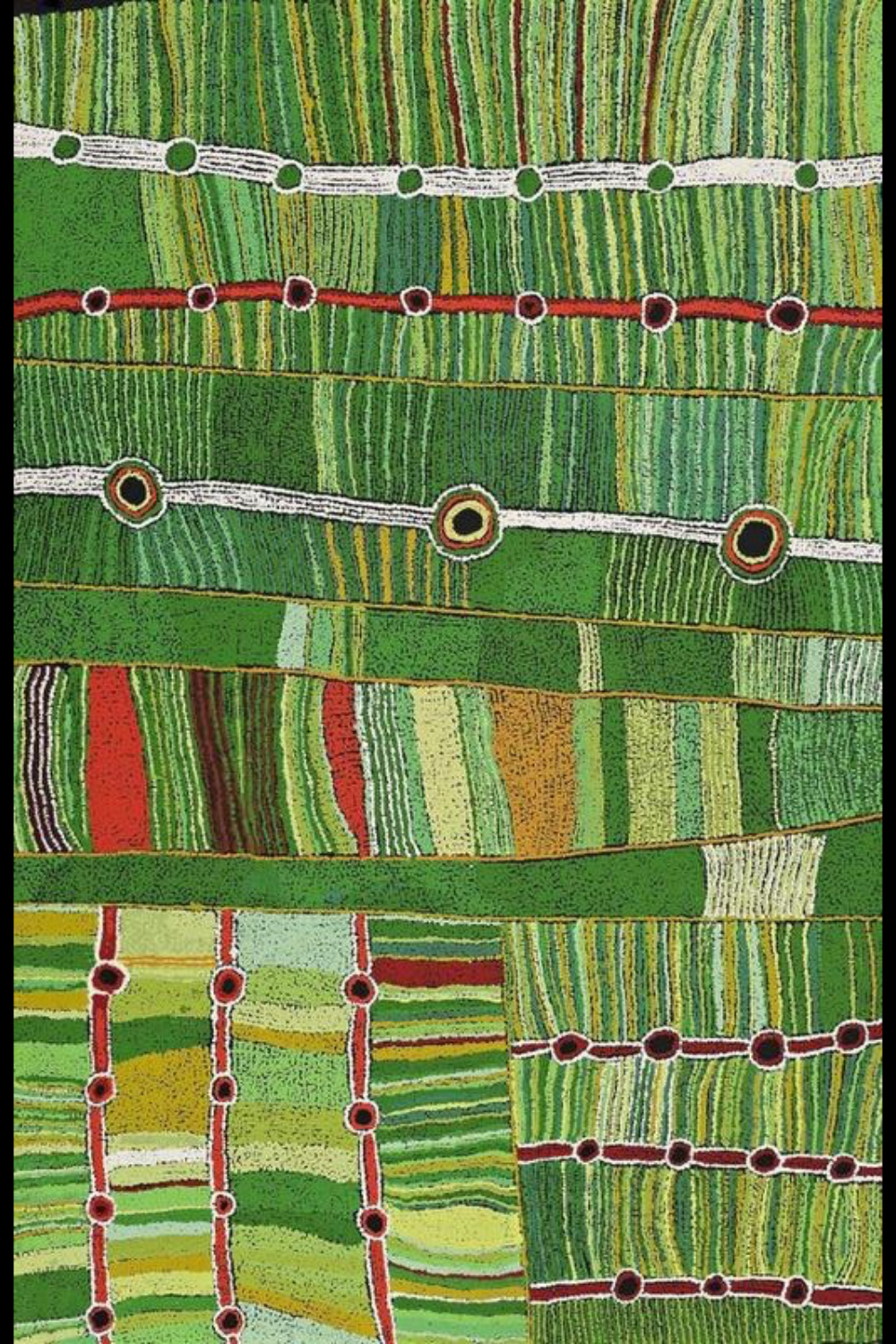
Many of her early paintings feature brilliant greens, yellows and whites contrasted with red ochre and black. Thousands of closely spaced dots accumulate into broad fields of colour, while circular forms mark important places within the ancestral landscape.
Green became particularly associated with her early work. Rather than presenting the desert as permanently dry, some paintings evoke Country transformed by rain, when grasses and other vegetation flourish around waterholes.
Art historian Christine Nicholls has highlighted Maringka’s unusual command of colour and spatial relationships. Darker passages appear to recede while brighter areas advance, producing a striking sense of depth.
Her compositions often divide the canvas into interconnecting areas, suggesting the relationships between rockholes, ceremonial places and ancestral journeys.
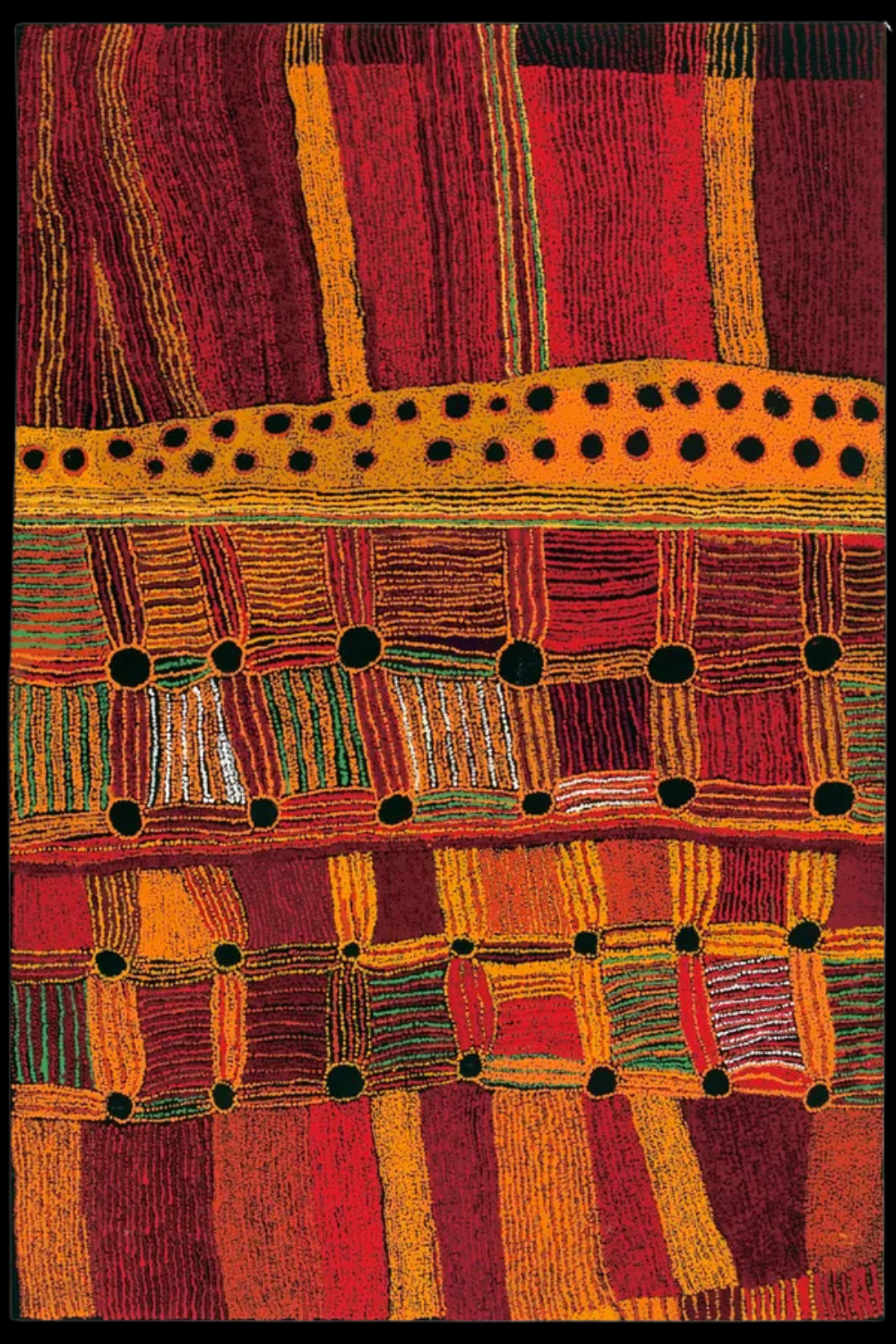
Over time, Maringka developed increasingly fluid compositions. Later paintings frequently employ deep reds, purples, aubergines and expanses of black, alongside passages of delicate dotting.
Painting as a Journey Through Country
Liz Bird, who managed the Tjungu Palya studio between 2016 and 2019, provided an illuminating account of Maringka’s working methods.
Before beginning a painting, Maringka would contemplate the Tjukurpa she intended to depict and consider her position in relation to the canvas.
She then began travelling mentally through Country, allowing the composition to develop as she moved between remembered ancestral places.
Sometimes she sang quietly or conversed with other artists. Her painting stick moved rapidly through some passages, while others developed slowly through layers of densely accumulated marks.
Bird observed that this process remained consistent whether Maringka worked on a small canvas or a monumental painting.
Her compositions therefore developed through a process of remembering and mentally traversing Country, rather than simply copying a predetermined design.
Maringka Baker Painting Subjects and Meaning
Maringka’s paintings describe particular places, ancestral journeys and ceremonial knowledge. Although several subjects belong to interconnected traditions, individual paintings frequently concern different episodes and locations.
Minyma Kutjara – The Two Sisters Dreaming
Minyma Kutjara Tjukurpa, the creation story of the Two Sisters, is one of Maringka’s most important subjects.
The narrative concerns an older sister travelling with her younger sister towards their homeland around Kaltukatjara (Docker River).
The younger sister had been separated from her family and had lived for a long time with another group near the ocean to the south.
As they travelled north through unfamiliar Country, she became frightened and reluctant to continue.
Her older sister comforted her, carried her on her back and taught her about the places through which they travelled.
The sisters stopped at significant locations, including Punuwara and Irrunytju rockhole, where they performed inma, ceremonial singing and dancing.
The story concerns family reunion, protection and the transmission of knowledge between generations of women.
In Maringka’s paintings, their journey unfolds through rockholes, vegetation, campsites and ceremonial places.
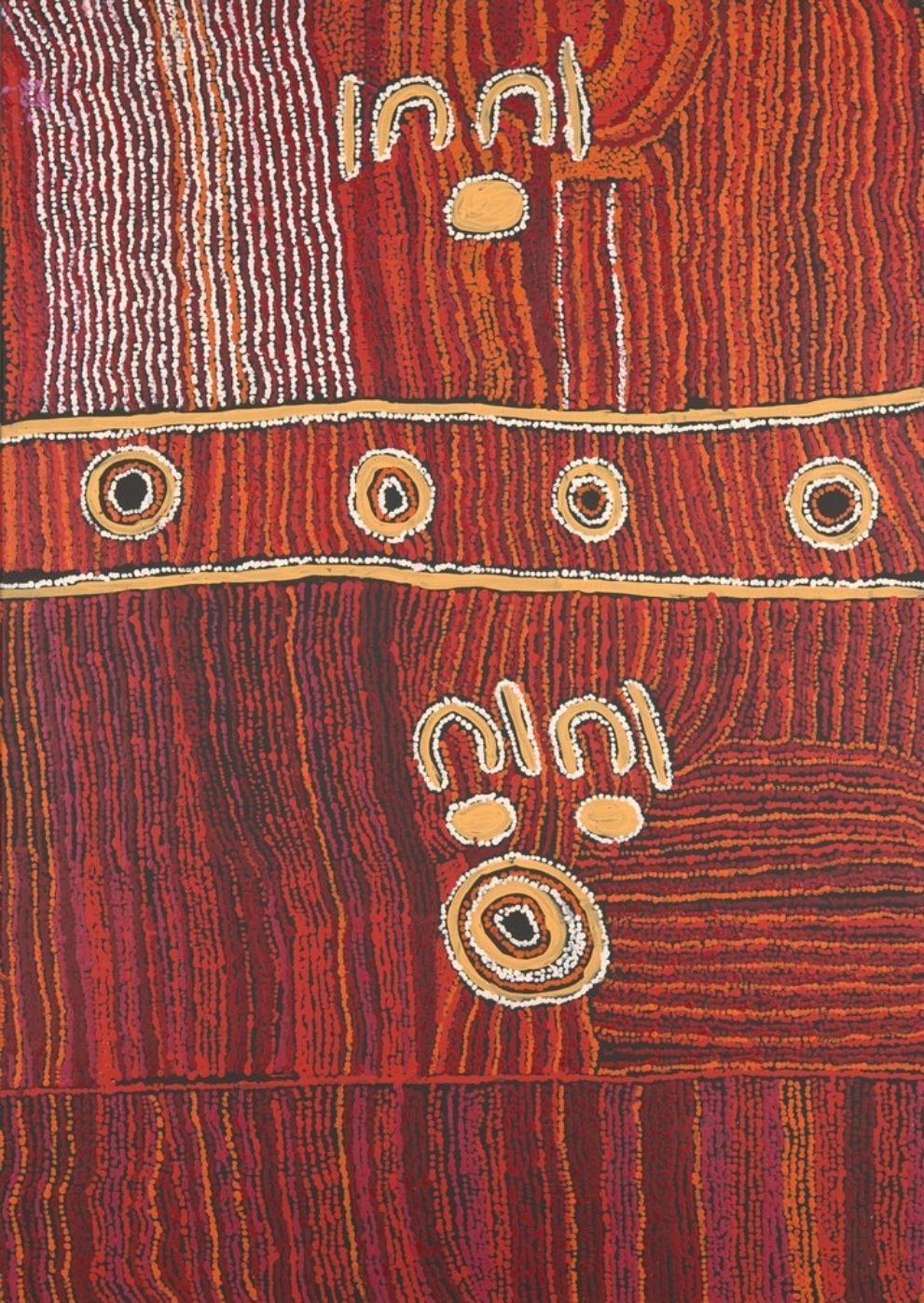
Kuru Ala – The Seven Sisters Dreaming
Kuru Ala is an important women’s ceremonial place associated with the Seven Sisters Dreaming.
The Kungkarrakalpa Tjukurpa describes ancestral women travelling across extensive areas of the Western Desert while pursued by Wati Nyiru, a male ancestral being.
Their journeys established places and ceremonial relationships across Country.
Maringka holds custodial knowledge associated with Kuru Ala, a location in Western Australia near Tjuntjuntjarra.
Her paintings describe the creeks, rockholes, rocky hills, trees and ceremonial places associated with this Country.
In Kuru Ala (2007), acquired by the National Gallery of Australia, brilliant ribbons of green, yellow, red, orange and white dots flow between dark circular forms.
The National Gallery identifies the black circles as waterholes, although these places also carry significance through the ancestral events associated with them.
Maringka explained:
“This is Kuru Ala. These are creeks and rock holes everywhere, and many trees.”
She identified the painting as representing the Seven Sisters creation story.
Maringka was not the only important artist to paint Kuru Ala. Wingu Tingima, who was born near the site, repeatedly painted its relationship to the Seven Sisters Tjukurpa. Tjungkara Ken also developed a major body of Seven Sisters paintings through her own inherited knowledge of Country. Their works reveal how a single ancestral journey could be interpreted through different places, custodial relationships and painting styles.
Pukara – The Two Ancestral Water Serpents
Pukara is associated with Wati Kutjara Tjukurpa, the story of two ancestral serpent men.
In Maringka’s account, the two wanampi, a father and son, travel between rockholes around Irrunytju and Wingellina.
Their journey takes them from Pukara towards Kuru Ala and Nyumu.
Maringka’s paintings include sandhills, trees, grasses and waterholes associated with these ancestral travels.
Some works also depict the transformation of desert vegetation following rain.
Her painting Pukara (2009), measuring approximately 118 × 200 cm, entered the National Gallery of Victoria through the Felton Bequest in 2011.
Wanampi and ancestral water serpents also appear prominently in the paintings of Tiger Palpatja and Jimmy Baker. Palpatja was particularly associated with Wanampi at Piltati, while Jimmy Baker painted Piltati and Wanampi Kutjara. These paintings should not be understood as interchangeable versions of a single story: each artist’s knowledge was grounded in particular ancestral journeys, places and responsibilities.
Kampurarpa Piti – Desert Raisins and Childhood Memories
Kampurarpa Piti is another place associated with Maringka’s childhood in Western Australia.
The surrounding Country contains extensive sand dunes and areas where women collected kampurarpa, or desert raisins.
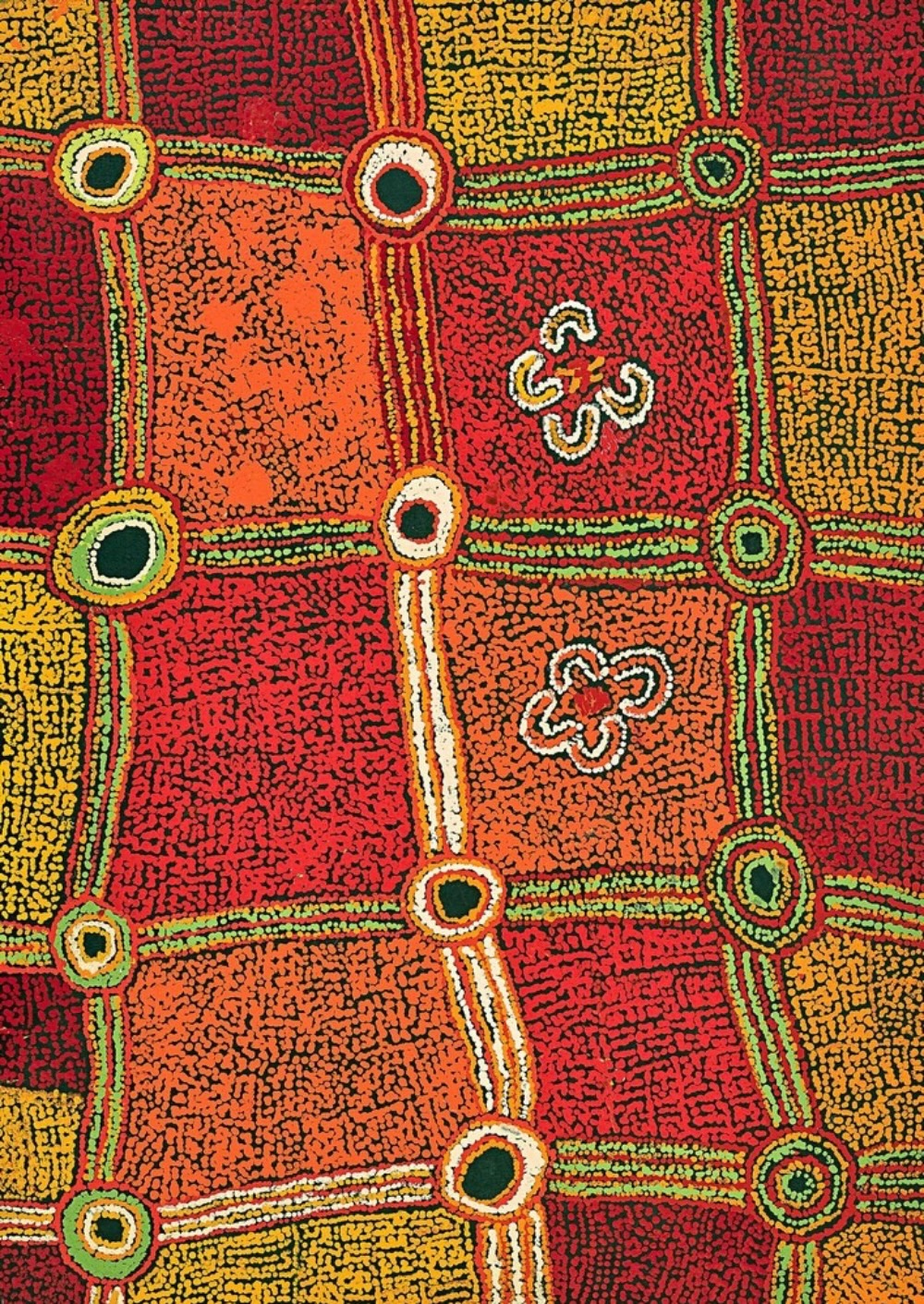
In her painting Kampurarpa Piti (2007), Maringka depicts women gathering fruit and the footprints of a dingo moving across the landscape.
The accompanying artist statement also records her experiences travelling with Anmanari Brown’s family after the deaths of her parents.
The work is particularly interesting because it incorporates bush-food gathering, remembered family experiences and specific knowledge of the physical landscape.
Anmangunga – Her Mother’s Country
Anmangunga is associated with Maringka’s mother’s Country near Watarru in South Australia.
Maringka also remembered camping and playing there during childhood.
Her painting Anmangunga (2006) concerns ancestral female dingoes, described as papa kungka, or girl dogs.
These are creation beings associated with the Country rather than ordinary animals.
The painting combines Maringka’s maternal connections with knowledge of a particular ancestral narrative.
Anmangunga was acquired by the Art Gallery of South Australia in 2006 and subsequently included in Culture Warriors.
Maringka Baker Value and Auction Results
Maringka Baker has an established secondary market, although auction prices vary according to size, quality, date, subject, condition and provenance.
Works Offered at Auction:28
Sale Rate: 79%
Highest Sale: $40,000 AUD
Median Sale Price: $8,000 AUD
Maringka Baker’s Importance in Aboriginal Art
Maringka Baker emerged during the rapid expansion of contemporary painting in the western APY Lands during the early 2000s.
Her distinctive compositions helped establish Tjungu Palya’s reputation for innovative painting by senior Pitjantjatjara artists.
Her inclusion in the National Gallery of Australia’s Culture Warriors exhibition in 2007 was an important early achievement. Works such as Kuru Ala (2007) and Ngura Mankurpa (2006) demonstrated her remarkable handling of colour.
Her Minyma Kutjarra (2009) was included in Ancestral Modern: Australian Aboriginal Art from the Kaplan & Levi Collection, organised by the Seattle Art Museum and subsequently shown at other North American institutions.
In 2018, Maringka was a finalist in the Wynne Prize and received the Members Choice Award at the Athenaeum Club 150 Art Award in Melbourne.
A 2022 survey exhibition at Vivien Anderson Gallery traced the development of her painting practice, from early compositions dominated by brilliant greens to the more fluid and varied colour arrangements of her later career.
Her importance lies in the combination of an unmistakable individual painting style with detailed knowledge of ancestral Country, and in the continuation of those traditions through younger members of her family.
Maringka Baker in Public Collections
Maringka Baker’s paintings are represented in several important Australian and international collections.
Further Reading
- National Gallery of Australia.Culture Warriors: National Indigenous Art Triennial, 2007.
- Vivien Anderson Gallery.Maringka Baker — A Survey, 2022.
- Art Gallery of South Australia. Collection record for Anmangunga (2006).
- National Gallery of Victoria. Collection record for Pukara (2009).
- Seattle Art Museum. Collection record for Minyma Kutjarra (2009).
- Deutscher and Hackett. Auction catalogues and associated Tjungu Palya artist statements.
All images featured in this article are presented strictly for educational and informational purposes.
This website may include copyrighted material for which specific authorization has not been obtained from the copyright owner.
All such images are presumed to be the intellectual property of the respective artist or their estate, and are used in accordance with principles of fair dealing or fair use under applicable copyright law.