
Jack Dale Mengenen: Biography, Wandjina Paintings & Kimberley History
c.1920–2013
Ngarinyin
Komaduwah clan
Imintji / Mount House Country, West Kimberley
Derby / Imintji
Wandjina Art / Kimberley Art
Ochre and acrylic painting
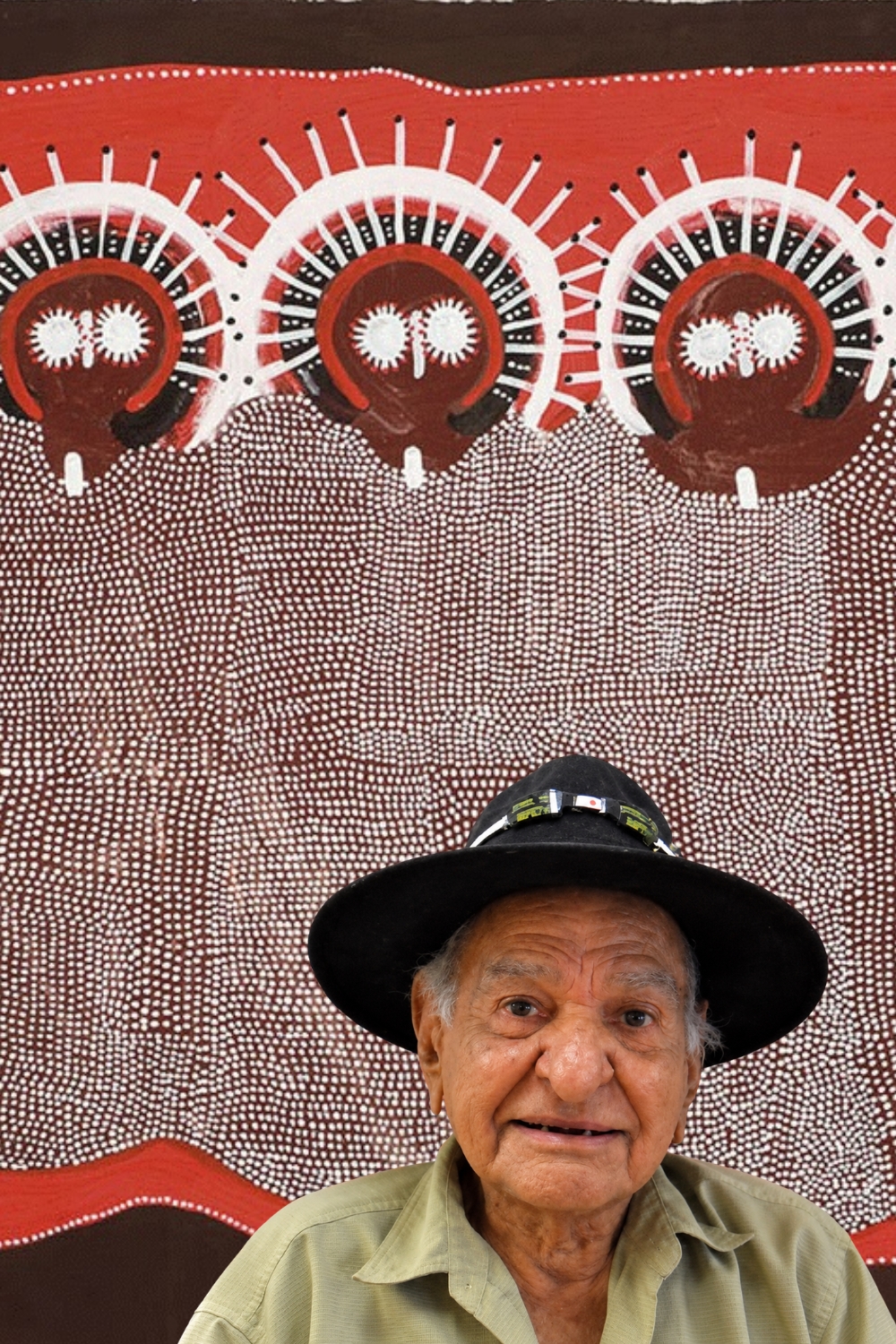
Jack Dale Mengenen (c.1920–2013) was a senior Ngarinyin Elder, Lawman, stockman and artist whose paintings bring together ancient Wandjina traditions and the turbulent history of the twentieth-century Kimberley. Born near Mount House Station in Western Australia, he lived through enormous change and painted from both inherited cultural knowledge and personal experience.
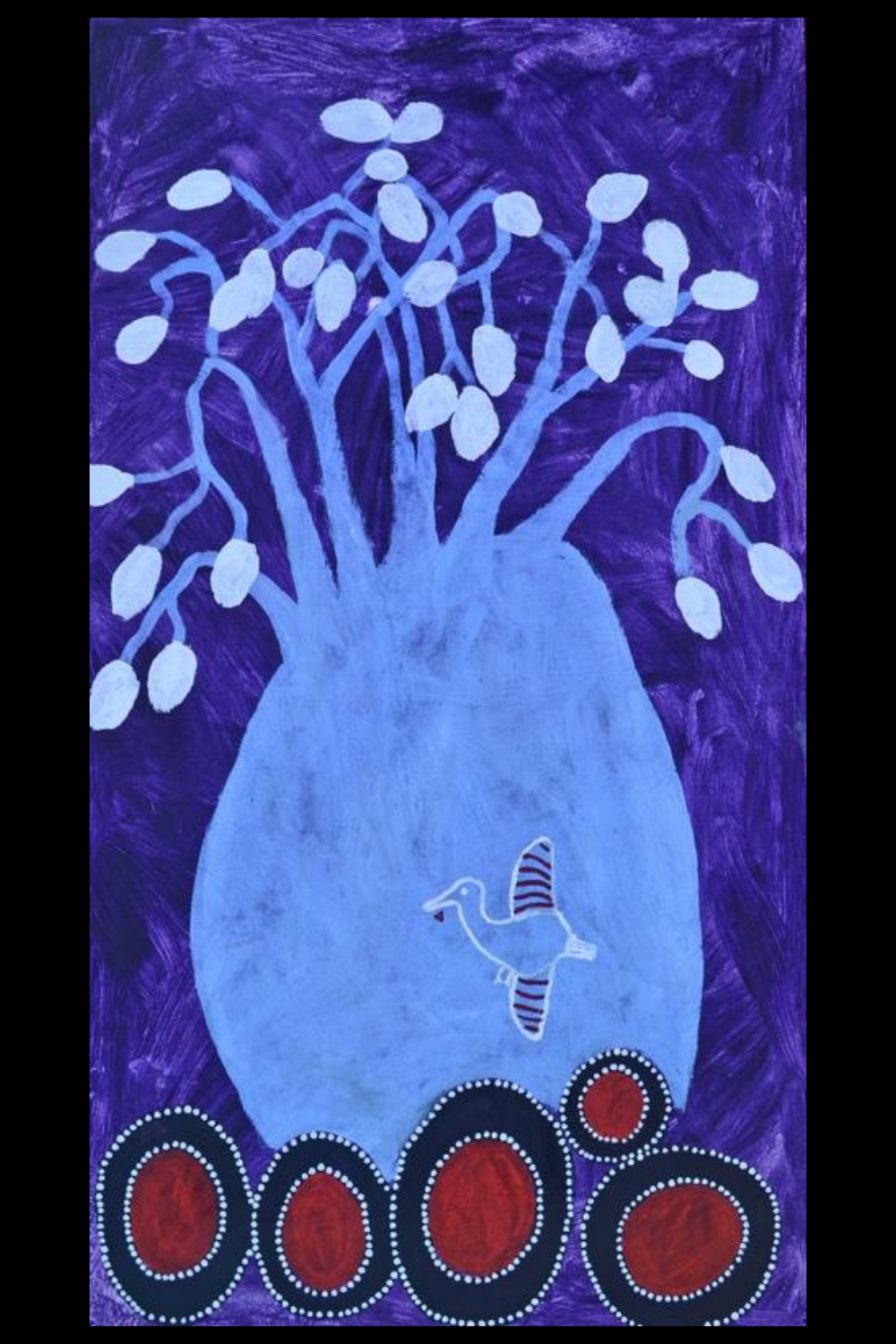
Dale began painting seriously late in life, after decades working as a stockman and bushman. His powerful Wandjina paintings relate to particular ancestral beings, clan estates and sacred places for which he held cultural knowledge. His equally distinctive historical paintings depict Aboriginal prisoners in chains, police, pastoral expansion, donkey wagons, stockmen, missionaries, boabs and aircraft.
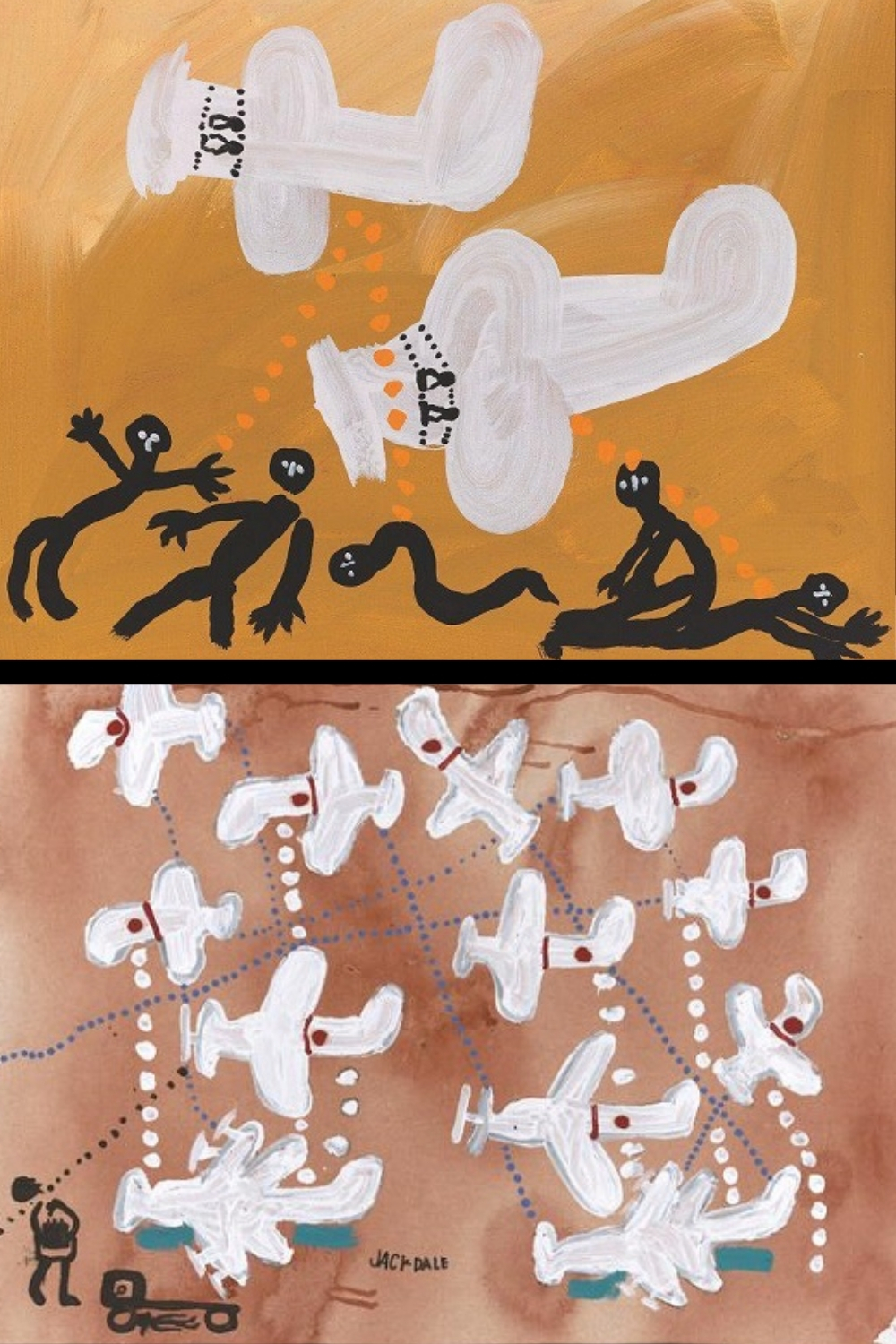
Much of this history Dale had witnessed himself. He remembered chained Aboriginal prisoners, police patrols, early pastoral life and Afghan cameleers, and was present during the Japanese bombing of Broome in 1942. His paintings are therefore more than representations of the Kimberley: they preserve the cultural knowledge, history and memories of a man whose own life spanned nearly a century of extraordinary change.
For additional artworks values dimensions and provenance you are referred to the Jack Dale Mengenen value support page
Jack Dale Mengenen Biography
Jack Dale Mengenen was born near Mount House Station in the West Kimberley around 1920–1922. His mother was Ngarinyin and his father, Jack Dale senior, a Scottish frontiersman.
His childhood reflected the difficult meeting of Aboriginal and European cultures. Accounts describe his father as violent, once shooting Dale in the leg to stop him running away, while his mother tried to keep the boy away from him.
After his father’s death, Dale returned to his mother’s family. His grandfather instructed him in Ngarinyin Law, ceremony, Country and Narrungunni. Dale became a respected Elder and Lawman with extensive knowledge of Wandjina places and the traditions of his people.
His Country centred on Imintji and the Mount House region, a landscape fundamental to his later art.
As a young man Dale witnessed events he would eventually paint: police patrols, the removal of Aboriginal children and prisoners marched in chains. He also remembered Afghan cameleers and the expansion of pastoral settlement through Aboriginal Country.
For most of his adult life, Dale was a stockman and bushman, eventually becoming a highly regarded head stockman. Working across the Kimberley gave him intimate knowledge of its ranges, tracks, water places, stations and communities.
On 3 March 1942, Dale was in Broome tending cattle awaiting shipment when Japanese aircraft attacked. He recalled sheltering beneath a truck during the raid, in which his friend Jim Kelly was killed.
Seventy years later he recorded the event in Japanese Zeros Attacking Dutch Seaplanes – Roebuck Bay 1942, 2012, now held by the Australian War Memorial.
Dale began painting seriously in the 1990s, already an elderly man. He also made large ceremonial boards used by dancers in Dreaming performances. Painting became a means of recording both his cultural knowledge and lived history.
His public career lasted roughly fifteen years. Heart problems eventually interrupted his work, although he returned to painting before his death in 2013.
Jack Dale Mengenen Painting Style
Jack Dale’s paintings have a bold, direct and highly individual visual language. Human figures, Wandjina, animals, boab trees, horses, wagons and aircraft are often reduced to strong outlines and simplified forms against relatively open backgrounds.
His historical paintings can appear almost diagrammatic. Dale was less concerned with conventional perspective than with showing who was there, where they travelled and what happened. Figures and objects are positioned according to the story, allowing complicated events to be communicated with remarkable economy.
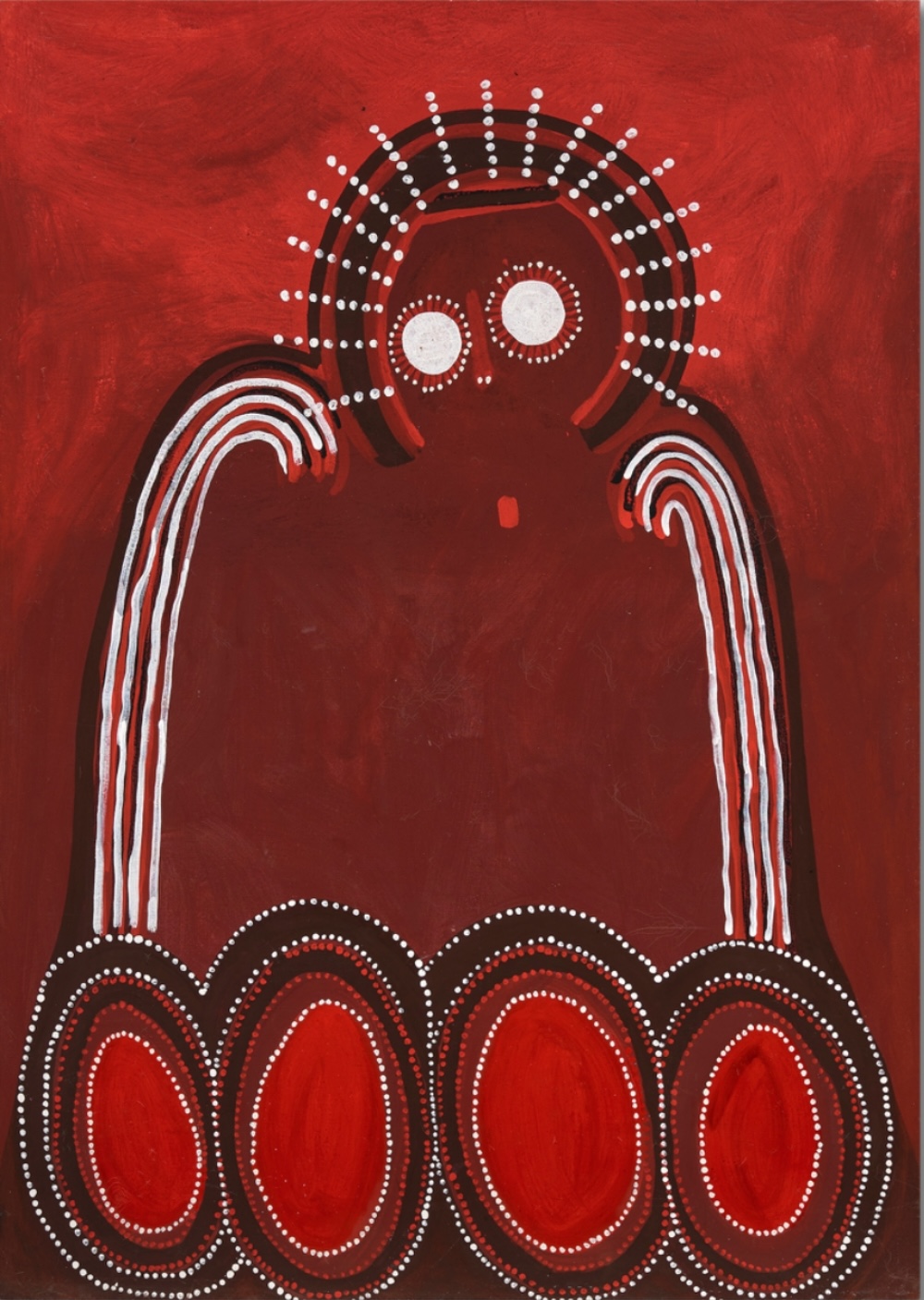
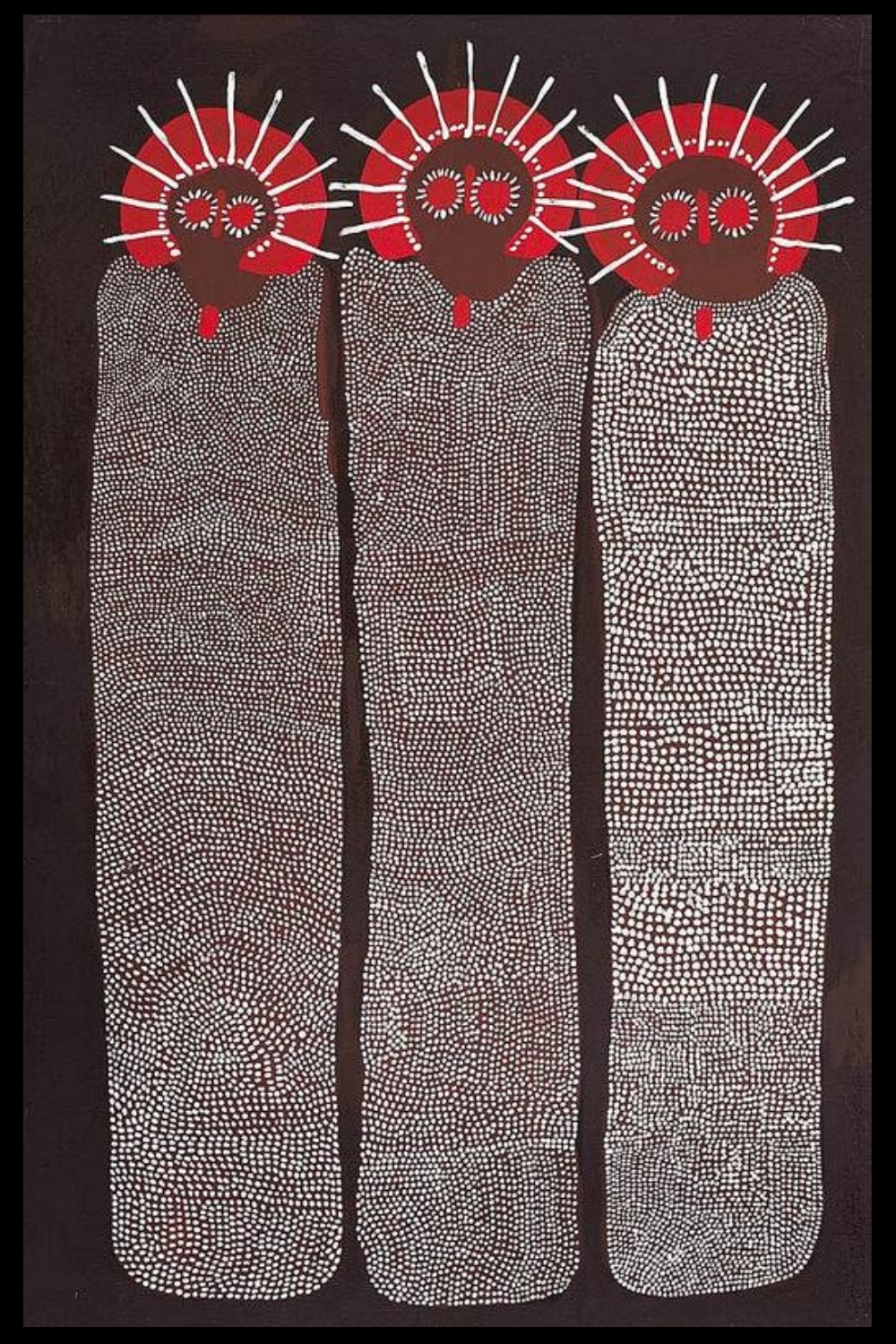
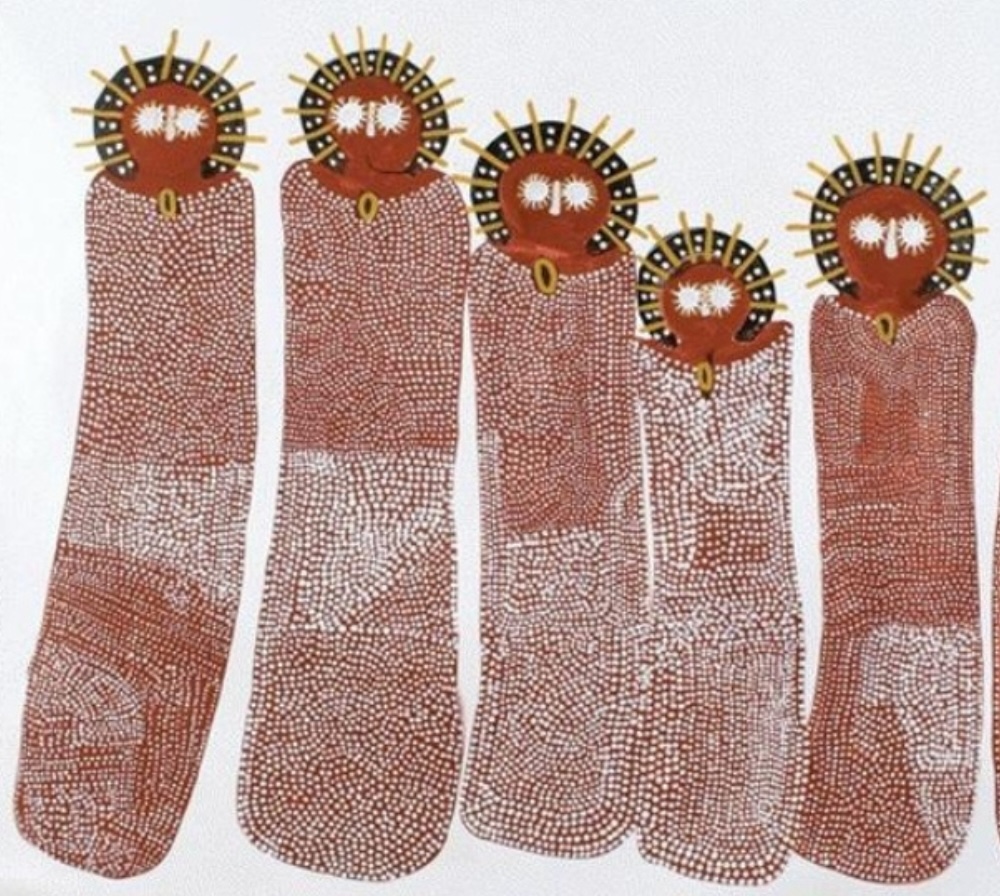
His Wandjina paintings are particularly distinctive. Like the Wandjina of Charlie Numbulmoore and Waigin Djanghara, Dale’s figures often have large, round eyes that dominate the face. When shown full-bodied, however, Dale’s Wandjina frequently have no separate legs. Instead, the body extends downward as a long, broad form, sometimes widening towards the base and sometimes remaining almost equal in width throughout.
These elongated bodies are commonly covered with hundreds of fine dots associated with falling rain. Importantly, the dotting is often not uniform. Dale deliberately organised dots into denser and more open fields, bands and patches, creating internal patterns across the body. This gives otherwise simple monumental forms considerable surface movement.
The ancestral beings usually appear frontally, with rounded faces surrounded by radiating halo-like forms. Dale explained their characteristic absence of mouths through their association with rain: giving a Wandjina a mouth risked allowing the heavens to open and the rain to continue without end.
Dale worked with natural Kimberley earth pigments as well as acrylic and synthetic polymer paints, sometimes combining them. Ochres produced earthy reds, browns, yellows, blacks and whites, while synthetic paints allowed stronger and brighter colour.
Despite their apparent simplicity, Dale’s images are often highly specific. Individual Wandjina refer to particular beings, places, family relationships and ceremonial knowledge, while his figurative paintings record particular journeys, locations and historical events.
Jack Dale Mengenen Painting Subjects
Wandjina, Country and Ceremony
Wandjina are the central ancestral figures in Jack Dale’s art, but his paintings are not simply representations of a generic Kimberley Wandjina tradition. Dale painted particular Wandjinas connected with specific places, clan estates, family relationships and ceremonial knowledge.
His Wandjinas at Iondra, 2006, depicts Wandjinas associated with rock shelters at Iondra in the Komaduwah clan estate. Dale described these ancestral images as evidence of his people’s connection to and ownership of the land. He recalled travelling extensively through this Country on foot and described Iondra as a proper Dreaming place.
Other paintings identify Wandjinas associated with Minjil Ridi near Mount House and Imintji, Albert Point and Beverley Springs. A 2004 work specifically depicts Wandjinas belonging to his mother’s clan.
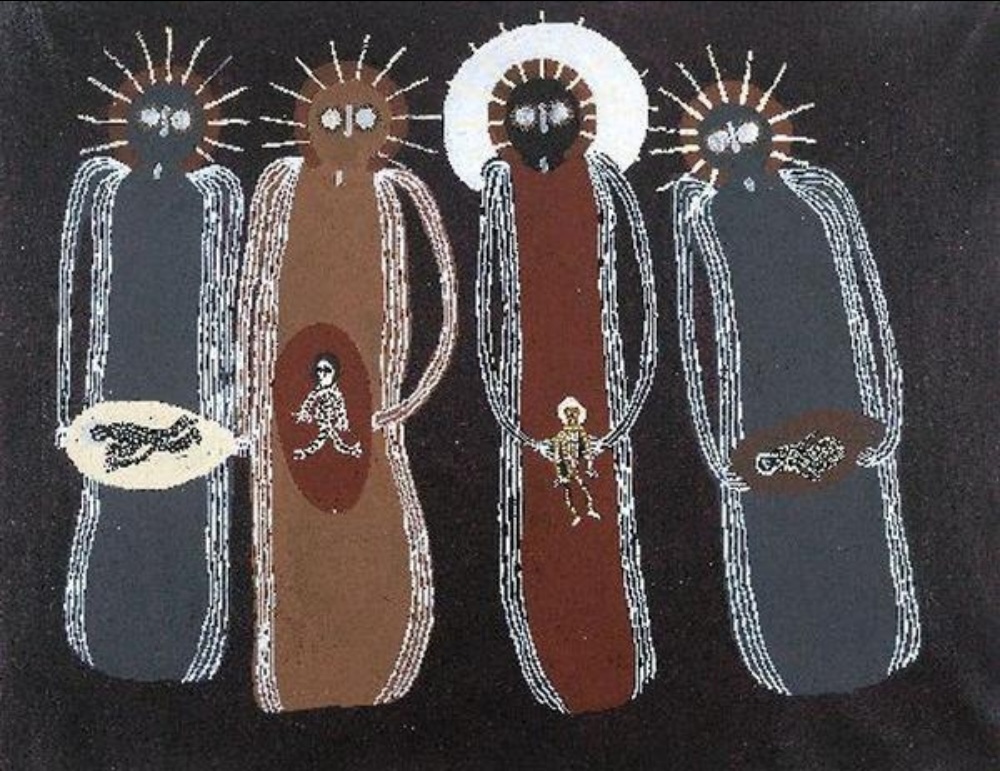
Baby Dreaming and Wungud form another important group. In Male Wandjinas – Baby Dreaming, 2006, initiated male Wandjinas carry babies associated with the sacred waterhole at Wuni-Ari-Wungud. The accompanying account describes babies travelling with the tide from the sea to the waterhole, where they wait for prospective parents. Women visit Wungud to dream about babies.
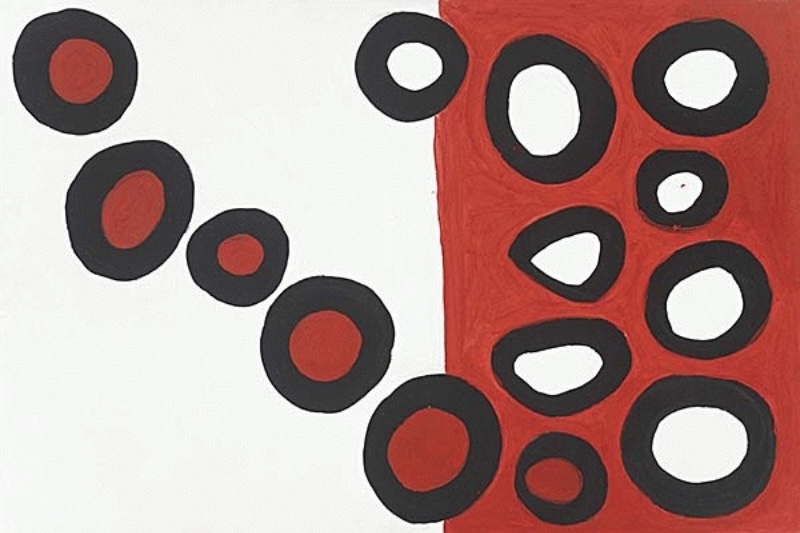
Dale also repeatedly painted Djalala or Jalala, described as marking or proof stones associated with Wandjina places. They appear alongside Wandjina and as subjects in their own right, including the monumental Djalala Stones (Proof Stones), 2006, measuring 163 × 313 cm. His Map of Country – Land Rights, 2007, makes the relationship between ancestral beings, landscape and ownership of Country particularly explicit.
Ceremony was equally connected to this cultural world. As a senior Lawman, Dale produced large ceremonial boards used by dancers in performances of Dreaming narratives, while paintings such as Ceremony Men, 2001, and Djunba Dancers, 2007, record ceremonial subjects directly.
Kimberley History and Personal Memory
The other great strand of Jack Dale’s art is Kimberley history. He painted Aboriginal prisoners, police, chain gangs, massacres, pastoral labour, missionaries, cattle stations, horses, donkey wagons, cameleers, boabs, trucks and aircraft. Some subjects belonged to collective historical memory; others came from events he had personally witnessed.
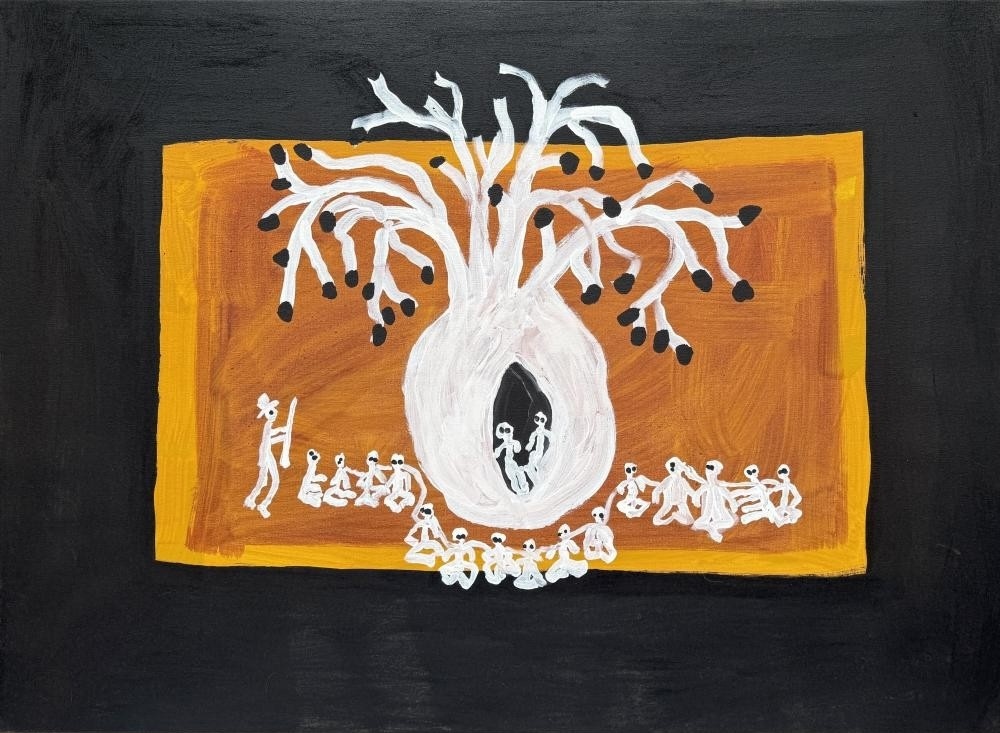
Aboriginal prisoners and chains are among his most confronting subjects. Dale remembered seeing Aboriginal men marched in chains and repeatedly returned to this history in paintings such as Prison Tree & Chained Men, Prison Tree Derby and Boab Prison Tree Derby. His simplified figures give these works a striking directness: people, chains, police and landscape contain everything necessary to tell the story.
Pastoral life was more complicated because it was also Dale’s own world. Horses, cattle, stockmen, camps and journeys reflect his long working life as a Kimberley stockman and record the contribution of Aboriginal workers to the pastoral industry.
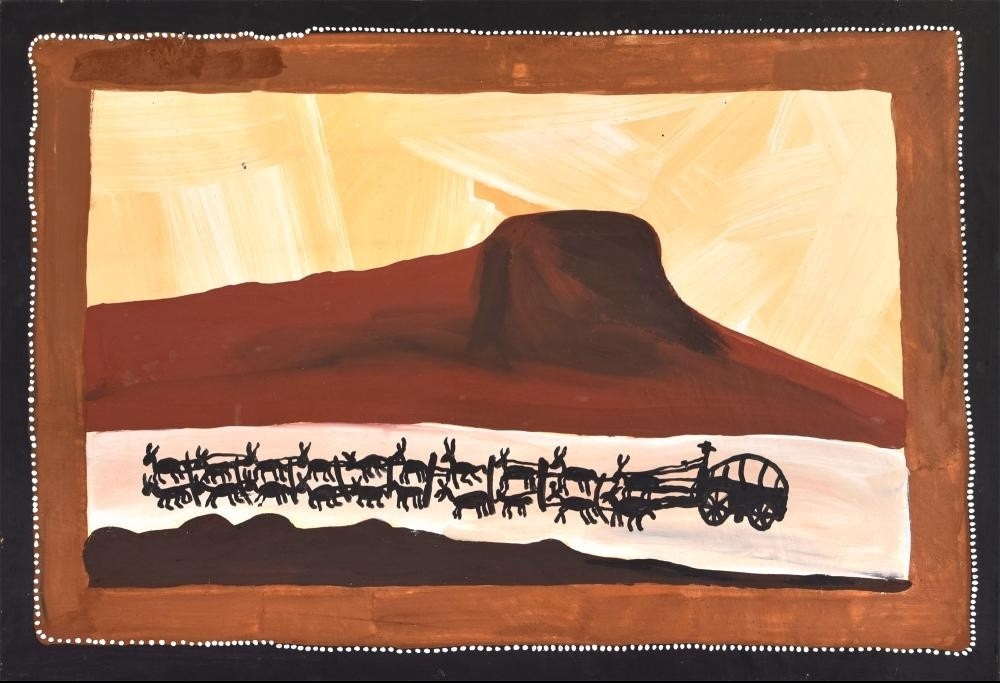
Donkey Wagons Memories, 2001, shows another side of that history. It depicts a wagon travelling through the King Leopold Ranges towards Derby, while its accompanying account describes Aboriginal workers constructing rough wagon tracks as pastoral settlement expanded into their Country. Aboriginal people seeking to avoid station labour could retreat into the ranges and watch the wagons passing below. The donkey wagons therefore represent more than nostalgic memories of early transport; they also record the pastoral frontier moving deeper into Aboriginal Country.
Some works are intensely personal. Inscriptions identify relatives, including his brother Jacob in connection with the Minjil Ridi Wandjina and his young grandfather Toby Nganingun in Maru Mindi, Middle of Boab Tree.
Dale could move from ancestral Wandjina narratives to twentieth-century history without treating them as completely separate worlds. Both belonged to Country and memory. His paintings can therefore function simultaneously as cultural record, family history, historical testimony and autobiography.
Importance of Jack Dale Mengenen
Jack Dale Mengenen is important in Kimberley art for his role in continuing and developing the Wandjina painting tradition.
An earlier generation of Kimberley artists, including Charlie Numbulmoore and other senior Wandjina painters, had transferred imagery associated with rock painting and ceremonial practice onto bark and other portable surfaces. Dale belonged to a later generation that carried this tradition onto canvas and into contemporary Aboriginal art.
His Wandjina paintings are traditional in subject but increasingly individual in form. Faces are reduced to large circular eyes, enclosing outlines and radiating halos, while full-length figures can become elongated, almost column-like bodies without separate legs. Fine rain dots cover their surfaces, sometimes arranged in distinct fields rather than as uniform decoration.
Dale pushed this simplification further in his paintings of Djalala or proof stones. Wandjina, stones and features of Country could be reduced to increasingly abstract shapes, outlines and fields of dots while retaining their connection to particular places and ancestral narratives. In works such as Djalala Stones (Proof Stones), 2006, the landscape itself becomes close to abstraction.
This development did not represent a movement away from tradition. Dale continued to identify his Wandjina with specific places, including Iondra in his mother’s Komaduwah clan estate, and described the Wandjina there as evidence of his people’s connection to and ownership of Country.
His historical paintings add another dimension, recording stockmen, prisoners, donkey wagons, police and events he had witnessed during a long life in the Kimberley. But Dale’s greater art-historical importance lies in the Wandjina tradition itself: continuing an older Kimberley visual tradition on canvas while developing a distinctive, increasingly simplified and abstract visual language.
Jack Dale Mengenen value and Auction results
Works Offered at Auction: 94
Sale Rate: 57%
Highest Sale: $38,000AUD
Median Sale Price: $4,200 AUD
For additional artworks values dimensions and provenance you are referred to the Jack Dale Mengenen value page
Jack Dale Mengenen In public collections
- Australian War Memorial, Canberra
- National Museum of Australia, Canberra
- Art Gallery of Western Australia, Perth
- National Parliament Collection, Parliament House, Canberra — Storm Wandjinas, 2006
- Queensland Art Gallery | Gallery of Modern Art, Brisbane — Wandjina, 2004, with Biddy Dale
All images featured in this article are presented strictly for educational and informational purposes.
This website may include copyrighted material for which specific authorization has not been obtained from the copyright owner.
All such images are presumed to be the intellectual property of the respective artist or their estate, and are used in accordance with principles of fair dealing or fair use under applicable copyright law.