
Aboriginal Astronomy: Orion and the Pleiades
Aboriginal astronomy is one of the world’s oldest continuous systems of celestial knowledge. Long before telescopes or written star charts, Aboriginal Australians observed the movements of the heavens and preserved that knowledge through oral tradition, ceremony and art. Few surviving artworks illustrate this relationship more beautifully than Orion and the Pleiades, painted by Minimini Mamarika in 1948 in Groote Eylandt style.
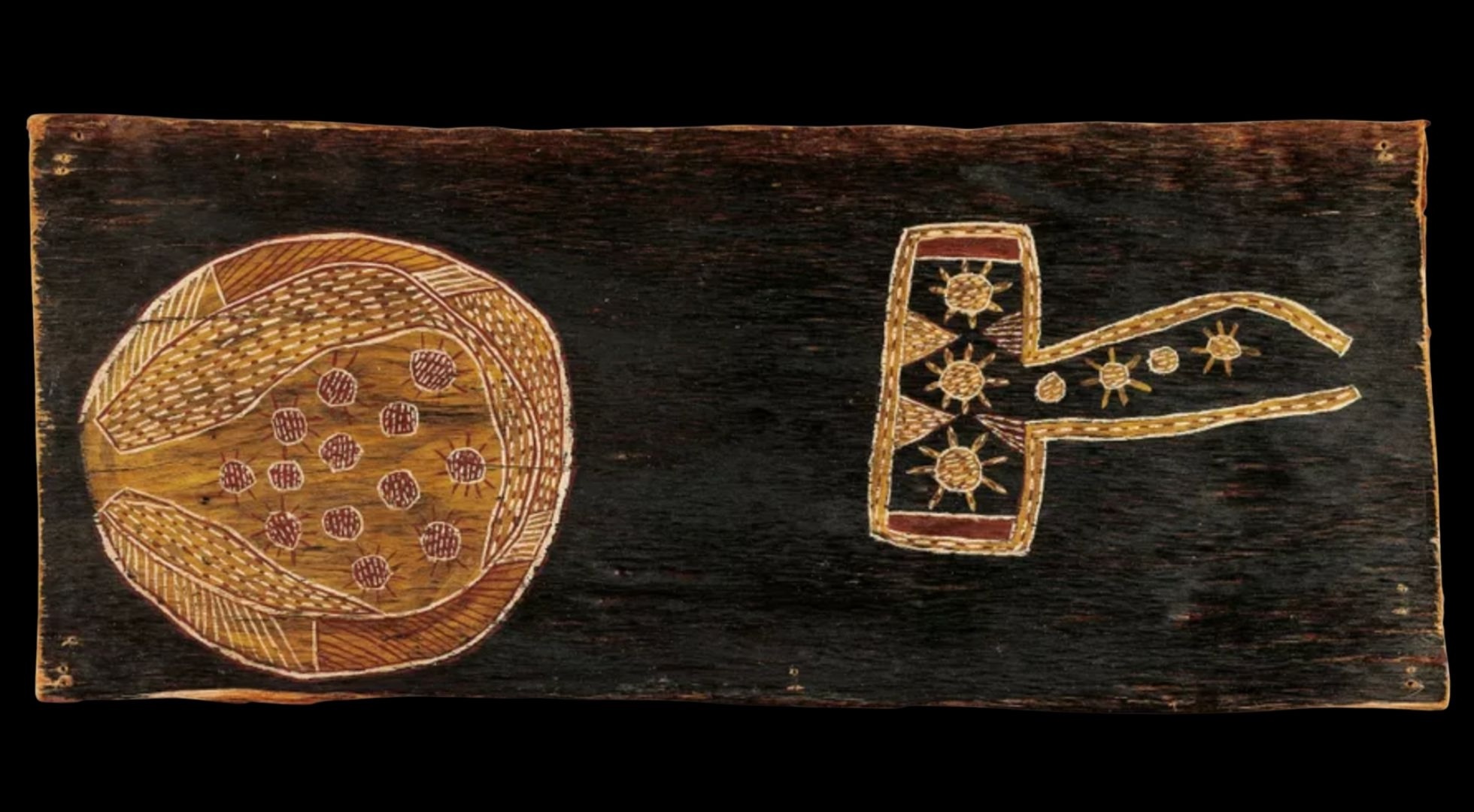
At first glance the Aboriginal bark painting appears deceptively simple. A closer examination reveals a sophisticated composition that transforms a sheet of eucalyptus bark into a living night sky. Rather than illustrating constellations as fixed patterns of stars, Mamarika presents them as dynamic celestial beings whose relationship unfolds across the surface of the bark. It is both an artwork and a visual expression of Aboriginal astronomy.
A Closer Look at the Painting
The composition is built around two dominant celestial forms suspended within the natural surface of the bark. Between them lies a broad expanse of unpainted bark that functions as much more than empty space. It becomes the night sky itself, allowing the two constellations to exist in quiet tension.
The larger form on the left immediately commands attention. A dense cluster of stars sits within a sweeping U-shaped enclosure that appears to push the constellation across the bark. Rather than forming a static border, the curved outline creates a powerful sense of momentum, almost like the glowing wake left by a meteor or comet travelling through the darkness. The cluster seems alive, leaning towards its celestial counterpart.
Opposite it, the second constellation is entirely different in character. Seven large star motifs occupy an elongated tapering form whose streamlined shape immediately suggests movement. To my eye, these seven stars naturally evoke the Seven Sisters (Pleiades). The narrow enclosure gives the impression that they are travelling rapidly across the heavens, as though fleeing Orion.
Whether this was Minimini Mamarika’s intended meaning can no longer be confirmed, but the visual language of the painting is remarkably persuasive. The title, Orion and the Pleiades, encourages the viewer to read the composition not as two isolated constellations but as two celestial bodies locked in an eternal relationship.
What Does Orion and the Pleiades Represent?
Across much of Australia, Aboriginal peoples recognised the relationship between Orion and the Pleiades long before European settlement.
Although every language group has its own traditions, many describe the Pleiades as a group of women pursued across the sky by a powerful male figure represented by Orion. In the Western Desert that pursuer is often known as Wati Nyiru, whose pursuit of the Seven Sisters forms one of Australia’s longest and most significant Songlines.
As Orion rises behind the Pleiades each year, the story is retold across the heavens.
Minimini Mamarika’s painting appears to capture that relationship through movement rather than literal description. Rather than painting stars as scientific objects, he paints their story.
Aboriginal Astronomy Through Art
Modern astronomy measures the positions, distances and physical properties of stars.
Aboriginal astronomy asks different questions.
It connects the stars with Country, ancestors, ceremony, morality and memory. The night sky becomes a vast cultural landscape where stories preserve knowledge across generations.
This is why artworks such as Orion and the Pleiades are so important. They demonstrate that Aboriginal astronomy was not preserved only through spoken tradition but also through visual culture. The painting becomes another way of remembering the relationship between the constellations and the stories they carry.
About the Artwork
Artist: Minimini Mamarika
Date: 1948
Language Group: Anindilyakwa
Community: Umbakumba, Groote Eylandt
Medium: Natural earth pigments on eucalyptus bark
Collection: Art Gallery of South Australia
Created more than twenty years before the Papunya painting movement began, Orion and the Pleiades is one of the earliest surviving Aboriginal artworks explicitly depicting recognised constellations. It provides an important record of Indigenous astronomical knowledge and demonstrates that the stars formed part of Aboriginal artistic expression long before contemporary Aboriginal art became internationally recognised.
A Story We Can No Longer Ask
Looking at this remarkable bark painting, I cannot help wishing I had the opportunity to sit with Minimini Mamarika and ask him to explain it. His own words would have revealed layers of cultural knowledge that no museum label or academic interpretation can fully recover. What remains is the painting itself—a powerful reminder that every Aboriginal artwork once had a storyteller, a teacher and an audience who understood its deeper meaning.
This was never simply decoration. It was sacred art preserving sacred knowledge—knowledge of the stars, of Country, of ancestors and of humanity’s place within the universe. Like the painted pottery, and sculptures of ancient Greece that preserved stories of Orions pursuit of 7 nymphs, this bark painting preserves an ancient understanding of the cosmos. Both traditions used art to carry knowledge across generations. Thousands of years after they were created, they continue to speak, although some of their deepest meanings may only ever have been fully understood by those who first heard the artist tell the story.
Why This Painting Matters
Few Aboriginal artworks are explicitly identified with recognised constellations. Fewer still were painted before the emergence of the contemporary Aboriginal art movement.
Orion and the Pleiades occupies a unique place in Australian art history. It demonstrates that Aboriginal astronomy is not simply preserved in oral tradition, but also in enduring works of art. More than seventy-five years after Minimini Mamarika painted this bark, it continues to invite us to look beyond the stars themselves and consider the stories, relationships and knowledge they have carried across countless generations.
All images in this article are for educational purposes only.
This site may contain copyrighted material the use of which was not specified by the copyright owner.