
Greeny Purvis Petyarre : Biography, Painting Style and Importance
1930-2010
Eastern Anmatyerre
Alhalkere, Utopia
Boundary Bore (Atneltye)
Utopia Art
Acrylic on canvas and linen
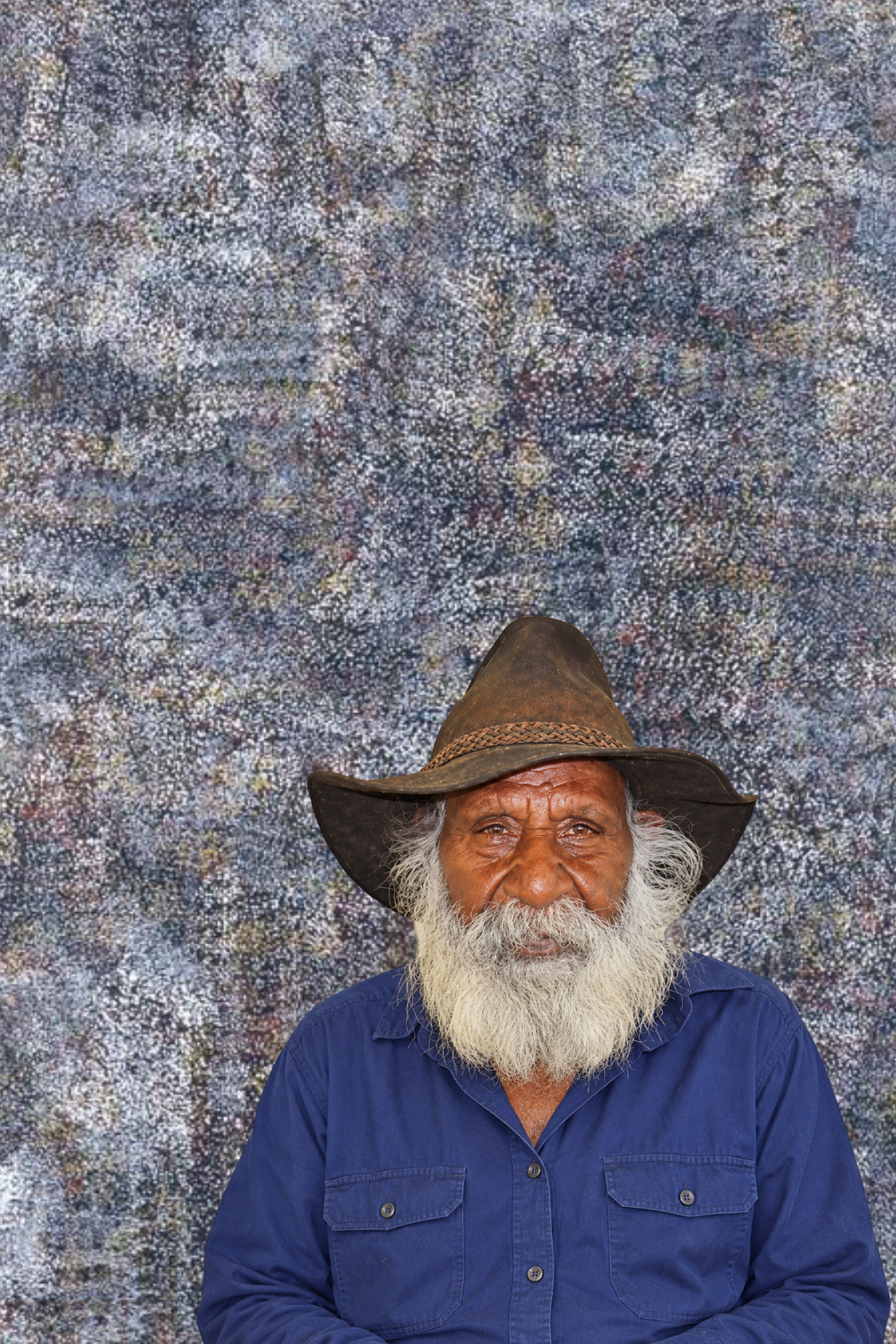
Greeny Purvis Petyarre was a senior Eastern Anmatyerre ceremonial leader and an important artist from Alhalkere Country in the Utopia Art Movement of Central Australia. Best known for his paintings of Yam Dreaming, Emu Dreaming and men’s ceremonial designs, he transformed inherited knowledge of Country into sophisticated compositions of repeated lines, intricate dotting and rhythmic colour.
The eldest nephew of Emily Kame Kngwarreye, Greeny was also a senior custodian of the ancestral stories associated with her paintings. His importance extended beyond his own artistic achievements to the cultural authority he exercised within the Utopia community.
Greeny was one of the few senior male artists to achieve prominence within the Utopia painting movement, which became internationally celebrated through the work of its women painters. His monumental Plum root Dreaming (1995), measuring almost five metres across, was acquired by the Art Gallery of South Australia in 1996. His finest paintings combine ceremonial knowledge with a bold and highly individual approach to abstraction, establishing him as an important artist in his own right.
Greeny Purvis Petyarre Biography
Greeny Purvis Petyarre (c.1930–2010) was born into an Eastern Anmatyerre family whose ancestral Country was Alhalkere, in the Utopia region northeast of Alice Springs. His father, Alhalkere Jack, was the brother of Emily Kame Kngwarreye, and his mother was Rosie Ngale. His younger sister, Evelyn Pultara, also became a distinguished painter, winning the General Painting Award at the 2005 National Aboriginal and Torres Strait Islander Art Awards.
Greeny lived for much of his life at Boundary Bore on his traditional Country. He married Kathleen Kemarre, and they had four daughters, Judy, Maureen, Jedda and Jennifer. Known as a senior ceremonial leader, he held responsibility for maintaining and passing on Anmatyerre Law. Don Holt of Delmore Gallery described him as the senior Emu Man of Utopia, a position that reflected his authority well beyond the art world.
Greeny was painting in acrylics by the late 1980s, as the Utopia art movement began attracting national attention. An Emu Dreaming dated 1989 survives in auction records, accompanied by a photograph of the artist with the work. His early paintings also addressed men’s ceremonies and body-painting traditions. By the mid-1990s, he was producing ambitious paintings of ancestral plants, including extensive Bush Yam compositions combining roots, flowers, seeds and ceremonial designs.
Greeny and Emily Kame Kngwarreye
Greeny’s relationship with Emily was more than that of nephew and aunt. Both held knowledge and responsibilities relating to Alhalkere Country. In October 1994, art dealer Hank Ebes travelled to Utopia to discuss a monumental painting commission with Emily, assisted by fellow Utopia artist Barbara Weir, who helped interpret their conversations. Before proceeding with the project, later known as The Emily Wall, Emily insisted that Ebes consult Greeny.
According to Ebes, Greeny gave his approval, and their meeting resulted in two further commissions: a painting of his own, which was not to be sold, and a work made jointly with Emily. The 53-panel Emily Wall was completed in 1995 and exhibited in Bruges, Belgium, the following year. The episode demonstrates Greeny’s standing as a custodian whose consent mattered even when Emily had become internationally celebrated.
After Emily died in September 1996, Greeny helped organise the family’s mourning ceremonies. Holt recalled Greeny inviting him to the gathering, attended by hundreds of people, and discussing arrangements for Emily’s burial. Holt later helped Lindsay Bird construct her grave headstone. These recollections reveal a respected leader actively carrying out family and ceremonial responsibilities.
Greeny’s own reputation grew through exhibitions in Australia and overseas. His monumental Plum root Dreaming (1995) entered the Art Gallery of South Australia in 1996. He exhibited with Dacou, Delmore and Mbantua galleries, and later participated in printmaking associated with Basil Hall. In 2004, dealer Gabrielle Pizzi reportedly praised his sophistication as a painter.
Greeny continued working into the 2000s and died on 3 May 2010, leaving a body of work inseparable from his lifelong responsibilities to Country.
Greeny Purvis Petyarre Painting Style
Greeny’s paintings are distinguished by their strong linear organisation, repeated dotting and sensitive use of colour. Although he was closely related to Emily Kame Kngwarreye, his artistic approach developed an independent character.
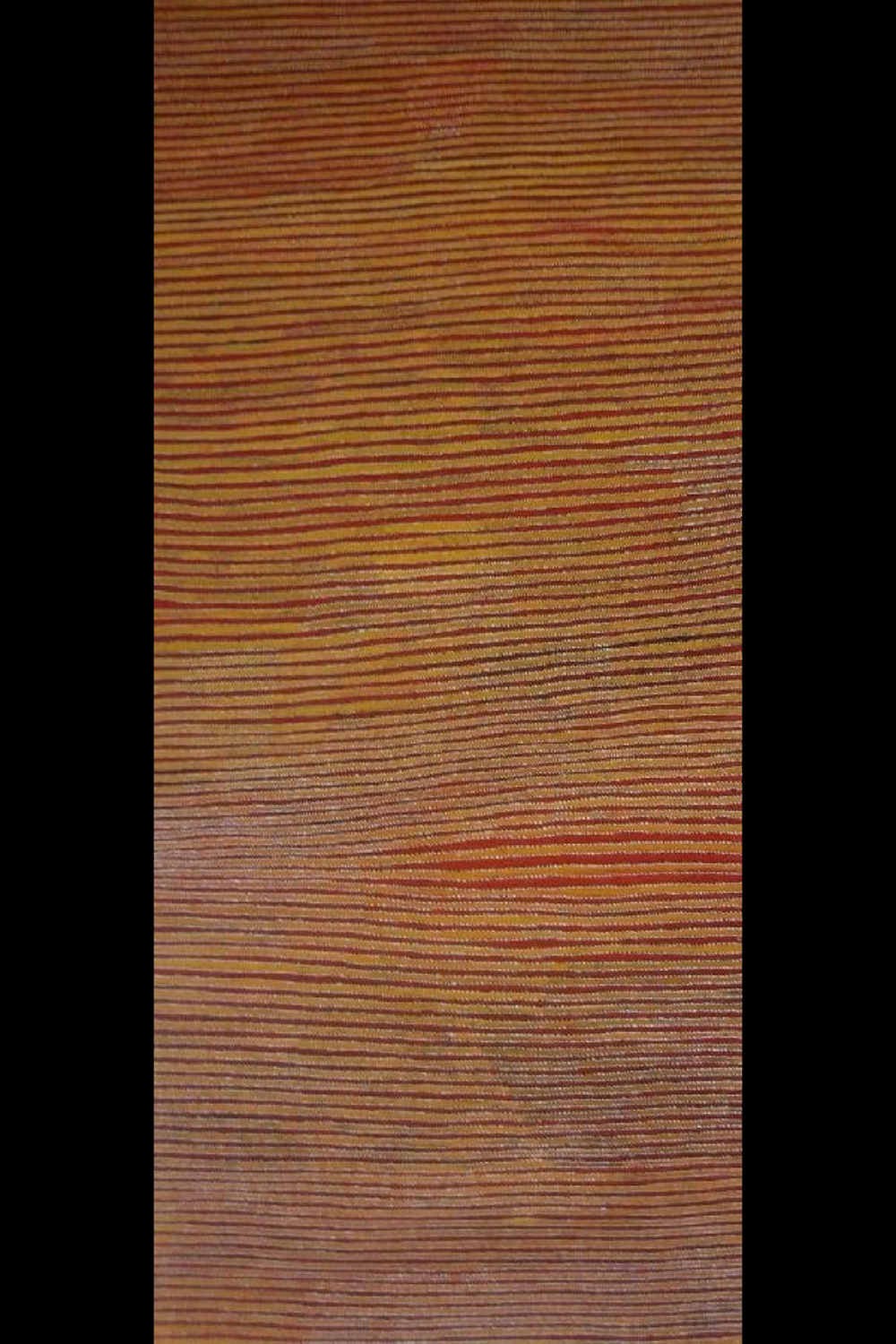
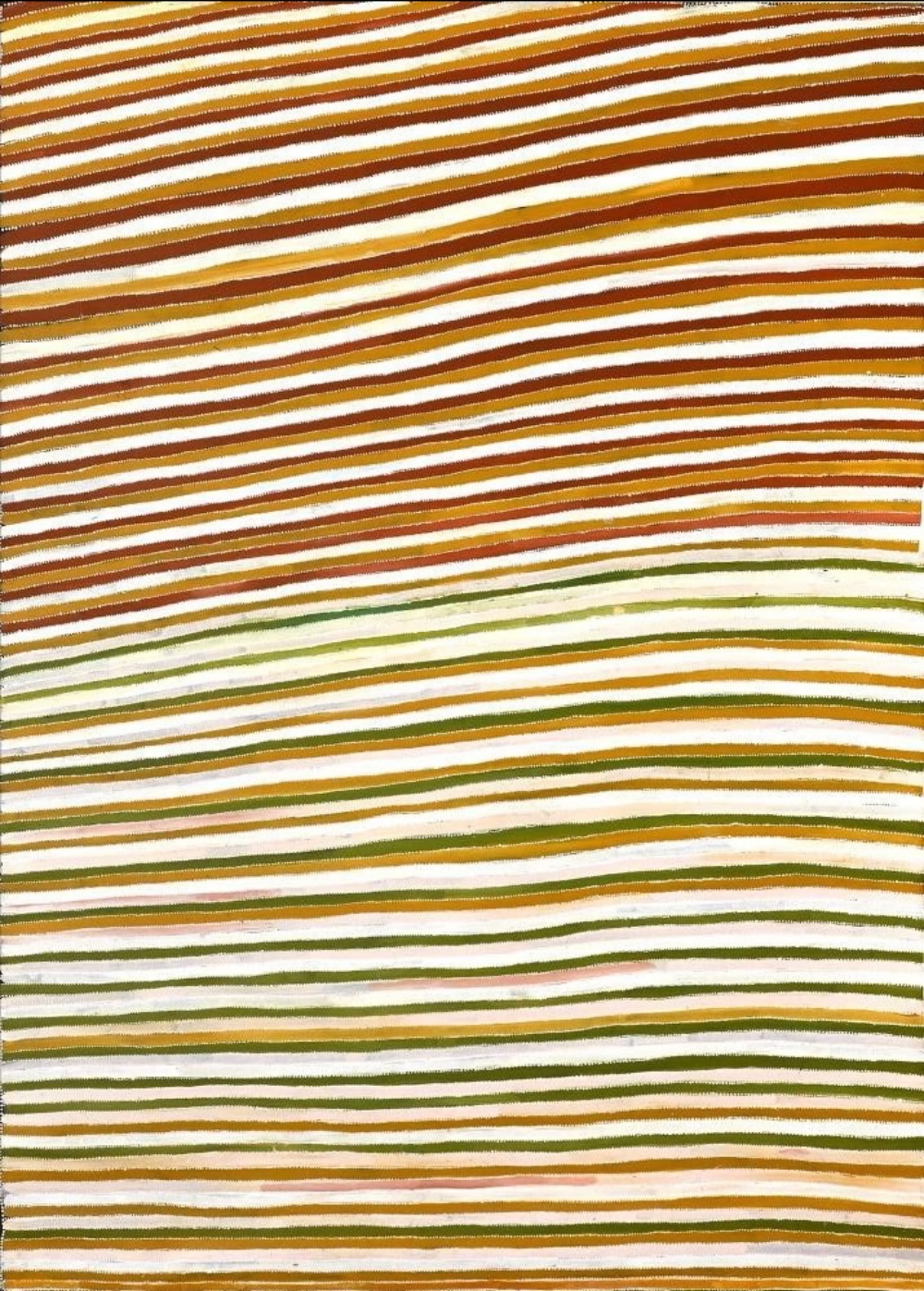
His best-known Yam Dreaming paintings consist of parallel or gently irregular lines extending across the canvas. The lines may be closely grouped or separated by bands of contrasting colour, creating a sense of rhythmic progression.
These patterns are not simply decorative. Gallery documentation explains that changes in colour represent stages in the yam’s life cycle, from germination and flowering to seed maturation and the subsequent renewal of the plant.
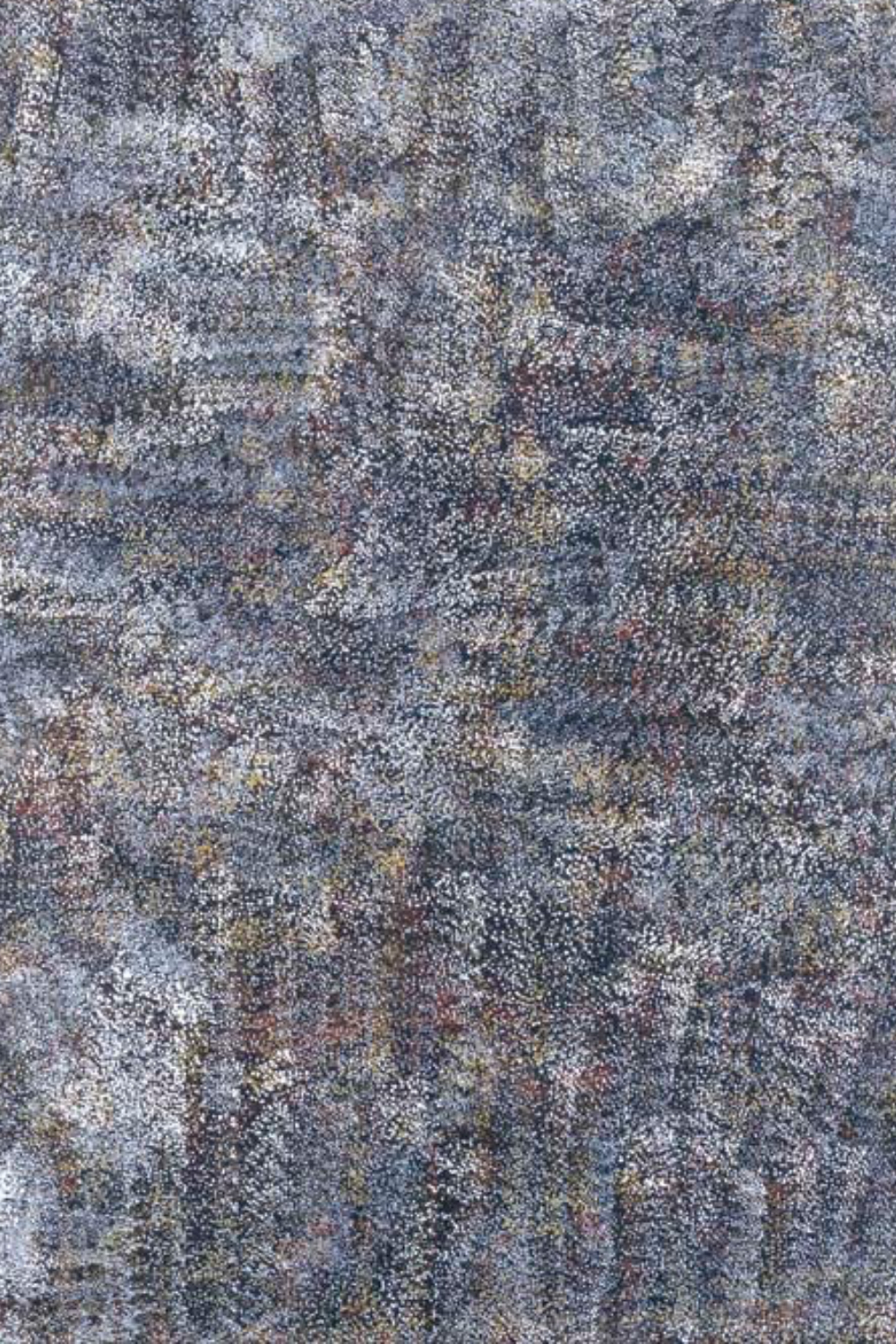
Greeny also employed different sizes of dots, from minute marks to broader, loosely applied passages. Some paintings consist almost entirely of densely worked fields of colour, while others use bold stripes, concentric rectangles or circular forms.
His earlier works frequently used subdued earth-related colours. Later paintings could be much more vibrant, incorporating blue, yellow, red, green and violet.
In 2004, the influential Aboriginal art dealer Gabrielle Pizzi reportedly described Greeny to Don Holt as the most sophisticated male Aboriginal artist of his time. Although a personal assessment, it reflects the admiration his strongest paintings inspired among experienced observers.
His achievement lay in bringing together the discipline of inherited ceremonial design and a remarkably individual understanding of abstract painting.
Greeny Purvis Petyarre Painting Subjects and Their Meaning
Greeny Purvis Petyarre’s paintings draw upon the ancestral stories, ceremonial designs and natural environment of his Alhalkere Country. His principal subjects include Pencil Yam Dreaming, Emu Dreaming, Plum Root Dreaming and men’s ceremonial body painting. Although highly abstract, his compositions frequently describe the relationships between plants, their underground roots, seasonal growth and the ancestral knowledge associated with particular places.
Pencil Yam and Yam Seed Dreaming
Atnwelarre (pencil yam) and kame (its seed) were among Greeny’s most important painting subjects. The pencil yam is a trailing plant with edible underground roots whose growth, flowering and seed production are associated with ancestral stories belonging to Alhalkere.
Mbantua Gallery records a narrative concerning two ancestral seeds from which different kinds of yam originated. Atnwelarre belongs to Greeny’s Country, while arlatyeye is associated with Arnumarra Country.
Greeny’s paintings often describe the seasonal development of these plants through repeated lines and changing bands of colour.
An especially informative example is Yam Dreaming (1997), which has an explanation recorded on the reverse of the painting which identifies the stripes as representing successive stages of the yam’s growth towards maturity, while dots around the border represent seeds.
This inscription provides unusually direct evidence of how Greeny understood his own imagery. Rather than depicting the plant at a single moment, he represented its continuing cycle of growth and renewal within an abstract composition.
Atneltyeye – Of My Country, Aneltyeye
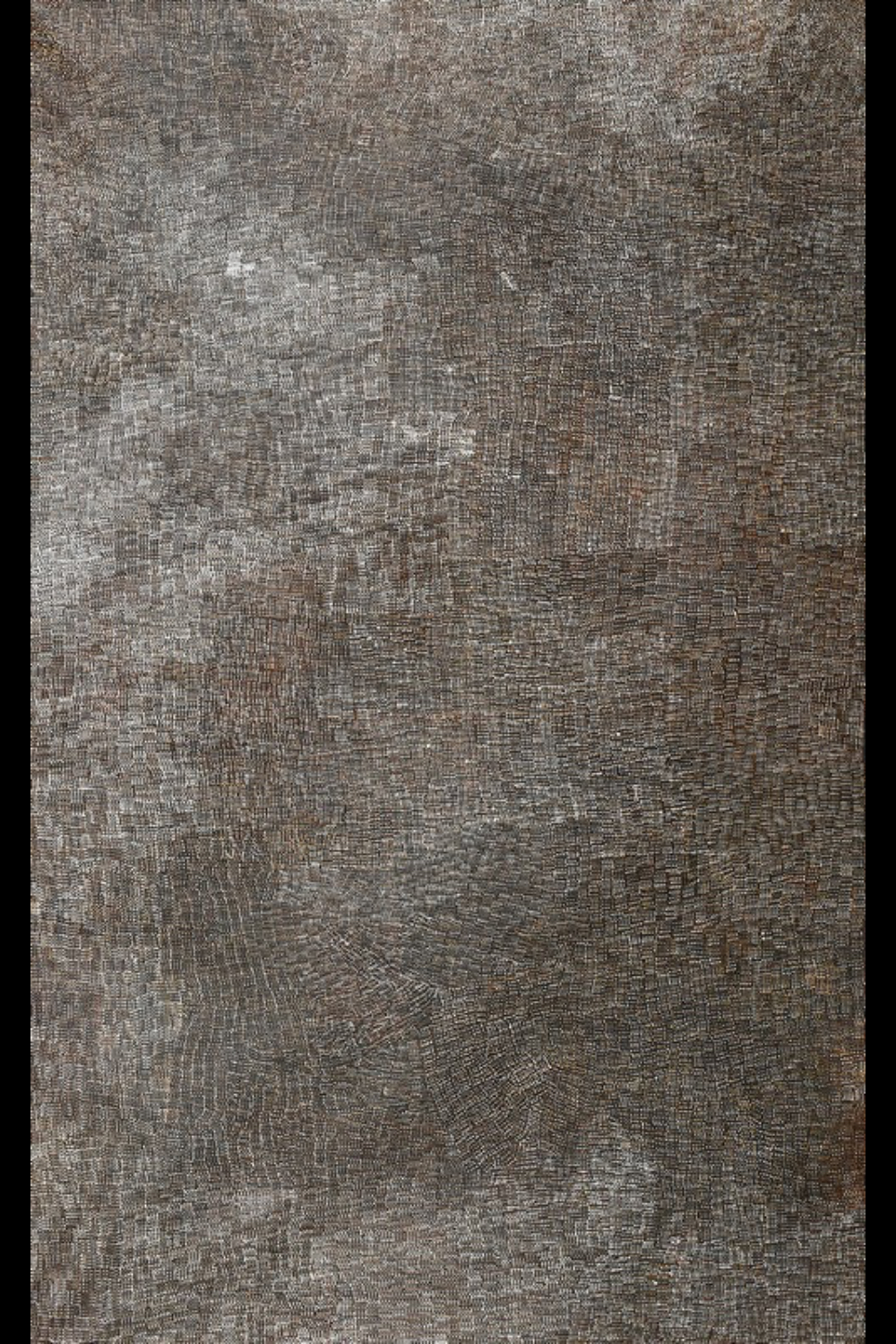
Atneltyeye, also recorded as Aneltyeye or Atneltye, refers to Boundary Bore in the Utopia region, where Greeny Purvis Petyarre lived and painted for much of his life. His paintings titled Of My Country, Aneltyeye express his enduring connection to this landscape and its ancestral significance.
Unlike his strongly linear Yam Dreaming paintings, these works often feature dense, intricate fields of fine dotting, with subtle variations in ochre, grey, brown and white creating richly textured surfaces.
An important example is Of My Country, Aneltyeye (1999)I, its densely worked composition demonstrates Greeny’s ability to express Country through abstract pattern rather than recognisable landscape features. The painting evokes the complexity of his homeland without revealing the precise ceremonial meanings of its individual marks.
Emu Dreaming
Greeny was recognised as a senior custodian of Emu Dreaming, and Don Holt of Delmore Gallery described him as the senior Emu Man of Utopia.
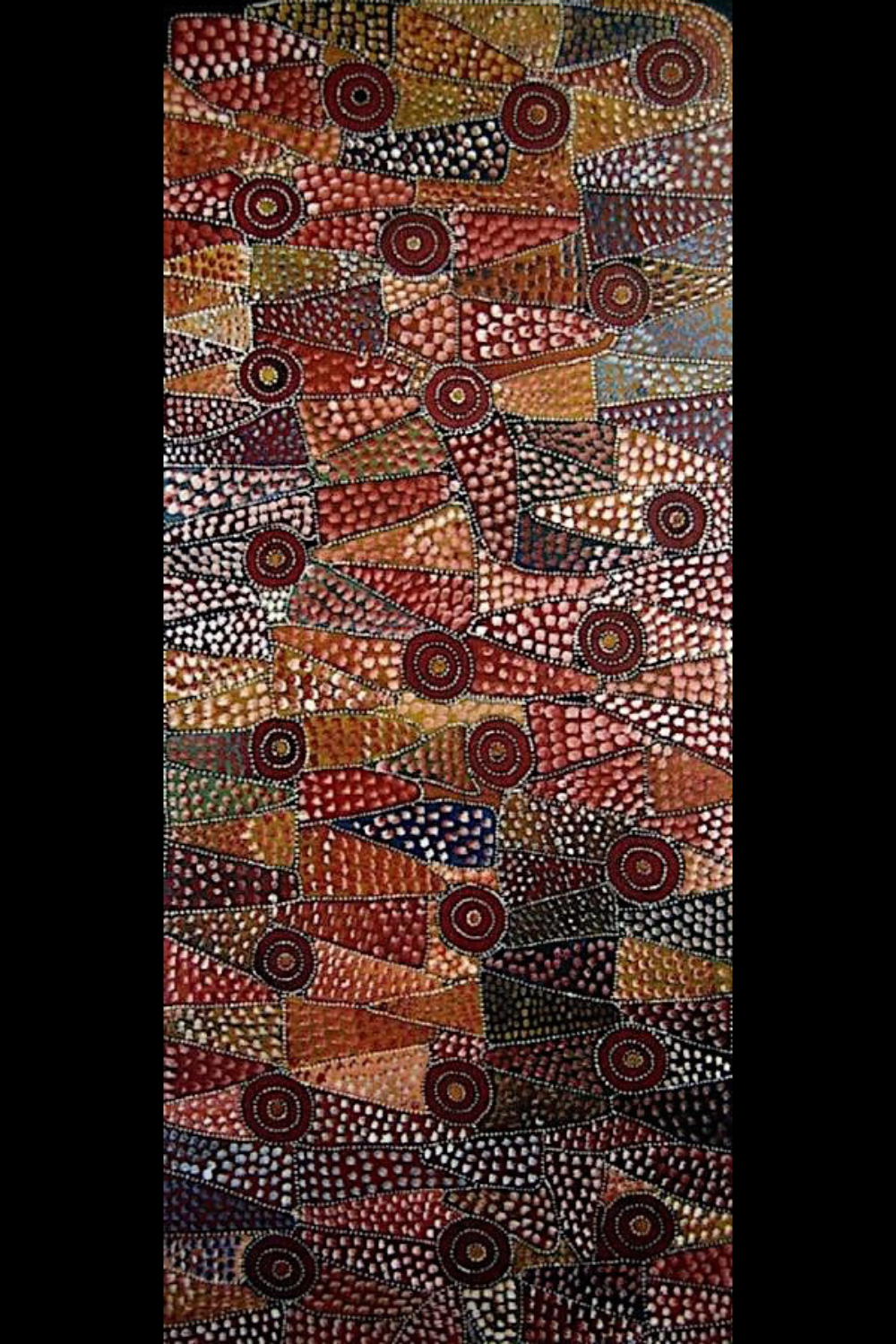
His responsibilities for this ancestral story were an important part of his standing within the Eastern Anmatyerre community. His Emu Dreaming paintings express this inherited connection to Country rather than necessarily depicting the bird in a recognisable naturalistic form.
An early example, Emu Dreaming (1989), synthetic polymer paint on canvas, 127.5 × 54.5 cm, demonstrates a different aspect of Greeny’s painting technique.
The work is characterised by unusually soft, feathery dotting. A Shapiro auction catalogue compared the handling of these marks with the technique of his aunt, Emily Kame Kngwarreye, observing that they differed from the firmer marks commonly associated with Greeny’s paintings.
Painted at Utopia, the work was acquired directly from the artist and accompanied by a photograph of Greeny holding the painting.
Its significance lies both in its early date and in its association with a Dreaming for which Greeny held important ceremonial responsibilities.
Emu Dreaming also appears in paintings by Kudditji Kngwarreye, another senior Anmatyerre artist associated with the Utopia region. Although both artists drew upon ancestral Emu traditions, their paintings developed in remarkably different directions, reflecting individual approaches to Country and inherited cultural knowledge.
The Importance of Greeny Purvis Petyarre
Greeny’s significance lies in both his artistic achievements and his position within Eastern Anmatyerre cultural life.
As a senior custodian of Alhalkere, he helped determine how ancestral knowledge could be expressed through paintings intended for a wider audience. His participation in the creation of The Emily Wall offers a particularly well-documented example of that authority.
As a painter, he developed a highly individual visual language in which repeated lines and dots express growth, seasonality and ceremonial knowledge. His paintings demonstrate that the abstract art of Utopia was not the achievement of its internationally celebrated women alone. Senior male artists also made substantial contributions, bringing their own inherited responsibilities and artistic invention to the movement.
Greeny Purvis Petyarre Value and Auction results
Works Offered at Auction: 80
Sale Rate: 55%
Highest Sale: $15,000 AUD
Median Sale Price: $2,400 AUD
Public Collections
Further Reading
- Hank Ebes, Nangara: The Australian Aboriginal Art Exhibition from the Ebes Collection, 1996. Particularly page 284, cited in contemporary auction descriptions of Greeny’s paintings. Includes essays by Geoffrey Bardon, Robert Edwards and Richard Kimber.
- Hank Ebes, Origins, Aboriginal Gallery of Dreamings. A firsthand account of Greeny’s position within the Utopia community and his involvement in commissioning The Emily Wall.
- Art Gallery of South Australia, Plum root Dreaming, 1995. Museum documentation of one of Greeny’s major paintings.
- Michael Boulter, The Art of Utopia: A New Direction in Contemporary Aboriginal Art, Craftsman House, 1991.Background to the emergence of contemporary painting in the Utopia region.
- Belinda Carrigan (ed.), Utopia: Ancient Cultures, New Forms, Art Gallery of Western Australia and Heytesbury Holdings, 1998. Broader historical and artistic context for the Utopia movement.
All images featured in this article are presented strictly for educational and informational purposes.
This website may include copyrighted material for which specific authorization has not been obtained from the copyright owner.
All such images are presumed to be the intellectual property of the respective artist or their estate, and are used in accordance with principles of fair dealing or fair use under applicable copyright law.