Aboriginal Art >Contemporary > Sally Gabori
Mirdidingkingathi Juwarnda Sally Gabori: Biography, Painting Style and Importance
- c.1924–2015
- Kaiadilt Mirdidingki,
- Bentinck Island Country Bentinck Island / Gulf of Carpentaria,
- Queensland Mornington Island Art
- Contemporary Aboriginal Art Acrylic painting on canvas and bark
Mirdidingkingathi Juwarnda Sally Gabori was a senior Kaiadilt woman and one of the most distinctive Australian painters of the early twenty-first century. Born around 1924 on Bentinck Island in the southern Gulf of Carpentaria, she did not begin painting until 2005, when she was about eighty years old.
Over the following decade she developed an extraordinary visual language of sweeping brushwork, brilliant colour and increasingly monumental fields of paint. Although her paintings can appear abstract, their subjects were remarkably specific. Again and again she painted Bentinck Island: her birthplace at Mirdidingki, her father’s Country at Thundi, her brother’s Country at Makarrki, her grandfather’s Country at Dingkari, Nyinyilki and the Dibirdibi Country associated with her husband Pat Gabori.
These were not landscapes observed from a distance. They were places she had known intimately — rivers, reefs, saltpans, mangroves, sandbars, fish traps, hunting grounds and tidal waters — inseparable from particular people and memories.
Curator Bruce Johnson McLean observed that Gabori painted several of these places hundreds of times, yet each painting could be markedly different. She did not reduce Country to a fixed set of symbols. Instead, every return to a subject offered another way of remembering and experiencing it.
Sally Gabori Biography
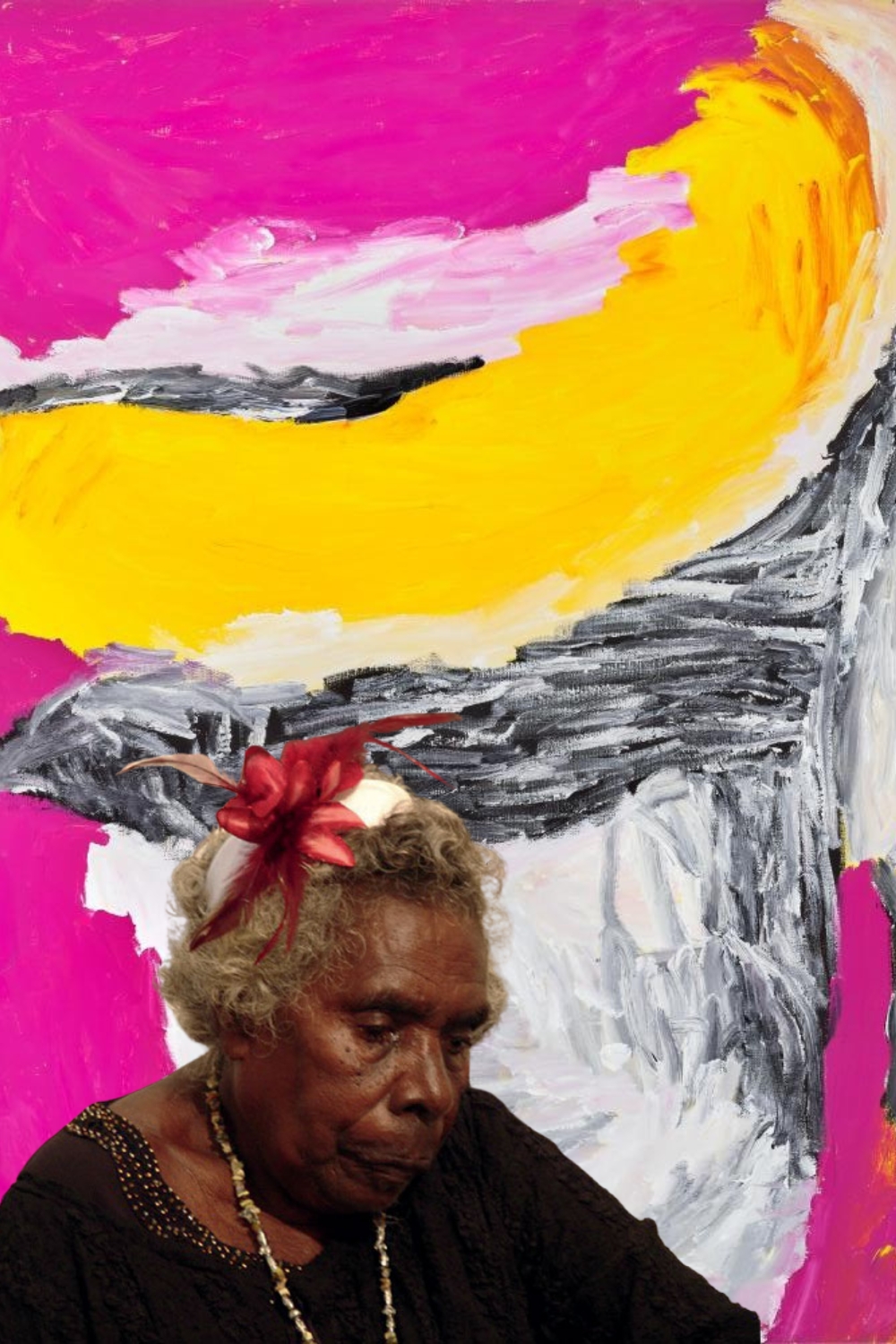
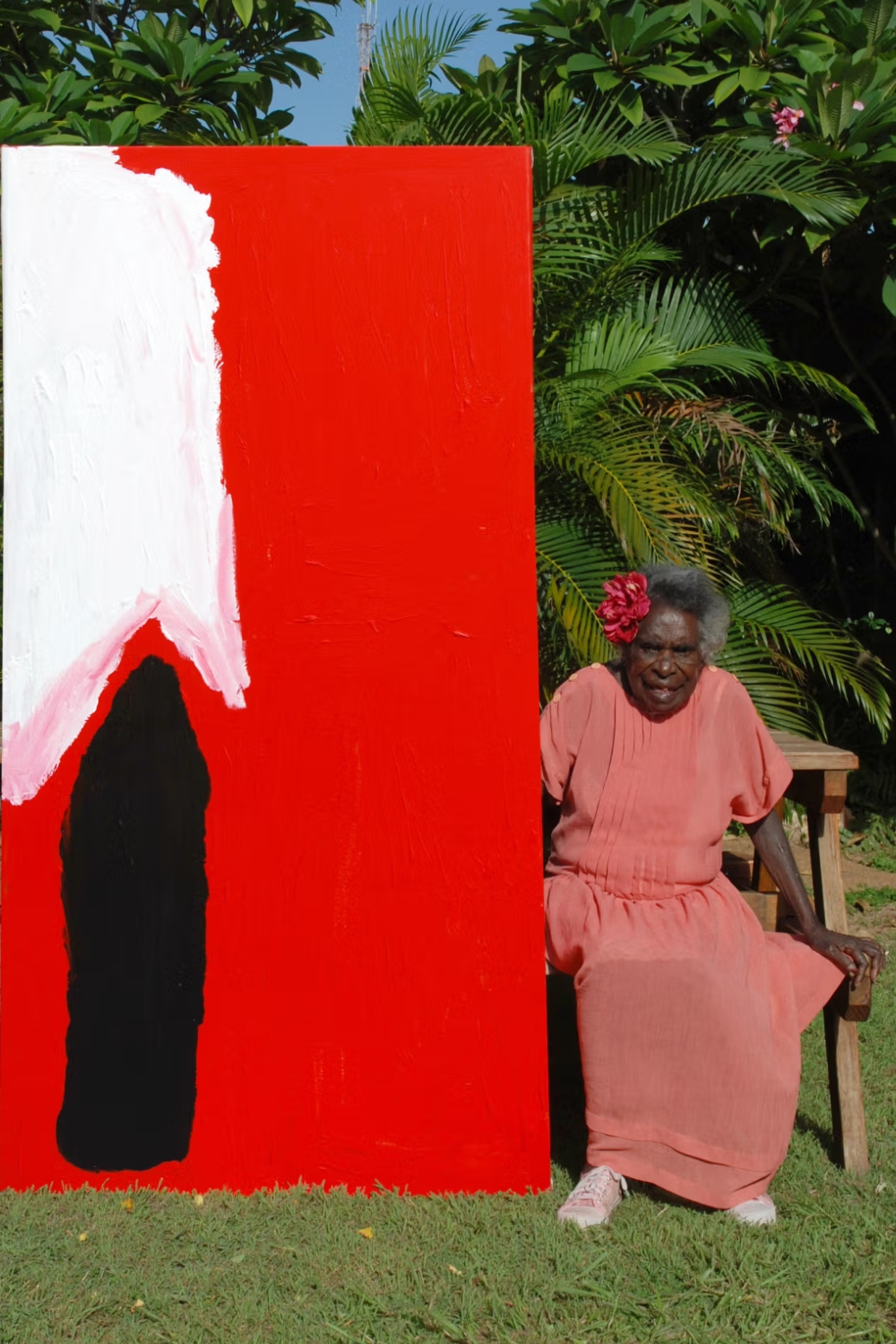
Mirdidingkingathi Juwarnda Sally Gabori was born around 1924 near Mirdidingki Creek on the southern side of Bentinck Island, homeland of the Kaiadilt people. Her Kaiadilt name reflects this connection: Mirdidingkingathi means “born at Mirdidingki”, while Juwarnda refers to dolphin, her totem.
For her first twenty-three years, Sally lived on Bentinck Island according to Kaiadilt custom. She gathered shellfish and other foods, maintained the island’s extensive stone-walled fish traps, made string and woven objects, and was a respected singer of Kaiadilt songs. Long before becoming a painter, she had acquired an intimate knowledge of the island’s rivers, reefs, hunting grounds, freshwater places, tides and seasonal changes.
In 1948 the Kaiadilt population was moved to the Presbyterian mission on Mornington Island following years of severe drought, storms and saltwater contamination of freshwater supplies. The separation from Country was profound. The NGV later described Sally as remaining in “enforced exile” until outstations began to be established on Bentinck Island during the land-rights era of the 1980s.
Nyinyilki, on south-eastern Bentinck Island, became particularly important in this return. Its outstation allowed older Kaiadilt people to spend extended periods on Country again. Anthropologist Paul Memmott described Nyinyilki as a place where memories of earlier life were renewed and, eventually, an important centre in the emergence of Kaiadilt painting.
Sally began painting at the Mornington Island Arts and Crafts Centre in 2005. Already known for her weaving, she now encountered an entirely new medium. Her first painting, My Country, concerned her birthplace around Mirdidingki Creek. Within months she was painting the Countries of her father, brother and husband on canvases several metres long.
Her development was remarkably rapid. The NGV traced her progression from the small paintings of 2005 through enormous collaborative works and brilliantly coloured monumental canvases to the more restricted, sometimes almost monochromatic paintings and works on bark of her final years.
Throughout these changes, her fundamental subject remained Bentinck Island and the people whose identities were bound to its particular places.
Sally Gabori Painting Style and Subjects
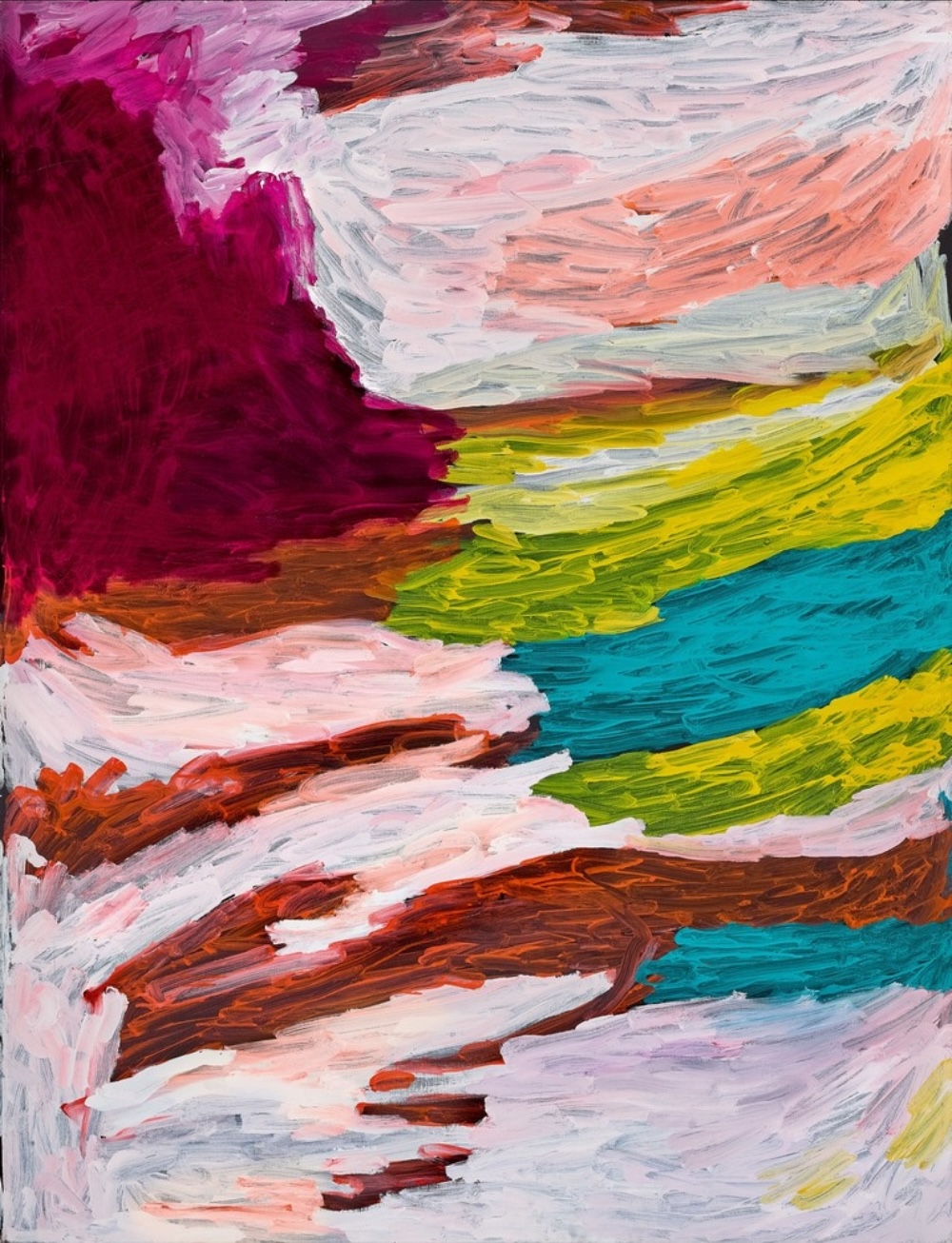
Sally Gabori created a highly individual visual language for Country. Her paintings can appear abstract, with expansive areas of colour, irregular forms and energetic brushwork, but their subjects are remarkably specific.
Gabori repeatedly painted named places on Bentinck Island connected with herself and her family: Mirdidingki, her own Country; Thundi, her father’s Country; Dingkari, her grandfather’s Country; Makarrki, associated with her brother King Alfred; Nyinyilki; and Dibirdibi Country, associated with her husband Pat.
She did not give each place a fixed design. Instead, she transformed particular memories and experiences — rivers, reefs, fish traps, saltpans, mangroves, hunting grounds, tides and marine life — into colour, shape and gesture. Gabori was painting Country as lived experience rather than landscape as scenery.
Painting Bentinck Island
Her first painting, My Country (2005), concerned Mirdidingki Creek near her birthplace. Within months she was painting the Countries of her father, brother and husband and producing works several metres long.
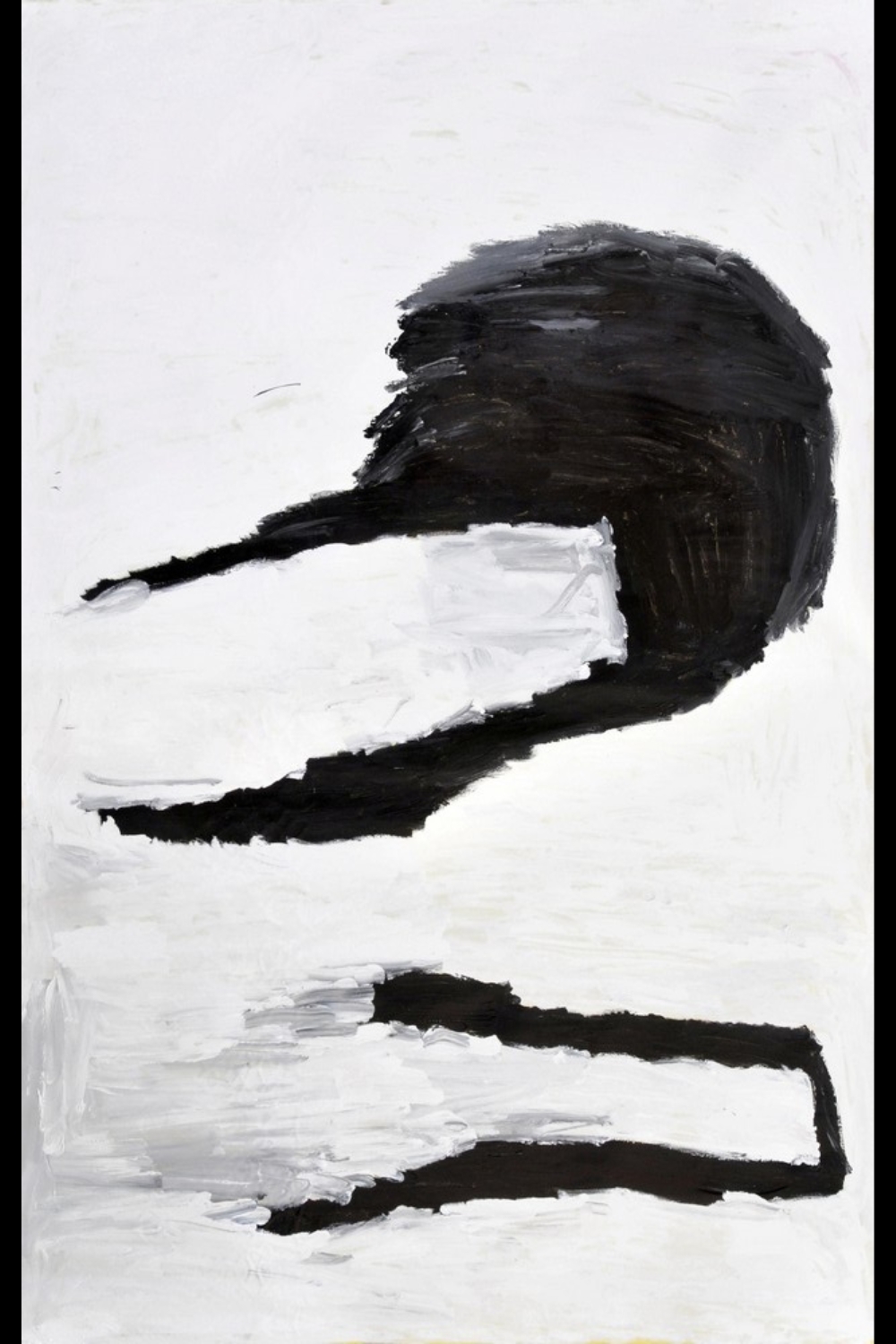
Thundi demonstrates how freely Gabori could reinterpret the same place. It was her father’s Country, centred on a river and important fishing ground near the north-eastern end of Bentinck Island. In one early painting, a large circle represented a fishing place at the river mouth, while flashes of colour indicated fish. Later Thundi paintings became much more austere, sometimes using only two colours. White could evoke exposed sandbars, rippled sand, frothing water, inundation and approaching weather.
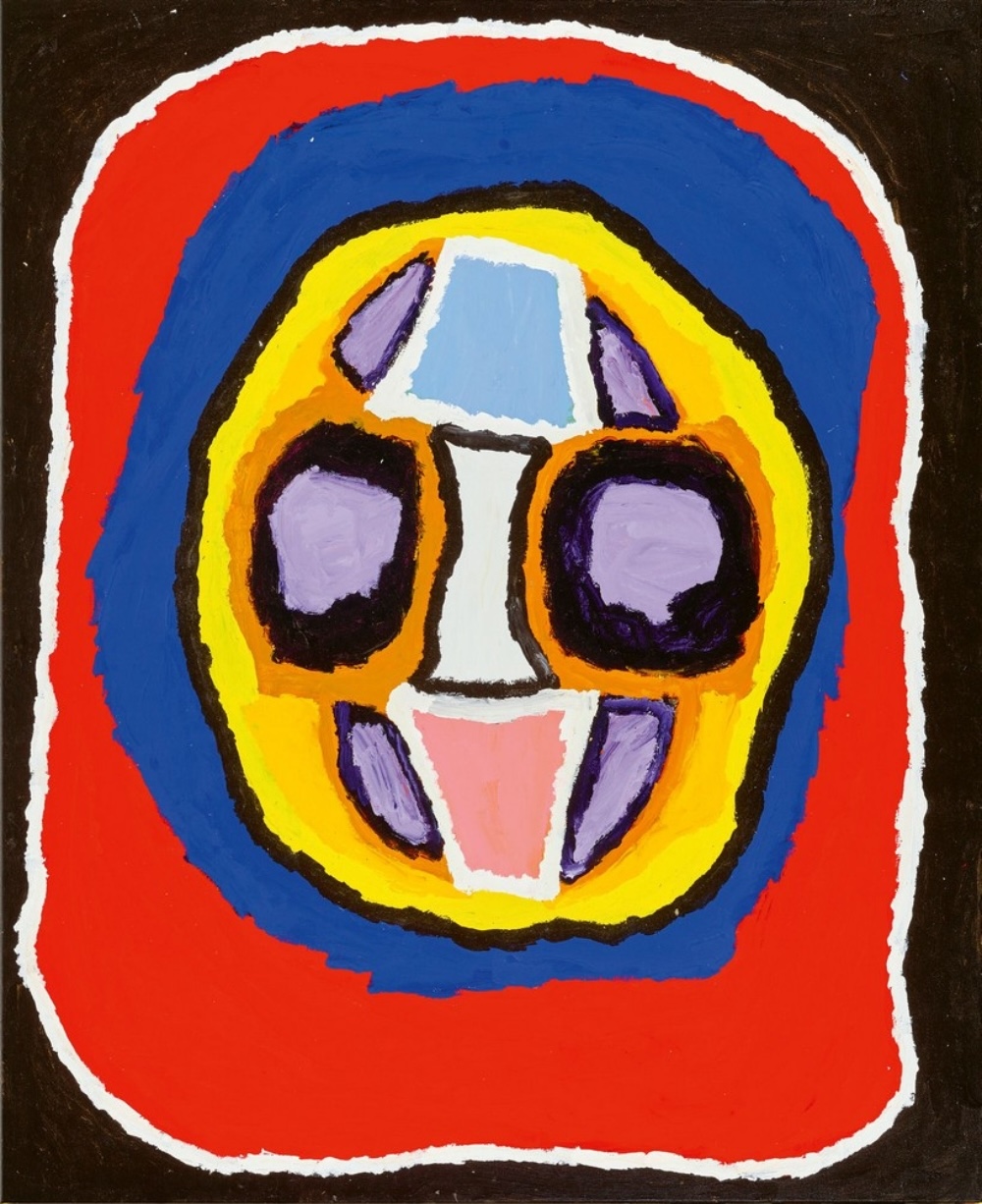
Dibirdibi Country, associated with her husband Pat and the Rock Cod ancestor, became another major subject. These paintings can refer to saltpans, mangroves, reefs, floodplains, hunting grounds and sea Country. One Dibirdibi Countrymay therefore look completely different from another. The title identifies Country, not a prescribed visual design.
At Nyinyilki, the principal Kaiadilt outstation on Bentinck Island, Gabori could paint activity within the landscape itself. Documentation for one work identifies its subject as discoloured water created by feeding dugongs. Other paintings evoke the lagoon, shallows and movement of water across sandbars.
Fish, Hunting and the Sea
Gabori’s early paintings make this relationship between experience and image particularly clear. Works such as All the Fish, Plenty Fish and Hunting Ground recall fishing, hunting and the abundant marine life surrounding Bentinck Island.
In All the Fish (2005), hundreds of coloured circles suggest fish breaking the sea’s surface. Rather than depicting the fish figuratively, Gabori painted the temporary traces of their activity — ripples and disturbances spreading across the water.
This is central to understanding her work. Gabori could paint what happened at a place, rather than simply what the place looked like. Feeding fish, dugongs stirring water, tides exposing sandbars, waves breaking, saltpans drying and people hunting or fishing could all become subjects
Colour, Gesture and Movement
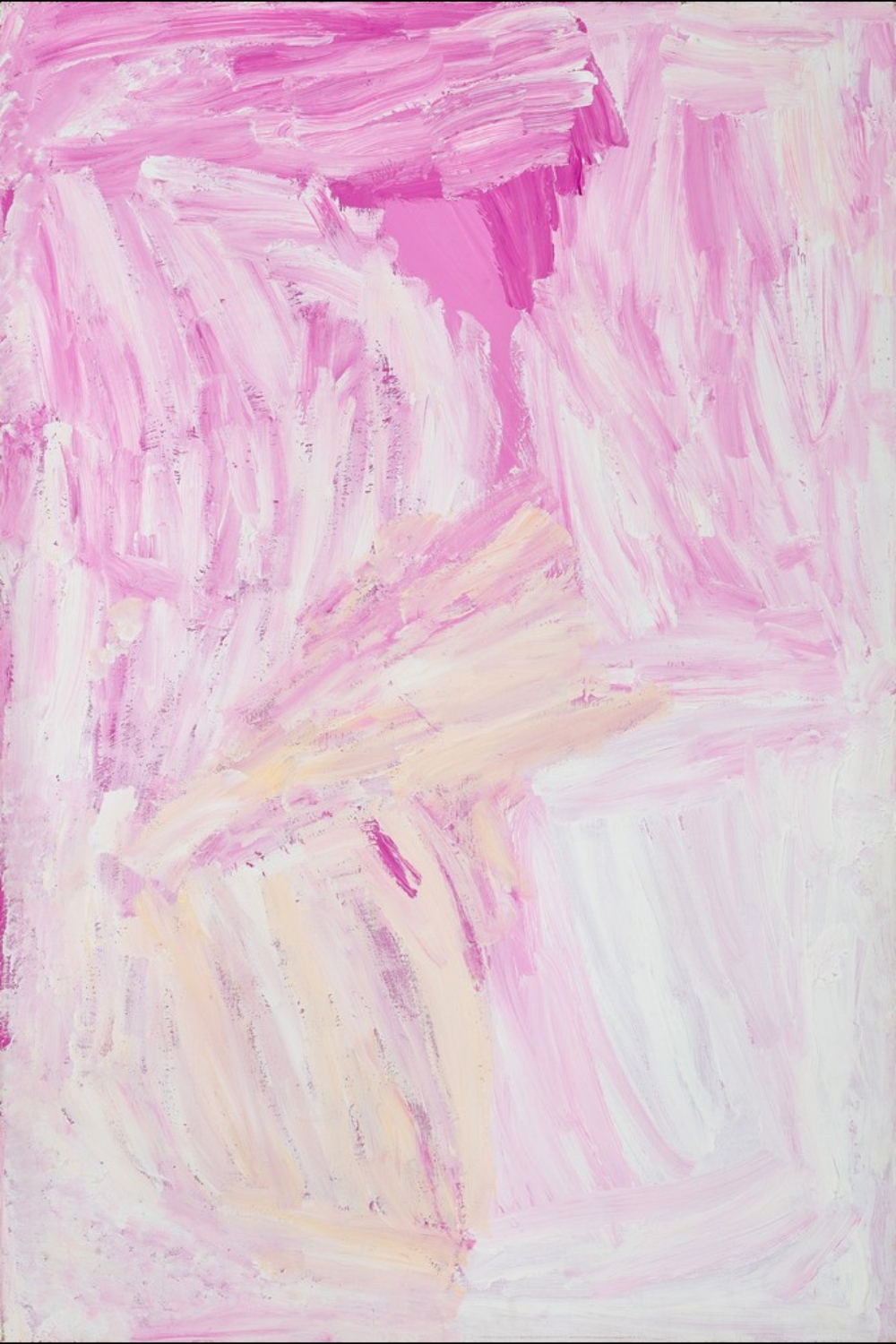
As Gabori’s confidence developed, her paintings became increasingly physical and monumental. She worked with intense colour and sweeping gestures, sometimes holding the brush firmly and generating movement from her shoulder.
She also worked rapidly, mixing wet colours directly on the canvas. In paintings of Thundi, for example, white was brushed into still-wet colour, creating tonal changes that could suggest water, sand and shifting environmental conditions.
Her style could change dramatically — from densely coloured early paintings to enormous gestural canvases and later works with restricted, sometimes almost monochromatic palettes. Yet the foundation remained the same.
Behind the apparent abstraction was a lifetime of Kaiadilt knowledge: particular places, particular people and remembered experiences of Bentinck Island transformed into paint.
Why Is Sally Gabori Important?
Sally Gabori is important not simply because she began painting at an extraordinary age, but because of what she achieved once she began.
She entered painting without an established Kaiadilt canvas tradition or inherited system of painted symbols to follow. Bruce McLean described this unusual circumstance as creating room for “pure innovation”.
Within months she was developing large, confident paintings unlike those of surrounding Aboriginal art movements. Within only a few years her canvases had expanded to monumental scale.
Yet their visual radicalism did not require her to abandon customary knowledge.
The opposite occurred.
Painting gave Gabori a new means of expressing a world she already knew intimately: Mirdidingki, Thundi, Makarrki, Dingkari, Nyinyilki and Dibirdibi; their rivers and reefs; saltpans and mangroves; fishing grounds and fish traps; tides, storms and changing water; and above all the people whose identities belonged to those places.
Her paintings therefore resist a simple division between “traditional” and “contemporary” Aboriginal art. Their form was new, but their foundations lay in Kaiadilt Country, family, language, memory and experience.
She also helped open painting to other Kaiadilt women. In 2007 she worked with six other senior Kaiadilt artists on the monumental Dulka Warngiid — “Land of All” — a six-metre collaborative painting in which each woman painted the Country special to her, together forming a conceptual map of Bentinck Island.
Across her short career Gabori continually reinvented her paintings. Early works could be crowded with the circular disturbances of feeding fish. Her mature paintings expanded into vast fields of saturated colour and sweeping gesture. Later works could become dramatically austere, sometimes approaching monochrome.
What remained constant was Country.
That is ultimately the key to Sally Gabori’s work. A painting may initially appear to be an extraordinary arrangement of colour and gesture. Behind it lies something much more precise: a particular place, a particular person, an experience remembered, and a lifetime of knowledge of Bentinck Island.
Sally Gabori Value and Auction results
Works Offered at Auction: 201
Sale Rate: 88%
Highest Sale: $215,000 AUD
Median Sale Price: $10,000 AUD
To view individual select artworks along with dimensions provenance and sales prices please ivsit the Sally Gabori Value page (not yet constructed)
Sally Gabori Public Collections
Sally Gabori’s paintings are held in major public collections in Australia and internationally, including:
- National Gallery of Australia, Canberra
- National Gallery of Victoria, Melbourne
- Queensland Art Gallery | Gallery of Modern Art, Brisbane
- Art Gallery of New South Wales, Sydney
- Art Gallery of South Australia, Adelaide
- Art Gallery of Western Australia, Perth
- Museum of Contemporary Art Australia, Sydney
- Musée du quai Branly – Jacques Chirac, Paris
- Auckland Art Gallery Toi o Tāmaki, Auckland
Further Reading
- McLean, Bruce; Ryan, Judith; Mudge, Lisa; Saines, Chris. Mirdidingkingathi Juwarnda Sally Gabori: Dulka Warngiid – Land of All. Queensland Art Gallery | Gallery of Modern Art, 2016.
- McPhee, John A.; Knight, Beverly. Sally Gabori: A Survey Exhibition of Paintings 2005–2012: Danda ngijinda dulk, danda ngijinda malaa, danda ngad – This is my land, this is my sea, this is who I am. Drill Hall Gallery, Australian National University, 2013.
- Evans, Nicholas; Memmott, Paul; Evans, Brett; and Turner, Simon. Sally’s Story. Brisbane: Woolloongabba Art Gallery, 2005. Exhibition catalogue accompanying Sally Gabori’s first solo exhibition, with essays on her Kaiadilt background, life on Bentinck Island and early paintings
All images featured in this article are presented strictly for educational and informational purposes.
This website may include copyrighted material for which specific authorization has not been obtained from the copyright owner.
All such images are presumed to be the intellectual property of the respective artist or their estate, and are used in accordance with principles of fair dealing or fair use under applicable copyright law.