
Eubena Nampitjin: Biography and Painting style
c. 1921
Kukatja
Tjinjadpa, near Well 33 (Kunawarritji), Great Sandy Desert
Balgo
Balgo Art / Western Desert Art
Warlayirti Artists
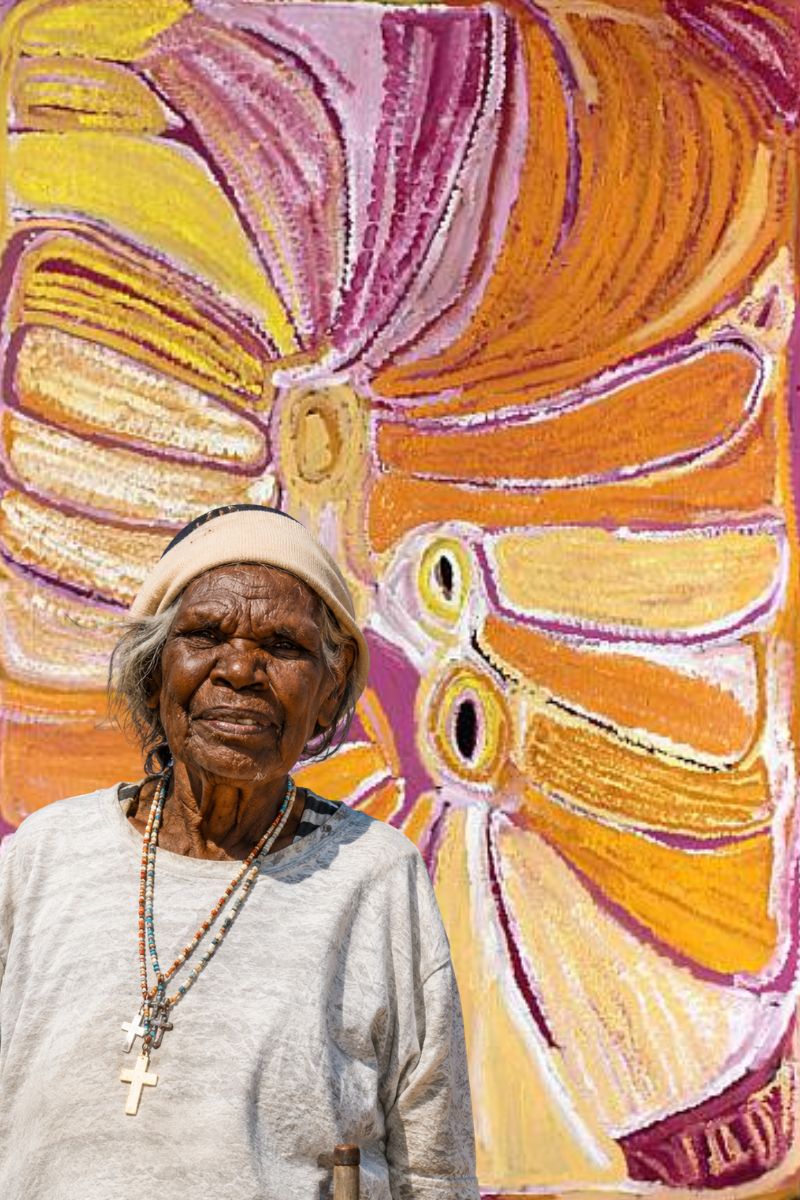
Eubena Nampitjin transformed a lifetime of travelling through the Great Sandy Desert into one of the most distinctive bodies of work in Balgo Art. A senior Kukatja Law woman and respected maparn (traditional healer), she carried an intimate knowledge of the rockholes, soakwaters and sandhills of her ancestral Country from years spent travelling through the desert before settling at Balgo.
Eubena began painting in the 1980s alongside her husband Wimmitji Tjapangarti, with whom she formed one of the important early painting partnerships at Warlayirti Artists. Their early works were often carefully structured around the sites and ancestral journeys of Country, but Eubena gradually developed a powerful visual language of her own. Brilliant colour, sweeping brushwork and densely worked fields of paint increasingly replaced the more explicitly mapped structures of her earlier paintings.
This transformation made Eubena one of the defining painters of Balgo Art and an important figure within the wider Western Desert Art movement. Her later paintings can appear almost abstract, yet they remained grounded in Kukatja Country, Law and lived experience. Rather than abandoning traditional meaning, Eubena found an increasingly personal way of expressing it through colour, movement and the remembered presence of Country.
Eubena Nampitjin’s paintings vary considerably in value depending on their date, size, provenance and quality. If you own one of her works and would like to know its value or are considering selling, visit our Eubena Nampitjin Painting Values page.
Biography of Eubena Nampitjin
Eubena Nampitjin was born around 1921 near Tjinjadpa, close to Well 33 on the Canning Stock Route in the Great Sandy Desert of Western Australia. A Kukatja woman with strong connections to Wangkajunga, Mantjiltjarra and Putijarra Country, she spent her childhood living a traditional nomadic life, travelling between rockholes and soakwaters, gathering bush foods and participating in ceremonial life. This intimate knowledge of Country would become the foundation of her art decades later.
Following prolonged drought, her family eventually settled at the Catholic mission at Balgo during the late 1940s. Despite settlement, Eubena continued returning to her ancestral Country and remained one of its senior custodians. Within the community she was respected not only as an Elder but also as a maparn, or traditional healer, whose knowledge had been passed down through her family. She also assisted anthropologists compiling the Kukatja dictionary, helping preserve her language and cultural knowledge.
Although already a respected Elder, Eubena did not begin painting until 1986. One of her earliest works was selected for the landmark exhibition Art from the Great Sandy Desert, introducing Balgo painting to a wider audience. After the establishment of Warlayirti Artists she rapidly became one of the community’s leading painters, winning the Open Painting Award at the 1998 Telstra National Aboriginal & Torres Strait Islander Art Awards and establishing an international reputation that continues today.
Eubena also belonged to one of Balgo’s most significant artistic families. Her second husband was the acclaimed painter Wimmitji Tjapangarti, with whom she shared deep ceremonial knowledge, while their daughter Ena Gimme Nungurrayi later became an accomplished artist in her own right. Auction records and exhibition catalogues frequently describe Eubena and Wimmitji as one of the great husband-and-wife partnerships in Australian Aboriginal art.
Painting Style
Early Style (late 1980s–mid 1990s)
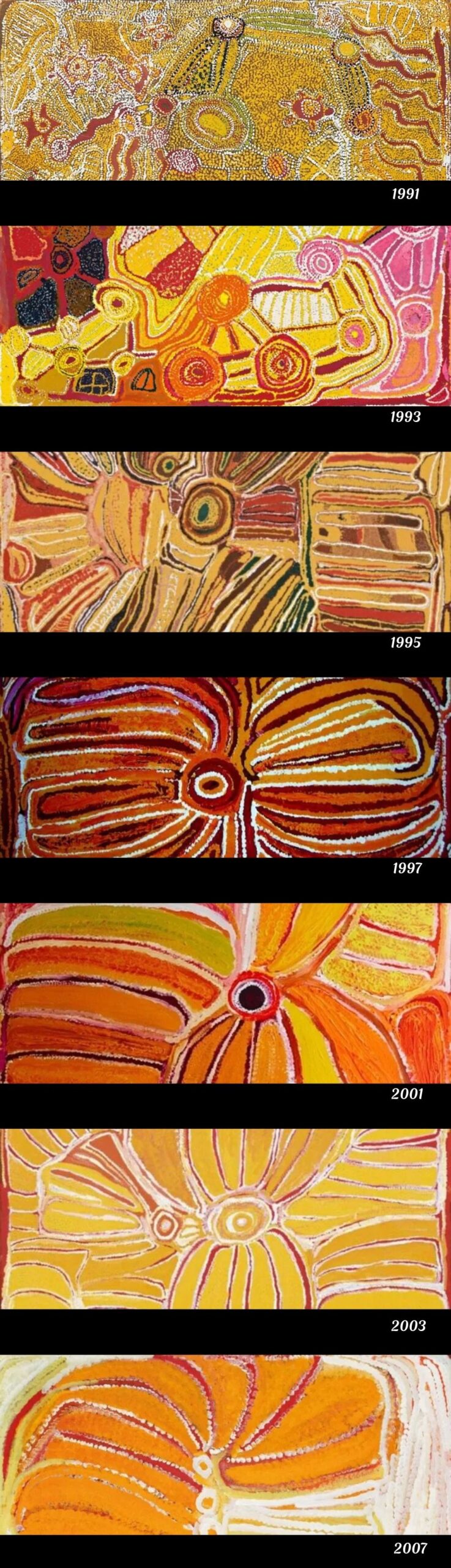
Eubena Nampitjin’s earliest paintings are comparatively restrained and remain closely aligned with the established visual language of Western Desert art. Their compositions are open and clearly organised, with recognisable rockholes, travelling lines and ceremonial sites connected through carefully balanced arrangements. Her palette is dominated by ochres, reds, black and white, while fine, controlled dotting defines individual forms rather than dissolving them into the surrounding surface.
These early works read as conceptual maps of Country. Individual sacred places remain distinct, guiding the viewer’s eye across the composition in a deliberate sequence. Although already displaying the rhythmic movement that would become characteristic of her work, the emphasis remains on describing the relationships between important sites within the landscape.
Middle Style (mid 1990s–early 2000s)
During the 1990s Eubena’s painting underwent a remarkable transformation as colour and gesture became increasingly important elements of the composition. Rather than simply filling pre-defined shapes, colour began to construct the painting itself. Brilliant oranges, pinks, mauves, violets, yellows and occasional turquoise blues appeared alongside the traditional earth colours associated with the Western Desert. While this vibrant palette reflects the broader Balgo movement, Eubena developed an especially luminous and harmonious use of colour that became one of her defining characteristics.
Eubena Nampitjin’s brushwork also became noticeably freer. Fine, carefully placed dots gave way to broader, more painterly marks applied with increasing confidence and spontaneity. Rockholes, travelling lines and ceremonial pathways became less rigid as their boundaries softened into flowing passages of colour. Individual motifs no longer dominated the composition; instead, the entire painted surface began to function as a unified field of movement, rhythm and light.
Late Style (early 2000s onwards)
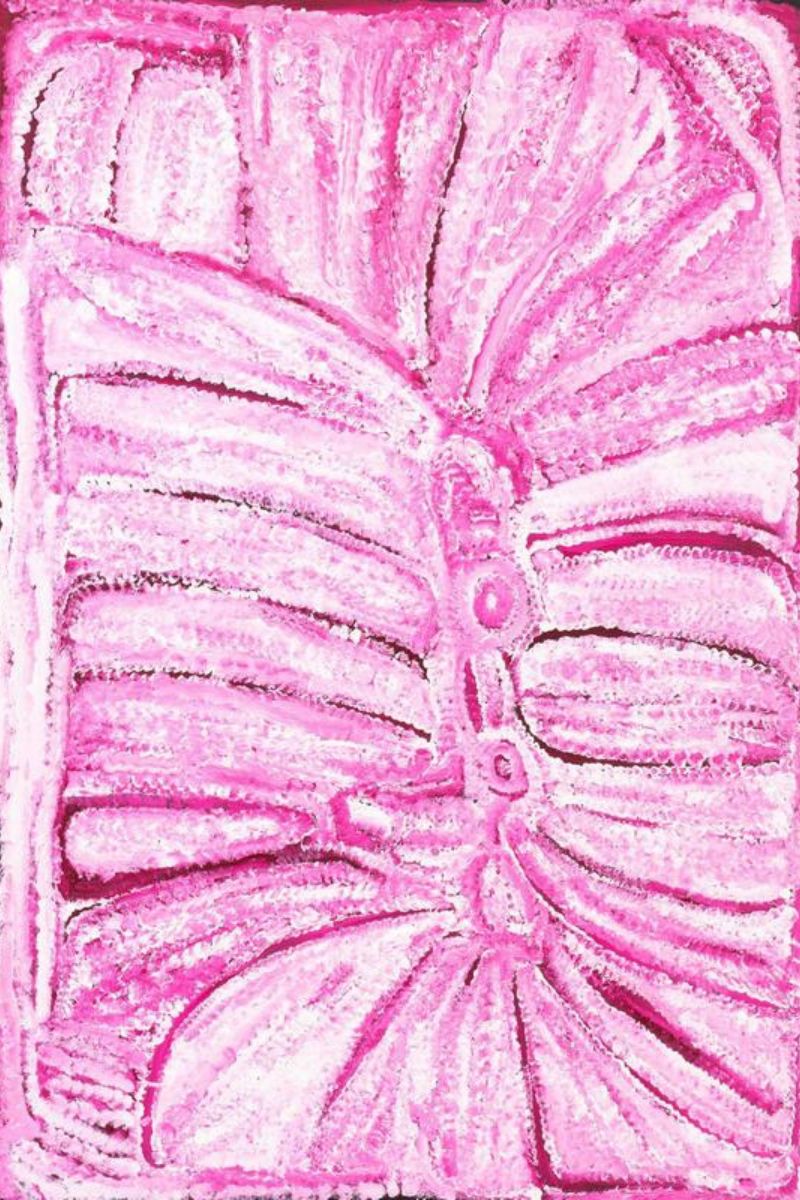
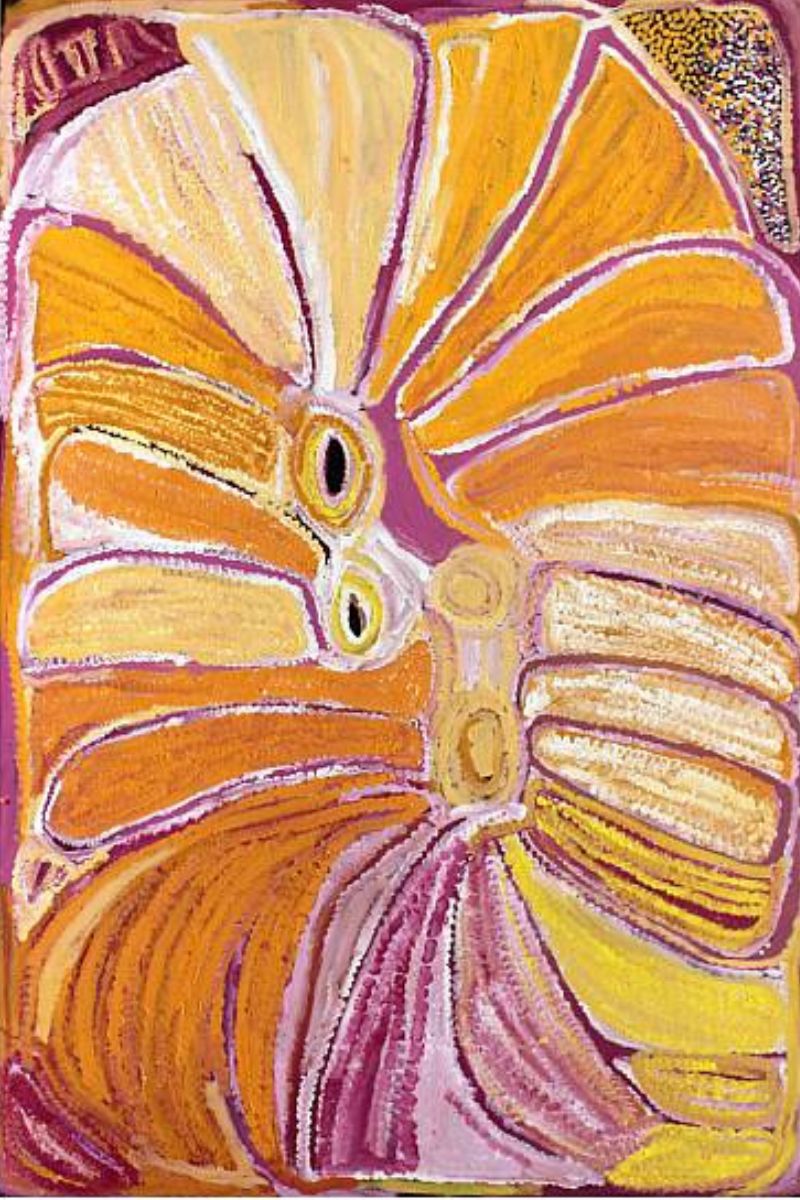
Eubena’s mature paintings represent the fullest expression of her artistic vision and are among the most recognisable works to emerge from the Balgo movement. Large luminous fields of pink, orange, yellow and violet drift across the canvas in layered brushstrokes and painterly dotting, creating compositions that shimmer with extraordinary energy. Rather than depicting discrete ceremonial symbols, these works distil Country into its essential rhythms, transforming landscape into an immersive visual experience.
The paint surface itself becomes increasingly complex. Multiple layers of colour overlap through dense dotting, translucent passages and broken brush marks, producing remarkable optical depth despite the absence of Western perspective. The viewer’s eye rarely settles on a single focal point. Instead, colour pulses evenly across the canvas in an all-over composition that became one of Eubena’s defining achievements.
Her handling of paint also becomes increasingly expressive. Neatly spaced dots and carefully defined edges evolve into varied mark-making, overlapping colours, dragged brushstrokes and visible gestures that give the paintings a striking sense of spontaneity while remaining firmly grounded in ceremonial knowledge.
Perhaps the greatest transformation is conceptual. Whereas her early paintings can be read as carefully structured representations of Country, her mature works invite the viewer to experience Country itself. Rather than describing individual places, they evoke the light, heat, movement and vastness of the Great Sandy Desert, conveying memory and atmosphere as much as topography. In this respect, Eubena’s development parallels that of several senior Balgo artists, whose later paintings increasingly privileged the sensory and spiritual experience of Country over literal description.
Despite this remarkable evolution, the foundations of her art remained constant throughout her career. Her paintings consistently employ an aerial perspective, ceremonial mapping, rhythmic mark-making and strong compositional balance, all grounded in her enduring connection to her own Country and Tjukurrpa. As her style became increasingly abstract, it never lost its cultural authority or profound sense of place.
Eubena Nampitjin Painting Subjects
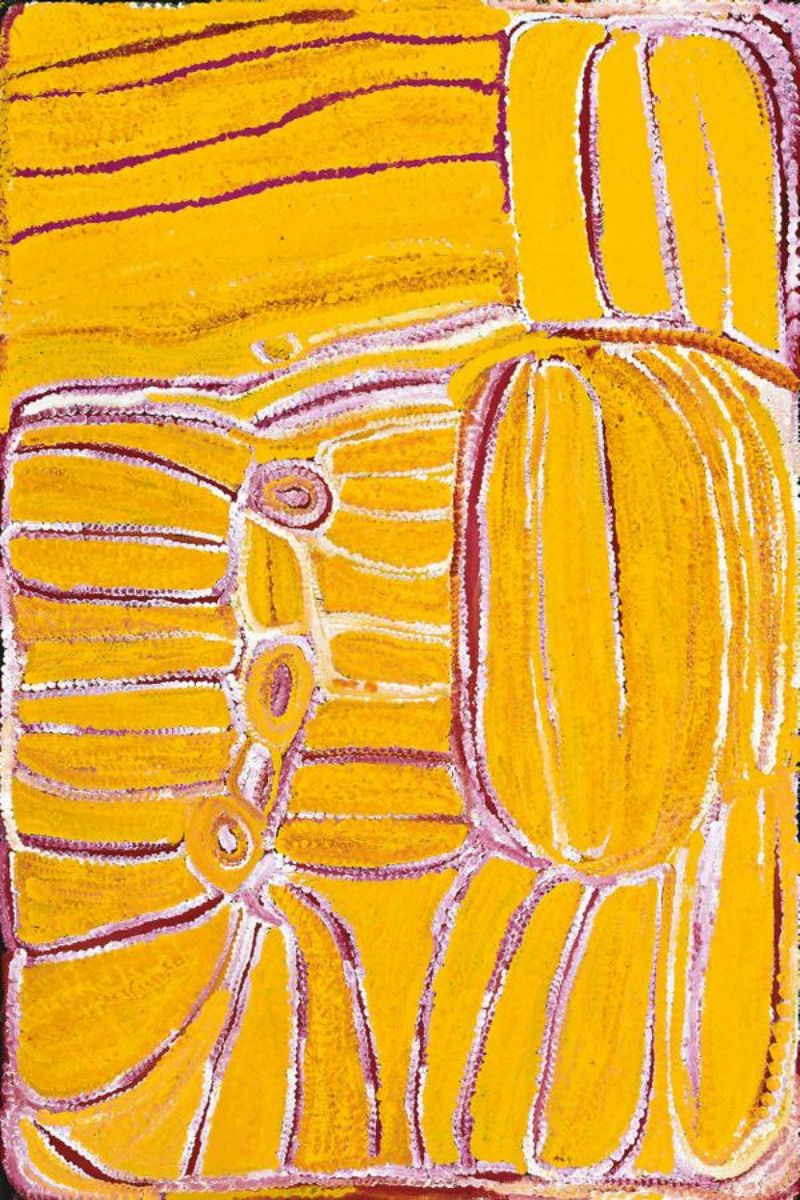
Eubena’s paintings are best understood as remembered journeys across her ancestral Country rather than isolated depictions of individual places. They record the interconnected network of rockholes, soakwaters, sandhills and ceremonial sites that she travelled throughout her childhood before settlement at Balgo. Repeatedly, Warlayirti Artists documentation describes these paintings as places she knew intimately through lived experience—where water could be found, bush foods gathered and ceremonies performed.
Recurring subjects include:
- Kinyu (Spirit Dog Dreaming)
- Kunawarritji (Well 33)
- the Canning Stock Route
- rockholes and soakwaters
- rolling sandhill landscapes
- women’s ceremonial places
- ancestral travelling routes
- bush foods and native plants
- Wati Kutjarra (Two Men)
- important family and ceremonial sites
Many paintings centre on Kinyu, the ancestral Spirit Dog associated with rockholes around Kunawarritji. Certificates accompanying her paintings describe how Eubena remembered leaving gifts for Kinyu and covering important soakwaters with leaves, blending personal memory with ancestral tradition. Other works trace the journeys of Wati Kutjarra and other ancestral beings whose travels shaped the landscape.
Commentary
What distinguishes Eubena Nampitjin from almost every other major Western Desert artist is that her paintings are less concerned with describing Country than recreating the experience of moving through it. While many Western Desert painters organise compositions around clearly defined ceremonial sites connected by travelling lines, Eubena gradually dissolved these structures into sweeping bands of colour and energetic brushwork. The result is a body of work that feels remarkably alive, as though the viewer is travelling across the rolling sandhills rather than looking down upon them.
This transformation became increasingly evident during the 1990s and reached its full expression in her mature paintings of the 2000s. Early works retained the tighter organisation and finer dotting typical of many Balgo paintings, but over time she abandoned descriptive detail in favour of broad gestural marks and luminous colour fields. Rather than reducing cultural meaning, this painterly freedom intensified it, allowing memory, ceremony and landscape to merge into a single visual language. Auction catalogues and Warlayirti documentation consistently describe these paintings as records of Country known through lived experience rather than imagined landscapes.
For collectors, Eubena’s finest works are usually those in which this confidence is most apparent. Large canvases painted after about 2000 often possess an extraordinary sense of rhythm, with radiant oranges, reds and yellows flowing across the surface in broad arcs that evoke the movement of wind across desert sandhills. These paintings demonstrate why Eubena is regarded not simply as one of Balgo’s leading artists, but as one of the great colourists and most expressive painters in contemporary Aboriginal art.
Artistic Importance
Eubena Nampitjin helped define the expressive visual language that distinguishes Balgo painting from every other Western Desert tradition. Alongside artists such as Wimmitji Tjapangarti, Boxer Milner Tjampitjin and Helicopter Tjungurrayi, she demonstrated that Western Desert painting could move beyond strict geometric structure while remaining firmly grounded in cultural authority.
Her greatest achievement was transforming remembered journeys through the Great Sandy Desert into paintings of remarkable emotional intensity. Drawing upon a lifetime of travelling between waterholes, sandhills and ceremonial sites, she replaced description with experience, allowing colour, movement and gesture to communicate the rhythm of Country itself. The resulting works are simultaneously cultural maps, personal memories and powerful abstract paintings.
Today Eubena is recognised as one of the defining artists of Balgo and among the most significant Aboriginal painters of the late twentieth century. Her influence continues to be seen in subsequent generations of Balgo artists who embraced the expressive use of colour, movement and painterly freedom that became her hallmark.
Further Reading & Sources
Exhibition Catalogues and Museum Publications
Art Gallery of Western Australia. Aboriginal Art from the Great Sandy Desert. Perth: Art Gallery of Western Australia, 1986.
National Gallery of Victoria. Power of the Land: Masterpieces of Aboriginal Art. Melbourne: National Gallery of Victoria, 1994.
Ryan, Judith (ed.). Colour Power: Aboriginal Art Post-1984 in the Collection of the National Gallery of Victoria. Melbourne: National Gallery of Victoria.
West, Margie (ed.). Transitions: 17 Years of the Telstra National Aboriginal & Torres Strait Islander Art Award. Darwin: Museum and Art Gallery of the Northern Territory, 2000.
National Museum of Australia. Yiwarra Kuju: The Canning Stock Route. Canberra: National Museum of Australia, 2010.
Books
Cowan, James. Balgo: New Directions. Sydney: Craftsman House, 1999.
Cowan, James. Balgo Hills: Aboriginal Paintings. Sydney: Craftsman House, 1994.
Ryan, Judith (ed.). Power of the Land: Masterpieces of Aboriginal Art. Melbourne: National Gallery of Victoria, 1994.
Williamson, Stephen & Togni, Samantha (eds.). Eubena Nampitjin: Art and Life. Wirrimanu (Balgo): Warlayirti Artists Aboriginal Corporation, 2005.
Berndt, Ronald M. & Berndt, Catherine H. Publications relating to Kukatja culture and the Great Sandy Desert.
Auction Catalogues
Bonhams. Aboriginal Art auction catalogues.
Christie’s. Australian Aboriginal Art auction catalogues.
Deutscher and Hackett. Important Australian Indigenous Art and Important Aboriginal + Oceanic Art auction catalogues.
Lawsons. Aboriginal Art & Artefacts auction catalogues.
Lawson~Menzies. Fine Aboriginal Art auction catalogues.
Leonard Joel. Fine Art and Australian Indigenous Art auction catalogues.
Mossgreen. Australian, Indigenous & Oceanic Art auction catalogues.
Shapiro Auctioneers. Modern + Contemporary, Indigenous Art and Aboriginal Art auction catalogues.
Sotheby’s. Important Aboriginal Art, Aboriginal Art and Aboriginal & Oceanic Art auction catalogues.
Art Centre Documentation
Warlayirti Artists Aboriginal Corporation.
Certificates of Authenticity and accompanying documentation for paintings depicting:
- Kinyu (Spirit Dog)
- Midjul
- Kunawarritji (Well 33)
- Millagudoo
- Kaliyangku Waterhole
- Tjurlkurlu
- Mindiki Karu
- Papulpa
- Soakwaters along the Canning Stock Route
- Wati Kutjarra (Two Men)
- Tjintalpa
- Pingkarri
- Wantaru / Yintarnyu
These certificates provide artist-approved descriptions of Country, ancestral narratives, ceremonial associations and the significance of individual rockholes, soakwaters and travelling routes represented in Eubena Nampitjin’s paintings. They also document the artist’s personal connection to these places, explaining how lived experience, memory and cultural knowledge informed her work.
Public Collections
Art Gallery of New South Wales
Art Gallery of South Australia
Art Gallery of Western Australia
Museum and Art Gallery of the Northern Territory
National Gallery of Australia
Queensland Art Gallery | Gallery of Modern Art
National Museum of Australia
Singapore Art Museum
Research Used in Preparing This Page
This biography draws upon:
- public museum collection records
- exhibition catalogues and collection publications
- Eubena Nampitjin: Art and Life published by Warlayirti Artists
- curatorial essays by Judith Ryan, Wally Caruana, Christine Watson and other leading Aboriginal art scholars
- Warlayirti Artists documentation and Certificates of Authenticity
- more than 110 documented auction records dating from 1999–2026, including provenance, exhibition history, literature references and original art centre documentation where available.
All images featured in this article are presented strictly for educational and informational purposes.
This website may include copyrighted material for which specific authorization has not been obtained from the copyright owner.
All such images are presumed to be the intellectual property of the respective artist or their estate, and are used in accordance with principles of fair dealing or fair use under applicable copyright law.