David Milaybuma
David Milaybuma (c.1938–1993) was one of the leading Kuninjku bark painters of Oenpelli western Arnhem Land and a respected custodian of cultural knowledge. While his finely executed bark paintings of crocodiles, Rainbow Serpents, Yawkyawk Lumah Lumah and other ancestral beings are represented in major Australian collections, his contribution extended well beyond the visual arts. Throughout the 1970s and 1980s he worked closely with anthropologists, museum curators and researchers, sharing his knowledge of Country, ceremony and clan traditions to help document Kuninjku culture for future generations.
Milaybuma belonged to the generation of artists that followed Yirawala, the pioneering Kuninjku painter who helped establish Western Arnhem Land bark painting as one of Australia’s great artistic traditions. Like Yirawala, he combined artistic excellence with high ceremonial authority, using Aboriginal bark painting to preserve and communicate Kuninjku cultural knowledge.
David Milaybuma Biography
David Milaybuma was born around 1938 in the Marrkolidjban region of western Arnhem Land, east of present-day Maningrida in the Northern Territory. He was a member of the Kuninjku people and belonged to a distinguished generation of artists that included Peter Marralwanga and Mick Kubarkku. Together, these artists established Maningrida as one of Australia’s most important centres for traditional Aboriginal bark painting.
During the early 1970s Milaybuma became associated with Maningrida Arts and Crafts. His paintings quickly gained recognition for their exceptional rarrk (cross-hatching), balanced compositions and faithful depiction of important ancestral beings. Over the following two decades his work entered state galleries, museums and significant private collections throughout Australia.
Milaybuma was also widely respected as a senior cultural authority. Anthropologist Luke Taylor worked extensively with him while documenting Kuninjku society during the 1970s and 1980s. Taylor’s field records show Milaybuma explaining sacred sites, identifying clan estates, interpreting ancestral narratives, demonstrating traditional hunting practices and discussing the cultural significance of the subjects represented in his paintings. Rather than simply producing artworks for researchers, Milaybuma actively guided ethnographic fieldwork and contributed to the documentation of Kuninjku cultural knowledge.
This role places him among a relatively small group of Arnhem Land artists whose contribution to Australian cultural history extends well beyond the paintings themselves.
David Milaybuma’s Painting Style
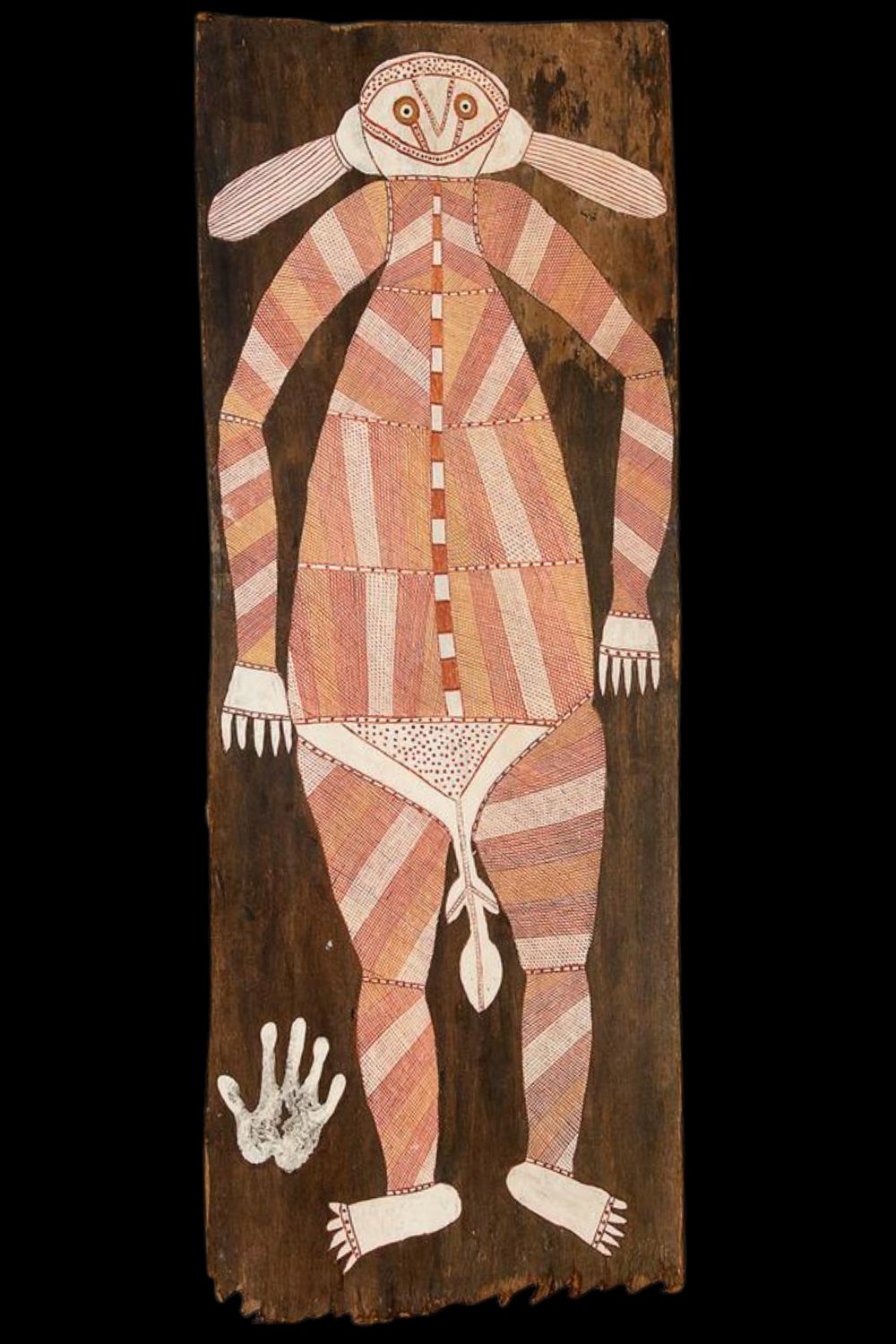
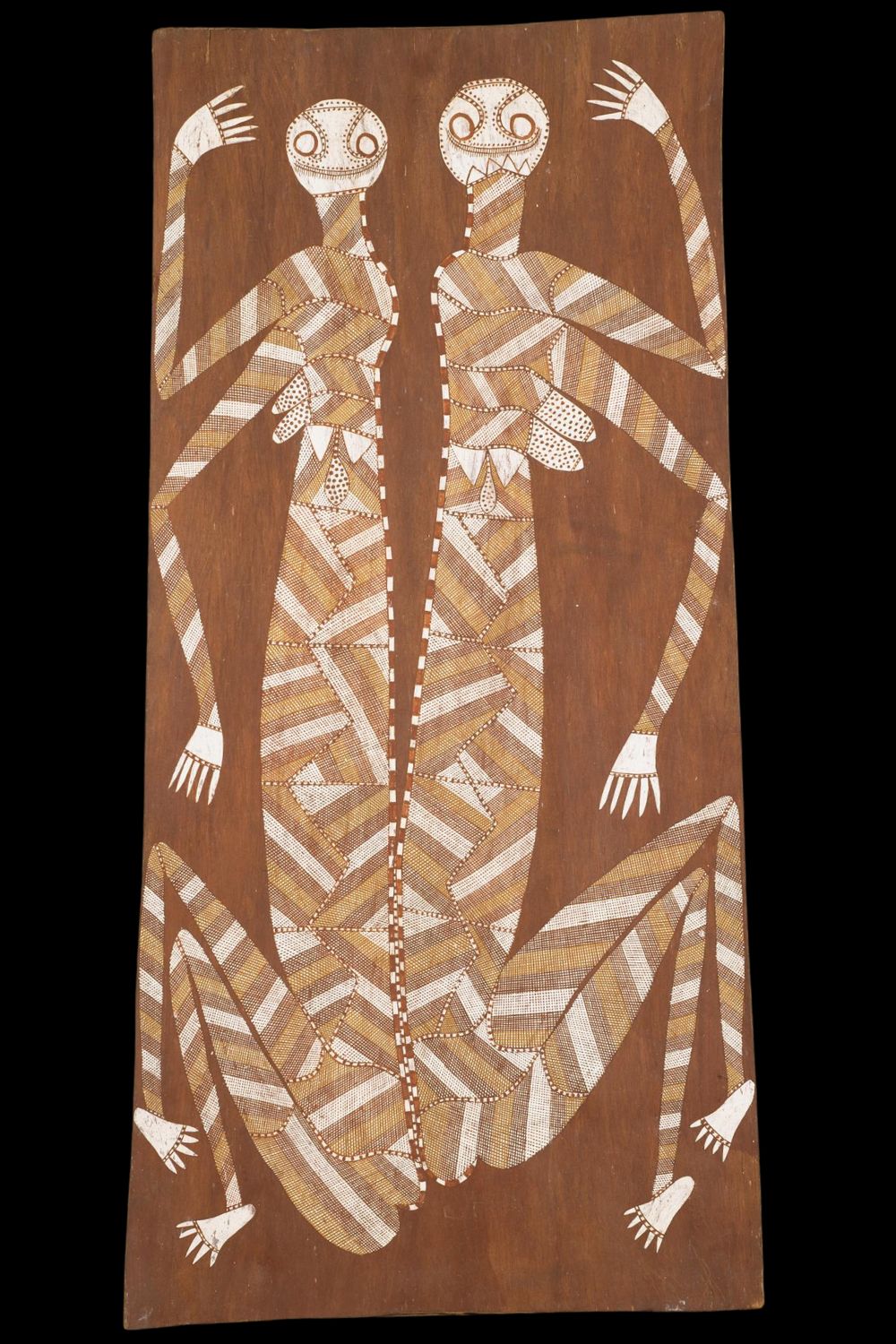
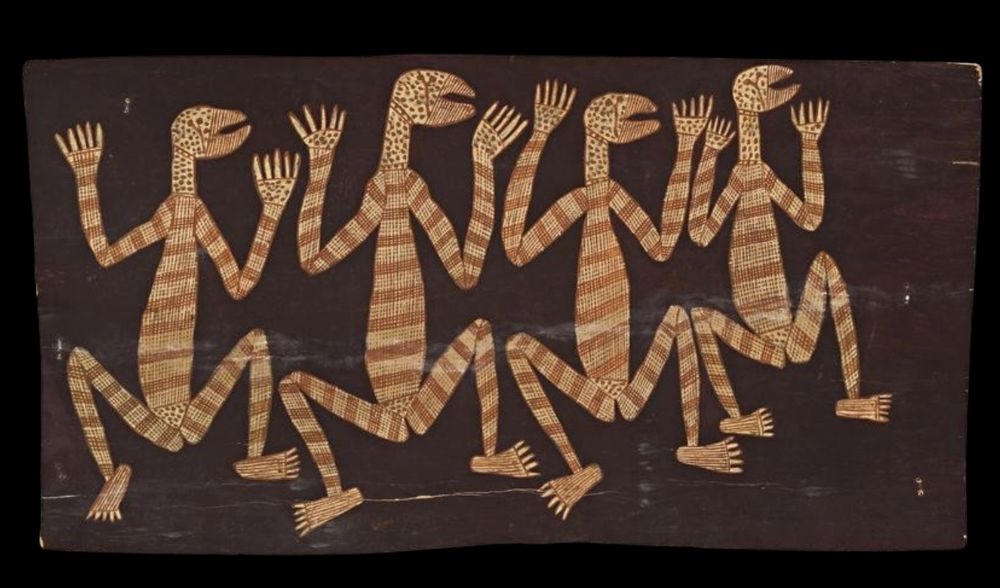
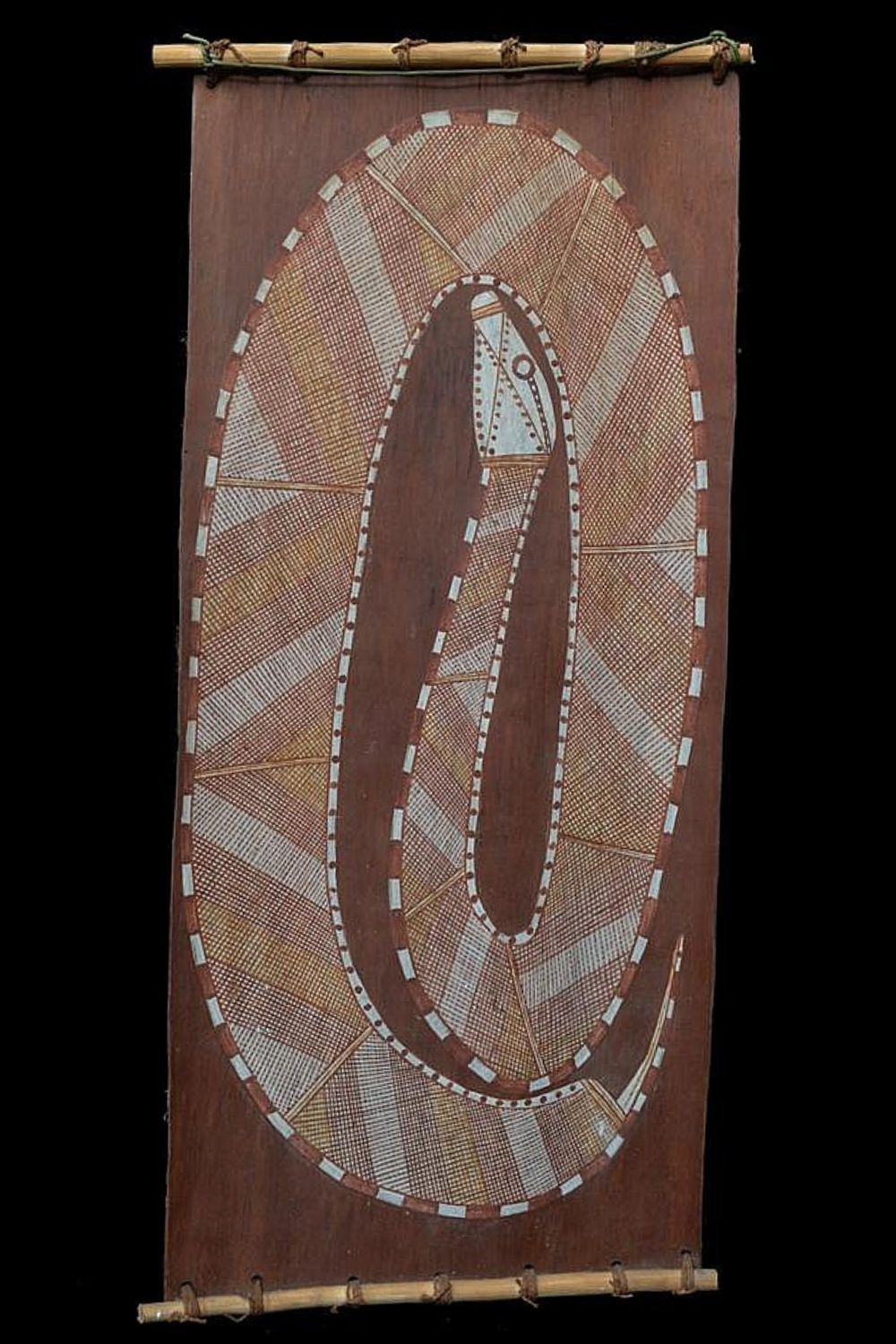
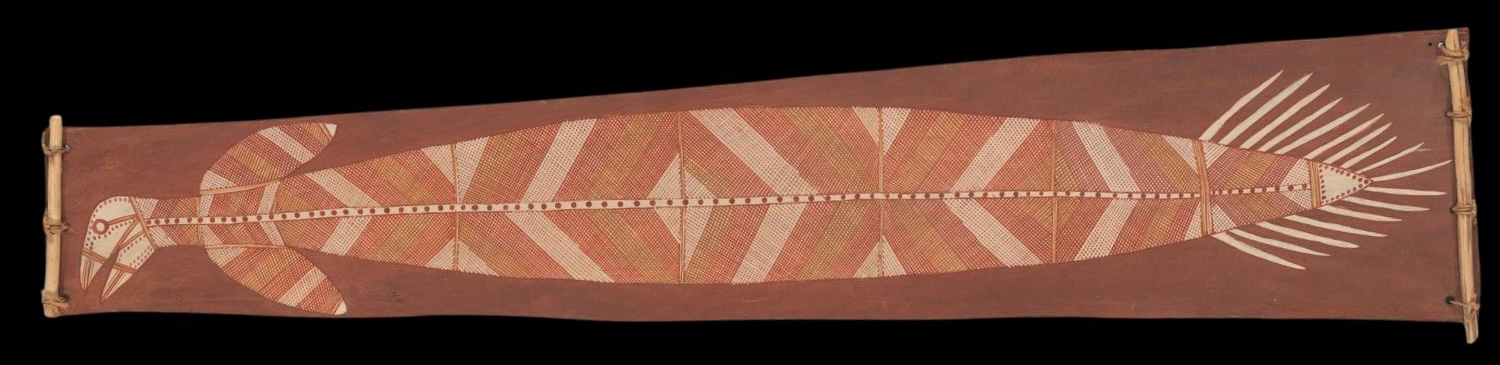
David Milaybuma developed a highly distinctive figurative style that combines finely executed rarrk (cross-hatching) with simplified ancestral forms. Unlike many western Arnhem Land artists who filled figures with uninterrupted cross-hatching, Milaybuma divided the body into carefully organised geometric sections. Alternating bands of coloured rarrk are separated by bold white panels or central white block motifs, creating a strong rhythm that guides the eye through the composition.
His paintings are characterised by:
- exceptionally fine natural pigment rarrk executed with remarkable consistency
- bodies divided into geometric panels of alternating cross-hatching rather than continuous fields of rarrk
- white bands or rectangular blocks separating areas of different coloured rarrk, particularly along the spine or body axis
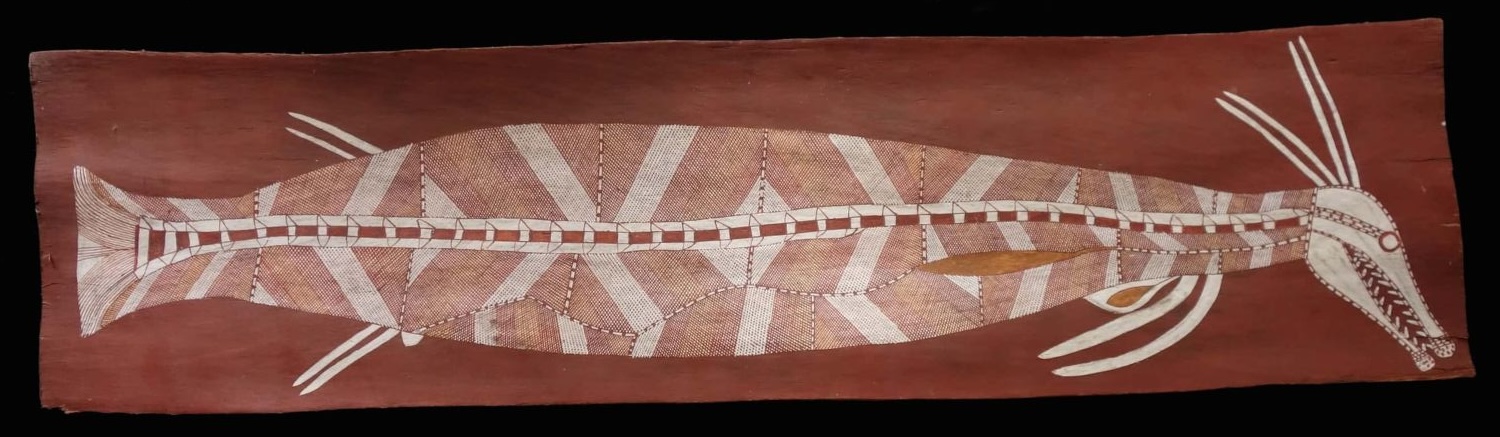
- simplified x-ray treatment, with the backbone and central nerve or spinal column often emphasised while internal organs are reduced, highly stylised or omitted altogether
- faces that are typically left white or decorated with dotted patterns rather than cross-hatching
- elongated, elegant figures with long limbs and carefully balanced proportions
- restrained palettes of white, yellow ochre, red ochre and brown natural pigments
- large areas of plain bark that give the figures considerable visual presence.
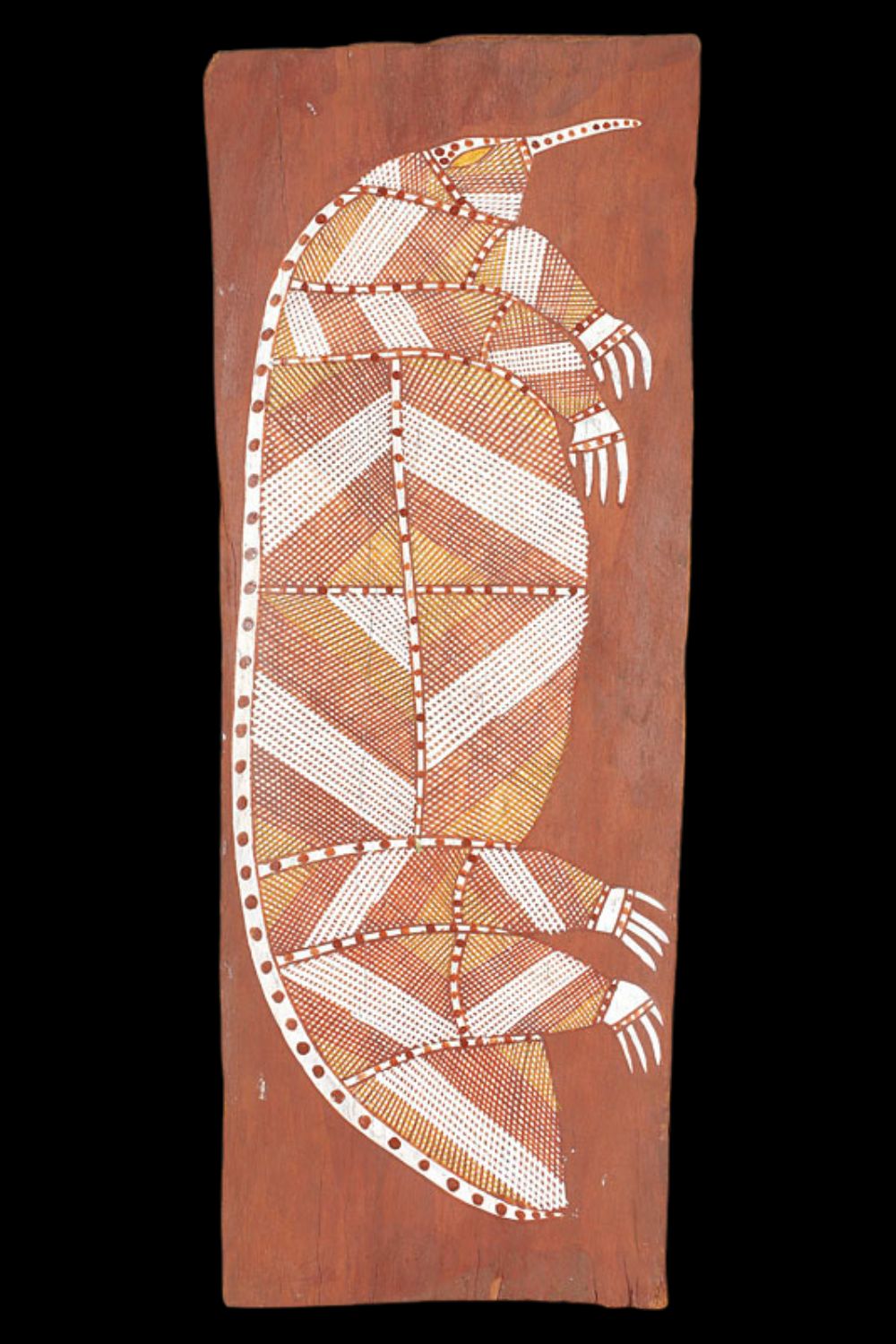
Unlike the densely anatomical x-ray paintings produced by some Arnhem Land artists, Milaybuma generally reduced the internal structure to its essential elements. Crocodiles, fish and ancestral beings commonly display a prominent backbone and central body axis, while organs such as the lungs, liver and stomach are either absent or represented only very subtly. This simplification gives his paintings a striking graphic quality that distinguishes them from more anatomically detailed x-ray traditions.
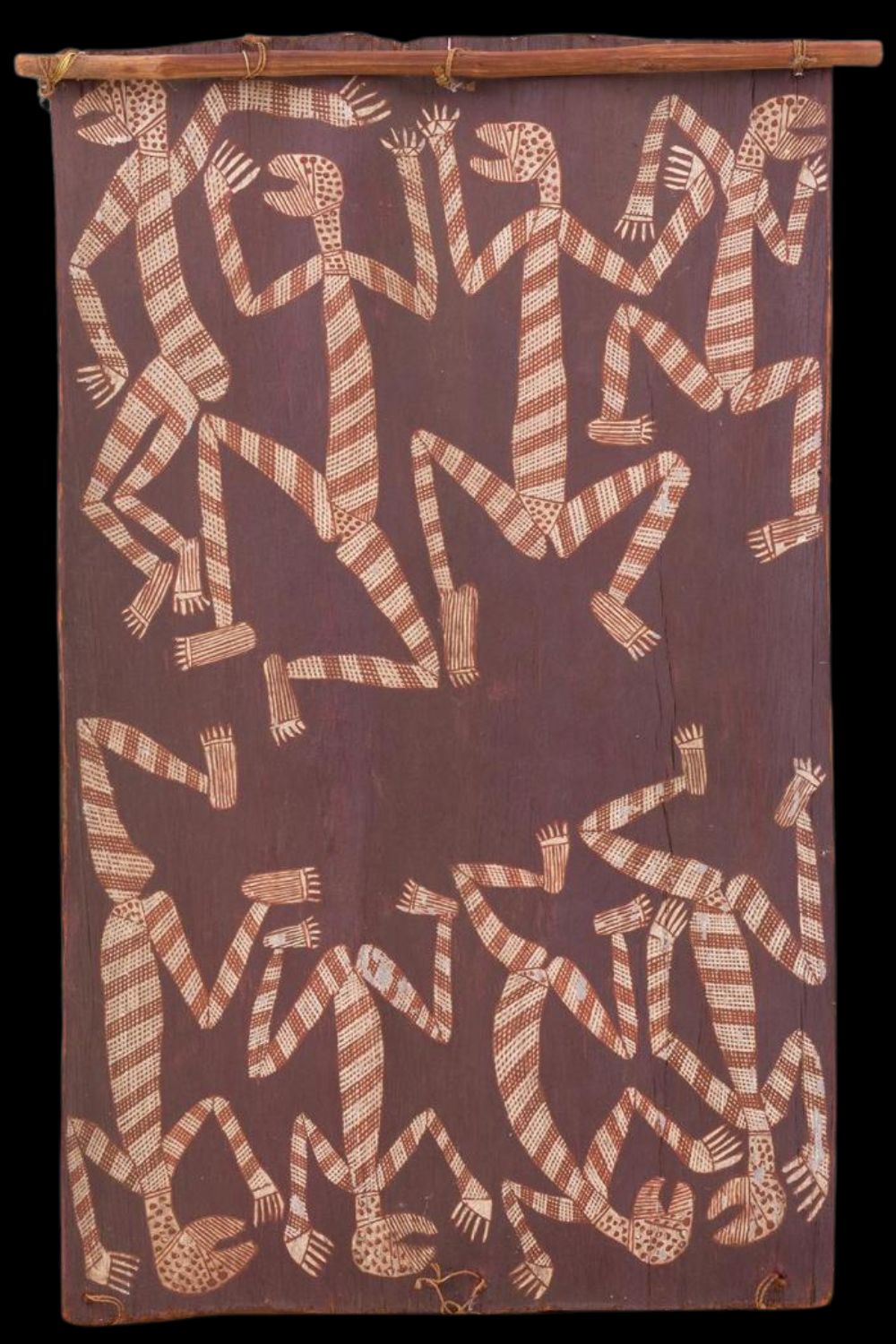
Perhaps the defining feature of Milaybuma’s work is its clarity. Whether depicting Mimih spirits, Yawkyawk figures or ancestral animals, his compositions avoid unnecessary complexity. Strong silhouettes, disciplined geometry and exceptionally controlled cross-hatching combine to produce paintings that are immediately recognisable from a distance yet reveal extraordinary technical refinement on close inspection.
Subjects
David Milaybuma painted many of the principal ancestral beings associated with western Arnhem Land, including:
- Namangwari (Saltwater Crocodile)
- Ngalyod (Rainbow Serpent)
- Yawkyawk spirit women
- Nawarran (Oenpelli Python)
- Mimih spirits
- Barramundi
- freshwater fish and reptiles
- waterbirds
- clan totems and sacred places.
His saltwater crocodiles are among his most recognisable works, combining powerful silhouettes with intricate internal rarrk and anatomical detail that reflect both ceremonial body designs and the western Arnhem Land x-ray painting tradition.
Beyond Bark Painting
One of the most significant aspects of David Milaybuma’s career was his contribution to anthropology and cultural documentation.
Luke Taylor’s field archives record Milaybuma guiding researchers to important Dreaming sites, identifying sacred places, explaining clan ownership, discussing the stories represented in his paintings and demonstrating traditional ecological knowledge. He also participated in documenting clan estates and recording knowledge of Country during an important period following the introduction of Aboriginal Land Rights legislation.
These collaborations established Milaybuma as more than an accomplished artist. He was a respected cultural educator whose knowledge helped preserve important aspects of Kuninjku history, ceremony and traditional law.
Printmaking
In 1979 David Milaybuma and fellow Arnhem Land artist John Bulunbulun travelled to Melbourne to work with Port Jackson Press, becoming among the first Aboriginal artists from Arnhem Land to produce fine-art screenprints.
Milaybuma’s Crocodile, Barramundi and Yabby remains one of the landmark Indigenous prints of the period and demonstrated that traditional Kuninjku imagery could be successfully adapted to contemporary printmaking while retaining its cultural integrity.
Recognition
David Milaybuma achieved national recognition during his lifetime.
His work is represented in major public collections, including the National Gallery of Victoria, the Art Gallery of South Australia and the Australian Parliament House Art Collection.
In 1982 one of his bark paintings was reproduced on an Australia Post 27-cent stamp, bringing his work to a national audience and reflecting the growing recognition of Aboriginal art within Australia’s cultural identity.
Today his paintings continue to be exhibited as outstanding examples of traditional Kuninjku bark painting and remain an important record of western Arnhem Land cultural traditions.
David Milaybuma Paintings for Sale
David Milaybuma’s bark paintings appear only occasionally on the secondary market. Collectors generally place the greatest value on works with:
- documented Maningrida or early gallery provenance
- finely executed rarrk
- large, well-preserved sheets of bark
- important ancestral subjects such as Ngalyod or Namangwari
- exhibition or publication history
- excellent structural condition.
Because Milaybuma was both an accomplished artist and a respected cultural authority, authenticated examples remain highly sought after by collectors of Arnhem Land bark paintings.
David Milaybuma Artwork Value
The value of David Milaybuma’s paintings depends on size, condition, subject matter, provenance and exhibition history.
Smaller bark paintings and works on paper generally sell for several hundred dollars, while larger, high-quality bark paintings with strong provenance and important ancestral subjects command $1000 – $3000. His finest works have achieved several thousand dollars at public auction, with documented examples attracting consistent interest from collectors of early Arnhem Land bark painting.
If you own a painting by David Milaybuma and would like to know its value or are considering selling it, please feel free to contact me. Include clear photographs of the front and back, the dimensions, and any known provenance or purchase history.
All images in this article are for educational purposes only.
This site may contain copyrighted material the use of which was not specified by the copyright owner.