Owen Yalandja: Aboriginal Sculptor and Bark Painter
- 1962–
- Kuninjku
- Dangkorlo clan, Barrihdjowkkeng / Mirrayar Country
- Maningrida, Western Arnhem Land
- Arnhem Land Art / Kuninjku Art
- Carved wooden Yawkyawk sculptures / Bark painting
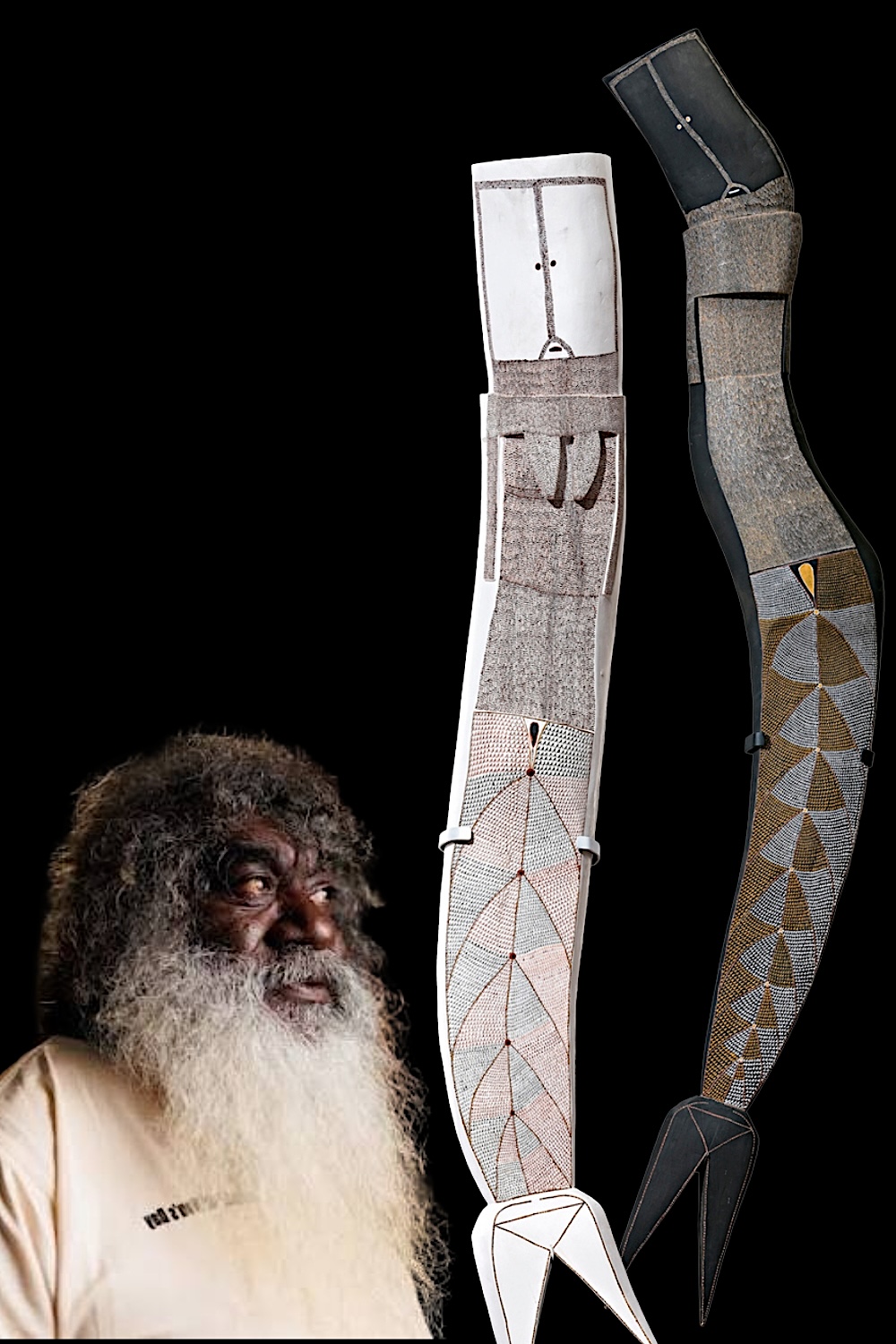
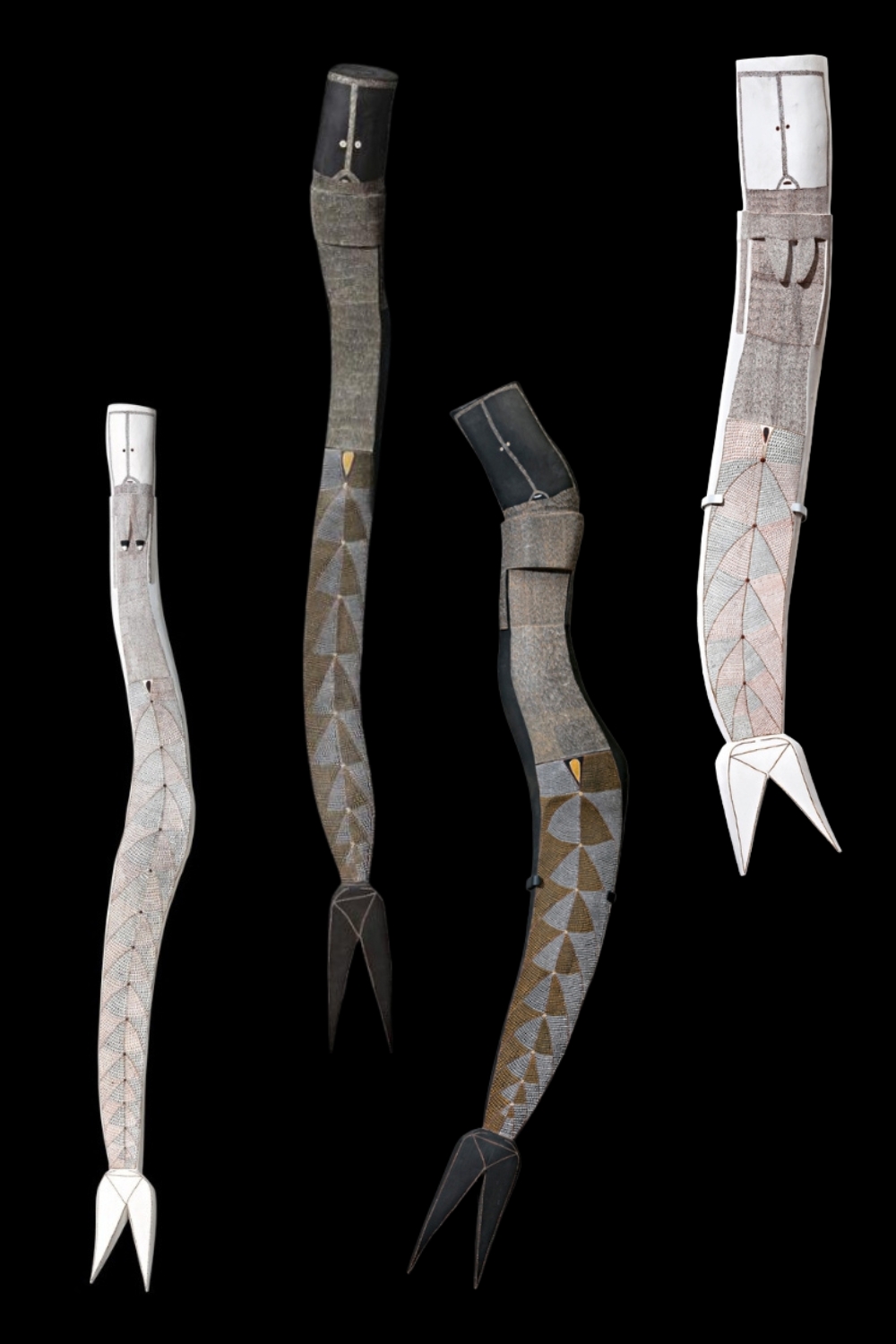
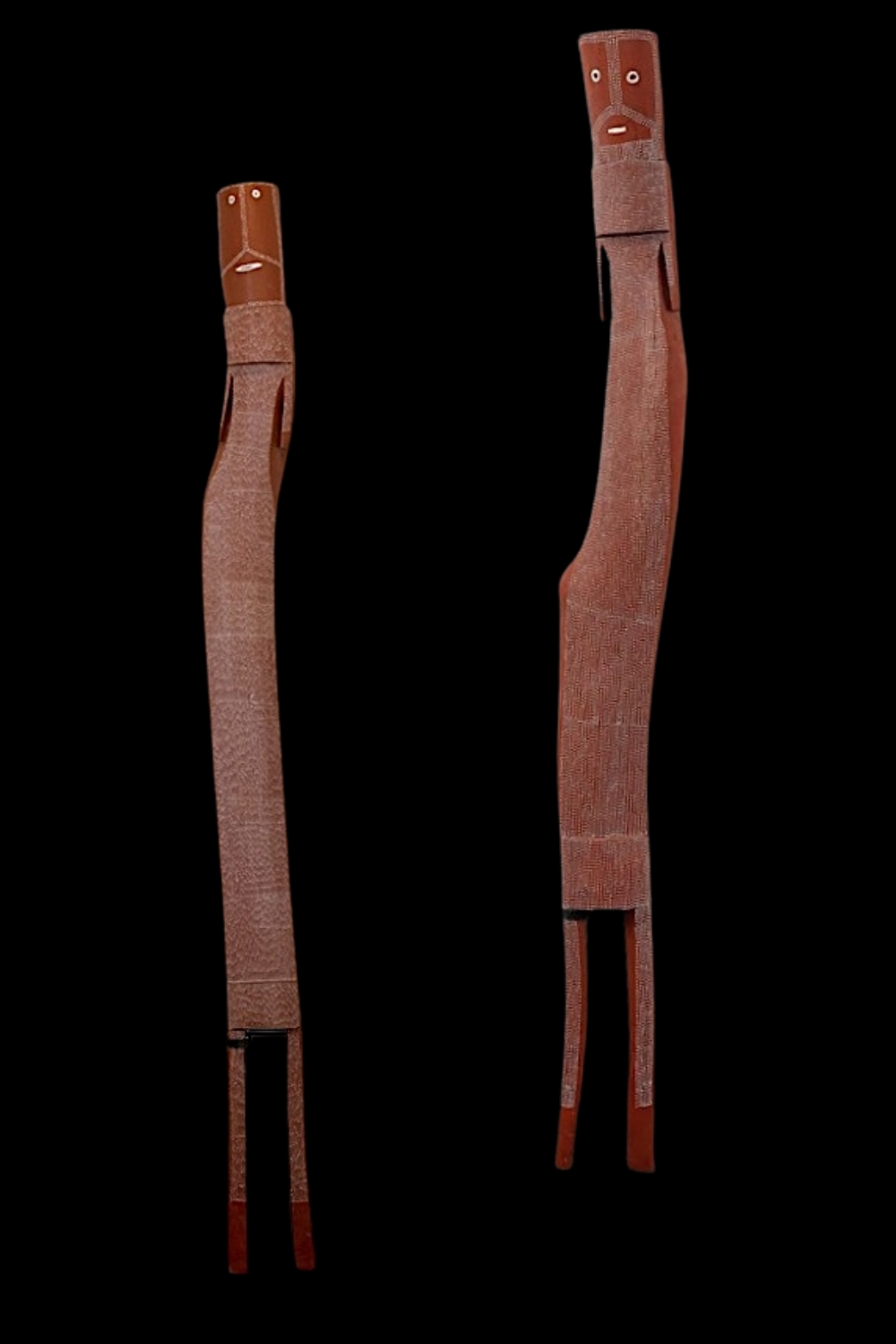
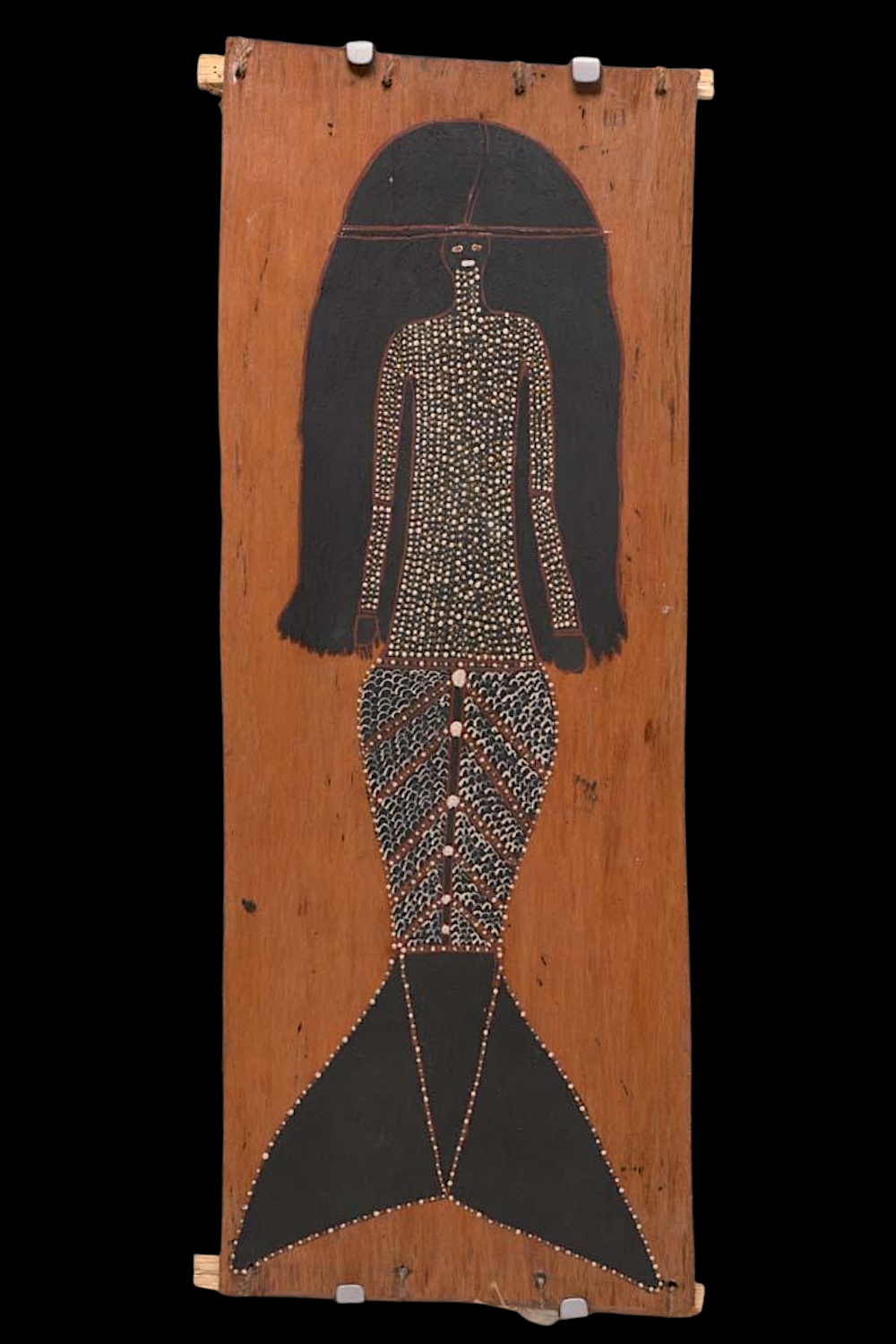
Owen Yalandja (born 1962) is a Kuninjku Aboriginal sculptor and Aboriginal bark painter from western Arnhem Land, best known for his distinctive wooden sculptures of Yawkyawk (ancestral female freshwater spirits). The son of pioneering sculptor Crusoe Kuningbal and brother of Crusoe Kurddal, Yalandja transformed his family’s tradition of carving slender Mimih (ancestral spirits) into a highly individual style distinguished by flowing female forms, fish-like tails and intricate painted scales.
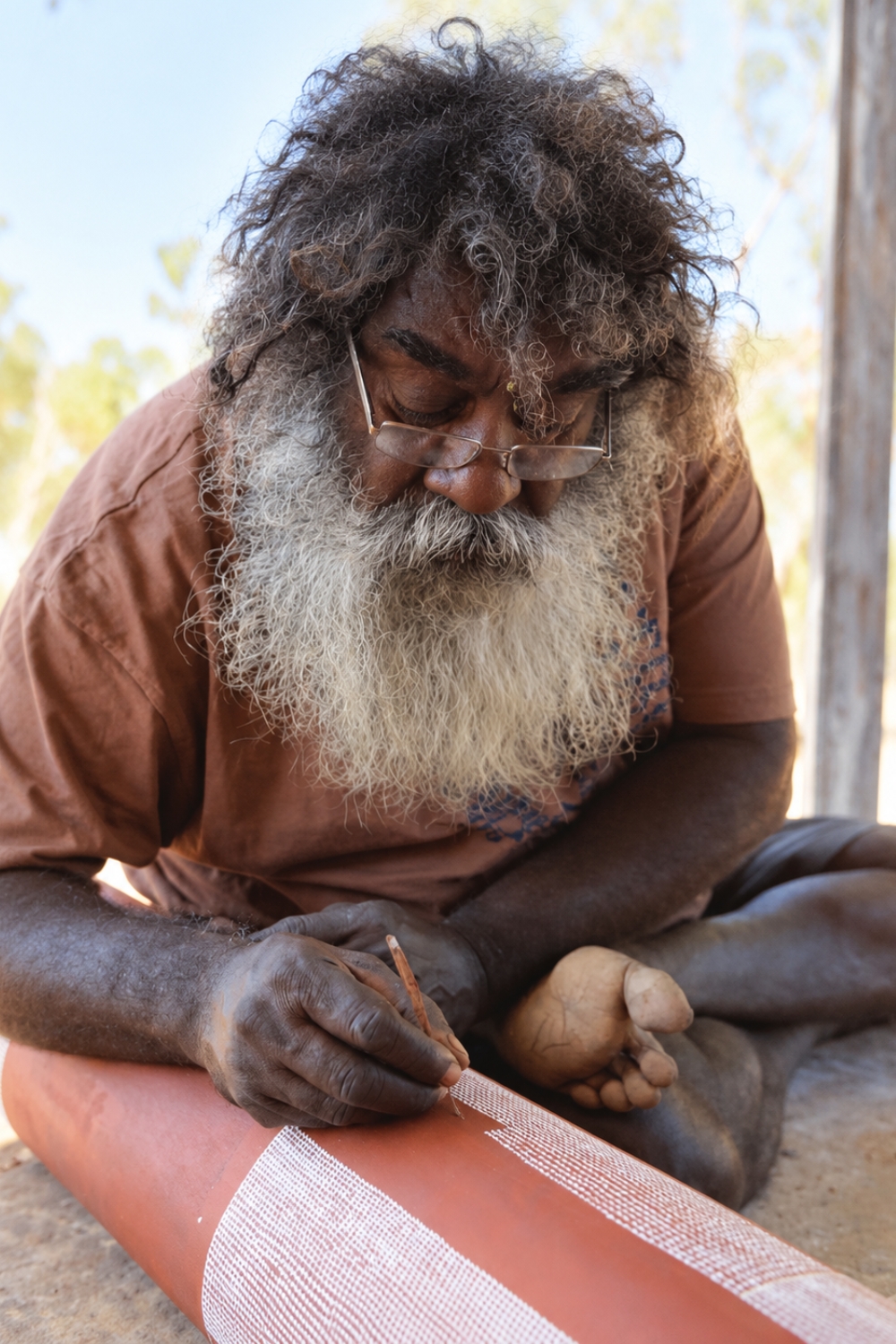
A senior member of the Dangkorlo clan, Yalandja works from Barrihdjowkkeng, near Maningrida. His increasingly abstract Aboriginal bark paintings, in which dense fields of fine V-shaped markings evoke ancestral presence, invite comparison with the work of fellow Kuninjku artist John Mawurndjul. His sculptures have been exhibited internationally since the 1990s, and in 2023 he won the Telstra Bark Painting Award
Owen Yalandja Biography
Owen Yalandja was born in 1962 into a family of Kuninjku artists and ceremonial leaders in western Arnhem Land. His father, Crusoe Kuningbal, was an influential singer and sculptor who pioneered the production of freestanding wooden Mimih figures associated with the Mamurrng (ceremonial exchange) tradition.
During the Second World War, Kuningbal spent time at Milingimbi Mission, where he encountered mokuy (spirits) associated with mourning ceremonies in central Arnhem Land. He subsequently became renowned for his knowledge of kunborrk (traditional ceremonial songs) and for developing wooden sculptures decorated with rows of painted dots.
Before his death in 1984, Kuningbal established an outstation at Barrihdjowkkeng and encouraged his wife Lena Kurinya and their sons Owen Yalandja and Crusoe Kurddal to continue the family’s carving tradition.
Yalandja learned sculpture from his father during the early 1980s. His earliest works followed the established family style, including Mimih figures and bark paintings. A surviving Mimih bark painting dated circa 1990 demonstrates his early engagement with the subjects and techniques inherited from his father.
By the early 1990s, Yalandja had begun concentrating on the female freshwater spirits associated with his Dangkorlo clan estate. A monumental Yawkyawk carved in 1993 was exhibited in Metamorphosis: Contemporary Australian Aboriginal Photography and Sculpture, presented at Palazzo Papadopoli during the 1997 Venice Biennale. The sculpture was subsequently exhibited in Turin in 2001 and Utrecht in 2002.
Further international recognition followed with exhibitions in Girona and Barcelona in 2004–05. In 2007 his work was included in Culture Warriors, the inaugural National Indigenous Art Triennial at the National Gallery of Australia, confirming his standing among Australia’s leading contemporary Aboriginal artists.
Owen Yalandja Sculpture and Painting Style
Yalandja initially adopted his father’s techniques but gradually developed new sculptural forms and painted designs. His early Yawkyawk figures retained the elongated proportions of Kuningbal’s carvings while introducing twisting female bodies and tapering fish-like tails.
The dots inherited from his father developed into delicate curved marks and eventually into closely spaced V-shaped scales, sometimes arranged in overlapping chevrons or alternating dark and light triangles.
Yalandja explained his artistic independence in a conversation with Apolline Kohen in 2007:
“I make it (yawkyawk) according to my individual ideas. My father used to decorate them with dots. A long time ago, he showed me how to do this, but this style is my own, no one else does them like this.”
Other Aboriginal artists who have depicted Yawkyawk (ancestral female freshwater spirits) include Bobby Ngainjmirra, Mick Kubarrku and Peter Marralwanga, each working within the artistic traditions of western Arnhem Land.
Sculpture: Timber, Form and Movement
Yalandja’s early sculptures included works carved from the soft cotton-tree timber traditionally used for Mimih figures. As his sculptural ambitions developed, he increasingly favoured kurrajong, a stronger timber that allowed him to carve elaborate three-dimensional forms without the wood splitting across the grain.
He carefully selected naturally curved and forked tree trunks, incorporating their existing shapes into the finished sculptures. The curves of the timber became twisting bodies and divided tails, giving his figures an impression of movement through water.
His later works became increasingly monumental, with fuller female bodies and complex arrangements of multiple figures.
An outstanding example is his three-part Yawkyawk installation of 2010, acquired by the National Gallery of Victoria. One figure has two heads formed from the natural fork of a tree, another depicts a pregnant spirit with an embryonic figure inside her abdomen, while the third is surrounded by smaller spirits twisting around her body.
These sculptures demonstrate Yalandja’s ability to combine the natural character of the timber with increasingly ambitious figurative compositions.
Bark Painting: From Figurative Art to Abstraction
Yalandja’s bark paintings developed alongside his sculpture, eventually taking the intricate scale patterns of his carved figures in a new direction.
His early paintings included recognisable ancestral figures, but he later began producing bark paintings and lorrkon (hollow-log forms) covered entirely with minute V-shaped markings.
In these works, the ancestral being is no longer necessarily depicted as a recognisable figure. Instead, the repeated patterns express its continuing presence at a particular ancestral site.
Judith Ryan, Senior Curator of Indigenous Art at the National Gallery of Victoria, identifies this development as an important move towards abstraction. She compares Yalandja’s approach with that of John Mawurndjul, whose intricate crosshatched paintings similarly communicate the ancestral significance of particular places without necessarily depicting their associated beings.
Yalandja’s abstract paintings are therefore an extension of his sculptural practice. The scales that originally described the surface of a carved ancestral figure became an independent means of representing ancestral presence.
Owen Yalandja’s Artistic Subjects
The principal subject of Yalandja’s mature work is the Yawkyawk, an ancestral female freshwater spirit associated with his Dangkorlo clan estate in western Arnhem Land. As a senior clan member, Yalandja has inherited cultural responsibilities for Mirrayar billabong, a Yirridjdja-moiety ancestral site near Barrihdjowkkeng.
His sculptures and paintings are therefore grounded in a specific ancestral relationship rather than simply illustrating traditional stories. His earlier work also included Mimih spirits, reflecting the artistic tradition established by his father.
For the ancestral narratives and wider cultural meaning of these beings, see Yawkyawk (Ngalkunburriyaymi): The Spirit Mermaids of Arnhem Land
Owen Yalandja Value
Works Offered at Auction: 64
Sale Rate: 88%
Highest Sale: $42,000 AUD
Median Sale Price: $4,000 AUD
The Importance of Owen Yalandja in Aboriginal Art
Owen Yalandja’s importance lies in extending the possibilities of western Arnhem Land sculpture beyond the forms established by the previous generation. His increasingly monumental and technically ambitious figures demonstrate how an inherited artistic tradition can accommodate substantial individual innovation without losing its ancestral foundations.
Equally significant is his contribution to bark painting. By developing the surface markings of his sculptures into independent abstract compositions, Yalandja established a distinctive relationship between two artistic media. His achievement belongs to a wider movement in contemporary Kuninjku art, exemplified by artists such as John Mawurndjul, in which ancestral knowledge is expressed through increasingly abstract visual forms.
His contribution was recognised in 2023 when he received the Telstra Bark Painting Award at the National Aboriginal and Torres Strait Islander Art Awards for Ngalkodjek Yawkyawk.
Owen Yalandja in Public Collections
Owen Yalandja’s sculptures and paintings are represented in major Australian and international public collections. These holdings include early Mimih figures, monumental Yawkyawk sculptures and examples of his development as a contemporary Aboriginal artist.
Australian Public Collections
- National Gallery of Australia, Canberra
- National Gallery of Victoria, Melbourne
- Art Gallery of New South Wales, Sydney
- Art Gallery of South Australia, Adelaide
- Queensland Art Gallery, Brisbane
International Public Collections
Further Reading on Owen Yalandja
The following publications and museum resources provide additional information about Yalandja’s artistic development and the traditions of western Arnhem Land art.
- Ryan, Judith. Magical Transformations: Yawkyawk and Ngalyod Become Art. National Gallery of Victoria. Examines Yalandja’s sculpture, his father’s carving tradition and the development of his abstract painting.
- Taylor, Luke. Outstation: Works by Ivan Namirrkki, John Mawurndjul, Owen Yalandja and Paul Nabulumo. 2018. Explores the work of four western Arnhem Land artists and their relationships to ancestral Country.
All images featured in this article are presented strictly for educational and informational purposes.
This website may include copyrighted material for which specific authorization has not been obtained from the copyright owner.
All such images are presumed to be the intellectual property of the respective artist or their estate, and are used in accordance with principles of fair dealing or fair use under applicable copyright law.