William Barak (King Billy) – Painting the Survival of Wurundjeri Culture
- c. 1824–1903
- Wurundjeri Woi-wurrung (Eastern Kulin)
- Yarra River (Birrarung) Country, Victoria
- Coranderrk / South-Eastern Australia
- South-Eastern Aboriginal Art / Ceremonial Art
- Earth pigments, charcoal and watercolour on paper; carved and painted shields
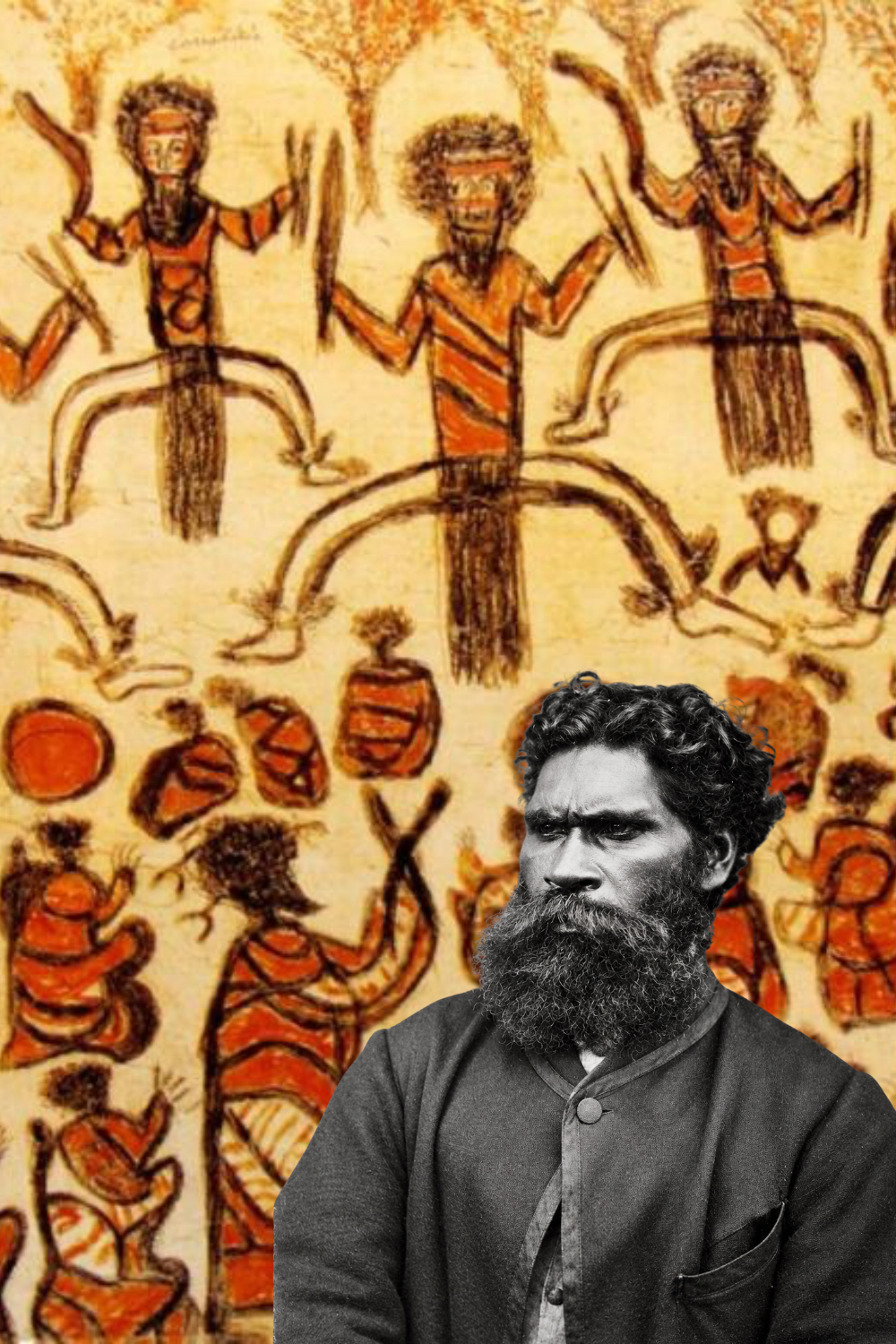
William Barak (c. 1824–1903), known as Beruk, was a Wurundjeri Woi-wurrung artist, ceremonial leader and one of the most influential Aboriginal political figures of nineteenth-century Australia.
Born before the European settlement of Melbourne, Barak witnessed the dispossession of his people, fought to protect their land at Coranderrk and became an extraordinary painter of Aboriginal ceremonial life.
Alongside Tommy McRae and Mickey of Ulladulla, Barak was among the most important Aboriginal artists working on paper during the nineteenth century. His drawings depict dancers, ancestral animals, ceremonial gatherings and figures wearing elaborately decorated possum-skin cloaks.
Created predominantly during the final decades of his life, his paintings preserve knowledge of ceremonies and cultural practices that colonial authorities sought to suppress.
Barak defended Wurundjeri Country through political action and maintained Wurundjeri culture through ceremony, storytelling and painting.
William Barak Biography
Childhood Before the Founding of Melbourne
William Barak was born around 1824 on Wurundjeri Country in the Yarra Valley, near present-day Melbourne. His father, Bebejan, was an important Wurundjeri leader, while his mother, Tooterrie, came from a family associated with the Goulburn River region.
He was related to several prominent Wurundjeri leaders, including Billibellary and Jakki Jakki, and was a cousin of Simon Wonga, who would later help establish Coranderrk.
Barak grew up learning to hunt, prepare weapons, identify plants and animals, and participate in ceremonies. The Wurundjeri were among the peoples of the Eastern Kulin nation, whose Country included the Yarra and Plenty Rivers and surrounding ranges.
In 1835, when Barak was approximately eleven, John Batman arrived in Port Phillip seeking land for European settlement.
According to Barak’s later recollections, he witnessed the meeting between Batman and Aboriginal leaders associated with the so-called Batman Treaty. Although the circumstances remain disputed, the agreement became closely associated with the dispossession of the Kulin peoples.
Barak remembered the arrival of settlers who cleared the land and transformed the landscapes of his childhood. In 1882, he dictated an account of these events, later published as My Words, providing rare testimony from an Aboriginal man who had experienced the founding of colonial Melbourne.
Mission Education and the Native Police
Between 1837 and 1839, Barak attended George Langhorne’s mission school near Melbourne, where he received instruction in English and Christianity.
In 1844, he joined the Port Phillip Native Police Corps, serving as a tracker under Captain Henry Dana. His intimate knowledge of Country made him valuable to the police, although the corps formed part of the colonial system that was transforming Aboriginal life.
After leaving the force, Barak faced increasingly difficult circumstances. Disease, displacement and the destruction of traditional food resources had devastated Aboriginal populations around Melbourne.
For Barak and his surviving community, securing somewhere to live together and maintain their connection with Country became an urgent priority.
Coranderrk and the Fight for Aboriginal Land
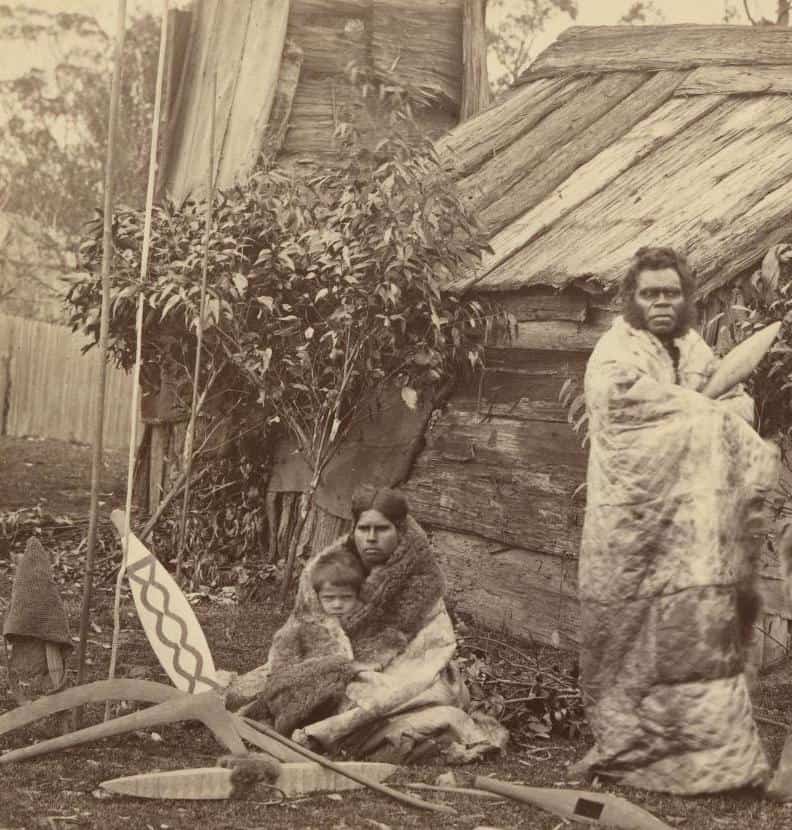
In 1859, Barak and his first wife, Lizzie, joined Aboriginal families establishing a settlement at Acheron, northeast of Melbourne.
When the arrangement proved insecure, Barak worked alongside his cousin Simon Wonga and government employee John Green to obtain a more permanent home.
In June 1863, approximately 2,300 acres were reserved at Coranderrk, near Healesville, at the meeting of Badger Creek and the Yarra River.
Coranderrk developed into a productive agricultural community. Residents grew vegetables and hops, raised livestock and made baskets, shields, boomerangs and other objects for sale.
Its success attracted opposition from neighbouring European landholders. Government authorities increasingly interfered with the settlement’s management and attempted to remove its residents.
Following Simon Wonga’s death in 1875, Barak became the recognised Wurundjeri Ngurungaeta, or traditional leader.
He organised petitions, led delegations to Melbourne and developed relationships with influential Europeans, including Graham Berry, Alfred Deakin and Anne Fraser Bon.
During the 1881 parliamentary inquiry into Coranderrk, Barak demanded that residents be allowed to manage their own affairs:
Give us this ground and let us manage here ourselves.
His campaigning helped secure Coranderrk’s continuing status as a reserve in 1884, although genuine self-government remained beyond reach.
The Aboriginal Protection Law Amendment Act of 1886 subsequently forced many residents of mixed ancestry to leave, separating families and undermining the community Barak had struggled to preserve.
He continued defending Coranderrk throughout his remaining years.
Family and Personal Tragedy
Barak married three times and suffered considerable personal loss.
His first wife, Lizzie, died before 1863. His second wife, Annie, and several of their children also died.
In 1881, his young son David became gravely ill. According to Wurundjeri family history, Barak carried him from Coranderrk to a hospital at Kew, but was not permitted to remain beside him. David subsequently died, aged approximately ten.
Annie also died of tuberculosis.
In 1890, Barak married his third wife, Sarah, a Gunaikurnai woman.
Despite these losses, he remained an active leader, storyteller and ceremonial authority. It was during these later decades, amid his continuing political struggles and personal bereavements, that he produced most of his surviving drawings.
The Art of William Barak
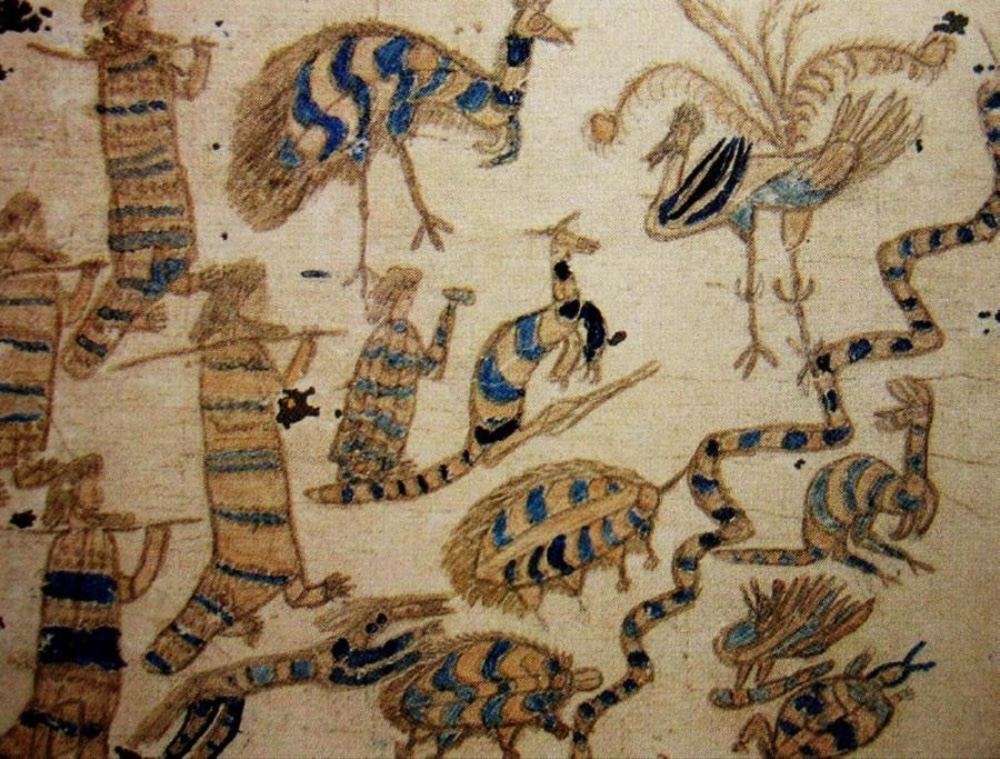
William Barak developed a distinctive painting style characterised by strong outlines, rhythmic movement and carefully arranged groups of figures.
Working predominantly on paper and cardboard, he combined traditional earth pigments and charcoal with introduced pencil, watercolour and gouache. His palette of ochre reds, yellows, browns and black reflected the materials used in southeastern Australian ceremonial painting and decorated cultural objects.
Barak generally outlined his figures before adding clothing, body designs and colour. His dancers have exaggerated movements, with widely spread legs and raised arms. Rather than following European conventions of perspective, he arranged people and animals according to their relationships within a ceremony.
His best-known compositions are organised into horizontal groups. Male dancers occupy the upper section, while seated participants wearing possum-skin cloaks appear below. Fires, musicians and animals occupy the intervening space. Repeated forms create an impression of movement and ceremonial rhythm.
The decorated surfaces of his figures are equally distinctive. Possum-skin cloaks contain sweeping curves and parallel lines, while patterns painted on bodies sometimes resemble those engraved on wooden shields.
Barak was himself an accomplished maker of shields, boomerangs and other cultural objects. In 1892, German ethnographer Arthur von Baessler observed him making fire-making equipment and boomerangs as well as paintings. Several shields attributed to Barak survive, including examples decorated with concentric diamond patterns.
He also occasionally painted on unconventional supports, including recycled printed material. A painting on bark reportedly presented to Lord Brassey, Governor of Victoria, during the 1890s has been described in historical records but has not been securely located.
His surviving works demonstrate considerable variety. Although ceremonial gatherings dominate his paintings, he also depicted hunting, ancestral beings, women carrying children and the animals of Wurundjeri Country.
Subjects in William Barak’s Paintings
Ceremonial Dance and Initiation – Ceremony, 1897
Ceremony was central to Wurundjeri spiritual and communal life, and it became Barak’s most important artistic subject.
His paintings record not merely the appearance of a gathering but the relationships between participants, including differences in age, authority and ceremonial responsibilities.
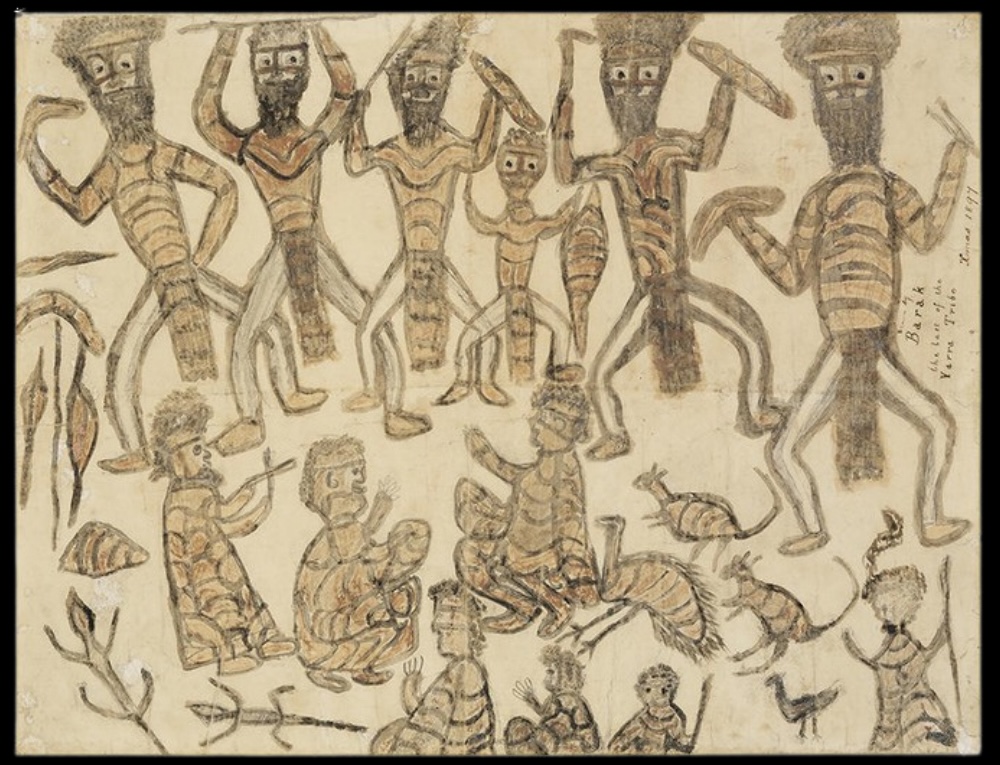
Ceremony (1897), sold by Bonhams in 2016, is particularly interesting because it may depict an initiation ceremony.
The upper section contains mature bearded men carrying spears, shields, boomerangs and a leangle club. Smaller, younger figures appear among them. In the centre, two crouching men perform animated movements beside an elder providing the rhythm.
Along one edge, Barak included an assortment of weapons and implements, including a spear, boomerang, broad shield and parrying shield.
Art historian Wally Caruana interpreted these details as possible evidence of initiation into adult male responsibilities. The relationship between the younger figures and senior men, together with the ceremonial weapons, suggests a ritual involving the transmission of knowledge and status.
Although the exact ceremony cannot be established, the painting demonstrates how Barak represented distinctions between participants through posture, personal adornment and the objects they carried.
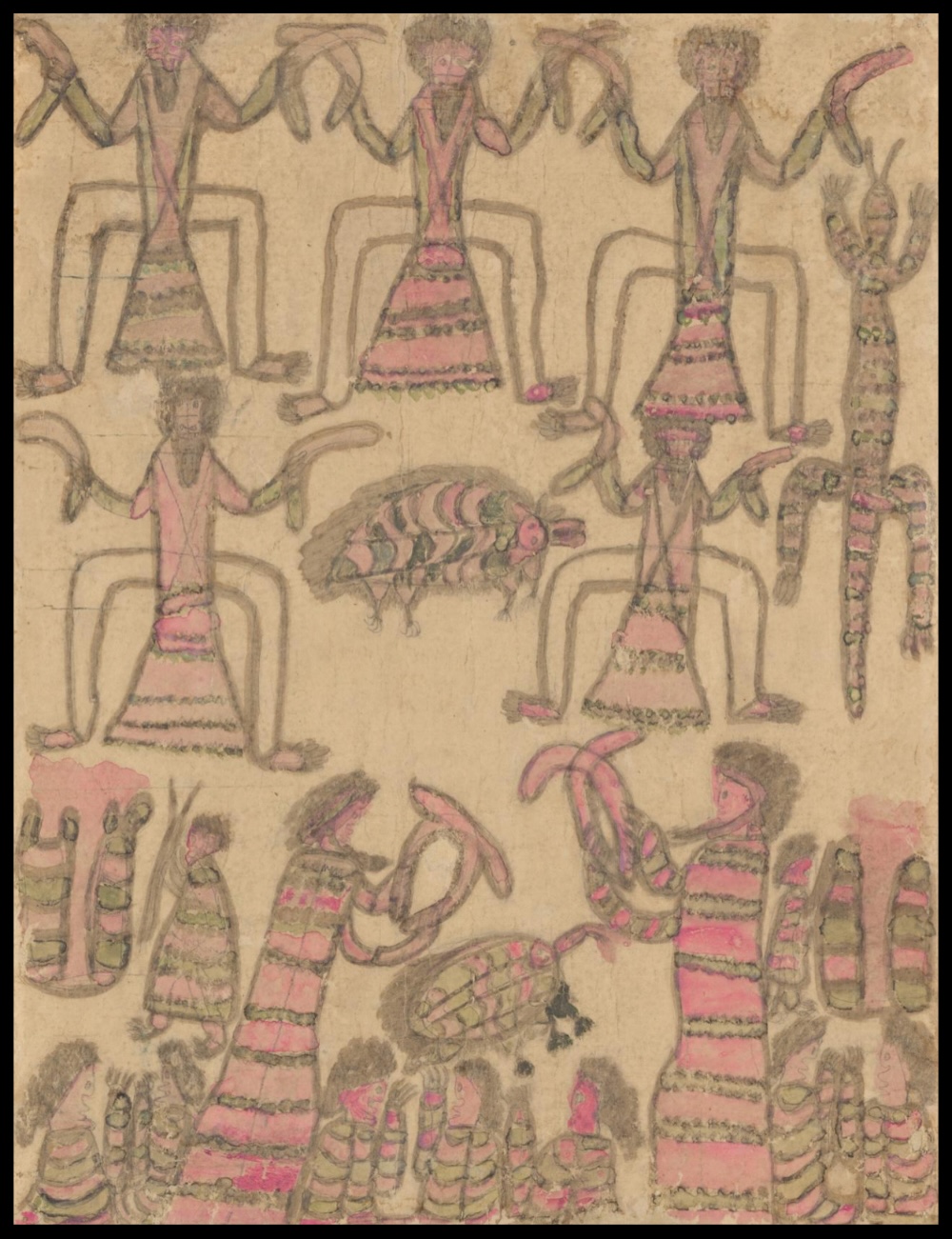
Possum-Skin Cloaks – Figures in Possum Skin Cloaks, 1898
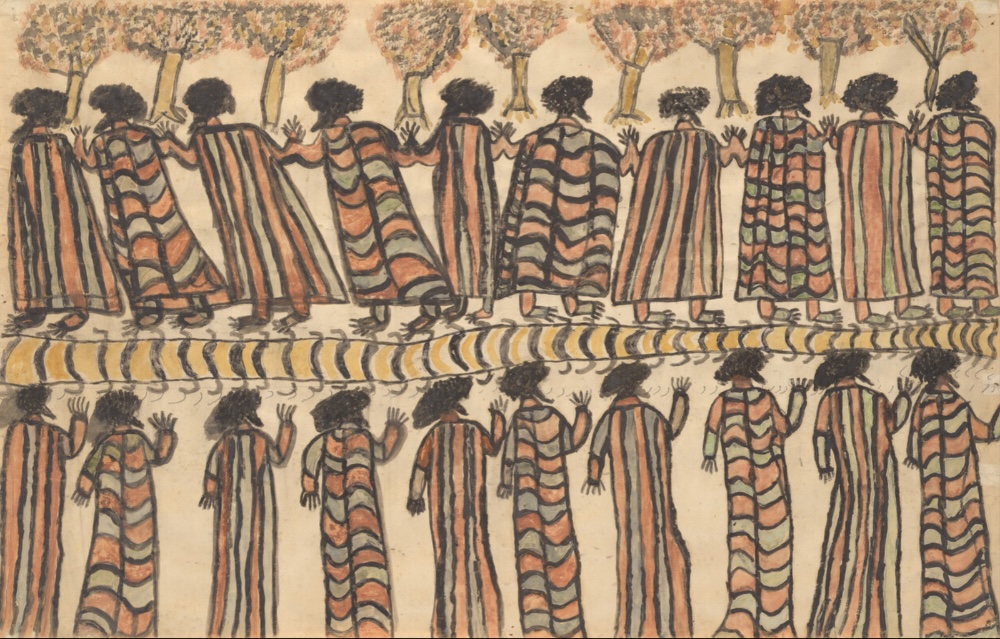
Figures in possum skin cloaks (1898), held by the National Gallery of Victoria, is one of William Barak’s most distinctive paintings.
The composition depicts two rows of Wurundjeri men wearing elaborately patterned possum-skin cloaks, with their hands raised. Stylised trees appear above the figures, while a long, serpentine form separates the two groups.
The cloaks were important expressions of identity. Made from joined possum skins, they provided warmth and could be decorated with incised designs associated with the wearer, their ancestry and Country. Additional skins were sometimes added throughout a person’s life.
Barak carefully differentiated the cloaks using alternating vertical stripes, curved bands and geometric patterns. Some designs resemble those found on traditional southeastern Australian shields and ceremonial objects.
Art historian Carol Cooper has suggested that the serpentine form may represent Mindi, a powerful ancestral being associated with Wurundjeri spiritual traditions. Although this interpretation remains uncertain, it suggests that the painting may communicate ceremonial knowledge beyond its depiction of cloaked figures.
The work was acquired by the National Gallery of Victoria in 1962 and is an important example of Barak’s use of traditional designs to express Wurundjeri cultural identity.
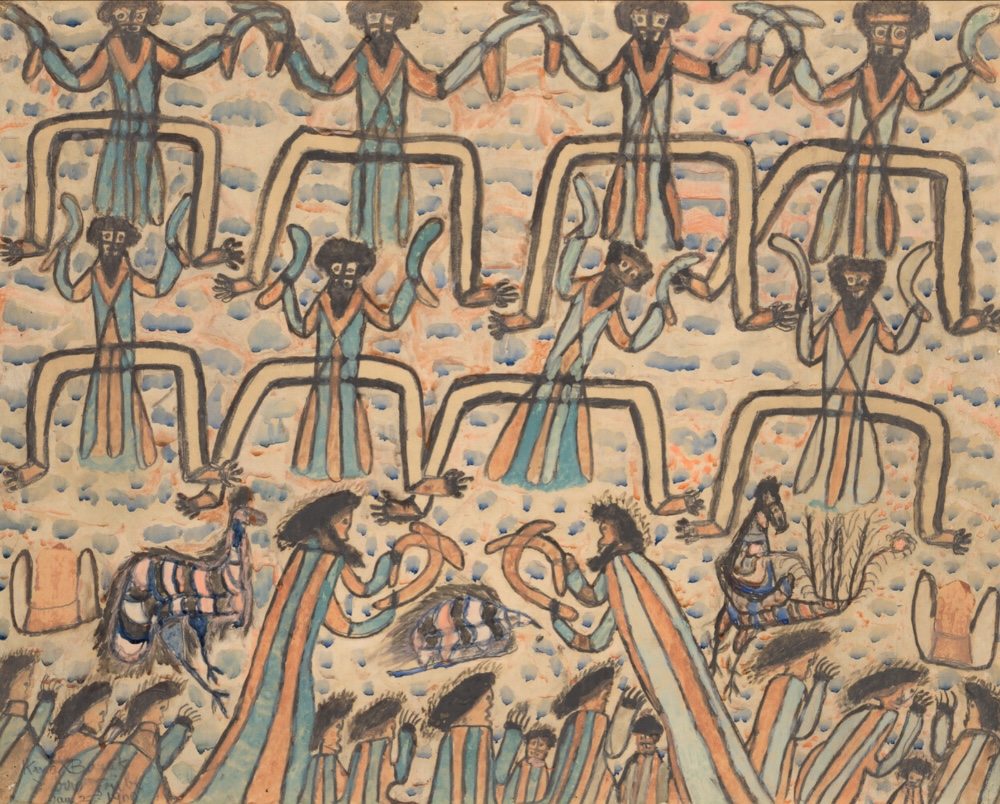
Ancestral Beings – Ceremony with Rainbow Serpent, c. 1880
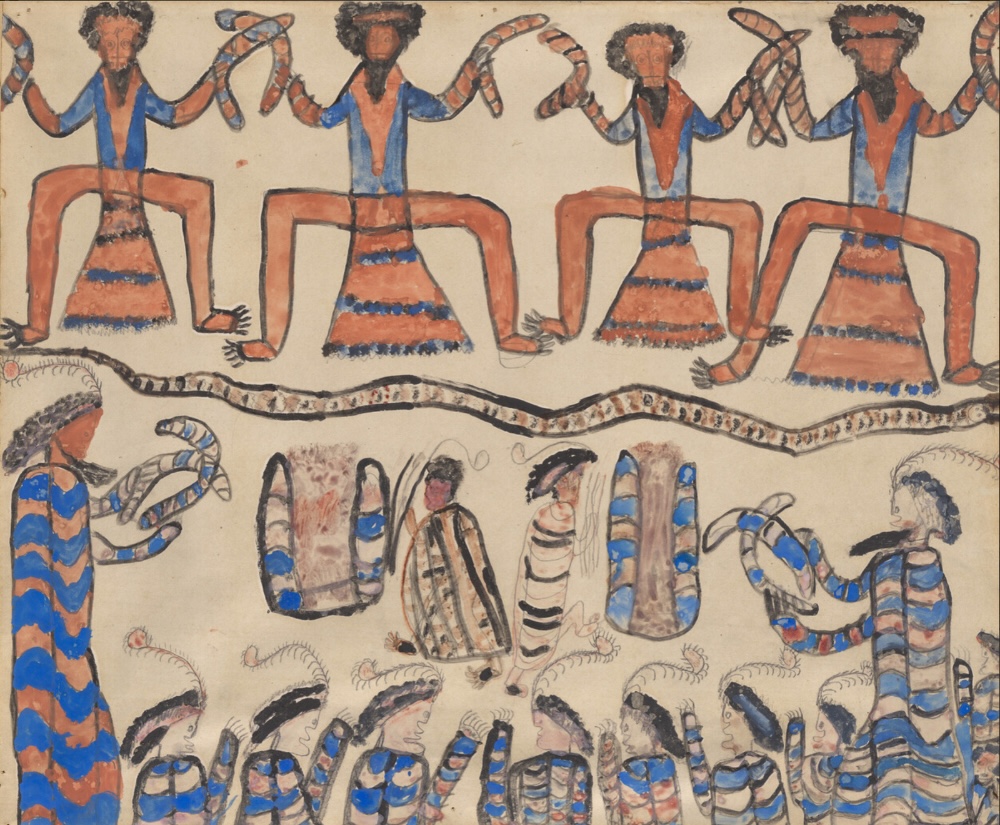
Not every ceremonial painting by Barak can be understood simply as a record of people dancing.
Some works incorporate imagery associated with ancestral beings and spiritual beliefs.
Ceremony with Rainbow Serpent, dating from approximately 1880 and held by the National Gallery of Victoria, is an important example.
Executed in pencil, gouache, earth pigments and charcoal on paper, the drawing measures 48.5 × 58.5 centimetres.
The work’s title identifies the Rainbow Serpent as part of its ceremonial subject. It suggests that Barak’s paintings could bring together human participation and ancestral narratives within a single composition.
Such subjects are important because ceremonies were not simply social gatherings. They could involve songs, dances and designs relating to ancestral events, places and responsibilities.
The precise cultural interpretation of this particular drawing should not be assumed from its title alone, but its inclusion within Barak’s surviving work demonstrates the spiritual dimensions of his artistic subjects.
Hunting and the Natural World – Untitled (Hunting an Emu)
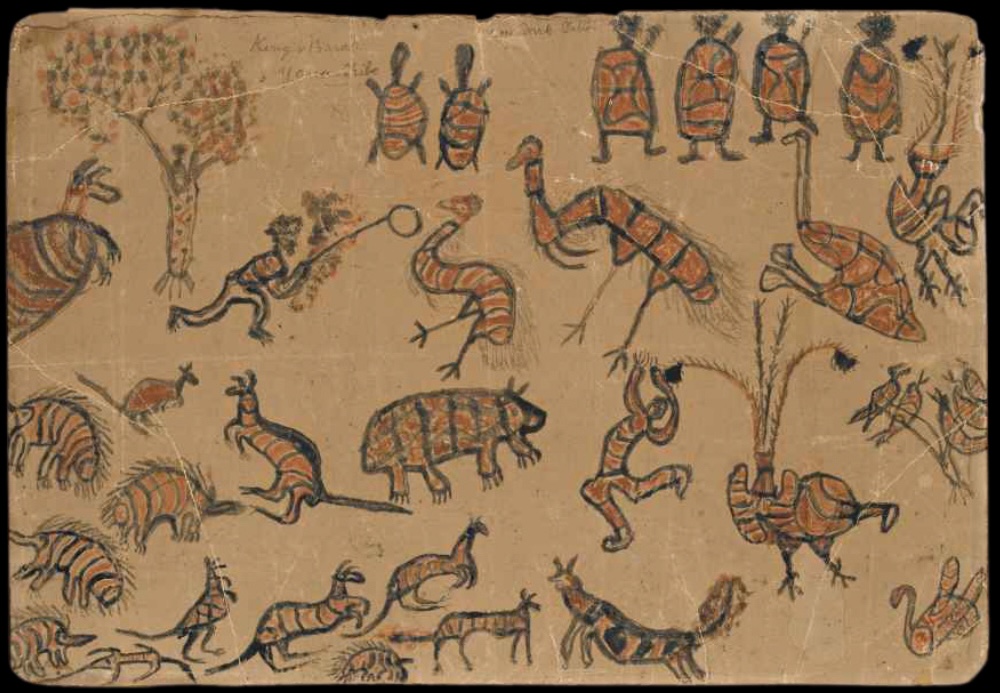
A rare hunting composition sold in 2009 demonstrates another aspect of Barak’s art.
Rather than depicting a formal ceremony, the drawing shows an emu attempting to escape two hunters. One advances carrying a snare and a bundle of branches intended to conceal his movements.
Around them, Barak included wombats, echidnas, kangaroos, wallabies, turtles, reptiles and numerous birds.
Unlike his carefully structured ceremonial paintings, the animals are scattered across the surface in a lively, informal composition.
Particularly striking are two lyrebirds depicted from behind, allowing Barak to show their distinctive tail feathers. Most of the other animals are shown in profile.
This drawing reveals Barak’s keen observation of animal behaviour and his ability to adapt his artistic approach to the subject.
Hunting had been an essential part of his early life, and his knowledge of the natural world was grounded in decades spent travelling through Wurundjeri Country.
The drawing therefore provides a different perspective on an artist usually associated with ceremonial imagery, demonstrating that his interests also extended to the everyday skills and wildlife of the landscapes he knew intimately.
William Barak’s Shields
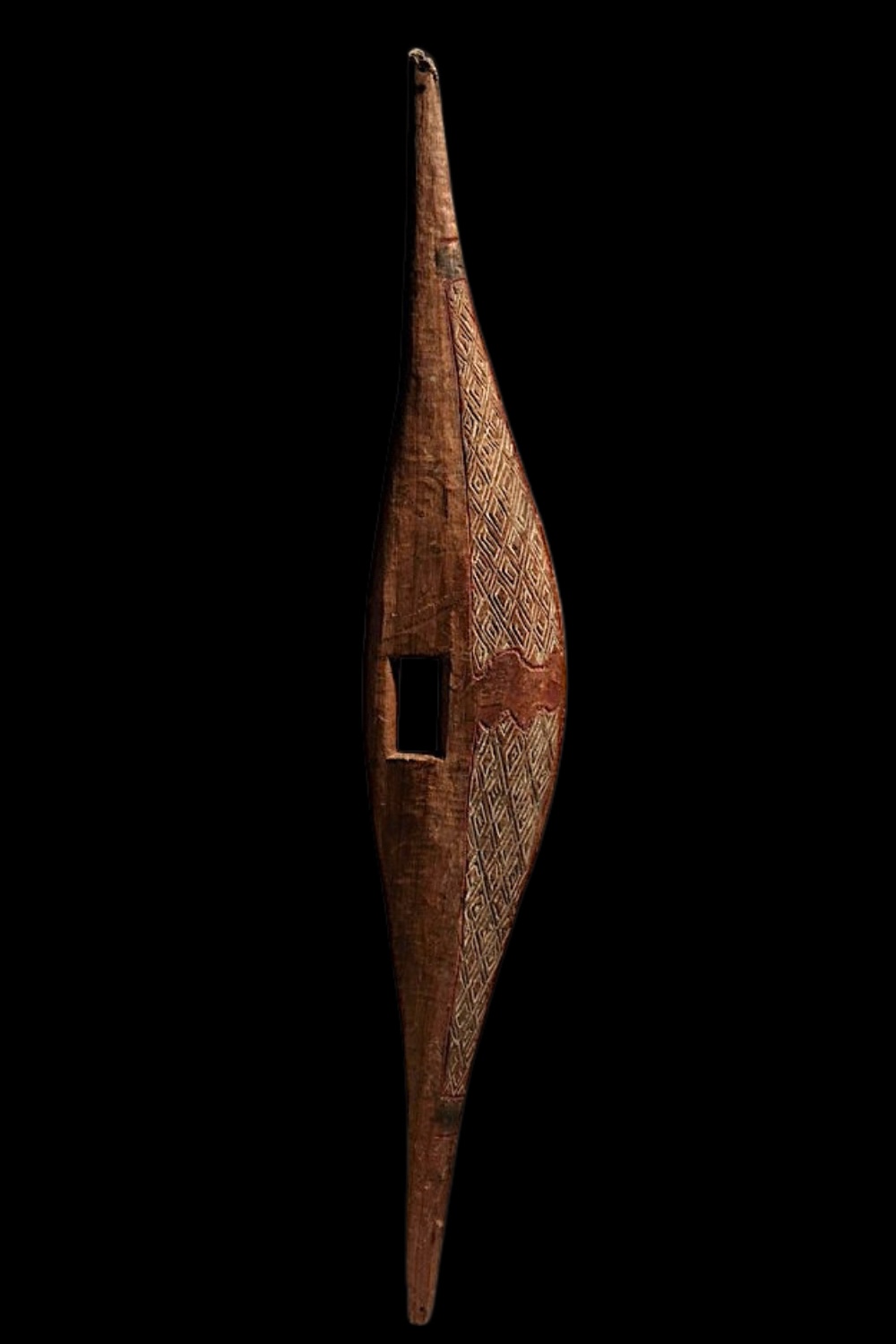
William Barak was an accomplished shield-maker whose carved wooden objects demonstrate his mastery of traditional Wurundjeri design. His Parrying Shield (1897), made at Coranderrk, is a long, narrow hardwood shield measuring 95 centimetres, with engraved concentric diamonds and a distinctive curved central motif. These geometric patterns, sometimes described as lozenge designs, also appear on other shields attributed to Barak and resemble the decorations he depicted on shields in his ceremonial paintings. The shield was acquired by his friend Jules de Pury and remained in Switzerland with the family for generations. In 2022, it was purchased at Sotheby’s New York by the Wurundjeri Woi-wurrung Cultural Heritage Aboriginal Corporation, returning an important example of Barak’s craftsmanship to his descendants.
William Barak’s Final Years and Legacy
Barak shared extensive cultural knowledge with anthropologists, particularly Alfred Howitt, whose publications drew upon his accounts of Wurundjeri songs, customs and kinship relationships.
Howitt recorded Barak singing songs learned from older generations and becoming emotional as he remembered the people who had taught them.
Barak continued painting into his final years.
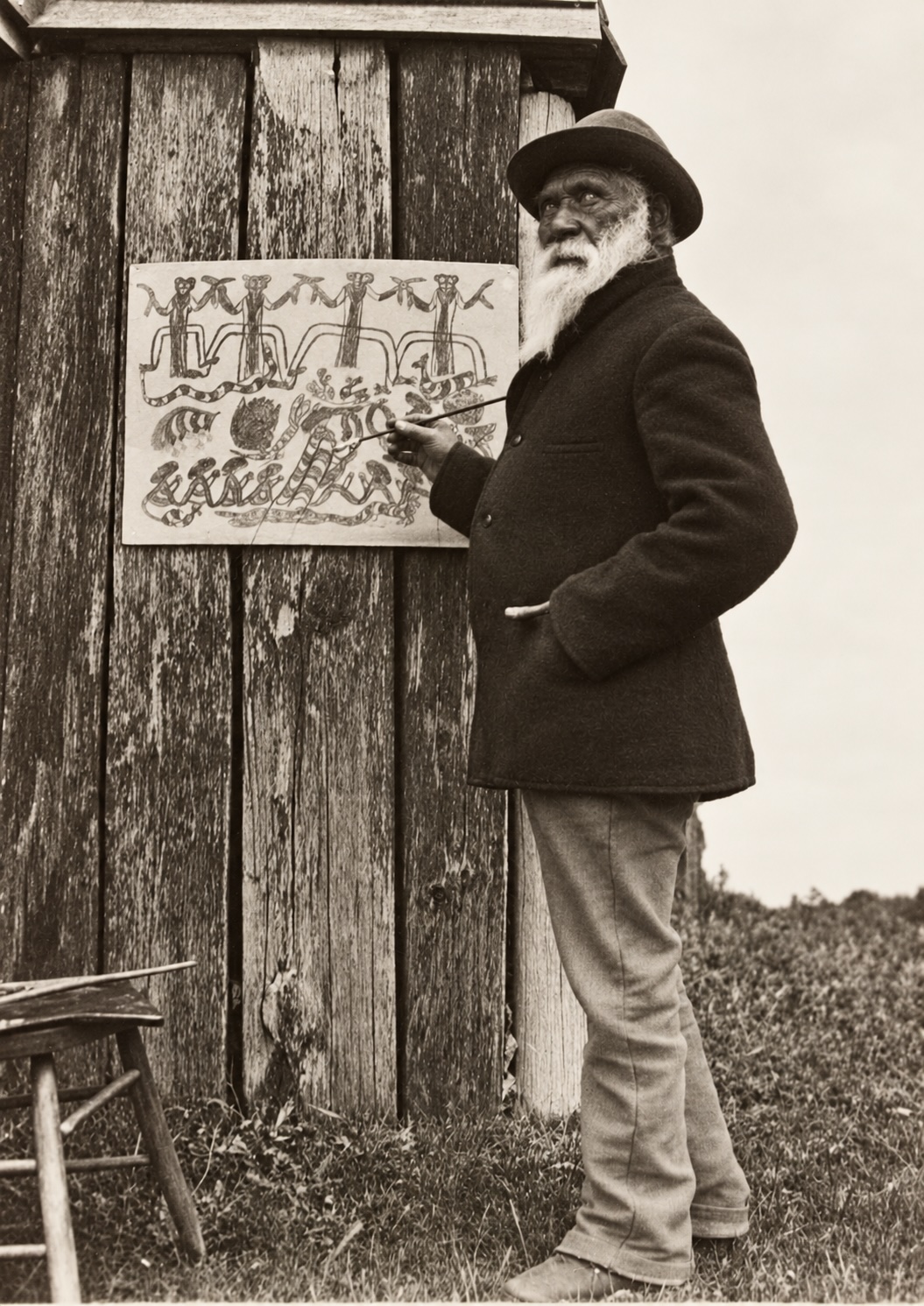
A photograph taken by Johannes Heyer in 1902 shows him working on a ceremonial drawing at Coranderrk. The artwork depicted in the photograph survives in the Art Gallery of South Australia, providing an exceptional record of an Aboriginal artist creating a surviving nineteenth-century work.
Barak died at Coranderrk on 15 August 1903.
Approximately 52 drawings attributed to him survive in Australian and international collections, alongside shields and other cultural objects.
His paintings are now recognised as outstanding works of nineteenth-century Aboriginal art, but their significance extends beyond artistic achievement.
They preserve knowledge of ceremonial life, cultural relationships and traditions maintained by the Wurundjeri despite the enormous changes imposed upon their Country.
Barak spent much of his life fighting to keep his people on their land. Through his paintings, he also helped ensure that their cultural knowledge would not be lost.
William Barak Value and Auction results
Works Offered at Auction: 20
Sale Rate: 80%
Highest Sale: $450,000 AUD
Median Sale Price: $36,000 AUD
To view individual select artworks along with dimensions provenance and sales prices please visit the William Barak Value page (not yet constructed)
William Barak in Public Collections
William Barak’s paintings, drawings and ceremonial objects are held in major Australian museums, galleries and cultural institutions. His work is also represented in European ethnographic collections, reflecting the considerable interest in his art during the late nineteenth century.
10 Interesting Facts About William Barak
1. His Name Came from a Grub Found in Gum Trees
Barak’s traditional name, Beruk, refers to the white grub found in manna gum trees. The spelling Beruk reflects its pronunciation in Woi-wurrung and is preferred by Wurundjeri descendants. The name connects him to the natural world of his ancestral Country, where such grubs were an important traditional food.
2. His Initiation Was Disrupted by European Settlement
Barak grew up during the destruction of traditional Wurundjeri life around Melbourne. According to the Australian Dictionary of Biography, he did not undergo the full traditional initiation expected of young men. Instead, relatives invested him with a possum-skin cloak, neck ornament, waist-string and nose peg in a shortened ceremony. He subsequently acquired much of his ceremonial knowledge through older relatives.
3. He Reportedly Tracked Ned Kelly
Barak’s tracking abilities remained valuable long after he left the Native Police. According to an account preserved by Victorian Collections, he once located Ned Kelly and his gang hiding in dense scrub. When the accompanying police officers reportedly demanded that he approach the armed bushrangers first, Barak refused, declaring, “I have no gun. I track. You are cowards.” The story survives as a historical anecdote rather than an independently verified police report.
4. He Helped Present Gifts to Queen Victoria
In 1863, Barak joined Wurundjeri leaders seeking permanent land for their people. At a government reception celebrating Queen Victoria’s birthday and the marriage of the Prince of Wales, Kulin representatives presented baskets and weapons intended for the royal family. An address in Woi-wurrung accompanied their appeal for land. Within weeks, Coranderrk was formally reserved for Aboriginal occupation.
5. He Walked to Melbourne Ten Times to Demand Justice
Barak’s political campaigning involved considerable physical determination. According to the Wurundjeri-curated Berukexhibition, he led ten deputations from Coranderrk to Melbourne, travelling on foot to present his community’s demands. These journeys brought him face-to-face with politicians and colonial officials as he argued for Aboriginal control over the settlement.
6. His Knowledge Filled 73 Pages of Anthropological Notes
In 1882, Barak travelled to Gippsland at the invitation of anthropologist Alfred Howitt to explain Wurundjeri customs, kinship and ceremonial practices. Their discussions produced 73 foolscap pages of notes. Barak returned in 1884 and attended a Kurnai initiation ceremony. Howitt subsequently drew extensively upon Barak’s knowledge in The Native Tribes of South-East Australia, quoting him directly at least 35 times.
7. He Could Read but Not Write
Although Barak attended mission school and received further education at Coranderrk, the Australian Dictionary of Biography records that he could read but not write. This makes his surviving recollections especially interesting. In 1882, he dictated an account of his childhood and the arrival of Europeans to a person associated with the Coranderrk school. His words preserved an Aboriginal eyewitness perspective on the establishment of Melbourne.
8. He Painted with Chewed Sticks
Wurundjeri Elder Professor Joy Wandin Murphy described Barak painting with the frayed end of a chewed stick rather than relying exclusively on European brushes. He used ochre, charcoal and pipeclay to produce surprisingly varied colours. According to this family account, he could create subtle mixtures of pink, white and blue-grey tones using traditional materials.
9. His Grave Monument Originally Commemorated Another Family
Barak’s friendship with Anne Fraser Bon continued beyond his death. Bon had lost her husband and child and commissioned an elaborate stone memorial for them. When the original site was threatened by flooding associated with the Eildon reservoir, she arranged for the memorial to be rededicated to Barak. After a complicated history, the monument was relocated to Coranderrk cemetery in 1955, where it marks his grave.
10. His Portrait Covers an 85-Metre-High Melbourne Building
In 2015, an enormous portrait of William Barak was unveiled on the façade of the Swanston Square apartment building in central Melbourne. Designed by ARM Architecture in consultation with Wurundjeri representatives, the 85-metre-high image is formed by the contrasting shapes of the building’s balconies and windows. Facing along Swanston Street towards the Shrine of Remembrance, it makes Barak’s presence visible in the city established on his ancestral Country.
Further Reading
- State Library Victoria –Beruk. Wurundjeri-curated exhibition exploring Barak’s life, leadership, artworks and cultural legacy.
- Australian Dictionary of Biography – William Barak. Historical biography.
- Judith Ryan – Important Drawing by William Barak. National Gallery of Victoria.
- Judith Ryan, Carol Cooper and Joy Wandin-Murphy,Remembering Barak, National Gallery of Victoria, 2003.
- Andrew Sayers,Aboriginal Artists of the Nineteenth Century, Oxford University Press, 1994, particularly “Barak and the Affirmation of Tradition”, pp. 12–25.
All images featured in this article are presented strictly for educational and informational purposes.
This website may include copyrighted material for which specific authorization has not been obtained from the copyright owner.
All such images are presumed to be the intellectual property of the respective artist or their estate, and are used in accordance with principles of fair dealing or fair use under applicable copyright law.