
Tommy Mitchell: Biography, Painting Style and Importance
c. 1943–2013
Ngaanyatjarra
Nganturn / Walu / Warlpapuka, ancestral Country
Warakurna, Western Australia
Ngaanyatjarra Art / Western Desert Art
Warakurna Artists
Synthetic polymer painting on canvas and linen
Tommy Mitchell was a Ngaanyatjarra Aboriginal artist and senior ceremonial lawman from the Gibson Desert in Western Australia. He began painting in 2005, aged approximately 62, and became one of the most distinctive artists associated with Warakurna Artists. His paintings are recognised for their brilliant colour, intricate dotting and energetic compositions, drawing upon a lifetime of knowledge of the desert landscape and its ancestral stories.
Mitchell painted his father’s Country around Nganturn and Walu, and his mother’s and uncle Tjunka Lewis’s Country around Warlpapuka (Mount Fanny). His subjects include ancestral rockholes, sandhills, vegetation, men’s Tingari ceremonial sites and the Parrtjarta (western quoll) Dreaming. His Walu paintings recount an ancestral story in which a boy steals an emu’s heart and transforms into wind.
Although his painting career lasted only eight years, Mitchell developed a highly individual expression of Western Desert Art. His work was exhibited internationally in No Boundaries: Aboriginal Australian Contemporary Abstract Paintingand is represented in major collections, including the National Gallery of Victoria and the Art Gallery of Western Australia.
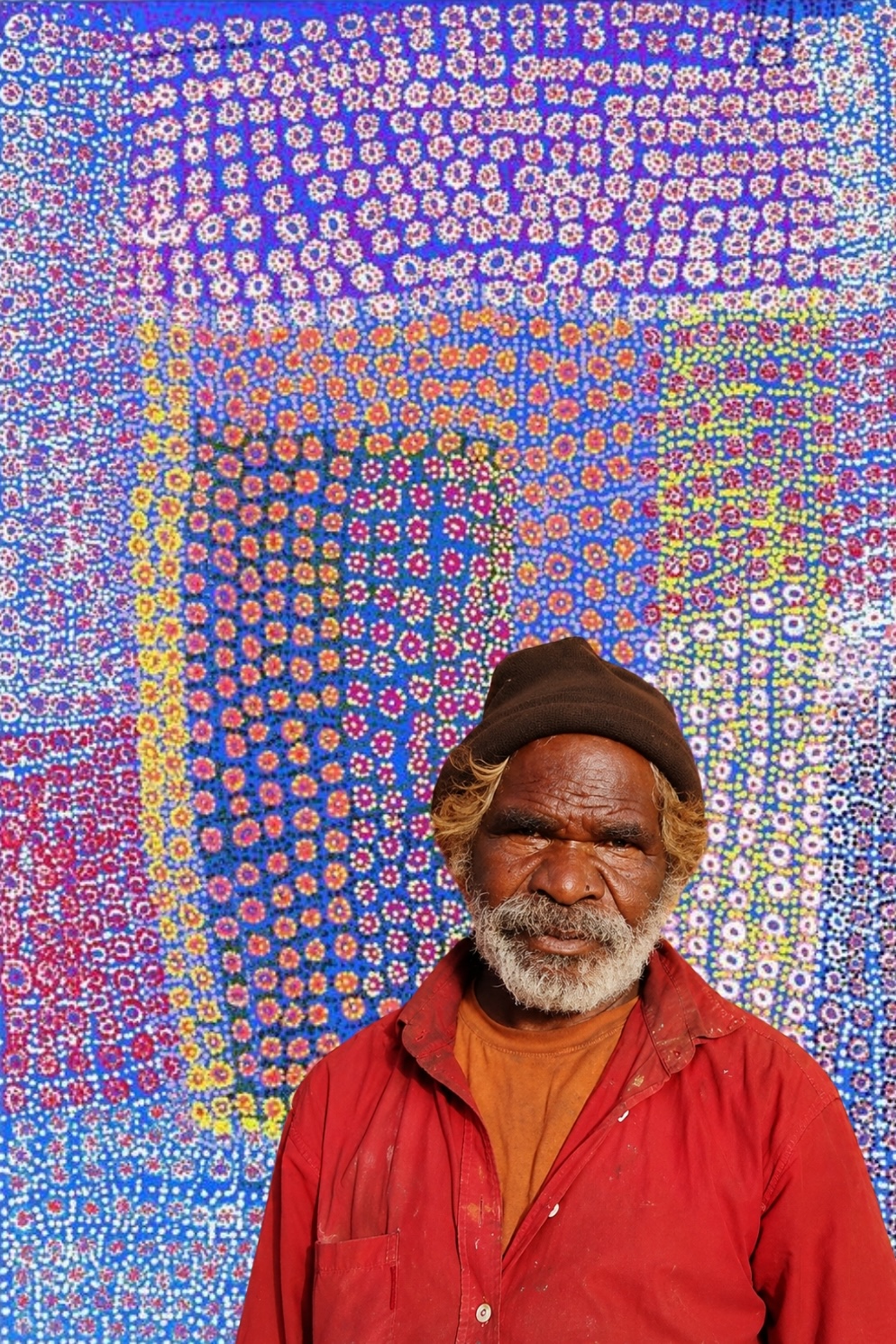
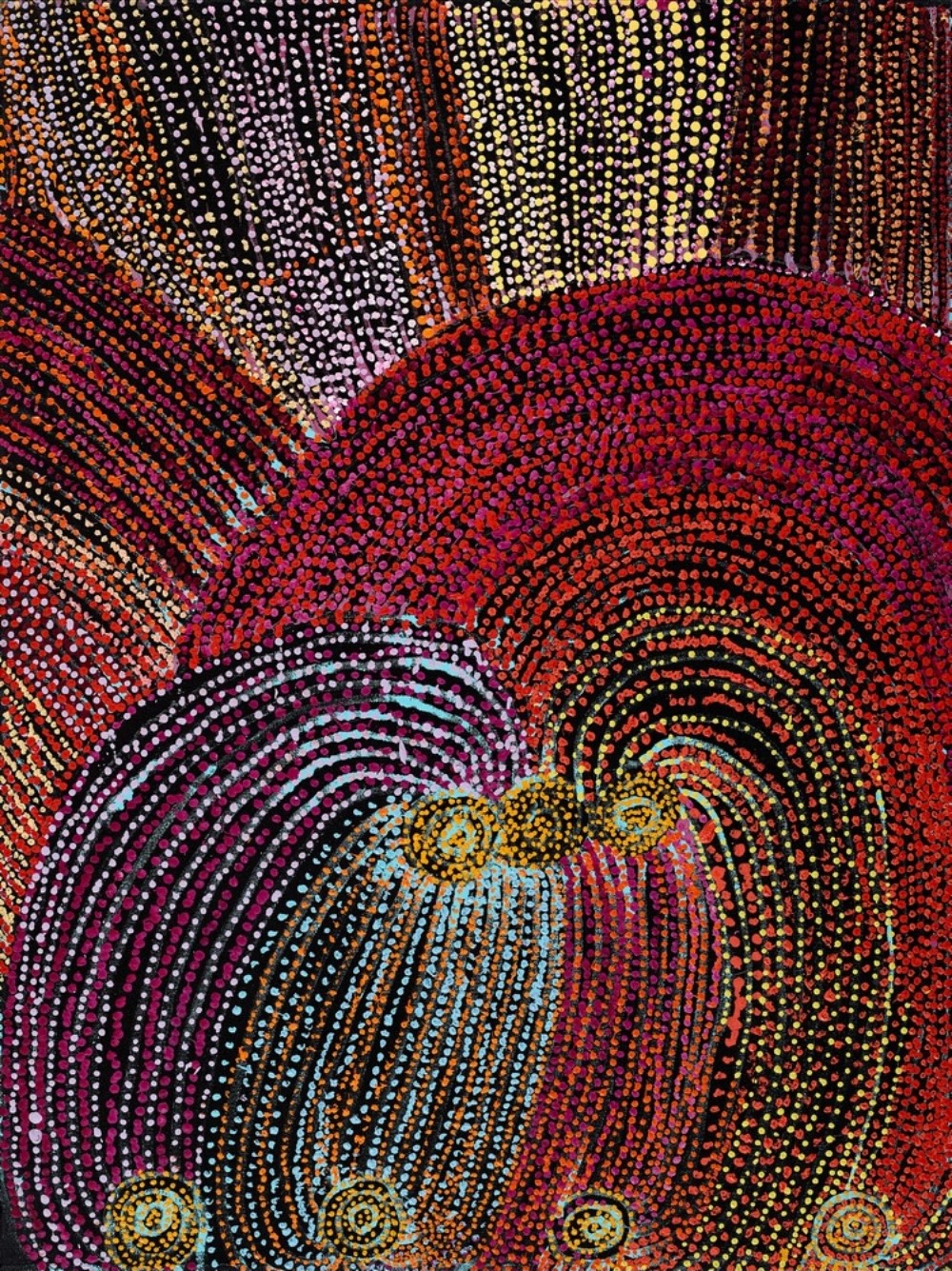
Tommy Mitchell Biography
Tommy Mitchell was born around 1943 near Papulankutja (Blackstone), in the Ngaanyatjarra Lands of Western Australia. A Karimarra skin man, he grew up travelling with his family through the sandhill country of the Gibson Desert, learning the locations of waterholes, the seasonal availability of bush foods and the ancestral stories associated with particular places.
Mitchell recalled hunting marlu (kangaroo), rabbits, tirnka (small goanna) and native cats, and collecting tjarnmarta(bush onions), maku (bardi grubs) and kampurarrpa (bush raisins). In an account recorded by Warakurna Artists, he remembered:
“We lived in the bush, there was no hospital and no clothes and we were naked and it was cold.”
These experiences gave Mitchell an intimate knowledge of the rocks, creeks, vegetation and waterholes that would later become the subjects of his paintings.
Mitchell became a respected senior lawman and ceremonial leader among the Ngaanyatjarra people. He actively participated in traditional ceremonies, passed on Tjukurrpa (ancestral Dreaming) knowledge to younger members of his family and was an accomplished carver of traditional ceremonial weapons.
His artistic development was closely connected to his uncle, Tjunka Lewis, who painted the Parrtjarta Dreaming associated with Warlpapuka. Through their collaboration, Mitchell began developing his own paintings of this ancestral place.
In 2007, Mitchell participated in a traditional song and dance project presented at the Perth International Arts Festival, reflecting his continuing involvement in ceremonial and cultural life beyond painting.
Mitchell lived at Warakurna with his family and continued painting until his death in 2013.
Tommy Mitchell Painting Style
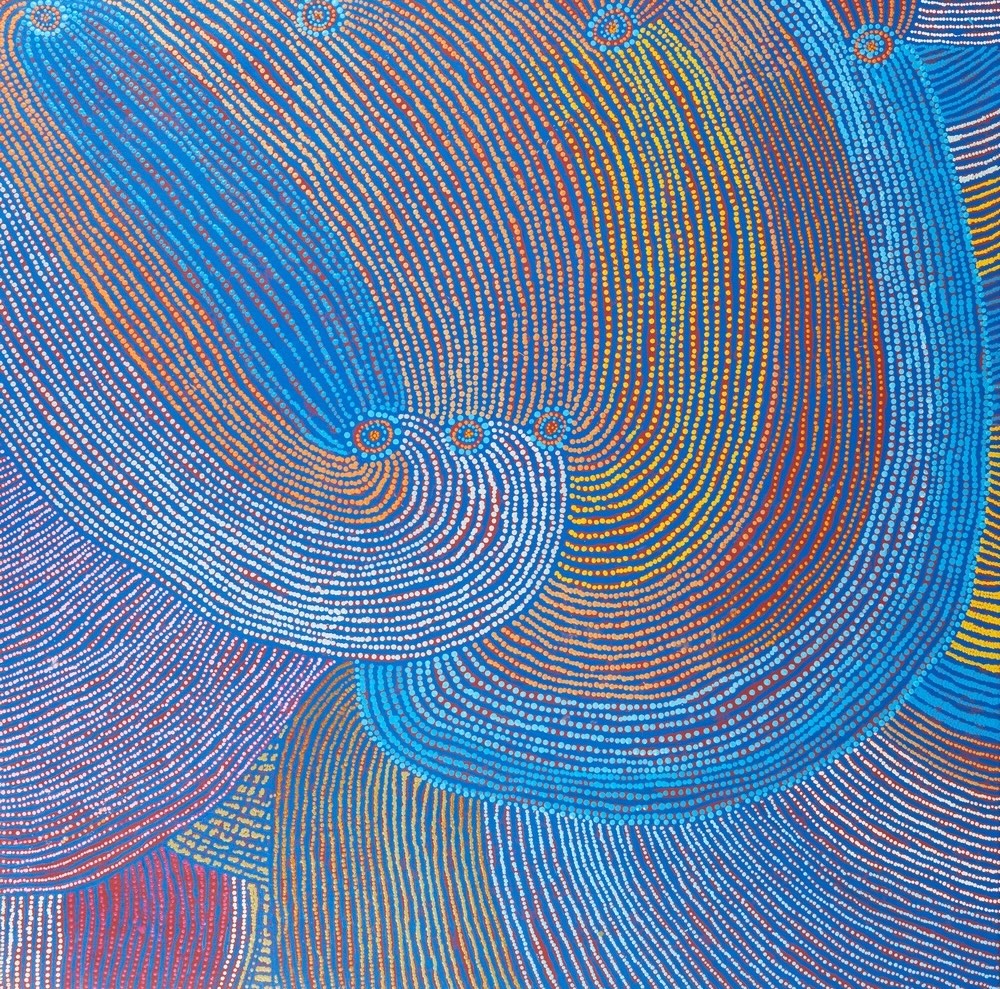
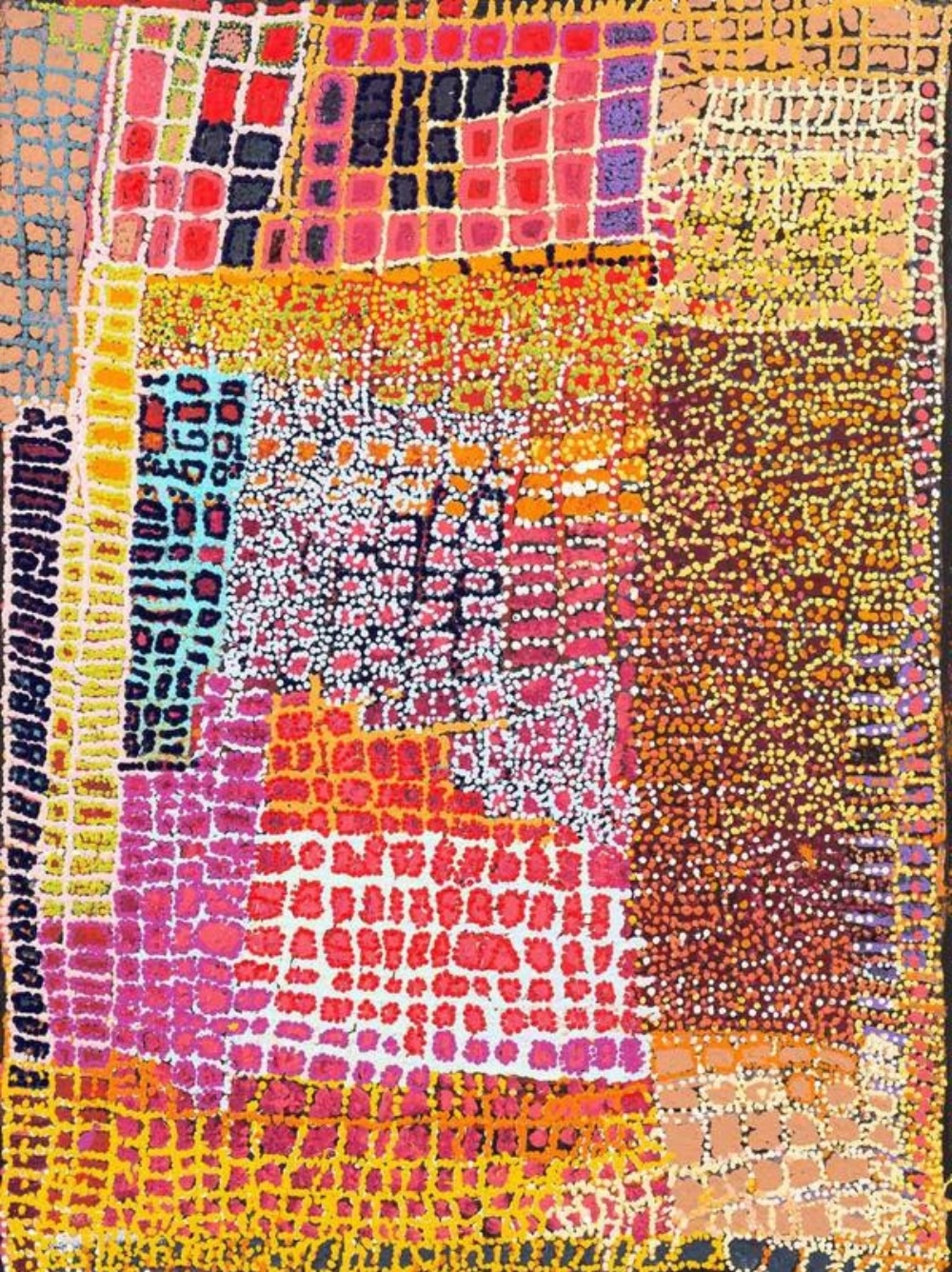
Tommy Mitchell developed a highly distinctive style characterised by brilliant colour, intricate dotting and compositions that appear to pulse with movement. Pinks, oranges, yellows, purples and blues are arranged in irregular geometric fields or sweeping, curvilinear forms, often producing an almost shimmering intensity.
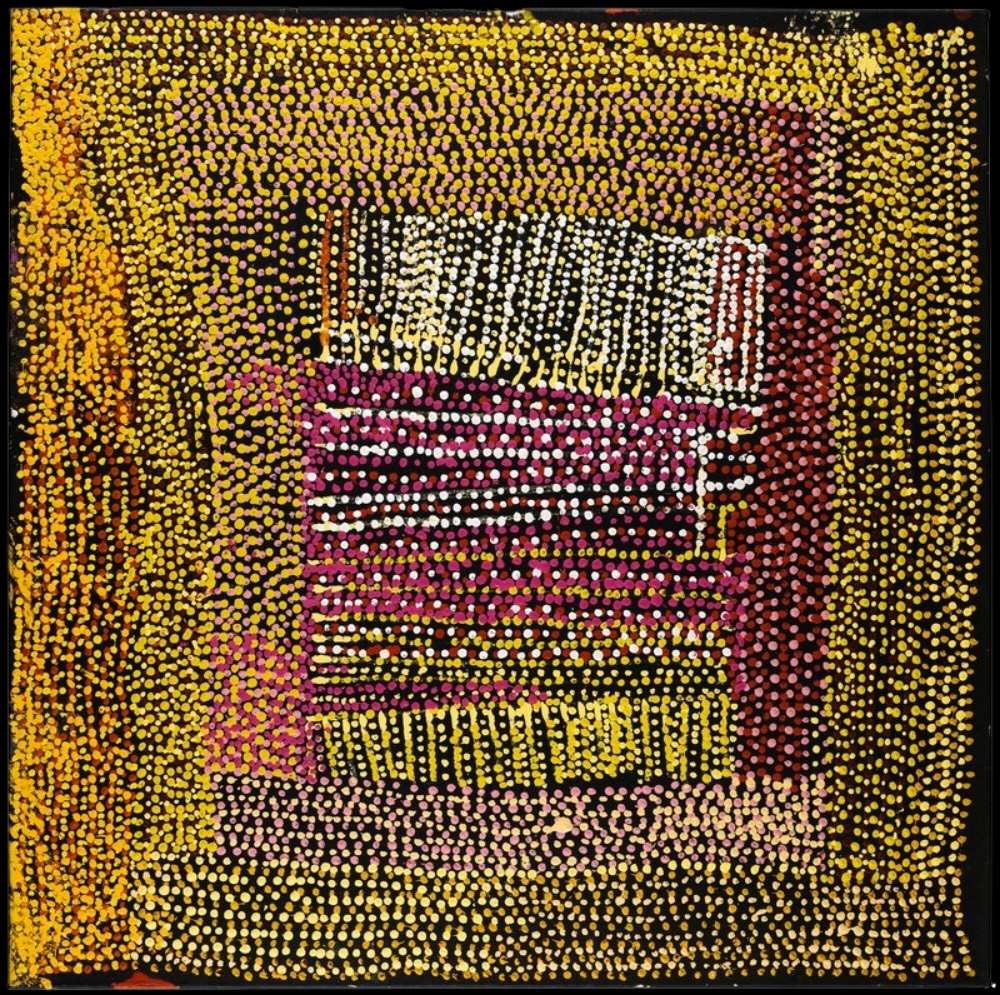
His paintings range from relatively ordered arrangements of rectangular colour fields to more fluid compositions in which thousands of closely spaced dots create shifting patterns of colour and texture.
An art specialist writing for Mossgreen Auctions compared Mitchell’s Wakalpuka (2011) to:
“a Paul Klee-like colour matrix”
The comparison reflects Mitchell’s unusual combination of geometric structure and restless movement. In Wakalpuka, the coloured sections suggest different areas of Country, while irregular dotted lines evoke the movements of the ancestral western quoll.
Although his paintings appear highly abstract, their compositions are grounded in the geographical and ancestral features of particular places. Mitchell transformed this inherited knowledge into a remarkably individual visual language within Western Desert Art.
Tommy Mitchell Painting Subjects and Meaning
Warlpapuka (Mount Fanny)
Warlpapuka, also known as Mount Fanny, is an isolated mountain between Warakurna and Papulankutja. Surrounded by undulating desert plains, it was an important stopping place for Ngaanyatjarra people travelling through the region, providing food, timber and other resources.
Anthropologist David Brooks explains that warlpa means windy, while puka, in this context, means place.
Mitchell’s paintings of Warlpapuka incorporate the distinctive vegetation of the mountain, including kurlilypurru(southern cypress pine), wakapuka (dead-finish) and nganturn (bardi bush).
Brooks recalled Mitchell asking to stop at Mount Fanny during journeys to Papulankutja, excitedly identifying the different trees growing on and around the mountain.
However, Brooks cautions against interpreting the paintings simply as botanical or topographical maps. He describes the trees as:
“metaphysical sign-posts”
The vegetation identifies elements of a landscape containing numerous interconnected Tjukurrpa narratives. Rocks, creeks, rockholes and trees are not merely geographical features but are embedded within the ancestral events associated with Warlpapuka.
The paintings therefore communicate both the physical character of the mountain and its ancestral significance.
Wakalpuka and the Parrtjarta Dreaming
Wakalpuka is also the name associated with a rockhole at the base of the mountain. Warakurna Artists documentation identifies this place with the Country of Mitchell’s mother and his uncle Tjunka Lewis.
The principal ancestral narrative associated with these paintings concerns the Parrtjarta (western quoll), a small carnivorous marsupial once found throughout the region.
The ancestral Parrtjarta man was an elusive trickster who travelled along the dry creek beds surrounding Warlpapuka, evading other ancestral characters and playing tricks upon them.
Tjunka Lewis painted this Dreaming, which Mitchell subsequently developed in his own distinctive compositions.
Mitchell recalled that the western quoll had disappeared from the region following the introduction of feral cats. His paintings preserve the ancestral significance of an animal that had become increasingly difficult to find in his lifetime.
Walu Dreaming – The Boy Who Stole an Emu’s Heart
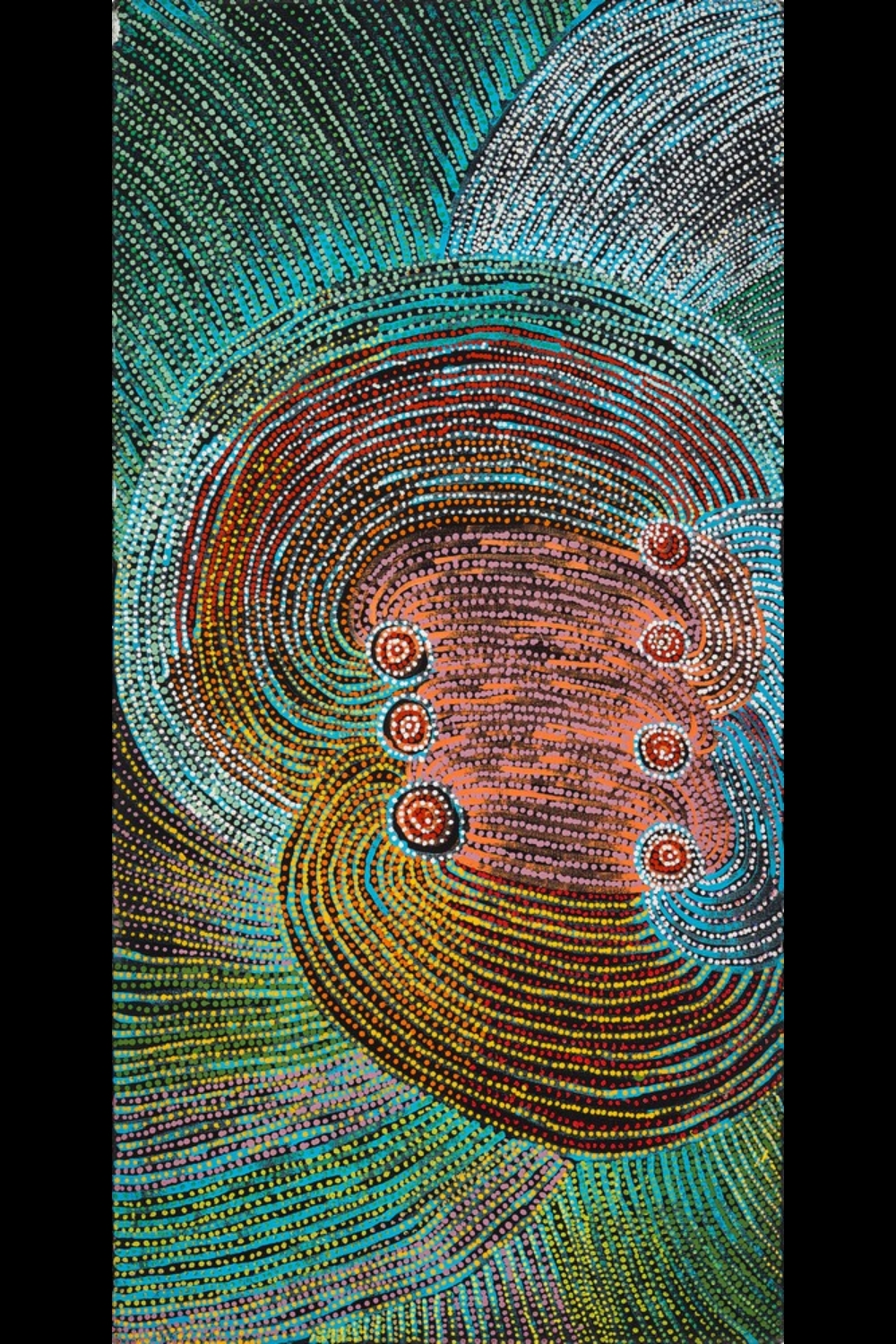
Walu is an important rockhole associated with Mitchell’s father’s Country, Nganturn. It was one of his most frequently painted subjects and the setting for an ancestral narrative involving two men, their young nephew and the Owl people.
According to the account recorded by Warakurna Artists, the two men regularly went hunting, leaving their nephew at camp. While they were away, the boy stole meat from the Owl people’s camps.
When the Owl people complained, the boy denied the theft. His uncles became angry with the accusers, and a powerful whirlwind swept through the camp.
Later, the men returned from hunting with an emu. As they prepared the animal, the boy seized its heart and ran away. Blood from the heart fell upon the rocks, leaving marks that can still be seen at Walu.
The boy subsequently transformed into wind.
Mitchell described the narrative as:
“this is a really sorry one, a really sorry story”.
His Walu paintings frequently employ sweeping bands of colour, curved lines and densely accumulated dots, creating a sense of movement that can be understood in relation to the wind and whirlwind central to the ancestral narrative.
Nganturn and Tingari Country
Nganturn was Mitchell’s father’s Country and another important subject throughout his painting career.
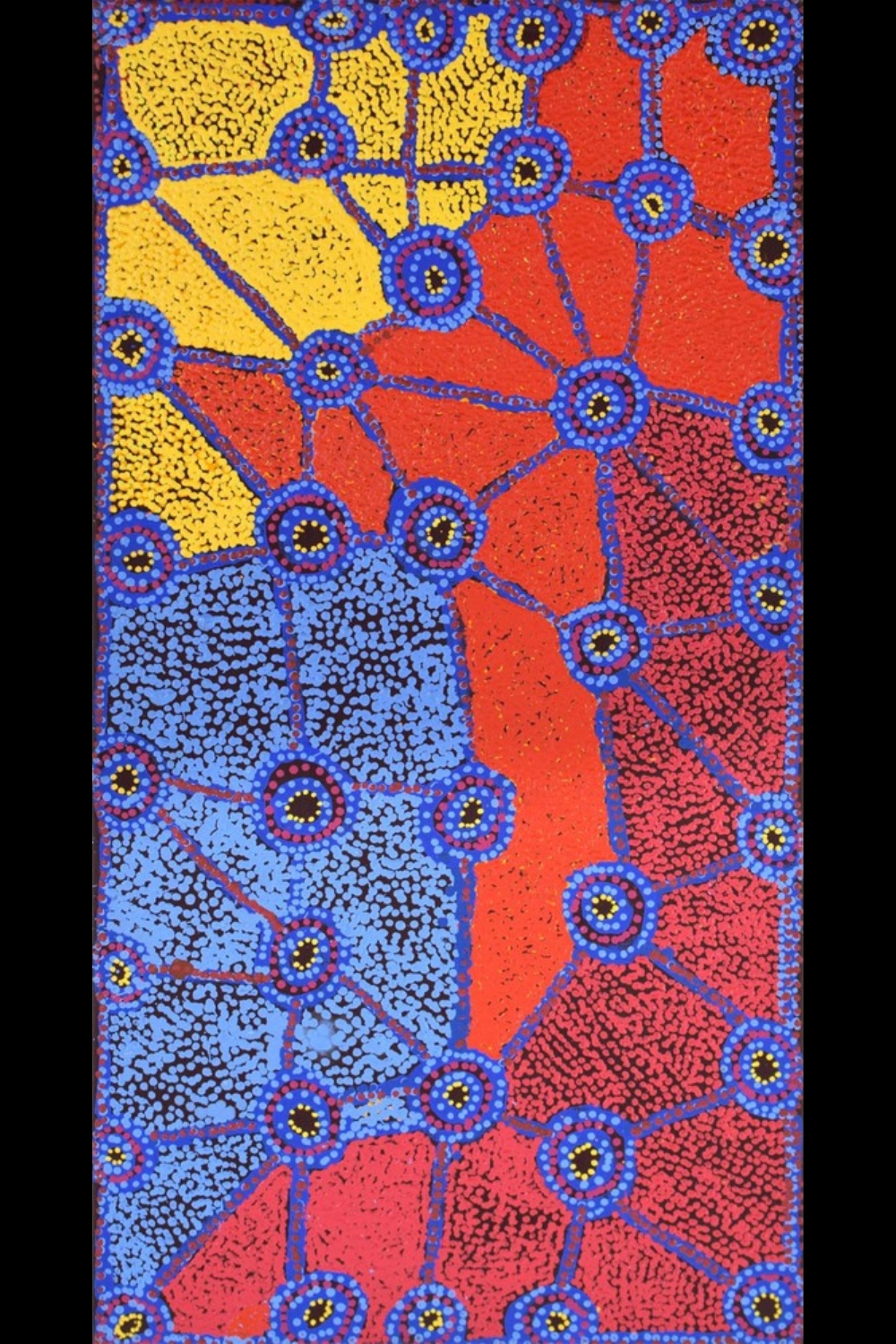
Works such as Nganturn Tali and Nganturn Tingari Tjukurrpa represent the sandhill landscape and ancestral sites associated with this region. Tali means sandhills, a prominent feature of Nganturn Country.
His paintings of Nganturn also include men’s Tingari ceremonial sites. The Tingari narratives concern ancestral beings whose journeys established significant places, ceremonial knowledge and relationships across the Western Desert.
An Art Leven catalogue identifies Ngatum Tingari Tjukurrpa (2007) as depicting sacred men’s Tingari sites on Mitchell’s father’s Country.
The abstract forms in these paintings refer to particular ancestral places and narratives, although the full significance of these sites is not necessarily available to viewers.
Tommy Mitchell’s Importance in Western Desert Art
Tommy Mitchell emerged during a period when the Western Desert painting movement was expanding well beyond its origins at Papunya in 1971. The establishment of Warakurna Artists brought new opportunities for senior Ngaanyatjarra people to develop their own approaches to painting, distinct from the earlier Papunya tradition.
Mitchell became one of the art centre’s most recognisable painters. His bold compositions contributed to the increasing diversity of Western Desert Art, demonstrating that its visual language was not confined to the conventions established by earlier generations.
His international recognition was strengthened by his inclusion in No Boundaries: Aboriginal Australian Contemporary Abstract Painting. Two paintings, Nganturn Tali (2011) and Warlpapuka (2011), were included in the exhibition and reproduced in the accompanying catalogue edited by Henry F. Skerritt.
Between 2015 and 2016, the exhibition travelled to five American institutions:
- Nevada Museum of Art, Reno
- Portland Institute for Contemporary Art, Oregon
- Pérez Art Museum Miami, Florida
- Charles H. Wright Museum of African American History, Detroit
- Herbert F. Johnson Museum of Art, Cornell University, New York
Through exhibitions such as No Boundaries, Mitchell’s paintings reached international audiences and became part of a wider reassessment of Aboriginal painting within contemporary abstract art.
Tommy Mitchell Value and Auction results
Works Offered at Auction: 36
Sale Rate: 83%
Highest Sale: $20,000 AUD
Median Sale Price: 6,000 AUD
To view individual select artworks along with dimensions provenance and sales prices please ivsit the Tommy Mitchell Value page (not yet constructed)
Tommy Mitchell in Public Collections
Tommy Mitchell’s paintings are represented in Australian and international museum collections, reflecting the recognition of his contribution to contemporary Western Desert Art.
-
National Gallery of Victoria, Melbourne – Kurlilypurru (2009), acquired through the Felton Bequest in 2011. View artwork
-
Art Gallery of Western Australia, Perth
-
Seattle Art Museum, USA – Walu (2008), exhibited in 2013 and identified as a promised gift from the Kaplan Levi Collection.
Further Reading
-
Circuitt, Edwina. “Mr. Tommy Mitchell: Pirriya Purlkanya, Big Wind.” In Henry F. Skerritt (ed.), No Boundaries: Aboriginal Australian Contemporary Abstract Painting. DelMonico Books/Prestel, 2014.
-
National Gallery of Victoria. Living Water: Contemporary Art of the Far Western Desert. National Gallery of Victoria, Melbourne, 2011.
-
National Museum of Australia. Warakurna: All the Stories Got into Our Minds and Eyes. National Museum of Australia, Canberra, 2012.
Carty, John, and Tim Acker (eds.). Ngaanyatjarra: Art of the Lands. UWA Publishing, 2012. A richly illustrated study of six Ngaanyatjarra art centres, including Warakurna Artists, examining the development of contemporary art across the Ngaanyatjarra Lands.
All images featured in this article are presented strictly for educational and informational purposes.
This website may include copyrighted material for which specific authorization has not been obtained from the copyright owner.
All such images are presumed to be the intellectual property of the respective artist or their estate, and are used in accordance with principles of fair dealing or fair use under applicable copyright law.