Billy Thomas Joongoorra: Biography and Painting style
c.1920 – 2012
Wangkajunga (Wangkatjunga)
Jungurrayi
Great Sandy Desert / Canning Stock Route
Billiluna; later associated with Kununurra
Waringarri Aboriginal Arts, Warlayirti Artists, Red Rock Art
Natural earth pigments and synthetic binder on canvas and linen
Billy Thomas Joongoorra (c.1920–2012), also known as Karntakarnta Billy Thomas, was a senior Wangkajunga lawman, healer, stockman and painter whose life connected the Great Sandy Desert, the Canning Stock Route and the contemporary art worlds of Balgo Art and the East Kimberley Art.
Billy began painting publicly around 1995, when he was already in his seventies. The knowledge behind those paintings, however, had been accumulated over a lifetime spent travelling through and participating in the ceremonial life of his Country. Waterholes, sandhills, ancestral journeys and places of ceremony became recurring subjects.
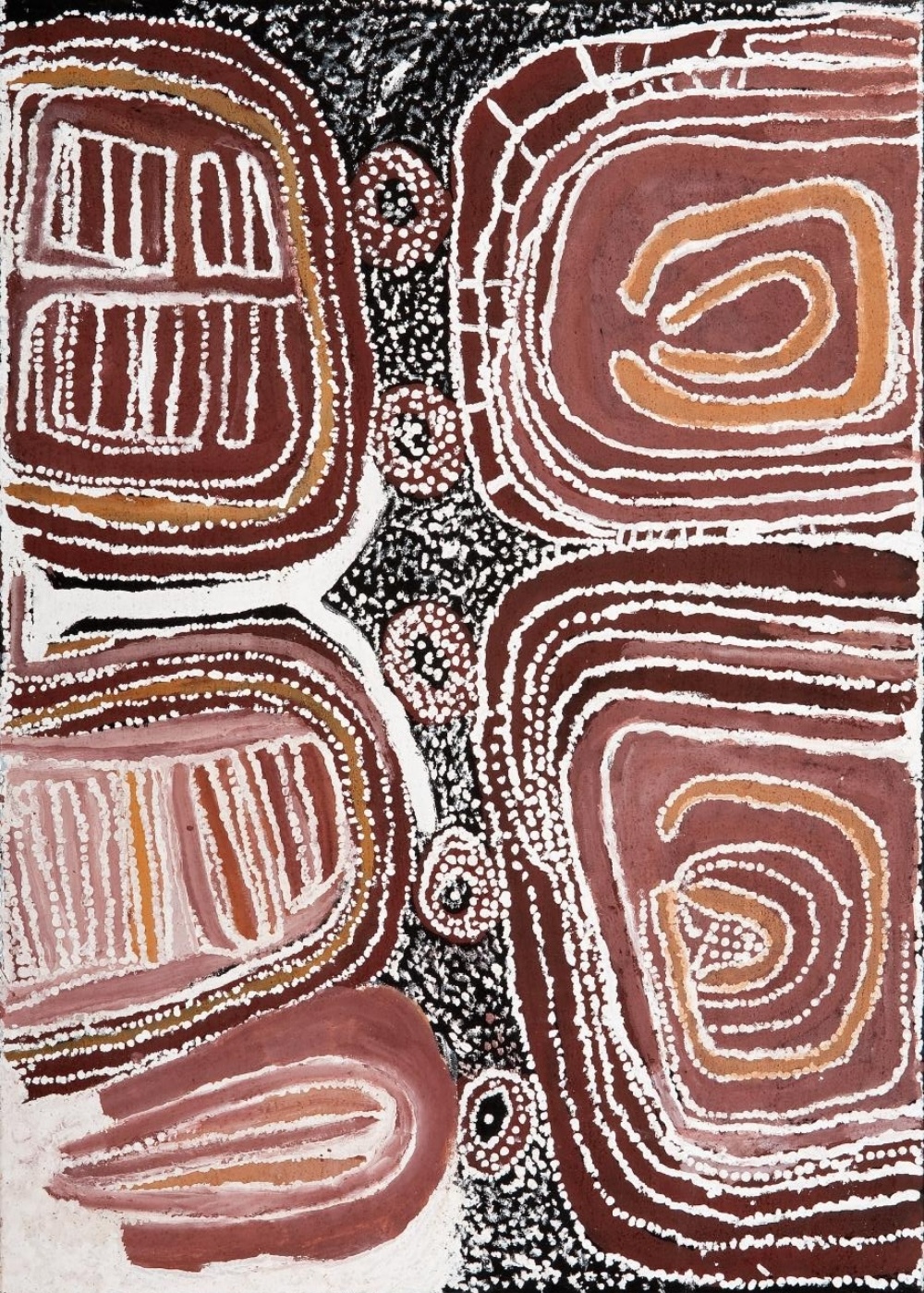
Working principally in natural earth pigments, Billy developed a distinctive visual language combining Wangkajunga desert iconography with the ochre palette associated with Kimberley painting. His paintings are particularly remarkable for the way imagery can be drawn, covered, scraped back and partially revealed. Art historian Wally Caruana described Billy’s style as one that “both reveals and conceals”.
Billy Thomas Joongoorra Values and Auction Record
Works Offered at Auction: 131
Sale Rate: 60%
Highest Sale: $36,000 AUD
Median Sale Price: $3,400 AUD
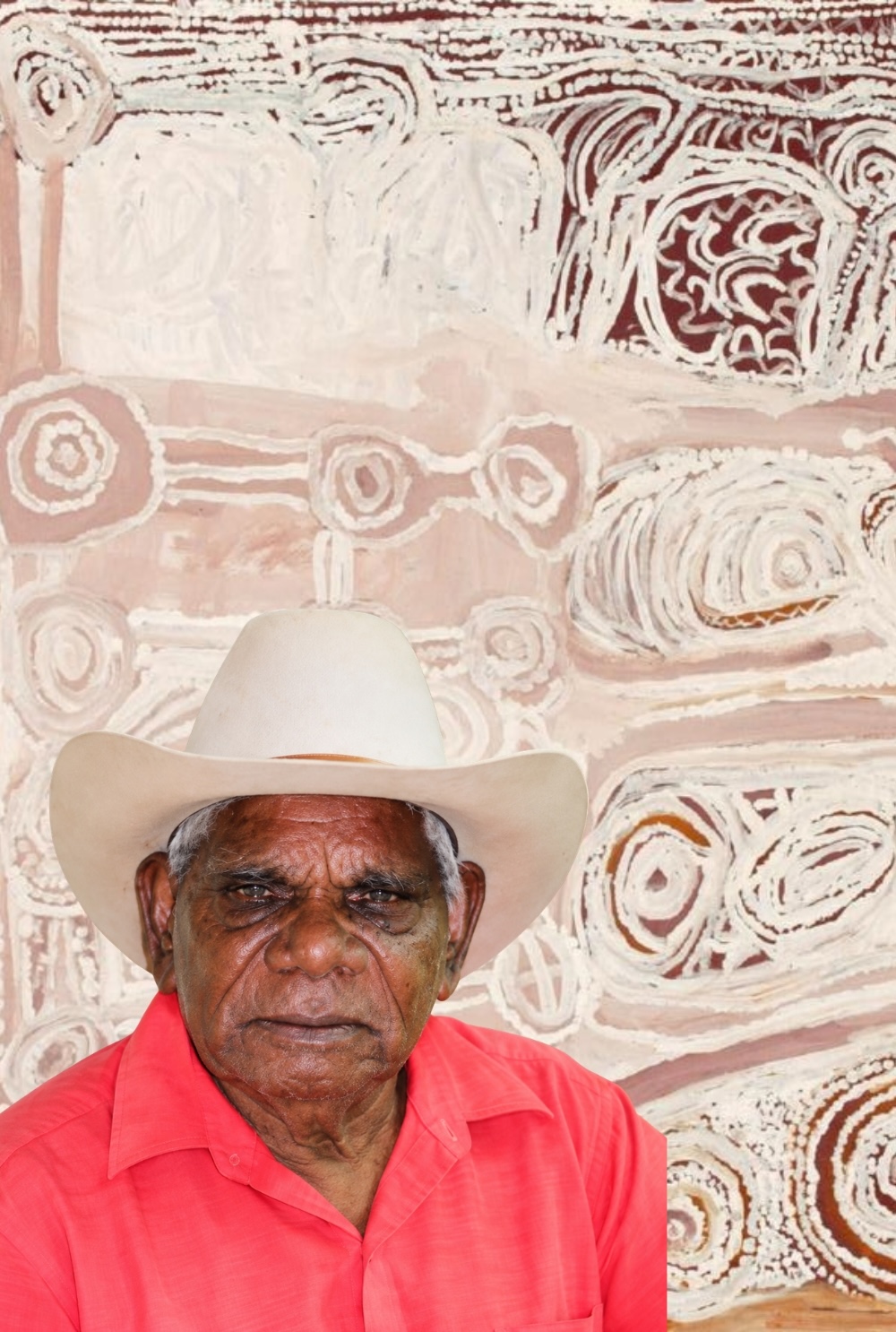
Billy Thomas Joongoorra Biography
Billy Thomas was born around 1920 in the northern Great Sandy Desert of Western Australia. Published accounts differ slightly over his precise birthplace. The National Museum of Australia records Kulyayi, near Well 42 on the Canning Stock Route, while the Art Gallery of South Australia gives Mindil Country near Billiluna. Both place his origins within Wangkajunga Country around the northern Great Sandy Desert.
Billy spent his childhood living traditionally before becoming caught up in the rapidly changing pastoral world of the Canning Stock Route. As a teenager he became a stockman and spent years droving cattle through remote Western Australian desert Country.
It was during these years that his life intersected with that of Rover Thomas. Auction documentation records the two young men working with cattle around Kukupanyu, Well 39, probably during the early 1940s. Half a century later both had become important painters associated with the Kimberley, although Billy’s paintings remained grounded particularly in his own Wangkajunga Country in the Great Sandy Desert.
Billy also became a senior lawman and healer with extensive knowledge of Country, ceremonial songlines and initiation. Even after becoming an artist, he continued spending extended periods out bush before returning to Billiluna or Kununurra.
Around 1995, at approximately 75 years of age, Billy approached Waringarri Aboriginal Arts in Kununurra for painting materials. Although he had not previously belonged to an established community of painters, decades of ceremonial practice had already provided the cultural and visual knowledge from which his paintings developed.
Recognition came remarkably quickly. A Bonhams catalogue records that within approximately twelve months he had been selected for the National Aboriginal Art Award, won the East Kimberley Prize and held his first solo exhibition. By 1997 Billy Thomas: Recent Paintings was being shown at William Mora Galleries in Melbourne.
Billy’s career subsequently crossed several important centres of Aboriginal painting. His earliest documented works are associated with Waringarri Aboriginal Arts in Kununurra. He also painted through Warlayirti Artists at Balgo, including Mindijarra Waterhole (1999) and Wilboree (Artist’s Country) (2002), while much of his mature work was documented through Red Rock Art in Kununurra.
Rather than placing him exclusively within either Balgo or the East Kimberley, Billy is best understood as a Wangkajunga desert artist whose career crossed the Great Sandy Desert and Kimberley art worlds.
Billy Thomas Painting Style
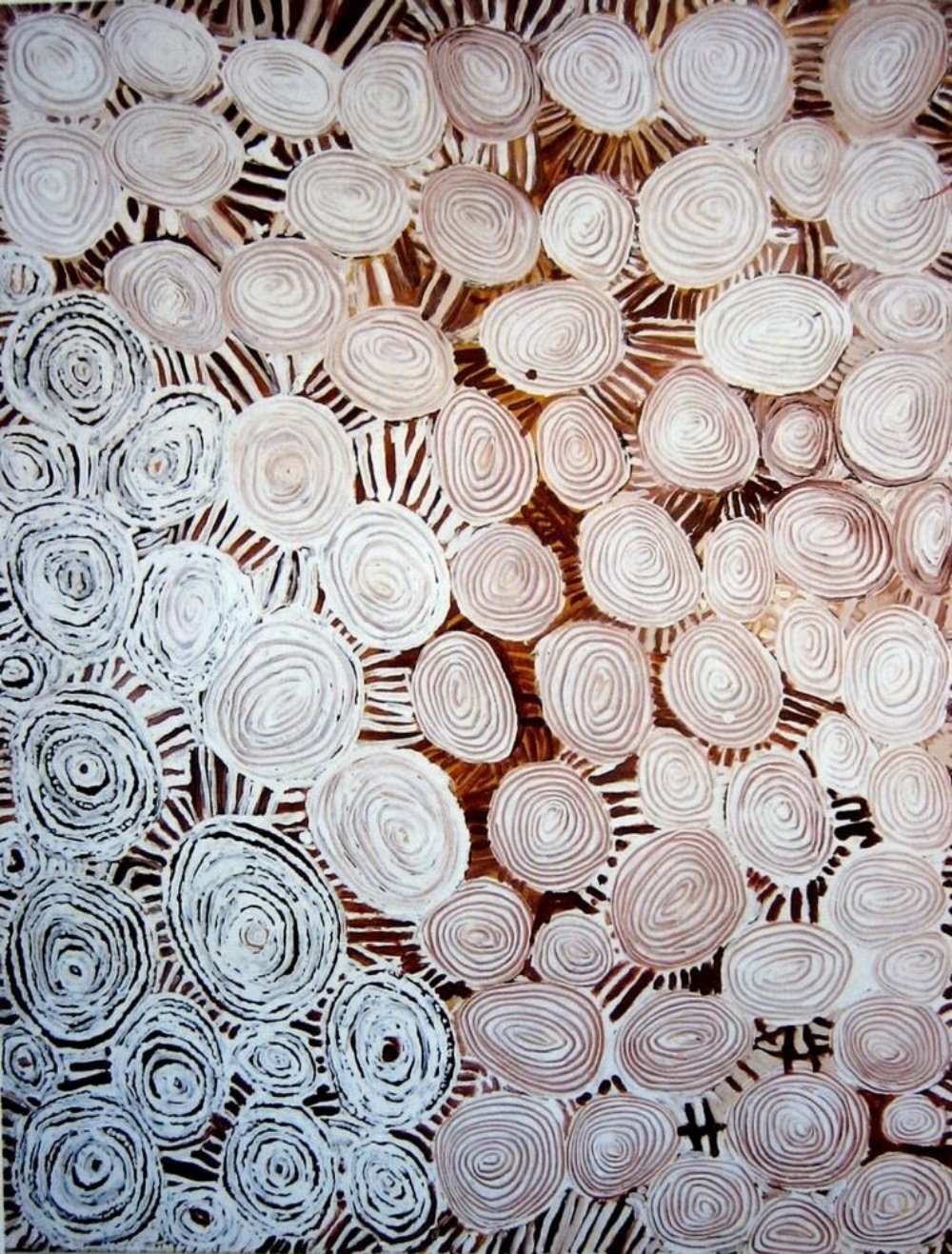
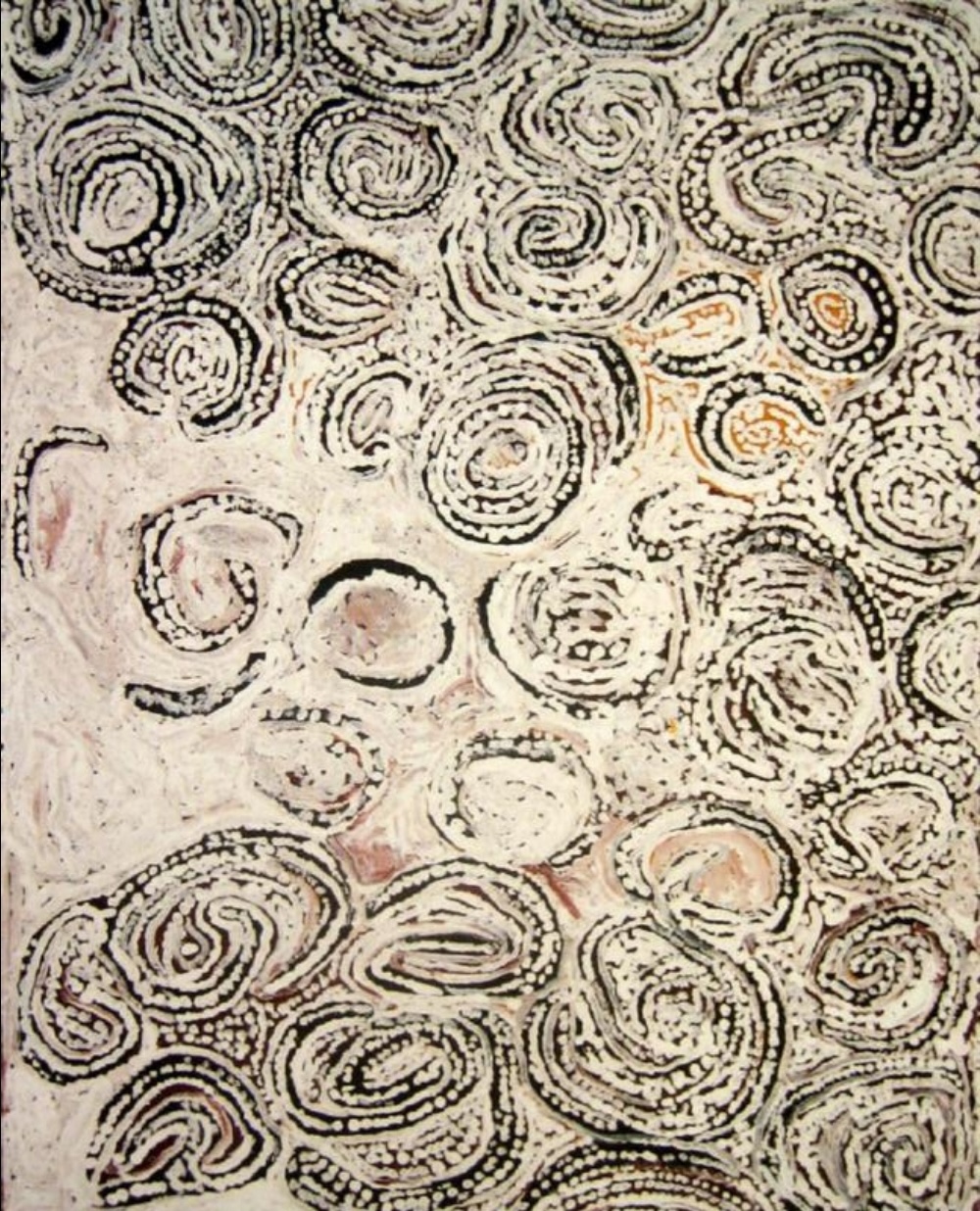
Billy Thomas developed a distinctive style based on fluid drawing, natural earth pigments, repeated mark-making and the layering, concealment and reappearance of imagery.
His paintings often contain structures familiar from desert painting: circles and rounded forms, waterholes, ancestral tracks, sandhills, pathways and sweeping curvilinear lines. Billy could draw these forms freely, then cover them with dots or passages of pigment, paint across earlier marks, scrape areas back and leave portions of the underlying imagery visible.
This was more than a painterly effect.
Art historian and former National Gallery of Australia curator Wally Caruana, writing about Waringarri at Warla (2003), described Billy’s style as one that:
“both reveals and conceals”.
Caruana observed that Billy could draw conventional desert icons and then bury them beneath swirling passages of pigment, often white. This process of marking, overpainting and partial erasure reflected the boundary between knowledge that could be made public and knowledge restricted to ceremonial contexts.
Billy’s use of natural earth pigments further distinguished his work from much acrylic Western Desert painting. Whites, greys, yellow and brown ochres, pinks, reds and blacks recur throughout his work, with pale pigments becoming particularly characteristic. His visual structures came from Wangkajunga desert culture, while his materials connected his paintings with the ochre traditions of the Kimberley.
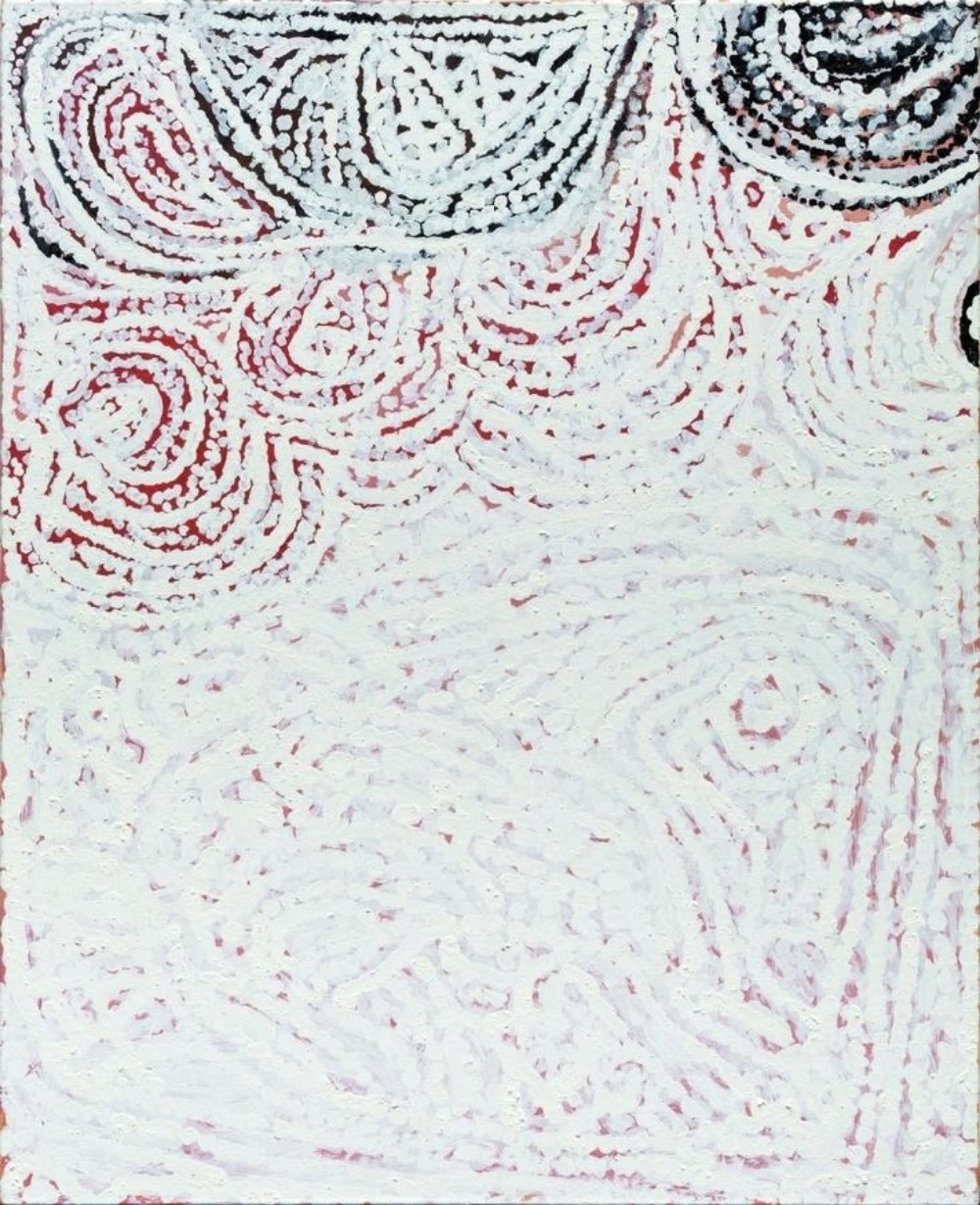
His style continued to develop. In some later works, conventional desert iconography almost disappears beneath freer, more gestural passages of pigment. Thick applications of predominantly white paint produce tactile, unexpectedly light and atmospheric surfaces. Three Wangkatjunga Law Men (2001), now in the Art Gallery of South Australia, belongs to this development.
Across his relatively short painting career, Billy continually explored how Country and ceremonial knowledge could be made visible — and how much should remain concealed.
Billy Thomas Painting Subjects
Billy Thomas painted the Country he had known throughout his life. His subjects include waterholes, sandhills, ancestral beings, travelling routes, ceremonial gatherings, animals and bush foods.
These were not necessarily separate subjects. In Billy’s paintings, physical geography, ancestral history and ceremonial meaning can occupy the same painted form.
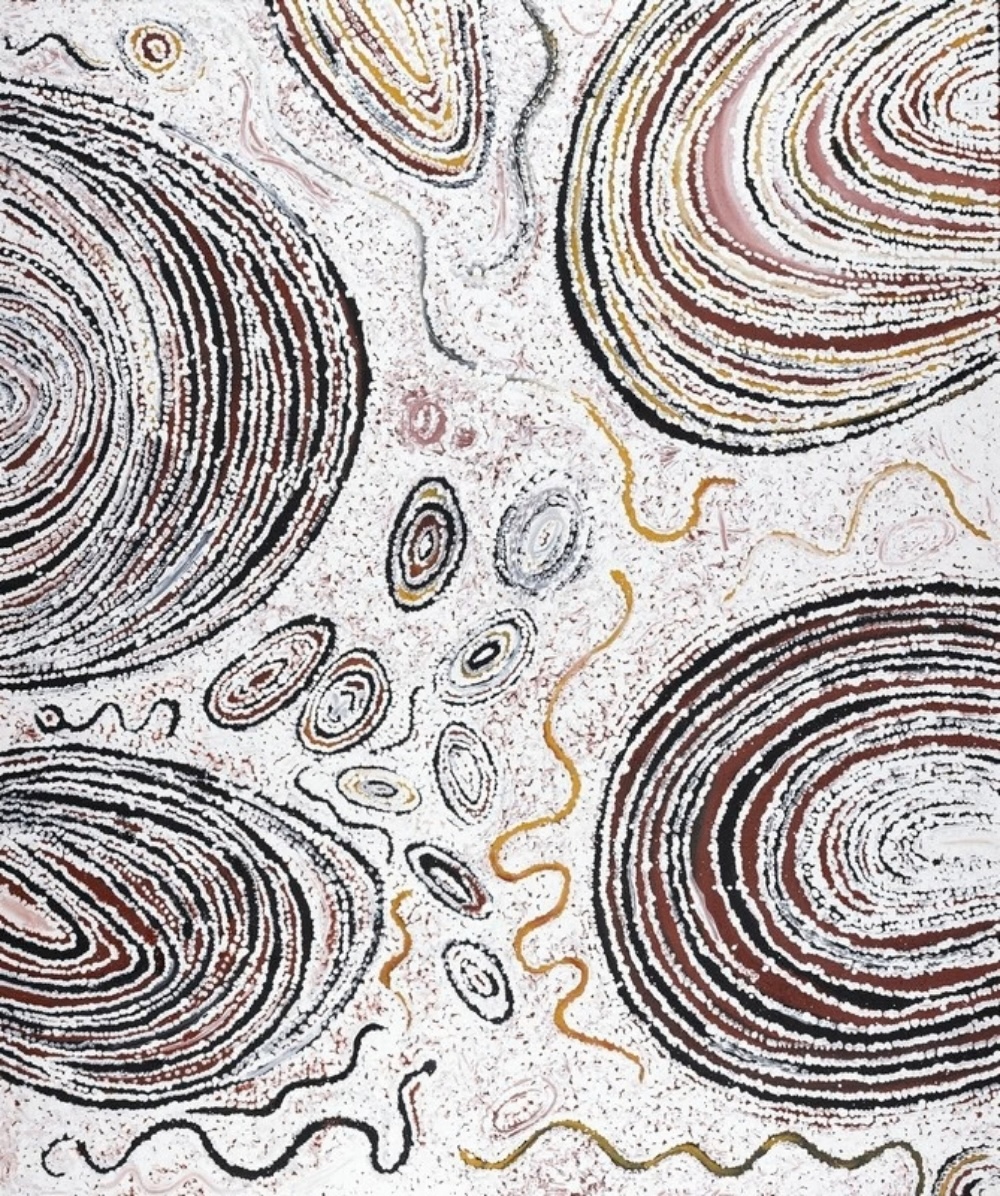
Gunambalayi — The Black Snake
The ancestral Black Snake, Gunambalayi, is one of Billy’s most persistent subjects.
Documentation accompanying Gunambalayi – Travels of the Black Snake identifies the Black Snake as Billy’s totem and records his repeated depiction of its Dreamtime travels and role in creating the landscape.
In one documented painting, Gunambalayi travels through Giningingill Country west of Balgo searching for her children. The Snake creates sandhills as she travels and permanent waterholes appear within the Country. The lines running through the painting represent simultaneously the Snake’s body and the path of its ancestral journey.
Documentation for another Gunambalayi – Travels of the Black Snake explains that the painted black lines are at once the ancestral Snake and the cracks, waterways and gullies visible in the landscape.
This capacity for a painted form to possess several meanings simultaneously is fundamental to Billy’s art.
Waterholes and the Great Sandy Desert
Waterholes recur throughout Billy’s paintings because they were central to both physical and ceremonial life.
His works depict soaks and rockholes among the rolling sand dunes of the Great Sandy Desert. Documentation for Waterholes and Sandhills in the Great Sandy Desert explains that knowledge of these water sources was essential for travelling and living in the desert and that many were also places where ceremony and Law were undertaken.
Waterholes in Billy’s paintings therefore carry several interconnected meanings: water and survival, geographical knowledge, ceremony and ancestral creation.
Warla and Waringarri — People Coming Together
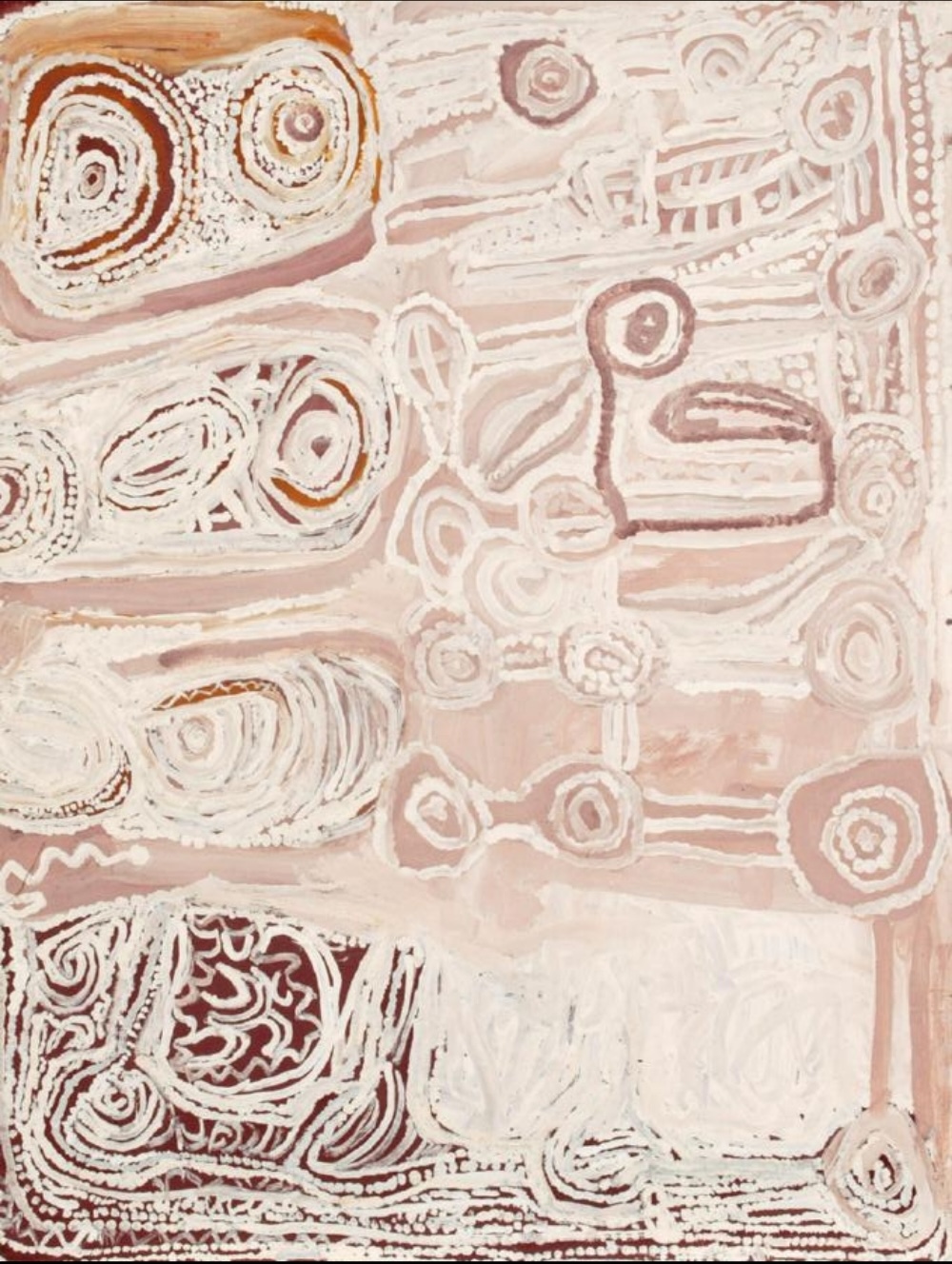
Warla, also written Waarlla, is one of the most important places in Billy’s paintings.
Located in the Great Sandy Desert southwest of Balgo, Warla is an immense flat area containing hundreds of rockholes. Billy memorably described the Country as:
“flat like an airport”.
Some rockholes provide reliable water while others have ceremonial or burial associations. After heavy rain the flat expanse becomes a temporary lake; as the water retreats, the rockholes are replenished.
Warla was also a place where people came together.
In his discussion of Waringarri at Warla (2003), Wally Caruana explains that waringarri is a Miriwoong word meaning “coming together”. Gatherings at Waarlla brought together people from different language groups for ceremony and Law.
Billy’s curvilinear forms capture this relationship particularly well. They can represent groups of people gathering for ceremony while simultaneously describing features of the landscape. Another documented Wangkajunga Waringarrisimilarly explains curved and circular forms as both landforms and groups of people camping together.
In Billy’s work, people, ceremony and Country are therefore not necessarily represented separately.
Other Dreamings and Subjects
Gunambalayi and Warla were important, but Billy’s paintings encompass a much broader range of subjects.
Balgoo Balgoo concerns Country southwest of Billiluna associated with Jaandoo, the Wild Dog Dreaming, where rockholes were understood as connected underground by pathways carrying the Wild Dog spirit.
Gularabun depicts Waterhole Country through black, white and yellow roundels representing waterholes created by a Kangaroo in the Dreaming.
Kangaroo and Spear Dreaming relates to ceremony before a kangaroo hunt at Warla, with straight lines connecting circular rockhole forms representing spears.
Billy also painted plant and food subjects. Jalpiny depicts the flower of the Desert Banksia, an important source of sugar.
His paintings consequently bring together water, food, animals, ancestral beings, ceremony and named places within a larger understanding of Country.
Billy Thomas Joongoorra Values and Auction Record
Works Offered at Auction: 131
Sale Rate: 60%
Highest Sale: $36,000 AUD
Median Sale Price: $3,400 AUD
For additional artworks provenance sizes and values achieved please see the Billy Thomas Joongoorra Values page (not yet constructed)
Importance of Billy Thomas Joongoorra
Billy Thomas occupies an unusual position in contemporary Aboriginal art.
A Wangkajunga artist grounded in Great Sandy Desert Country, his career crossed Waringarri in Kununurra, Warlayirti Artists at Balgo and the wider East Kimberley art world. His paintings brought the spatial structures and ceremonial imagery of desert painting together with the natural earth pigments associated with Kimberley painting.
More importantly, Billy developed an individual way of translating cultural knowledge into public art. His paintings resist simple interpretation: a line might simultaneously represent an ancestral Snake, its journey and a physical waterway, while imagery could be painted over without disappearing entirely.
Wally Caruana’s description of Billy’s work as “both reveals and conceals” therefore identifies something fundamental about his achievement. The boundary between what could be shown publicly and what should remain restricted became part of the structure of the painting itself.
Recognition came rapidly despite Billy beginning to paint publicly only in his seventies. By 1997 he had held a Melbourne solo exhibition at William Mora Galleries. Later works including Gunambalayi – Travels of the Black Snakeand Kangaroo and Spear Dreaming were included in the international exhibition No Boundaries: Aboriginal Australian Contemporary Abstract Painting, while Kangaroo and Spear Dreaming was also illustrated in Ian McLean’s Rattling Spears: A History of Indigenous Australian Art.
Billy’s achievement lies not simply in starting late, but in giving public form to knowledge of Country and ceremony accumulated over a lifetime — without attempting to reveal everything.
Public Collections
Billy Thomas Joongoorra’s work is represented in major Australian and international institutional collections, including:
- Art Gallery of South Australia, Adelaide
- National Gallery of Victoria, Melbourne
- Australian Parliament House Art Collection, Canberra
- Museum of Contemporary Aboriginal Art (AAMU), Utrecht, Netherlands
Further Reading
National Museum of Australia — Yiwarra Kuju: The Canning Stock Route
An important institutional source on Karntakarnta Billy Thomas, his Wangkajunga identity, Kulyayi (Well 42), stockman years and relationship with the Canning Stock Route.
Wally Caruana — commentary on Waringarri at Warla (2003)
One of the most useful critical discussions of Billy Thomas’s painting. Caruana examines his fluid desert iconography, overpainting and erasure, and his distinctive approach to revealing and concealing cultural knowledge.
Henry F. Skerritt (ed.) — No Boundaries: Aboriginal Australian Contemporary Abstract Painting
Places Billy Thomas within a broader discussion of major Aboriginal painters and contemporary abstraction. The project included Gunambalayi – Travels of the Black Snake and Kangaroo and Spear Dreaming.
Ian McLean — Rattling Spears: A History of Indigenous Australian Art
A broader history of Indigenous Australian art that includes Billy Thomas’s Kangaroo and Spear Dreaming and provides useful art-historical context for his work.
Art Gallery of South Australia — Billy Thomas Joongoorra Collection
Institutional collection record for Billy Thomas, including Three Wangkatjunga Law Men (2001), painted in earth pigments on linen.
All images featured in this article are presented strictly for educational and informational purposes.
This website may include copyrighted material for which specific authorization has not been obtained from the copyright owner.
All such images are presumed to be the intellectual property of the respective artist or their estate, and are used in accordance with principles of fair dealing or fair use under applicable copyright law.