Select Page

Aboriginal Art Symbols and Meaning

Aboriginal art symbols and meaning chart showing circles, lines, tracks, campsites, animals and traditional Indigenous symbols

This page explains Aboriginal art symols. For the spiritual and cultural meaning behind these traditions, see Meaning of Aboriginal Art. For ancestral narratives, see Dreamtime Stories. For history of aboriginal art see Aboriginal art History.

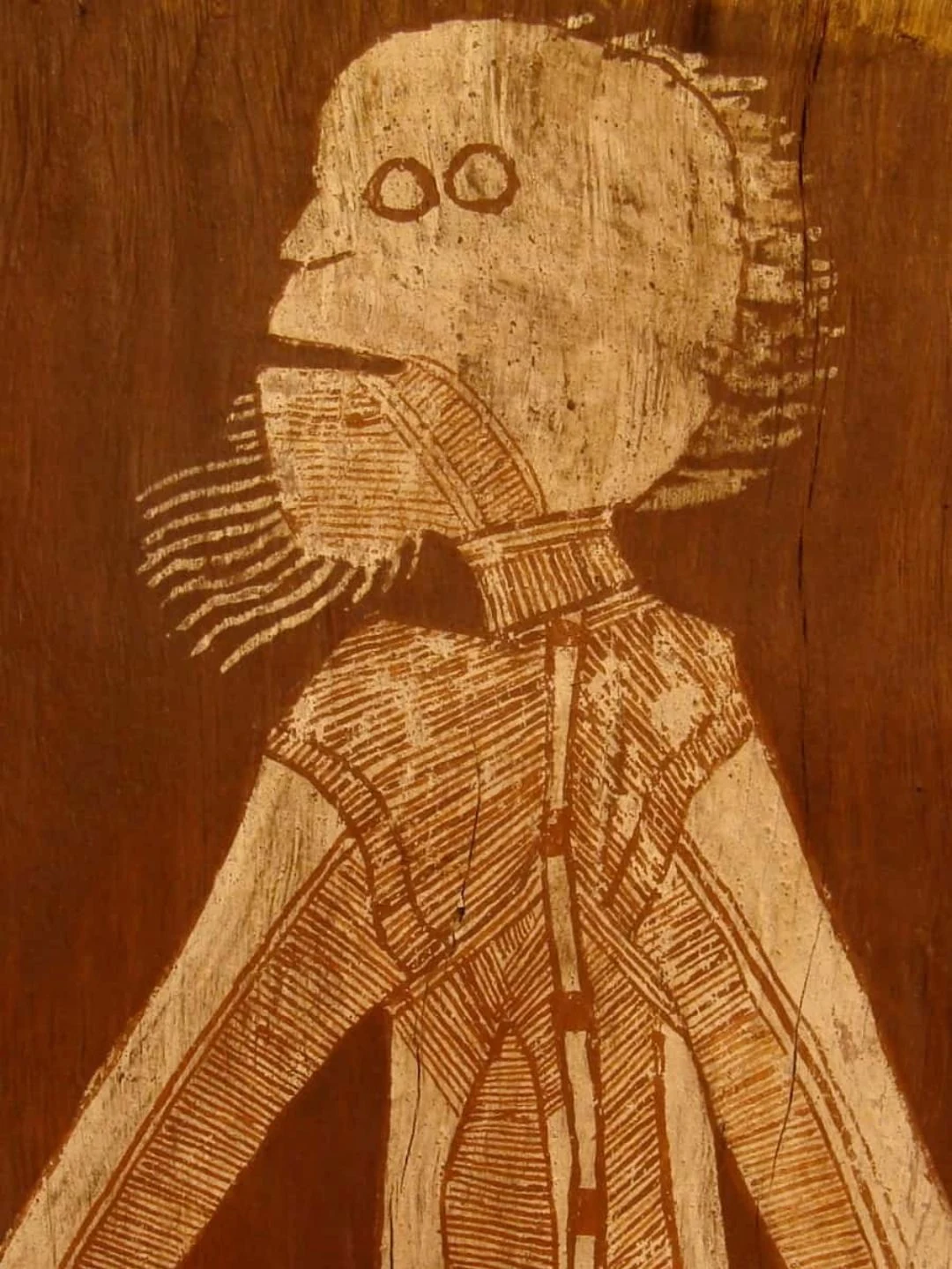
Aboriginal art symbols are not used across all Aboriginal art traditions in Australia. The symbol system most people recognise today—featuring concentric circles, U-shapes, tracks, and journey lines—originated with Western Desert artists during the early years of the Western Desert Art Movement at Papunya in the 1970s. While some symbols have broader cultural parallels, many Aboriginal art styles such as Oenpelli Art,  East Kimberley Art, Tiwi Art, and Utopia Art developed their own distinct visual languages and do not rely on the symbolic conventions associated with Western Desert painting.

  • Concentric circles = waterhole
  • U-shape = person
  • Lines = journey
  • Wavy Lines = Flowing Water
  • Tracks = animals
  • Dots = Rain
  • Large Dots = Bush Tucker

Aboriginal art symbols are a visual language used to represent dream time stories, landscapes, and cultural knowledge. Common symbols such as circles, lines, dots, and tracks depict waterholes, journeys, people, and sacred sites, often carrying layered meanings that vary between regions and communities often referred to as Aboriginal Dot Art.

At first glance, Aboriginal art can appear abstract. Repeating circles, flowing lines, and scattered dots may seem simple, yet each element has Meaning in Aboriginal Art.

Unlike written language, Aboriginal symbols are not a fixed alphabet. Their meaning depends on context—the story being told, the artist’s cultural background, and the landscape being represented. The same symbol can carry different meanings depending on where and how it is used.

This guide explains Aboriginal art symbols and meaning in a clear and respectful way, starting with a simple visual understanding before exploring the deeper cultural knowledge that underpins this extraordinary tradition.

Concepts in Aboriginal art are often interwoven so the Rainbow Serpent for example may not be visible but it’s presence is indicated by waterholes.

Symbols in Real Aboriginal Art

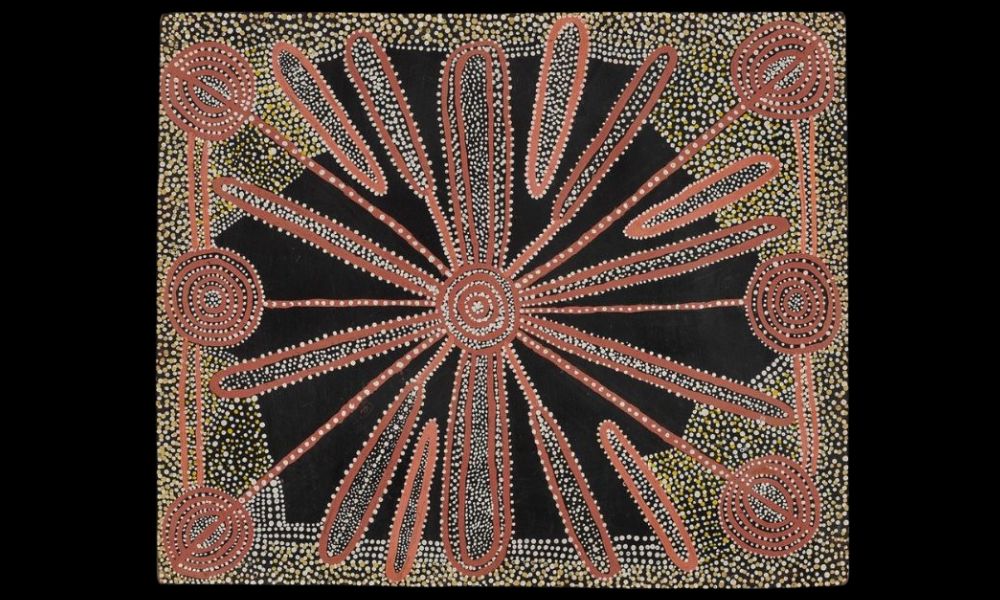
This painting by Johnny Warrangkula Tjupurrula shows how Aboriginal art symbols work together as part of a connected visual language, rather than as isolated signs with fixed meanings.

At the centre, the concentric circles with radiating lines represent an important Water Dreaming site. From this focal point, grow wild yams (white) travel lines, describing journeys through Country. Associated waterholes are linked by running water while ceremonial objects used in rain making magic are hidden within the designs

Across the surface, different forms identify bush tucker, cliffs, caves, and ceremonial objects such as churinga. Repeated circles mark waterholes and campsites, while tracks indicate the presence and movement of the ancestral Water Man, whose story is embedded in the landscape.

What becomes clear in this work is that symbols cannot be understood in isolation. 

This is the essential principle. Aboriginal art symbols are not a fixed dictionary, but a living visual language where meaning emerges through context, connection, and cultural knowledge.

Annotated Aboriginal painting by Johnny Warangkula Tjupurrula explaining Water Dreaming symbols including waterholes, running water, bush tucker, ceremonial tracks and churinga motifs.

What Do Aboriginal Art Symbols Mean?

Aboriginal art symbols are used to represent knowledge about land, people, animals, travel, food, ceremony, weather, and ancestral narratives. In many paintings, the symbols work together as a map of Country seen from above.

This aerial viewpoint is one of the defining features of much Aboriginal art, especially in desert painting traditions. Instead of showing a landscape from the side, the artist may show it as if looking down from the sky. Campsites become circles. Paths become lines. People become U-shapes. Tracks become repeating marks. Water sources, food sites, and ceremonial places are all reduced to powerful symbolic forms.

At a deeper level, Aboriginal art symbols and meaning are inseparable from the Dreaming, from kinship, and from custodianship of place. What appears visually simple can hold a sophisticated record of law and belonging.

Aboriginal Australia is not Monocultural so while these symbols are from the Central and Western Desert other aboriginals in the Kimberley paint Wandjina or those in Oenpelli paint the Mimih spirits

The First Rule: Symbols Are Not a Fixed Dictionary

One of the biggest mistakes people make is treating Aboriginal symbols like a universal codebook. They are not.

A single symbol can have several meanings depending on context. Concentric circles might indicate:

  • a waterhole
  • a campsite
  • a meeting place
  • a ceremonial site
  • a sand mosaic

Likewise, lines may represent:

  • journeys
  • boundaries
  • running water
  • smoke
  • rain

This is why Aboriginal art symbols and meaning must always be read in relation to the full composition, not in isolation. The story matters.  The place matters.

A useful symbol guide can help viewers understand broad conventions, but it should never be treated as a complete translation.

Common Aboriginal Art Symbols and Meaning

Below is a clear guide to many of the most recognisable symbols found in Aboriginal art.

Traditional Aboriginal art symbol for a waterhole shown as concentric circles representing a sacred water source or important site in the landscape.

Waterhole

The waterhole is one of the most important symbols in Aboriginal art. It is commonly shown as concentric circles. Depending on the painting, it may represent a permanent water source, a soak, a spring, or a place of life-giving importance in the landscape.

Waterholes are often linked by lines showing movement between places. In many desert works, these connected circles form the backbone of the composition.

Traditional Aboriginal art symbol showing two waterholes connected by running water represented by concentric circles joined with wavy parallel lines.

Waterholes Connected by Running Water

Two circles joined by parallel or wavy lines often indicate waterholes connected by a creek, river, or flowing watercourse. It is both a geographic symbol and a narrative one, showing how places relate to one another.

aboriginal art symbol for travel with concentric circles representing water holes or camps and straight lines depicting travel

Campsite or Travelling Sign

A row of circles linked by straight lines can indicate movement from campsite to campsite or waterhole to waterhole or an ancestral journey passing through Country. This kind of symbol often functions like a travel map.

aboriginal art symbol for a person

Person Sitting

A person is often shown as a U-shape, reflecting the impression made by someone seated on the ground. This is one of the best-known Aboriginal art symbols. On its own it may simply mean a person, but when placed beside tools or food symbols it becomes more specific.

Traditional Aboriginal art symbol showing two people sitting at a fire represented by U-shapes facing a central concentric circle campsite symbol.

Two people sitting at a Fire

Two U-shapes facing a central circle are commonly used to represent two people sitting around a fire or campsite. This is a beautiful example of how Aboriginal art symbols and meaning emerge through combination rather than through isolated marks.

Traditional Aboriginal art symbol showing a group sitting around a meeting place or fire represented by four U-shaped figures surrounding concentric circles

Group Sitting at Fire or Meeting Place

Four U-shapes around a circle may indicate a group gathered at a meeting place or around a fire. The central circle can suggest a campfire, a communal site, or an important place in the story. It is a meeting place.

Traditional Aboriginal art symbol representing a person inside a humpy or shelter shown as enclosing curved forms around a seated figure.

Person in Humpy

A circle or shelter-like form partly enclosing a central symbol can suggest a person in a humpy or simple shelter. It is a good reminder that many Aboriginal symbols relate not only to sacred narratives but also to everyday life on Country.

Traditional Aboriginal art symbol representing digging sticks shown as two elongated oval forms associated with gathering bush foods and women’s work.

Digging Sticks

Two narrow elongated oval shapes are often used to represent digging sticks or clapping sticks, depending on context. Digging sticks are associated with collecting bush foods and women’s work in many visual narratives.

Traditional Aboriginal art symbol representing spears shown as parallel straight lines with pointed tips associated with hunting and men’s activities.

Spears

Parallel straight lines, sometimes with a pointed tip, can represent spears. In some paintings spears appear beside person symbols to identify hunters or men.

Traditional Aboriginal art symbol representing a hunting boomerang shown as a curved open form associated with hunting and traditional weapons

Hunting Boomerang

A curved open form can indicate a hunting boomerang. The precise shape matters, and artists often distinguish between types of implements through slight changes in line.

Traditional Aboriginal art symbol representing a fighting boomerang shown as a curved number 7-shaped weapon associated with combat and ceremonial conflict.

Fighting Boomerang

A boomerang roughly shaped as a number 7 was used in tribal fighting. The meaning of a Hunting boomerang is different to a fighting boomerang

Traditional Aboriginal art symbol representing a woomera or spear thrower shown as a long pointed oval with a small attached projection.

Woomera

A long pointed oval with a small projection or attached mark may indicate a woomera, or spear thrower. In paintings, it may appear alongside spear motifs or human figures.

Traditional Aboriginal art symbol representing a shield shown as an elongated oval with internal markings indicating grips or decoration.

Shield

An elongated oval with internal marks can represent a shield. Depending on the style, interior shapes may indicate grips, decoration, or ceremonial markings.

Traditional Aboriginal art symbol representing a coolamon shown as an elongated oval carrying vessel used for food, water and children.

Coolamon

A long oval vessel form is commonly used for a coolamon, the wooden carrying dish used to transport food, water, or children.

Traditional Aboriginal art symbol representing a stone axe shown with a rectangular axe head attached to a straight handle.

Stone Axe

A rectangular head with a straight handle-like line can be used to indicate a stone axe or similar implement.

Animal Tracks in Aboriginal Art

Animal tracks are central to Aboriginal art symbols and meaning because they link the animal to movement, hunting, totemic identity, and the living surface of Country.

Traditional Aboriginal art symbol representing grazing kangaroo tracks with paired footprints and a central tail-drag line showing slow movement across Country.

Kangaroo Tracks grazing

Kangaroo tracks may be shown as repeated paired marks with a central line added to show the tail dragging behind and supporting the animal. This shows the Kangaroo is peaceful and not jumping, just shuffling along

Traditional Aboriginal art symbol representing jumping kangaroo tracks shown as spaced paired footprints without a tail drag mark.

Kangaroo Tracks Jumping

Jumping Kangaroo tracks are usually spaced further apart and do not have a tail drag mark. Kangaroos jump when they are moving from one place to another.

Traditional Aboriginal art symbol representing emu tracks shown as three-pronged bird footprints indicating movement across Country.

Emu Tracks

Emu tracks are usually shown as three-pronged bird-like marks. These can appear singly or in groups, often indicating direction of movement.

Traditional Aboriginal art symbol representing dingo tracks shown as clawed paw-like footprints moving across Country.

Dingo Tracks

Dingo tracks are sometimes drawn as paw-like or clawed marks. As with other track symbols, the important idea is not just the animal itself, but its passage through the land.

Traditional Aboriginal art symbol representing echidna tracks shown as rounded footprints with claw-like projections., sometimes called a porcupine by some

Echidna Tracks

Rounded forms with claw-like projections may be used for echidna tracks. These are often distinctive and compact.

Traditional Aboriginal art symbol representing human tracks shown as footprint-like forms with visible toe marks.

Human Tracks

Human tracks can appear as small footprint-like symbols, often with toe marks. They may indicate presence, travel, or the route of an ancestral figure

Traditional Aboriginal art symbol representing goanna or monitor lizard tracks shown as a wavy body line with repeated side footprints.

Monitor Lizard or Goanna Tracks

A wavy line with repeated side marks can represent a monitor lizard moving across the ground. These are among the most dynamic track symbols because they combine body and motion.

Traditional Aboriginal art symbol representing a snake shown as a winding sinuous line moving across Country.

Snake

A sinuous winding line is one of the simplest and most effective symbols in Aboriginal art. Depending on context it may represent an actual snake, a snake ancestor, water movement, or a powerful Dreaming presence.

Traditional Aboriginal art symbol representing frog tracks or frog presence shown as repeated rounded segmented forms linked vertically.

Frog Tracks

Some regional symbol sets use repeated rounded or segmented forms to suggest frog tracks or frog presence, especially in relation to water and seasonal change.

Traditional Aboriginal art symbol representing Mala hare wallaby tracks shown with small paw-like footprints inside and larger rear feet on the outsides

Mala Hare Wallaby Tracks

Even animals no extinct like the Mala can have it’s own tracks. In some traditions, these also connect to significant ancestral stories.

Bush Foods and Plant Symbols

Aboriginal art frequently records food knowledge. Many paintings are maps not only of sacred sites, but of abundance: where to find food, when to travel, what grows where, and which places sustain life.

Traditional Aboriginal art symbol representing wild yam plants shown as branching lines with rounded bulb-like ends.

Wild Yam

Branching lines with small bulbs or rounded ends often represent yam plants or yam places. This symbol can indicate a site where wild yams are found or harvested.

Traditional Aboriginal art symbol representing bush tucker shown as repeated small oval or seed-like forms.

Bush Tucker

Small repeated oval or seed-like marks may represent edible seeds, bush foods, fruits, or gathered produce.

Traditional Aboriginal art symbol representing eggs shown as small oval forms associated with nesting sites and food gathering.

Eggs

Eggs may be shown as small ovals arranged in a row or cluster. The spacing can matter, especially when the image is linked to bird nesting sites or food collecting.

Traditional Aboriginal art symbol representing a wild orange plant shown as branching stems with clusters of rounded fruit.

Wild Orange

A branching plant-like symbol with clusters of rounded fruit can indicate wild orange or a fruiting bush. Design used by Kaapa Mbitjana

Weather, Landscape, and Natural Forces

Aboriginal art symbols and meaning are deeply tied to landscape and seasonal knowledge.

Aboriginal art symbol for rain shown with diagonal lines and dots representing falling rain and storm activity.

Rain

Rain is often shown by diagonal lines, or with with dots scattered around them. The lines may suggest falling rain, while the dots can indicate drops or storm activity.

Aboriginal art symbol showing curved parallel lines representing sand hills, dunes, ridges, or landscape contours.

Sand Hills or Ridges

Arched parallel lines often represent sandhills, dunes, ridges, or the contours of the land.

Aboriginal art symbol showing an arched rainbow shape with dots and rain lines representing rain, storms, and the Rainbow Serpent.

Rainbow with Rain

An arched band containing dots or internal rain symbols may represent a rainbow with rain. In some contexts this can also carry ceremonial or ancestral associations. It can also be strongly related to the presence of the Rainbow serpent.

Aboriginal art symbol showing wavy lines, dots, and curved forms representing lightning, rain, and storm activity across the landscape.

Lightning with Rain

A composition combining curved land forms, falling dots, and zigzag or wavy lines may indicate lightning with rain or a storm event.

Aboriginal art symbol showing horizontal wavy lines representing running water, smoke, mist, or flowing energy.

Running Water or Smoke

Three or more horizontal wavy lines can indicate running water, smoke, mist, or even bush fire depending on context. It is one of the most flexible symbols in Aboriginal iconography.

Aboriginal art symbol showing a central oval surrounded by radiating flame-like shapes representing a large bush fire.

Large Bush Fire

A central oval or circle surrounded by radiating flame-like marks can represent a large bush fire. It is one of the more dramatic symbols, conveying heat, energy, and spread.

Ceremony and Sacred Objects

Many symbols refer to ceremonial life rather than daily survival.

Aboriginal art symbol showing concentric diamond shapes crossed by straight lines representing a ceremonial hairstring adornment.

Hairstring Ceremonial Object

Concentric diamond or circular forms crossed by straight lines may indicate a ceremonial hair string object worn on the head during ceremonial dancing. These symbols often carry ritual significance.

Aboriginal art symbol showing an elongated ceremonial bullroarer with a string attached.

Bullroarer

A narrow elongated form with a small hole and attached line can suggest a bullroarer or ceremonial object. This symbol usually appears in contexts involving ceremony, initiation, or sacred sound.

Aboriginal art symbol showing an elongated ceremonial board with concentric circle designs representing a sacred object or Tjuringa.

Wooden Ceremonial Object

An elongated oval containing repeated internal circles or designs may suggest a decorated ceremonial board or Tjuringa.

Aboriginal art symbol showing a curved ceremonial hair ornament with internal circles and projecting strands.

Initiation Hair Ornament

An arched segmented form with internal circles and projecting strands can indicate an initiation ornament or sacred adornment.

Aboriginal Art Symbols and Meaning in Context

The real power of Aboriginal art lies in how these symbols work together.

A painting may combine:

  • waterholes
  • tracks
  • campsites
  • people
  • food sources
  • ceremonial objects
  • landscape features

Together, these create a visual narrative. The artwork may map a journey, recount a Dreaming story, mark the route of an ancestor, or record important knowledge about survival and belonging.

This is why Aboriginal art symbols and meaning cannot be reduced to a single chart. Meaning emerges from relationships between forms.

How to Read Aboriginal Art Respectfully

When looking at Aboriginal art symbols and meaning, it is worth keeping a few principles in mind.

First, start with what is visible: place, movement, people, animals, and landscape. Second, recognise that there may be deeper meanings not intended for public explanation. Third, remember that no symbol chart can replace the authority of the artist or their community.

A respectful reading asks:

  • What is being shown?
  • Is this a map, a journey, a gathering, or a site?
  • How do the symbols connect?
  • What does the arrangement suggest about movement and place?
Chart of traditional Tiwi art symbols showing meanings for hills, creeks, trees, fire, sun, moon, spider, crocodile, Tutini poles, and ceremonial designs.

Are Aboriginal Symbols the Same Everywhere?

No. They are not universal in the way written letters are universal.

Different communities have different conventions. Some symbols are widely recognised across desert painting traditions, while others are more local or specific. Even when the same form appears in different regions, its meaning may shift.

That is why broad guides are useful for learning, but never complete.

The Tiwi Island painters for example have a completely different set of symbols

Conclusion

Understanding Aboriginal art symbols and meaning opens a doorway into a visual tradition that is at once elegant, practical, ceremonial, and profound. Waterholes, tracks, campsites, boomerangs, eggs, rain, bush foods, and ceremonial objects all become part of a larger language of Country.

To read Aboriginal art well is not simply to memorise shapes. It is to recognise that each symbol belongs to a living system of knowledge. These marks are maps, memories, stories, routes, and relationships. They show how people move through land, how ancestral beings shaped it, and how meaning is carried across generations.

Aboriginal art symbols and meaning are therefore not just about what a sign stands for. They are about how a whole world is held in image.

FAQ: Aboriginal Art Symbols and Meaning

What do circles mean in Aboriginal art?

Circles commonly represent waterholes, campsites, meeting places, or sacred sites. Their precise meaning depends on context.

What does a U-shape mean in Aboriginal art?

A U-shape usually represents a seated person viewed from above.

What do lines mean in Aboriginal art?

Lines may indicate travel, movement, boundaries, running water, smoke, or rain.

What do dots mean in Aboriginal art?

Dots may represent energy, texture, rainfall, movement, or may help conceal deeper sacred meanings.

What do animal tracks mean in Aboriginal art?

Tracks show the movement and presence of animals such as kangaroo, emu, dingo, snake, echidna, or monitor lizard. They often carry narrative and totemic meaning.

Is there one official chart of Aboriginal symbols?

No. There are common guides, but Aboriginal symbols are context-based and meanings vary between communities, stories, and artists.

All images featured in this article are presented strictly for educational and informational purposes.

This website may include copyrighted material for which specific authorization has not been obtained from the copyright owner.

All such images are presumed to be the intellectual property of the respective artist or their estate, and are used in accordance with principles of fair dealing or fair use under applicable copyright law.